Juice WRLD’s Legends Never Die is a haunting capstone to a life and career cut shortLuca Cimarustion August 4, 2020 at 5:00 pm
By the time Chicago rapper Juice WRLD died in December at age 21, he’d already made a gigantic impact on hip-hop. His meteoric rise started when he was just a teenager with the 2017 single “Lucid Dreams,” a landmark in the burgeoning “emo rap” genre, which exploded after he rerecorded it for his 2018 debut full-length, Goodbye & Good Riddance. The whole album was a stone cold masterpiece; Juice sang some of the catchiest melodies ever put to tape over slick, ethereal trap beats, weaving in poetry about self-doubt, isolation, and drug use. But barely a year and a half after the release of Goodbye, pills and lean–the same things Juice’s fans loved to hear him sing about so beautifully–became his demise. He overdosed on oxycodone and codeine on a flight back home to Chicago, just days after his birthday. Juice allegedly left behind something like 2,000 unreleased songs, 21 of which have made their way onto his new posthumous release, Legends Never Die. These tracks follow the Juice WRLD formula: they walk the line between pop and trap, with haunting melodies and profoundly sad lyrics. His approach on these new songs is a bit more streamlined than in the past: they’re less up and down, with a smoother flow, and he’s more economical, clean, and concise in his delivery. Legends Never Die shows what a talent Juice had grown into, and how much promise he still had when his life was cut short. And the matter-of-fact way he lays out his issues with mental illness and substance abuse makes the whole record feel even more sad and eerie. Rumors of further posthumous Juice WRLD releases already abound on the Internet, so maybe Legends Never Die–which feels like a nice capstone to a short but powerful career–won’t be the last we hear of him. v
Demons of drip on the gig poster of the weekSalem Collo-Julinon August 5, 2020 at 11:00 am
This week we’re sharing a poster for a locally produced livestream concert with images from a Chicago artist previously featured in this space. Animator, artist, and Columbia College grad Angel Onofre created this poster for a show to be streamed from Belmont Cragin’s Treehouse Records studio via the YouTube channel of the band Sugarpulp. It’s free to view, and donations will be accepted for the National Independent Venue Association’s #SaveOurStages campaign.
The Reader continues to welcome submissions of gig posters for future concerts, be they virtual or in-person. We’d also love to keep receiving your fantasy gig poster designs.
To participate, please e-mail [email protected] with your name, contact information, and your original design or drawing (you can attach a JPG or PNG file or provide a download link). We won’t be able to publish everything we receive, but we’ll feature as many as possible. Your e-mail should include details about the real or fantasy concert and about any nonprofit, fundraiser, or action campaign that you’d like to bring to the attention of our readers.
Not everybody can make a gig poster, of course, but it’s simple and free to take action through the website of the National Independent Venue Association–click here to tell your representatives to help our homegrown music ecosystems survive the pandemic. And anybody with a few bucks to spare can support the out-of-work staffers at Chicago’s venues–here’s our list of fundraisers. Lastly, don’t forget record stores! The Reader has published a list of local stores that will let you shop remotely.
ARTIST: Angel Onofre
GIG: Daisychain, Sunvolume, and Sugarpulp livestreaming on Fri 8/7 at 6 PM via Sugarpulp’s YouTube channel
MORE INFO: Angel Onofre
NPO TO KNOW: National Independent Venue Association
Asheville trio Nest Egg smashes psychedelic sounds into postpunk oblivion on DislocationSteve Krakowon August 5, 2020 at 1:00 pm
I was once at a Nest Egg gig where a friend said to me, “The thing I love about these guys is that they’re punks who just happen to play psychedelic music.” This joyously astute statement gets at something important about psychedelia: though the word often conjures lovey-dovey visions of the pastoral and the perfumed, 1970s movements such as Krautrock and Eurorock took these heady, trance-inducing sounds into much bleaker and more experimental terrain. I’m pretty sure I’ve read that David Thomas of Cleveland protopunk gods Pere Ubu has described his band’s music as psychedelic, but under a veil of darkness (or something poetic like that). And Nest Egg’s driving acid punk brews up a similarly malevolent storm. The Asheville band formed in 2011 and released their first LP, the incendiary Respectable, in 2015. The trio features Harvey Leisure on fuzzed guitar and cavernous vocals and Ross Gentry on driving bass and textural keys, but their not-so-secret weapon is drummer Thom Nguyen. He excels at the hard-hitting motorik rock beat and moonlights with avant-garde experimental types such as guitarist Tashi Dorji; he brings the expansive subtleties he employs in the improvisational realm to Nest Egg’s gargantuan sound. The band’s new LP, Dislocation, opens with Nguyen’s drum attack on the savage epic “Eraser,” where his frenzied tom-tom rhythms propel Leisure’s jagged, scuzzed-out guitar and menacing, nihilistic vocals, intoned from the void–and then the whole band roars to a fearsome, noisy boil. This sure isn’t yer grandmum’s psychedelia: Nest Egg come off more like an angry, determined, and fiercely minimalist postpunk band a la Wire or Killing Joke. The track “Helix” could invite comparisons to Hawkwind or Can, with its nine-plus minutes of floating sonics following a single unrelenting chord progression, but it’s not as easy as you might think to draw lines between prog, Krautrock, and punk–Hawkwind supposedly once had Johnny Rotten as a roadie. Why not just invent a new name and call Nest Egg “maxi-minimalism”? This style is best heard on the darkly excessive nine-minute jammer “Gore,” which barely has any riff or progression at all and only really changes in the density and volume of its guitar scree–imagine if the Gun Club joined Faust and Whitehouse for a gig at the dawn of the apocalypse (the actual apocalypse, I think, is due in just a few minutes). And right when you think you’ve figured out the Egg’s modus operandi, they throw in a posthardcore blast on the comically named “What!!??! I’m a Bastard!!??!” By the end of Dislocation I’ve mentally crowned Nest Egg the Band Most Capable of Scoring the Collapse of Civilization With Bong in Hand. That’s high praise these days. Invest in Nest Egg’s latest endeavor, as it may very well be the last best musical document of the end. My only friend. The end. v
Goodbye to songwriter Michael SmithMark Guarinoon August 5, 2020 at 4:25 pm

Michael Smith died in his bed at home on Monday, on a cold August afternoon in Chicago. Wind snapped at the windows of his lakefront apartment. Dark clouds sprinkled rain on children in summer clothes. People in masks scurried under trees or to their cars. Later the sun came out.
These could all be snapshots from one of Smith’s songs, which go deeper than detached observation and ask you to feel along with the people they bring to life.
Smith, who died of colon cancer at age 78, moved to Chicago in the 1970s, at the height of the second folk boom. He never became a household name the way John Prine and Steve Goodman did, but his lengthy discography is just as mighty. And his work scoring theater–including Steppenwolf Theatre’s production of Frank Galati’s The Grapes of Wrath and the 2010s incarnation of Blair Thomas‘s long-gestating Moby Dick–proved him to be a songwriter who could summon characters from the world’s greatest works of literature and make them speak with convincing authority.
Smith was a prodigious talent, and considered himself a songwriter first–he performed only occasionally, to make a living. His best songs–“Crazy Mary,” “Ballad of Dan Moody,” “Panther in Michigan,” “Spoon River,” “Sister Clarissa”–tell stories and cast moods just as powerfully as anything on a theater stage. “The Dutchman,” a tender song about caring for someone losing their mind, is today considered a modern folk classic.
“It didn’t occur to me they were about me in the beginning,” Smith told me in 2018. “People would say, ‘Your songs are so personal.’ I would say, ‘Well, I’ll try to get away from that.’ But I couldn’t.”
Michael Peter Smith was born September 7, 1941, and grew up the oldest of six children in Little Falls, New Jersey. He came of age during the folk revival of the late 1950s. The Kingston Trio and Harry Belafonte got him into the world of guitar music, but he discovered that what mesmerized him were the songs, mined from decades past, and the worlds they created in his imagination.
“Harry Belafonte singing ‘Shenandoah.’ I played ‘Shenandoah’ 50 times. Oh, it’s so beautiful. And one guitar. ‘Shenandoah, I long to see you.’ What the fuck does he mean by that? I have no idea. I don’t care. It was so poignant,” he said.
Smith’s idyllic childhood ended the morning of December 1, 1958, when his father, a frustrated musician who worked factory jobs to support the family, walked into the garage and killed himself by carbon monoxide poisoning. “When you’re the oldest kid at 17, and you’re a boy, and your dad kills himself, you’re done,” Smith said. “You’re fixed in a certain angry and lost place. You’ll never be graceful and suave.”
The suicide would wrack Smith with survivor’s guilt into adulthood, and his Catholic upbringing only compounded it. “I’m still apologizing to my dad, to myself, and to the world for not coming through. . . . But it’s too late, man. It’s ingrained. And they tell you at Catholic school, you’re six years old and looking at a fucking crucifix and they’re telling you, ‘It’s your fault,'” he said. “Songwriting was the one way I could say, ‘I have beauty inside me.'”
Smith’s mother waited until he’d finished high school to move the family to St. Petersburg, Florida, and start a new life. In 1962 Smith started playing the Florida coffeehouse circuit, and he soon ended up the house act at the Flick, an influential nightspot in Coral Gables where he performed alongside the likes of David Crosby, Joni Mitchell, Steve Martin, and Steve Goodman (who would eventually record several of his songs). Smith honed his chops there and, along the way, met singer Barbara Barrow. The two of them married in 1968 and played together in a psychedelic folk-rock band called Juarez that put out an LP on Decca in 1970 and toured nationally. Eventually the couple returned to a duo format, and after spending several years living a nomadic life, they settled in Chicago in 1976.
By the time they arrived, they were already known here. With repeated tour stops, they’d built up an audience at the Earl of Old Town, the Wells Street club that was a mainstay for singer-songwriters at the time. Goodman had already made Smith’s songs familiar to Chicago audiences. Eventually Suzy Bogguss, Tom Russell, John Gorka, Jerry Jeff Walker, David Allan Coe, Celtic Thunder, Jimmy Buffett, and many others would record Smith’s material as well.
Chicago had a robust community of songwriters in the 1970s, and Chris Farrell, who was part of that community himself, remembers that Smith was seen as a “deity.”
“He always had a great way of explaining something with a simple phrase. Some of these things we all struggle with. But it made more sense because he had a handle on it,” Farrell says. “In writing a song, you don’t want to make any mistakes, but he said as long as you know the truth of the song you’ll be fine. I never heard it said so perfectly.”
In the 1980s, the club scene in Chicago eventually dried up. Smith relied on a job selling subscriptions for Time-Life and the occasional teaching gig at the Old Town School of Folk Music. His life changed when director Frank Galati caught one of his performances there and asked him to write songs for, and appear in, an adaptation of John Steinbeck’s novel The Grapes of Wrath that premiered in 1988 and would eventually win two Tony Awards. In a New York Times review of Steppenwolf’s 1990 revival of the play, critic Frank Rich called Smith’s score “astringent and evocative . . . [it] echoes Woody Guthrie and heartland musical forms and is played by a migrant band on such instruments as harmonica, jew’s-harp and banjo. Sometimes salted with descriptive lyrics from Steinbeck, the music becomes the thread that loosely binds a scattered society.”
Smith quit his job and entered his most productive run of his career. The three albums that followed–Michael Smith (1986), Love Stories (1988), and Time (1993)–represent a suite of songs that he would perform until the end of his life. Like the theater work he was increasingly undertaking, the songs were dramatic mood pieces, comparable to Leonard Cohen or Kurt Weill, and he sang them quietly, backed by his guitar or by strings. On “I Brought My Father With Me,” he addressed for the first time his lifelong struggle with his father’s death: “There are some ways I’m just like him / Some ways he was just like me / And sometimes when the mirror’s dim / His face is clear to see.”
Chicago itself would sometimes creep into Smith’s songs. On “Ballad of Elizabeth Dark,” he recounted taking the el to Rogers Park to visit the lake. “And I walk along the Sheridan sand / Where the waves are breaking over the jetty / Where the wind is like an icy hand.”
“He gives you a real sense of time and place. He puts you right in the center of a scene so you can experience it with him,” says Anne Hills, who produced those three records. She thinks of Smith as a painter who could develop scenes “right in front of you.”
His song “We Become Birds” imagines that humans return to life as birds after they die: “I know because sometimes I just want to / Lift off / Go right to the mesa and / Have a feast / Eat our bread / Stand in a circle / Hear my grandmother talk about our people.”
“He was extremely masculine, but he had emotional insight to his writing. You hear deep empathy in his work,” Hills says. “He brings a lot of sensuality.”
Smith continued to work in theater until the late 2010s, writing music for and appearing in shows at Victory Gardens and Lookingglass and collaborating several times with puppeteer and producer Blair Thomas. He reunited with Galati in 2006 for The Snow Queen, an adaptation of the Hans Christian Andersen story. He also partnered with Jamie O’Reilly to develop folk cabaret shows that the duo appeared in together throughout Chicago.
In February, Barrow died of complications stemming from her 12-year struggle with Parkinson’s disease. In June, Smith discovered he had colon cancer, which had already spread to his liver. O’Reilly opened her apartment to him as a hospice for three weeks. Toward the end, he transferred to his own apartment, where he was surrounded for his final days by his five surviving siblings.
During this time, Smith took to Facebook to share with the people he couldn’t see. He started posting covers of his songs that he liked. He told jokes. He shared stories of his time playing with and getting to know Michael Bloomfield, Steve Goodman, Fred Neil, Fred Willard, and Steve Martin on the nightclub circuit. He talked about his love of Paul McCartney, the Kingston Trio, President Barack Obama. He was happy, O’Reilly recalls. “He did his moral inventory. He did it deliberately. And in this last chapter he felt fully free,” she says. “That’s the gift he’s given himself.”
On June 20, when Smith knew his failing strength would soon rob him of his ability to communicate, he took to Facebook one last time. “I been a good ole wagon, and if I’ve done broke down they’ll fix me up if they possibly can,” he wrote. “Old man, everybody dies.” v
Goodbye to songwriter Michael SmithMark Guarinoon August 5, 2020 at 4:25 pm Read More »
Chicago indie rocker Jeff Kelley digs into experimental pop with Ocean CultLeor Galilon August 5, 2020 at 5:00 pm
Over the past decade, it’s often felt like everyone in Chicago’s underground-rock subscenes was legally required to have multiple projects, and Jeff Kelley certainly cleared that bar. He fronted frazzled art-rock group Vaya, mathy indie-pop outfit Dick Wolf!, and ragged new-wave band New Drugs. When he wasn’t making music, Kelley helped document the scene as cofounder and creative director of Chicago Singles Club, a hybrid music-journalism outlet and record label whose activity sadly tapered off in the late 2010s (the site stopped posting monthly artist profiles in 2016, but continued to host events for about another year). These days Kelley focuses on his solo project, Ocean Cult, which builds on the complicated mathletics of Dick Wolf! and the peculiar, irascible angles of Talking Heads. On Ocean Cult’s new debut album, Elastic Era, Kelley stretches out as a singer and songwriter, reaching past his old prickly ruggedness to embrace a heartfelt flamboyance. On “Touch Me, Electricity” he delivers the hook atop a patchwork of zigzagging synths, his voice swooping down from its highest register into a sensual croon—-and his confidence makes the song glow. v
The Reader has 56 places to start your shopping this Bandcamp dayLeor Galilon August 6, 2020 at 12:15 am

Last week, Music Ally published an interview with Spotify CEO Daniel Ek where he suggested that artists upset with paltry streaming royalties should produce more music. “Some artists that used to do well in the past may not do well in this future landscape,” Ek said. “Where you can’t record music once every three to four years and think that’s going to be enough.” I can’t speak to why people decide to pursue careers in music, but I’m pretty sure it’s not so they can have a boss who devises a business model so broken that the only way they can hope to survive is by doubling or tripling the amount of work they release.
Bandcamp can’t match Spotify’s reach–it has just a tiny fraction of the streaming giant’s user base–but because it sells music outright, each of its users represents the potential for a lot more artist income. Ever since COVID-19 disemboweled the live-music industry in March, shutting down touring revenue, Bandcamp has periodically waived its cut of sales so that all proceeds go directly to artists and labels. Friday, August 7, will be the fifth such “Bandcamp day.”
An extra 10 or 15 percent from Bandcamp certainly won’t replace musicians’ lost income, but anecdotal evidence at least suggests that Bandcamp days incentivize enough buying binges to make a difference. On June’s Bandcamp day, Chicago polymath Nnamdi released the EP Black Plight, which made more than $10,000 in 24 hours (he donated the proceeds to charitable causes). On the four previous Bandcamp days–in March, May, June, and July–artists and labels made more than $20 million total, many times more than they would have on ordinary Fridays.
I’ve once again rounded up all the Reader’s recent recommendations of albums and EPs available through Bandcamp. Each one is linked to the Reader story that mentions it. I hope this gets you started searching through the bounty of great material on Bandcamp–happy hunting, and I’ll see you again for next month’s list!
Another Sunny Day, London Weekend
Vince Ash, Vito
Julianna Barwick, Healing Is a Miracle
Bloodmist, Phos
Boris, No
Peter Brotzmann & Fred Lonberg-Holm, Memories of a Tunicate
Bruges, A Thread of Light
Cinder Well, No Summer
Cold Beaches, Drifter
Chris Crack, Cute Boys (The Rise of Lil Delicious)
Cutta, Physicalism
Dehd, Flower of Devotion
Evicshen, Hair Birth
Fat Night, Live for Each Other
He Who Walks Three Ways, Technology Delivered 91/94
HHY & the Macumbas, Camouflage Vector: Edits From Live Actions 2017-2019
Park Hye Jin, How Can I
Ghetto Kumbe, Ghetto Kumbe
Gosh Diggity, Bedtime for Bonzos
Jovan Landry, World Vibe
Lawrence Arms, Skeleton Coast
Le Tour, S/T 2020
Scott McGaughey, You Don’t Need a Key to Leave
Mexican Werewolf, Murder House
Robert Millis, Related Ephemera
Nicole Mitchell & Lisa E. Harris, EarthSeed
Myquale, Passport Package
Bob Nanna, Celebration States
Thiago Nassif, Mente
Nest Egg, Dislocation
Carlos Nino & Miguel Atwood-Ferguson, Chicago Waves
Nnamdi, Krazy Karl
Ocean Cult, Elastic Era
Old Man Gloom, Seminar VIII: Light of Meaning and Seminar IX: Darkness of Being
Oscillator Bug, Fruit Collection
Paisley Fields, Electric Park Ballroom
Park National, The Big Glad
Margo Price, That’s How Rumors Get Started
Protagonists, 1983-1985
Protomartyr, Ultimate Success Today
Pyrrhon, Abscess Time
Quicksails, Blue Rise
Quiet Eye, Program One
Sault, Untitled (Black Is)
Silicone Prairie, Two Songs
Spectacular Diagnostics, Thebeautifulmusic
Surgery Boys, 1
James Swanberg, The One and Only
Various artists, Attack of the Chicago Boogie
Various artists, Lillerne #122
Various artists, SituationChicago
Vile Creature, Glory, Glory! Apathy Took Helm!
Warm Human, The Bummer Album
Warrior Tribes, The Con
Xoe Wise, Air
Zombi, 2020 v
Steve Von Till finds beauty and humanity within a chaotic universe on No Wilderness Deep EnoughJamie Ludwigon August 6, 2020 at 1:00 pm
Steve Von Till is best known as co-front man of the mighty Neurosis, but for two decades the singer, multi-instrumentalist, and poet has also led an ambitious and expansive solo career. Under his own name he’s released dark pastoral folk, and as Harvestman he’s made dynamic, psych- and drone-infused music. On his new album, No Wilderness Deep Enough (released alongside a new book titled Harvestman: 23 Untitled Poems and Collected Lyrics), Von Till merges those personas with glistening ambient washes and somber neoclassical arrangements. He began working on the album in early 2018, first recording stark piano melodies on the rural land in northern Germany that his wife’s family has farmed for more than 500 years and then adding electronic elements at his home studio in Idaho. He originally intended No Wilderness Deep Enough to be strictly instrumental, but when he consulted producer Randall Dunn about incorporating French horn and cello in the studio (provided by Aaron Korn and Brent Arnold, respectively), his friend challenged him to add lyrics. Though the music certainly could’ve stood on its own, Von Till’s deep voice and contemplative delivery help draw threads connecting heaven and earth and his ruminations on longing, loss, and humanity, which lie at the album’s core. “Indifferent Eyes” seems to cast its glance upward–its shooting-star synths cascade into serene piano and cello, as if providing a glimmer of light by which Von Till can study the possibilities in detachment, the unknown, and connection. On the brooding, textural “Shadows on the Run,” he ponders the esoteric mysteries of the universe and the legacies of those who’ve left this plane of existence behind. Neurosis at their most turbulent and commanding can summon all the heaviness of the world–a sonic manifestation of Atlas bearing his load–even as they break into cosmic catharsis. No Wilderness Deep Enough carries some of that same weight, but for all the enormity of its spacious meditations, they also offer us a chance to stretch out, take a breath, and even tap into untouched sources of strength before we head into the next storm. v
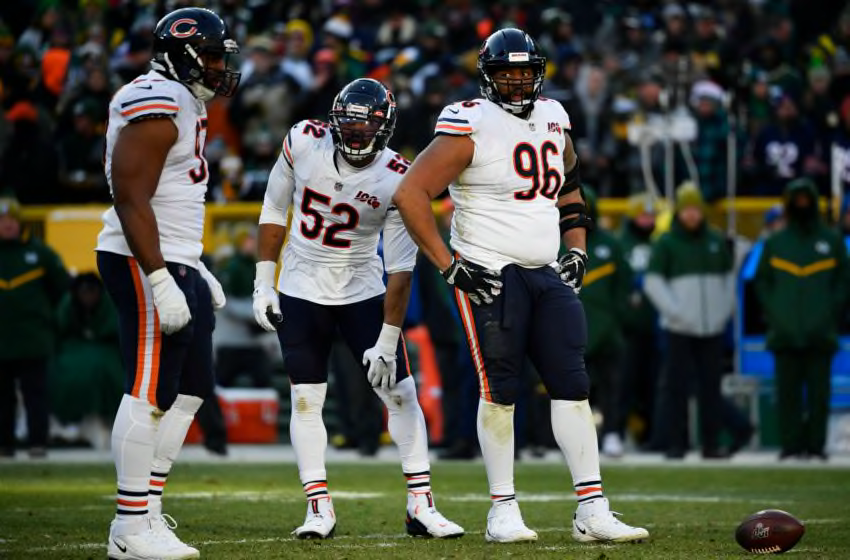
Chicago Bears: Why Akiem Hicks being healthy mattersUsayd Koshulon August 6, 2020 at 3:00 pm
With Chicago Bears defensive end Akiem Hicks reportedly being healthy, what impacts does this have?
On a defense that’s loaded with stars like Khalil Mack and Eddie Jackson, outside of the Chicago Bears fanbase, Akiem Hicks is clearly a name that doesn’t get the respect he deserves. If you wanted to, you could make the argument that Hicks is one of the best defensive lineman in the NFL.
There’s no doubt that as soon as Hicks went down with an elbow injury in 2019, the Bears defense took a slight step back. Takeaways and sacks, two categories that were central to the Bears 2018 defense, decreased as soon as Hicks went down.
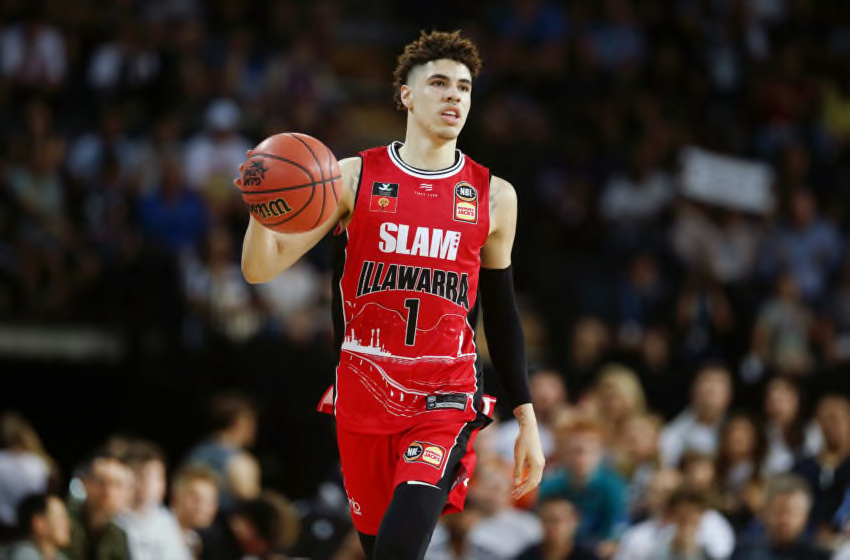
Chicago Bulls hit jackpot in latest mock draftPatrick Sheldonon August 6, 2020 at 4:00 pm
The Chicago Bulls are big winners in the latest mock draft.
The NBA restart is in full swing, while the Chicago Bulls are home beginning their offseason early for yet another year. As such, the front office will — if they have not already — turn their sights to the 2020 NBA Draft Lottery (scheduled for Tuesday, August 25th) and subsequent Draft (on Friday, October 16th.
Entering the NBA Lottery, the Bulls have just a 7.5 percent chance of landing the No. 1 overall pick. However, in Bleacher Report’s latest mock draft simulation, Chicago somehow defies the odds and lands the top choice.