What’s New

WHEN I READ – I LEARN ABOUT A HISTORY I NEVER DISCOVERED IN SCHOOLcitizen john q publicon August 21, 2020 at 5:27 pm

Go Do Good!

WHEN I READ – I LEARN ABOUT A HISTORY I NEVER DISCOVERED IN SCHOOL

Read More

WHEN I READ – I LEARN ABOUT A HISTORY I NEVER DISCOVERED IN SCHOOLcitizen john q publicon August 21, 2020 at 5:27 pm Read More »

Dear Diary: Journaling is self-care, and here’s howMargaret H. Laingon August 21, 2020 at 9:41 pm

Margaret Serious

Dear Diary: Journaling is self-care, and here’s how

Read More

Dear Diary: Journaling is self-care, and here’s howMargaret H. Laingon August 21, 2020 at 9:41 pm Read More »

Cubs vs White Sox Series Preview: (8/21-8/23)Sean Hollandon August 21, 2020 at 9:18 pm

Cubs Den

Cubs vs White Sox Series Preview: (8/21-8/23)

Read More

Cubs vs White Sox Series Preview: (8/21-8/23)Sean Hollandon August 21, 2020 at 9:18 pm Read More »

The Democratic National Convention was a Social Experiment and It Was a Wild Successcinnatwistson August 21, 2020 at 9:51 pm

cinnamon twists

The Democratic National Convention was a Social Experiment and It Was a Wild Success

Read More

The Democratic National Convention was a Social Experiment and It Was a Wild Successcinnatwistson August 21, 2020 at 9:51 pm Read More »

SAIC’s graduate students take it to the webS. Nicole Laneon August 21, 2020 at 11:00 am

I always leave the School of the Art Institute (SAIC) graduate opening reception sweating. With more than 100 artists, it’s a marathon art-viewing experience. Bring your water, grab some cookies, and take it all in. Every year I leave saying, “I’m exhausted.” However, this year, things look a lot different.

Originally slated to open April 24 with a comprehensive floor plan in the Sullivan Galleries, the MFA thesis show was a year-long process for curatorial fellows. But as we know, those plans were put to a halt with the pandemic hitting the U.S. earlier this year. The planning for the show was finalized on March 12 and on the same day, the school president, Elissa Tenny, announced the closure of the campus. The curators were forced to modify their plans and work with the turbulent and uneasy times.

SAIC launched their MFA thesis show, “The Future of Our Plans,” as an online art exhibition on August 5 cataloging the 150 graduate students in the class of 2020. In SAIC style, the website where the exhibition lives is sexy, sleek, and clean. It begins with an introduction text from Arnold Kemp, the dean of graduate studies, wishing the best of luck to a class entering an unknown future in a distressing time.

The website selects three graduate students for every day in August and highlights their work. Taking in 150 artists in real life at an opening is a lot of work, so I appreciate this type of introduction on the website, which allows me, as the viewer, to easily digest the work of a select few artists. It also keeps me coming back, as every day there is a new trio to check out. Additionally, folks can filter through artists. As a viewer, you can select an area by medium, degree, department, and theme. Having a BFA in photography myself, it’s the first section I picked. There I discovered the work of MFA candidate of photography, Chelsea Emuakhagbon.

“Process has always been at the core of my image-making practice,” Emuakhagbon says. Her photographic project began in Dallas while working on a series that focused on family and her uncle’s migration from Nigeria to Japan. When in Japan continuing the project, Emuakhagbon met a few African migrant workers and began having conversations about migration and the definition of “home.” During this experience, she says, “the project became less and less about anguished confusion and searching, and more about located hope, solidity, and structure. It’s less about the pain within the waiting and seeking of the journey, and more about the hope found while stripping oneself of the once-perceived burdens of the move itself. Less pain and mourning, more reverence.”

Emuakhagbon’s work in the exhibition also includes audio with her uncle as well as a silent film that depicts the making of a segaiha pattern in Japan. This pattern is also physically held by many of the subjects in her photographs, which represents the connection between humanity, migration, and culture.

When I ask Emuakhagbon how her graduate experience was altered due to COVID-19 she says, “I think SAIC is just being what it is and has always been: a private university. It’s a school that was built in a specific way for a specific type of people. It’s attempting the only way it’s able to understand how to adapt to society’s current atmosphere.” She goes on to say that faculty and students helped with this strange transition to the new normal.

The MFA exhibition is a culmination of two-year projects for many students. SAIC’s thesis website does a great job of not overwhelming the viewer with images. By having three artists a day on display, a viewer can visit the website for a gradual viewing process. Or, if they are ready to dive in, they have access to all of the artists. Amira Hegazy‘s artist statement mentions her upbringing between American and Egyptian culture and how this influences her activism, while Megan Tepper explores their body and sexual relationships through photography and film. Viewers can sit longer with the artist’s work and take control of their viewing experience. They can look at a few pieces and exit the experience. It’s not as demanding as an in-person opening.

At the beginning of the year, the fate of many undergraduate and graduate shows was at the mercy of the pandemic. Though many students and staff were disappointed at the postponed MFA shows and cancellation of events, the curators investigated alternative methods for presenting projects and exhibitions during a pandemic. SAIC adapted to the crisis and created something more digestible and accessible for folks to view as these artists graduate and enter into the art world in even more uncertain times than usual. Having virtual events and a virtual gallery gives the final exhibition–and the work of many artists–a much larger audience beyond Chicago. v

Read More

SAIC’s graduate students take it to the webS. Nicole Laneon August 21, 2020 at 11:00 am Read More »

The founder of Pride Films and Plays is gone. What happened? What’s next?Kerry Reidon August 19, 2020 at 8:45 pm

click to enlarge
Pride Films and Plays founder David Zak; artistic director Donterrio Johnson - BOB EDDY/ZEKE DOLEZALEK

There are no shows to speak of happening on Chicago stages, but the offstage drama has been at a fever pitch in recent months.

Victory Gardens Theater underwent a very public dressing-down from the playwrights ensemble and others in the theater community after the board announced that Erica Daniels, the executive director, was replacing departing artistic director Chay Yew as the executive artistic director, sans the national search the ensemble had requested. Daniels subsequently resigned in the wake of protests, and Roxanna Conner was named acting managing director; the board has announced a new search process for the next artistic director, including a call for public comment.

Andrew Alexander, the longtime owner, CEO, and executive producer at Second City, also resigned after social media criticism about institutional racism at the comedy behemoth, with Anthony LeBlanc named interim executive producer. Charna Halpern, the owner of iO, beset with financial difficulties exacerbated by COVID-19 and facing ongoing allegations about a culture of racism and harassment at her comedy theater, decided to close it down for good.

The release of the “BIPOC Demands for White American Theatre” from the coalition We See You, White American Theater (We See You W.A.T.) last month has also focused attention on issues of diversity, equity, and inclusion across the country. Locally, the collapse of Profiles Theatre after many longstanding allegations of sexual abuse and harassment came to light in the Reader in 2016 has led to a national push to adopt standards for safety and accountability, especially in non-Equity venues, piloted by Not In Our House through the Chicago Theatre Standards.

In late June, David Zak, executive director of Pride Films and Plays and one of the pioneers of Chicago off-Loop theater with the long-gone Bailiwick Repertory, faced a wide-ranging series of Facebook allegations. These encompassed stories of unsafe physical conditions in both the two-venue PFP home (for those who like irony, the theaters were formerly occupied by Profiles) and the company’s Uptown rehearsal space, as well as allegations about Zak engaging in patterns of abuse and harassment toward actors and others involved with PFP, or ignoring such abuse from others associated with the company.

On July 3, the 64-year-old Zak issued a public statement announcing his departure that read in part: “It pains me that my actions and words have hurt many others in our Chicago theatre community and for that I apologize greatly. I would not intentionally offend, hurt, or exclude anyone in our arts community, which plays such an important role to build understanding and bridges in our community. But it has happened, and I am sorry.”

The PFP board simultaneously announced the appointment of Donterrio Johnson as artistic director. Johnson is an actor and director whose lengthy list of credits includes his Jeff-nominated 2019 staging of the musical A Man of No Importance at PFP. The board also announced that JD Caudill and Robert Ollis will continue as company artistic associates.

So what happened? And why did it all come to a head now?

I heard from well over a dozen people who were involved either with PFP or with Bailiwick Repertory–detractors of Zak, champions, and those who fall in between. What emerged was a complex portrait of how much things have changed, in both Chicago theater and the gay community, since Zak first opened doors for LGBTQ theater artists at Bailiwick in the 1980s. (Zak was inducted into the Chicago LGBT Hall of Fame in 2013.) The recent calls to rename “Boys Town” illustrate some of those changes, as does the increased attention in recent years to the racism and harassment young LGBTQ people of color face in the neighborhood.

Some of the conflict seems driven by generational shifts, as the old paradigms of putting up with whatever you have to in order to be in a show have thankfully broken down in the wake of #MeToo and so many other heightened calls for justice inside and outside theater. But there are also lessons here for going forward; about board accountability for the actions of artistic leaders, particularly when those leaders are the organization’s founders; about how even theaters that champion work by marginalized communities can continue patterns of bias, neglect, and abuse toward others; and finally, about what a theater community wracked by the pandemic and facing societal reckonings on several fronts can and should be in the future.

From Bailiwick to PFP

In 1982, Zak started Bailiwick Repertory. Initially identified primarily as a director’s theater (as opposed to a company with a standing acting ensemble, like Steppenwolf), Bailiwick produced an annual directors’ festival (full disclosure: I directed a piece for the 1991 installment). An early hit was the Zak-directed 1987 musical adaptation (by Sir Peter Hall) of George Orwell’s Animal Farm, which won seven non-Equity Jeff Awards.

But by the end of the 1980s, Bailiwick became increasingly identified with work by and about LGTBQ people–particularly gay men. Among many other shows, the company produced the Chicago premiere of Robert Chesley’s Jerker, about two gay men connecting via phone sex, in 1988, and the world premieres of Hannah Free by Claudia Allen, Trafficking in Broken Hearts by Edwin Sanchez, and the long-running hit Party by David Dillon. Long before rising to national fame, Alexandra Billings (Transparent) explored life as a transwoman in her 1996 solo show at Bailiwick, Before I Disappear.

Eventually, Bailiwick’s annual Pride series became a showcase for LGBTQ work. Jerker was a harbinger of things to come, so to speak: over the years, Bailiwick offered a slew of shows highlighting gay relationships, often with men in various states of undress, including the long-running Naked Boys Singing. Alongside the more overtly sexually charged shows, Bailiwick also won acclaim for its musical productions, such as its 2004 Chicago premiere of Jason Robert Brown and Alfred Uhry’s Parade, based on the 1913 lynching of Leo Frank, a Jewish foreman accused of murdering a young girl who worked in his factory, and the American premiere of Richard Thomas and Stewart Lee’s Jerry Springer: The Opera.

Bailiwick primarily operated out of two Lakeview spaces: the long-gone Jane Addams Hull-House Center at 3212 N. Broadway (which housed Steppenwolf in its early days) and then the old Chicago Filmmakers space at 1229 W. Belmont (now the home of Theater Wit). They moved out of the latter in 2008, and dissolved in 2009. (Another company, Bailiwick Chicago, which had no association with Zak, arose from those ashes and produced until 2015 under artistic director Lili-Anne Brown.)

Pride Films and Plays, Zak’s next venture, formed in 2010 and was itinerant for a few years before taking over the old Profiles venues in 2016 and renaming them the Pride Arts Center. According to the last tax forms on file, covering the fiscal year of July 2017-June 2018, PFP’s annual revenues were $361,446, against operating expenses of $348,249.

But a common thread in the histories of both Bailiwick Repertory and PFP has been ongoing financial problems. A 2008 Time Out Chicago piece by Jake Malooley noted that various theater blogs were calling out Bailiwick for failing to pay artists, and that playwright Jim Provenzano was suing over nonpayment of royalties for his play Pins. “There are two really popular misconceptions about the Bailiwick,” Zak responded. “One is that people are always naked on stage, and the other is that no one gets paid. And that’s just wrong.”

Nicholas Patricca, a playwright and former artistic associate at Bailiwick Repertory, praised Zak in an e-mail (one of several pro-Zak missives that landed in my inbox last month) as “one of the most important artists of our contemporary Chicago Theatre movement,” adding, “David has a rough and ready style that suits him and that keeps the theatres he heads ‘up and running.’ His genius and his style overcome great obstacles and often produce great theatre.”

But that “rough and ready style” is precisely what others found objectionable.

The call out

On June 26, director and choreographer Jon Martinez, who worked on two shows at PFP (as choreographer for 2017’s Priscilla, Queen of the Desert by Stephan Elliott and Allan Scott, codirected by Zak and Derek Van Barham, and director for 2018’s It’s Only a Play by Terrence McNally) made a public post on Facebook that began, “People have recently asked me if they should work for PFP. PFP is not a place I think any Chicago artist should work and here is why.”

Among the six bullet points Martinez listed were sets that featured “exposed sharp edges of wood,” and a rehearsal room “that was dirty and had roaches and rodent feces.” He also called out PFP staff for “not swiftly dealing with a robbery in their theatre when in production or providing alternative measures to help the cast feel safe” as well as lack of marketing support for productions and the fact that PFP, at the time of the post, had been without an artistic director since 2018. (Zak’s official title was executive director. Nelson Rodriguez served as artistic director from 2016 to 2018. He could not be reached for comment for this article.)

click to enlarge
Jon Martinez - COLLIN QUINN RICE

That post opened up the floodgates. Over 260 comments were posted, with many commenters amplifying Martinez’s complaints and adding stories about verbal sexual harassment from Zak and other associates at PFP, body shaming, lack of respect for nonbinary and trans artists, and marginalization of women’s work at PFP. Subsequently, a petition on change.org to Not In Our House (which has no regulatory authority over theaters) and other organizations circulated, calling for Zak’s resignation.

Reached for comment on Martinez’s post and the subsequent allegations, Zak said, “I’m not denying anything. I apologize to the people who got hurt. But I also think that we wouldn’t have lasted this long if there was not a lot of good stuff going. And that’s what’s interesting about reading comments from people who worked here, in some instances for four or five or six shows.”

In a follow-up interview, Martinez noted that the precipitating event for his post was that he had been asked by Zak to direct a two-person musical, Girlfriend, inspired in part by Matthew Sweet’s 1991 album of the same title and originally slated to open live this month (it has since been canceled). After the McNally play, Martinez said that Zak and some of the PFP board members “asked for my feedback on the experience and I gave my feedback honestly on how I felt the experience was.” That e-mail from Martinez ended with, he said, “And that is why I will never work for PFP again.” He never received a response or heard from the board or Zak, until the offer to direct the musical arrived.

In addition to his unease in directing even a socially distanced live two-person show amid COVID, Martinez said he was discomfited that his earlier complaints were never acknowledged, and that he felt the message was “all is forgotten, because I have this opportunity for you.”

“I think in particular in Chicago, there is this sort of mentality to forgive and forget without actually receiving an apology or anything because of the opportunity,” Martinez said. “I did not have David in my mind whatsoever in terms of listing these grievances. Because I didn’t see him as the sole person that was part of this . . . I’m not calling for the termination of anyone. I’m not calling for the theater to be burned to the ground.”

Martinez added that as the comments piled up on his post, along with private messages he received, “All of them started to focus on David. And what became apparent to everyone, which is what I assume prompted the petition that was started, was that it’s not the company. It is stemming from this one person who has all of this power, logistically, with how the company is set up.” He added that no one from the current board reached out to him after the post went public.

For Martinez and others to whom I spoke, the fact that PFP is one of the few queer-identified theaters in the city made their experiences even worse. “For myself as a gay man, as a queer person, as a queer-identifying person, you live your whole life hardly ever seeing examples of things on TV or in movies or in your real life of people like you. . . . To have this place that not only exists and produces plays, but they have their own actual space, specifically in Chicago? That is so incredibly cool.”

Martinez added that being in the COVID shutdown has led him to reevaluate what he wants in an artistic collaboration. “I refuse to go back to a world where [actors] have to ask me if it’s OK to work at a company because they’ve maybe heard some stories, but they really need to audition because it would be a great opportunity for them. . . . I think I didn’t say anything before because I was afraid for me.”

Women’s work

Like Martinez, director Iris Sowlat was drawn to PFP because of its mission. “I applied to be the assistant director of a show in 2015. The show was going to open in 2016. At that point I had not heard any whisperings about David. I was 22 and had just finished college. So I was just like, ‘Oh, there’s a gay theater. I’m gay.’ And that one show alone [Raggedy And by David Valdes Greenwood, directed by Cecilie Keenan] from my perspective was a good experience.” (That show was produced by PFP at Rivendell Theatre in Edgewater, prior to the company taking over Profiles.)

click to enlarge
Iris Sowlat - COLIN MORRIS

Sowlat said that her first negative experiences with PFP came in 2017 with (For the Love Of), or, The Roller Derby Play, a world premiere by Gina Femia and directed by Rachel Edwards Harvith, on which Sowlat served as production manager. Nelson Rodriguez, then the artistic director, hired Sowlat for the job. “He was a great mentor, he encouraged my theatrical pursuits, and he was the main reason I accepted company membership when it was offered to me,” she said. But though Rodriguez was the artistic director, Sowlat found that necessary production questions she had–involving everything from budgets to contracts to schedules–ended up going through Zak, who, she said, “basically positioned himself to be the one who had all the information. But I think he also definitely distanced himself from people or things that he just didn’t care about nurturing as much.”

In Sowlat’s view, those people and things often involved work by and about women.

Sowlat directed Corinne J. Kawecki’s lesbian drama The Days Are Shorter in 2018. Around the same time that play was running in PFP’s smaller venue, the Buena, Flies!, a musical parody of Lord of the Flies, was playing in the larger Broadway space. “It was abundantly clear that Flies had more advertising than The Days Are Shorter,” Sowlat said. She also noticed that posters for her show were left sitting in boxes in the theater, undistributed, while posters for Flies! were on the street, and that her show didn’t get the same social media profile from PFP as the musical. In an itemized statement Sowlat prepared for a community meeting on PFP (one that never happened in light of Zak’s resignation), she said that Zak told her a separate company handled poster distribution. Zak said that he thought “Iris, like everybody else, knew that people in many ways marketed their own shows because we didn’t have a full-time marketing staff at that point.”

Sowlat noted, “There were many conversations where [Zak] would say, ‘Oh, we’d do more stuff about women if we had the money for it, but we don’t have the money for it.'” She also said that Zak “started treating me as though I was in charge of the women’s program,” even sending her lists of the “wealthiest lesbians” and asking if she could coax any of them to join the PFP board. She added in an e-mail, “The way that David viewed and treated women, including asking me to go search for lesbian board members, was his way of creating a false problem where there really shouldn’t have been one at all.”

Zak attributed some of the problems with the women’s program to a dearth of available lesbian-themed plays with significant audience appeal. “It’s a national trend, even a worldwide trend, that few lesbian plays are being produced. That creates a vicious circle in which writers, seeing a limited market for lesbian-themed plays, are discouraged from writing about those themes. . . . That’s as old as time. We attempted to overcome this by instituting our LezPlay competition and in fact The Days Are Shorter was a finalist in our 2016 LezPlay Contest.”

Part of the management problems at PFP Sowlat also attributed to an overambitious production schedule. “They ended up growing to a point where they easily had eight or nine shows a year,” she said. “It definitely looked like they were biting off more than they could chew because for most of those shows, the quality was not that good.”

“It may be fair to say we were overly ambitious in our production plans,” said Zak. “After moving into the Pride Arts Center spaces we felt financially pressured to keep both stages busy. Sometimes outside tenants canceled on us and we responded by planning productions of our own on short notice to fill in the gaps the cancellations created. I’m proud of all our work–much of which was recognized through awards and positive critical reviews–but we may have spread ourselves thin in our ability to market all the shows.”

Like Martinez, Sowlat said that attempts to involve the board in discussions about concerns she and others at PFP had with Zak’s management style and “general rude behavior,” as her community statement characterized it (she claimed that this behavior included comments on actors’ body types and “sex appeal”) went nowhere; when one board member found out that she was collecting some stories from other artists concerned about what they had experienced, “he sent me this really nasty e-mail.”

But Keenan, who worked with Zak for many years at Bailiwick Rep, paints a slightly different picture. “Many of us owe our careers to him,” she noted in an e-mail. “He is part of our community and has given thousands of people work. He is complex and complicated but I have more ‘problems’ with others who have less heart and gobs of money.”

Reached by phone, Keenan expanded on her comments. “I feel like we’re starting to kick babies out with bath waters, as opposed to ‘who is responsible for this particular thing?’ It’s the board. The board, when I was there . . . with few exceptions, never ever stepped up. And it’s not just these boards. It’s every board. It’s always the fricking artistic director, executive director, whatever you want to call them, who has to get down on their hands and knees and scrub the floor.” But she also noted that both she and Zak “come from a different generation where we really didn’t expect anybody to give a shit, you know? That doesn’t take away from what other people are wanting now.”

Structural flaws

The lack of board oversight is something others who worked with PFP noted. Derek Van Barham, who served as associate artistic director at PFP and directed eight productions there (two as codirector with Zak) before leaving in November of 2018, first met Zak as a grad student at Roosevelt University. “I’m very grateful for the opportunities that I was given, and I’m very proud of a lot of the work that I created there,” he noted in an e-mail. “Like many directors at PFP, I realized that part of the job was incubating the cast and team, protecting the process.” He added, “There’s a disconnect between the award-winning shows and the experiences of the artists working on them. And that’s not just a PFP thing.”

click to enlarge
Derek Van Barham - COLE SIMON

Barham shared his 2018 resignation letter from PFP with me, in which he wrote, “As AAD, I was often the recipient of people’s frustrations, concerns, and disappointments. And I just don’t have the energy to hold the dam anymore, especially when I don’t know how to justify or defend the decisions from the top.” In an e-mail, Barham noted that he did receive responses from some members of the board, but there were “no action items, or attempts to rectify anything.” The board has turned over completely since Barham’s resignation.

In a phone interview, Barham noted, “There are a few areas of concern being expressed. There’s David as a problematic figure in a queer organization because of insensitive things that he says, and working methods that may feel dated or old school. Then there’s David just as a challenging, difficult person to work with. And then there’s the safety of the building that needs to be addressed.”

Zak attributed many of the problems with the move into the old Profiles space and the subsequent expansion of programming. “We were trying to do all the letters of the LGBTQ and more. We were trying to bring in racial diversity as much as possible. And looking back on it, that’s not something that any organization could have done, no matter the size. Unless you’re the Royal Shakespeare Company or the National Theatre of Great Britain.” He also said that the artistic associates, who were supposed to help fill the gap between the fundraising of the board and the day-to-day operations, didn’t always step up to meet those demands.

John Nasca, 62, a director and costume designer who began working with PFP in its earliest days in 2010, was an artistic associate with the company for several years. “I think there were nine of us [artistic associates],” he said. “And basically we were there in name only as we came to realize that we didn’t really have a voice. We had monthly meetings, but it never really came to much because it was what David wanted to do.”

Nasca also attributed internal conflict to changing tastes for gay theater audiences. “Every show, we have to do shirtless publicity photos, and it’s like, these don’t sell tickets anymore. They might have back then in the early days of Bailiwick, but it’s not enough to get people in the seats anymore. Could we be a little bit more creative rather than doing the same old thing over and over and over again?”

Nasca noted that he wasn’t alone among the artistic associates in feeling that his concerns were not heard by Zak and the board. “David was telling the board one thing and he was telling us another thing. . . . When we did personally talk to the board, it just felt like they didn’t have any position of power.” Nasca finally left PFP in 2018, and he said, “There were like 18 people who left in the same span of two weeks.”

James Anthony, who joined the PFP board in 2014 and also worked as audience services director until they too left in 2018, noted, “Sometimes, it was difficult working with David because cofounders tend to have a way they like to do things.” Anthony, who is nonbinary, said, “There was quite a bit of sexual harassment and disrespect towards people, not just in pronouns, but just in the tone of voice and how things were run and operated.” They added, “That was a recurring theme for me, too. I had conversations with David about it as much as I could when I was there, and it never seemed to stick.” They also said, “PFP, technically, the whole company was just David.”

But Anthony, who has extensive experience in equity, diversity, and inclusion training, cautioned that the problems with PFP, both in terms of EDI and structural soundness, aren’t unique. “Most boards of directors are white folks,” and too many companies are “trying to become something that they’re not too quickly without developing a strategic vision and plan to put it into action.”

What now?

As the new artistic director, Donterrio Johnson is understandably focused on the future. “The first thing is–I spent quite some time reading over all the comments and things that were both on Facebook and the petition–and the first thing is really the inner structure of the company, making sure that we have representation for everybody, both on the board and the artistic associates, making sure that our theater looks like the world that is outside. I know a lot of people have issues with the rehearsal space and dressing rooms and just the upkeep of the theater, so we’ve already started gutting the space and making sure it can be presentable when the doors open again.”

But Johnson, who is Black, also wants to overhaul the kinds of shows that PFP has been best known for. “I think the big thing now is about inclusion. I want every story to be told within a season.” He added, “We’re really looking to broaden what we’re doing and not just focus on the five great gay plays that exist, but kind of go into the world and go ‘OK, how can we tell these well-known stories in different ways, with different genders and different color and all that kind of thing?'” As an example, he cites his dream project: an all-female/femme-identified Sweeney Todd.

Dan Hickey has been on the PFP board for two years, and though he said he was unaware of any “interactions” between artists and the board regarding conditions at PFP or Zak’s actions, he emphasized that actor safety is a priority now for the company. “When I heard that there were actors who didn’t feel safe, or that there were certain things within the theater that made them feel unsafe, that concerned me a lot.” Hickey also noted that the Martinez Facebook post came shortly after PFP was taken to task by a BIPOC actor for announcing a virtual staged reading in their “Pride in Place” series of Brad Fraser’s Unidentified Human Remains and the True Nature of Love that featured an all-white cast. (That reading was canceled.) “That, in my estimation, was what gave people pause to look more closely at Pride as an arbiter and as [an organization] that doesn’t operate within full representation. So that I feel was a precursor.”

The board seems to be making the right noises about encouraging diversity and overhauling both the physical environment of PFP and its vision, which Johnson describes as “rebrand, restructure, and reignite.”

But what still remains unknown is what resources will be available for Johnson and his team to fully remake an organization that has for so long carried the imprimatur of its founder. As with Victory Gardens and Second City–as well as other organizations across the country that have started handing over leadership to BIPOC artists and administrators just as American theater is facing its worst financial crisis in living memory–one wonders if the new generation will be fully empowered by their boards, as well as foundations, audiences, and the larger community to move forward with the changes that are desperately needed.

Creating an atmosphere where artists feel they can speak out about their working conditions and have those concerns heard and addressed would be a welcome first step. v


Read More

The founder of Pride Films and Plays is gone. What happened? What’s next?Kerry Reidon August 19, 2020 at 8:45 pm Read More »

Pop-up performances and protests break the pandemic chainsIrene Hsiaoon July 28, 2020 at 7:15 pm

click to enlarge
A dancer during the first weekend of the George Floyd protests downtown - KIERAH KING

When theaters closed their doors for COVID-19 in March, it looked like curtains for performing artists. With distancing guidelines in place for a virus with no cure in sight, an industry based on contact and physical presence was forced to retreat behind a screen–to video, video calls, and livestreams–where dimension and shared space is reduced at best to the illusion of shared time. In the absence of spaces verified by the lives of others, never has time seemed so fictional (“What is time?” we all ask). And yet dancing has never ceased.

In the shock of sheltering in place and as the city has begun to reopen, dancers and dance companies have found ways to come together in person, rediscovering ways to make contact at a safe distance. Their methods favor the small, the nimble, and the improvisational–and create more community than cash.

After the May 25 passing of George Floyd, at the rallies, marches, and vigils that have proceeded since, people are coming together again, driven by the need to take space and express what can only be experienced in the fragility and resilience of the body.

There is risk to dance, but also passion, power, beauty, and love. Bodies are continuing to speak.

MAY

May 24: In a parking lot in Bridgeport, 12 cars gathered beneath a blazing sun at high noon. For 30 minutes, in a city that had been under lockdown for ten weeks, with theaters worldwide abruptly and indefinitely shuttered, humans gathered for live performance. Three masked dancers (full disclosure: I was one of them) on cracked concrete, surrounded by a canyon of industrial edifices. Beyond them, quiet streets and closed doors–a city hibernating through its loveliest season. And yet, for a moment, alive and beating.

“We had a show March 14 on Navy Pier, for the Holi celebration for the arrival of spring, that got canceled,” recalls Kinnari Vora, codirector of contemporary Indian dance collective Ishti. It was a moment every performer has by now experienced: “We realized, this is real. Getting together, moving, and sharing what we have is not happening and doesn’t seem like it’s going to happen.”

“We had been trying to do Zoom classes and rehearse together, but physically we hadn’t seen each other since February,” says codirector Preeti Veerlapati. An Instagram post of a diagram by set designer Emanuele Sinisi showing cars arranged in a circle with headlights shining inwards to light a performance space set Ishti into motion. With parks and the lakefront closed, parking lots could serve as a space for people to gather safely in the shelter of their own cars.

“We have done pop-ups before,” says Vora. “You don’t need a stage, you don’t need a tech. You just take your speakers, set up in the middle of a square, and start performing there. And drive-in concerts exist all over the world.”

They began to envision an array of cars at night tasked with lighting cues to create a theatrical experience. Composer and collaborator Bob Garrett, who assisted at the event, intervened. “He said, ‘Guys, 16 cars is too much. Don’t worry about the formation,'” remembers Vora. They queried an artist friend about the parking lot at the Zhou B Art Center. “He said, ‘When?’ I said, ‘This weekend?’ We talked on Wednesday night, and we performed Sunday.”

click to enlarge
Ishti performs in Pilsen in May. - LARISSA ROLLEY

Ultimately, keeping the event small and simple was essential for safety and success. They decided an even dozen cars would allow for ease of distancing and direction by just two volunteers. To limit the size of the gathering, Ishti announced the location two hours before the start time to a restricted list of guests, who had agreed to their own costume and choreography: arrive on time, park where directed, wear a mask, and remain in or near your vehicle.

The program opened with Sparsh, developed by Vora and collaborator Tuli Bera in 2019. “Kinnari and Tuli were exploring touch last year in the Bharatanatyam space, which has an absence of touch and physical contact. It was an opportunity to say, ‘We built this on touching and sensing, how do we continue to do that today in this new world?'” says Veerlapati. The experiment was conducted in real time: like the audience, the dancers came together for the first time that day to explore what was possible at a safe distance. “They talked about what they were going to do and did one rehearsal on Zoom. That day was like, ‘All right, what is this going to look like?’ We had to take the risk.”

Yet they entered new territory with little fear. “Let’s think of this as a family backyard gathering,” recalls Vora of an audience largely composed of artists. “The people who were there would be there with us even if we failed, to stand with us. The people who said, ‘Yes, we’ll come’–that was enough. That empowered us to be present. And being there and being together was the most important aspect. As soon as [dancer and choreographer Ayako Kato’s] car came in, with Ayako popping out of the top, I knew everything would be good–however it happened.”

“The drive-in performance was like returning home,” says Bera. “I was surrounded and witnessed by those I hold dearly in my soul. The sun was out. The ground was hot. It was a huge hotspot of energy and a performance where I truly felt alive!”

“We want to do many outdoor series, not just one,” says Vora. “We are thinking about organizing and cocurating with other artists. This platform can be shared with different people in different neighborhoods working in different media–dance, music, painting, sculpture.”

“After the first one, we were thinking, ‘Why can’t we take over United Center’s parking lot?'” laughs Veerlapati. “But we also need to be mindful of our capacity in this moment: keeping it intimate, connecting, and expanding a network by including other curators and other forms of art. At the end of the day, I want to be sharing space with you.”

JUNE

June 12, 18, 22, ongoing: the Seldoms are bringing dance to residential neighborhoods in a privately commissioned series called Sidewalk Dances that brings live music and dance direct to your doorstep.

“Like everyone, I felt completely derailed [by the lockdown],” says artistic director Carrie Hanson. Following the Wisconsin premiere of FLOE, a dance theater piece on climate change, the Seldoms were on the cusp of bringing the work to the Art Institute of Chicago and touring it to Cincinnati. “It wasn’t as if I was in a process where I could keep steadily working, and it would come out in a different form. We were ready to do shows!”

In contrast to many companies that shifted work online, Hanson says, “I felt no attraction to figuring out how to do things online or virtually.” Instead, she focused on a different project, GRASS, currently scheduled to premiere in March 2021, and turned to analog modes of connecting: storytelling and house calls: “I wanted to invite people to talk about their relationships to turf grass and cannabis. And maybe folks will want to have a small dance ensemble perform outside their house or apartment building.”

Three commissions in the month of June affirmed the desire for live performance. “I think people have been almost relieved to have a live event. It’s energetically, visually, and sonically revitalizing after so much time in the same four walls and probably too much time on a screen.” In contrast, Sidewalk Dances is “totally low tech. We take along a live musician, Bob Garrett, who has worked with us for 15 years. We show up 30-40 minutes ahead of time to look at the lay of the land. In Hyde Park, it was a one-way residential street, so we moved into the street, with 25 to 30 people standing in masks on their front yards. In Edgewater, it began to pour, Bob played his instruments from his hatchback, and the dancers went on for 15 minutes in solid rain. We’re all a little bit numb right now. To have this opportunity to be in a small crowd, with a group of people and a musician creating something outside your home, a really familiar space on this street you see all the time, it changes how you see that space.”

click to enlarge
Damon Green performs Sidewalk Dances with the Seldoms. - ANDREW GLATT

Sidewalk Dances has also given Hanson the opportunity for on-the-ground research, allowing her to test movement phrases for GRASS with the dancers and meet people at their homes to discuss lawns and weed. “My past work has explored the environment and political power, and GRASS [inspired by Paul Robbins’s 2007 book Lawn People: How Grasses, Weeds, and Chemicals Make Us Who We Are] bridges both,” she says. “The American lawn is a green space but also a white space, hand in hand with the American suburb. Monoculture is a key word: how do we look at biodiversity and what is gained there in terms of resiliency, and how do we think about social diversity?” Robbins considers lawns in conjunction with cannabis, the legal status and licensing of which has transformed an illegal drug into a profitable business–for some. Says Hanson, “The people able to access those licenses and gain profits are white, to the detriment to Black and Brown communities decimated by war on drugs–in other words, a plant is upholding white capitalist culture.”

The performances, which have lasted 15 to 20 minutes, have been commissioned to celebrate events including graduation and retirement. They have also required more logistical work by Hanson. “I’ve never worked in this model,” she says. “It feels really direct. Usually I work through a venue, and they’re selling the tickets.” Practical matters dominate the conversation: “What is the street like? How wide is the sidewalk? Is there a place for the musician? Can we go to the bathroom? How long would you like us to perform?”

Yet the work has been “invigorating for the dancers,” she says. “And I’m able to give 20 percent of our fees to Forward Momentum Chicago, an organization committed to increasing access to dance, founded by former Joffrey dancer Pierre Lockett. That feels good.”

JULY

July 10, 19: “A tap jam is a gathering of tap dancers, a cypher, or ‘trading,’ as musicians call it. It’s all about dancers getting together, motivating one another, inspiring one another, stealing from one another–that’s how the original tap dancers created the art form,” says Bril Barrett, founder of tap company M.A.D.D. Rhythms. “We honor that tradition of stealing from each other by holding tap jams twice a month. It’s all levels. Some people come and watch and get motivated to try it, some people just come dance, some people just come watch. It’s really whatever you want it to be. We have fun sharing each other’s energies, rhythms, and steps.”

For almost 20 years, Barrett has upheld a practice that dates back to the early development of the dance in the nineteenth century. Every second Friday and third Sunday of the month, he and other members of M.A.D.D. Rhythms can be found at the Harold Washington Cultural Center in Bronzeville in a circle of dance anyone can join. “The last one we had in person was the third Sunday in March, which was literally when the stay-at-home order went into effect. In April, May, and June, we did them virtually. I was determined to not let the virus or the circumstances take that joy away. It was cool because people joined us from all over the world, but in terms of sharing energy with each other, it wasn’t the same.”

In July, as the city moved into new phases of reopening, the tap jam reconvened outside–which both observes guidelines for safe gathering during a pandemic and carries the jam closer to its origins. “From Master Juba to Chuck Green, Hoofers would create, practice and perfect this artform….OUTSIDE!” Barrett wrote in a letter explaining tap jams last January. “In those times, the United States still had a long way to go when it came to black people and their treatment. Many dance schools didn’t allow African Americans, so the streets became our studios and the dance became our resistance & perseverance at the same time.”

“Art forms based in choreography are privileged over art forms based in improvisation,” notes Barrett. “It follows the hierarchy of the white supremacist power structure that is of this country. This society is used to privileging documented forms. But [in improvised forms] you have to take the years of training and apply them in an instant. We don’t have the luxury of working through the thing. Our process is done in front of your eyes.”

“That’s why the jams are so important for us. M.A.D.D. Rhythms rehearsals are part improvisation, part choreography, part technique. The tap jam is a way for us to improvise with people whose style we don’t know, whose cadences we aren’t familiar with, and sometimes it gives you a new way to think about or approach something. A lot of times their level is not even important to that process. It is simply that I never would have thought to do that step in that way at that time!”

Beyond building community among dancers, the jam brings people from around the city to Bronzeville–and thus more awareness of the neighborhood and more economic opportunities for its residents. “Little by little, with jams and classes, we’ve broken down the barrier of the south side being unreachable. We used to think we couldn’t be an internationally renowned company based in our own neighborhood, because that’s what we were taught growing up.”

On July 10, tap dancers came together again for the jam on a wooden floor set up in the parking lot of the Harold Washington Cultural Center. “It was only supposed to last an hour, but we were so happy to be in the same space that we went almost two hours,” says Barrett. “Even though we were all out of breath, and our stamina was not the same because we haven’t been dancing as much, the joy of being together and having the opportunity to be in that space with each other was very different. We’ve all reexamined the value of being able to connect with other souls.”

“Jamming with a group of people is the most selfish and unselfish thing you can do at the same time,” he says. “When that one person is dancing, everybody else is holding time for them, i.e., supporting them. When you really get into it, some people ‘sing’ together–one person will be wrapping up, and another will start, and they’ll start dancing together. We have this conversation before we pass it on. But usually it’s about each person taking their turn to say what they want to say, and we all support, and we all listen. The jam is the perfect opportunity to be heard but also to hear.”

“No matter what we’re doing, we try to always have the jam,” he says. “We do them for ourselves, and if people come, it’s a bonus. We’re going to have them, and if nobody ever shows, it’s still going on, and we’ll have a great time.”

AUGUST

“I was a participant in Cairo during the 2013 occupation of the Ministry of Culture,” says social practice dance artist Shawn Lent. Though the Fulbright she had been awarded to teach at the state-run Higher Institute of Ballet had been suspended because of the Egyptian revolution, Lent, who first went to Egypt on a UN Alliance of Civilizations fellowship in 2010, stayed to stand by artists and activists against a regime that sought to ban dance and other forms of art and expression (“I was supposed to be there six months and stayed almost four years”). “Every night for 33 days, not only did activists occupy the complex, they did street performance. As it led up to June 30, the biggest political demonstration in modern history, I was realizing all the marches coming to the square were all led by artists–film artists, musicians. There were pop-up installations, ballet performances–it was so infused in the arts.”

When Lent moved to Chicago in 2016, she continued to support and participate in social movements. “One of the first things I did coming back to the U.S. after years abroad was join a Black Lives Matter march. I noticed that while there were witty signs, there wasn’t much artist leadership of the march or the movement. The morning after Trump was elected, there was a big rally in front of Trump Tower. I just felt it in my body. I couldn’t do the witty signs. I did a solo demonstration for about a half hour by myself at that rally and then decided to mobilize other dancers to join.”

These demonstrations, initially organized over Facebook, began to grow as Chicago dancers joined Lent in peaceful expression. “We had a pretty big one for Inauguration Day. We had a big one for President’s Day. People brought their babies and danced with their children. During the health-care crisis, dance movement therapists came. Sometimes they’ve been very planned, with choreography people rehearsed. Other times, like after Charlottesville, there was just one young woman who said, ‘I need to do something.’ And no one else came, so it was just the two of us.” Most demonstrations have taken place at the Heald Square Monument, a sculpture on Wacker Drive directly across from Trump Tower that depicts the Statue of Liberty on its base, reaching her arms out to all people, beneath George Washington and two financiers of the American Revolution (“It’s about diversity”).

Though initially organized by Lent, the dance demonstrations have frequently been collaborative in nature and led by others in the city, incorporating marching bands and entire dance companies, with Kristina Isabelle Dance Company joining for the 2017 March for Science.

In recent demonstrations, Lent says, “I’ve been reconsidering my role as a white woman. It was my time to listen and not lead. I’ve been joining others, following, supporting.” However, when word of the Black, Indigenous Solidarity Rally July 17 at Buckingham Fountain reached her, Lent was moved to act. “When I saw the theme and the 16 organizations that were putting this one on–and that it was a solidarity rally–I thought, ‘If I can get a few people there, I think it will mean a lot to them. I need to move. I need to be there. Solidarity for the Indigenous and Black community right now! I put the word out the night before.”

Five dancers joined Lent at 5 PM that day for a 20-minute demonstration. “The prompt was, ‘Do we all want to dance together? Yes.’ That was it. Solidarity. A circle. Twenty minutes of dancing together. There was no other agenda, plan, or structure.” As they finished, two more dancers arrived, and the crowd had begun to march. “It’s very common for a rally to turn into a march, and usually we try to dance as we march, and we try to collaborate with musicians in the crowd. We found some drummers who were interested in collaborating, but there was a lot going on, social distancing, and we didn’t know where the crowd was going.”

The march arrived at the Christopher Columbus statue in Grant Park. “Protesters were spray painting and throwing things at the statue. There were fireworks. One person was climbing and trying to put ropes around it. From Cairo I knew property damage is symbolic and important. I thought the police must be standing back and letting this happen.” Minutes later, however, riot police arrived. “They came in and beat two protesters heavily and started attacking a medic who had come to their aid. One of the cops was trying to push me to leave over the wall. I said, ‘Shame on you.’ He said, ‘This is city property! Trump 2020!’ and spat in my direction.” As violence intensified, the dancers decided to hold their ground. Finally, they were marched out, hands up, down Lake Shore Drive. “I’ve been through many large-scale rallies and demonstrations in Cairo, and never felt the fear I felt on Friday,” says Lent. “The cops had their batons ready to use on anybody, no matter where you were standing or what you were doing.”

“I do not use the word protester,” she says. “Within the movement, people say, ‘Are you here to demonstrate or to protest?’ There’s an inside language that a protester is there for action and ready to defend the other protesters. There’s a lot more risk involved. A demonstrator bears an undertone of peace. I felt uncomfortable asking dancers to choose that level of risk. If they want to protest and put their bodies at more risk, that window is open, but what I’m organizing is demonstration through the body. I’m now questioning if it is even possible to do a dance demonstration on city property even with a permit. By inviting people to join me, am I setting people up? Are they at risk? I think I will continue myself, but [do others] really know what they are signing up for if they come to dance?”

“In Cairo there were farmers doing installation art pieces, gestural or sculptural expressions in [Tahrir Square]. Not because they’re artists but because they’re fully expressing what they wanted to express. There were pop-up galleries. Murals. Anywhere there was destruction of property, there was some sort of art: original song, dances everywhere, a full expression of what the protester was trying to get out of their body or tell the world or realize for themselves. It’s a claiming of space: we are not leaving the square; we have built a whole gallery. It is important for the individual protester to realize what they’re trying to say, and to build a collective message and common ground for demands, [whether] in song, in artwork, or in the gut–in the body.”

“Here we march in a straight line. We hold comedic, witty, satirical signs, and we’re flanked by police on both sides who tell us what we can do. When I started dancing in demonstrations, I felt I was saying so much more from myself to the world. That’s the importance of the arts.”

Among those who have joined Lent in dance demonstrations is Kierah King, a 2020 graduate of Columbia College. “A lot of my work in dance and empowerment started in school,” says King, who majored in dance and minored in Black world studies. “I have worked with different communities and socioeconomic backgrounds, particularly kids dealing with traumatic experiences, bringing dance into programs and educational settings.” King and Lent first met working with Educare Chicago, teaching dance to children in Bronzeville. When she joined the dance demonstration Lent organized for the Women’s March in 2017, King says, “I began seeing how the power of dance could be used to change people’s perspectives.” She has since participated in several dance demonstrations, including the Black, Indigenous Solidarity Rally.

“I think all artists bring something beautiful to a space,” she says. “Especially at a protest, having dance in the space creates a certain energy, where you see not only the work that goes in but also the beauty that comes out of it. A dance demonstration is such a strong way to say something, be political, create community, and be empowering: this is what joy looks like. This is what freedom can look like. This is what it can be when we come together and create something beautiful. This is what a movement is, and this is what it’s supposed to be, because this is the natural movement of our body.”

During a march the weekend after George Floyd’s death, King recalls a particularly potent expression. “They were raising all the bridges. The last one was the one at Trump Tower, and [police] started getting really violent with protesters on that bridge. And this one girl started dancing at them. People started screaming, ‘Black Girl Magic!’ Everyone started running towards her and being in this moment and encouraging her. This is beautiful! This is what a woman is! She was twerking, doing African dance, jazz dance, ballet, high kicks, and ended up in a straddle on the ground and just stared at the cops. She just sat there for a good minute. It was a beautiful moment to witness.”

“At that protest, there were people dancing throughout. And I’ve noticed people starting to bring speakers to the protest to play music and dance along as they’re walking. So you see these little dance parties going on as protesters are walking down the streets, and in these little groups you see this joy and happiness and all these different moods and emotions depending on the music, as people are chanting. There are so many different energies going on. People are using it as a way to continue the movement and progress it forward.”

King is determined to continue the work, beginning with a dance demonstration she is organizing this August. “My ultimate goal is to create a really big dance demonstration in Chicago with social distancing, masks, being completely respectful. We did a similar one in Indiana with 25 dancers. It was beautiful and healing for people to connect in that way, even though we can’t touch right now. Right now people are gathering for protests in a state of rage–which is completely understandable–being up front with the cops and having them scream and yell and seeing the physical violence and feeling so upset and overwhelmed with emotion that you can’t feel anything other than that. Dance can bring a sense of calmness, joy, and connection while continuing the movement. It’s so important to maintain that connection when we’re coming together to protest in a way that can take so much out of you. It’s exhausting, being out there for hours all day, with everything in your face, tear gas, yelling, screaming. Remembering why we come together, why we connect, what is the purpose of it–dance has always been a way to express all of those things.

“That sense of community is the biggest thing, and art has been a huge catalyst. Right now, when the arts are standing at such a dire time, people are stepping into roles that have never been held before. It is going to affect the next years and generations to come.” v


Read More

Pop-up performances and protests break the pandemic chainsIrene Hsiaoon July 28, 2020 at 7:15 pm Read More »

Chicago’s drag performers serve amid COVID-19 restrictionsEmma Oxnevadon August 20, 2020 at 4:00 pm

click to enlarge

On a scorching hot Sunday in early August, drag performers at Hamburger Mary’s in Andersonville braved the heat, wearing showstopping costumes and performing slickly choreographed routines for patrons on the burning pavement. If performers were tired or overheated, it didn’t come across to the audience as they utilized their new performance space, which now includes both a standard indoor dining room and an extended outdoor patio. While the queens’ overall drag styles varied between performers, they all sported the latest accessory within the community: over-the-head face shields to protect from potential exposure to coronavirus.

As is the case for a majority of professions, abiding by COVID-19 restrictions poses new challenges to those who perform drag for a living.

“My style of performance is super interactive, so I’m used to touching people, I’m used to conveying an emotion,” says Cee-Cee LaRouge, a performer at Hamburger Mary’s. “And trying to do that at a distance now is a bit more challenging because you can’t really touch people, so it’s all based on innuendo now, which gets harder.”

When stay-at-home orders were enforced in Illinois in March, it led to the mass shuttering of dine-in restaurants and bars. For drag performers in Chicago, it also meant the loss of a live performance space. Many drag queens turned to online shows, utilizing platforms like Instagram, Facebook, and Twitch to continue working and interacting with fans. For performers like LaRouge–who boasts a Facebook following of more than 180,000–adapting to an entirely virtual audience was rather seamless.

“I actually love [online shows],” she says. “And the reason why is because I can read people a mile away, so I know if they’re not interested. I can command attention, one way or another, I’m gonna get it, online or in person.”

Other performers, like fellow Hamburger Mary’s performer Fay Ludes, found transitioning to a digital audience more challenging.

“For me, drag is so much about community and human interaction,” they say. “I live alone, so performing in my house to a tripod and my dog just doesn’t appeal to me.”

Ludes, whose routines feature intense choreography full of high kicks and other impressive dance moves, briefly turned to digital platforms like Twitch and Facebook Live to compensate for the loss of a live-performance space.

“A lot of drag performers had to go out and get jobs. I basically just suffered,” they say. “I didn’t get unemployment, I couldn’t get it to work. I called so many times and it didn’t work out. Luckily, I have a little bit of an online following and they were tipping me online for some digital shows, but yeah, it’s been really rough. Any savings I had, which is already hard to have when you do drag full-time, is gone.”

To help supplement the loss of live-performance spaces amid the stay-at-home order, several venues created GoFundMe pages to support their employees.

click to enlarge
Ruff N' Stuff already contracted COVID once, and even while performing she's taking every precaution to make sure it doesn't happen again. - COURTESY ASHLEY WRIGHT

As restaurants citywide prioritize outdoor dining as a safety precaution, venues like the Kit Kat Lounge in Boystown have also utilized outdoor patios to keep a distance between patrons and employees. However, according to showgirls–the term preferred by these trans women who work as drag performers–employed at the club, this presents a challenge in the form of easily preoccupied customers. Showgirl Traci Ross says there is “no way” to divert attention away from various outdoor distractions during a show, like people walking by, dogs barking, sirens, or someone walking down the street just for attention.

“You can’t compete with outside things that are happening,” she says. “So there is nothing I can do. I could jump off the building on fire, and [if] the fire truck is coming down the street, everyone is going to instantly turn and see what’s going on.”

Face shields have also required performers to adapt their looks in order to make them conducive to the over-the-head design.

“I wear a face shield and a different version depending on my outfit,” says Madam X, a showgirl at Kit Kat Lounge. “Sometimes I wear headpieces and so those shields I kind of have to work around. I’ve had to adjust a lot of things, you know, like the way I put on my wigs, picking [them], and keeping in mind that I’m gonna have to put a shield on.”

LaRouge reiterates this sentiment, remarking that the combination of high outdoor temperatures and the high level of costuming makes performing drag a very involved endeavor.

“The main thing I wanna tell people is that if you’re gonna come to a place like this, and there’s gonna be a show, pay attention, please, because we’re doing a bit more than everybody else here,” she says. “We have to do all this stuff, all of it, and it’s homophobically hot, it is so hot. I’m wearing padding, stuff like that, my internal body temperature is already rising. I just wish that people would take that into consideration.”

In addition to having to adapt routines to new safety guidelines, performers have anxieties regarding the uncertain state of the world.

Ruff N’ Stuff, a queen at Lips Chicago in the near south side, recently started doing shows at Hamburger Mary’s, Replay Lincoln Park, and Lark Chicago during the venue’s temporary closure. When asked about the challenges that come with adapting a live routine, she mentions the omnipresent fear of contracting COVID-19–a hardship she does not want to repeat. Stuff, who contracted the virus in March before recovering, says that abiding by safety measures designed to prevent the spread of COVID-19 is a cultural shift that can be hard to keep up with.

“We come from a culture where we’ve never in our lives had to wear masks. We’ve never had to keep social distance,” she says. “So from overnight to go from that culture and then in the last six months or so to now have to always wear a mask or some type of shield, as an entertainer you have to keep those things in mind at all times. And sometimes it can feel a little draining or a bit much sometimes.”

In spite of the hardships presented by working amid a global pandemic, these drag performers feel gratitude for being able to continue entertaining. While appreciative of the ongoing support, queens also want the general public to recognize the hard work that goes into a professional career in drag.

“I would say that a lot of people don’t realize that drag for a lot of us is not a hobby, it’s literally our lives,” Ludes says. “I think that a lot of people take entertainment for granted and COVID just kind of showed us, your local queer community is suffering because our livelihood is entertaining people. And with COVID, we just can’t really do that in the way we once did.” v

Read More

Chicago’s drag performers serve amid COVID-19 restrictionsEmma Oxnevadon August 20, 2020 at 4:00 pm Read More »

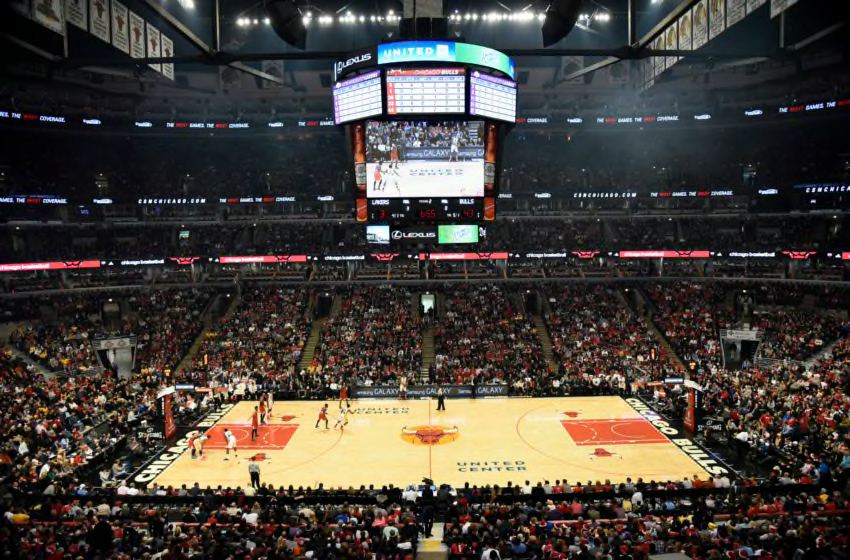
Chicago Bulls pull off major win in 2020 NBA Draft LotteryRyan Heckmanon August 21, 2020 at 1:14 am

Read More

Chicago Bulls pull off major win in 2020 NBA Draft LotteryRyan Heckmanon August 21, 2020 at 1:14 am Read More »