On Saturday, Tenci front woman Jess Shoman released Days Go By, a benefit compilation that features a dazzling array of Chicago indie rockers, including Fran, Sima Cunningham (of Ohmme), Izzy True, Mia Joy, Liam Kazar, and Gia Margaret (who collaborated with Dan Wriggins of Philadelphia band Friendship). Proceeds from the 19-track album go to Black- and trans-led Hyde Park LGBTQ+ center Brave Space Alliance, which provides “for-us by-us resources, programming, and services” on the south and west sides, and to the Chicago chapter of prison-abolition organization Black & Pink, which provides support for queer and trans inmates in Illinois. Shoman has uploaded Days Go By to Bandcamp as a “name your price” album, and you can’t give too much for it!
Ester bandleader Anna Holmquist is a kick-ass songwriter, though you might not know it from their hilarious Bad Songwriter Podcast, which features local guests (Nnamdi Ogbonnaya, Ratboys’ Julia Steiner) sharing their wince-inducing early efforts. Last week, Ester–which includes cellist Katelyn Cohen, guitarist Chris Colson, drummer Raul Cotaquispe, synth player Chris Harris, and bassist Tim Newsum–dropped the album Turn Around, and it’s winsome, not wince inducing. Holmquist spills tales of woe and perseverance over atmospheric, jazzy indie pop. When Ester finally play their postponed record-release show at the Hideout, Gossip Wolf will be first in line!
On Friday, February 21, local dance-pop juggernaut Pixel Grip played an epic set as part of the MCA’s Soundtrack series. They’ve since dropped a tasty recording of that show–more than an hour of thumping hot-goth jams, including a deliriously dubbed-out version of “Diamonds” that’ll probably remind you what it’s like to actually party with your friends in real life. Downloads are available now, and a limited cassette version should be available by May; you can order either via Bandcamp. v
The YouTube video opens with a young woman seated at a vanity table, writing in her diary and waving good-bye to end a FaceTime chat. The soundtrack begins with a brief acoustic-guitar intro, and then a soft, sweet voice floats into the arrangement, slightly sad but still comforting. A good voice to listen to in hard times, or when sheltering in place.
The song is called “Melody,” and the singer is Elena HT Par, a 17-year-old student at Holy Trinity High School in Noble Square, where I teach. Though Par isn’t one of my students, I have directed her in school drama productions. I first learned about her because she, like a lot of teens, regularly uploads short clips of herself singing to YouTube. But Par is a standout among young amateur YouTubers. “Melody” has attracted more than 1,685,000 views since she uploaded it on January 1, 2019. It’s also elicited more than 2,500 comments from fans around the world: “Love from Korea.” “Love from Australia.” “Love from Mizoram [a state in India].”
Even if it hadn’t attracted almost two million hits, the video would stand out. It’s not a shaky selfie, with audio captured in real time by a phone mike. Par is clearly lip-syncing along to a song she’s already recorded, and though she does a superb job, the edits give her away. In one shot she sings at a professional-looking microphone, round pop screen in place; in the next shot she’s back at her vanity, lingering over her diary.
Par met the videographer for “Melody,” Rin O. Zual, at her church, and they shot at his home on what could be generously described as a shoestring budget. “We didn’t spend any money,” Zual says. “Everything was done by friends supporting each other.”
“Melody” was written by a fellow YouTube performer, Indianapolis-based Honey KhuaitiZuu, who has her own YouTube channel. The song is sweeter and less gritty than KhuaitiZuu’s usual rap tracks.
“Her name is really cool, because Honey means ‘honey,’ right? And KhuaitiZuu means ‘honey’ in our language,” says Par. English is her second language; her first is Hakha Chin. “So it’s like Honey Honey.”
The way Par sings the song, it flows like honey. The first word is in English–“FaceTime”–which Par draws out, letting it hang for a moment before switching to her native language. The words appear in the air around her, and though they’re spelled out in the Latin alphabet, if you only know English that’ll be no help. Hakha Chin, also called Lai, is spoken by fewer than half a million people worldwide. It’s the shared language of the Chin, an ethnic group in Myanmar (or Burma, as Par prefers to call her home country).
Par came to the U.S. when she was six. “It was so much safer here in the U.S.,” she explains. “And more opportunities and an education.”
The Chin people were one of the founding groups of what became the Union of Burma at the end of British rule in 1948. The Chin had converted to Christianity during the colonial period, and that put them at odds with the country’s powerful Buddhist elite. They’ve been persecuted in Burma since the military takeover in 1962, and the situation hasn’t improved much since the country became a democracy in 2011.
This persecution has taken the form of the destruction of churches, the arrest or murder of clergy, and attempts by the Burmese military to forcibly convert Chin people. The Chin State, a mountainous, sparsely populated area, has suffered acute shortages of food and medical facilities. The Chin haven’t been targeted by the kind of genocidal attacks inflicted on the Muslim Rohingya, but there’s nonetheless a large and ongoing diaspora of Chin people from Burma to safer havens around the world. Many Chin live in India and Bangladesh, and there are Chin communities in North America, Europe, Australia, and New Zealand. “Most Chin people [in the U.S.] are in Texas and in Indianapolis,” Par explains. “But we are in Chicago.”
“Melody” is by far the most popular song Par has released, and it’s one of a handful of songs (“Lonely,” “White December”) that she’s uploaded for streaming on Spotify and Pandora and for sale digitally via iTunes and Amazon Music. Despite its success, though, Par has no immediate plans to try for a career in music. She’s performed at a few concerts, but she doesn’t tour–she’s still a full-time student, after all. She downplays her status as a YouTube celebrity at school. At a school event last year, a mischievous friend teased her by playing “Melody” on her phone; Par grimaced, blushed, and made her turn it off. Par is an honor student, and likes to keep her school life separate from her online life. “At the moment, singing is a hobby, but I do hope to put my music out there,” she says. “I am interested in education [in music], but nothing is for sure. I’m still learning and discovering new things about me.”
When did Par start singing? For that question she has an immediate answer: “That is basically asking me when I first came to the U.S.,” she says. “I started singing when I came to the U.S. in 2010. I was like six.”
Par’s older sister, Suisui Zaathang, has another story. She’s four years older, and she says she can’t remember a time when Par wasn’t singing, even when they were growing up in Burma. (The sisters have different surnames because, according to Par, “All of our families have different names–it’s not a tradition to go by last names.”)
Zaathang says they lived in “a city called Than Tlang in Chin State,” close to the Indian border in the west of the country, and the family didn’t have a TV in their house. “We would go to a friend or neighbor’s house to watch TV,” she recalls. “Most of the time they would put on a music video with many talented singers from all over Burma. Every time my sister and I would come home, she would imitate the singer. She would climb on top of a chair or a desk and sing.”
When Par was done, she would demand that the family give her flowers to show their approval. “That’s a very popular gesture during her live shows,” Zaathang says, “because that was a very popular gesture seen in many music videos.”
Par has few memories of Burma. “I left Burma when I was three or four,” she says. “Then we went to Malaysia for three or four years, then we came to the U.S.” Her family moved separately to Malaysia–father, mother, two sons, and two daughters–but from there they moved together straight to Chicago.
Par had trouble at first adjusting to her new life here. “Kindergarten was such a struggle for me,” she says, “because I didn’t know English. I would have anxiety attacks. I had an outgoing personality, but I could not communicate with my friends.” Par credits PBS Kids with helping her pick up English–that, and being forced to speak her new language every day. “What’s so hard was, I was afraid I would forget my Chin language.”
Par’s church, the Chicago Chin Baptist Church on Foster west of Harlem, also acts as a de facto community center, and it gave her a place to practice her language and keep in touch with her roots. The church has a video on its website that prominently features Par, dressed in red, at the head of a small choir. Par credits singing in church with helping her develop her talent.
“My Sunday school teacher and the people at my church realized my talent before I did,” Par says. “They were like, ‘Wow, you have so much potential.’ On Sundays there would be solos. And they would encourage me to sing solos, to use my voice.”
In a video Par posted in April 2019, titled “Q&A with Elena HT Par,” she admits she’s had no formal musical training. Or rather, all the training she has received came through singing in choirs. (She was also a member of the Chicago Children’s Choir for “about four months.”)
“I hope this doesn’t come off wrong, but I never learned how to sing,” Par says. “When I was younger, I had this thing–if you want to sing, to be able to sing, you just have to keep on singing.”
Zaathang seconds that emotion: “[My sister is] very passionate about learning new songs, and I watch her sing pretty much every day.”
Singing also runs in the family. Par says that her father, who died of a heart attack four years ago, loved to sing and write songs. Zaathang explains that he was an evangelist and then became a pastor. “He would go from village to village [in Burma] singing, preaching, and that’s how he met my mother,” she says. “They both sang together for a long time at jubilee, churches, conferences, and many more events. My dad loved to write and sing early in his teens–and he even taught me how to play the guitar. Singing is one of the many ways we bond in my family.”
Par credits one other factor in her singing career: the Disney Channel. “There’s this movie called Camp Rock,” she says, laughing and a little embarrassed. “When I was like 13, I watched the movie, and I was so inspired. Because of the music and the actors–you know, the Jonas Brothers, Demi Lovato. Demi Lovato was really my inspiration, how I wanted to be.”
Released in 2008, Camp Rock revolves around Lovato’s character, a girl from a poor family with a powerful singing voice who can only attend a prestigious camp for aspiring pop stars by working in the kitchen. The dramatic question that powers the film is whether her talent will be recognized and celebrated.
Lovato sings a powerful anthem at the climax of the movie, “This Is Me,” bravely revealing her true self and bringing down the house. (It’s not to be confused with another powerful anthem called “This Is Me,” delivered at the climax of the 2017 movie The Greatest Showman.)
Par took the song to heart and started singing it all the time. “My sister recorded a video of me singing the song,” Par says, laughing. “I used a vacuum cleaner as a microphone. At that moment I knew I loved music, I loved singing, and this is what I do–this is what I am here for.”
Par and her sister started recording Par singing covers of songs she liked. “I told [Elena] it would be amazing if she had a page of some sort, so that she can just upload them and share it with the world,” Zaathang explains. Soon after, she encouraged her sister to create a Facebook page to post these videos–a page she still uses, despite the popularity of her YouTube presence. One of Par’s early videos was a cover of Elvis Presley’s “Can’t Help Falling in Love.”
“On Facebook,” Par says, “there are a lot of people from my community. So my sister and I decided to record a video. And it got a lot of reactions. Many people were like, ‘You need to start a YouTube channel.’ My sister said, ‘Go for it!’ And so we created a YouTube channel.”
That was in August 2017, when Par was about to begin eighth grade. Since then she’s attracted more than 30,000 subscribers, and at publication time the channel had more than 2.3 million total views. The videos she posts are a mix of cover versions of pop hits, original songs in Hakha Chin, and concert footage from events–religious and secular–where Par has sung. This past winter she and her sister posted an original Christmas song, “White December,” that they’d written in Hakha Chin.
In November 2017, Par started collaborating with videographer Rin O. Zual, who would later work with her on “Melody.” In February 2018, Par posted a video shot by Zual where she sings a cover of “Rewrite the Stars” from The Greatest Showman. Par performs with another young amateur, Dave Lian, who also plays acoustic guitar, and the video identifies them in its title as “Dave and Elena.”
“It took us about two hours,” Zual says. “We didn’t have a budget for this. It was just the camera gear that I have, and the location was at my house.” Zual and Par continue collaborating today.
Since posting that track, Par has become something of a celebrity in the Chin community. She and KhuaitiZuu won the Chin Cable Network’s 2019 song of the year award for “Melody.” “I got a little trophy for it,” Par says, smiling. “Which was cool.”
But even more surprising is how popular this sweet little song–about someone wishing she could see her beloved in real life, and not just on social media–has become worldwide. “When I saw my music doing well in the Philippines, I was really shocked,” Par says. “There were YouTube comments like ‘Love you from the Philippines.’ There was one I remember from Africa. The biggest population of people who listen to my music is from India, a place called Mizoram–that’s a state in India. They were like, ‘Oh, this song is very similar to our language.'”
Par says she’s proudest of how “Melody” advances the Chin language in her new country. “It’s not an everyday thing that there’s someone in the community who is able to do something like this,” she says. “With the Chin community, there are lots of kids who have grown up in America and have forgotten the Chin language. A lot of young kids hear [‘Melody,’] and it has inspired kids to learn their language and to find out about their roots. I think that’s cool.” v
At this outlier moment in our history, every story is about coronavirus–even last week’s perfectly staid announcement that Chicago History Museum president Gary T. Johnson will be retiring at the end of the year.
It followed, by ten days, the announcement that the museum, like every other cultural venue in the city, was closing its doors until further notice.
Johnson says neither the pandemic nor an atypical $234,000 operating budget shortfall last year influenced his decision. After 15 years on the job, in a position he took after a 28-year career as an attorney, the retirement date’s been on his and his board’s calendar for a while. As for the fiscal red ink: it’s a relatively small deficit, he says, after 11 years of operating in the black.
Thanks to the virus, however, Johnson’s tenure will be bookended by closures. When he started in 2005–taking over for Lonnie Bunch, who left to become founding director of the National Museum of African American History and Culture, and now heads up the entire Smithsonian Institution–the museum was about to go into a nine-month shutdown for a reconstruction that also became a reinvention.
The museum, founded in 1856, is the oldest cultural institution in the city, and it had retained its original name: the Chicago Historical Society. Johnson was dismayed by the fact that many people thought it was a private club–a problem the board had long been debating. When it reopened in 2006–tradition be damned–the “Society” had a new, friendlier moniker: the Chicago History Museum.
Johnson has visited 350 Chicago public schools with artifacts from the Great Chicago Fire in tow; he says it’s what he’s loved most about his job. When asked for historical precedents to the coronavirus crisis, the fire, “one of the three most famous fires in world history,” is what first comes to mind. (The others? Rome and London.)
“It left a third of the population homeless, but the city quickly sprang back,” he says. On the other hand, and perhaps more to the point, there was also the Depression: “an extended event that hit the workforce and businesses very hard.” The museum’s been a national leader in programming about the history of the LGBTQ+ community (an initiative that Johnson says began before he arrived), and he’s overseen a significant expansion of CHM’s photography collections. Among them: the complete body of work by the architectural photography firm Hedrich-Blessing and, after a 2018 purchase of about five million images, the entire archive of Chicago Sun-Times photographs from the 1940s through the early 21st century.
There’s a sorry tale behind that acquisition. In 2009, the financially strapped Sun-Times sold its photo archive to John Rogers, a sports memorabilia dealer from Arkansas. Rogers had become a celebrity of sorts a year earlier when he purchased a Honus Wagner baseball card for $1.6 million, and was also developing a newspaper image business. He would pay newspapers for their negatives and prints and, as part of the deal, would promise to digitize their collections and give them a searchable archive. The papers would usually retain the copyrights; Rogers would get to keep the negatives and prints.
In 2010, the Reader‘s Michael Miner wrote about vintage Sun-Times photos showing up on eBay, priced at less than $10. By 2014 (a year after the Sun-Times decided it didn’t need photographers and infamously fired its entire prizewinning photo staff), Rogers’s businesses were failing and the FBI was raiding his Little Rock home. In 2017, he was sentenced to 12 years in prison for selling items that included a fake Heisman trophy.
His assets–including the Sun-Times archive–were liquidated in a bankruptcy sale and purchased by another dealer. When CHM heard about that, Johnson says, they feared the collection would be sold off piecemeal and, in effect, vanish. With donor support, they stepped in and bought it for $125,000.
The first exhibit drawn from the Sun-Times collection was scheduled to debut March 28; now we’ll have to wait until the museum reopens to see it. But a chunk of other photos from that collection have been posted on the CHM website–part of Johnson’s decision, a few years ago, to be a “digital first” museum. The photos look to be mostly from the 1970s: Vietnam war protests; Apollo astronauts on parade; a Gay Liberation Front rally. Oddly, many of them lack a credit for the photographer; CHM vice president John Russick says that likely reflects the state of the collection when they got it.
Johnson says the museum recently donated its stock of personal protective equipment–used, for example, when working with musty materials–to Stroger Hospital. He’s confident that this venerable institution can weather the shutdown, though it’ll be painful.
“It’ll be interesting to see how people become re-accustomed to being in places where there are lots of other people,” he says. “Will they shy away from a place that might be crowded? Or, on the other hand, will they crave it so much that they’ll celebrate that they’re in a welcoming place with other Chicagoans?
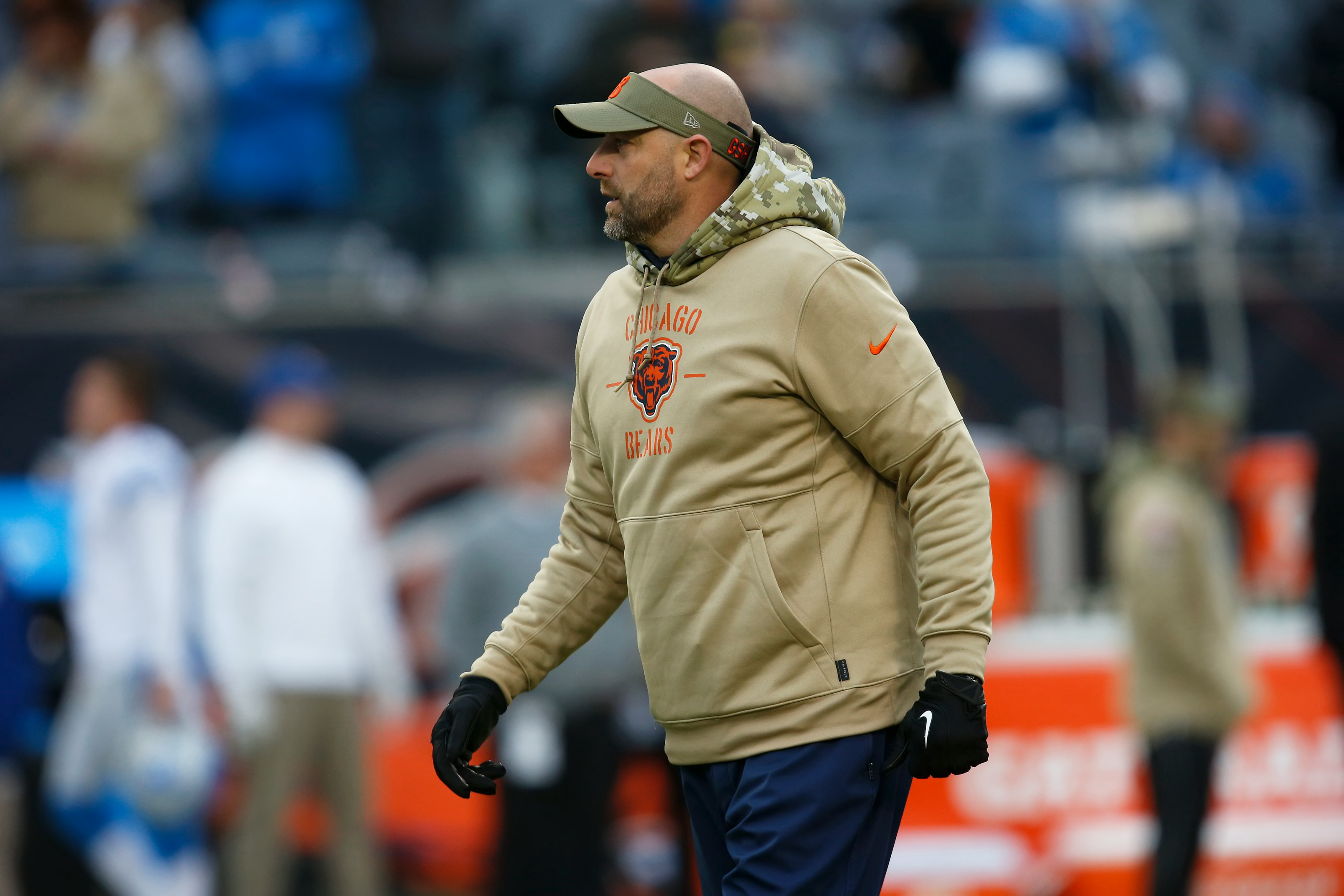
ChicagoBears (Photo by Nuccio DiNuzzo/Getty Images)
Two veterans were just cut by their respective teams, and the Chicago Bears could use help at their positions.
Right about now is where you will want to keep an eye out for teams making even more roster cuts prior to the 2020 NFL Draft. The Chicago Bears got their primary cuts out of the way before free agency, but still more teams are letting go of some notable names as we speak.
Tuesday, there were two key veterans released from their teams which should interest the Bears. First to be released was cornerback Dre Kirkpatrick of the Cincinnati Bengals.
Kirkpatrick had two seasons left on his original 5-year deal he signed with Cincinnati back in 2017, which at the time was an enormous deal worth over $52 million on five years. Now, he is left looking for a new home.
The second prominent name to be cut on Tuesday was veteran tight end Ed Dickson of the Seattle Seahawks. The 32-year-old only spent one season with the Seahawks, but with Seattle signing Greg Olsen and also having some future faith in Will Dissly, Dickson became expendable.
That begs the question: Should general manager Ryan Pace look at either one of these guys before the draft hits in less than a month?
RELATED PRODUCT
Tailgate Men’s Chicago Bears Fleece Hoodie Basic Navy XS
Let’s look at each one of these guys individually and how they would fit into the Bears’ current roster and plans for 2020.
My daughter spent the past couple of weeks at our house, but she headed back to her home for the rest of the shelter in place today. For the few days she was with us, which seemed like months when we lived through them, it felt like we were safe as a family. There were walks with the dog, cooking, a trip to the grocery store, shared viewing of old “House” episodes, and a shared anxiety.
We worked through the stages of grief together—denial, anger, depression, bargaining, and acceptance. I’m sure we’ll cycle through them again and again. But our first group landing on acceptance meant a huge grocery shopping trip and packing her up to go home.
We realized, without really saying so, that this is the way life is going to be for awhile and we best get on with living. She has lost her job for now, but she still has her apartment and her intense home workout schedule, her roommates, and all of the rest of life’s business.
My husband and I have become online teachers, and we are grateful to have our jobs, our students, and our communities.
I was teaching via Zoom when she left, and for that I am grateful. I’m sure I would have cried had I watched her car leave the driveway. My world is tucked in her grocery bags, among the oranges and carrots. I cannot bear thinking about this invisible beast of a virus licking and spitting her direction. Foolishly I imagine I can protect her if she’s home.
The house is so quiet now. Not as quiet as walks in the neighborhood, where I feel like a character in Stephen King’s “The Stand,” but quiet. It is a relatively peaceful quiet for now. It is punctuated by my dog barking at other dogs and my husband playing drums in the late afternoon.
I’m trying to get on with my life in ways that work for me. It’s a steep learning curve.
I’ve arranged a socially distanced walk with a friend for Wednesday, several Zoom sessions with students and colleagues, and have a to do list I’ll never ever finish. I feel like I’m walking in slow motion most of the time. I can’t get things done. My concentration is splotchy. My emotions are mostly suppressed.
During my Zoom session with students today, they asked if we’d be meeting like this weekly. I told them that most of our work would be asynchronous. I confessed that I scheduled the meeting today mostly because I needed to see that they were ok.
What I saw was people like me, struggling with anxiety and depression, fear, exhaustion, hope. They want to do school work, to write, but they want to go to their jobs and get paid and to feed their families even more. They have children to care for, life to cope with.
Sometimes it feels like moving to online courses is hardest for faculty, but I think the students struggle just as much or more. We are, at least, in control. They are at the mercy of our skill or lack of skill and of our mercy or lack of it. Suffice it to say that mercy is more scarce than I would have hoped.
My writing in this post is much like my brain’s functioning at the moment. I start down one path and then end up somewhere else.
I suppose what I’m saying is that I’m trying very hard to pivot. To learn how to find the closeness and contact with human beings that is so natural face to face, inches or a foot apart. I’m trying to learn how to be a teacher and a mother when neither students nor daughter are nearby.
Landing here on acceptance of life in a pandemic means becoming a new sort of person and contributing to a new sort of community.
Here’s hoping that you are finding the peace and connection that you need and that you are, most importantly, healthy.
Like me, you probably dislike all of the ads on this page. They pop up unexpectedly, sometimes cover text, start playing videos and clutter the post itself. I have no control over any aspect of the ads, from content to form to placement to number. I am sorry that they have taken over our blogs on ChicagoNow and I appreciate that you continue to read.
If you’d like to know first-hand when I have a new post, type your email address in the box and click the “create subscription” button. My list is completely spam free, and you can opt out at any time.
I am a writing professor who lives in the suburbs south of Chicago. I’ve lived my life in the deserts and mountains of New Mexico, the tundra of Alaska, and, now, in Chicagoland. If I could have lived a different life, I would have chosen to be taller and to play point guard for Pat Summitt’s Lady Vols. Instead I’ve gotten to live my life as a writer and reader, a teacher and student, a cook and a bike rider with my husband, daughter, two cats and a dog. If you’d like to get in touch, please email me at [email protected]
Oh, Jeez – where to begin? (And please bear in mind, I’m not making light here – this is the single, most dire health event most of us have experienced in our lifetime, unless you were around for the 1918 Spanish Flu pandemic.)
So here’s what I can’t handle about the nasty, one-celled little fucker that’s up-ended the entire world:
It’s a nasty, one-celled little fucker that’s up-ended the entire world.
And you thought global terrorism was bad? Compared to this thing, ISIS, the Taliban and Al Qaeda were a petty inconveniences. Welcome to true germ warfare, my babies. All I can think about is a one-celled organism with my name on it, on the surface of something I forgot to decontaminate before I touched it.
I can no longer touch my face or, God forbid, chew my pens.
Both bad habits of mine. I had no idea how many times I touched my face on a daily basis until Corona-scourge appeared. You probably didn’t, either.
Lots of people are dying and more will die.
And I pray to holy God it isn’t you, me or anyone that we know and love. This is the one that keeps me up at night – like tonight – it’s 4:23 AM as I write this. Just a little abject fear of dying.
I have to keep working. I’m the new pariah.
I’m not gonna get into specifics here, but I have a job that I can’t phone in, and we are not closed for the duration. Virtually my entire neighborhood is home, so every day when I leave for work, I feel like a criminal, or that I’m crossing a picket line. I fully expect to find “SCAB” spray-painted on my car one morning. I want to stay home. I’m supposed to stay home. But I can’t. And there are thousands more just like me. Unless and until martial law is declared, we working pariahs are bearing a ton of guilt, along with a ton of fear. And it sucks.
I hate that our first responders and medical professionals are so incredibly put-upon and in constant danger.
Like their jobs weren’t difficult enough. We all need to thank God every day that we have selfless professionals like this in our midst, much of the time working ill-equipped and against incomprehensible odds. Absolute heroes.
This damn thing is open-ended – no closure in sight.
This, I think, is the real crux here. We don’t know when it will peak, level off, if having it gives one immunity for a second-strike, and if there will BE a second-strike. Or a vaccine, treatment or cure. Present AND future fear. Really hard to handle such long-term peril.
I can’t get a grip on my fear.
I keep thinking that this is the closest we will come to understanding how the country felt the day in 1941 that Pearl Harbor was bombed. Confused. Not comprehending. Frightened. Uncertain. And looking to State and Federal governments that are feeling the exact same way, yet still have to act.
Over the weekend, I re-read President Franklin D. Roosevelt’s famous speech from the day after Pearl was hit – the “Day Which Will Live In Infamy” speech.
In it, there are parallels to our coronavirus fight that I found interesting:
“… The facts of yesterday and today speak for themselves. The people of the United States have already formed their opinions and well understand the implications to the very life and safety of our nation.
As Commander in Chief of the Army and Navy, I have directed that all measures be taken for our defense. But always will our whole nation remember the character of the onslaught against us.
No matter how long it may take us to overcome this premeditated invasion, the American people in their righteous might will win through to absolute victory.
I believe that I interpret the will of the Congress and of the people when I assert that we will not only defend ourselves to the uttermost, but will make it very certain that this form of treachery shall never again endanger us.
Hostilities exist. There is no blinking at the fact that our people, our territory, and our interests are in grave danger.
With confidence in our armed forces, with the unbounding determination of our people, we will gain the inevitable triumph—so help us God.”
From Roosevelt’s mouth to God’s ear. (Would that he were with us now!) I can well-understand why Americans danced in the streets on VE and VJ Days.
So take every precaution, my babies. Pray hard and continue taking care of one another. Don’t give up.
And may we one day soon be doing our own victory dance in the streets.
Hello, my babies! Here on Planet Michelle (Earth name: Michelle Babicz), you will find satire, song, sexy stuff and other musings from my little monkey brain. And of course, politics, given the Human Comb-Over currently occupying the Oval Office. / I live over by there, have a foreclosure cat named Lou and currently am between husbands. (Hopefully, not yours.) Enjoy your orbit!
It’s difficult to reach your business goals if you don’t have the right materials and/or the information to help your business reach the success it’s capable of, especially during these trying times. These three insights will help you generate the business you’ve always dreamed of.
1. Find Your Niche
Chances are, you already have a target audience that you are marketing your products to. Let’s face it, you’re probably looking for ways to increase your market audience and profit…or you probably wouldn’t be reading this article. Here are the real facts… you don’t have to find a wider audience to increase your sales.
Have you noticed similar characteristics that groups within your target audience have in common? Maybe you have a group of businessmen, a group of young mothers, and a group of retirees that frequently make purchases. That is just the set-up I’m talking about.
Pay attention to the individual characteristics of each group, and divide your advertising into similar segments, or niches. Focus on the specific needs of the group in the advertising products you put out. General advertisements are not as effective as more specific ads. Hey, we all sit up and pay attention to someone who recognizes our specific needs and desires!
2. Create A Unique Selling Point
Why should someone buy from you and not your competitor? I hate to deal a blow to your ego, but it really has nothing to do with you, your product, or your service. Yeah, it’s a little self-centered, but customers are attracted by offers that point out the things that benefit THEM.
If you want to stand out from the crowd, create a unique selling proposition that stresses the benefits the customers will receive from doing business with you. Will they get faster service? Go ahead and dramatize it, but keep the customer at the focus…”Get free overnight delivery!” Hey, it tells the customer…you get quick service and a discount on shipping. Two definite benefits in one statement.
Don’t go out on a limb to create new products and services to get attention. Just, add a special benefit to the ones you already have… maybe it’s quicker service. The most effective things to emphasize are the benefits that your competition cannot or is not willing to give.
3. Offer Your Way To Greater Profits
How many times have you began manhunting? Sure, as a marketer you scrounge and search for brand new or ancient methods of drawing brand new faces to your place of business. The fact of the matter is that you don’t have to find new customers for your sales to grow.
No, in fact, you can take the current business you have and send your profits to the moon with one easy technique… make an offer.
Greet every sale with an offer of an item that is related to the purchase. The offered product doesn’t even have to be yours. The Internet is wonderful for affiliate marketers who can make great profits selling the material of others.
Making your business grow doesn’t have to be a stressful, backbreaking or frantic process. Simply implement these three strategies, and watch it bloom!
Like at all times, there are ups and there are downs.
Miss #1: We Could Be Testing, Yeah!
Our laboratory is still open, and we came so close to being able to do some COVID testing. As I wrote last year, we planned on entering the field of molecular microbiology (MM), a relatively new technique to identify small amounts of bacteria in a patient sample. Instead of trying to grow bacteria in a petri dish as we do in traditional laboratory cultures, and then using a variety of observational and biochemical techniques to identify which bacteria are present, MM actually identifies the DNA present in a sample and compares it to a “hit list” of known bacteria. This technique is quicker and more sensitive than the current technique but not cheaper–2 out of 3 ain’t bad.
And guess what! MM can identify viruses too. In fact, the equipment we need to bring in for our new MM lab protocol is just the equipment that is used in COVID testing. If only we had obtained it a few months ago!
Sadly, the building process (new lease, budgeting, bidding, waiting for the former tenant to leave the space) took longer than expected, as it always does. Our build-out was completed today (hurray) but the testing instruments and training to use them are no longer available. I trust they are being used wisely at some other laboratory doing COVID testing, but we would have liked to have been able to provide this test for our patients who met testing criteria.
Miss #2: It’s a Puzzlement
After our flopped attempt at a YouTube masterpiece, Barb and I turned our attention to the 1000 piece jigsaw puzzle we had ordered to help fill stay-at-home days. It was a difficult puzzle, composed of pictures of classic postcards from around the country–you know, the “Greetings from Sunny California” type. Neither of us is a puzzle veteran, so we attacked the challenge systematically, first the outer frame, then the larger, most obvious colors and shapes. The finely detailed areas came last.
After 4 days and nights of squinting, comparing, and pressing things into place, we had a 99.9% completed puzzle. Alas, the 1000th piece in the box was a duplicate of piece 999 and we were left with a giant hole in Fargo, North Dakota. Aside from Frances McDormand, I have never given much thought to Fargo, North Dakota–but when this COVID thing is over, I want to go there and look for my missing piece.
The Haiku Hit
Earlier this month I posted a number of Haiku I had written about our COVID world, and the world seems to have appreciated them. The Haiku have been read in almost 40 countries, including Japan. I’d like to share some of the verses readers have sent in response.
From Dr. Andy Curtis in Canada:
Played God today
No respirator for you
So, so, so sorry
From Juli Krista
Coronavirus
Resets our priorities
Do we have TP?
From Margaret Densley
Cleaning my house now
antibacterial smells
Covid-19 Life
From Woof
Spikey, tiny balls bounce
Collide with humanity…
Obituaries
Thanks and keep them coming!
The opinions expressed above are those of the author and not UroPartners, LLC.
Like what you read here? Add your name to our subscription list below. No spam, I promise!
___
Hi! I am Les, a practicing pathologist living in the North Suburbs and commuting every day to the Western ones. I have lived my entire life in the Chicago area, and have a pretty good feel for the place, its attractions, culture, restaurants and teams. My wife and I are empty-nesters with two adult children and a grandchild. We recently decided to downsize, but just a bit! I will be telling the story of the construction of our new home, but also writing about whatever gets me going on a particular day. Be sure to check out the “About” page to learn more about where we plan to go with this blog!
Make no mistake about it the world’s economies are in for a world of pain as mandatory social distancing measures cripple entire industries and their related supply chains. No one can say for sure how long it will last or how bad it might get, but it’s possible that the stock market has already priced in the lean times ahead.
For those believe the Dow Jones Industrial Average is predictive and anticipative of greater economic conditions, perhaps the worst is now behind us. Before a sizable pull back this past Friday, last week consisted of a three-day surge that saw the Dow post the largest rally since the Depression era. Monday closed 690 points above the previous trading day, and that put the index in the green four of the past five sessions.
Maybe the resistance level has been found now amid the impact of the COVID-19 pandemic? There are certainly some favorable signs, starting with reaction to the U.S. government’s $2.2 trillion relief package. The bill is intended to help facilitate corporate hiring, consumer spending, small business loans and other basic building parts of the American ecnomic engine. The plan calls for $1,200 stimulus checks to reach every American in the middle and working classes within three weeks time, but with consumer sentiment falling to a multi-year low in March, there is only so much this monetary amount can do.
For most, this amount will be utilized to cover bills, not acquire any form of capital, but at it’s still better fiscal support than having no stimulus package at all. There are two other factors of greater consequence to the stock market than the stimulus package during the coronavirus inspired crisis.
The first is our global quest to flatten the curve, and not overwhelm the health care system. The second is the rate at which medical science progresses with containment tactics and a safe, widely available vaccine.
On the first point, we’ve seen that social distancing and stay-at-home orders (when adhered to) work. Italy, one of the world’s worst hot spots for the virus, reported 4,050 new COVID-19 cases on Monday, their lowest daily number since March 17. More importantly, their 5-day moving average is now starting to level out, and it looks like they might have passed their peak at this point.
The U.S. which leads the world in both number of people tested and number of cases, has consistently tracked behind Italy, just on a 10-15 day delay.
In terms of the race for a vaccine, Monday saw news of the U.S. Government reaching a $450 million deal with Johnson and Johnson to get it on a faster track.
Johnson and Johnson claims human testing of its experimental would begin by September and that it could be available for emergency use by early 2021.
Finally, we’ve also seen a blue print for how to contain community spread of the disease. Look no further than Taiwan, where a blend of social collectivism and high-efficiency governing has resulted in an impressive level of containment. The measures implemented in this tiny island nation off the coast of China could be a window into what the new normal is for the rest of us.
The Dow closed at 18,591.93 on Monday March 23rd, a four year low. One week later, it was back up at 22,327.48. Perhaps it’s a false dawn? Or, it could be the opposite, a stock market rebound driven by the good news that’s out there?
Paul M. Banks runs The Sports Bank.net and TheBank.News, which is partnered with News Now and Minute Media. Banks, a former writer for the Washington Times, NBC Chicago.com and Chicago Tribune.com, currently contributes regularly to WGN CLTV and ChicagoNow.
He’s been a featured guest in dozens of media outlets including The History Channel. His work has been cited in hundreds of publications including the Wall Street Journal and Washington Post.
With COVID-19 changing the world as we know it into an invisible enemy, one of the hardest hit institutions is the American Theatre which has been completely shutdown until further notice.
If and when theaters will reopen and life will be back to normal, no one knows for sure.
As a member of American Theater Critics Association (ATCA) I am privy to coverage from other critics. Together their observations and reporting offer a microcosm of what’s happening to theatre in communities across America.
Some of the coverage offers signs of hope…others signs of despair. Together they paint a picture of how various communities are handling life when the theaters go dark.
VIRUS CRISIS COVERAGE Here is a sampling of the coverage of the impact of the novel coronavirus pandemic on America’s theater community by members of ATCA.
If you would like to keep in touch with what’s happening in Chicago, like us on Facebook or subscribe to Show Me Chicago by email. To subscribe, type your email address in the box below and click the “create subscription” button. Our list is completely spam free, and you can opt out at any time.







3 comments