Videos

NBA lookback: Michael Jordan vs. analyticsChicagoNow Staffon April 29, 2020 at 8:45 pm

ChicagoNow Staff Blog

NBA lookback: Michael Jordan vs. analytics

Read More

NBA lookback: Michael Jordan vs. analyticsChicagoNow Staffon April 29, 2020 at 8:45 pm Read More »

The COVIDiots strike again! It’s not time to open up the gates of COVID-19Ms. Crankypantson April 29, 2020 at 8:54 pm

Ms. Crankypants and the City

The COVIDiots strike again! It’s not time to open up the gates of COVID-19

Read More

The COVIDiots strike again! It’s not time to open up the gates of COVID-19Ms. Crankypantson April 29, 2020 at 8:54 pm Read More »

Look at Listiner MartinezThe Look Chicagoon April 29, 2020 at 8:58 pm

The Look Chicago

Look at Listiner Martinez

Read More

Look at Listiner MartinezThe Look Chicagoon April 29, 2020 at 8:58 pm Read More »

Lollapalooza is Livestreaming Throwback Sets Every Thursday and SundayAlicia Likenon April 29, 2020 at 5:03 pm

If we’re just being honest, isolation is driving us slightly crazy. We’re on week seven (or eight? Maybe nine?) of not seeing friends, no live music, and avoiding large crowds. But things are starting to look up—some venues are getting creative in quarantine offering virtual happy hours. Many artists have taken to the internet to share their talents. And now even Lollapalooza is livestreaming past shows to keep you entertained at home.

Recently, Global Citizen put on a virtual concert called One World: Together at Home to support frontline healthcare workers. The broadcast featured pop culture icons Lady Gaga, Elton John, and Taylor Swift. Also, a Chicago startup called Cameo hosted a free livestream event with live sets from Chris Daughtry, Lee Brice, and Thompson Square.

Advertisement


Then on Tuesday afternoon, the Lolla squad blessed us with some exciting news on their social media: Lollapalooza is going virtual by livestreaming past shows! That’s right folks, they’re opening up their archives to bring you Perry’s Power Hour and Lolla From The Vault—two memorable sets every week on YouTube. Hell. Yes. Here’s what we know so far.

[embedded content]

Advertisement


Lolla from the Vault

Thursdays @ 7 pm CST | THIS WEEK: The Strokes 

Buckle up, this time machine is about to go back 10 years. Tune in to a livestream performance of The Strokes from 2010. Set your clocks for 7 pm CST on Thursday, April 30th. Because that’s how you do a #TBT. 

Advertisement


Lollapalooza plans on livestreaming past shows every Thursday through May, at least, so make sure to keep this on your calendar!

[embedded content]

Advertisement


Perry’s Power Hour

Sundays @ 7 pm CST | THIS WEEK: Alesso 

Be kind, rewind… and get rid of your Sunday scaries by watching a livestream performance of Alesso from 2019. It all goes down Sunday, May 3rd at 7 pm CST. Don’t miss your favorite Swedish DJ as he drops the hook, and make sure to tune in next Sunday for another livestream power hour!

Advertisement


All money raised will benefit Crew Nation, a global relief fund supporting the crew members who work tirelessly behind the scenes to make events like Lollapalooza happen. Pop over to Lolla’s website and mark your calendars for both shows, and make sure to check back in with UrbanMatter for next week’s lineup!

Advertisement


Advertisement


Read More

Lollapalooza is Livestreaming Throwback Sets Every Thursday and SundayAlicia Likenon April 29, 2020 at 5:03 pm Read More »

5 Satisfying Breakfast Takeout Spots in LakeviewAlicia Likenon April 29, 2020 at 7:19 pm

Local Chicagoans know: downtown is for work, Lakeview is for living. The community’s casual vibes and idyllic shoreline make it feel like a coastal city, bustling with nice, Midwestern folks. Five-star restaurants and bars have flocked to the area, serving it’s roughly 100,000 residents. So of course, top-notch breakfast spots aren’t hard to find. Here are five of our favorite early-bird eateries that are still offering breakfast takeout in Lakeview during COVID-19. 

Advertisement


Maison Parisienne

This quaint French cafe is known for satisfying its customers with buttery croissants, savory quiches, and breakfast sandwiches. Looking to dabble in a new morning drink? Try their lavender rose latte or spicy hot chocolate. Order on Grubhub, you won’t be disappointed.

Breakfast
Photo Credit: Batter & Berries Facebook

Batter & Berries

French toast is nice. But have you ever had a World Famous French Toast Flight? Treat yourself to blueberry, strawberry, lemon, and caramel french toasts made with locally baked Brioche bread and B&B maple butter. Tack on a deconstructed omelet or a giant Belgium waffle and there’s a good chance you’ll be full until Halloween. Get the goods on Grubhub

Advertisement


The Crepe Shop

Inspired by street eats of Paris, this relatively new neighborhood joint dishes up a unique twist on crepes. Their menu is tiny but mighty. Feeling savory? Go for honey truffle or ham and cheese. Got a major sweet tooth? Try Nutella or lemon curd. Pair your crepes with a Mocha New Belgium which consists of espresso, bourbon vanilla, Belgium chocolate, and coconut cream. Get the hookup on Grubhub and start your morning right. 

Advertisement


Mortar & Pestle
Photo Credit: Mortar & Pestle Facebook

Mortar & Pestle

Chicago Chef Stephen Ross launched Mortar and Pestle to focus on making everything by hand and getting back to the basics. The stylish and sleek bistro offers delectable items like Alaskan King crab benedict, foie gras and eggs, and bircher muesli. Open daily for breakfast takeout

Southport Grocery & Cafe

Looking to stock up your pantry and grab some grub? Pop into this hybrid grocery & cafe where you’ll find shelves stocked with soup mixes, chocolate sauce, spreads, spices, and some of the area’s best preserves. Then make your tummy happy with one of their unique breakfast offerings. Popular items include a grown-up Poptart, cupcake pancakes, and a roasted butternut squash bacon omelet. Place an order on Caviar and make your day amazing. 

Read More

5 Satisfying Breakfast Takeout Spots in LakeviewAlicia Likenon April 29, 2020 at 7:19 pm Read More »

Top football recruits bring in big money for colleges — and COVID-19 threatens it allContributoron April 29, 2020 at 4:53 pm

Colleges and universities are spending more than ever to land the nation’s top football recruits, with some schools having boosted their recruiting budgets by more than 300% in the last five years.

These budgets can surpass $2 million for schools like the University of Tennessee.

Is it worth it?

I study economics. Research I recently did shows just how big the payoff for spending money to recruit the best players can be.

Half a million dollars

The schools that secure five-star recruits — the 30 or so players judged to be in the top one-hundreth of the top 1% of high school football players — can increase total revenue by over $500,000 for a university’s athletic department. Most football teams never secure a five-star recruit. Others, such as the University of Alabama and Louisiana State University, recruit three or four every year.

My research team came to this $500,000 figure by linking 10 years’ worth of football recruiting information from Rivals.com and Scout.com, two of the top recruiting services for prospective college football players, with federal data on how much colleges take in and spend on athletics, win-loss records for individual schools and post-season bowl appearances.

The data shows revenue and expenditures for each sport separately, which made it possible to determine what a football recruit added to football revenue at each university.

Schools like the University of Oklahoma, the University of Michigan and Notre Dame, which on average bring in over a dozen four- or five-star recruits every year, bring in millions of dollars more in revenue when they land more of the top recruits in a given year.

For instance, my estimates suggests that Clemson University’s five-star recruits, of which there were five, and 12 four-star recruits — also in top one-quarter of 1% of all players — in the 2020 recruiting class will increase the school’s football revenue by well over $3 million, well above its $1.8 million recruiting budget.

The reason is simple: Top recruits help teams win.

Since a top recruit correlates strongly with increases in the number of victories, they help determine the type of post-season play. Five-star recruits are not the deciding factor in whether a school gets to a bowl game, the mark of a winning season — the big-time programs will have winning records every year without fail.

But they do push them to the upper echelon of post-season play — the College Football Playoffs or its forerunner, the Bowl Championship Series. Reaching the championship level in college football contributes to lucrative broadcast contracts, corporate partnerships and even more successful recruiting.

Very few schools are consistently successful in the race to recruit top football talent and win at the highest levels. Just as nine schools have been responsible for 20% of all players drafted into the NFL over the past two decades, only six schools have made it to the College Football Playoff championship game.

Financing other sports

There is more than hoisting football trophies at stake.

College football is a key driver of athletic department revenue as well, helping to pay for other sports programs. Athletic departments that field more than 30 varsity teams do so understanding that fewer than five varsity teams generate enough revenue to cover the entire athletics department’s expenses.

In fact, some critics argue that big-time college sports, which feature rosters made up primarily of black student-athletes, pay for the sports programs that include overwhelmingly white student-athletes, such as lacrosse and swimming, which receive far less media attention but are the bulk of athletes in major collegiate sports programs. Sixty-one percent of all student athletes are white.

Football revenue also helps finance athletic recruiting efforts and amenities, such as state-of-the-art facilities. All of that takes money, which takes recruits, which takes money. Every recruiting video, campus visit and hosted meal is a line item on an athletic department’s budget.

COVID-19 repercussions

The possibility of there being no college football season in the fall of 2020 is making athletics departments fear big budget cuts.

Already, some schools are dropping sports that were subsidized by college football revenues, like men’s soccer and wrestling. Smaller schools that depend on a few $1 million paydays in September from the major programs, may be left with gaping holes in their athletic budgets, threatening all sports.

There is little doubt that changes are coming to the current model of athletic department operations through a variety of converging forces. COVID-19 is unleashing widespread job losses, business closures and declining consumer spending that will limit what fans and advertisers can spend on football.

Another factor could be a change by the National Collegiate Athletic Association — which governs college athletics — that could allow student-athletes to get paid from their name, image and likeness.

While schools rich with talent may continue to get richer, those schools further down the recruiting pecking order will be left to wonder how they can survive at all.

Trevon Logan is a professor of economics at The Ohio State University.

This article originally was published on The Conversation.

Send letters to [email protected].

Read More

Top football recruits bring in big money for colleges — and COVID-19 threatens it allContributoron April 29, 2020 at 4:53 pm Read More »

Chicago Blackhawks: Three candidates to replace John McDonoughVincent Pariseon April 29, 2020 at 11:00 am

Read More

Chicago Blackhawks: Three candidates to replace John McDonoughVincent Pariseon April 29, 2020 at 11:00 am Read More »

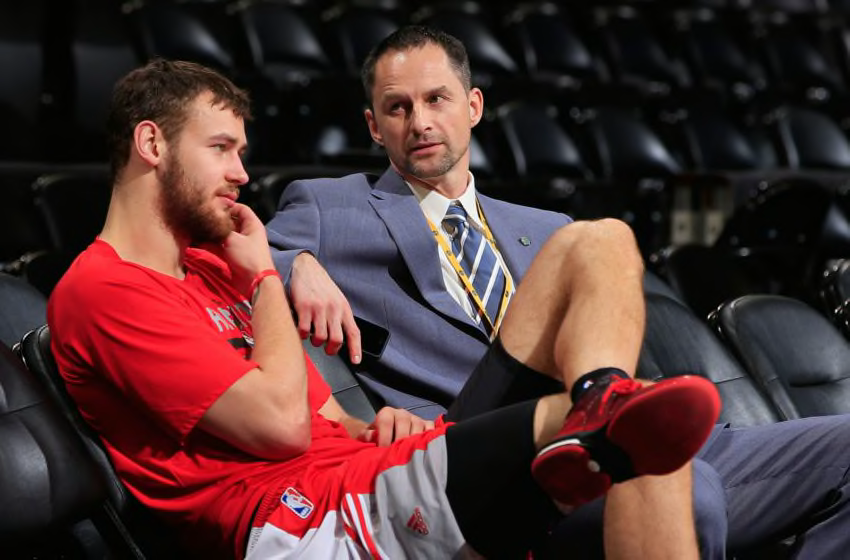
Chicago Bulls: What is the next step for Arturas Karnisovas?Michael Guistoliseon April 29, 2020 at 12:00 pm

Read More

Chicago Bulls: What is the next step for Arturas Karnisovas?Michael Guistoliseon April 29, 2020 at 12:00 pm Read More »

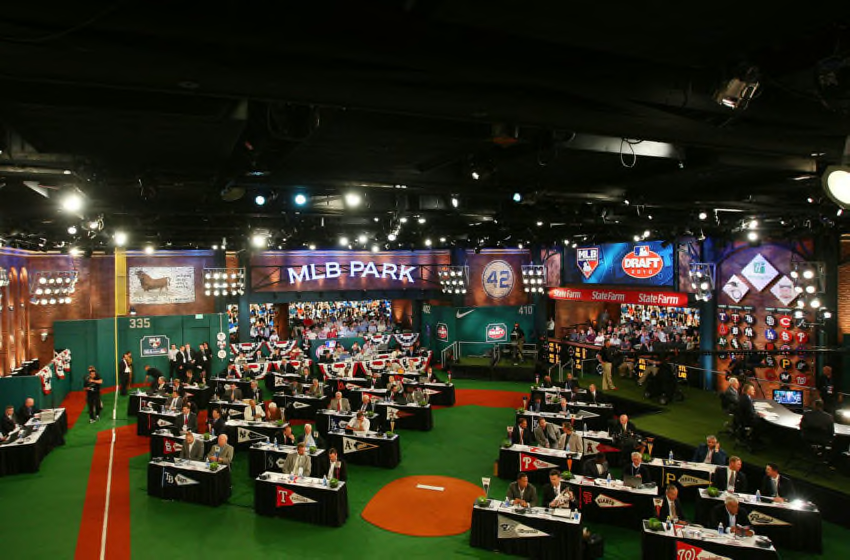
Chicago Cubs: Latest mock draft has puzzling first round pickRyan Sikeson April 29, 2020 at 1:00 pm

Read More

Chicago Cubs: Latest mock draft has puzzling first round pickRyan Sikeson April 29, 2020 at 1:00 pm Read More »

The Upright Citizens Brigade shutters its New York venuesJack Helbigon April 28, 2020 at 10:25 pm

Last week the folks at the Upright Citizens Brigade (UCB) sent out a letter announcing they were permanently closing their venues for both performances and classes in New York City. (This on top of announcing in March they were laying off all their employees at their theater spaces in NYC and LA, in response to the pandemic.) The letter was signed “Matt Besser, Amy Poehler, Ian Roberts, Matt Walsh, Founders of the Upright Citizens Brigade.”

I don’t know why, but this news hit me hard. Maybe it was the thought of all those theater people (in one count 160 employees) suddenly without work. Just another reminder of how many theater people are unemployed. (All of them. Well, almost all of them.) Or maybe it was just another reminder of how dire things are in the world of live entertainment.

How can you do a live show, if you can’t safely pack people together in a room to watch it? And even if you could adapt a theater space so everyone was spaced–at a minimum–six feet apart, would audiences show up? And could a theater survive on the meager box office returns?

Groups like UCB (improv-based comedy troupes that also taught improv classes) were always partly insulated from the vagaries of the box office, because so much of their revenue came from their classes, and from the ready-made audience of friends, family, and fellow students those classes generate once you put your students together into teams and have them compete against each other on stage.

The folks at UCB learned how to do this in Chicago, in our (until now) always crowded improv scene. At iO. At the Annoyance. At Second City.

But shelter in place and social distancing kicks that model in the ass. You can take your classes online. And I have heard of two improv-based theaters doing shows with performers who have quarantined together–Boom Chicago in Amsterdam and the Annoyance–but that does not seem like a viable model for all future live shows. And most of the games created by Viola Spolin that birthed modern improvisational theater are intended for intensely social situations where people are on stage, together, interacting at much closer range than six feet. Try playing freeze while also respecting social distancing.

I have to admit, though, that the thing that shocked me the most about UCB was how big they had become in the years since they moved (with almost no fanfare) from Chicago to New York in 1996. I knew they had become a player in the comedy business. And I have gone to shows at UCB in NYC over the years. Still, I was surprised when the news of their closing prompted articles in not just the New York Daily News and New York magazine’s Vulture section but the New York Times, New Yorker, and the Hollywood Reporter.

I should not have been. Over the past two and half decades UCB became a rich source for talent, and many of the top comic actors on TV today have some connection to UCB: Aubrey Plaza, Ilana Glazer, Chris Gethard, Kate McKinnon, and of course Walsh and Poehler.

In a way the UCB had come to resemble the large organizations they used to make fun of when they were a scrappy troupe of unknowns in Chicago in the early 90s. Back then Besser used to describe the Upright Citizens Brigade as a dark corporation that secretly runs everything. “We are the invisible government,” he told me once, snickering.

They used to be the bad boys (and for a long time, like all improv in the early 90s, they were male dominated), the guys who sat in the back of the class and needled the teacher. They loved tweaking the noses of authority figures. And I loved them for that.

In 1994’s Conference on the Future of Happiness they faked a fight between Besser and an actor pretending to be Richard Christiansen, lead critic at the time at the Chicago Tribune. Besser ended up driving the faux Christiansen from the theater shouting “We don’t want critics. We don’t need your approval!”

UCB founding member Adam McKay once called Besser a “guerrilla ontologist,” a term coined by science fiction writer Robert Anton Wilson to describe people who deliberately undermine simpleminded, often manufactured consensus views of reality to reveal seamier, more complex truths. The UCB I covered in the 90s was all about guerrilla ontology.

Their 1992 show Virtual Reality was full of moments where they explored the concepts of reality, which is, as Luigi Pirandello revealed a hundred years ago, a very slippery thing in theater. At one point in the show the actors led the audience out of the theater for a “virtual street demonstration,” a demonstration that actually blocked traffic on North Avenue and resulted in the very real (unplanned) arrest of cast member Horatio Sanz, who stayed in character throughout the arrest. Sanz ended up spending the night in jail; his father picked him up in the morning.

As I write this, I realize these are the kind of minor rebellions you can indulge in when you are young and broke–and struggling to get noticed. But the world is different when you become an institution. It also looks different when the world you have thrived in suddenly stops working–literally and figuratively.

It is easy to call for disruption when you have no stake in the status quo. But what do you do when the disruption comes and you don’t want it because you have something to lose? What do you do when reality itself undermines the consensus reality?

I spoke with Besser last week and he seemed to lament how big and corporate UCB had become. That desire for the founders of UCB to recapture what they had in the past is reflected in the open letter they sent last week; “paring down to the size we were when we started is our best chance for survival.”

Survival.

Those are the stakes. For UCB. And probably for most people involved in live theater. Which is the final reason UCB’s news hit me hard. If they can’t keep it going, who can? On the other hand, if they do find a way to survive the current crisis, others can as well. UCB has said they will host shows at another venue in New York and rent space for classes once it’s safe to do so.

The Hollywood Reporter interview ends on the following hopeful note from Walsh: “We’ve lost our venues multiple times. We’re scrappy. So, god willing, we’ll survive this as well. Hang in there with us as we figure this out, please.” v


Read More

The Upright Citizens Brigade shutters its New York venuesJack Helbigon April 28, 2020 at 10:25 pm Read More »