Videos

Mother’s Day as a foster mama gets complicatedBrittany Keepermanon May 16, 2020 at 2:45 am

Motherhood in the Middle

Mother’s Day as a foster mama gets complicated

Read More

Mother’s Day as a foster mama gets complicatedBrittany Keepermanon May 16, 2020 at 2:45 am Read More »

When family isn’t forever as a foster parentBrittany Keepermanon May 16, 2020 at 2:50 am

Motherhood in the Middle

When family isn’t forever as a foster parent

Read More

When family isn’t forever as a foster parentBrittany Keepermanon May 16, 2020 at 2:50 am Read More »

Reunification hits homeBrittany Keepermanon May 16, 2020 at 3:00 am

Motherhood in the Middle

Reunification hits home

Read More

Reunification hits homeBrittany Keepermanon May 16, 2020 at 3:00 am Read More »

Musical time traveler Paul Burch creates vivid, impressionistic stories on Light SensitiveMark Guarinoon May 15, 2020 at 3:54 pm

Paul Burch is a musical time traveler: four years ago he released Meridian Rising, a pristine concept album in the voice of Jimmie Rodgers, the greatest pop star of the Great Depression era. The choice made sense, since Burch likewise is an expert stylist who meshes past popular genres but always manages to sound like himself–he can even stand out when working with artists who are distinctive in their own right, such as art-country collective Lambchop and Chicago country-punks the Waco Brothers. On his own, Burch is more refined; think of him as Nashville’s answer to Nick Lowe or Joe Henry. On the new Light Sensitive, he’s surrounded by a group of tasteful players, including multi-instrumentalist Fats Kaplin, slide guitarist Luther Dickinson, and upright bassist Dennis Crouch. They swirl textures together with the deft touch of jazz musicians, moving the music into intimate spaces that are both nocturnal and joyful. There’s hardly a pre-Beatles rock genre that Burch doesn’t touch: the album includes an early rock ‘n’ roll shuffle (“Boogie Back”), a country-pop tune (“The Tell”), a twinkly instrumental (“Glider”), and a bluesy number (“You Must Love Someone”) that sounds like it could be an unearthed Rodgers B side. Musically, these songs are impressionistic memories of another time, but they’re alluring in large part thanks to their present-tense storytelling. Burch sings, croons, and yelps in the voices of different characters: exotic party hosts, jet-era travelers, Mardi Gras revelers in small-town Alabama, even a bookshop customer who discovers his fortune told in the pages of a “book of dreams.” The spark for Light Sensitive was an arts commission Burch received to musically document the life of southern raconteur Eugene Walter, whose resume includes cofounding The Paris Review and serving as a translator for Federico Fellini–but you don’t need to know the details to enjoy the songs. What resonates from Walter’s life is the flamboyant fun Burch is clearly having with songs that skip across genres and geographies. Throughout “On My Flight to Spain,” a tremolo guitar cuts between verses of a lonely traveler imaging himself cast in Hemingway’s life–and though the plane hasn’t landed by the song’s end, we’re still enjoying the view. v

Read More

Musical time traveler Paul Burch creates vivid, impressionistic stories on Light SensitiveMark Guarinoon May 15, 2020 at 3:54 pm Read More »

Buscabulla’s tropical soul vignettes distill the mixed blessings of returning homeCatalina Maria Johnsonon May 15, 2020 at 4:00 pm

In the wake of Hurricane Maria, at least 130,000 people left Puerto Rico to live elsewhere. Yet in February 2018, Puerto Rican musicians Raquel Berrios and Luis Alfredo del Valle, aka experimental dream-pop duo Buscabulla (“Troublemaker” in English), returned to the island after nearly a decade in New York City. During those years, they’d become known for their music, which layers minimalist, electro-tropical grooves with high-pitched, ethereal vocals, but despite this success Berrios felt “incomplete” in New York. “Puerto Rico has something–and you probably know it if you know a Puerto Rican–there’s something about this island that really calls you,” she told NPR earlier this month. After two acclaimed EPs, this month Buscabulla released their debut full-length album, Regresa (Ribbon), whose bold sonic palette feels like it developed its fullness while ripening in the sun. Berrios’s vocals remain front and center, but the music is less dreamy and more vivid–it blends strange, abstract fragments of Puerto Rican rhythms into a mix of tropical-tinged retro R&B and soul. The drums on “Vamono” take cues from Puerto Rican marching bands and various colorful festival sounds, while the romantic, plaintive bolero “Club Tu y Yo” features orchestral arrangements (courtesy of Helado Negro) that enhance a sense of isolation. Buscabulla’s island perspective also adds political double entendres to their lyrics: “Mio,” which lays Berrios’s croon against slinky smooth bass, seems at first to be about possessing a lover, but on closer listen it’s a critique of wealthy tourists who lay claim to what isn’t theirs to have. “Manda Fuego” comments on the rise of religious fanaticism on the island with a brief recording of a preacher warning of impending suffering, but with its soulful grooves and ambiguous lyrics, it could also foretell a night of fiery passion. By juxtaposing such disparate emotions, Regresa offers sophisticated reflections on anxiety, estrangement, and returning home–in this case, a home that differs greatly from the idealized vision that del Valle and Berrios imagined while they were in the diaspora. But the promise of better times shines on “Nydia,” a tribute to New York-born Puerto Rican actress and singer Nydia Caro, who moved to Puerto Rico at 19. Caro makes a guest appearance on the gently funky tune, and as it turns increasingly upbeat, she prophesies that light will appear in the greatest darkness: “Tu no puedes ver las estrellas,” she sings, “Si tu no tienes una noche oscura” (“There is no way you can see the stars / If you don’t have a dark night”). v

Read More

Buscabulla’s tropical soul vignettes distill the mixed blessings of returning homeCatalina Maria Johnsonon May 15, 2020 at 4:00 pm Read More »

Chicago’s Dark Fog offers trippy escapism on two new EPsMonica Kendrickon May 15, 2020 at 4:30 pm

When I wrote about prolific Chicago three-piece Dark Fog last winter, the trippy psych voyagers were releasing three albums within a three-month span. It’s nice to know that, even in these uncertain times, some things you can still rely on: Dark Fog dropped the EP Escape Into This on April 6 and followed it up with Escape Into This 2 on April 20 (as if there were ever a chance they’d let that date go by). Both releases arrived just a couple months after February’s Psychedelic Landscape, which closes with the masterpiece “D.T. Suzuki’s Bathrobe.” The band’s founder, vocalist and guitarist Raymond James Donato, recently told me that he created both Escape records out of material from his extensive collection of archival Dark Fog tapes. Before the Illinois shelter-in-place order went into effect, Donato, drummer Yt Robinson, and bassist Drew Kettering were in the habit of recording every rehearsal and jam session, which is most likely the key to their prolificacy. Donato built these lush tunes by layering extra guitar and effects onto previously recorded songs “in a haze of THC and pandemic freak-out.” He captured each new addition in one take, creating something as close to the Dark Fog live sound as we’re likely to get during social isolation. The first record consists of four tracks, though the mirror-image titles of “The Fantasy Driver” and “Revird Ysatnaf Eht” indicate that they’re plants grown from the same root. Psychedelia is what happens when the mind’s inner space becomes vast enough to overwhelm physical reality, and these records feel like a beautiful snapshot of the isolated consciousness. Gritty, clicking loops evoke claustrophobia, which prompts the listener’s mind to react like a caged wild animal, releasing adrenaline in a desperate attempt to break free. And Donato’s frenzied, ululating guitars are like rocket fuel for the spirit, powering it up to levitate right out of your body. On the fizzing “Dnim Ruoy Daer” and the fey “In Golden Curtain’s Yellow,” the two-song punch that wraps up Escape Into This, astral projection reaches full fruition with futuristic grandeur. Escape Into This 2 continues in a similar vein, with shorter cuts and a slightly more turbulent sensibility–even when the vocals are soothing, as on “In Dove Daze,” the spiky, processed-through-a-black-hole guitars ripple with unease. On “Lick Celestial,” a rhythm slightly reminiscent of “Misty Mountain Hop” provides a heartbeat under a plasma shimmer that keeps threatening to explode but never quite hits the breaking point. Both albums are available digitally on Bandcamp as pay-what-you-can lockdown offerings, and Donato says that they’ll be released on vinyl this summer. v

Read More

Chicago’s Dark Fog offers trippy escapism on two new EPsMonica Kendrickon May 15, 2020 at 4:30 pm Read More »

Bob Watson, All-Star slugger and baseball executive, dies at 74Associated Presson May 15, 2020 at 2:22 pm

Bob Watson, an All-Star slugger who became the first black general manager to win a World Series with the New York Yankees in 1996, has died. He was 74.

The Houston Astros, for whom Watson played his first 14 seasons in a baseball career spanning six decades, announced his death Thursday night. The team didn’t provide details, but son Keith wrote on Twitter that he died in Houston from kidney disease.

“He was an All-Star on the field and a true pioneer off of it, admired and respected by everyone he played with or worked alongside,” the Astros said in a statement. “Bob will be missed, but not forgotten.”

Watson, nicknamed “The Bull,” made the All-Star team in 1973 and 1975, hit over .300 four times and drove in at least 100 runs twice while hitting in the middle of the Astros’ lineup. He also holds the distinction of scoring the 1 millionth run in major league history — on May 4, 1975, against the San Francisco Giants at Candlestick Park.

Commissioner Rob Manfred lauded Watson as a “highly accomplished figure” and “deeply respected colleague.” He also praised his work with the Baseball Assistance Team, which assists those in baseball who are in need.

“I will always remember the outstanding example that Bob set for others,” Manfred said in a statement Friday.

Watson also became a big hit off the field for his cameo, along with several Astros teammates, in the 1977 comedy film “The Bad News Bears in Breaking Training.” In a key scene, Watson delivered the memorable line: “Hey, c’mon, let the kids play!”

He also played for Boston (1979), the Yankees (1980-82) and Atlanta Braves (1982-84), finishing with a .295 career batting average with 184 home runs, 989 RBIs and 1,826 runs scored while primarily playing first base and left field. Watson also hit .371 in 17 career postseason games. He was the first player to hit for the cycle in both leagues — for Houston in 1977 and Boston two years later.

After retiring as a player, Watson began coaching and helped the 1988 Oakland Athletics win the American League pennant as the hitting coach for the likes of Jose Canseco and Mark McGwire.

He became the second black general manager in major league history — after Atlanta’s Bill Lucas (1976-79) — when he was hired by the Astros in 1993.

Watson was hired as the Yankees’ GM in 1995, and made the then-highly criticized decision to hire Joe Torre as New York’s manager. Watson, along with Torre leading the team on the field, helped put together the World Series-winning squad in 1996.

He retired from the Yankees after the 1997 season, and Brian Cashman replaced him as New York’s GM. Watson later served as Major League Baseball’s vice president in charge of discipline and vice president of rules and on-field operations and worked in the league offices until 2010.

The Astros honored Watson in March by dedicating the Bob Watson Education Center at the Astros Youth Academy in Houston with the former All-Star in attendance.

Watson overcame prostate cancer after being diagnosed in 1994 and became an advocate for awareness and early detection. He often spoke at conferences and seminars about his experience, which he discussed in his 1997 book, “Survive To Win.” He dealt with other health problems in recent years.

“I know that my dad has accomplished more than even he ever thought he would accomplish in life,” Keith Watson told Houston TV station Fox 26. “The legacy that he has left behind for us is one of giving, one of sharing, one of winning, and he doesn’t leave here not having done everything that he set out to accomplish in his life.”

Watson is also survived by his wife, Carol, and daughter Kelley.

Read More

Bob Watson, All-Star slugger and baseball executive, dies at 74Associated Presson May 15, 2020 at 2:22 pm Read More »

Chicago Bears: How Matt Nagy failed Andy ReidFrank Grizzlyon May 15, 2020 at 11:00 am

Read More

Chicago Bears: How Matt Nagy failed Andy ReidFrank Grizzlyon May 15, 2020 at 11:00 am Read More »

Chicago Blackhawks: Is “One Goal” a thing of the past?Vincent Pariseon May 15, 2020 at 12:00 pm

Read More

Chicago Blackhawks: Is “One Goal” a thing of the past?Vincent Pariseon May 15, 2020 at 12:00 pm Read More »

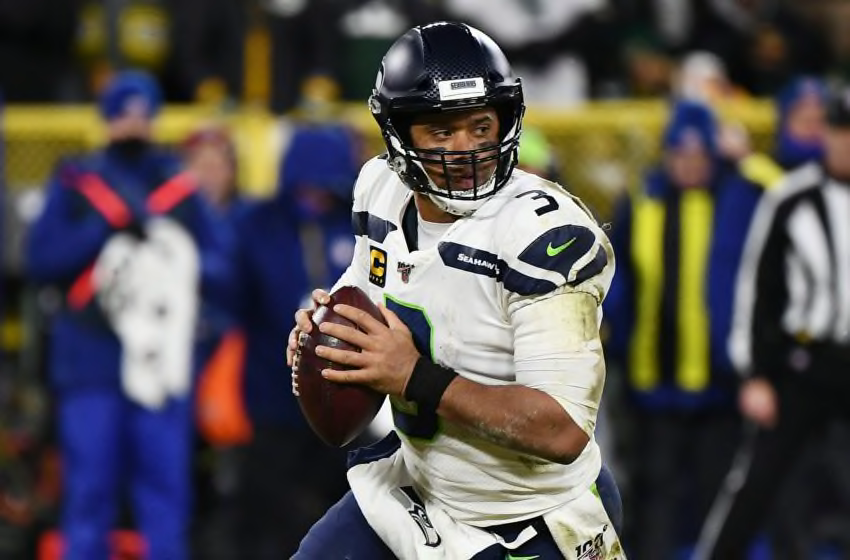
Chicago Bears Rumors: Russell Wilson an eventual trade candidateRyan Heckmanon May 15, 2020 at 1:21 pm

Read More

Chicago Bears Rumors: Russell Wilson an eventual trade candidateRyan Heckmanon May 15, 2020 at 1:21 pm Read More »