Hyde Park Cats is a local, all-volunteer group dedicated to helping stray and homeless cats in and around Chicago’s Hyde Park. We received our 501(c)(3) status in 2014 and have had over 1,200 adoptions since our founding in 2008. See all our adoptable kitties on our webpage: http://hydeparkcats.org/adopt/
All of our cats are in loving foster homes, which means the cat you adopt will be familiar with the sounds, smells, and movements of life in a home and accustomed to living with humans. He or she has been interacting on a daily basis with people who know this particular cat intimately, and the foster mom or dad can tell you all about the cat’s individual personality, habits, preferences. You can’t judge a cat by its cover! And while we can’t predict the future or know everything about a cat, we can help you choose the cat who is right for you. We have an adoption application and an adoption fee, $125 for the adoption of one cat, or $250 for a pair. This fee goes towards covering their vet costs. All cats adopted out by us are neutered/spayed, micro-chipped, tested for FIV/FeLV, and treated with Revolution.
Orange “purr machine” Papas Guero and tortie “lap warmer” Nena are about 11 yo and have been together since they were few weeks old. They are looking for a new home!
They are very friendly and love to play with wands and laser pointer. They are fine with dogs.
Papas Guero is diabetic – he gets fed twice a day with an injection of insulin with each meal.
Hyde Park Cats is a local, all-volunteer group dedicated to helping stray and homeless cats in and around Chicago’s Hyde Park. We received our 501(c)(3) status in 2014 and have had over 1,200 adoptions since our founding in 2008. See all our adoptable kitties on our webpage: http://hydeparkcats.org/adopt/
All of our cats are in loving foster homes, which means the cat you adopt will be familiar with the sounds, smells, and movements of life in a home and accustomed to living with humans. He or she has been interacting on a daily basis with people who know this particular cat intimately, and the foster mom or dad can tell you all about the cat’s individual personality, habits, preferences. You can’t judge a cat by its cover! And while we can’t predict the future or know everything about a cat, we can help you choose the cat who is right for you. We have an adoption application and an adoption fee, $125 for the adoption of one cat, or $250 for a pair. This fee goes towards covering their vet costs. All cats adopted out by us are neutered/spayed, micro-chipped, tested for FIV/FeLV, and treated with Revolution.
Mona is a sweet, curious, gentle little cat who loves to play.
She eats well, enjoys playing with the resident cat, and has adapted well to her newest apartment.
Although hand shy, she has started to rub herself on her caretakers occasionally and enjoys being near people. She is however more of a companion cat, as in she is less keen on people but really likes other cats!
She’s very tiny and pretty. Her favourite hobbies are climbing things, chasing paper balls, scratching, and playing with just about any toy that dangles from a stick. Mona is middle aged (between 3-7 years old).
Hyde Park Cats is a local, all-volunteer group dedicated to helping stray and homeless cats in and around Chicago’s Hyde Park. We received our 501(c)(3) status in 2014 and have had over 1,200 adoptions since our founding in 2008. See all our adoptable kitties on our webpage: http://hydeparkcats.org/adopt/
All of our cats are in loving foster homes, which means the cat you adopt will be familiar with the sounds, smells, and movements of life in a home and accustomed to living with humans. He or she has been interacting on a daily basis with people who know this particular cat intimately, and the foster mom or dad can tell you all about the cat’s individual personality, habits, preferences. You can’t judge a cat by its cover! And while we can’t predict the future or know everything about a cat, we can help you choose the cat who is right for you. We have an adoption application and an adoption fee, $125 for the adoption of one cat, or $250 for a pair. This fee goes towards covering their vet costs. All cats adopted out by us are neutered/spayed, micro-chipped, tested for FIV/FeLV, and treated with Revolution.
Paul Farahvar is a catch. But good luck catching him! This accomplished comedian and attorney in his forties will not be walking down the aisle anytime soon and maybe never. But dating is another story. He has cornered the market on funny, honest relationship tales in his podcast Singles Only. He also uplifts hearts and minds with the shows he created and hosts at Laugh Factory: Drink, Date, Laugh and Everyone’s A Lawyer and his live Instagram show Stuck with Paul.
In all these venues, digital and live, he’s an inspiring interviewer, revealing stories that are legendary, insightful, funny, and inspiring from the resilient, the spurned, the adamantly single, the divorced, the dumpers and dumpees, and from the phoenixes risen from the ashes of romantic catastrophe to thrive another day. On Singles Only, Paul includes a “Voice of Reason,” usually a married comedian who argues the other side.
Shedding light on love’s perils and pitfalls is only part of this intriguing comedian’s material. His parents immigrated to the United States from Iran in the 1970s. In his stand-up, Paul says, “I talk about [my family background] onstage nearly as much as being single.” As he says, he’s “leaned in” to his Iranian heritage even with right-wing red-hatted audience members in the front row.
Paul Farahvar
Paul was named one of “Top 40 Up and Coming Comedians in America” and was one of “Top 40 under 40” lawyers in Chicago. When the COVID shutdown began, he was quick to support Chicago’s hard-hit comedy community with funds and pro bono legal counsel. The pandemic forced him to postpone his long planned stand-up tour and raised the question of what to do with all the merch he hoped to sell along the way. He is still selling it, but now all proceeds go to Chicago comedy club staff and comedians in need.
Paul kindly spoke with me by phone about making the leap from court to comedy club, the beauty of Baha’i, and some personal insights into life, dating and marriage. (Don’t tell my husband about Paul’s seven-year free agent theory!)
FAMILY
Teme: I love hearing about your family’s roots in Iran, a place I’ve always wanted to go. When did your family arrive here?
Paul: My parents moved to the United States in 1970, way before I was around. My dad had a [medical] residency here. They were thinking of going back, but then the Iranian revolution happened in 1979. My parents aren’t Muslim, and there’s no religious tolerance in Iran, so they could not go back. My dad is Jewish and my mom is Baha’i, both persecuted pretty heavily in Iran.
Teme: Do you ever go to the Baha’i Temple in Wilmette?
Paul: I do. It’s one of the seven wonders of Chicago. When people come to Chicago, right after I talk about Portillo’s, the next place I tell them is the Baha’i Temple which I think is beautiful. It’s just a peaceful place. It’s open late, too, and you can walk around at midnight.
When we were kids, my parents let us find our own faith, so we did a little of everything. The great thing about the Baha’i religion, is they believe in inter-faith marriage and all the prophets. My parents let my older brother and me go to the Temple for classes. I don’t practice it, unfortunately, but I do think there are a lot of cool things and the Temple is amazing. I love showing it off to people. The Baha’i Temple was a big part of why my parents moved to Chicago. We moved to Chicago, actually Lincolnwood first. I remember when I was a kid they were thinking about moving up to Wilmette to be near it.
TATTOOS
Teme: I’ve noticed the tattoo on your arm. What does it say?
Paul: All my tattoos are a symbol of a memory for me. I have a microphone on my right arm. My goal when I started comedy was to perform at The Laugh Factory in Hollywood. When I became a regular at Laugh Factory, including Hollywood, I got the tattoo. On my other arm I have “esquire” because I used to be a lawyer. After I had tried twenty jury trials in the federal and state court, I got a tattoo to remind me that I was a lawyer.
Most recently I got a tattoo across my arm that says, “Nobody else can live the life you live,” which is a Mr. Rogers quote. I’m fascinated by Fred Rogers. Any time a book comes out about him I have to read it. He restores faith in humanity every time you’re down.
On my lower back I have shoe prints. I used to manage and play in bands. My music company was called Shoeshine Boy Productions. I got a shoe print every time one of my bands got signed to a label. I was going to have them go up my back, but after two, I was like, “I should probably stop this.”
My last name is Zoroastrian, an ancient Persian religion, and means “eternal life,” essentially, “winged man.” So I got that tattoo on my upper back as soon as I found out what my last name meant. I was in my early 30s when I found out what my last name meant and then I got a tattoo, that’s how smart I am.
COMEDY AND CULTURE
Teme: One of the things I loved learning about Iran is that the history of spirituality there is extraordinary.
Paul: The culture influences me significantly. If you look up the stats, we’re one of the most educated immigrant groups contributing to the economy and holding “essential jobs,” and yet the administration would impose this travel ban. I know a lot of people, family friends who are doctors, who are medical students, who have been American citizens for years that were affected by that ban and it was really sad.
Teme: How would you say the culture has influenced you?
Paul: When the travel ban happened or when anything happens in Iran, I lean into it onstage. There’s a lot of misinformation. I’ve been in towns where I’m the first Middle Eastern person they’ve seen. So I try to waive the flag in a white flag-ish sort of way to say, “Hey, there’s no need to freak out.” I have had experiences where people are scared. I was in Reno, Nevada doing shows when the Trump administration shot and killed the Iranian general earlier this year.
I would start, “Hey, so I’m from Iran” and watch the crowd react. A couple times there were people in the front row wearing Trump hats. I didn’t make eye contact with them because I was actually a little scared, but after the show they all bought my shirt.
COURT TO COMEDY
Teme: How did you decide to stop being a lawyer and become a comedian full-time?
Paul: I had done everything I wanted to do with law. I tried cases. I was a partner at a law firm. Then I had my own firm. I was getting more work as a stand-up comic and I felt that I wanted to take a chance and go at it full-time. I had my own firm until right before COVID. So I stopped taking new clients and I just started working full-time as a comic. I had accomplished what I wanted to in law and I got burnt out. Comedy gave me a creative outlet and I got to make connections with people on a nightly basis. It was where my heart was.
Teme: Is there anything you’ll miss or won’t miss about law?
Paul: I won’t miss waking up early. I’m not a morning person. I hated court in the morning. If court were always in the afternoon, I probably wouldn’t have minded law as much. I won’t miss the lawyers that made the job harder than it was. There are a lot of great lawyers and I always gave people the benefit of the doubt, but once a lawyer did something shady or to screw me in court, then it was over. I won’t miss that.
I will miss going to court. I loved trying cases. I loved defending my clients and I’m a big advocate of justice. I will still get involved in things as a lawyer if need be. I definitely help my friends with their cases and encourage people to message me or call me if they have legal questions. I still love the law, but I love comedy, too.
Teme: Did you ever have a chance to make a joke in court?
Paul: I did. I always tried to get the jury on my side with being lighthearted. I did civil litigation, but we had serious issues. If there were just judges and lawyers, I would try to make the judge laugh or make the jury laugh with me. But it’s hard because they’re not happy people. Juries aren’t happy to be there and judges aren’t happy.
Sometimes I’d be self-deprecating. I was always late if there was an early morning call. A lot of judges knew that I did shows late at night, and so a 9:00 or an 8:30 call was always hard for me. So I would make jokes about being late like, “Hey, can we make this a 10:00 next time?”
AN INVITATION FROM BOB SAGET
Teme: I read that you started out in improv. How did you move to stand-up?
Paul: I never thought I would make a career in comedy. I was just taking improv classes for fun. I thought it would make me a better lawyer and it was a fun way to meet people. My coach at Second City, Kate Duffy, took me and a couple other people aside, and said, “I hope you keep doing this because you guys are good.” That encouragement was all we needed.
Then I had a friend who was opening for Bob Saget at a sold out casino show. I went backstage with him as his manager, just to keep him comfortable and then my friend was too nervous to talk to Bob Saget. So I was talking to Bob and I started telling him something, and then he just looked at me and goes, “Is this a bit? Are you doing this tonight?” And I said, “Oh, no. I’m not the comedian, I’m just a friend of his.” And he goes, “Do you want to go up and do some time?”
I was like, “No! I’ve never done standup before. I’m just goofing around here.” Everyone in the room was saying, “Just go up and do a couple of minutes!” And I was like, “I’ve never done stand-up. I’m not going up for the first time at a sold out show!” I don’t know if they were serious or not. I didn’t go up, but the next day I went to an open mic and tried that same bit and I had a blast, and I thought, “This is what I want to do.”
“SINGLES ONLY” BEGINS!
Teme: Of course I want to ask you about Singles Only! What inspired the podcast?
Paul: Jamie Masada, the owner of Laugh Factory, gave me my own show called Singles Only where we had single comics. The people in the crowd were single and we did interactive stuff and games. I love interactive stuff and I love competition where people come onstage at the end to compete. That show became Drink, Date, Laugh and it’s open to everybody.
The podcast initially was a way to promote the show. I ended up liking the podcast so much that it became its own animal. I’m talking to everybody about dating, being single, their goals, their journey and why they’re single.
Because I’m single, I leaned into that aspect of my life thinking, “I’m an aging single person. Should I get married? I think marriage is an outdated institution. Show me that I’m wrong.” I thought [my guests] can help me figure out where I am. Over 200 episodes I’ve learned from my guests what I want in a relationship and why I’m single, and it’s been fun hearing everyone else’s story.
THE LIFE-CHANGING WISDOM OF “SINGLES ONLY”
Teme: What did you learn from the folks you’ve interviewed?
Paul: Initially, the podcast was supposed to be lighthearted, but some of the episodes become really heartfelt. We’ve had people come on after a bad breakup and people who have reinvented themselves after divorce.
I’ve learned that personal growth is important to people. I’ve learned when I’m dating not to waste people’s time. I learned something from Jim Cornelison that I incorporate in my dating life to this day: if people want to get married and have kids, and they’re in their thirties and they haven’t had kids, he doesn’t date them. I do that now, too. I don’t want to waste anyone’s time because I don’t think I am going to have kids and I don’t think I am going to get married. Sometimes when I say that, people say, “Oh, you’re going to change your mind,” but here I am in my early forties and I haven’t changed my mind.
My friends who are married say, “If you don’t want to have kids, don’t get married. It’s a lot of work.” I didn’t know if I wanted to have kids until my brother had kids and I became an uncle. I was like, “I love being an uncle, but I love leaving when I want to go.” I don’t have any responsibility. I love that aspect of it. Once I knew that, it changed my outlook on whether I would ever get married.
I tend to date women who have kids already, who are divorced and share my outlook. A lot of people who have been divorced say they’re never getting married again. It’s becoming a more popular cult-like opinion. I’m trying to make the podcast eventually into a cult. That’s the goal.
Teme: That would be a good cult! How do you choose your podcast guests?
Paul: I like to have different opinions and backgrounds, people who are interesting to me. Mostly comedians and musicians. I’ve had a few divorce lawyers and politicians. Renato Mariotti from WGN was a guest. I like to have athletes. Anyone that has a unique journey, whether they’ve always been single or they got divorced, or they’ve discovered something about themselves that makes them different.
Teme: What were some of your most memorable podcasts?
Paul: My favorite podcast was with Joe Kwaczala. He had such a funny story of a date gone wrong. It still hurts my face when I hear him tell stories about that. The one with Geoffrey Asmus was really funny. Joe McMahon, who’s now married. Jen Zanotti was a fun one, too. Her story was embracing and empowering. It’s not a funny one, but it’s one of my favorites because she talks about how her life changed after she got divorced and she lived her best life. She’s a Jiu Jitsu champion now, a passion she found after she got divorced. Now she’s in a successful relationship again. It’s a story for people who are in a marriage that’s not working and they’re afraid to leave. It’s empowering.
MARRIAGE IS SALAD: GET THE FRIES!
Teme: Congratulations on two hundred episodes of Singles Only! You’ve said that you were thinking of stopping at 200, but I’m happy you didn’t.
Paul: Thank you. I didn’t think I’d have 200 episodes, but here we are. Maybe we’ll get to 250 and then decide I’ll get married.
Teme: Is it a possibility?
Paul: I know this is an unpopular opinion. I just don’t think people want to get married anymore, it’s just something you end up doing because it’s the right thing to do.
It’s like when you go to a restaurant you want to get a steak or fries, or something big and greasy, and just eat gluttonously. But then you get the salad because you know it’s the right thing to do. Marriage is like a salad. It’s healthy and it’s a thing you should do every once in a while. You’re at Portillo’s, do you get the burger and fries or Italian beef, or do you just get a healthy salad? These are the decisions that I think people make when they’re in a relationship.
Teme: What inspired your seven-year marriage contract theory?
Paul: The “seven-year itch” is when a relationship hits its downturn. If marriage was a seven-year contract, then there would be less pressure on both people to decide. It’s like a contract in sports. When you’re up for your contract year, you’re either going to get in shape and have a great year, or you’re going to say, “I’m ready to go to a different team.”
Marriage was until “death do you part” when it was created, but at the time, people were living until they were 35 years-old but with science, people live long lives. You can’t expect people to stay with the same people for their whole life.
Watching my parents has shaped my opinion more than anything in life. They’ve been married for over fifty years and it’s been hard work. I know all fifty of those years were not happy, but now they have each other and there is something to be said about that. So I do see the other side.
COMEDIANS DATING COMEDIANS: GOOD IDEA OR DISASTER?
Teme: You say that dating other comedians is not a good idea. Why?
Paul: Oh, it’s the worst idea. They tell you not to shit where you work. You’re going to see and work with that person. Comedy adds another element because we’re kind of all damaged in some way. We’re sensitive and if [the relationship] goes wrong, it’s going to be twice as hard as if you were working at an accounting firm together.
Teme: Are some professionals better to date than others? Like are accountants better partners than lawyers?
Paul: Dating lawyers is the worst. Two lawyers do not work together especially if you’re both litigators. I’ve done that and that’s not healthy at all. The arguments were epic. I’ve dated lawyers in the past and that was bad.
Comedians are unique people. We have crazy hours. We’re emotionally unavailable and physically unavailable during normal hours. I always push comedians to date musicians or other people in the arts or service industry because they have similar hours. Or date someone comedy adjacent, like a stand-up comedian who dates an improv person. You’re not on the same path necessarily.
Teme: That makes a lot of sense; compatible but not on a crash course.
Paul: Right. But dating people that are 9:00 to 5:00 jobbers is hard. They don’t understand what we have to go through. It’s so important for us to go to a show even just for a five minute spot. You have to hang out at the clubs to get booked. People that have a 9:00 to 5:00 job don’t understand that or they say they do, but when you cancel a dinner date last minute because you got a last minute slot at Zanies, they don’t seem to understand as much.
It’s a hard situation to explain to people. I’ve dated people who have 9:00 to 5:00 jobs. I haven’t dated a musician, so I think that’s probably my next goal.
FORWARD FROM COVID
Teme: Has COVID impacted your perspective?
Paul: Definitely. It makes you think about what you want out of life. In terms of dating, I’ve taken a step back to think about who I want in my life, like people that are going to help you grow and not people with negative energy who are sucking energy out of you. In terms of dating, nothing has really changed in terms of me wanting to get married. It hasn’t made me want to get married. In fact, I think most people who are together during this time are going to evaluate their relationships significantly.
There are going to be a lot of breakups and divorces on the other side of COVID because you’re with people more often than you ever were in your life. Three months in COVID is like three years in dog years. If you can survive living with someone during COVID, I think you are made to be together.
Teme: So if you could go on any date with anyone, who would it be and where would you go?
Paul: My ideal date would be with Heather Graham. She’s my crush. We would go wherever she wants to go. I would take her to Chicago … maybe to Portillo’s and the Baha’i temple.
Stay up to date with Comedians Defying Gravity by typing your email address in the box and clicking the “create subscription” button. My list is completely spam, spam, spam, spam free, and you can opt out at any time.
I’ve been a comedy fan since age four when Moe Howard asked me, “What’s your name, lil’ goil?” Fortuitously somehow by way of Washington, D.C., Poughkeepsie and Jerusalem, I ended up in Chicago, the comedy Mecca of the world where comedians are kind enough to give me their time and where I was lucky enough to meet the great Dobie Maxwell who introduced me to the scene. You can reach me at: [email protected]. (Please remember the “w” there in the middle.)
I am often very reasonably asked, “How DO you pronounce that?” The spelling is Teme, but it’s pronounced Temmy.
Coronavirus. We’re over it, right? Quarantine fatigue. It’s happening to you, it’s happening to me, and it’s happening to our dogs. Just kidding, the dogs LOVE quarantine!
Those of us who have been cooped up since mid-March are starting to get the appeal of the neighbors down the block who’ve refused to wear masks this entire time – it sucks. I get it now. Nearly 100 days of staying strong has brought us to the brink.
Don’t get me wrong, I’m still freaked out enough that I’m not rushing out to the closest restaurant patio and I’m not going shopping or meeting friends for coffee just yet. We’re still in a pandemic. But I’m getting really, really sick and tired of some of the things the new normal has forced upon us.
Take Zoom for example. Connecting with humans right now is, like, really hard. The progression of Zoom as a staple of daily American life, both work and personal, has moved along at lightning speed. At first, it was weird – wait, I have to show my coworkers what I look like when I work from home? A couple months later and I’ve lost all confidence in my jokes. That 1-2 seconds before other people recognize that what you said is kind of funny can be a deafening silence.
Needless to say, we, as a society, got over those Zoom hurdles (Zurdles?) and all of the sudden your friends and family were scheduling Zoom happy hours left and right (yes, I’m guilty). But as the weeks have dredged on, the topics of conversation have changed. It used to be fun to catch up with colleagues, friends and family. But we’re running out of stories about how crazy things are, and for some of us, we’re running out of positivity.
I know what I’m sick of (in-home yoga classes and my quarantine hair that’s now down to my waist, yuck!), but I was curious to know what normal people are griping about these days. Naturally, I turned to Facebook to get some input from my network and my favorite pandemic parenting group (shout out to 50k amazing moms and dads!), to see what people are really, genuinely just OVER. Some of the top responses were surprising, but the recurring theme was all about not being able to do the things we want to do, or not feeling safe doing so. No surprise there.
Here are the top 7:
1. People not taking it seriously: I was pretty surprised that this was the top response! If anything, based on my own neighborhood, I would think most people are on the opposite end of the spectrum, ready to loosen up and return to some form of normal life. But I guess that doesn’t account for all the people staying in their homes and watching the same episode of Mother Goose Club with their toddler for the gazillionth time.
2. Not being able to see loved ones: This is a toughie, and the #1 over-it item for my family for sure. From faraway parents/grandparents to friends with new babies, I definitely get it. Zoom calls just aren’t cutting it anymore.
3. Lack of social interaction: This goes for both kiddos and adults, but there were a lot of comments from parents about how tough it is to watch their kids play alone all the time. I know what that’s like – my daughter much prefers singing and dancing alongside her old daycare pals over listening to Mom try and do her best rendition of “Let it Go.” Again.
4. Masks: I know, they’re annoying. Especially now that summer is really upon us in Chicago. I LOL’d reading some of the comments that just said “Masks.” No explanation needed. I know they give you chin acne, but they’re also minimal effort with a potentially high reward. So just wear one when you’re supposed to. Or as my dad would say, where the (expletive) mask!
5. Confusion about the rules: Speaking of masks, remember when leading health organizations told us we didn’t need to wear them? The lack of cohesive guidance on so many levels has been nothing if not frustrating. Now that a lot of businesses are back open, it’s hard to keep track of the new protocols that sometimes vary shop to shop. Definitely a lot of frustration here.
6. No hugs allowed: Even when we can see our loved ones, we’re supposed to try and stay six feet apart. This is just sad! When the pandemic really started to pick up steam, I never really thought about hugs as something I’d long for. But when I saw my BFF and her newborn (from the street), it was so hard not to run up and give her a big hug and smell that baby’s head! The “hugs” emoji via text can only get you so far.
7. Monotony of it all: Normal life can already be pretty monotonous. Add restrictions (and take away hugs) and people are bound to get antsy. One commenter said she’s sick of Netflix. Is this what it’s come to? When a Netflix binge can’t solve our problems, what has the world come to?
While much of the country has opened up at least a bit, my unscientific Facebook survey tells me that a lot of people are still at home, especially those of us with kids. Breaking quarantine with a friend meet-up or a restaurant patio meal is a weird luxury that many of us are just not used to yet.
When I initially posted the question, “what are you most sick of,” my first commenter summed it up pretty perfectly: “All of it.” Yeah, we’re sick of it. All of it. And it can be therapeutic to air grievances and complain alongside your fellow humans. But don’t forget that 2020 doesn’t have to be all bad. Let’s try to stick together – whether that’s in commiseration or coming up with the bright side of things. We need to do both at a time like this.
Thank you to all the lovelies who shared comments! If you have one to share, feel free DM me on Instagram @aspiringdancemom.
In the news:Book recommendation of the week comes from AfriWare Books: Black Wall Street: From Riot to Renaissance in Tulsa’s Historic Greenwood District by Hannibal B. Johnson. Order the book here.
During the month of June, Unabridged Books will donate 10% of its sales to the Equal Justice Initiative founded by Bryan Stephenson (Just Mercy). Plus, “Unabridged Bookstore commits to a yearlong effort of promoting and supporting the work of activists and organizations engaged in the fight against systemic racism, social injustice, sexism, homophobia, and transphobia.”
American Writers Museum invites you to join a virtual tour of its Frederick Douglass exhibit here.
Women and Children First’s Pride Reading List is here.
Following are Chicago book events (and a few more) that you can enjoy at home. Most are free, but some may require registration or purchase.
MONDAY, JUNE 15
Unorthodox 10 a.m. Author Deborah Feldman will discuss the Netflix series based on her book with Shira Haas who plays the lead role. Moderated by Abigail Pogrebin. Temple Emanu-El Streicker Center.
The Glass Hotel 6:30 p.m. Author Emily St. John Mandel in conversation with Alice Moody. The Book Stall.
TUESDAY, JUNE 16
Antiracist Baby 6:00 p.m. Author Ibram X. Kendi and illustrator Ashley Lukashevsky discuss their new board book. Politics & Prose.
America’s Best Baseball Writing 6:30 p.m. A discussion with writers Joe Bonomo and Rick Telander for fans looking forward to the season whenever it begins. American Writers Museum.
What We Inherit 6:30 p.m. A virtual reading with author Jessica Pearce Rotondi in conversation with Sarah Blakley-Cartwright. City Lit.
Big Ideas presents PRIDE 7:00 p.m. “Authors Alicia Garza (The Purpose of Power), John deBary (Drink What You Want), R. Eric Thomas (Here For It), Jesse Szewczyk (Tasty Pride), and Nico Tortorella (Space Between), and Arlan Hamilton (It’s About Damn Time) share stories and readings about what Pride means to them. Moderated by Will Lanier, executive director of the OUT Foundation.” Random House.
WEDNESDAY, JUNE 17
The Mothers 6:30 p.m. City Lit’s Online Book Club discusses this bestselling book by Brit Bennett.
THURSDAY, JUNE 18
Pop Goddesses 6:30 p.m. A virtual reading with author Jennifer Keishin Armstrong and Britt Julious. City Lit.
Pain Studies 7:00 p.m. Author Lisa Olstein in conversation with Eula Biss. Pain Studies is inspired by Lisa Olstein’s lifelong battle with migraines. Women & Children First.
Friend 2:00 p.m. Translator Immanuel Kim and novelist Patricia Park discuss this novel by Paek Nam-nyong, one of North Korea’s best selling authors. Politics & Prose.
I’ve been a comedy fan since age four when Moe Howard asked me, “What’s your name, lil’ goil?” Fortuitously somehow by way of Washington, D.C., Poughkeepsie and Jerusalem, I ended up in Chicago, the comedy Mecca of the world where comedians are kind enough to give me their time and where I was lucky enough to meet the great Dobie Maxwell who introduced me to the scene. You can reach me at: [email protected]. (Please remember the “w” there in the middle.)
I am often very reasonably asked, “How DO you pronounce that?” The spelling is Teme, but it’s pronounced Temmy.
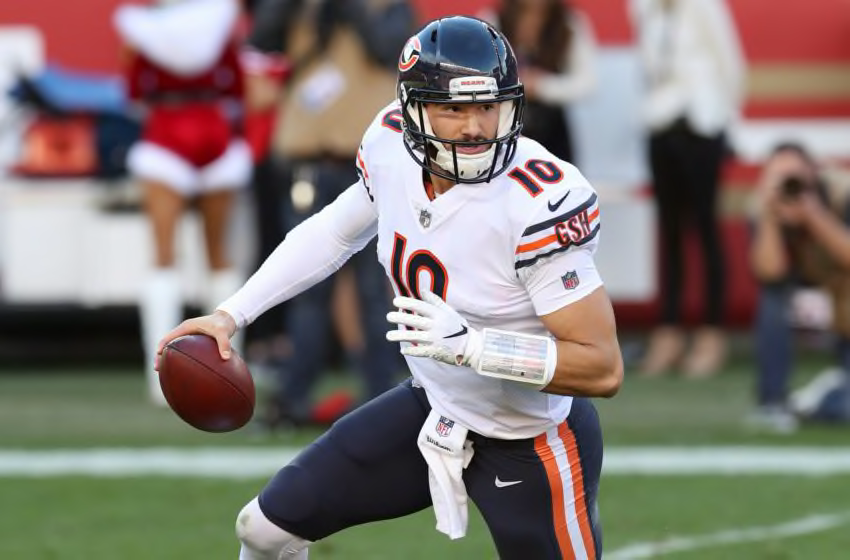
Mitchell Trubisky #10, ChicagoBears (Photo by Rob Leiter/Getty Images)
Chicago Bears quarterback Mitchell Trubisky spoke to the media and said enough to keep him as the starter.
After listening to Mitchell Trubisky‘s press conference with the media Friday, I’ve gained more confidence on Trubisky’s odds to win the starting quarterback position for the Chicago Bears in 2020. Trubisky has taken a hands-on, leader approach to the Nick Foles challenge, something many expected him to.
Trubisky spoke on the team’s poor offensive performance in 2019, explaining that injuries and lack of detail were the key reasons for the regression of the Bears. Another thing that should catch fans’ eyes is his wording.
Trubisky kept saying “we”, “our” or “my team”. He never acted like he was the odd man out. The belief of this being Trubisky’s team is still there with him, which is important. The biggest moment was when Trubisky talked about needing to earn his next contract, which shows that he has a chip on his shoulder and is ready for the quarterback competition with Foles.
[embedded content]
Lastly, Trubisky brought up how he’s watched every offensive snap from 2018 and 2019 with Matt Nagy, something he’s done to see where he needs to place the ball and where he can read defenses easier. If he can master these little details, 2020 could be an exciting year for this team.
There’s room to believe that Trubisky is at a disadvantage because of how poorly last season went and the love Matt Nagy has foe Nick Foles.
Trubisky will need to show his ability to run the football, along with his ability to extend plays as early as in training camp. If he has learned more about reading defenses and ball placement, he’ll benefit more when on the field.
RELATED PRODUCT
Chicago Bears Stadium Street Sign
If Trubisky wins the job, Foles is there as a mentor and a solid backup. Historically, this has been a good role for Foles, as he’s come off of the bench to win a Super Bowl back in 2018. This also helps the Bears in a case of Trubisky getting injured, they’d have a backup capable of running the offense.
The next few months will be interesting, with both men competing for the starting job. For Bears fans’ sake, let’s hope the right man wins the job and this team can make the playoffs again.
I have no interest in a “both sides” argument about clear-cut instances of police brutality, and “bad apples” arguments lose ground by the minute. (Also, I care way less about Congressman Bobby Rush’s popcorn than our mayor seems to.) The conversations around police reform, defunding, and abolition have made massive leaps forward over the past two weeks, and some teachers find themselves in a complicated spot. Rather than shame them for struggling with these questions, I’m choosing to find a lens that sees them and reaches out.
Right now, accusations of hatred and vilification fly in both directions: teachers are engaged more and more with calls to rethink and reshape policing as we know it, and police feel besieged by public opinion and massive protests. Both see an increasing distance between the two professions and their respective unions. And amid the growing national conversation around policing, these two occupations still live side by side in many Chicago neighborhoods, often under the same roof. There’s a lot of overlap in families and communities, since all city workers are required to live within the city limits and thus tend to pile up at the edges, where a house with a yard on a quiet side street is more affordable.
The demand to remove police from our schools is growing fast. Many teachers see the impacts of police presence on Black and Brown students, on students with disabilities, on immigrant students — even when the school resource officer is kind and well-intentioned. (I love both of the resource officers at my school.) This isn’t about the officers; it’s about the students. In twenty-two years as a teacher, I have never encountered a situation at school that wouldn’t have been better handled by a social worker or other wellness professional, and that includes when I was physically assaulted. But alongside calls for wider defunding, police feel it as another slap at their profession.
Many police resented our strike last fall; tensions have grown between our unions over the past several years as the Chicago Teachers Union has taken on larger social issues in Chicago inherent to improving our schools. At the same time, I wonder as a teacher why the police union doesn’t fight harder on these same issues for a better version of their city and profession, one that doesn’t pit police against their neighbors, friends, and family. I wonder, too, why the Fraternal Order of Police doesn’t prioritize everyday worker protections. (If they do, we don’t hear about it, and their recently elected President does not engender confidence.) Police hold fundraisers to buy vests like we hold bake sales to buy books. We need to realize that we are ALL being played.
Teachers also see the impact of policing as it exists now on our students’ lives outside of school. We see the outsized portions of our city budget used to further militarize the police, settle misconduct lawsuits, and pay out the overtime used to keep their union happy(ish) and quiet(er), and teachers stop wondering why we can’t have librarians anymore. Again: this isn’t about police as human beings as much as it’s about what we see kids needing and experiencing.
But let’s talk about police as human beings. I count police officers among my loved ones. I married into a police family. I grew up in a police neighborhood and settled into another to raise my kids. There are plastic blue ribbons on half the trees in my neighborhood, and we call this supporting the police.
But if we really think about what we see as friends and family of police officers, the calls for reform and defunding should be loudest among us. Instead of claiming outsized voices in discussions about protests and police brutality, those of us with first responders in our circles should take this moment to look with more honesty and discomfort at what we have seen — some of us for our entire lives. And if we’re really honest, uncomfortably honest, we’ll start to see that this profession as it currently exists is killing them, too.
I’ve watched marriages crumble, substance abuse take hold, callouses start to cover an otherwise kind soul. We buried a family member who was only 25, one of so many more police officers who die by suicide than in the line of duty. We are not supporting our police by tying blue ribbons on trees and calling them superheroes. We are setting them up.
For those teachers and others who feel conflicted between the current call to rebuild policing and the loved ones they feel called to defend, I hear you. You’re not wrong when you think of the long hours and mentally devastating nature of police work; you know better than anyone what police work does to a human being. You probably know that the work our loved ones signed up to do didn’t turn out the way they expected. They didn’t join the profession to be reviled and distrusted. I genuinely believe most joined to serve their communities — just like teachers. And in many ways, they’re backed into a corner in our culture, reinforced by the rhetoric of their unions, isolated from the communities they serve and taught to trust only one another. With-us-or-against-us might be a comforting space for officers and loved ones, but it also intensifies the challenges police face and the devastating impacts on their lives and families.
The call to defund and change policing doesn’t center police officers; but it could be about supporting them, too.
I urge police family members and friends to read some of the explanations of defunding and abolition and imagine what it could mean for those who do police work. Because of the inclination to circle up and defend what feels like a very personal attack, it’s difficult to untangle. But especially as teachers, we are capable of processing that complexity and finding a space where multiple things can be true and in need of our care and attention.
Lifelong Chicagoan, veteran CPS English teacher, metaphorical nazi-puncher, rabid defender of books, mother of two sons. Comics, postmodern fiction, punk shows, horror, roller derby, strong coffee, veggie food, job-stopping tattoos and brilliant bad ideas.
Most of what made my Release Radar this week were remixes and guest spots. I mentioned a few weeks back that I’m so tired of that trend. Maybe it’s no longer a trend, maybe it’s here to stay?
[embedded content]
Twin Peaks is one of those collabos, but this one actually works well. The guys benefit from the swooning female voices and could use more charm, like their getting from V.V. Lightbody and Ohmme, in their repertoire. It’s a funky jam that sees the band staying true to the style.
[embedded content]
Paul McCartney drops in with a beautiful little acoustic ballad. Some of the best work he’s done in years. It’s quick and to the point. A nice reprieve for your backyard playlist.
[embedded content]
Here we go with another collaboration, this time featuring Elton John? Yep, Surfaces give us a sunny jam that has a guest spot by none other than Sir Elton. I’ll be honest, it’s cool, but it almost feels forced. This song would’ve been great without the star power, but I do like it.
[embedded content]
Murs must be putting together a full-length album? He’s consistently released a new single almost every week for the last month or so. They’ve all been quality, and “Cocaine Rap” is no different. I’m not a fan of the genre, and it seems like Murs isn’t either. He states his case while guesting on this new Sir Veterano track. Yep, another collaboration.
[embedded content]
I’ve talked about Gizmo Varillas a lot lately. “A Silver Lining” is another great track from an inspired voice and songwriter.
[embedded content]
Colony House put something special out this week, “The Walls Come Crashing Down” and I wanted you to give it a listen. There’s a subtle beauty to it, that stays with you.
[embedded content]
Finally, jazz, lest not we forget. “What Is Geography Without Borders” is the selection for the week, by Slow Is The New Fast. I know, a great name and an even better song title.



 Book recommendation of the week comes from



 I have no interest in a “both sides” argument about clear-cut instances of police brutality, and


