Chicago rapper Vic Spencer couldn’t let the year pass without dropping at least a couple albums. August’s Spencer for Higher 3 (Old Fart Luggage) is his third solo outing of 2020, and that’s not even all he’s put out. After February’s Psychological Cheat Sheet and April’s No Shawn Skemps, he released June’s Your Birthday’s Cancelled as part of Iron Wigs, an underground supergroup that also features Chicago rapper Verbal Kent and UK rapper-producer Sonny Sathi, better known as SonnyJim. Sathi produced the bulk of Spencer for Higher 3, and his elegant old-school soul approach to boom-bap brings out the musicality in Spencer’s gritty voice. Spencer can come off as irascible, but on this album he’s most often self-deprecating and playfully mischievous–he occasionally uses his ad-libbed grunts as an exclamation mark at the end of a jocular line. Spencer’s a workaholic, but throughout Spencer for Higher 3 he sounds like he’s unlocked the secret to having more fun on the clock than anybody else. v
The age of Zoom has created a split-screen metaphor for the changes in our private and public lives. We’re separated physically, but the world is invited into our personal spaces in a way that never happened in Cube Farmlandia. For theater pieces created at a distance and for online consumption, the dichotomy feels even more keen.
Increasingly, companies producing new work online are leaning into that dichotomy. That’s clear in two streaming shows that have premiered in recent weeks: BoHo Theatre’sThe Pursuit of Happiness and Lifeline Theatre’sPride and Prejudice.
In content and style, the pieces are completely different. BoHo’s show, subtitled A BoHo Exploration of Freedom, brings together 17 BIPOC artists under the direction of the company’s new executive director, Sana Selemon, in a virtual cabaret of song, spoken word, personal storytelling, and combinations thereof.
The show kicks off with Donterrio Johnson, the artistic director of PrideArts, singing and dancing in an empty theater to “I’ve Gotta Be Me,” a song from the 1968 musical Golden Rainbow, composed by Walter Marks and made famous by Sammy Davis Jr. At the end, we see a photo of vaudeville star Bert Williams, who was the first Black artist to have a leading role in a Broadway show. It’s an effective way to encapsulate the ways that Black artists have struggled to achieve success in a white-dominated cultural landscape without losing their own identity.
It concludes with Marguerite Mariama, a longtime artist and activist who notes that her political organizing began as a student protesting the “Willis Wagons”–portable classrooms that maintained de facto segregation in Chicago schools. Mariama’s recounting of her personal involvement in politics is set against a backdrop of imagery from the civil rights movement and graphic photos of lynchings. (BoHo has a content warning on the site for a reason.) Her rendition of “Sometimes I Feel Like a Motherless Child” reminds us that the notion of “home” as a sanctuary has never been respected for Black people in this nation (the police killings of Breonna Taylor and Botham Jean made that all too clear), while her exhortation to “Stand Up” suggests that getting out of our homes and into the streets is a moral imperative.
Mariama chooses to perform against a solid black drop cloth, with her voice and the archival photos creating the emotional environment. But other performers allow us glimpses into the interior of their homes as well as their histories. (Tony Churchill deserves credit for his excellent editing work at blending all these segments.) Natara Easter performs a spoken-word piece that begins with “Well, I feel free,” and then takes us through all the ways she’s been made to feel ashamed about her appearance and expression–“the blackest sound in my laugh,” her smile, her way of speaking, her hair. (Easter notes that Black boys in her school were as likely to tease her about the latter as her white peers.) Throughout, we see Easter in her home; looking out a window to her backyard, writing in her journal, washing her face in her bathroom, and otherwise claiming herself in her space.
The theme of self-acceptance also comes through in Dillon Chitto’s piece about growing up gay and Native American in Santa Fe (“the gayest city in the southwest”) and the culture shock of attending a Jesuit seminary in Ohio. (The piece begins with a quick history lesson in how queer or “two-spirit” people, who were accepted in Native culture, were labeled as sinful when the colonizing Catholic missionaries arrived.) Chitto tells us that he has “a rosary in one hand, and a bagful of cornmeal in the other,” and creates his own personal trinity from “culture, religion, identity.”
Whether showing us the interiors of their homes or the inner workings of learning to blossom as a BIPOC artist, The Pursuit of Happiness is an exhilarating, intimate, and thoughtful 75-minute journey well worth taking. And I can’t wait to see all these performers again, live and in public.
Since 1986, Lifeline Theatre has thrice presented Christina Calvit’s adaptation of Jane Austen’s most beloved novel onstage. But the version available online now works beautifully at suggesting the tensions between private feelings and public behavior that undergird Austen’s world. Directed by Lifeline’s former artistic director Dorothy Milne, edited by Harrison Ornelas, and featuring a lineup of longtime ensemble members (including delightful real-life couple Katie McLean Hainsworth and Christopher Hainsworth as Mrs. and Mr. Bennet), the piece should resonate equally well with Austen purists (the dialogue remains faithful to the original) and those who are trying to figure out the rules of dating in a socially distanced time and place.
There are few attempts at costuming (save some plastic tiaras donned during various balls), and no attempts at creating a simulacrum of Austen’s world in the homes of the performers (though Caroline Andres’s period violin music adds resonant aural texture). But the story of Elizabeth Bennet (Samantha Newcomb) and Mr. Darcy (Andres Enriquez) unfurls with all the wit and fire you could ask for. A moment when Newcomb’s Lizzy breaks away from the on-camera world to stride down the sidewalk (the only exterior shot in the piece), intent on visiting her sick sister Jane (Kristina Loy) not only shows us the forthright bull-by-the-horns candor underneath Lizzy’s careful exterior, but adds an extra layer of meaning in a time of pandemic and panic.
Taken together, BoHo and Lifeline’s productions reveal sophistication in style and material, and an admirable ability to take the limitations of our Zoom-saturated current reality and transform them into something fresh, personal, and wholly entertaining on their own terms. v
When news broke in May that the California Clipper was permanently closing, people began to talk. Not just about the circumstances of the bar’s closure–which owner and boutique restaurateur Brendan Sodikoff claimed was due to the financial strain of the pandemic–but about the bar’s history, too.
Most believe the Clipper was originally a nickelodeon that shuttered because of the 1918 flu pandemic. Many believe it’s haunted, too, because that’s the kind of place the Clipper is: a fountain for fascinating stories. But much like the bar’s closure announcement, all Clipper stories contain a drop of truth amidst a pool of speculation–ones that reveal more about Chicago and culture than about the tavern itself.
In interviews with more than half a dozen former Clipper employees spanning the last 20 years, “David Lynch” is used as a descriptor of the space almost every time. “David Lynch turned sideways,” one person says. “Patsy Cline meets David Lynch,” says another. Even patrons describe it as a place where time doesn’t feel linear. Its air sizzles with an expectation that past and present might collide in surprising, even unnerving ways, making it a likely place for something spooky.
Early into her year-and-a-half as a bartender there, Chelsea Foss-Ralston heard rumors about a ghost. One of her opening duties included saging the space, and coworkers would tease it was to clear lingering spirits. If something unexpected happened, like a mop falling over, someone might joke, “Clipper ghost!” Occasionally, she’d meet adventurers on self-guided ghost tours who’d ask about the lore. The bar is included in two books on Windy City haunts, and in the aughts, its website used to advertise a woman in white who’d appear to “freak out management.”
But then Foss-Ralston started to have experiences: things like hearing phantom knocking and footsteps, even one night losing her garage door opener only to find it placed on her driver seat in the morning. These encounters convinced her it was more than talk, and she’s not the only former employee with such accounts.
“Ghosts are liminal (between here and there, between now and then),” writes Dr. Tok Thompson, an anthropology professor at University of Southern California and folklore expert. “So often they appear at liminal places. Ghost stories are interesting to me in the way they express the ‘shadow side’ of history. They often can contain truths that official histories do not.”
The Clipper is an ideal site for a ghost–or at least a ghost story–because as far as official histories go, it doesn’t have much of one. Or rather, the one it has is markedly incomplete. It’s true that it started as a turn-of-the-century movie theater. There are sub-basements in the area similar to those beneath the Green Mill and a false wall in the bar, too, prompting suspicion it might have been a speakeasy during Prohibition, which collapses the Clipper into beloved Chicago mythology
When the Clipper’s landlord Gino Battaglia bought the building nearly 20 years ago, part of its appeal was its hazy, storied past. He likes that it’s still a true tavern–a holdover from a pre-Mayor Daley time when liquor licenses weren’t contingent on serving food, and bars commonly functioned as neighborhood hearths. Rumors swirled that bootlegger Baby Face Nelson–born only a half block south on California Avenue–had maybe used the bar as part of his operation. While very likely untrue, Battaglia likes that it feels like it could be true. Lots of patrons did.
Alas, the movie theater chapter of the Clipper’s long life was not actually ended by the flu pandemic. Relative to now, few businesses permanently closed then because the 1918 quarantine only lasted a few weeks, and anything not associated with nightlife (like movie theaters) quickly reopened. Newspaper ads in the Tribune reveal the theater was still showing films early into the 20s. Then in 1927, a for sale ad at 1002 N. California boasted a 300-seat movie theater and a side space for a beauty shop. (Presumably, this is what the false wall was for.) But the persistence of rumors that it closed in 1918 reminds people of the cultural toll pandemics take.
It likely wasn’t a speakeasy, either. Contrary to many people’s belief, beer barons didn’t build any tunnels beneath Chicago, just exploited ones that already existed. The ones underneath California and Augusta were likely part of a larger freight network that moved coal, housed telephone wires, and even funneled cool air into large gathering spaces such as movie theaters. But according to Battaglia, there’s no indicator the Clipper had direct access to such tunnels.
Some speculate a Walgreens shared a wall with the Clipper. Pharmacies could legally sell booze, making this a convenient Prohibition workaround. But property records show this also isn’t true; the nearest pharmacy–a family operation–was a block away, and alcohol prescriptions were so expensive, no one in the working class Humboldt Park of the 1920s could have made a habit of them. But the fact that so many ghost stories are associated with the bar is itself a holdover of Prohibition.
As legend goes, a woman in white haunts booths one and nine, as well as the women’s restroom, and her rose-like perfume chases lingering drunks at close. Foss-Ralston thinks the ghost is a woman from one of the photographs on the wall of the bar who’s never been identified. According to the Chicago Haunted Handbook, a manager brought in a psychic in the mid-aughts who said something similar.
“The woman in white was waiting for her beau who went to war and never returned,” says Jessi Meliza, a long-time patron who ran a trivia night there for a year.
“A young woman gets dressed up and goes to the Clipper for a date she’s excited about,” recounts Stephen Spataro, who worked at the Clipper for more than a decade. “He stands her up, and she gets so distraught, she runs out and gets hit by a car. Now she haunts the place.”
According to Daniel Majid, who also worked at the Clipper for more than a decade, first-time customers would go to the bathroom–most often the women’s one–then return and say, “Is this place haunted?” Or they’d remark on their hair standing on end, the place feeling a little eerie.
Amidst all the accounts, two themes emerge: the ghost is always a woman, and she’s often heartbroken.
“[Ghost stories of heartbroken women] are a common thread in many cultures,” says Thompson, the USC anthropologist, “particularly patriarchal ones where a woman’s place in society is heavily dependent on marriage.”
Temperance was born, in part, from women organizing to deal with alcoholism’s impact on their families. If booze wasn’t so readily available, they contended, their husbands wouldn’t undermine their security by, say, losing their jobs or becoming violent. In this light, it makes sense why people might perceive or imagine a female ghost scaring off drunks with her perfume.
But the way the story varies expresses a plurality of ideas about women, too–the toll WWII took on women’s security and livelihoods, for example. Changing attitudes about women even persist in stories of one of the Clipper’s former owners.
In 1937, the Caporusso siblings–Gus, Joe, and Antonia–bought the building and opened the Clipper Tavern. Gus died in the 1950s, but Joe and Antonia continued running it until the late 90s, when Joe died and Antonia retired. (She continued living in the building until she passed around 2010.) Tales of the bar’s life pre-1999, when Max Brumbach bought it and transformed it into the California Clipper, all center on Antonia.
In one, cops come in to shut down an illegal gambling night. “OK, OK, everybody out,” they say, but Antonia grabs a gun and says, “No, you get out.” In another, she refuses to serve women who come in unescorted. “Harlots,” she supposedly called them.
They’re anecdotes that reveal less about who Antonia was than ideas of what Humboldt Park–and women in it–were becoming. As a myth, she gets to be a brazen outlaw who puts her financial stakes above the law as much as a strict enforcer of traditional gender roles. A woman who’s tough enough to provide for her family and come out strong in a changing, often turbulent neighborhood. But she’s not so tough that her job interferes with her or other women’s abilities to have a family.
That stories of imbibing persist as threatening marriage or performing idealized womanhood might be the scariest part of all.
All the talk of ghosts makes Battaglia chuckle. “One of our tenants has been living there 22 years,” he says. “A lot, seven to ten years. We rarely have a vacant apartment. Certainly nobody scared off by ghosts!”
Battaglia’s proud of the relationships he has built with his tenants, which made it all the more wrenching when Sodikoff announced he was closing the Clipper, a neighborhood bar that’s become a local institution, and retaining rights to the name. According to Battaglia, he offered Sodikoff ample rent relief, but he believes Sodikoff was just looking for an excuse to break his lease. (Hogsalt Hospitality, the group that owns the Clipper, did not respond to an interview request.) Now they’re duking it out in court.
While the future of the California Clipper is unclear, one thing is very obvious: there’s something about 1002 N. California that makes it a mirror for local fantasies and anxieties. And that’s something that will endure regardless of what comes next. v
Chicago’s skyscraper modernism–the Hancock, Marina City, Sears/Willis–is the city’s treasured calling card. What’s less known and much less appreciated is our area’s parallel cache of modernist residential architecture. Modern in the Middle, a new book by historian and preservationist Susan S. Benjamin and IIT professor Michelangelo Sabatino, sets out to fix that.
Published this month by the Monacelli Press, it offers a portfolio of 53 modern houses built in the city and suburbs between 1929 and 1975, along with the story behind each house, more than 300 stunning period photos (many of them from the Chicago History Museum’s Hedrich-Blessing archive), and essays by the authors that provide broader context.
Modern in the Middle originated with Benjamin, the co-author of two previous books on Chicago architecture and the researcher-writer responsible for numerous national and local landmark nominations. She says she’s been thinking about writing it since she worked on an exhibition on the same subject in 1976. Co-author Sabatino is an architect, preservationist, and historian.
The word “middle” in the book’s title, with its potentially sleepy connotations, was a deliberate choice according to the authors, locating this architecture smack in the middle of the century, middle of the country, and middle class.
At a time when great urban centers were considered the hubs for everything serious and sophisticated, “What we tried to show is that these clients were perfectly fine with living in the suburbs,” Sabatino said in a phone interview last week. “And that, even for those who could afford more, there was a sense of being frugal, but elegant.”
“We’re not talking lifestyles of the rich and famous here,” he said. “This is cosmopolitan informality.”
The title also points to a middle ground between the opposing philosophies of the two towering figures of Chicago modernism, Frank Lloyd Wright’s organic approach to design and Mies van der Rohe’s more abstract focus on structure. The authors say that despite their differences, the two shared an appreciation of nature: while Wright used natural materials and designed buildings that melded into the landscape, it’s Mies’s massive expanses of glass that bring the outside in.
“If you lie down on the bed in the Farnsworth House,” Sabatino told me, “the architecture disappears, and you’re basically in nature.”
Many of these houses will be a revelation. While a few, like Farnsworth and the Mies house that’s now a part of the Elmhurst Art Museum, are open to the public, and a number of others are familiar–the glass box garage from the John Hughes film Ferris Bueller’s Day Off; Adlai Stevenson’s country house–most are functioning private homes scattered anonymously through suburbs from Flossmoor to Waukegan, and even further afield.
A smaller number are in the city, where vacant land was sparse, but they include the only house in the book by a Black architect–the compact Miesian home John W. Moutoussamy (who studied with Mies at IIT) designed for his own family in the Chatham neighborhood, before he went on to bigger projects, including the Johnson Publications Company headquarters.
There is also only one house by a woman architect in the book–Jean Wiersema Wehrheim–another reflection of the fact that the profession was, for so long, notoriously short of opportunity for anyone but white men, Benjamin told me. On a more positive note, while the houses those white male architects built have traditionally been identified by the names of their male owners, every home in this book that was commissioned by a couple is labeled with the names of both partners.
Modern in the Middle ends in 1975, when high modernism began to wane and people were moving from the suburbs back into the city. Now, both authors think that trend may be reversing. “Even when this pandemic disappears, people have learned that they can actually work from home,” Sabatino says. “I’m imagining that there’s going to be increased interest in having access to nature and in this kind of elegant but informal space.”
That could help preserve Chicago’s stock of these midcentury modern residences. It’s the authors’ hope that this book will, too. The front cover bears an interior photo of the long, low, flat-roofed, open-plan Highland Park home designed by Keck & Keck for Maxine Weil and Sigmund Kunstadter and built in 1952. It was demolished and replaced with a larger house in 2003–a fate too many midcentury modern homes met when the land they stood on became more valuable to the marketplace than the house itself. “We really hope this book serves as a catalyst,” Sabatino says. “We hope the positive examples of preservation will encourage folks that might want to take a project like this on.”
The book closes with a glimpse at the authors’ own homes–suburban houses in the modernist mode, built in 1939 and 1941. It’s an impressive scholarly work, but also, clearly, a labor of love. v
Chicago Bears receiver Allen Robinson has reportedly asked about a trade.
Has he asked for a trade? Has Allen Robinson actually gone to the Chicago Bears brass and asked about a trade? That’s the question many are wondering right now.
Tuesday morning, a lot of information came out at once. First, Robinson appeared to have deleted all Bears content from his Instagram — a fairly strong message in today’s society.
Then, Chicago Tribune beat writer Brad Biggs reported that Robinson had asked the Bears about a trade, according to a league source. The verbiage was specific, though. Some outlets ran with this information as if Robinson had demanded a trade.
The report simply stated that he had asked about a trade. But, what did that mean?
For a while, most assumed that had meant Robinson had asked the front office if they would consider trading him — not necessarily a trade demand. Let’s be real. Robinson loves the locker room. He loves Chicago. He loves the fans. He’s been very vocal about that.
Would he really demand a trade? Not necessarily.
Brandon Parker, agent for Bears’ WR Allen Robinson, said he and his client have not requested a trade. However Robinson, who is in the last year of his contract, is unhappy that Chicago has been unwilling to pay him market value for wide receivers.
Now, later in the day, ESPN’s Adam Schefter reported that Robinson’s agent, Brandon Parker, had clarified the swirling rumors. According to Parker, he and his client (Robinson) have not asked for a trade. However, they are unhappy with the Bears for being unwilling to pay Robinson market value.
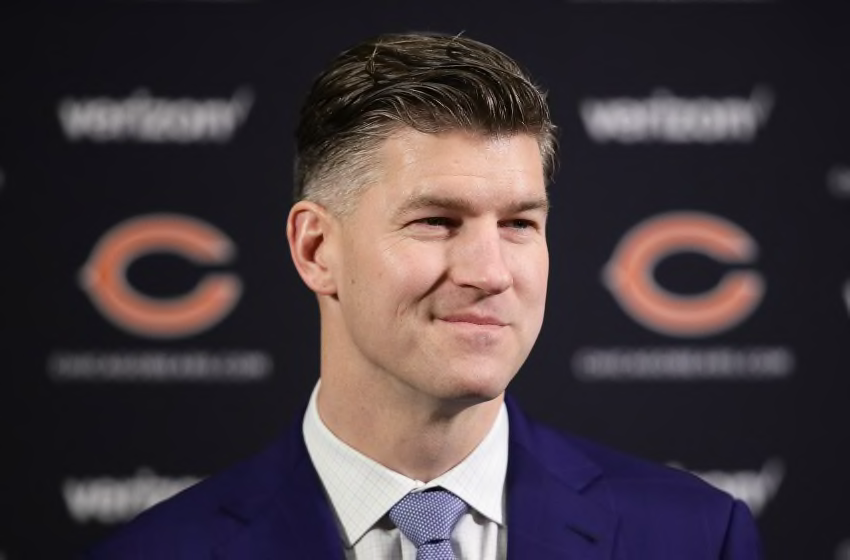
Robinson is in the last year of his current contract with the Bears and has seen plenty of his peers get paid over the past few weeks, and even months. It is not mildly upsetting to see Robinson this displeased. As a fan, it’s actually infuriating — but that rage is directed at none other than general manager Ryan Pace.
Robinson deserves to get paid. But, if the Bears truly do not want to pay him what he’s worth, then Pace will be forced to pull the trigger on a trade. That’s the last thing the Bears want to see right now, but if it comes down to it, the following five teams make the most sense.
To clarify, the following organizations would most likely have to give up either a first rounder, or a combination of a first or second rounder combined with a mid-round pick.
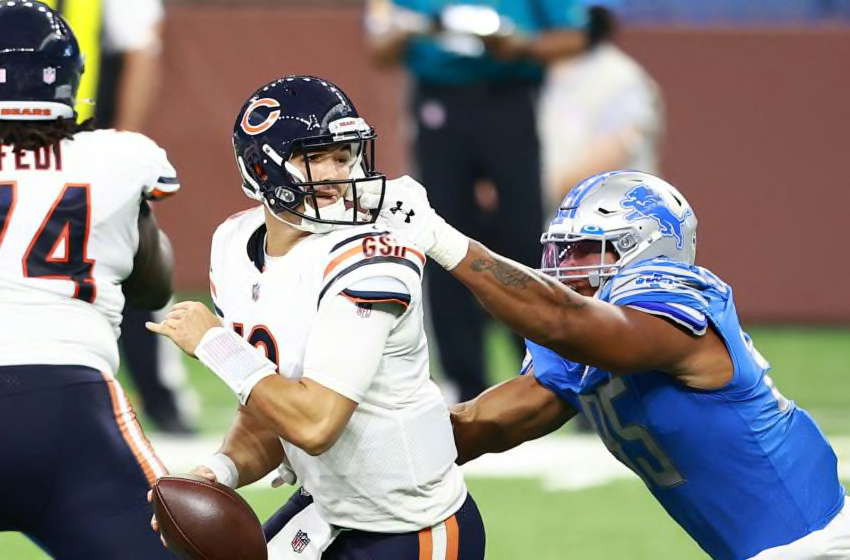
DETROIT, MI – SEPTEMBER 13: Romeo Okwara #95 of the Detroit Lions grabs the facemask of Mitchell Trubisky #10 of the Chicago Bears in the fourth quarter at Ford Field on September 13, 2020 in Detroit, Michigan. (Photo by Rey Del Rio/Getty Images)
For three quarters against the Detroit Lions on Sunday, the ChicagoBears offense led by quarterback Mitch Trubisky looked predictably lifeless.
The Chicago Bears are 1-0 to begin the season. Quarterback Mitch Trubisky threw three come-from-behind touchdown passes in the game’s final quarter to rally his team to a 27-23 victory over the hapless Detroit Lions.
Yet, if not for a dropped end-zone pass in the game’s final seconds by Detroit’s rookie running back, the Bears would be 0-1, frustrated – rather than excited.
Football outcomes, wins in particular, stand out more than anything else. The headlines everywhere will point out the fact that Trubisky overcame a sluggish three quarters to deliver an impressive, somewhat improbable opening day win. He made some impressive throws in the game’s final minutes, no doubt. His final touchdown throw to receiver Anthony Miller was a thing of beauty.
Unfortunately, these are the types of plays that far too often only come in brief flashes for Trubisky. A light switch seems to only flick on for him after his team’s offense has dug itself a huge deficit to climb out of late.
Trubisky’s stat-line: 20/36, 243 Yds, 3 TD, 0 Int, 104.2 Passer Rating, looks very impressive. Yet, if you actually watched the entire game, you’d notice that Trubisky’s up-and-down, inaccurate play hasn’t left despite this now being his fourth NFL season.
By now, Trubisky should be able to put together a consistent game from start to finish; one where he gets it going well before it becomes crunch time. If Trubisky was a rookie, or in his second season, or even playing against a championship contending team, this type of performance from him would still be completely understandable, but not when he’s in his fourth season, now one of the veteran leaders on the Bears.
Furthermore, this was the Detroit Lions … a team that had a depleted secondary due to injuries. A team that is hardly known to play good defense despite hiring a defensive minded coach. How much stock should we really put into Trubisky’s performance as a result?
Not a ton. Trubisky definitely showed resiliency and the ability to shake off his struggles to come up big in the clutch. He’s already proven he could do that from time to time which is an excellent quality you want your franchise quarterback to have. But displaying consistency is the biggest challenge Trubisky has still yet to master.
If he can’t improve upon that now, are the Bears really better off with him taking snaps under center in this make-or-break season? Doubtful, unless Nick Foles isn’t really as good as his reputation.
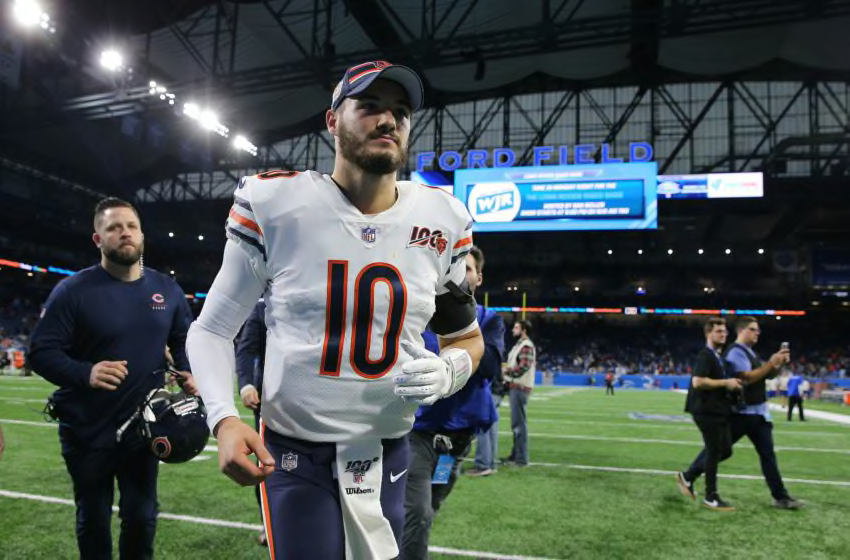
After the ChicagoBears fell behind 23-6 against the Lions, quarterback Mitchell Trubisky led a fourth-quarter comeback to show promise for his future in Chicago.
It might have taken the Chicago Bears three-quarters to get a touchdown, but once they got it, their offense didn’t slow down. Mitchell Trubisky led the team back down 17-points, for his fifth career fourth-quarter comeback.
During the first three-quarters, Trubisky missed a few key throws to various targets, but after how great he played in the fourth quarter, it’s fair to chalk some of that up to him being rusty from no preseason. There is still work to be done by Trubisky, as he is far from how great he can be this season, but this win against the Lions is a great first step.
Trubisky showed promise as a leader by staying poise in the pocket and making plays when they needed to be made. Instead of looking over his shoulder after every failed possession, Trubisky looked mentally tough and had a drive that he wasn’t going to be stopped.
From there, he threw three touchdowns to three different receivers (Graham, Wims, Miller). He also became the first quarterback in franchise history to throw for at least three touchdowns and have no interceptions.
FUN FACT: On Sunday, Mitchell Trubisky became the first #Bears QB to pass for at least three TDs with no interceptions in a season opener in franchise history.
There’s a lot of positives coming out of the Bears’ quarterback room after Sunday’s win. Trubisky now has tape on himself to re-watch the missed throws, take a look at his decision making, and work with the coaches on becoming a better player.
The offense moving starts with Mitch (Trubisky) and he proved that he can run this offense, even when he’s struggling. It just takes one big play to get him back in the rhythm he needs to be in to be successful.
The most important thing from that game is that he did in fact struggle. If Trubisky came in and dominated against the Lions, yes, that would have been amazing, but he wouldn’t have tape of him under adversity to learn from. Coach Nagy and Trubisky can both look at that and break down the decision making, the play calling, and where things went wrong. If they can eliminate those negative things and get the offense moving in the first quarter as opposed to late in the second half, this team will win a lot of football games.
There’s still a lot of work to be done, but Trubisky showed promise on Sunday. Fans have to stop counting Trubisky out of games too early. He can make the big throws and can play well, he just has to do that a lot sooner in games to become the franchise quarterback the Bears hoped he’d be in 2017.
The ChicagoBears are in a tough spot in a lot of areas because of Ryan Pace.
The Chicago Bears are in a tough spot. They looked bad in week one and it is only going to get harder from there this season and their future is rather bleak. The reason that their future is bleak is because of the fact that Ryan Pace has basically done everything wrong since coming over. There have been some good late-round draft picks and the Khalil Mack trade was awesome but the cons have outdone the pros in his Bears tenure.
The first major mistake he made was his first-ever draft pick. He took Kevin White with the seventh overall pick in the 2017 NFL Draft and that was one of the biggest mistakes in the history of the team. He barely ever played for them because he was always hurt and when he was there, he wasn’t very noticeable.
The most famous mistake was the Mitchell Trubisky draft pick. The Bears were originally slotted to make the third overall pick but they traded up to the second overall pick to select Mitchell Trubisky. With Deshaun Watson and Patrick Mahomes still on the board, they opted to go with Mitch and it has been a disaster. The latter two have become superstars and Trubisky probably won’t be with the Bears beyond this season.
They have a very good defense (we think) but the offense is awful because of the quarterback. Well, Pace continues to make things worse because of the current Allen Robinson situation. He has been making it clear that he wants a contract extension for a while now but he hasn’t stayed away or anything like that. Instead, he continues to play well but they won’t extend him for whatever reason.
Well, it finally came to a head over the past 24 hours as Robinson has removed anything Chicago Bears related from his social media profiles. His teammates continue to back him on Twitter and it is a terrible look for Pace. Robinson was one of the only reasons the Bears offense even had a chance last week and the first three quarters would have been even worse without him.
They need to get this done but it feels like Pace continues to make things worse for this team every single day. With or without a Robinson extension, this guy needs to go and the Bears need to start over.
There’s a Chicago man who deserves his own TV show so much that he started his own. His name is Joe Scott. I’ve seen him in sponsored ads on social media, but his YouTube channel shows the brilliance of his production style. For me, he’s definitely the perfect person to get a segment on “News Nation” on WGN or Channel 26’s “The Jam”. (You can find more about him at his Realtor page.)
Joe obviously knows about media markets as much as he knows about real estate markets. He realized that there wasn’t a black male presence in local real estate promo videos. Thankfully, he got to it and created his own.
Picture yourself on the Metra train heading south from Barrington into the city. There’s a lady reading the new James Patterson novel. A guy flipping through the Chicago Tribune. Another guy reading, “The Omnivore’s Dilemma” by Michael Pollan.
The train pulls into Ogilvie and the three people grab their bags, head to the station. They make their way to three different office buildings downtown.
For all three of them, this morning is about to be jam-packed with emails and meetings. Conference calls and deadlines. A month from now, the James Patterson lady has a two-week vacation. The newspaper guy is about to become a granddad.
The guy reading Michael Pollan’s book? He’s about to purchase four Angus beef calves, 25 laying hens, and 25 broiler chickens to raise in his backyard.
Be Careful What You Read… You Might Become a Farmer
“The Omnivore’s Dilemma,” was a Christmas present Cliff received from his left-wing sister out in California. Cliff devoured the book in a week and especially connected with the middle section of the book where Pollan spends a week at Joel Salatin’s grass-based livestock farm in Virginia.
“I started doing some research on Salatin and discovered that he had written a number of books on livestock farming, including a book titled “You Can Farm,'” Cliff writes in his origin story blog. “At that time we were doing pretty well and had purchased a large house on almost 9 acres of open land in suburban Barrington Hills. However, in spring 2011, I started a new insurance job from my home office, which saved me 3 hours per day of time commuting. With a head full of ideas picked up from the You Can Farm book, I decided to use that time to start raising food for my family and friends on our acreage.”
You know when a neighbor comes by asks for a cup of sugar? Cliff’s version: Neighbors were placing orders for beef, eggs, and chicken – all from his backyard.
Cliff was enjoying the work and decided to make it a side business. He put together a simple website and his listing was up on Eatwild.com. The orders started multiplying fast and it became clear that his backyard operation wasn’t going to be nearly enough space. It was time for a bigger farm.
“We were lucky to find a 40-acre parcel of fenced land available to rent about 5 minutes from our house. And so I borrowed a neighbors trailer and we moved the growing beef herd and chicken production over to the new property that spring (we called it “The Ranch”), to make room for a few dairy cows on our backyard acreage.”
Got Milk?
Whether it’s starting a farm or starting a tech company, I always picture the owner as the big idea guy. Like a Steve Jobs pacing around his bedroom, having the light bulb moment for the first iPhone. But in so many cases, the big new product idea comes from the customers themselves. This was the case for Cliff who, in March of 2012, started receiving numerous inquiries about raw milk from his website visitors.
“At the time I was not at all familiar with raw milk or the health benefits, but after the 30th or so email within a month, I decided it was time to start looking into this burgeoning raw milk movement.”
When you’re passionate about something and caught up in the flow of an idea, the research doesn’t even feel like work. In what was probably only a matter of weeks, Cliff became a raw milk expert. He learned the health benefits of A2 milk, how it’s easier to digest than our main grocery store milk, and how it causes less inflammation. He started his search for the holy grail in dairy farming, aka the Guernsey cow, the only major dairy breed that still produces A2 milk. He also learned that there weren’t many farms in Illinois that sold raw milk.
And it makes sense. It’s like any other competition in business, the deli down the street can’t compete, at least not financially, with the giant scale of a place like McDonald’s. We see it especially right now during COVID-19, the mom and pop restaurants are hurting and struggling to survive while the global fast-food chains are doing just fine. The big guys can weather the storm. The smaller shops, it’s gonna be a fight.
But what the small restaurant, the small shop, or the small farm can do better than the bigger operation is create a superior product. Sure, it might not scale. And there won’t be the same volume, but for that carton of eggs, that 1/2 gallon of milk, that five lbs of beef brisket, the small family farm has the opportunity for every customer to experience their food and say, “Wow, this is incredible!” They tell their friends, they post on Facebook, and the line gradually gets a little longer outside the farm store.
So Cliff drove up to Dodgeville, Wisconsin, toured a farm that had 10 purebred Guernsey cows available. He ordered milking equipment online and then purchased his first two Guernseys (named Custard and Sapphire). He put all the proper protocols in place and, just like that, he was in the raw milk business. Announced it on the website. Demand went up, supply went down. He went back to Wisconsin and bought two more cows (named Joy and Alice).
Two Gallons of Milk, Side by Side
Let’s compare two approaches to dairy farming: The common practices on big factory farms vs. the process at All Grass Farms.
At a factory farm, dairy cows live in tight dark quarters. When you have thousands of cows and the goal is to produce $3-4 gallons of milk, efficiency has to be the top priority. Because of this cramped arrangement, the cows don’t have room to spread out on the land and they spend a lot of time standing and sleeping on concrete surfaces (easier to hose down). As a result, factory farm cows often have sore joints and develop illnesses from these poor living conditions.
The cows’ diet is cheap and mediocre consisting of poor grains, soy, and other supplements vs. eating grass and living off the pasture. This process of going from pasture to grain isn’t natural and a lot of the cows become afflicted with a number of disorders. To prevent more serious and sometimes fatal reactions, “the animals are given chemical additives along with a constant, low-level dose of antibiotics. Some of these antibiotics are the same ones used in human medicine. When medications are overused in the feedlots, bacteria become resistant to them. When people become infected with these new, disease-resistant bacteria, there are fewer medications available to treat them.”
When the cows on a factory farm have a daughter, the two are separated within the first 24 hours. The calves receive synthetic milk alternatives so their mothers’ milk can still be sold. Here’s a deeper look at the process from an article on Sentient Media.
Mother cows have been known to scream for their young, attempt to break out of their pens, break down fences, and go to other extreme lengths in their desperation for reunification. They want to spend time with their offspring. In fact, cows often bond with their mothers for life, remaining in the same herd, when allowed to live naturally.
The extreme distress these cows demonstrate often lead them to refuse water and food. They get sick, become malnourished, and are impregnated again within three or four months. The cycle continues, with each new baby taken away from his or her mother.
Compare this to the process at All Grass Farms. Back in July, “The Moo Crew” welcomed six new calves to the herd, four of those being heifers, aka future milking cows. Here’s a picture of Orbit cleaning her newborn calf, Olive.
Look at the contrast here. This is an excerpt from their July Newsletter:
We allow the heifer calves to stay with their mamas until weaned, so they can nurse whenever hungry, and learn to graze and socialize with the herd from an early age.
The downside of keeping the calves with their mamas is they drink a lot of milk, but we just have to settle for sharing their production with the babies. There should be more milk available to sell in the store soon though as we bring more cows back into production.
Right now, they have between 30-35 dairy cows, milking around 20. The maximum they can milk is about 24. The cows roam around the farm receiving a natural diet. They head into the barn to be milked and the product goes all of 20 yards away to the farm store. It’s about as farm fresh as it gets.
When you compare these two approaches, to me it seems like pasteurized vs. non-pasteurized, homogenized vs. non-homogenized, the heating process, none of that is the biggest factor. The biggest factor is how the farm cares for their animals. It seems pretty simple, the farm who names their cows and offers them moo-ternity leaves, the farm who recognizes maximums and doesn’t push beyond it, and doesn’t cram cows into tight quarters, all of that will come through in the quality of the product, delivering healthier milk to their customers.
But what about the cost difference?
The last time I went to All Grass Farms, a 1/2 gallon of raw milk cost $6.50.
And that’s true for everything. The meat. The eggs. If you’re comparing cost, the grocery store will always win.
To be fair, there are so many factors at play in those numbers above and I can’t paint one broad brushstroke, boiling it down to that old expression, “It’s better to pay the butcher than the doctor.” But when I look at everything as just a regular guy and not a scientist, it feels like for the last 30-40 years, the emphasis on speed and scale and low cost has resulted in lower quality food because it was coming from unhealthy animals. The response in recent years to move toward organic, grass-fed options, it really isn’t anything new. It’s a return to a past era in America when there were more small local farms supplying the nation’s food.
The downside: the price tags will be higher at checkout. It has to be, otherwise, there’s no way for the smaller shops to stay in business. But I think it’ll pay off in the end, both in the long-term healthcare impact and just the simple fact that it’s more enjoyable having a place like All Grass Farms in the neighborhood.
What if I want to start a family farm?
Cliff hears from people all the time who are interested in starting their own farm. So he offers volunteer and summer internships. Weekend help. Summer help. Douglas Callegario, the sourdough bread baker, started here. And now they’re thinking about setting up a farm-to-table restaurant on the site.
However, volunteers discover right away this is no easy job.
“A lot of people have a very romantic vision of a farm, ‘oh wouldn’t it be great to have some cows, chickens, eggs, they think about the good parts of that, but not the fact that’s a 365 days per year commitment,” Cliff said. “Never going to have a day off, never gonna have a vacation. You’re gonna have a dead animal at some point, you’re gonna have a sick animal at some point. All those issues have to be dealt with and a lot of people aren’t really prepared for that. So I always say, go experience it on a small level first. Or, like what we did, I started in my backyard with just 25 chickens see if I liked this, do I like doing this work. A lot of people jump into it really big and then they realize after a year this isn’t for them. So I’m always a big advocate of starting small and then, if you make a lot of mistakes, you’re gonna make mistakes, you learn from them, but if you have the desire and passion for it, you keep at it. But I would say maybe 5-10% of the people are going to stick with it more than a couple years.”
His volunteers are usually one-hit wonders.
“We’ve had so many volunteers. I make so many offers. ‘Be there at 6 am. Help us milk.’ They come one day and we never see them again. They’re like “Wow, this is hard work.”
He doesn’t sugarcoat the financial side either.
“You know it’s hard, not easy to make a living at it for sure, you really gotta be passionate about it,” Cliff said. “I tell people you gotta be willing to work through this for free at this for years before you make any money. It’s not like any other job. And the weather, doesn’t matter if there’s a snowstorm, polar vortex, we gotta work. We gotta take care of the animals. Gotta milk the cows. With livestock there’s no letting up, it’s every day.”
But if you hear all of that and there’s still this itch or you’re looking at email and thinking, “Man, I know it’s hard, but at least I’d be outside. I wouldn’t be staring at this screen.” If those thoughts keep coming back to the surface, it might be time to volunteer at a farm.
If so, Cliff will see you at 6 am.
Over the last several months, I’ve been using the Medium Rare blog in a different format, featuring local restaurants and businesses around Chicago. These can also drift into a little bit of philosophy and stories from my own life + a historical deep dive like this one a couple weeks ago on the history of milk. To catch up on some of the previous posts and read about great local spots, here they are below:
I was born and raised in Midland, Michigan and moved here to Chicago a couple years ago after graduating from Hope College. I live in the city with my beautiful wife Ashley.
A little bit about me – I go to bed early, I enjoy greasy food and would wear sweatpants everyday if I were allowed to. I just signed up for a year-long Divvy membership, but could very well be the slowest bicyclist in Chicago.
I write the Medium Rare blog and will have a new post up every Monday.







 There’s a Chicago man who deserves his own TV show so much that he started his own. His name is Joe Scott. I’ve seen him in sponsored ads on social media, but his YouTube channel shows the brilliance of his production style. For me, he’s definitely the perfect person to get a segment on “News Nation” on WGN or Channel 26’s “The Jam”. (You can find more about him at his Realtor page.)


Leave a comment