Videos

PHOTOS: Bears safety Eddie Jackson buys Long Grove mansion for $950,000on December 16, 2020 at 1:57 pm

ChicagoNow Staff Blog

PHOTOS: Bears safety Eddie Jackson buys Long Grove mansion for $950,000

Read More

PHOTOS: Bears safety Eddie Jackson buys Long Grove mansion for $950,000on December 16, 2020 at 1:57 pm Read More »

Actress Keesha Sharp Starring In BET’s A Christmas Surpriseon December 16, 2020 at 2:20 pm

Just N

Actress Keesha Sharp Starring In BET’s A Christmas Surprise

Read More

Actress Keesha Sharp Starring In BET’s A Christmas Surpriseon December 16, 2020 at 2:20 pm Read More »

Bears: Texans prove getting a quarterback won’t solve everythingon December 16, 2020 at 1:00 pm

Read More

Bears: Texans prove getting a quarterback won’t solve everythingon December 16, 2020 at 1:00 pm Read More »

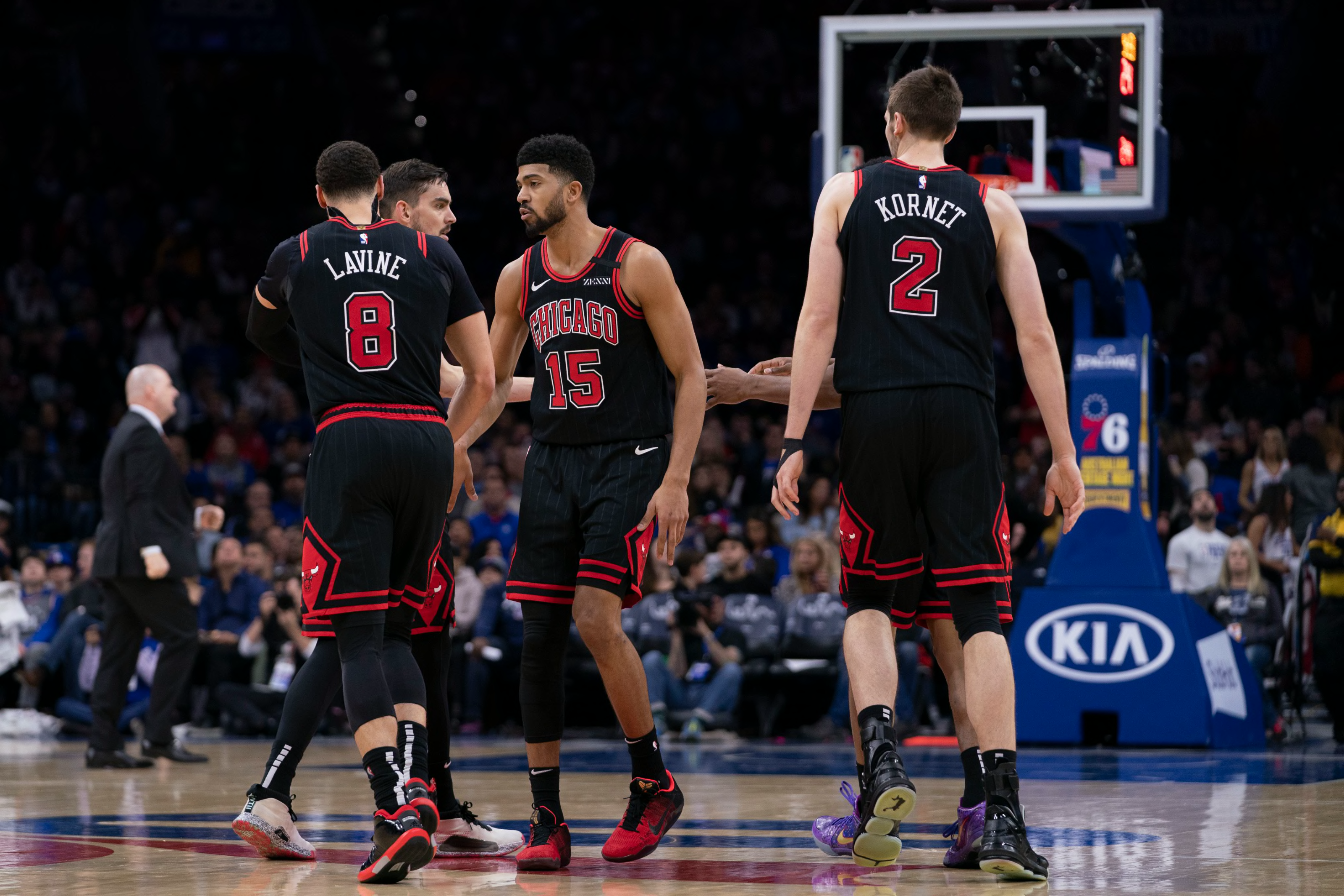
Chicago Bulls: This is the perfect lineup for 2020-2021 seasonon December 16, 2020 at 12:00 pm

Read More

Chicago Bulls: This is the perfect lineup for 2020-2021 seasonon December 16, 2020 at 12:00 pm Read More »

Brys Estate: A glimpse at paradiseon December 16, 2020 at 12:46 pm

Medium Rare

Brys Estate: A glimpse at paradise

Read More

Brys Estate: A glimpse at paradiseon December 16, 2020 at 12:46 pm Read More »

Craft Beer Review: Goldfinger/Hop Butcher Und Hopfenon December 16, 2020 at 6:17 am

The Beeronaut

Craft Beer Review: Goldfinger/Hop Butcher Und Hopfen

Read More

Craft Beer Review: Goldfinger/Hop Butcher Und Hopfenon December 16, 2020 at 6:17 am Read More »

Catherine Edelman Gallery closes with a ‘Place in the Sun’on December 15, 2020 at 5:00 pm

Raised in the suburbs of Washington, D.C., scott b. davis first became interested in photography in the early 90s when he was compelled to document the wilderness. Looking for places that led him off of the map and into spaces unexplored, he began to dive deep into history. By the mid-90s, davis was working with 19th-century photographic processes and formulas like platinum and palladium printing with large format cameras. The artist, looking for ways to be more physically involved in photography, decided to pick up this practice in order to fail more and try new things with his practice. This led him to discover ways in which he could render new landscapes.

The east coast-born photographer, now capturing western landscapes, has always been interested in the American west. As someone who grew up surrounded by small hills and many trees, the desolate and vast land captivated the artist. He says in a Zoom interview with the gallery that the “extremes of hot and cold, the extremes of lightness and dark, the extremes of the plants and animals” all interest him in comparison to what he grew up with on the east coast. At this point, davis has lived out west for 30 years, but he’s still invested in documenting the wide-open space that surrounds him.

“Place in the Sun” at Catherine Edelman Gallery looks at the large moments of the west–like the mountains–and also hones in on the details, like the speckles that make up the sand in the Anza-Borrego Desert. The exhibit will be the last at the gallery–Catherine Edelman Gallery recently announced their closure after 33 years of operation. The lasting marks of davis’s photographs are symbolic of what will remain of the gallery, an imprint of photography exhibited in Chicago.

The gallery, which hosted 245 exhibitions, will transition into pop-up exhibitions at future art fairs and work with curators and collectors. However, the physical brick-and-mortar model of the space does not fit into the current reality of the pandemic.

davis creates a ghost of an impression of a landscape by coating a piece of platinum paper, trimming it, and putting it inside of a film holder of a large format camera. As a result, a negative image is created–a white-on-white landscape. Before switching to this process, davis was making very dark, minimalistic, night-based photographs. In a 2013 interview with Jonathan Blaustein, davis says that he was drawn to the landscapes of the western U.S. but that he’s interested in the unfamiliar. And many landscapes are becoming more and more familiar. The answer? Darkness. “I’m looking at the world and seeing how it’s transformed, the other 50 percent of the time. In the darkness. Once the magic hour happens, most people head off to the bar to knock back a drink. Not me,” he says. Now, like a switch on a wall, davis is exploring lightness.

With this new process, the paper negatives are even more limited in familiarity. The works in the exhibition are multi-panel pieces that include paper negatives and film photographs. Capturing a mountain or wild landscape is reduced and the monumental significance of the landscape is simply an outline of what is there. While in “Place in the Sun” we may be looking at a recognizable landscape, davis reduces it to resemble uncharted terrority. As he searches for this idea of the “unknown,” he takes the viewer along with him. Looking back on davis’s older work, we see darkness, and now seeing his newer work, we absolutely feel like we’ve found a place in the sun. Blinded by brightness, the details are erased by the whiteness of the exposure.

For example, box canyon, anza-borrego desert is from the half blind series in which we see a faint outline of two shapes. They look natural and organic in shape. They barely touch, just close enough to create tension. The five-by-four-inch piece is all white, with a darker grey background representing a negative image. Here, we can imagine what the positive image would look like. The sandstone box canyon twists and winds through the Calcite Mine Trail, which follows a four-mile-long old mining road in the California Santa Rosa mountains. From the same series, black mesa, western arizona creates a similar dichotomy. A battle between white and grey occurs between two shapes. The Black Mesa is on Navajo and Apache land. Its name derives from the appearance–which is dark–because coal runs through it. It’s clever, then, that the work is light and blown out in detail and texture. We see a glimpse of a tree to the left but the two frames are mostly texture-less and flat for a mesa that rises to 8,168 feet in reality.

The way in which davis displays his work in the exhibition is incredibly stimulating to look at. In notch, western arizona, he quite literally plays with the positives and negatives of space and in the process of developing the photos. Displaying a print and a negative side-by-side, davis also captures the absence of a triangular shape in a mountain landscape with a notch that would fit directly into the negative space.

Eventually, davis would build his own 16-by-20-inch camera. He describes it as something between a “woodworking project and a functional camera project.” He says the camera is incredibly heavy, which is imperative since he works in the desert, hiking and walking to his next destination in the sand. “I built the strongest and beefiest thing I could.” Working with a film-changing tent, he explains in the Zoom interview that he is drawn to the remoteness of the wild. “You know you can be alone and get into your own headspace. And get into the work you’re there to do.” Not only are the results of davis’s images meditative, but his process is too.

It’s easy to meditate on these photographs, uniquely displayed on the gallery walls in black and white. davis works with the contrast of the frames to create a lightness and darkness encapsulating each image. For so many of us, doom-scrolling and living in the hustle-bustle of a city, davis’s works slow us down, help us sit in thought, and offer a place of reflection within the brambles, brittlebush, and crevasses of the American west. v

“Place in the Sun” is on view until December 31. Catherine Edelman Gallery recently announced their closure after 33 years. They will close their doors on January 1.

Read More

Catherine Edelman Gallery closes with a ‘Place in the Sun’on December 15, 2020 at 5:00 pm Read More »

Ghost Gun confronts class and raceon December 15, 2020 at 7:40 pm

This past Monday marked eight years since the massacre at Sandy Hook Elementary School in Newtown, Connecticut. The children killed that day (mostly six and seven years old) would be teenagers if they’d lived. So it’s fitting that a project focused on new plays about gun violence specifically focused on work by teenagers.

Launched by Chicago-based director Michael Cotey in 2019, #Enough: Plays to End Gun Violence sought submissions of ten-minute plays from students at middle schools and high schools around the country. Seven were selected as winners by a panel of high-profile playwrights, including Lauren Gunderson, David Henry Hwang, Tarell Alvin McCraney, Robert Schenkkan, and Karen Zacarias.

The Goodman Theatre partnered with #Enough to produce one of the selections: Ghost Gun by Olivia Ridley, a high school senior from New Jersey. Ridley’s play, directed by Goodman associate producer Ken-Matt Martin and starring Jayson Lee, is a solo piece for a young Black man which turns the convention of the “villain’s monologue”–the speech delivered by the “bad guy” to the hero just before a final act of evil–on its head as an indictment of white supremacy and assumptions about Black youth.

Ridley’s approach has Lee’s impassioned nameless speaker describing his own anguish and despair at feeling invisible and “decayed.” “Do you see me? You see me?” he asks in the opening line. “My flesh is rotting. My flesh.” And then he adds, “I got a gun now. Of course you all see me now. You all couldn’t help but see me. You all are scared shitless.”

Ghost Gun weaves together the polemical and the poetic. “When you’re really alive, the ugly is inescapable. It runs in rivers and blood-soaked streets,” Lee’s narrator says, while anatomizing the paradox of being both invisible and feared while moving through the world.

Ridley, who writes and performs slam poetry in addition to plays, says that she’d been having “conversations with my friends about trying to pursue activism in art, especially with everything that’s happened in the past few months.” The focus on school shootings in debates about gun control, however, made her feel that “there is a great deal about this conversation that lies outside of that. This is such a far-reaching issue. It’s so complex and nuanced and with countless other components to it. Two of those components, I thought, are race and class, and I didn’t really think I had really seen that introduced into the conversation in many places.”

She also notes that her twin brother’s experiences as a young Black man influenced her writing. “We move through the world beside each other. So I do notice when we’re at CVS if someone is following him, or they think he’s up to something suspicious. Or having the conversation with him: ‘John, when you walk by cop cars at night, you have to pull your hood down. John, walking anywhere at night, pull your hood down. Be extra friendly to police officers.'”

In a panel discussion hosted virtually by the Goodman on December 12, Ridley noted the limiting ways many narratives about gun violence frame Black lives. “It’s either a complete victimization of them as a person, or they’re characterized as violent and aggressive and not allowed to be multifaceted individuals.”

Creating the piece by remote presented its own challenges, notes Martin. But he and Ridley decided that doing it simply as a “Zoom play” wasn’t the right approach. “Olivia’s language is incredible and the story and the way in which she’s telling this particular story and the narrative that she crafted is something that is vivid and wide and so deep and rich that I was just not interested in trying to make it only over Zoom.” Yee Eun Nam’s expressionist backdrop (black splatters on white, eventually overtaken by pools of red) and Twi McCallum’s haunting electronic soundscape add to the sense that we’re in a kind of limbo with Lee’s end-of-his-rope speaker.

The #Enough festival streams free through December 20 at BroadwayOnDemand.com.

August Wilson lives

As buzz grows around the new film version of the late August Wilson’s play Ma Rainey’s Black Bottom, starring Viola Davis and the late Chadwick Boseman in his last film role, it’s a good time to revisit another youth-oriented theater venture, also featured on Netflix. The documentary Giving Voice follows six high school students (three based in Chicago) as they journey through the 2018 August Wilson Monologue Competition, hoping to win a shot at performing on Broadway (back before COVID shut down the theaters). The documentary, directed by James D. Stern and Fernando Villena, won an audience favorite award at Sundance this past year. The competition for 2021 is going virtual; submissions from Chicago students will be accepted beginning January 4. For information, contact [email protected].

Scott Silberstein wins Maurice Seymour Award

This past year, with so much streaming and archival content filling the gap left by the loss of live performance, we’ve perhaps come to appreciate more than ever the art of documenting theater and dance. For many Chicago theaters and dance companies, no one does it better than Scott Silberstein and HMS Media. Now the Chicago Dance History Project recognizes Silberstein’s contributions with the inaugural Maurice Seymour Award. The name of the award is actually a combination of two brothers, Maurice and Seymour Zeldman, who joined their names when opening their respective photo studios. The two often photographed celebrities, but Maurice also won acclaim for his two-volume collection of ballet photographs.

The award “recognizes an individual who has demonstrated the ability to ‘see more’ in the Chicago dance world and made an extraordinary contribution in specific alignment with CDHP’s mission to investigate, document, and present the individual and institutional histories of Chicago dance.” Silberstein, who opened HMS Media in 1988 with his longtime friend and collaborator Matt Hoffman, has won numerous Emmys and other awards for his work. He’ll receive the Seymour as part of CDHP’s “Interview Marathon,” which streams all day on Sunday, January 31, featuring live interviews and archival clips of past performances. You can see the whole thing for $20, which helps support CDHP’s ongoing efforts to preserve dance history in Chicago. v


Read More

Ghost Gun confronts class and raceon December 15, 2020 at 7:40 pm Read More »

Movie Review: Wolfwalkerson December 15, 2020 at 11:45 pm

Hammervision

Movie Review: Wolfwalkers

Read More

Movie Review: Wolfwalkerson December 15, 2020 at 11:45 pm Read More »

Actress <strong>Keesha Sharp</strong> Starring In BET’s <em>A Christmas Surprise</em>on December 16, 2020 at 12:09 am

Just N

Actress Keesha Sharp Starring In BET’s A Christmas Surprise

Read More

Actress <strong>Keesha Sharp</strong> Starring In BET’s <em>A Christmas Surprise</em>on December 16, 2020 at 12:09 am Read More »