Videos

Packers QB Aaron Rodgers skips first OTA practice session amid standoff with teamUSA TODAYon May 24, 2021 at 5:16 pm

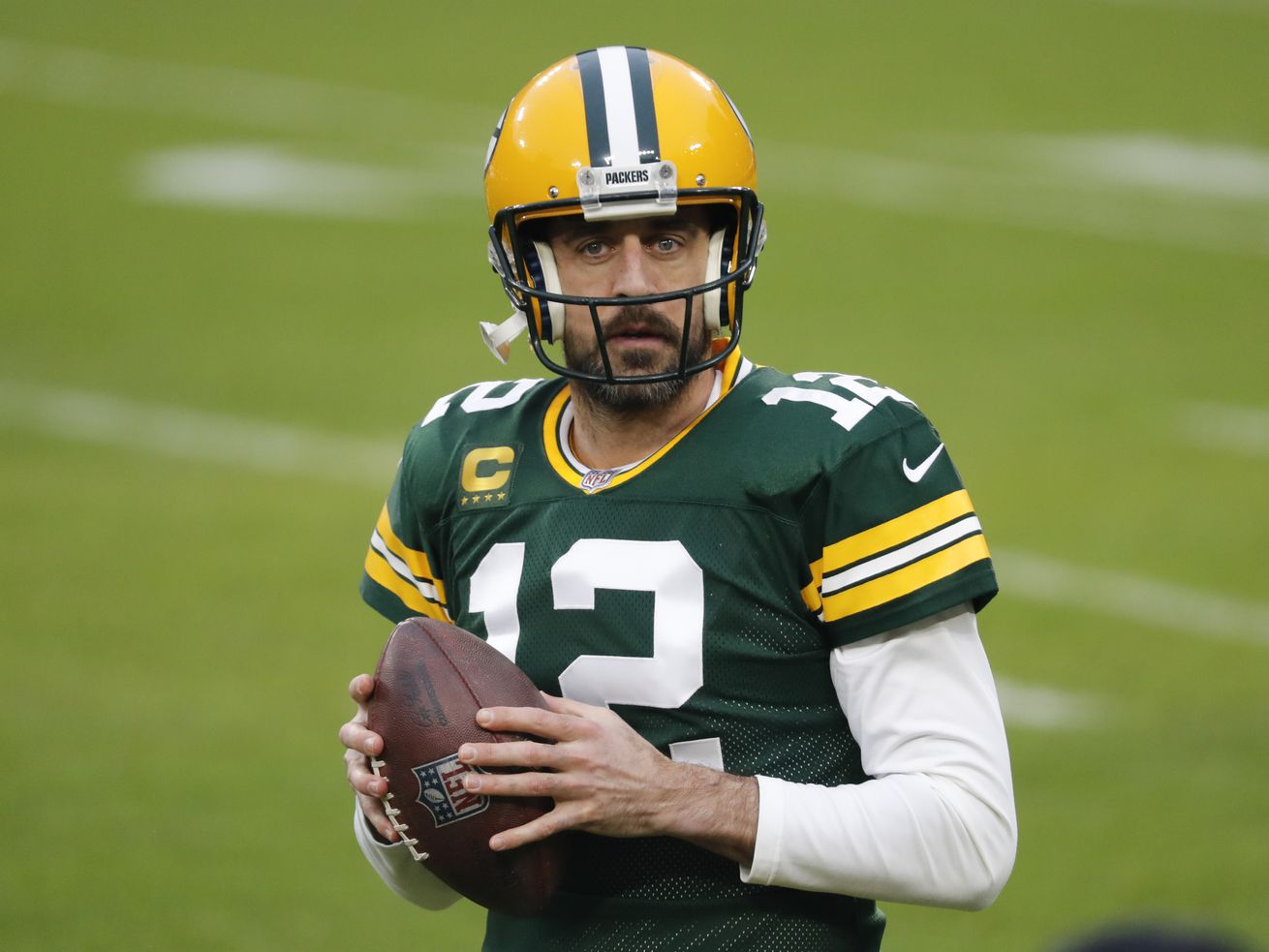
Aaron Rodgers was a no-show at the Packers’ first organized team activities session.
Aaron Rodgers was a no-show at the Packers’ first organized team activities session. | Mike Roemer/AP

The quarterback hasn’t spoken publicly since ESPN first reported April 29 that Rodgers had told teammates he no longer wanted to play for the Packers. Rodgers isn’t required to report for offseason workouts until the start of the Packers’ mandatory minicamp June 8.

GREEN BAY — As expected, quarterback Aaron Rodgers was a no-show Monday for the Green Bay Packers’ first organized team activities session of 2021, a person with knowledge of his plans told the USA TODAY Network. The person spoke on condition of anonymity because they were not authorized to discuss the matter.

ESPN first reported that Rodgers was not in attendance.

The quarterback hasn’t spoken publicly since ESPN first reported April 29 that Rodgers had told teammates he no longer wanted to play for the Packers. Rodgers isn’t required to report for offseason workouts until the start of the Packers’ mandatory minicamp June 8.

Rodgers could provide a firsthand perspective on his standoff with the team Monday night. Kenny Mayne, a staple of ESPN’s “SportsCenter” who announced he was leaving the network this month, tweeted the rundown of his guests on his final episode of the show, scheduled for 10 p.m. Chicago time. Rodgers is among those listed to appear.

In years past Rodgers always has participated in the OTA sessions. But it’s likely other Packers players also stayed away Monday, given the ongoing disagreement between the league and the NFL players association regarding the length of the offseason program.

Tuesday’s OTA session will be open to the media.

Read more at usatoday.com

Read More

Packers QB Aaron Rodgers skips first OTA practice session amid standoff with teamUSA TODAYon May 24, 2021 at 5:16 pm Read More »

Timothée Chalamet gets the Golden Ticket, will play young Willy WonkaAssociated Presson May 24, 2021 at 5:46 pm

Timothée Chalamet was an Oscar nominee for his work in Luca Guadagnino’s “Call Me By Your Name,” | Evan Agostini/Invision/AP

‘Paddington’ filmmaker set to direct story of the candy man before he built the chocolate factory.

Timothée Chalamet will play Willy Wonka in a musical based on the early life of Roald Dahl’s eccentric chocolatier.

Warner Bros. and the Roald Dahl Story Co. announced Monday that the 25-year-old Chalamet will star in “Wonka.” The studio said the film will “focus on a young Willy Wonka and his adventures prior to opening the world’s most famous chocolate factory.”

Paul King (“Paddington,” “Paddington 2”) will direct from a script he wrote with Simon Farnaby, with “Harry Potter” producer David Heyman producing. Warner Bros. earlier this year set a release date in March 2023.

Gene Wilder starred in 1971’s “Willy Wonka and the Chocolate Factory,” based on Dahl’s celebrated book. In Tim Burton’s 2005 reboot, Johnny Depp played Wonka in a Warner Bros. release that grossed $475 million worldwide.

Taika Waititi (“Jojo Rabbit,” “Thor: Ragnarok”) is separately making a pair of animated series for Netflix, one centered on the world of “Charlie and the Chocolate Factory” and one based on the Oompa-Loompas.

Chalamet, the Oscar-nominated star of Luca Guadagnino’s “Call Me By Your Name,” has a number of high-profile projects upcoming, including Denis Villenueve’s “Dune,” Wes Anderson’s “The French Dispatch,” Adam McKay’s “Don’t Look Up” and Guadagnino’s “Bones & All.”

Read More

Timothée Chalamet gets the Golden Ticket, will play young Willy WonkaAssociated Presson May 24, 2021 at 5:46 pm Read More »

Somehow the Same Old New Thingson May 24, 2021 at 4:42 pm

She made me promise to go to the doctor, which I did. My new doctor, with the insurance I had to get after Mike died that didn’t cover my old doctor. My new doctor, in Mike’s old hospital system. My new doctor, who gave me the exact same piece of paper I got after all Mike’s appointments, with the phone number highlighted for where to call to schedule the exact same brain MRIs, with the exact same questionnaires. Only my name is on the top instead of his.Read More

Somehow the Same Old New Thingson May 24, 2021 at 4:42 pm Read More »

Deadliest weekend of the year in Chicago: 12 killed, 42 wounded in shootingson May 24, 2021 at 4:26 pm

At least 12 people were killed and another 42 were wounded in Chicago over the weekend, the deadliest of the year.

Nearly all of the violence happened in neighborhoods on the South and West sides identified by the city last fall as “priority community areas” where police and other resources were to be boosted.

According to a report issued by the Lightfoot administration titled “Our City, Our Safety,” 15 community areas have accounted for more than 50 percent of all shootings over the last three years.

Fifty percent of the shooting victims were “within 10 community areas that comprise 15 percent of the city’s population,” the report noted.

The first shooting of the weekend was in West Garfield Park, where a man was shot 11 times in front of his home, according to Chicago police. Nine other people were shot over the next six hours, including a man and woman in a parking lot in South Chicago; a couple shot to death in a convenience store in East Garfield Park; and just before midnight, a 15-year-old boy killed on a porch in Lawndale — the youngest victim of the weekend.

The boy, Dajon Gater, was shot when two gunmen opened fire in the 3900 block of West Lexington Street, police said. The 15-year-old was shot in his head and taken to Mount Sinai Hospital, where he was pronounced dead, according to the Cook County medical examiner’s office.

Other homicides:

— Early Monday, a 56-year-old man was shot to death in West Garfield Park. Officers found the man unresponsive with a gunshot wound to neck about 1:30 a.m. in the 4500 block of West Maypole Avenue, police said. He was taken to Stroger Hospital, where he was pronounced dead, police said. His name hasn’t been released.

— On Sunday night, two men were found fatally shot in Bronzeville on the South Side. About 8:40 p.m., they were found unresponsive with multiple gunshot wounds inside a car in the 4600 block of South Federal Street, police said. The 49-year-old man and 56-year-old man were taken to the University of Chicago Medical Center, where they were pronounced dead.

— A man was killed and another wounded in a drive-by Sunday in Homan Square on the West Side. About 7:10 p.m., they were riding in a car in the 3700 block of West Flournoy Street, when someone fired at them from the street, police said.

A 25-year-old man was struck in the abdomen and taken to Mt. Sinai Hospital where he died, police said. His name hasn’t been released. A 31-year-old man was also grazed by a bullet on his right shoulder and taken to the same hospital in good condition.

— A man was shot and killed early Sunday in West Garfield Park. The 49-year-old was standing outside about 12:15 a.m. in the first block of North Kilbourn Avenue when someone got out of a silver sedan and began firing, police said. He was struck multiple times in the face and body and pronounced dead at the scene.

— On Saturday night, a man was killed and two others wounded in a shooting in Washington Park. Johnnie Williams, 46, was with two others on the sidewalk in the 5500 block of South Michigan Avenue when people in a gray Jeep and a blue Acura opened fire about 7:30 p.m., police said. Williams was shot in the back and was taken to the University of Chicago, where he was pronounced dead.

Another man, 30, was shot in the head and critically wounded, police said. A third man, 50, was struck in the arm and hospitalized in good condition.

— Early Saturday morning, two men were shot dead in West Garfield Park. They were standing outside in the 4000 block of West Wilcox Street when someone fired shots at 2 a.m., police said.

One man, 24-year-old Haniff Collins, was shot in his head, neck, chest and leg, police said. He was taken to Loretto Hospital where he was pronounced dead, police said. The second man, 29-year-old Derrick McCampbell, died after being shot in the chest, torso and arm.

— Hours earlier, a man was fatally shot on the Eisenhower Expressway on the West Side. Jerry Thornton, 27, was westbound on Interstate 290 about 12:07 a.m. when someone fired shots from another car on the ramp to Austin Boulevard, Illinois State Police said. The Austin neighborhood resident was pronounced dead at a hospital.

— Friday night, a man and woman were shot dead at an East Garfield Park convenience store. About 10:25 p.m., a man was arguing with a 23-year-old woman in the 500 block of North Kedzie Avenue when he began shooting at her and an 18-year-old man with her, police said.

Destiny Nunez of Aurora suffered a gunshot wound to the torso and was taken to Stroger Hospital, where she was pronounced dead, officials said. Adrian Navarro, 18, was struck in the torso and leg and transported to Humboldt Park Health hospital, where he died.

At least 42 other people were wounded between 5 p.m. Friday and 5 a.m. Monday.

Last weekend, 48 people were shot citywide, including a 2-year-old girl, a 13-year-old boy and two Chicago police officers.

Read more on crime, and track the city’s homicides.

Read More

Deadliest weekend of the year in Chicago: 12 killed, 42 wounded in shootingson May 24, 2021 at 4:26 pm Read More »

After another war, displaced in Gaza face familiar plighton May 24, 2021 at 4:35 pm

BEIT HANOUN, Gaza Strip — It took Ramez al-Masri three years to rebuild his home after it was destroyed in a 2014 Israeli offensive. When war returned to the area last week, it took just a few seconds for the house to be flattened again in an Israeli airstrike.

The despondent al-Masri once again finds himself among the thousands of Gazans left homeless by another war between Israel and the territory’s Islamic militant Hamas rulers. He and the 16 others who lived in the two-story structure are scattered at relatives’ homes, uncertain how long they will remain displaced as they wait with hope for international aid to help them rebuild the home.

“My children are scattered — two there, three here, one there. Things are really very difficult,” he said. “We live in death every day as long as there is an occupation,” he said, referring to Israel’s rule over Palestinians, including its blockade of Gaza.

The United Nations estimates that about 1,000 homes were destroyed in the 11-day war that ended last Friday. Lynn Hastings, the U.N. humanitarian coordinator for the region, said hundreds of additional housing units were damaged so badly they are likely uninhabitable.

The destruction is less extensive than in the 50-day war of 2014, in which entire neighborhoods were reduced to rubble and 141,000 homes were either wiped out or damaged.

But following that war, international donors quickly pledged $2.7 billion in reconstruction assistance for the battered enclave. It remains unclear this time around whether the international community, fatigued from the global COVID-19 crisis and years of unsuccessful Mideast diplomacy, will be ready to open its wallet again.

It was 3 a.m. on Wednesday when the phone call from Israel came to a neighbor ordering everyone in the area to evacuate. “Leave your homes, we are going to bomb,” al-Masri says they were told.

The neighborhood is home to members of al-Masri’s extended family. At the time of the warning, he said no one knew which house might be targeted. But he could not believe that the airstrike hit the two-floor home where he lived with his eight children, his brother’s family and their mother.

“If we knew someone was wanted, we would not have stayed here from the outset,” he said. Al-Masri, who owns a small grocery store, said neither he nor his brother have anything to do with militant groups.

The airstrike turned his home into a crater. On Sunday, the massive hole was filled with murky water spewing from broken water and sewage lines.

Seven adjacent homes belonging to relatives were badly damaged. Their walls were blown up, exposing the colorful interior decorations of the living and bedrooms. The blast was so powerful that concrete support beams were weakened and the houses are likely beyond repair.

On Sunday, a mobile pump was deployed to suck the stinky water out as bulldozers worked to reopen streets. City workers were removing damaged power lines. But much of the rubble remained uncleared.

After the 2014 war, al-Masri bounced around between rental homes and “caravans” — small metal huts that dotted hard-hit areas of Gaza like shantytowns. He dreads the thought of returning to the temporary shelters.

“Life was disastrous in the caravans. We were living between two sheets of tin,” he said.

He said he hopes the international community “will stand by us, try to help us so we can rebuild quickly.”

The Israeli military did not immediately respond to a request seeking comment on why the home had been targeted.

Throughout the fighting, it accused Hamas of using residential areas as cover for rocket launches and other militant activity. The army says its system of warnings and evacuation orders is meant to prevent civilians from being harmed.

During the recent fighting, Israel unleashed hundreds of airstrikes across Gaza at what it said were militant targets. Hamas and other armed groups fired more than 4,000 rockets toward Israeli cities, most of which were intercepted or landed in open areas.

The fighting began May 10, when Hamas militants in Gaza fired long-range rockets toward Jerusalem. The barrage came after days of clashes between Palestinian protesters and Israeli police at Al-Aqsa. Heavy-handed police tactics at the compound and the threatened eviction of dozens of Palestinian families by Jewish settlers had inflamed tensions.

The true costs of the war will not be known for some time. Palestinian health officials said 248 Palestinians, including 66 children and 39 women, were killed in the fighting.

Twelve people in Israel, including two children, also died in the fighting.

On Sunday morning, hundreds of municipal workers and volunteers started a one-week campaign to clear rubble from Gaza City’s streets.

Outside a flattened high-rise building, workers loaded rubble into donkey carts and small pickup trucks. Next to a destroyed government building, children collected cables and whatever recyclable leftovers they could sell for a few shekels.

In Beit Hanoun, one of the homes that was struck last week belonged to Nader al-Masri, Ramez’s cousin and a long-distance runner who participated in dozens of international competitions. Since he lost his house in the 2014 war, Nader, 41, has lived in the second of floor of a three-floor home belonging to relatives.

The third and the first floors sustained heavy hits. A room filled with medals and trophies that Nader collected through his 20-year career was damaged. Fortunately, he said, many of his mementos survived.

Nader al-Masri is familiar with loss. Beit Hanoun, situated just along the frontier with Israel, has frequently been the scene of heavy fighting, and his home has been damaged two previous times.

“I had over 150 trophies. In each of the previous wars, I lost one or two or three,” he said. Some 20 glass awards have been shattered over the years. “Each war the number drops,” he said, showing a medal from the 2008 Beijing Summer Olympics.

As a world-class runner from 1998 to 2018, Nader was one of Gaza’s most famous residents, especially after Israel and Egypt imposed a blockade on Gaza following Hamas’ takeover of the territory in 2007.

The blockade often prevented him from traveling abroad to compete. In many cases, he arrived just in time for his races.

On Sunday, debris filled his apartment. The ceiling of his daughters’ bedroom was cracked. The bright layers of paint had fallen off, exposing gloomy, dark plaster. School backpacks lay on the ground among shards and debris.

Nader, now a coach with the Palestinian Athletics Federation, moved his five children to their uncle’s house.

“I’m an athlete and have nothing to do with politics,” he said. “Things are difficult because we cannot build a home every day.”

Read More

After another war, displaced in Gaza face familiar plighton May 24, 2021 at 4:35 pm Read More »

On a mission to heal after exposing her dad to deadly viruson May 24, 2021 at 4:38 pm

SHARON, Mass. — For a year, Michelle Pepe awoke every day, recited the Kaddish, the mourner’s prayer, and kissed a photo of her father. And coped with her guilt.

“‘Dad,” she says, “I’m so sorry that this happened.”

“This” was COVID-19. In March 2020, just as the pandemic bloomed in the United States, Pepe traveled from Boston to Florida for her mother’s 80th birthday. She believes she gave the coronavirus to her father; Bernie Rubin died weeks later.

“At the beginning, people would say, ‘Well, how did he get it?’ From me. That’s how he got it — he got it from me,” Pepe says, sobbing.

“Nobody’s ever said, ‘This is your fault and you gave it to him,’ but I know it’s true. I know I couldn’t save him. It’s just something I’m going to have to go to the grave with.”

Hers is a common sorrow of the times. Around the world, countless people are struggling to shake off the burden of feeling responsible for the death of a loved one due to COVID-19. They regret a trip or feel anguish over everyday decisions that may have spread the disease — commuting to work, hugging parents, even picking up food.

On the eve of the anniversary of her father’s death, Pepe’s hands tremble as she holds a framed portrait of Bernie and Phyllis Rubin, smiling and surrounded by their 10 grandchildren. Taken on March 8, 2020, it’s one of the last images of the couple with their family.

After the celebration, Pepe stayed in Florida to take care of them during the pandemic. She believes she caught the virus while shopping for groceries for her parents. Then her father and mother sickened. Worried about his worsening condition, she called 911. He died alone at Delray Medical Center; family members were unable to visit him.

“I shouldn’t have given up and called the ambulance,” she says. “That’s what haunts me, and thinking about him, alone in that room … I know he was terrified.”

There was just a brief, socially distanced graveside burial. Pepe watched on Zoom while she continued to care for her mother, who has multiple sclerosis and was recovering from COVID-19.

Pepe has been battling despair ever since.

“I was in a real funk for a real long time,” she says. “And then one of my daughters said to me, ‘Mommy, we thought that we lost our grandfather, but … we didn’t realize we also lost our mom.’ I figured I have to snap out of it.”

Pepe joined online support groups where she met other grieving survivors; went to a psychic medium, searching for signs; and sought guidance from a rabbi who taught her how to recite the Kaddish.

On April 13, she awakens to say the prayer and light a yahrzeit candle marking the one-year anniversary of her father’s death. “We just have to get through this day,” she repeats on the drive to the cemetery. She wears her father’s gold chain and high school graduation ring.

At his grave, she places yellow flowers on a tombstone that reads: “Loving husband, father, pup” — his nickname — “and great grandfather.” In the Jewish tradition, family members leave behind small stones.

They remember a man who adored his grandchildren, calling them daily to catch up on the latest Red Sox news or to invite them to games at Fenway Park. In recent years, “he couldn’t walk very fast — unless it was for a baseball game. Then he’d turn into Carl Lewis!” says Bob Pepe, Michelle’s husband, who worked with his father-in-law and remained his close friend for 30 years.

The furniture store that Rubin founded with his wife in 1983 grew into the Bernie & Phyl’s Furniture chain, with nine locations across New England.

The couple were featured in TV commercials best-known for their catchy jingle. Strangers would often recognize them at restaurants and recite the catchphrase: “Oh, are you Bernie from Bernie and Phyl’s, quality, comfort and price?”

And Bernie Rubin would chime in, as in the ads: “That’s nice!”

After the cemetery, Pepe visits the company’s headquarters in Norton. She admires the walls adorned with hundreds of autographed photos of baseball players her dad began collecting as a kid. She takes a deep breath and walks into his office, decorated with another, equally prized collection: photos of his family on cruise vacations, at bar mitzvahs, college graduations and weddings.

She picks up her dad’s work phone, leaning in close to take a whiff as she often does with his wallet, his shirts and his cologne, hoping to sense his presence. But she smells nothing — COVID-19 robbed her of her senses of smell and taste.

At lunch, the family walks to Rubin’s favorite restaurant and orders the “Bernie Reuben,” a sandwich named after him. Every day, Rubin would walk into Kelly’s Place to order a cheese omelet and go through the same comedic routine with a waitress.

“‘Carol, I have to stand here for 20 minutes? There’s 10 empty tables. How do you run a business like this?'” Bob Pepe says, imitating Bernie’s voice. “And she’d go: ‘Will you shut up? You know where you’re sitting, go sit down!'”

Sitting next to her husband, Michelle Pepe bursts into laughter. Later, she wipes away tears.

“It was torture,” she says. “But a year later, here I am, and I can laugh at these stories.”

The next day, she awakens to kiss her father’s photo. She looks at the calendar and heaves a sigh of relief. The ritual year of mourning is over.

“My father would be so tortured if he thought about how tortured I was, and I want him to be happy and at peace,” she says. “And he’s only going to be that way if I’m that way here.”

___

Associated Press religion coverage receives support from the Lilly Endowment through The Conversation U.S. The AP is solely responsible for this content.

Read More

On a mission to heal after exposing her dad to deadly viruson May 24, 2021 at 4:38 pm Read More »