The NBA is attempting to create some fun and energy amidst the COVID-19 pandemic by televising a first-ever competition, and the ChicagoBulls will participate.
It has been a rough month or so for sports fans. It all began when the NBA learned of Rudy Gobert and his testing positive for COVID-19. For a team like the Chicago Bulls who had almost no chance of the postseason, fans might want to start looking towards next year.
The diagnosis almost immediately shut down the 2019-2020 season temporarily, and maybe even for good.
In the meantime, though, the league has been brainstorming ways to not only make up for some of the lost revenue during the suspension, but entertain their fans.
ESPN’s Adrian Wojnarowski first reported recently that the NBA has been working hard at putting together a special, never-been-done-before type of event. This competition will be a televised game of H-O-R-S-E and is going to feature plenty of familiar faces for basketball fans.
Download theScore App for the latest Basketball Scores, Stats, News and Odds
There will also be NBA alumni and WNBA players involved, and of course, the plan is to play this game in several places all at once. It should be impressive seeing the whole thing come together, but fans will have something brand-new to keep them entertained for a little while.
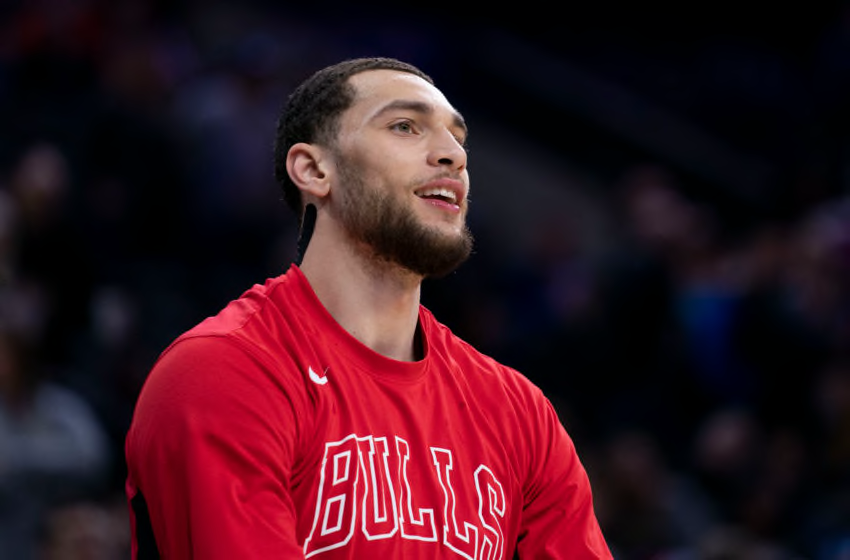
As more and more participants are announced, fans’ excitement will only grow as the event gets closer. It will be especially fun to watch if LaVine pulls off something similar to this game-winner:
Zach LaVine knocks down the game winning shot to cap off his career night and earn your Heads Up Play of the Day! ? pic.twitter.com/A5sIVsjRbO
The other option would be for LaVine to solely attempt jaw-dropping dunks the entire time, which would likely end up crowning him the champion. Maybe we see a free throw line attempt involving a 360? Wouldn’t that be something.
Obviously, the rules will probably prevent that — but, imagine how fun a simple dunk contest could be during the slow sports time we’re in? I think that should be next on the docket for the NBA.
For now, fans will get a chance to see one of their own players on a large, televised stage. No date has been officially announced just yet, but as Wojnarowski reported, things are getting closer to being done.
See, things aren’t so bad, are they? Pretty soon we will have the league’s H-O-R-S-E competition and in just days, we will get to watch the much-anticipated 10-part ESPN documentary, The Last Dance. Oh, and GarPax is no longer a thing — never forget that. Keep your head up, Bulls fans.
2131 W. Belle Plaine Ave. in Chicago: $1,549,900 | Listed on Feb. 19, 2020
This 3,981-square-foot new construction North Center home has five bedrooms and 5.5 bathrooms. The main level has 10-foot ceilings, 8-foot doors, white oak hardwood flooring and a combined living and dining room. The kitchen is made up of an island with a waterfall countertop, under cabinet lighting, dual pantry closets and a butler’s pantry with a wet bar and wine fridge. Two walk-in closets can be found in the master bedroom as well as a bathroom featuring a body spray steam shower, soaking tub, vanity with dual sinks, quartz countertops and heated flooring. The finished basement includes radiant heated flooring and a recreation room with a full wet bar. The fully enclosed yard features landscaping, new sod and a rear paver patio with a gas hook-up. A detached two-car garage has a finished roof deck.
Agent: Jason O’Beirne of Jameson Sotheby’s International Realty, 312-751-0300
If you are like me, you are used to jumping out of bed every morning and hitting the ground running. Not so much these past few weeks. We are all on lock down and sheltering in place. I don’t think its been easy for anyone. My motto has been stay busy stay sane. Each day I set goals for myself. They are small in comparison to what I normally try to accomplish.
Here are some projects to help keep you busy:
1. Paper Management- This is the perfect time to go through your papers and clean out your filing system or create one. You can also change your bills over to paperless to cut down your mail.
2. Sign up for Catalog Choice and unsubscribe from your catalogs.
3. What about all those emails coming in your inbox? You have the time to evaluate them right now vs just pushing delete. Its time to free up your inbox.
4. Clean out that coupon organizer- evict the expired.
5. Its a good time to go through those bathroom toiletries. Remember all those travel sized samples that you have been saving? This is the perfect time to use them. This will save you money! Put them in rotation and toss out the old stuff.
6. What’s in your pantry? What recipes can you make with those ingredients? Time to meal plan. Consider freezing some of your food as well.
7. Spring is almost here! Time to change out those closets and evaluate what you need for the new season.
8. Organize and categorize your dresser drawers.
9. Time for a toy purge? What is age appropriate for your kids?
10. What about those junk drawers? This is a perfect little project!!!
I hope these suggestions help keep you busy and give you some direction!!!
Dear Cubs Den Readers:In the wake of recent developments, Cubs Den is doing it’s part in trying to provide their readers with continual Cubs content. To that end, please enjoy this article recently publish at Prospects1500.
Aramis Ademan by Stephanie Lynn, Jose Albertos by Rikk Carlson
In 2018, most prospect lists for the Chicago Cubs had any one of shortstop Aramis Ademan, right-handed pitcher Jose Albertos, or catcher Miguel Amaya at the top. A few conservative raters had right-hander Adbert Alzolay first, but those three were not far behind.
However, at the start of the 2020 rating period, both Ademan and Albertos were left off of my Prospects1500 Cubs Top 50 list. What happened?
Most of these players would make it to the big leagues with the parent club. But the others ended up traded for major league talent, with no prospects in return. Making the situation more tenuous was the focus of Cubs’ player development. The Cubs’ emphasis on scouting and developing only top selections meant that they did not have the mid-round talent to fill the gaps. The result was a deepening talent void. Adding to the dearth were the 2016 and 2017 drafts that have yet to yield a Top 10 player.
It’s mid-February. Height of the flu season. I was at my primary care doctor’s office. Before I could see him, they made me put on a protective face mask. He said it was to protect him from illness so he could continue to see and help his patients.
When I checked out at the front desk, I noticed a box of those protective masks. They were next to a bowl of condoms. Safe sex, safe breathing!
I grabbed a couple of masks and took the above photo. It was done as a joke. Who knew I was two months ahead of my time?
Over the weekend, Illinois residents were told by Governor Pritzker that if we have to go outside, we should wear a mask. It’s for our protection, as well anyone we come into contact with. Safety all around. Makes sense, right? Even Donald Trump says we should wear them, although he won’t. Sigh! Something about dictators not respecting him. Sigh!
Yesterday, I’m taking a drive around the suburb in which I’m hibernating. While I’m cruising down the main drag of this town, I counted ten people out for a walk. Out of those ten, only one person was wearing a mask. ONE!
I don’t get it! I can’t begin to understand why anyone would take the slightest chance of becoming ill..or worse. If you are going anywhere you might encounter people, wouldn’t you want to take every precaution possible?
The mask you see in the above photo is gone. I have no idea where it is. I probably tossed it immediately after taking the joke photo. I now have a makeshift mask. It’s a scarf that wraps around my face. Yeah, it’s tough to breathe through it, but better that now than not being able to breathe at all later.
Type your email address in the box and click the “create subscription” button. My list is completely spam free, and you can opt out at any time.
My so called friends think it’s time to edit this section. After four years, they may be right, but don’t tell them that. I’ll deny it until they die!
I can’t believe I’ve been writing this blog for four years.
It started as a health/wellness thing and over the years has morphed to include so many things that I don’t know how to describe it anymore.
I really thought this was going to be the final year of the blog but then Donald Trump came along. It looks like we’re good for four more years..God help us all!
Oh yeah…the biographical stuff. I’m not 60 anymore. The rest you can read about in the blog.
This photo, “2016.04.06 Digital Health Howcove – Telehealth 00108” is copyright (c) 2016 Ted Eytan via Flickr and made available under an Attribution-Share Alike 2.0 license
In the midst of the coronavirus pandemic, telehealth has allowed people to engage their primary care physicians remotely while practicing social distancing. With recent changes to FCC and Federal Medicaid/Medicare policy, telehealth is now gaining greater traction and attention. With a recent West Monroe Partners study finding that although 80% of hospitals in the U.S. have some sort of telehealth service, only 18% of 1,000 Chicago residents surveyed used telemedicine services in the past year (and that 73% are open to using telemedicine as an alternative to in-person visits), we talked to Nathan Ray, director in West Monroe Partners’ Healthcare & Life Sciences practice, about the background of their study and why telehealth services are a critical tool.
Photo by Gordon Dymowski
Telehealth services provide physicians the opportunity to more effectively engage and maintain patient relationships as well as provide preventative and treatment options. For example, someone who has initial symptoms of a cold can contact their physician remotely rather than wait until there is a need for in-person intervention. (Triage for coronavirus is one service that can be performed via telehealth services. ) Certain specialized fields like dentistry are great opportunities for telehealth services; fourteen to fifteen (14 – 15) percent of emergency room visits are based on dental emergencies and would be easily preventable through early telehealth intervention. Preventative measures and interventions (like a remote session with a dermatologist about skin issues) become easier for patients through telehealth, and behavioral and mental health issues can be more easily addressed through telehealth services. (One great example are telepsychiatry services recently implemented by the Chicago Department of Public Health).
According to Nathan Ray, Medicaid and Medicare will allow providers to bill and be reimbursed for any type of encounter with patients where health issues can be monitored without the need for an inpatient visit, including physical and behavioral health encounters. Prior to the current coronavirus/COVID-19 pandemic, only a few providers were early adopters of telehealth, with many physicians considering it a potential future strategy. There are currently no standard tools or platforms for telehealth as many providers are using readily available online communication tools to provide services, and this can potentially remove barriers to people engaging specific health services (Dental hygienists in rural areas could share charts with remote dentists to provide greater access to patients and lower costs). As more people are stuck in their homes due to coronavirus/COVID-19, telehealth services “reduces the friction” of seeing their physician (as Nathan explained) and lowers the overall cost of primary care visits.
From March 4 to March 16, West Monroe Partners surveyed 1,000 residents in the metropolitan Chicago area (as well as residents in Seattle and Minneapolis) around their use of telehealth services. (Links to infographics are provided) All three cities showed similar results: approximately one out of five residents had used telehealth services, and four out of five would consider using telehealth services. As Nathan Ray explained, physicians who provide telehealth services can not only engage in more preventative measures but also facilitate greater engagement by reducing overall resistance and removing key barriers such as taking time from work and travel expenses. With federal legislation empowering Medicaid/Medicare reimbursement for telehealth services, private and employer-based insurance providers may follow as they observe how Medicaid providers adopt and develop policies around telehealth reimbursement.
Even outside of the current coronavirus/COVID-19 panic, telehealth provides a great opportunity to foster greater engagement and interaction between patients and their primary care providers. With Chicago’s current stay-at-home policy in place, many people rely on telehealth providers as a way to maintain their relationship with their physician, but also as a critical self-care strategy. As my recent conversation with Nathan Ray of West Monroe Partners reveals, telehealth is not only just a critical tool; it also has the potential to shape how health care resources are used. With its potential to reduce resistance towards engaging primary care providers, telehealth has the potential to facilitate a deeper, more productive relationship between patients and their physicians.
Especially after the current crisis ends.
Have questions or comments? You’re welcome to leave them in the space below or join the conversation on our Facebook page. You can find other contact information via this blog’s About page. (If you want to pitch a story for us to cover, please review our PR policy before contacting us).
As a professional, I’ve worked with – and admire – nonprofits, social enterprise, and other mission-driven community organizations. I enjoy learning about how many organizations are using technology and social networks to drive their mission. I also enjoy writing about them, and sharing that information with others. For more about me, please visit http://www.gordondymowski.com
You’ve had your turn. Now it’s time to tune up an economic recovery– to full employment, a vibrant functional financial system and prosperity. It won’t be easy, as you indicated in a Wall Street Journal podcast.
Anthony S. Fauci, M.D. NIAID Director (NIAID photo)
But as rapidly as the coronavirus showed up, the economy has crashed into the pit at even greater speed. While you look for a leveling off of the coronavirus incidence, the economy is failing at magnitudes much greater. This cannot continue.
You’ve done a great job, cutting through the scientific mumbo-jumbo and stepping into the leadership vacuum. You deserve the accolades.
But sometimes the science isn’t working. Take, for example, those models that were supposed to predict the seriousness of the pandemic. The results are all over the board, ranging from 20,000 deaths to more than a million. Useless. That’s like saying that buying an airplane ticket to New York from Chicago ought to be for 10,000 miles. Or 20 miles. The problem with the models is that, as you know, the required data are incomplete, and the more incomplete, the more unreliable is the output.
Maybe it’s prudent to base the strategy for combatting the pandemic on the worst possible scenario. But by now it’s apparent that it was wrong, that a policy of using a sledgehammer to swat a fly is overkill.
Then there’s this battle over whether anecdotal evidence should help guide our policies. Yes, the scientific method requires careful and rigorous clinical testing. To fully understand COVID-19, months and months of testing will be required. As you said, “sometime next year.”
We can’t wait that long. Anecdotal evidence of treatments that can dramatically reduce the disease’s symptoms is, nonetheless, evidence. And there’s evidence that drugs such as hydroxychloroquin have eased those symptoms. No, they cannot be called a miracle cure, but demands that they not be used until complete tests prove them safe and effective is, if I may, insanity. An example of how the perfect is the enemy of the possible.
If, indeed, if we’re beginning to see signs of the “flatting of the coronavirus curve,” there’s still the straight line of an economy heading for a crash landing. That, unlike the models, is something that we can be sure of.
True, the value of the lives of those killed by COVID-19 cannot be calculated. But that doesn’t make the grievous losses suffered by millions of Americans (including the 10 million who have applied for unemployment benefits it just two weeks) any less tolerable.
We’re about to eclipse the Great Depression. The time is past where we should not just thinking about how we can restore economic sanity in a measured way. It’s time to start doing it. Now. As you said, doctor, it won’t be like “throwing on a light switch.” But no longer we wait before we actually start doing it. Each hour we wait, the more prolonged and miserable will be the lives of hundreds of millions Americans.
Lenny is a three-year-old, strong-willed, high-energy, well-trained, 50-pound, Black and Tan Coonhound-mix looking for a loving guardian.
Lenny is great with other dogs and is looking for a strong handler to help direct his energy.
He is perfectly housebroken and actually enjoys his crate, so it’s a great place for him to be kept when visitors uncomfortable with dogs arrive.
Lenny has been professionally-trained and included in his adoption is a training class and a few private training lessons (when the pandemic is over).
He is loyal and loving to his people, but distrustful of strangers at first. He’s looking for a loving person or adult who can help guide him and keep him safe. He’s great in the car and is good on leashed walks.
His adoption fee of $275 benefits Rescue. He is very healthy, microchipped, vaccinated, de-wormed, neutered, heartworm-tested and on monthly preventative.
To meet and possibly adopt Lenny, please e-mail [email protected] for an adoption application.
After every crisis, after every disaster, there’s always a politician, journalist or other mentally challenged person who demands to know why help hasn’t shown up.
Right now. Lickety split. As if there’s a facility, like a 24-hour manned firehouse, in which doctors wait around so they can be free to rush to the scene of a hurricane, tornado, flood or tsunami to tend to the injured As if there are warehouses full of medicines, tests, pre-packaged food and other materiel that can be loaded on a plane and flown to the scene before the dust settles.
(Gary Middendorf / Daily Southtown)
And so it is with the coronavirus pandemic. Where are the masks?! We need more ventilators?! Groves? Don’t have any. Personal protection equipment? Gowns? Tents? Prepackaged food? No, no and no.
Then come the accusations: It’s Trump’s fault. It’s Obama’s fault. It’s the governors’ faults. Might as well add, it’s Bush’s fault.
Where this comes from is an abysmal failure to understand of the difficulties and complexities of moving people and stuff around. Especially on a moment’s notice. It’s called logistics.
Logistics is generally the detailed organization and implementation of a complex operation. In a general business sense, logistics is the management of the flow of things between the point of origin and the point of consumption to meet the requirements of customers or corporations. The resources managed in logistics may include tangible goods such as materials, equipment, and supplies, as well as food and other consumable items. The logistics of physical items usually involves the integration of information flow, materials handling, production, packaging, inventory, transportation, warehousing, and often security
If the states, for example, had gathered all the supplies necessary to fight a pandemic on a moment’s notice, people would have demanded: “What are you spending all that money on stuff that might never happen, when our needs are much more immediate.” In Illinois, that would be government employee pension funds.
There are no doctors’ or nurses’ B teams, ready to rush to anywhere in the nation’s four corners. Minor leaguers can’t be called up. Spare trucks aren’t idling in the crisis lot, with drivers ready to jump aboard like World War II fliers from the barracks to their planes to fight incoming bombers.
Current in the American mindset is an attitude that we have to be protected from every possible threat. Whether the threat is seen or, unbelievable, unseen. Years ago I served as a Navy supply officer, so I have an appreciation of the difficulties of obtaining that critical spare part needed to get the ship underway tomorrow morning.
As such, I appreciate the work that the men and women in the “supply chain” face–the warehouse people, the transportation people, the purchasing agents, the planners. We owe them our thanks as much as anyone who is on the front lines trying to keep us healthy.
2020 Toyota 4Runner TRD Pro (Photo by Jill Ciminillo)
It was only after I pulled the ticket out of the machine and started to proceed through through the gate that I looked up and realized maybe this wasn’t such a great idea.
I held my breath as the 2020 Toyota 4Runner TRD Pro, with roof rails, cleared the cement beam as I started to inch the vehicle forward up the ramp of the parking garage. Then it cleared the next one. Every time I passed a cement beam, I held my breath, instinctively ducked my head and let out a reflexive sigh when I didn’t scrape anything.
Maybe it would be OK.
And it was. Until I scraped a sign hanging from one of the beams.
Note to self: The Toyota 4Runner, with roof rails, should probably be parked on the street next time.
I like the 4Runner for so many reasons, but I’m going to issue a huge spoiler alert here: This isn’t a great city vehicle.
The 2020 Toyota 4Runner TRD Pro just barely cleared the pipes and cement beams in a Chicago parking garage. (Photo by Jill Ciminillo)
The Hits
The most striking thing about the test vehicle was the bold Army Green paint color. Without seeing anything else, that alone says: Don’t mess with me. Add that to the upright stance, big knobby tires and roof rails, the test vehicle looks ready to tackle the zombie apocalypse.
The interior is a nice blend of rugged and upscale. As a part of the TRD Pro package, the test vehicle included the all-weather floor liners, so I didn’t feel bad stepping inside with muddy running shoes. The leather seats were more functional than luxurious, but the embroidered TRD badge on the headrests was a nice touch.
The perforated leather on the steering wheel and the carbon fiber insert surrounding gearshift were also a nice touch.
As a petite driver, I appreciated the available running boards ($345), so I didn’t have to climb a mountain every time I got behind the wheel. And surprisingly, for such a large vehicle, I was able to get a good driving position with great visibility out the windows and a decent distance from the steering wheel.
Another huge bonus for 2020: The 4Runner gets a tech upgrade. It adds things such as Apple CarPlay, Android Auto and Alexa connectivity as well as Toyota’s active safety system TSS-P, which is standard on every trim.
We recently discussed the 4Runner on the Car Stuff Podcast, and it’s interesting to note this vehicle sits in the same class as the new Toyota Highlander, but we didn’t think the two vehicles compete because they target two completely different customers. The 4Runner is more adventure-ready, whereas the Highlander is family focused.
Also interesting to note is the 4Runner has experienced a resurgence of late, partly due to the fact it hasn’t ditched its body-on-frame architecture or upright and boxy stance in favor of aerodynamics and ride comfort. It’s a truck, and it works like a truck.
The 2020 Toyota 4Runner TRD Pro gets some new tech, including Apple CarPlay and Android Auto. (Photo by Jill Ciminillo)
The Misses
While it’s hard to call this a miss because it’s likely a part of the allure, the ride and handling is very rough. I felt like a U-Boat commander every time I got behind the wheel. The turning radius isn’t tight, and the knobby tires give you a lot of feedback in the steering wheel.
There is also a significant amount of outside noise that enters into the cabin — from the tires, from the road and from the wind.
The biggest miss is going to fuel economy. The EPA doesn’t even pretend that the Toyota 4Runner can get decent numbers, and it’s rated at 16 mpg in the city and 19 mpg on the highway. I averaged about 15.8 mpg in mostly city driving.
2020 Toyota 4Runner TRD Pro tires send a lot of road noise into the cabin. (Photo by Jill Ciminillo)
The Trims
The Toyota 4Runner has eight different trim variants. Rear-wheel drive is standard at the base level, and all-wheel drive is available.
SR5: $37,240
SR5 Premium: $40,435
TRD Off-Road: $40,960
TRD Off-Road Premium: $43,690
TRD Pro: $50,985
Limited: $46,105
Nightshade Special Edition: $47,845
Venture Special Edition: $45,505
The test vehicle was a TRD Pro and added a couple of small option items such as the sliding rear cargo deck, running boards, cargo divider, door edge guard and blackout emblem overlays for an as-tested price of $51,968.
I love the looks of the 2020 Toyota 4Runner TRD Pro, but it is a tight fit in the city. (Photo by Jill Ciminillo)
The Chicago Factor
Anyone who follows me on instagram, will likely be familiar with the will-it-fit game I like to play with the larger vehicles I end up testing. I take a picture of the vehicle in my driveway and ask people to vote on whether they think it will fit in my small city garage.
The Toyota 4Runner TRD Pro actually got a lot of “yay” votes — and they were right. It did fit in my garage — barely. But as I stated above, I’d think twice about parking it in a public city garage.
This would be a tough vehicle to live with in the city on a daily basis — not only to parallel park but also to maneuver in any of the several small spaces you encounter while living in a city. Backing it into my garage when my neighbor was already in her space was a delicate ballet (thank goodness for back-up cameras), and driving through the Mariano’s parking lot at noon on a Sunday had me white knuckling it.
The one place the 4Runner shines in the city: Every time it drives over the plethora of potholes and speed bumps. The extra ride height and TRD-tuned FOX shocks and springs provide added cushion, so I didn’t feel like I was going to scrape anything or pop a tire while traversing the obstacle course that is Chicago city streets.
The Specs
Engine: 4.0-liter V-6 Horsepower: 270 Torque: 278 lb-ft Fuel economy (combined): 17 mpg Drivetrain: RWD (std.), 4WD (avail.) Height: 71.5 inches (72 inches for TRD Pro) Width: 75.8 inches Length: 190.2 inches (191.3 for TRD Pro) Wheelbase: 109.8 inches Seating capacity: 7 Cargo capacity (behind rear seats): 47.2 cu ft (46.3 cu ft with sliding deck) Base price: $37,240 Price as tested: $51,968




2 comments