What’s New

5 Satisfying Breakfast Takeout Spots in LakeviewAlicia Likenon April 29, 2020 at 7:19 pm

Local Chicagoans know: downtown is for work, Lakeview is for living. The community’s casual vibes and idyllic shoreline make it feel like a coastal city, bustling with nice, Midwestern folks. Five-star restaurants and bars have flocked to the area, serving it’s roughly 100,000 residents. So of course, top-notch breakfast spots aren’t hard to find. Here are five of our favorite early-bird eateries that are still offering breakfast takeout in Lakeview during COVID-19. 

Advertisement


Maison Parisienne

This quaint French cafe is known for satisfying its customers with buttery croissants, savory quiches, and breakfast sandwiches. Looking to dabble in a new morning drink? Try their lavender rose latte or spicy hot chocolate. Order on Grubhub, you won’t be disappointed.

Breakfast
Photo Credit: Batter & Berries Facebook

Batter & Berries

French toast is nice. But have you ever had a World Famous French Toast Flight? Treat yourself to blueberry, strawberry, lemon, and caramel french toasts made with locally baked Brioche bread and B&B maple butter. Tack on a deconstructed omelet or a giant Belgium waffle and there’s a good chance you’ll be full until Halloween. Get the goods on Grubhub

Advertisement


The Crepe Shop

Inspired by street eats of Paris, this relatively new neighborhood joint dishes up a unique twist on crepes. Their menu is tiny but mighty. Feeling savory? Go for honey truffle or ham and cheese. Got a major sweet tooth? Try Nutella or lemon curd. Pair your crepes with a Mocha New Belgium which consists of espresso, bourbon vanilla, Belgium chocolate, and coconut cream. Get the hookup on Grubhub and start your morning right. 

Advertisement


Mortar & Pestle
Photo Credit: Mortar & Pestle Facebook

Mortar & Pestle

Chicago Chef Stephen Ross launched Mortar and Pestle to focus on making everything by hand and getting back to the basics. The stylish and sleek bistro offers delectable items like Alaskan King crab benedict, foie gras and eggs, and bircher muesli. Open daily for breakfast takeout

Southport Grocery & Cafe

Looking to stock up your pantry and grab some grub? Pop into this hybrid grocery & cafe where you’ll find shelves stocked with soup mixes, chocolate sauce, spreads, spices, and some of the area’s best preserves. Then make your tummy happy with one of their unique breakfast offerings. Popular items include a grown-up Poptart, cupcake pancakes, and a roasted butternut squash bacon omelet. Place an order on Caviar and make your day amazing. 

Read More

5 Satisfying Breakfast Takeout Spots in LakeviewAlicia Likenon April 29, 2020 at 7:19 pm Read More »

Top football recruits bring in big money for colleges — and COVID-19 threatens it allContributoron April 29, 2020 at 4:53 pm

Colleges and universities are spending more than ever to land the nation’s top football recruits, with some schools having boosted their recruiting budgets by more than 300% in the last five years.

These budgets can surpass $2 million for schools like the University of Tennessee.

Is it worth it?

I study economics. Research I recently did shows just how big the payoff for spending money to recruit the best players can be.

Half a million dollars

The schools that secure five-star recruits — the 30 or so players judged to be in the top one-hundreth of the top 1% of high school football players — can increase total revenue by over $500,000 for a university’s athletic department. Most football teams never secure a five-star recruit. Others, such as the University of Alabama and Louisiana State University, recruit three or four every year.

My research team came to this $500,000 figure by linking 10 years’ worth of football recruiting information from Rivals.com and Scout.com, two of the top recruiting services for prospective college football players, with federal data on how much colleges take in and spend on athletics, win-loss records for individual schools and post-season bowl appearances.

The data shows revenue and expenditures for each sport separately, which made it possible to determine what a football recruit added to football revenue at each university.

Schools like the University of Oklahoma, the University of Michigan and Notre Dame, which on average bring in over a dozen four- or five-star recruits every year, bring in millions of dollars more in revenue when they land more of the top recruits in a given year.

For instance, my estimates suggests that Clemson University’s five-star recruits, of which there were five, and 12 four-star recruits — also in top one-quarter of 1% of all players — in the 2020 recruiting class will increase the school’s football revenue by well over $3 million, well above its $1.8 million recruiting budget.

The reason is simple: Top recruits help teams win.

Since a top recruit correlates strongly with increases in the number of victories, they help determine the type of post-season play. Five-star recruits are not the deciding factor in whether a school gets to a bowl game, the mark of a winning season — the big-time programs will have winning records every year without fail.

But they do push them to the upper echelon of post-season play — the College Football Playoffs or its forerunner, the Bowl Championship Series. Reaching the championship level in college football contributes to lucrative broadcast contracts, corporate partnerships and even more successful recruiting.

Very few schools are consistently successful in the race to recruit top football talent and win at the highest levels. Just as nine schools have been responsible for 20% of all players drafted into the NFL over the past two decades, only six schools have made it to the College Football Playoff championship game.

Financing other sports

There is more than hoisting football trophies at stake.

College football is a key driver of athletic department revenue as well, helping to pay for other sports programs. Athletic departments that field more than 30 varsity teams do so understanding that fewer than five varsity teams generate enough revenue to cover the entire athletics department’s expenses.

In fact, some critics argue that big-time college sports, which feature rosters made up primarily of black student-athletes, pay for the sports programs that include overwhelmingly white student-athletes, such as lacrosse and swimming, which receive far less media attention but are the bulk of athletes in major collegiate sports programs. Sixty-one percent of all student athletes are white.

Football revenue also helps finance athletic recruiting efforts and amenities, such as state-of-the-art facilities. All of that takes money, which takes recruits, which takes money. Every recruiting video, campus visit and hosted meal is a line item on an athletic department’s budget.

COVID-19 repercussions

The possibility of there being no college football season in the fall of 2020 is making athletics departments fear big budget cuts.

Already, some schools are dropping sports that were subsidized by college football revenues, like men’s soccer and wrestling. Smaller schools that depend on a few $1 million paydays in September from the major programs, may be left with gaping holes in their athletic budgets, threatening all sports.

There is little doubt that changes are coming to the current model of athletic department operations through a variety of converging forces. COVID-19 is unleashing widespread job losses, business closures and declining consumer spending that will limit what fans and advertisers can spend on football.

Another factor could be a change by the National Collegiate Athletic Association — which governs college athletics — that could allow student-athletes to get paid from their name, image and likeness.

While schools rich with talent may continue to get richer, those schools further down the recruiting pecking order will be left to wonder how they can survive at all.

Trevon Logan is a professor of economics at The Ohio State University.

This article originally was published on The Conversation.

Send letters to [email protected].

Read More

Top football recruits bring in big money for colleges — and COVID-19 threatens it allContributoron April 29, 2020 at 4:53 pm Read More »

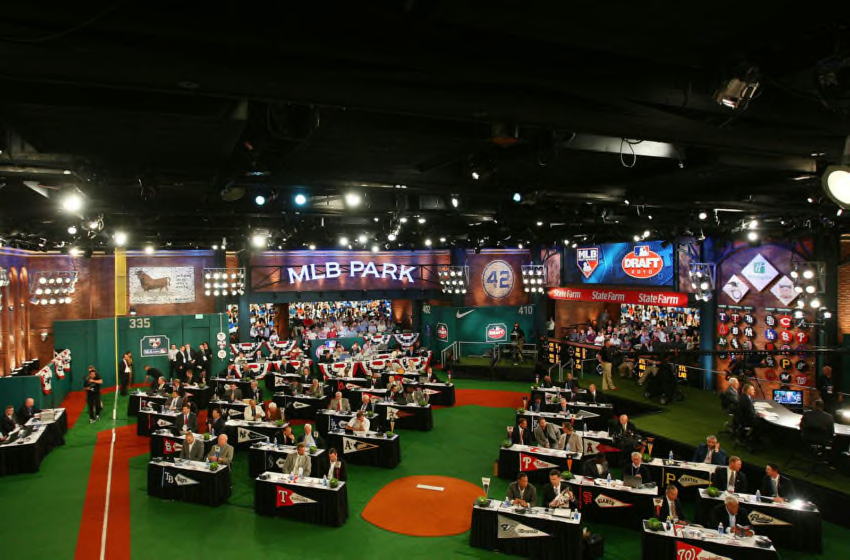
Chicago Cubs: Latest mock draft has puzzling first round pickRyan Sikeson April 29, 2020 at 1:00 pm

Read More

Chicago Cubs: Latest mock draft has puzzling first round pickRyan Sikeson April 29, 2020 at 1:00 pm Read More »

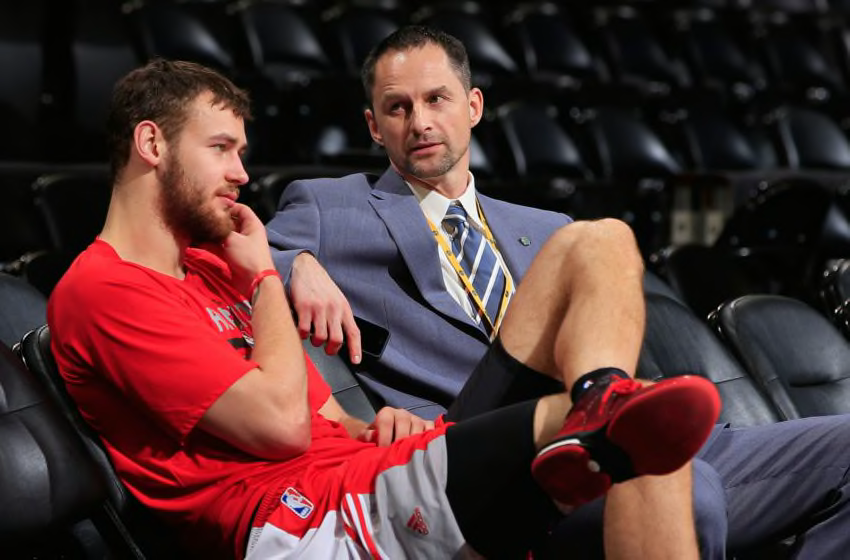
Chicago Bulls: What is the next step for Arturas Karnisovas?Michael Guistoliseon April 29, 2020 at 12:00 pm

Read More

Chicago Bulls: What is the next step for Arturas Karnisovas?Michael Guistoliseon April 29, 2020 at 12:00 pm Read More »

Chicago Blackhawks: Three candidates to replace John McDonoughVincent Pariseon April 29, 2020 at 11:00 am

Read More

Chicago Blackhawks: Three candidates to replace John McDonoughVincent Pariseon April 29, 2020 at 11:00 am Read More »

The Upright Citizens Brigade shutters its New York venuesJack Helbigon April 28, 2020 at 10:25 pm

Last week the folks at the Upright Citizens Brigade (UCB) sent out a letter announcing they were permanently closing their venues for both performances and classes in New York City. (This on top of announcing in March they were laying off all their employees at their theater spaces in NYC and LA, in response to the pandemic.) The letter was signed “Matt Besser, Amy Poehler, Ian Roberts, Matt Walsh, Founders of the Upright Citizens Brigade.”

I don’t know why, but this news hit me hard. Maybe it was the thought of all those theater people (in one count 160 employees) suddenly without work. Just another reminder of how many theater people are unemployed. (All of them. Well, almost all of them.) Or maybe it was just another reminder of how dire things are in the world of live entertainment.

How can you do a live show, if you can’t safely pack people together in a room to watch it? And even if you could adapt a theater space so everyone was spaced–at a minimum–six feet apart, would audiences show up? And could a theater survive on the meager box office returns?

Groups like UCB (improv-based comedy troupes that also taught improv classes) were always partly insulated from the vagaries of the box office, because so much of their revenue came from their classes, and from the ready-made audience of friends, family, and fellow students those classes generate once you put your students together into teams and have them compete against each other on stage.

The folks at UCB learned how to do this in Chicago, in our (until now) always crowded improv scene. At iO. At the Annoyance. At Second City.

But shelter in place and social distancing kicks that model in the ass. You can take your classes online. And I have heard of two improv-based theaters doing shows with performers who have quarantined together–Boom Chicago in Amsterdam and the Annoyance–but that does not seem like a viable model for all future live shows. And most of the games created by Viola Spolin that birthed modern improvisational theater are intended for intensely social situations where people are on stage, together, interacting at much closer range than six feet. Try playing freeze while also respecting social distancing.

I have to admit, though, that the thing that shocked me the most about UCB was how big they had become in the years since they moved (with almost no fanfare) from Chicago to New York in 1996. I knew they had become a player in the comedy business. And I have gone to shows at UCB in NYC over the years. Still, I was surprised when the news of their closing prompted articles in not just the New York Daily News and New York magazine’s Vulture section but the New York Times, New Yorker, and the Hollywood Reporter.

I should not have been. Over the past two and half decades UCB became a rich source for talent, and many of the top comic actors on TV today have some connection to UCB: Aubrey Plaza, Ilana Glazer, Chris Gethard, Kate McKinnon, and of course Walsh and Poehler.

In a way the UCB had come to resemble the large organizations they used to make fun of when they were a scrappy troupe of unknowns in Chicago in the early 90s. Back then Besser used to describe the Upright Citizens Brigade as a dark corporation that secretly runs everything. “We are the invisible government,” he told me once, snickering.

They used to be the bad boys (and for a long time, like all improv in the early 90s, they were male dominated), the guys who sat in the back of the class and needled the teacher. They loved tweaking the noses of authority figures. And I loved them for that.

In 1994’s Conference on the Future of Happiness they faked a fight between Besser and an actor pretending to be Richard Christiansen, lead critic at the time at the Chicago Tribune. Besser ended up driving the faux Christiansen from the theater shouting “We don’t want critics. We don’t need your approval!”

UCB founding member Adam McKay once called Besser a “guerrilla ontologist,” a term coined by science fiction writer Robert Anton Wilson to describe people who deliberately undermine simpleminded, often manufactured consensus views of reality to reveal seamier, more complex truths. The UCB I covered in the 90s was all about guerrilla ontology.

Their 1992 show Virtual Reality was full of moments where they explored the concepts of reality, which is, as Luigi Pirandello revealed a hundred years ago, a very slippery thing in theater. At one point in the show the actors led the audience out of the theater for a “virtual street demonstration,” a demonstration that actually blocked traffic on North Avenue and resulted in the very real (unplanned) arrest of cast member Horatio Sanz, who stayed in character throughout the arrest. Sanz ended up spending the night in jail; his father picked him up in the morning.

As I write this, I realize these are the kind of minor rebellions you can indulge in when you are young and broke–and struggling to get noticed. But the world is different when you become an institution. It also looks different when the world you have thrived in suddenly stops working–literally and figuratively.

It is easy to call for disruption when you have no stake in the status quo. But what do you do when the disruption comes and you don’t want it because you have something to lose? What do you do when reality itself undermines the consensus reality?

I spoke with Besser last week and he seemed to lament how big and corporate UCB had become. That desire for the founders of UCB to recapture what they had in the past is reflected in the open letter they sent last week; “paring down to the size we were when we started is our best chance for survival.”

Survival.

Those are the stakes. For UCB. And probably for most people involved in live theater. Which is the final reason UCB’s news hit me hard. If they can’t keep it going, who can? On the other hand, if they do find a way to survive the current crisis, others can as well. UCB has said they will host shows at another venue in New York and rent space for classes once it’s safe to do so.

The Hollywood Reporter interview ends on the following hopeful note from Walsh: “We’ve lost our venues multiple times. We’re scrappy. So, god willing, we’ll survive this as well. Hang in there with us as we figure this out, please.” v


Read More

The Upright Citizens Brigade shutters its New York venuesJack Helbigon April 28, 2020 at 10:25 pm Read More »

Huntsmen bassist Marc Stranger-Najjar on a spoken-word poet with a beautiful brainJamie Ludwigon April 29, 2020 at 12:30 am

A Reader staffer shares three musical obsessions, then asks someone (who asks someone else) to take a turn.

click to enlarge
A 1960s photo of Roky Erickson that appears in Paul Drummond's book 13th Floor Elevators: A Visual History - WILLIAM WARNER

Paul Drummond, 13th Floor Elevators: A Visual History Most biographers move along once they’ve published, but some subjects demand further exploration. Paul Drummond, author of the 2007 13th Floor Elevators history Eye Mind, returns with a new look at the world’s first psychedelic band, from the 1950s Texas childhood of singer-guitarist Roky Erickson through the group’s 2015 reunion. The book is filled with photos, poster art, newspaper clips, and other ephemera, but its extensive oral history could easily stand alone.

Mind Melt Video archives Livestreaming abounds while we shelter in place, but maybe you’d rather see an old show you missed. Local metal promoter Rodney Pawlak has been uploading concert footage from Mind Melt Video Magazine, the cable-access show he ran from 1993 till 2003. His YouTube offerings include alt-rock, punk, and Sunday metal uploads (when he’d usually be hosting Exit’s CMF Metal Sundays). His 1995 Weed Fest Chicago video is a snapshot of another universe, and his trove of Acid Bath shows will fix the tragic shortage of Acid Bath in your life.

National Independent Venue Association The importance of independent music venues can’t be overstated, and they’re already struggling to survive COVID-19 closures. This week, more than 800 member venues in the National Independent Venue Association (NIVA), including dozens from Illinois, sent a letter to Congress asking for support and relief. In the meantime, you can still support Chicago venue staff by donating to fundraisers.

Jamie is curious what’s in the rotation of . . .

click to enlarge
London-born spoken-word poet Kate Tempest - JULIAN BROAD

Thundercat, It Is What It Is No one can deny Thundercat’s prowess, and the fact that he’s breaking into the mainstream as a virtuoso bassist is very encouraging (as my personal mission is to make the bass cool). I love his George Duke-esque singing style, along with his nods to Duke’s compositional approach. He’s also got this sort of sarcastic lyrical voice that’s a reminder that you don’t have to take life so seriously!

Fiona Apple, Fetch the Bolt Cutters Holy shit. What a powerful record. I had other submissions in mind, but Fiona’s new one came out as I was writing and immediately jumped to the front of the line. Her choices across the board are just on another plane of existence: the production, the percussion tones, the captivating lyrics, and of course her perfectly unique voice singing them over the delightful (and almost through-composed) piano parts!

Kate Tempest, The Book of Traps and Lessons This one came out last year, and I’m admittedly just getting into the world of Kate Tempest. I was introduced to this London-born poet’s beautiful brain when I listened to her contribution to “Blood of the Past” by UK space-jazz band the Comet Is Coming. Never had I imagined loving poetry and spoken word until I heard what she has to say. Just listen to the Book of Traps and Lessons track “People’s Faces” and try not to cry. Her musical poetry is soul cleansing.

Marc is curious what’s in the rotation of . . .

click to enlarge
The cover art for the 1997 Muslimgauze album Narcotic

Muslimgauze, Narcotic This is what acid would sound like. Not like the sounds you hear while tripping, but like if acid were a person, learned to play an instrument, and started a band–it would sound like this album. Bryn Jones released dozens of albums under the Muslimgauze name before he passed away in 1999, but the 1997 release Narcotic is the one that has always stood out to me. It’s been the soundtrack to many of my overnight drives while traveling or on tour (and on acid).

Granular synthesis The process of granular synthesis involves taking an audio sample and splitting it into thousands of grains that can then be pitched, time stretched, and rearranged to create insane-sounding pads and textures. The idea of breaking a sound down into a single tiny grain and then manipulating that single tiny grain is pretty mind-blowing. Add a dark room, lots of reverb, and psychedelics, you’ll have hours of wasted . . . I mean productive time.

Roadburn Festival Based in the Netherlands, Roadburn is like no other fest. It hosts a wide variety of musical acts, including metal, folk, experimental, and electronica. I’ve had the pleasure of playing it six times with five different bands. Unfortunately, it was postponed this year due to the coronavirus, but there are several live releases from previous years available–I highly suggest you check them all out. Better yet, go to Roadburn when you finally can and experience it in person. There’s even a hash bar a few blocks away with a neon Old Style sign. I don’t know why–it just is. v

Read More

Huntsmen bassist Marc Stranger-Najjar on a spoken-word poet with a beautiful brainJamie Ludwigon April 29, 2020 at 12:30 am Read More »

Ratboys have been forced off the road, but they’re still on the railsTim Crispon April 29, 2020 at 12:00 am

Ratboys, from left to right: Dave Sagan, Julia Steiner, Sean Neumann, and Marcus Nuccio - COURTESY THE ARTIST

On February 28, Chicago band Ratboys celebrated the release of their third album, Printer’s Devil, by playing to a sold-out crowd at Lincoln Hall. The next night, they headlined a second sold-out show, this time at the Hideout. Ratboys had been working toward those gigs for nearly ten years, ever since the group’s founders–vocalist-guitarist Julia Steiner and guitarist Dave Sagan–started the band in a Notre Dame dorm room after meeting at freshman orientation in 2010.

Printer’s Devil is an ambitious leap into wide-reaching indie rock. It’s by far the best Ratboys album to date, and it’s also the first to feature the lineup that’s become their regular live band: bassist Sean Neumann has been aboard since early 2017, and drummer Marcus Nuccio has been in and out since later that same year (sharing the job with Ian Paine-Jesam, who also appears on Printer’s Devil). Steiner and Sagan started out as a duo, playing quiet tunes that leaned toward Americana, but they’ve been recruiting rhythm-section players for shows and sessions since moving to Chicago in 2015. After years of evolution, they’re now a full-fledged four-piece.

The release of Printer’s Devil was also supposed to provide the occasion for another big step in Ratboys’ development: their first tour as a headliner. They’d put together an ambitious plan. A couple weeks after their celebratory hometown shows, they’d head to South by Southwest, then tour the western U.S. for three weeks, returning to Chicago on April 12. While Nuccio toured Japan for two weeks with one of his other bands, Pet Symmetry, Steiner and Sagan would play three duo Ratboys shows opening for Wilco in the southeast. Then the full band would reconvene in Chicago to begin the east-coast leg of their tour, kicking off April 29 in Pontiac, Michigan, and concluding May 16 in Saint Louis. After a brief breather, they’d head to Europe for three weeks.

“It was really exciting, because we had never done a headlining tour,” Steiner says. “We’d done DIY tours, but those don’t have as much pressure or as much weight behind you. This was a new experience for us. And we were surprised–it looked like a lot of the shows were selling really well.”

Because SXSW was the first domino to fall, canceled due to COVID-19 on March 6, Ratboys never even left home. And by March 21, everything else had also been called off or postponed: all 29 of their stateside headlining shows, their Wilco dates, their European tour, and their other festival appearances (Treefort Music Fest in Boise, Idaho, and Waking Windows in Winooski, Vermont).

“Everything regarding this whole situation happened in small steps,” Nuccio says. “That week, I remember there being whispers that SXSW was getting canceled, and I remember thinking, ‘This might be real. This might be a big deal.'”

Thousands of musicians plan springtime tours around SXSW, and Ratboys have turned the trip to Austin into an annual rite. “The past four years we’ve gone down to SXSW,” Neumann says. “I keep telling Julia that I feel so weird right now, because the past four years I’ve experienced springtime by going down to South By. That’s been the change in season: we go from Chicago to Austin, Texas, where it’s warmer, and it literally turns from winter to spring. To not have that is throwing me off a little bit.”

Ratboys managed to hold onto hope for their pending tour for a few more days–most of their shows were in venues that held 300 to 500 people, and at that point, cancellations in America were still mostly restricted to bigger events.

“March 11 we did an AMA on Reddit, and we were telling people we’ll definitely be playing the rest of the shows, don’t worry,” Steiner says. “And then that night the NBA canceled its season, Trump held a White House press conference, Tom Hanks got coronavirus. It changed so quickly, and it was so disorienting. You’d think we’d be used to feeling disoriented, being on the road, but this was a whole new ball game for everyone.”

The following day, Live Nation announced the postponement of all events scheduled for March, and soon literally everyone else followed suit.

“I thought our shows were going to be fine, because at that point it was gatherings of 1,000 people,” Nuccio says. “Then the next day was 500–the next day was 100.”

“It’s weird, because we were all so diligent about preparing to go on tour,” Steiner says. “Physically, mentally, I was psyching myself up for this for months. There’s such a specific mindset you have when you’re on tour, to grind every day. It’s very fun, there’s a lot of room for spontaneity, but at the same time it’s very grueling.”

Bands often see touring as a gratifying payoff for the months or years they’ve spent writing, recording, and releasing a new album. The material on Printer’s Devil dates back to demo sessions Steiner and Sagan conducted in December 2017. Between the May 2017 release of Ratboys’ second album, GN, and the recording of Printer’s Devil, the band played to larger and larger audiences, opening tours for the likes of Diet Cig, Vundabar, Foxing, and Soccer Mommy. Their tour with Toronto band Pup included back-to-back sold-out shows at Metro.

Ratboys had certainly attracted a loyal fan base with GN and their 2015 debut, AOID, but by 2018 the growing sentiment in the emo and indie-rock communities was that they deserved to be recognized as one of the best live bands in the scene. In March of that year, Pittsburgh-based editor Eli Enis, one of several contributing to online music magazine the Alternative, wrote a piece titled “Ratboys Are Such a Good Fucking Band.” Steiner and Sagan had already made their songwriting prowess clear on record, but more and more people were seeing those tunes onstage, where they were bigger, louder, and more exciting thanks to Nuccio’s punk-rooted drumming and the spontaneity in Sagan’s masterful guitar playing.

The publicity campaign for Printer’s Devil began in November 2019 with the release of the video for lead single “Alien With a Sleep Mask On.” Directed by Chicago duo Coool, aka John TerEick and Jake Nokovic, it casts Steiner as an astronaut floating through space and Sagan as the leader of a team of scientists trying to rescue her. Helped along by the song’s power-pop charm and sing-along chorus, the video attracted coverage from Stereogum and the Grey Estates, among other outlets.

In January the band followed up with the video for “I Go Out at Night,” another Coool production. Styled like a campy black-and-white 50s-style horror flick, it depicts the four members of Ratboys as trick-or-treaters encountering a string of spooks, including a scary old witch and a werewolf–or rather the shadow of a werewolf, which turns out to be cast by a cute little pup (a cameo appearance by my dog Chloe the Pug, who’d gotten to know Ratboys after I invited Steiner on my podcast, Better Yet, in 2016). “I just had a thought: What if I never came home?” sings Steiner, almost whispering along to the meditative tune’s jangly guitars. “I’d go and get a job uninstalling 90s pay phones.”

Anticipation for Printer’s Devil was building on indie-rock Twitter. Between the instant dopamine jolt of “Alien With a Sleep Mask On,” the celestial daydreams evoked by “I Go Out at Night,” and the rambunctious, seesawing riff of the third single, the heartfelt “Anj,” the album promised to have enough variety to stand up to constant listening.

When Ratboys released Printer’s Devil on February 28, ringing endorsements came from the likes of Pitchfork, the Alternative, and Paste. The latter not only published a positive review but also ranked Ratboys number one in a listicle titled “Bernie Sanders Thanking Bands for Their Music, Ranked.” Steiner and Sagan had performed an acoustic set at the senator’s campaign rally in Davenport, Iowa, on January 11, and when Sanders took the stage, he acknowledged them, adding a superfluous “the” and hesitating a little before saying “Ratboys” in his Bernie Sanders voice: “Let me thank the, uh, Ratboys for their music.”

The new album also got fans looking forward to Ratboys’ upcoming tour. “The week after the album came out, I was excited ’cause I hadn’t been checking the ticket sales super often, and some of the cities were still up in the air–but the bigger ones like Seattle and LA, a lot of tickets were sold,” Steiner says. “We were pleasantly surprised and excited and confident to go, because we knew people were going to be there.”

The cancellation of a lengthy tour involves more than an emotional letdown, of course. Ratboys had secured guarantees ranging from $350 to $750 for most of their shows, and in larger markets such as New York and Los Angeles, the payouts reached $2,000. At more than 90 percent of their dates, the band could’ve made more than that guarantee–their contracts promised them a percentage of the gross box-office revenue, if that number were larger. Each cancellation results in lost income for the band and the venue, of course, and often for Ratboys’ booking agency, High Road Touring (which set up the U.S. tour and the shows with Wilco). The agency doesn’t charge up front–instead it gets a 10 percent cut of whatever the band gets paid, which means it’ll have to wait till the shows are rescheduled before it sees any money.

Steiner spent four months booking the European tour herself, and though Ratboys didn’t expect to do better than break even overseas, they were looking forward to that trip too–they’d enjoyed touring Europe with Dowsing in 2016 and Wild Pink in 2018. Thankfully the band were able to get a refund of the $3,500 they’d spent on airfare. Nuccio’s tour of Japan with Pet Symmetry was canceled as well.

Touring is a doubly important source of revenue for many bands, because they also sell the majority of their records and other merchandise on the road. Ratboys have established a goal of $250 per show for merch sales, and because they’ve set that number low enough for smaller markets, they often double or triple it in the bigger ones. They pay 100 percent of the up-front costs for their T-shirts, sweatshirts, and baseball caps, and for this tour’s initial order that came to almost $5,000 (though Ratboys planned to restock on the road). All their merch is priced to ensure a profit per item of $11 to $14. T-shirts sell for $20 apiece, for instance, and cost $6 to $9 to print; sweatshirts cost more than $16 each and sell for $30.

Ratboys aren’t yet making much money from CDs, tapes, and vinyl of Printer’s Devil, because their label, Topshelf Records, wants to recoup its expenses–the recording advance, the video budgets, the cost of the pressings, the PR bill for the album cycle, and so on–before it starts paying royalties to the band. For now Topshelf is keeping revenue from online sales, streaming, and sales through Ratboys’ distributor, Redeye Worldwide. The band can pocket the profit from copies they sell hand to hand, and after the first 100 (which the label gives them free) they pay for them up front at cost. Right now they’re sitting on about 200 LPs, having sold perhaps 50 so far. Ratboys know they’ll be in the black with Topshelf eventually, but it probably would’ve taken 12 to 18 months without a pandemic. It’ll take even longer if they can’t tour.

Gross sales of vinyl and other merchandise at Ratboys’ Lincoln Hall and Hideout concerts totaled more than $3,000–and I would know, because I volunteered to work the merch table for the band both nights. It seems pretty clear that tour sales would’ve quickly covered that initial $5,000 merch expense. When they’re on the road, each member of the band gets paid $500 per week through the band’s LLC, from a fund that’s replenished by revenue from tickets and merchandise. When the tour’s over, Ratboys tally up total sales, and whatever they’ve earned above and beyond their $250 goal per show, they split up equally. If that $250 per show totals more than the up-front cost of the merch, the surplus gets parked in the band’s account.

Thankfully, nobody in Ratboys ordinarily depends on the band for all their income. With three months of touring canceled, they’ve left more than $20,000 in guarantees on the table. Neumann and Nuccio both hold full-time jobs that they can do remotely on the road. During the shelter-in-place order, Nuccio has continued to work as a graphic designer for Gatorade without leaving his apartment in Humboldt Park. Neumann, who lives with Steiner, Sagan, and two other roommates in a house in Elmwood Park, has been working from home as a political journalist for People.

“It’s been exhausting,” Neumann says. “But at the same time, this exact moment is when the whole field of journalism is so vital to how things work in this country and around the world. There’s been this sense of duty, in that way.”

Steiner and Sagan make money with side jobs when they’re not touring, though touring is a better source of income for both of them. Steiner is ordinarily a brand ambassador for marketing firm Havas, but the pandemic means she can’t work. Sagan delivers for Amazon and supplements his income with graphic-design commissions (he also designs Ratboys’ merchandise).

On March 20, when Bandcamp waived its cut of sales for the day, Topshelf did the same for the entire weekend. Ratboys made almost $1,400 as a result, all of it from digital music. Immediately after the cancellation of their tours, Ratboys also pushed merch on social media, hoping to move some of the shirts and hats that they would’ve sold on the road. (Topshelf usually handles online merch sales, whether through Ratboys’ website or through Bandcamp.) In the weeks since the band made their first posts on March 14, more than 200 orders have come in, a surge that’s pushed Ratboys to a net profit of around $4,400 (including the money from the Chicago release shows). That’s after covering around $1,100 in shipping expenses and the entire cost of that initial $5,000 order–but it’s still nothing like what they would’ve made on the road.

A digital flyer for the third weekend of Ratboys Virtual Tour - ILLUSTRATION BY DAVE SAGAN

Deprived of the outlet of touring, Steiner and Sagan started looking into different ways to reach fans directly. “We were getting so ready to go on tour, and that’s how we express ourselves and reach out to our fans, by touring and playing live,” says Sagan. “So we have to create some sort of opportunity out of this.”

Like many other musicians stuck at home, Steiner participated in Instagram livestreams, but the band wanted more control of their presentation–they eventually settled on livestreaming service Twitch. Popular with video gamers, it gives fans an option to donate money by clicking a PayPal or Venmo link at the bottom on the screen.

“I was a little more familiar with Twitch than Julia,” Sagan says. “I knew that it was a format where people can watch livestreams of games for hours on end, and there are channels that have built communities of fans.”

“You have infinite options for the way you mike up instruments,” Steiner says. “Ninety-nine percent of Instagram streams, the person is just using their phone, which is fine if you’re just playing by yourself. Twitch allows us to use all of our gear and to have a setup rather than a handheld.”

Steiner and Sagan downloaded Streamlabs Open Broadcast Software, then spent a day watching YouTube tutorials to learn how to use it. “Going into this, we knew absolutely nothing–we didn’t even have a webcam,” Steiner says. “We learned all about the back end of streaming stuff. It’s very basic, but it’s all new, and that’s fun. It gives us a project to work on that we can immediately share with people.”

On March 26, the band premiered Ratboys Virtual Tour live on Twitch. So far they’ve hosted three weekends of the show, which combines talking segments and performances from Steiner and Sagan. They typically start on Thursday or Friday night, follow up with a Saturday-night show, and close with a Sunday-afternoon matinee. The show’s eight-bit-style title card and graphics were all designed by Sagan, and Ratboys use a green screen so they can pretend to broadcast from a new far-flung location each time.

“The first episode, we were in Brazil, in Rio,” Steiner says. “We did a lot of intro, telling people about the concept. It all felt . . . not self-conscious, but aware of how out of my element I was. It’s nice–I don’t feel that way very often when we’re performing.”

The show’s tongue-in-cheek presentation is a natural fit for Steiner and Sagan–they’ve embraced the public-access-show vibe, right down to recording in their basement. Steiner generally stays on-screen, while Sagan bounces back and forth between joining her for performances and working behind the camera. Neumann pitches in as well, moderating the live text chat that runs alongside the stream.

“Sean started to moderate the chat, which was really nice because the people watching started to develop a lot of camaraderie and humor,” Steiner says. “He was encouraging people to talk and have a good time.”

“He’s a real instigator,” Sagan adds.

“With Twitch it’s nice because you have direct contact with the listeners,” says Steiner. “The three of us are pretty introverted, but we’re humans–we want to have contact with people.”

The intimacy of the Virtual Tour community has helped Steiner feel comfortable taking new risks. “I did a segment called ‘Super New Songs’ where I played really new songs, and stuff like that is really exciting and nerve-racking,” she says. “It’s a whole new level of feeling vulnerable–it’s like jumping off a cliff into a large body of water. Things like that make you feel self-assured in what you’re doing.”

Whether the show streams from Stonehenge, from a Six Flags parking lot, or from the moon, fans keep coming back–sometimes Ratboys see the same people every night.

“There have definitely been familiar faces in the chat,” Steiner says. “The cool thing is that a lot of those people are people we know from playing shows. It feels like a lot of the people we’re playing for are the people we’d be playing for on tour–the cool thing is, now they can watch every day.”

So far Ratboys have brought in more than $1,000 in PayPal and Venmo donations via Twitch. Though that’s a small fraction of what they would’ve made on the road, they’re also saving money: they don’t have to pay for gas or lodgings, and it’s cheaper to eat at home. They’ve also sold out a batch of 50 special-edition Virtual Tour shirts. Assuming things ever get back to normal, livestreaming has potential as a new way for Steiner and Sagan to earn income while Ratboys aren’t on tour.

On the first night of Ratboys Virtual Tour, Julia Steiner transported herself to Rio de Janeiro. - COURTESY THE ARTIST

“Once this whole pandemic is in the past and behind us, I’m wondering if all these virtual performances will be looked at as a novelty of the past because at the time it’s all we had,” Steiner says. “Or I wonder if there’s going to be some sort of format or mode of connection that becomes ubiquitous that will . . . not replace traditional live-music performances, but supplement and become something that bands do when they’re home.”

Steiner doesn’t want to look too far ahead, but she’d love to be able to rely more on her music and less on side jobs. “It would be very rewarding for us to be able to come home from a tour, take a few days off to reset, and then have a way to perform for people and still make a connection and potentially still have an income stream,” she says. “That would make me feel so much more fulfilled as a musician–that would oddly enough make me feel even more fulfilled with choosing this as a career. You could go to work in your house. It could be an extra thing that could help us stay sharp and come up with new ideas.”

It’s obviously unclear when Ratboys will be able to return to the road to support Printer’s Devil, but whenever they do, it’ll still be their best record yet. They’re using their time sheltering in place to create something new, and they’re ready to share it any way they can. Ratboys post their Virtual Tour dates on Instagram and Twitter (on both platforms, their handle is @ratboysband). The show streams live on the band’s Twitch channel, twitch.tv/watchratboys, and past episodes are archived on Twitch and YouTube.

“We’re lucky that the record is out in the world and that we got to play the two release shows in Chicago–it was such an affirmation,” Steiner says. “I didn’t think at all that those would be our last two shows for a long time. But those were the best two shows to enter an involuntary worldwide hiatus.” v

Read More

Ratboys have been forced off the road, but they’re still on the railsTim Crispon April 29, 2020 at 12:00 am Read More »

Rest in power to hip-hop activist Jamie ‘J. Milla’ SevierJ.R. Nelsonon April 28, 2020 at 10:45 pm

click to enlarge
Jamie "J. Milla" Sevier (third from left) after a Chicago hip-hop panel at the Museum of Science and Industry, with Carrico "Kingdom Rock" Sanders, Bobby "Massive" Ambrose, Chuck D of Public Enemy, Jay Will, and Lavell "DJ Jihad" Watson - COURTESY CARRICO SANDERS

Veteran Chicago hip-hop activist, manager, and promoter Jamie “J. Milla” Sevier died Saturday, April 18, at age 47. As a kid, Sevier got into breakdancing and graffiti, and he’d joined Chi-ROCK Nation by the time he met longtime friend Carrico “Kingdom Rock” Sanders, founder of the Ill State Assassins crew, in the early 1990s. They’d crossed paths because both were organizing against an attempt to ban hip-hop from local radio. “Jamie has always been the bullhorn for Chicago,” Sanders says. “I will also call him ‘the plug’–there’s a few of us that connect people together, and Jamie was one.” Sanders and Sevier went on to promote hip-hop events together (Sevier also became an Ill State member), and they both worked for Operation PUSH–Sanders as a youth organizer, Sevier as national youth director (his godmother is PUSH Excel national education director Janette Wilson). In the 2000s, Sevier served as president of the nonprofit People Reclaiming Ourselves (whose board included Chico DeBarge) and hosted cable-access show Hip-Hop 2nite. On Sunday, April 19, Common honored Sevier during the Last Dance preshow on SportsCenter: “Rest in peace to my man Jamie–God bless his soul.”

Patrick Holbrook’s solo darkwave project Well Yells trafficks in the sonics of isolation–in 2018, Gossip Wolf said his Skunk cassette “sounds like it’s coming from a captive who’s given up on ever escaping from the bottom of Buffalo Bill’s pit in The Silence of the Lambs.” This month, Well Yells dropped the excellent full-length We Mirror the Dead, recorded with Adam Stilson at Decade Music Studios. Holbrook says he’s “broken into a new realm,” using “more industrial sounds, maybe even echoes of witch house.” Last week, Holbrook posted an eerie, gripping video for the propulsive “Kill the King,” filmed just after the stay-at-home order came down. He had a release party booked at Cafe Mustache in May–let’s hope it’s rescheduled! v

Got a tip? Tweet @Gossip_Wolf or e-mail [email protected].

Read More

Rest in power to hip-hop activist Jamie ‘J. Milla’ SevierJ.R. Nelsonon April 28, 2020 at 10:45 pm Read More »

NBA lookback: Michael Jordan scores 50 points in back-to-back playoff gamesChicagoNow Staffon April 28, 2020 at 9:25 pm

ChicagoNow Staff Blog

NBA lookback: Michael Jordan scores 50 points in back-to-back playoff games

Read More

NBA lookback: Michael Jordan scores 50 points in back-to-back playoff gamesChicagoNow Staffon April 28, 2020 at 9:25 pm Read More »