Videos

These Lori Lightfoot Memes Encouraging People to Stay Home Are Giving Us Life Right Nowon April 10, 2020 at 10:26 pm

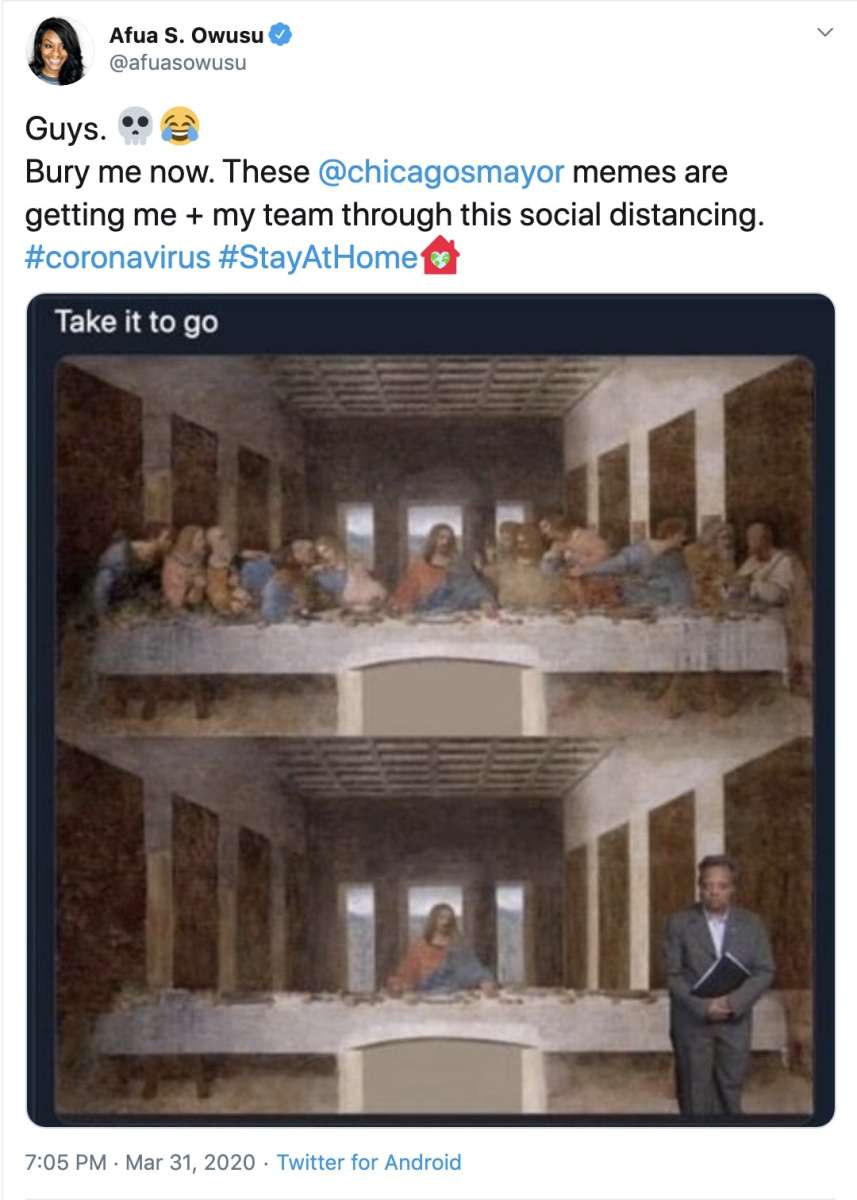
Even though Chicago has been locked down for nearly a month, it doesn’t mean that we aren’t still finding ways to entertain ourselves. And, our most recent source of meme entertainment has come from an unlikely source: Mayor Lori Lightfoot.

The memes of the stern-faced mayor started to take over social media after a March 26 order, where Lightfoot scolded the city for not practicing social distancing. Since then, more images have continued to pop up, as the glowering mayor tries to convince the city of millions to stay home. An Instagram page @whereslightfoot was created and already has more than 52 thousand followers. Here are some of our favorite memes of Lori Lightfoot:

Advertisement


Everyone in Chicago when the weather is nice: “Just enjoying a Sunday afternoon on the….”

Lori Lightfoot: “NO.”

Advertisement


Because she’s the hero Chicago deserves, but not the one it needs right now.
Advertisement


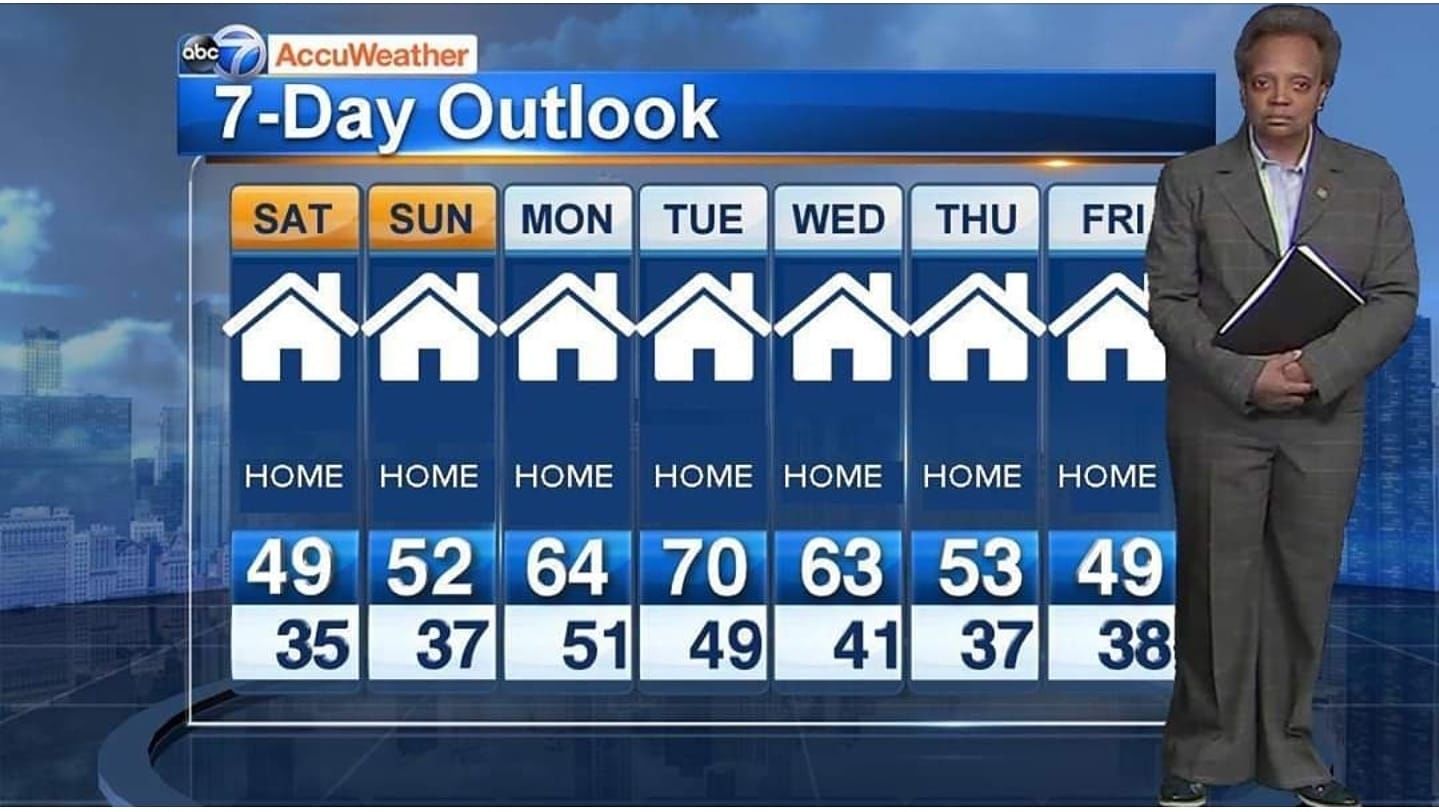
The forecast for the week is sunny with a chance of staying at home.
Advertisement


The new version of “American Gothic.”

Advertisement


“Cash me ousside… how bout dah.”

Advertisement


Lori Lightfoot: …..

Advertisement


Food is takeout or delivery ONLY.

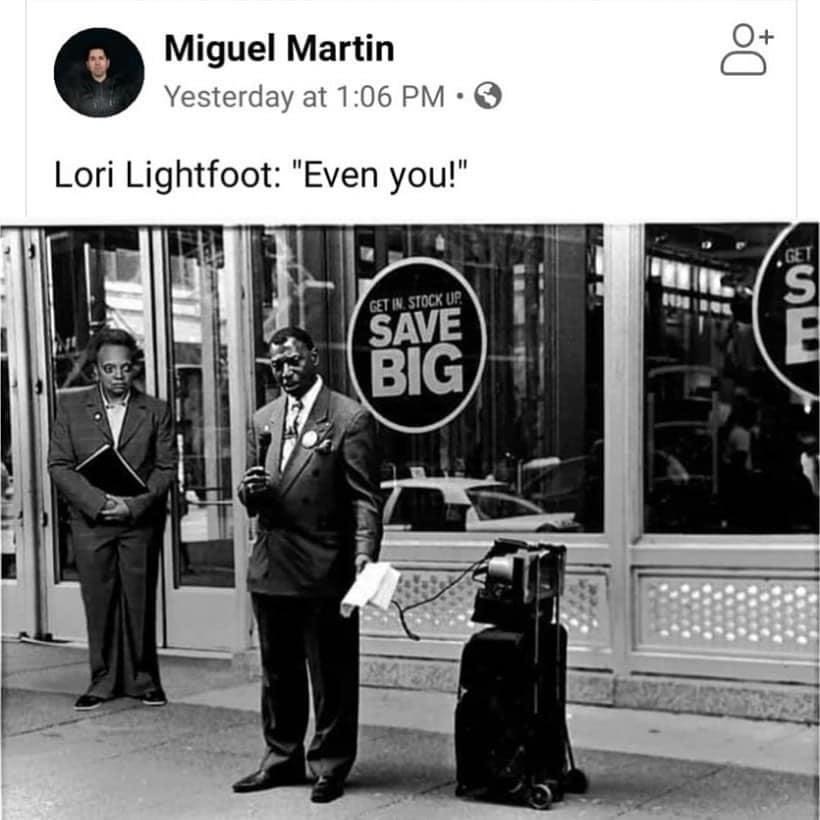
No one is exempt from Lori’s stink eye.
With all the extra time on our hands, some are becoming even more creative. People have brought the memes to life and placing cutouts of Mayor Lori Lightfoot in various locations.

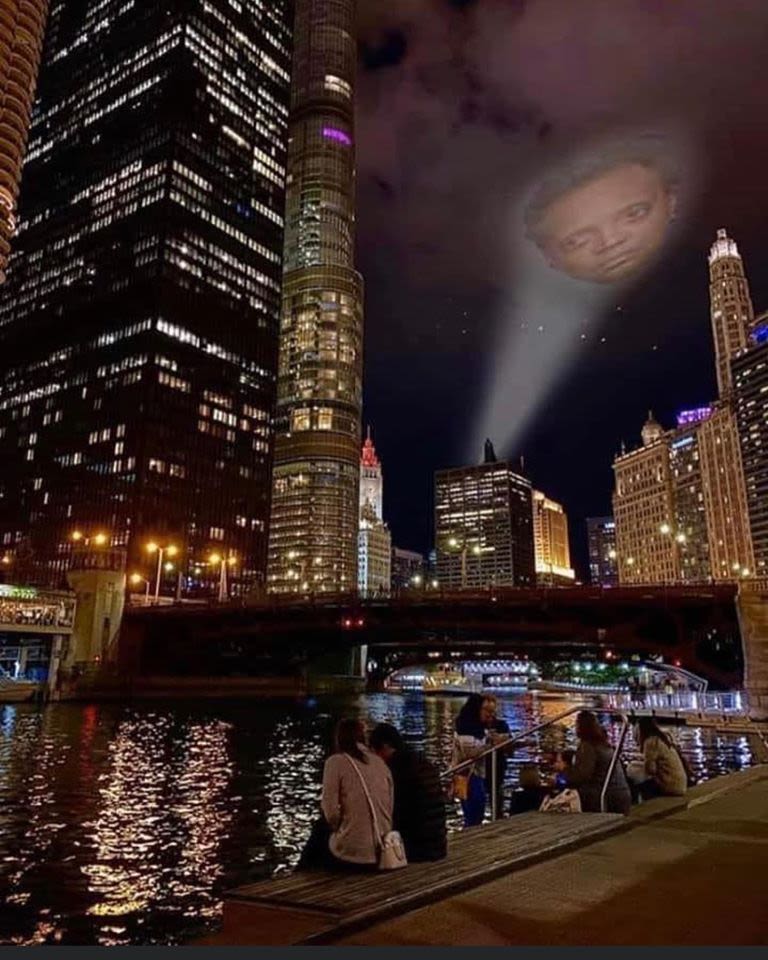
Remember, she is always watching.
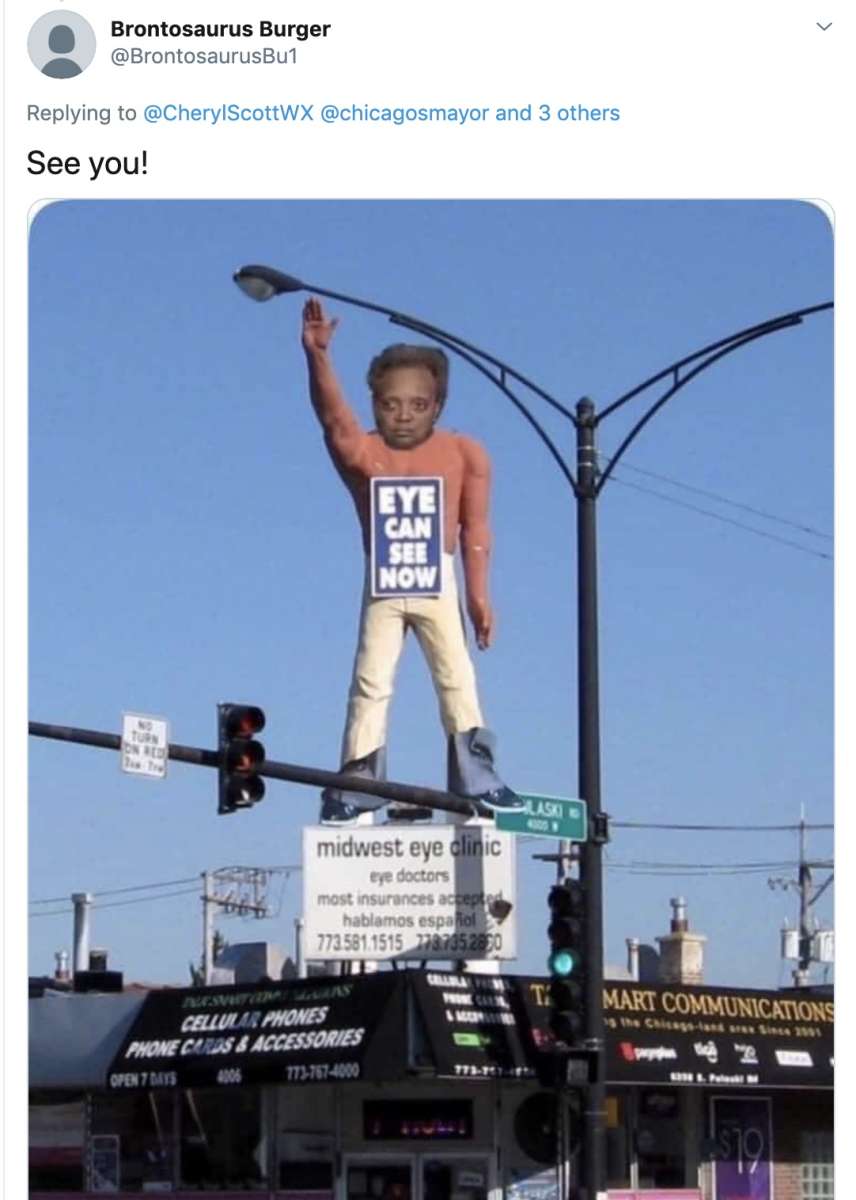
Finally, something we can all agree on!

And if you are wondering how Lori Lightfoot is reacting to all these memes, she is in on the fun too! She has been commenting on Twitter and social media regarding some of the memes. Even though she keeps a serious tone to convey the importance of staying home, the mayor is still having a bit of fun with the situation.

Lightfoot posted a “Stay Home, Save Lives,” PSA at the end of March, encouraging residents to stay home. In the PSA, you see her scrolling on Instagram, baking, shooting hoops, watching her favorite sports teams, tidying her home, and more, all while staying home. On the phone with a friend, she says, “Debbie, getting your roots done is not essential.” 

[embedded content]

Unfortunately, Lightfoot wasn’t practicing what she was preaching when she was caught getting her haircut earlier this week. Regardless, Lori Lightfoot is providing us with some quality memes and amusement during this difficult time.


Read More

These Lori Lightfoot Memes Encouraging People to Stay Home Are Giving Us Life Right Nowon April 10, 2020 at 10:26 pm Read More »

Chicago Bulls: J.J. Polk hiring proves Arturas Karnisovas means businesson April 10, 2020 at 8:58 pm

Read More

Chicago Bulls: J.J. Polk hiring proves Arturas Karnisovas means businesson April 10, 2020 at 8:58 pm Read More »

Legendary Chicago experimentalists Ono confront centuries of race-based violence on the transformative Red Summeron April 10, 2020 at 6:23 pm

I could write a novel about Ono. This Chicago avant-garde group are one of the great bands, and their story is endlessly fascinating. Few groups that had their heyday in the 80s have come back in the late aughts sounding completely rejuvenated and vital. Most important, they’ve continued to progress, honing their wild experimentation into incendiary, out-of-this-world performances and recordings. Like all great sonic art, their work isn’t just entertainment meant for toe-tapping. In fact, 74-year-old lead singer/whirlwind Travis will tell you he’s not much of a fan of mere “music” at all.


Starting with the very first, 1983’s Machines That Kill People, Ono’s records have always been journeys with the power to transform the listener in real time. Such is the case with their latest album, the hyperdetailed Red Summer (American Dreams), which includes several pieces they’ve been performing live in recent years. It’s a concept record that confronts ongoing race-based violence in the U.S., and it shares its title with a months-long stretch of 1919 marked by anti-Black white-supremacist terrorist attacks in dozens of cities across the country, including an epicenter in Chicago. The story starts to unfold with opening track “20th August 1619,” which refers to the date that African slaves were first brought to North America at the colony of Jamestown; something resembling carnival music slowly fades in, its jaunty bells almost soothing, but within two minutes everything swirls into unsettling, uber-processed oblivion. “Coon” exemplifies the classic Ono sound: it kicks off with samples (this time voices, hand drums, and woodwinds), and then Travis’s wildly delayed vocals echo through the void, heralding a sudden turn into dense industrial riffage that mixes white noise, sputtering drum machines, and skronky sax. Funky live drums permeate the anthemic “I Dream of Sodomy,” whose inside-out new wave could be a hit in an alternate universe.


Perhaps the best thing about Ono is their unpredictability; like life or a good thriller, you never know where they might go next. “Scab” starts off with an old-school Severed Heads-type beat that tapers into spoken word over a bleak soundscape, but then an actually catchy melody line saunters in, accompanied by tinkling Speak & Spell-like sounds. “Sniper” conjures Screamin’ Jay Hawkins via Throbbing Gristle darkness, serving up a lesson about Woodrow Wilson’s legacy of racism and his impact on the Red Summer. Underneath the lyrics, textural drums slowly open up into a cacophonous sound collage that’s in turn superseded by a jazzy melody, complete with moody electric-piano licks and an evocative sax solo–and just as quickly, this noir-ish street scene dissipates into the noise of a creaky door blowing open in the wind. Sometimes Ono are so sonically interesting that you can miss just how intense their lyrics are, but that’s not the case on “26 June 1919,” which refers to the gruesome lynching of John Hartfield in Mississippi, which was advertised in local newspapers and drew a mob of more than 10,000 witnesses. Album single “Tar Baby,” a regular part of Ono’s set, is a modern psychedelic classic, with its ominous strings, vocal chants, wild distortion, pulsing Can-like grooves, Stooges-style one-finger piano, and overarching spiral of backward-guitar madness.


“Syphilis” features seldom-heard Ono member Rebecca on vocals, and bandleader P. Michael undergirds its pedal-steel guitar and Suicide-type grind with monstrously funky bass. The song takes a broad look at the titular sexually transmitted infection and the compounding issues of race, sex, gender, and colonialism that surround its history in the U.S.; these aren’t topics that many bands could tackle, and the song feels even more relevant in light of the disproportionate impact COVID-19 is having on Black Americans. Ono close Red Summer with the transcendent live staple “Sycamore Trees,” which comes in with lapping waves of ambient sound and builds to towering operatic heights, with Travis’s deep, gospel-tinged baritone ringing from the mountaintops. Trust me: After this challenging but rewarding album journey, you’ll never be quite the same. Red Summer isn’t merely a collection of songs but rather an urgent document that addresses the past, present, and future–a work of art that penetrates the core of the human condition. v

Read More

Legendary Chicago experimentalists Ono confront centuries of race-based violence on the transformative Red Summeron April 10, 2020 at 6:23 pm Read More »

Tim Kinsella’s Friend/Enemy re-emerges after 18 years with koans about America’s nightmareon April 10, 2020 at 6:29 pm

Immediately after the 2016 presidential election, Tim Kinsella and a coterie of collaborators gathered at Chicago’s Minbal studios to work through their feelings about America’s new nightmare. It took them two days to record an album of solemn, fretful indie rock, and then it took them more than three years to release it. HIH NO/ON (Joyful Noise) came out late last month under the name Friend/Enemy, which Kinsella and HIH NO/ON synth player Todd Mattei used for 2002’s Ten Songs. Kinsella juggles a lot of projects, which partly explains the gap between the session and the release. In the intervening years, he’s released two Joan of Arc albums (2017’s He’s Got the Whole This Land Is Your Land in His Hands and 2018’s 1984), reunited Cap’n Jazz again for a spate of 2017 shows, published a novel (last year’s Sunshine on an Open Tomb), and formed postindustrial duo Good Fuck with Jenny Pulse of Spa Moans (they’ve released two albums and an EP so far). Kinsella and Pulse, who are recently married, moved to Italy in mid-January, and in early March they boarded the last plane out of the country as it shut down due to the coronavirus pandemic. Before they left, they’d both gotten sick–possibly with COVID-19–and recovered. HIH NO/ON arrived a few weeks after they got back to the U.S. The fears that Kinsella, Pulse, and the collective express on the album gain horrifying new dimensions from the suffering unfolding here due to the Trump administration’s denial, lying, bullying, and profiteering. Kinsella and Pulse half-sing about everyday fascism and creeping totalitarianism, their sparse lyrics and dehydrated duets evoking dread, helplessness, and grief. The rest of the ensemble–Mattei, pianist Jamey Robinson, guitarist Bill MacKay, Sam Wagster and Skyler Rowe of Mute Duo, and Kinsella’s younger cousin Nate from American Football–supports the vocals with looping melodies that gallop and drone. Kinsella has written that HIH NO/ON is his answer to his music-business pals who’ve long pushed him to try making a “simple ‘guitar rock’ record,” which is to say that these skewed jams are as straightforward as he can get, outlining the surreal and disastrous present through the curtain of a fugue state. v

Read More

Tim Kinsella’s Friend/Enemy re-emerges after 18 years with koans about America’s nightmareon April 10, 2020 at 6:29 pm Read More »

Chicago footwork producer DJ Hank takes inspiration from his bike-messenger job for Traffic Controlon April 10, 2020 at 6:31 pm

On the title track of DJ Hank’s debut 12-inch, Traffic Control (Sophomore Lounge), car alarms bleat atop thickets of overactive drums, occasional blown-out hi-hats, hiccuping bass, and a tasteful array of hand claps. At first listen, “Traffic Control” might rattle you just like a real-life car alarm, but thankfully Hank understands how to rearrange anxiety-inducing electronic screams into joyous blasts. A North Carolina native, he’s lived in Chicago for nearly a decade, paying his bills as a bike messenger while ingraining himself in the city’s footwork scene. He’s tight with many members of foundational footwork collective Teklife (for example, he contributed to Boylan’s September EP, Renegade), and though he’s not a member himself, he’s clearly learned from Teklife how to flit between pop ecstasy and battle-centric percussive arrhythmia. On Traffic Control, Hank colors a broad palette of dance styles with a blur of everyday street-transit blare, often rendering even the harshest sounds into smooth, glistening melodies while retaining the bite of his hard-hitting percussion. The album’s diversity of genres skews toward footwork, and the energy and noise in these frenetic tracks evoke the rush of zooming through the dense heart of the city on a bike, dodging pedestrians and threading the needle between cars and buses. In Hank’s music, the bustle doesn’t slow you down–it energizes you. v

Read More

Chicago footwork producer DJ Hank takes inspiration from his bike-messenger job for Traffic Controlon April 10, 2020 at 6:31 pm Read More »

Rising drill star King Von refines his storytelling and stunting on Levon Jameson April 10, 2020 at 6:40 pm

Sharp songwriting and bombastic delivery have made King Von one of fastest-rising stars in drill, the pummeling hip-hop subgenre born in Chicago. Born Dayvon Bennett, the 25-year-old rapper grew up in Englewood, and he’s been filling his verses with crime-fiction narratives at least since his breakout single, 2018’s “Crazy Story.” As he told Genius in a video this spring, he draws on urban novels and on his own experiences for his lyrics–his history of legal trouble includes arrests for firearm possession and attempted murder (he was acquitted of the latter after spending three and a half years in Cook County Jail). Von’s said he’s used his time while incarcerated (including a recent house arrest in Atlanta for a pending case involving Only the Family label boss and codefendant Lil Durk) to refine his street-rap storytelling. On “Took Her to the O,” a single from the new Levon James, Von plans to bring a date to O Block, the notoriously violent stretch of South King Drive (which Von compared to “a mini resort” in that Genius video because of the fun he’d have with his friends there). He’s waiting in his car outside her house, having doubled back to let her pick up her purse, when a stranger shows up and the confrontation spirals into a shooting. The date is unfazed, since the victim is from a different block, and Von drives off impressed. Von wrote the song a cappella while in jail, and producer Chopsquad structured the instrumental around it, a reversal of Von’s usual process. Levon James expands on the sonic palette of Von’s 2019 full-length debut, Grandson Vol. 1, which stays close to the classic drill sound, combining blown-out beats with blunt-force effects. The beat for “Block,” by superproducer Mike Will Made-It, pairs trap 808s with chimes that cut to the bone like winter wind. The synths on the G Herbo collaboration “On Yo Ass” sound like the ghosts from Super Mario 64 are chasing Von, only to turn invisible when he turns to face them–but the boom in his boasts makes it clear they won’t catch him. v

Read More

Rising drill star King Von refines his storytelling and stunting on Levon Jameson April 10, 2020 at 6:40 pm Read More »

Midwife turns loss into atmospheric dream pop on Foreveron April 10, 2020 at 6:42 pm

In December 2016, a fire ripped through Oakland arts space Ghost Ship, killing 36 residents and guests who were attending an underground electronic show. As the tragedy was picked up by mainstream media, misinformation and misrepresentation of DIY artists and venues resulted in a backlash felt across the country. Shortly after the fire, the Denver music community was hit hard when arts hub Rhinoceropolis was shut down without warning, displacing its occupants to face the high rents and gentrification that already threatened the city’s creative scene. Among them were multi-instrumentalist Madeline Johnston, who makes slow-burning dream pop as Midwife, and her close friend Colin Ward. A little more than a year later, Ward took his own life, and Midwife’s new second album, Forever, is dedicated to his memory. Over the mournful, atmospheric guitar of opening track “2018,” Johnston conjures the surreal feelings that can come when tragedy strikes hard and fast. The fuzzed-out, hook-driven “Anyone Can Play Guitar” and “S.W.I.M.” wouldn’t sound out of place on the soundtrack of a 90s indie flick, but underneath their relaxed, summery vibes, they’re both poignant confessionals about inner struggle and saying goodbye. “C.R.F.W.” starts with several minutes of spoken-word poetry recorded by Ward, after which Johnston emerges with a shimmering, ambient instrumental. Everyone is missing someone, and plenty of us are grieving–and those personal voids can feel even more overwhelming during these times of physical isolation. So while Forever focuses on one community and a special relationship between two friends, its intimate revelations can resonate with anyone. v

Read More

Midwife turns loss into atmospheric dream pop on Foreveron April 10, 2020 at 6:42 pm Read More »

Oranssi Pazuzu voyage beyond black metal to a sound all their own on the new Mestarin Kynsion April 10, 2020 at 8:00 pm

When I wrote about these Finnish xenonauts last October, on the occasion of the only stateside tour in their 13-year history, I called their music “wormhole black metal”: “Oranssi Pazuzu plunge you into a tunnel of fatally deformed spacetime, bathe you in a sizzling cocktail of exotic radiation, and spit you out somewhere cold, dark, alien, and very, very far away.” I stand by the wormhole metaphor, but the band’s brand-new fifth album, Mestarin Kynsi (“The Master’s Claw”), has me rethinking the “black metal” part. Over the years they’ve drifted so far from the genre’s familiar signposts that wherever they are now, they’re alone out there–and I can’t ask for more from musicians than that they grow to sound like no one but themselves. You’ll waste your time hunting for frosty tremolo-picked guitars, blurry blastbeats, and sandpaper shrieks on Mestarin Kynsi. The clotted vocals of guitarist and front man Juho “Jun-His” Vanhanen admittedly signal “some sort of metal is happening, probably,” but the album is dominated by turgid, peristaltic bass and a kaleidoscopic constellation of keyboards. Increasingly, Oranssi Pazuzu don’t have a sound so much as a psychedelic profusion of sounds: insistent oscillations of cosmic roller-rink organ, smears of dissonant hornlike synths, a violin ostinato that wobbles like a dragging reel-to-reel tape, pinging rhythmic chatter reminiscent of late-80s EBM, cascades of urgently pulsing wordless female vocals, a grotty guitar that dives in pitch like a circular saw biting into sheet metal. Only one track on Mestarin Kynsi uses a steady rock backbeat, and the lone recognizable blastbeat arrives in album closer “Taivaan Portti”: the drums hammer steadily forward, gradually overwhelmed by an insane ecstasy of cathedral-size drones that grows and grows until its howling overtones pour from the heavens like curtains of fire. The songs complicate riffs that might otherwise be catchy by dilating them with unpredictable extra beats or adding competing patterns–these guys will give you something awesomely heavy to dig into, but only so they can use that hook to drag you somewhere weird. “Ilmestys” begins with oozing synth bass and a kick drum that feels like it’s pressed up against your forehead, while whirling disco-ball keyboards stagger dizzily over the bar ends–one phrase is nine beats long, the other ten, and the phasing overlap creates a sort of gravity-defying tension. When the full drum kit finally enters, along with a second keyboard part that sounds like somebody going bonkers on a touch-tone phone, all the patterns converge at ten beats in an explosively satisfying release of that tension. In English, “Ilmestys” means “Revelation.” v

Read More

Oranssi Pazuzu voyage beyond black metal to a sound all their own on the new Mestarin Kynsion April 10, 2020 at 8:00 pm Read More »

Charles Rumback’s trio reconciles freedom and lyricism on June Holidayon April 10, 2020 at 8:04 pm

Like many other participants in Chicago’s contemporary jazz scene, drummer Charles Rumback is both a sideman and a leader. Whether backing singer-songwriters such as Steve Dawson and Angela James, playing space-bound Americana with guitarist Ryley Walker, swinging behind jazz saxophonist Dustin Laurenzi, or leading this trio with bassist John Tate and pianist Jim Baker, he sustains momentum and adds atmospheric accents without hogging the spotlight. The three pieces that he wrote for June Holiday, the trio’s third album, invite the listener to appreciate his accompanists’ strengths. While Rumback restricts himself to subtle accents on his tune “Here & Now,” Tate fluently articulates the piece’s dynamic shifts and harmonic framework; the molasses pace of “Burning Daylight” seems tailor-made to showcase Baker’s ruminative method of working through a ballad’s improvisational potential. Baker, who spends most of his time working in totally free settings these days, contributes three compositions as well, and their fleetly stated, elegantly constructed melodies showcase Rumback’s light but propulsive touch when playing at quicker tempos. Tate only brings one tune, “Hard Goodbye,” but the way that he and Baker exchange melancholy phrases over Rumback’s rustling brushwork makes it the album’s emotional center of gravity. Drummers are often evaluated by how good they make the rest of the group sound; part of Rumback’s genius as a bandleader is that in the group he’s put together, everyone has everyone else’s back. v

Read More

Charles Rumback’s trio reconciles freedom and lyricism on June Holidayon April 10, 2020 at 8:04 pm Read More »

Waxahatchee’s new Saint Cloud explores new beginnings, musically and personallyon April 10, 2020 at 8:36 pm

Katie Crutchfield has taken a huge step forward. The sound of her new album, Saint Cloud (Merge), her fifth under the Waxahatchee name, is a far cry from the ragged glory of her previous records, trading in bombast for slick, streamlined introspection. Crutchfield started Waxahatchee as an acoustic solo project shortly after the dissolution of her previous band, P.S. Eliot (which also featured her twin Allison, later of the band Swearin’). The fractured, confessional bedroom emo on her debut as Waxahatchee, American Weekend, remains one of the saddest, most beautiful collections of heart-on-the-sleeve songs ever put to tape. By the release of 2013’s Cerulean Salt, Waxahatchee had grown to a full band, and while the music was louder this time around, it still felt raw and exposed. With each subsequent album, Crutchfield’s sound grew bigger as her songwriting grew even better. It was an amazing progression to witness. The 2017 record Out in the Storm felt almost as over-the-top as Dinosaur Jr., barreling forward with guitars soaring; even the most heartbreaking numbers conveyed the punk energy and ethos behind the music. That’s why I find myself feeling a bit let down with Saint Cloud. Crutchfield can still write a chorus that will bring a tear to your eye, but the sound of the songs feels very safe and quaint. But while the album might not seem as punk as its predecessors, its musical shifts come from a place of positivity and personal growth–Crutchfield recently got sober, and many of her lyrics here explore this change. v

Read More

Waxahatchee’s new Saint Cloud explores new beginnings, musically and personallyon April 10, 2020 at 8:36 pm Read More »