Videos

A Puzzling Broadway Puzzle–Help Us Please!lesraffon May 20, 2020 at 7:44 pm

Getting More From Les

A Puzzling Broadway Puzzle–Help Us Please!

Read More

A Puzzling Broadway Puzzle–Help Us Please!lesraffon May 20, 2020 at 7:44 pm Read More »

Illinois, Notre Dame and more Big Ten schools unveil their own face masksChicagoNow Staffon May 20, 2020 at 8:15 pm

ChicagoNow Staff Blog

Illinois, Notre Dame and more Big Ten schools unveil their own face masks

Read More

Illinois, Notre Dame and more Big Ten schools unveil their own face masksChicagoNow Staffon May 20, 2020 at 8:15 pm Read More »

NBA lookback: Michael Jordan wins 5th NBA MVPChicagoNow Staffon May 20, 2020 at 9:08 pm

ChicagoNow Staff Blog

NBA lookback: Michael Jordan wins 5th NBA MVP

Read More

NBA lookback: Michael Jordan wins 5th NBA MVPChicagoNow Staffon May 20, 2020 at 9:08 pm Read More »

Two Chicago Icons Threatened by Recent RainWeather Girlon May 20, 2020 at 9:32 pm

Chicago Weather Watch

Two Chicago Icons Threatened by Recent Rain

Read More

Two Chicago Icons Threatened by Recent RainWeather Girlon May 20, 2020 at 9:32 pm Read More »

Finding the right quarantine gameDan Santaromitaon May 20, 2020 at 10:45 pm

Soccer Obsessive

Finding the right quarantine game

Read More

Finding the right quarantine gameDan Santaromitaon May 20, 2020 at 10:45 pm Read More »

Firebird Community Arts rises from the ashesBrianna Wellenon May 19, 2020 at 7:30 pm

Fire can heal. It’s an idea that has been the center of ArtReach’s practice since the introduction of Project Fire in 2015, its flagship glassblowing program focused on serving young Chicagoans dealing with violence-related trauma. Since 1990, ArtReach has existed in one form or another to connect traumatized communities in the city to arts education and practices. Now, in its 30th year, the Garfield Park-based organization is changing its name to Firebird Community Arts and focusing further on the flame.

“The new name, Firebird, is in relation to phoenixes, that through fire recreate and renew themselves,” says executive director Karen Benita Reyes. “Both the art forms that we use in our studio, glassblowing and ceramics, require fire and extreme heat, but also we’re using them as a way for people to renew and reimagine themselves and their communities.”

While the rebirth and renaming were originally slated to be announced at the organization’s spring fundraiser, the group was forced to pivot due to COVID-19 and instead reintroduced themselves to the world through a week of virtual events, including a glassblowing demo with artistic director and master glassblower Pearl Dick, drawing workshops with teaching artists, guided yoga and meditation sessions, and more. In addition to those public-facing programs, Firebird has continued and increased virtual trauma psychoeducation group sessions for the young people who were already participating in the programs in person.

A typical Project Fire program starts with a three-hour glassblowing session followed by an hour of a trauma support group. “If we walked in and were like, tell us what happened to you and how you process it, people would clam up and be like get out of my face. Whereas after they’ve been through all this trust building and team building and working nonverbally in this space, all of a sudden they sit down and feel a sort of comfort with each other and are ready to talk,” Reyes says. She’s found the glassblowing to be particularly beneficial to folks with symptoms of PTSD because it demands full attention–not only is there the immediate danger of burning yourself or shattering glass, but there’s a glowing orb of molten lava holding focus. Ceramics work is similarly hypnotic, but in a more calming, tactile way. Reyes says they use that form particularly with people who have language difficulties and with communities that are blind and vision impaired. Final pieces for both art forms are forged in fire, and throughout the process folks are able to connect with others, face their traumas, and participate in a creative experience typically only available to rich, white communities.

Of course, some things have changed during the pandemic–it’s not possible to send everyone home with a torch for glassblowing, especially if they’re not properly trained, and there’s limited capacity for pickups and drop-offs to the kiln for ceramic projects. But Firebird’s core values have remained. Maintaining a community around open communication and discussion about dealing with trauma is at the top of that list. Reyes says she’s found their young participants are more involved than ever in those sessions. And Firebird’s employment program is still fully funded through the end of the year. That means that teaching artists and youth participants in trauma psychoeducation group sessions are still being paid for their time.

Reyes says she’s been blown away by the discussions the Firebird teens have been having in the past two months, talking about the deep emotional processing they’re having to deal with. Until they can return to the studio again, she’s taking in the wisdom of the communities she serves. “Unfortunately a lot of the young people who we deal with are really way too accustomed to having the outside world be dangerous to them,” Reyes says. “And that ranges from contact with police to street violence, so having physical confinement to a place to be safe and having to limit one’s movements based on that is not new to these folks. So in that way, I’ve been talking to people a lot about how they’re the experts we need in how to handle trauma in isolation right now.” v


Read More

Firebird Community Arts rises from the ashesBrianna Wellenon May 19, 2020 at 7:30 pm Read More »

Site-specific performances moved us beyond the black boxBrandon Swardon May 19, 2020 at 9:15 pm

The truth about theaters is that they’re boring. This is not, however, to say that what happens within them is boring; merely that they’re rather blank, expectant, waiting. This waiting assumes added significance at the present moment, as no one can predict when lights will return to Steppenwolf, the Goodman, the Lyric. Like us, some will die. Less than two weeks after temporarily closing on March 14, the venerable Hubbard Street Dance Chicago announced the nearly half-century-old Lou Conte Dance Studio would remain shuttered indefinitely. And this is surely just a canary in the proverbial coal mine. If you’re worried about how–or even whether–the live arts will survive, your fear is well-founded. In the absence of some wealthy benefactor touching the city with a golden finger, many of our cultural institutions may already be gone. At least in their present form.

Over the past several years, however, Chicagoans have increasingly moved beyond the black box to present their work in locations not specifically designed for this purpose. Many of these “site-specific” performances have occurred in museums, especially at the Art Institute under the tutelage of Hendrik Folkerts, who was hired in 2017 after a stint curating performance at the Stedelijk Museum in Amsterdam. A monthly series, “Artists Connect,” brings artists, poets, dancers, and musicians into the galleries to engage the museum’s collection and draw connections to their own practices. These responses have run the gamut from video games to a solo harp recital of traditional Mexican folk music to a puppet show and more.

Museums have long used these cultural intermediaries to bridge the imagined gap between art and audience. From the docent to the audio guide and now the QR code, there seems to be an anxiety about leaving the act of interpretation solely to the viewer. Performances like those of “Artists Connect,” however, seem to explode interpretation, or at least a certain limited conception of it. The art world is often criticized, and rightly so, for its elitism, as though the only way of understanding art is through deep historical knowledge and, increasingly, a fluency in “theory.” These and other performances invite–or challenge–viewers to accept the possibility that a song might be as much of an interpretation as a monograph.

But this knife also cuts both ways. The living bodies of performers can also draw out aspects of works of art incapable of speaking for themselves. Consider the Court Theatre staging of Lisa Peterson and Denis O’Hare’s one-man adaptation of Homer’s Iliad in the Persian Gallery of the Oriental Institute, which highlights how that fountainhead of “western” civilization took place not in Greece but in what is now Turkey. By bringing text and images together in this way, the cold stone of ancient statues begins to warm with the heat of those emotions that produced both huge monoliths and epic poetry.

Far from being a mere museum phenomenon, site-specific performance has also “activated” the public art one can walk by every day without really seeing, such as Henry Moore’s Nuclear Energy, a bronze sculpture at the site of Chicago Pile-1, the first artificial nuclear reactor. For the 75th anniversary of the event, the University of Chicago commissioned artist Cai Guo-Qiang to shoot his “Color Mushroom Cloud” into the sky above its metallic counterpart. While the skull-like Moore has a sense of foreboding, the bright Guo-Qiang feels celebratory, perhaps expressing a hope for peaceful uses of nuclear energy. Notably, a student-organized die-in protested the university’s cheery framing, corporeally highlighting the human costs of the Atomic Age.

Beyond art, multiple choreographers in Chicago have brought attention to the powerful influence architecture exerts upon how we move. Commissioned by the Graham Foundation, Brendan Fernandes made visible the perhaps unexpected resonances between ballet and architecture in his The Master and Form. Through a series of BDSM-like installations in the Graham’s galleries, pupils from the Joffrey Academy of Dance perform a series of stretches and exercises, opening a small window into the intense discipline that characterizes the professional dance world. The linearity of their technique echoes that of the building around them and gives us a sense of that curious mix of pain and pleasure which results from gently yet persistently coaxing a body to move in ways nature never intended.

While Fernandes’s The Master and Form went on to become part of the 2019 Whitney Biennial in New York, other architecturally responsive dance pieces are altogether impossible to imagine in another venue. Take, for example, moving installations a stairway and a corridor, a presentation by HSPro, the preprofessional division of Hubbard Street Dance Chicago, during a recent residency at the Reva and David Logan Center for the Arts at UChicago. As the title suggests, dancers lead audience members down the Center’s ten flights of stairs, slowly bringing them into the bowels of an unnerving dystopia wherein coins seem to signify money and/or drugs. The eponymous “corridor” is on the second floor, from the windows of which one can see strange geometries come together and fall apart, like tai chi seen through a Black Mirror lens, until the performers appear crowded in the hallway, a dense amoeba of reaching arms, legs, and faces. After the intervention, the space feels different; the Logan’s clean modernist lines have begun to feel like those of a prison or asylum.

Having thus noted some of the similarities and differences between these practices, the question of what is fueling this increasing attention to site within contemporary performance remains. The impulse is rather counterintuitive. There has been much hand-wringing about how to handle the “you had to be there” quality of performance, and site specificity seems to only exacerbate these problems. What the theater loses in its “boringness,” it makes up in its versatility, which is precisely what allows productions to tour from one place to the next. To be sure, the theater that could only host one type of performance would be a bankrupt one (or else a sort of shrine, such as the Bayreuth Festspielhaus is for Richard Wagner).

We might, then, describe site-specific performance as “doubly ephemeral.” First, there’s the ephemerality of all performance, the bodies that disappear after the fact, leaving a residue in documentation, in the minds of the audience. But in addition, the site-specific performance can only be performed in one place. We might see another production of Peterson and O’Hare’s Iliad, but not one that plays alongside Persian artifacts. This is even more extreme in works specifically and self-consciously made for a certain space, such as moving installations a stairway and a corridor. There may be another stairway, and even a stairway of ten floors, but no stairway is quite like this one, with its polished floors and metal handrails, its heavy doors, the gaps between window and wall through which dancers thrust fingers or coins, to say nothing of the echoey shrieks and cries that bounce off the smooth concrete, growing more distorted each time.

What are we to make of this explosion of site-specific performance, particularly within Chicago? Long a “city of neighborhoods,” we might less optimistically point out that Chicago is one of the most segregated areas in the U.S. As someone who came of age in the placeless sprawl of the mountain west, moving to Chicago has attuned me to space and my relationship to it in an entirely new way. I tried to explain to my little sister when she moved to Chicago but couldn’t find the words. A petite, attractive woman, she’s gone on to develop a whole other sensitivity to its streets and trains that I, as a relatively gender-normative man, haven’t had to acquire. It’s at once tempting and irresponsible to draw a parallel to this kind of “urban awareness” and the deluge of site-specific performance we’ve witnessed recently in Chicago.

As we continue to weather these days of quarantine, many of us have newly recognized our real hunger for human proximity, as scenarios that were commonplace a few short months ago are now nowhere to be found. Unfortunately, theaters will likely be some of the last spaces to reopen. Or at least this author finds it hard to imagine gathering together with hundreds of your closest friends for hours in darkness at any point in the near future. Unfortunate given the shoestring budgets with which most cultural institutions operate. Even performances in public spaces feel impossibly distant at present.

Before lockdown, I was looking forward to seeing Tanztheater Wuppertal perform Palermo Palermo at the Harris Theater in Millennium Park. In response to the cancellation, the Pina Bausch Foundation made digitally restored video footage of the piece’s 1989 premiere available via their Vimeo, a poor but welcome substitute. After about 15 minutes of watching out of the corner of my eye, I was startled to attention by a character in blackface, which sent me into a Google frenzy. I learned that Bausch cut the controversial makeup early on in the run. Apparently, performance can not only be specific to a place, but also to a time, a culture, a country, a mentality.

Though many organizations have followed suit and opened their archives to the public, performers are nothing if not inventive, and have found ever more creative ways of sharing their work. Dancer and Reader critic Irene Hsiao, known about town for her museum interventions, has shared her “Score for an unfinished dance” through the “Allure of Matter” website, a joint exhibition of contemporary Chinese art between the Smart Museum and Wrightwood 659. The score begins with Hsiao’s e-mail to the curators, expressing with a delicate longing the feelings of so many of us whose lives and plans have been upended by a virus we cannot see but which has brought the globe to its knees.

Other companies have “simply” moved their performances online. For example, NKAME, the first U.S. retrospective of the late Cuban printmaker Belkis Ayon (1967-99), on display at the Chicago Cultural Center before COVID-19 shut it down, included a virtual presentation by Lucky Plush Productions, a maker of performances that blend contemporary dance and devised theater led by Julia Rhoads and Leslie Danzig. Lucky Plush offered Rooming House, a meditation on change that slips between English and Spanish and draws upon the experiences of Cuban expat ensemble members Michel Rodriguez Cintra and Rodolfo Sanchez Sarracino. Another NKAME participant is Honey Pot Performance, an Afro-diasporic feminist collaborative cofounded by Felicia Holman, Aisha Jean-Baptiste, and Abra Johnson. Honey Pot’s If/Then incorporates online performances and a series of scores worked through with monthly guest artists, culminating with a New Works Festival featuring all of the artists in a weekend-long performance.

These experiments show us a medium at a crossroads. While all artists have been hit hard by the pandemic, performers (site-specific or otherwise) are the only ones who explicitly rely upon that which is presently most dangerous: sustained, direct, personal contact in physical space. One road, here represented by Tanztheater Wuppertal Pina Bausch, attempts to reapproximate what we’ve lost, with the hope that we’ll get back to it as soon as possible. Another approach, represented by Honey Pot, is to imagine what “digitally native” performance might look like. A child of the 90s, I know firsthand how the Internet can provide community in times of profound isolation. But I also know how it can bring us face-to-face with the ugliest parts of ourselves. And so, you might ask: Where will we perform once we arrive at our new normal? This I cannot answer. But I can promise you’ll want a front-row seat. v


Read More

Site-specific performances moved us beyond the black boxBrandon Swardon May 19, 2020 at 9:15 pm Read More »

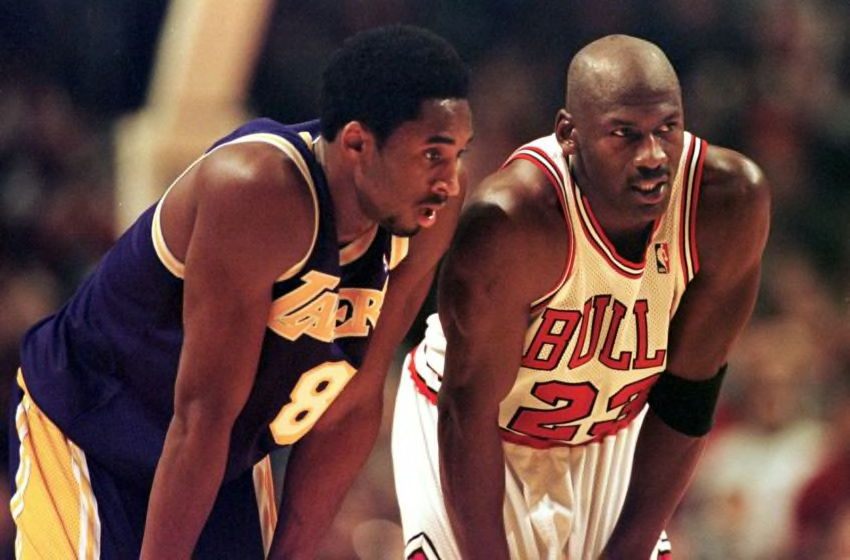
Chicago Bulls: Robbed of passing torch to Los Angeles LakersVincent Pariseon May 20, 2020 at 11:00 am

Read More

Chicago Bulls: Robbed of passing torch to Los Angeles LakersVincent Pariseon May 20, 2020 at 11:00 am Read More »

New movie watch-from-home recommendation: “Driveways” (2019), starring Brian DennehyLawrence Hartmannon May 20, 2020 at 2:59 am

From Hollywood to Ravenswood

New movie watch-from-home recommendation: “Driveways” (2019), starring Brian Dennehy

Read More

New movie watch-from-home recommendation: “Driveways” (2019), starring Brian DennehyLawrence Hartmannon May 20, 2020 at 2:59 am Read More »

Lori Branch’s greatest moments in Chicago music historyLori Branchon May 19, 2020 at 6:30 pm

"There's a steady flow of new kinds of music emanating from Chicago that go global." - PHOTO COURTESY LORI BRANCH

Not only is 2020 the Year of Chicago Music, it’s also the 35th year for the nonprofit Arts & Business Council of Chicago (A&BC), which supports creatives and their organizations citywide with business expertise and training. To celebrate, the A&BC has launched the #ChiMusic35 campaign at ChiMusic35.com, which includes a public poll to determine the consensus 35 greatest moments in Chicago music history as well as a raffle to benefit the A&BC’s work supporting creative communities struggling with the impact of COVID-19 in the city’s disinvested neighborhoods.

Another part of the campaign is this Chicago Reader collaboration: a series spotlighting important figures in Chicago music who are serving as #ChiMusic35 ambassadors. First up to discuss her own personal greatest moments in Chicago music history is Lori Branch, widely credited as the first woman DJ in Chicago’s legendary house-music scene. She’s been featured in several house-music documentaries and books and has held many DJ residencies. Branch cohosts the Vintage House show on WNUR 89.3 FM and serves on the board of the Modern Dance Music Research and Archiving Foundation. She’s also a longtime public-health advocate and LGBTQ+ activist–more information is available at lorabranch.com.

This interview was conducted by Ayana Contreras, who’s a DJ, host, and producer for WBEZ and Vocalo and writes for DownBeat magazine.


Ayana Contreras: What’s your favorite Chicago music moment?

Lori Branch: Aside from some personal moments, what comes to mind is Chaka Khan‘s performance in 2013 at the annual gala for the Center on Halsted. My favorite performance by one of my favorite artists.

It happened by chance. You know how at galas, people stay to hear the songs they know and then start to peel off? Well, after Chaka Khan finished her famous songs, the crowd of 800 to 900 guests started to thin, until there were about 150 of us. It became a very intimate concert. A native Chicagoan, Chaka Khan invited us to come up to the stage. She took a lot of requests, and it was a huge lovefest. My brother and my friends were there. We talk about it to this day.

For a more public performance, it’s definitely Billy Branch. He’s my cousin and a popular blues player, but I swear I’m not being biased. It was at a Chicago Blues Festival. The place was packed, the sun was setting–no better place to be in the world. Billy came onstage just as it got dark, and when the spotlight shined on him in this gorgeous blue suit, the crowd just erupted. I felt so proud of Chicago and our music legacy. The blues might not have started here, but it had its own kind of birthplace in Chicago.

What do you think makes Chicago such a hotbed for creating music genres?

There’s a steady flow of new kinds of music emanating from Chicago that go global. I have opinions about why, but if push came to shove, I’d say it’s because we have the silver lining of segregation here. It fosters a kind of backlash, an artistic explosion. That’s what you do when you’re forced into a corner. We’ve seen that in a lot of genres, like rock ‘n’ roll.

Take Sister Rosetta Tharpe, another Chicago legend. She’s the godmother of creating the sound that so many people emulate. Her sound had some country roots in the south, but it really grew up in Chicago. She brought along some of the greats in rock ‘n’ roll, like Little Richard. I love her story. She came from my family church, the Church of God in Christ on 40th Street on the south side.

Chicago’s been the birthplace of so many genres of music–including house music, which I’ve been doing for a long time. That’s a Chicago institution. Don’t let anyone tell you different. Its unique, stripped-down sound emanated from the south side. I still DJ, mostly for great festivals or local events that mean something to me–like last year’s Chosen Few event and now next year’s House Music Festival in Millennium Park. v

Read More

Lori Branch’s greatest moments in Chicago music historyLori Branchon May 19, 2020 at 6:30 pm Read More »