Videos

Toxic Business Partners, Part Onebadjackon June 16, 2020 at 8:28 pm

The Amused Curmudgeon

Toxic Business Partners, Part One

Read More

Toxic Business Partners, Part Onebadjackon June 16, 2020 at 8:28 pm Read More »

Sports lookback: Tiger Woods’ best flop shotsChicagoNow Staffon June 16, 2020 at 8:49 pm

ChicagoNow Staff Blog

Sports lookback: Tiger Woods’ best flop shots

Read More

Sports lookback: Tiger Woods’ best flop shotsChicagoNow Staffon June 16, 2020 at 8:49 pm Read More »

Hello 911? This Is Mayor Lightfoot”Send Us Cops Who Don’t Need Food-Water- Rest-or a Port-a Potty” /10-4 Mayor! ROBOCOP is On the WayBOB ANGONEon June 16, 2020 at 9:34 pm

JUST SAYIN

Hello 911? This Is Mayor Lightfoot”Send Us Cops Who Don’t Need Food-Water- Rest-or a Port-a Potty” /10-4 Mayor! ROBOCOP is On the Way

Read More

Hello 911? This Is Mayor Lightfoot”Send Us Cops Who Don’t Need Food-Water- Rest-or a Port-a Potty” /10-4 Mayor! ROBOCOP is On the WayBOB ANGONEon June 16, 2020 at 9:34 pm Read More »

Luna Bay Hard Kombucha: One-Man Taste PanelMark McDermotton June 16, 2020 at 11:52 pm

The Beeronaut

Luna Bay Hard Kombucha: One-Man Taste Panel

Read More

Luna Bay Hard Kombucha: One-Man Taste PanelMark McDermotton June 16, 2020 at 11:52 pm Read More »

Midnight Dice issue a passport to hesher heavenJ.R. Nelsonon June 17, 2020 at 1:45 am

click to enlarge
Midnight Dice are four-fifths of the defunct Satan's Hallow. - CHAD LARSEN

Gossip Wolf somehow failed to cover local trad-metal masterminds Satan’s Hallow before they went on hiatus in 2017, but thankfully four of that band’s five members kept going as Midnight Dice. If you enjoy banging your head till it falls off, cutting the sleeves off denim jackets, and making out with a hottie while blasting Dokken, then you’ll dig Midnight Dice’s new five-song EP, Hypnotized. This wolf especially loves the delightfully punishing “Starblind,” with Mandy Martillo’s lacerating vocals and a ripping solo from guitarist Steve “Lethal” Beaudette. Hypnotized should be out on CD, vinyl, and cassette this fall, but you can buy a Bandcamp download now if you don’t want to wait for an epic blast of adrenaline!

Since Gossip Wolf first wrote about Chicago indie-pop veterans Varsity in 2015, they’ve become one of the city’s most consistently excellent bands, balancing clever hooks, airily diverse arrangements, and the trenchant, insightful lyrics of singer and keyboardist Stef Smith. On Friday, May 29, Varsity dropped their third full-length, Fine Forever, via Boston label Run for Cover, and it’s as wide and open as a long drive through a midwestern summer afternoon. Standouts include the divinely sprawling “The Memphis Group,” about a crew of entitled jerks who collect nice furniture, and the crisp, effervescent “Reason to Run,” which features superlative jangle from guitarists Dylan Weschler and Patrick Stanton. A multicolored vinyl version is available via Varsity’s Bandcamp.

Avondale record shop No Requests, which opened in February 2019, will close at the end of June–co-owners David Beltran and Diana Bowden, who also run the FeelTrip label, say they can’t justify renewing their lease during the pandemic. The shop is open by appointment till June 28 (reserve a time on the FeelTrip site), and curbside pickup is still available. Beltran and Bowden will keep selling music online, even without a physical store. v

Got a tip? Tweet @Gossip_Wolf or e-mail [email protected].

Read More

Midnight Dice issue a passport to hesher heavenJ.R. Nelsonon June 17, 2020 at 1:45 am Read More »

The Blackivists on documenting movementsArionne Nettleson June 16, 2020 at 2:50 pm

Martin Luther King Jr. at the Chicago Freedom Movement Rally in Soldier Field; Martin Luther King, Jr. and Bernard LaFayette at street rally; Black Power movement at the Chicago Freedom Movement Rally at Soldier Field; Aerial view of a large crowd at a rally. - FROM THE CHICAGO URBAN LEAGUE PHOTOS COLLECTION, THE UNIVERSITY OF ILLINOIS AT CHICAGO SPECIAL COLLECTIONS AND ARCHIVES

When major movements rock the course of American history, Black voices and perspectives are often left out–out of textbooks, out of major museums, and out of public record.

Enter the Blackivists. Started in 2018, this group of six Black archivists in Chicago works to train and consult with community groups on how to properly preserve archives, prioritizing projects that fill in the gaps in history.

“Aside from our respective institutions, it’s important for us as Black information professionals, archivists, and librarians, and records managers, to be able to provide and share this expertise, these skills, with our communities and with our people,” says Skyla S. Hearn, a former chief archivist and director at the DuSable Museum of African American History. “So we all work together at various sites and events to educate the public about archives and also how to do the work as citizen archivists.”

The job of these memory workers is even more essential today as the police killing of George Floyd has reignited widespread protests across the country and discussions on the historic narratives. Black communities are again, in the current movement, working to ensure they have the power to document what is happening. The importance of this is further amplified by what Blackivist Stacie Williams says seems to be “most of white America’s collective gasp moment” that racism and oppression still exists.

“I think just even knowing and seeing that in that moment is understanding that our history has not always been documented, according to the dominant structures that did that type of documentation in this country,” says Williams, who is director of the Center for Digital Scholarship at the University of Chicago Library. “So, the importance I think of all of us being in our respective spaces and trying to elevate the histories, the stories, the narratives, the material culture, all of it, of Black people in this country is so important.”

Last fall, some Blackivist group members worked on a project with the Smithsonian to speak with Chicagoans on the west side about what happened in days after Martin Luther King Jr. was killed in 1968. Those stories, says Blackivist Raquel Flores-Clemons, explain how the National Guard treated Black residents at the time, but aren’t found in any textbook.

“It traces directly to what is happening, why things are the way they are, why people are responding the way they’re responding, and why certain communities are impacted by police brutality and over-policing more than other communities,” says Flores-Clemons, who is the university archivist and director of archives, records management, and special collections at Chicago State University. “A lot of that is still very much in the minds and hearts of our individual community members.”

Documenting the relationship between Black communities and law enforcement can show the connection between generations and the incremental progress made–or the lack thereof.

“When I think about the whole idea of community control of policing, that isn’t something new,” says Tracy Drake, an archivist at Reed College. “But if you know your history, you can trace that term back to what the Black Panthers were fighting for in the 60s. They used that exact same phrasing, but most people don’t know that and can’t make that connection. So that’s why it’s important to document it in all those phases. So you can see, ‘Wait, we’ve been fighting for community control of police for over 40 years.'”

Much of that history had not yet been recorded. Last year, the Blackivists consulted with members of the Illinois chapter of the Black Panther Party. An important part of the process was capturing the organization’s oral history.

“Largely, the records that we have are government documents and secondary book sources, but a lot of that story wasn’t told by the Panthers themselves,” Drake says. “So this was an opportunity to document that history [with them]. And that narrative creates a counternarrative to the larger history that we know about them and it allows us to disable any misconceptions and preconceived notions that are false that people have about them.”

Working directly with community members is a key focus of the Blackivists. The group has worked with Honey Pot Performance since 2018 on their Chicago Black Social Culture Map–an online public humanities project documenting Black social culture from the Great Migration through the early 21st century. This project focuses on the emergence of house culture in the 1980s so the group consults with those who attend the Honey Pot events to give do-it-yourself archiving help. That is a part of a larger commitment to help Chicago.

“There are a lot of materials out there that need preservation, that need care, and we don’t pretend to be able to do all of that work ourselves,” Hearn says. “So we really have to uplift, encourage, and also provide people with the tools to be able to do that work. So you know, through this particular project, we were able to do that.”

And those tools can be essential in documenting history. Blackivist Erin Glasco, an independent archivist, researcher, and organizer, says, “archivists in this moment–especially in this revolutionary moment that we’re in–are really uniquely posed and have a lot of unique skills that lend themselves very well to what’s happening in the streets.”

Recently, citizen-recorded video has helped dispel police accounts of misconduct: a 75-year-old man pushed to the ground in Buffalo, New York; two students violently arrested in Atlanta, Georgia; beanbag ammunition shot at protesters in Austin, Texas. Stressing that social media isn’t an archive, the Blackivists say archivists can help people properly archive what they capture. The group published a guide this month that provides tips for organizers, protesters, and anyone who wants to document a movement.

“The video evidence doesn’t lie,” says Glasco, who served as the research team lead for the #NoCopAcademy campaign–a Black and Brown youth-led grassroots effort to stop the construction of a $95 million police academy in Chicago. “I know when people were taking these videos, they weren’t thinking they were going to be seen, that they were documenting human rights offenses, but that’s exactly what they were doing. So I think that’s something very powerful that I would like to see more archivists very carefully and intentionally and mindfully get into.”

Even as the industry becomes more diverse, white archivists, curators, and museum technicians still make up a majority of positions nationwide–almost 90 percent. But there have always been Black archivists, the group notes, although the work of those trailblazers often went unseen.

“There has been this growth in terms of Black archivists being in the field, but for a period of about 30 to 40 years, there was just maybe about five or seven, and they all knew each other, and they were spread out across the country,” explains Steven D. Booth, an archivist with the U.S. National Archives where he manages the audiovisual collection for the Obama Presidential Library. “They weren’t in a position to do the work that we’re currently able to do now. And so, we do this work for our communities, for our families, but also in honor of them.” v

Read More

The Blackivists on documenting movementsArionne Nettleson June 16, 2020 at 2:50 pm Read More »

Beyond the Canon highlights BIPOC playwrightsSheri Flanderson June 16, 2020 at 9:50 pm

George Floyd, Breonna Taylor, Ahmaud Arbery, Trayvon Martin, Sandra Bland, Renisha McBride, Atatiana Jefferson, Jordan Edwards, Botham Jean. The space of this article could solely consist of the names of those Black lives who are no longer with us due to police brutality. Police murder. Yet this is an article about theater, which in the shadow of death feels extremely small and insignificant.

What is the purpose of theater in the midst of a pandemic, in a political moment where the world is rising up to protest and march in solidarity with human rights? Theater serves as a device to document; it serves as a vessel to cradle the emotional weight of the moment, and perhaps most importantly, it serves as an investment in the future. As theaters across the world sit dark in a COVID quarantine, the arts hold the most optimistic and fragile kernel of our hope; that one day Black lives will matter to not just some, but all, and that Black youth will have the freedom to indulge in art without the heavy weight of death pressing on their necks.

One artist helping to cultivate that hope is the founder and artistic director of Beyond the Canon (BTC), Simeilia Hodge-Dallaway. Each Wednesday on Instagram Live at noon (CDT), BTC offers a virtual writer’s room that champions hidden plays by Black, Asian, Latinx, and Middle Eastern playwrights. During the chat, viewers can connect with the featured writers, comment, ask questions, and celebrate each other and the work.

Hodge-Dallaway is an award-winning author; dramaturg; founder of Artistic Directors of the Future; executive director and creative producer of the Black Lives, Black Words International Project, which will be hosted online; and producer of the I Am . . . Fest at the Goodman last year, which concluded with the U.S. premiere of The Interrogation of Sandra Bland by Mojisola Adebayo. Hodge-Dallaway is also a Black play specialist.

BTC began in 2016, and Hodge-Dallaway’s initial intention was to find a way to share her extensive play library. “How do we get the plays from the shelf into the hands of those who need them most, and how do we help them to become teachers and ambassadors for the next generation?” she asks. The closure of the education system in the wake of COVID created an increasing sense of urgency.

Hodge-Dallaway went to publishing houses such as Methuen and Playwrights Canada Press and asked them to donate plays that are languishing on warehouse shelves to young POC students. “These plays are our legacy,” notes Hodge-Dallaway. Then, each week, BTC gives away free play texts, the first week’s literary selections being a two-book anthology edited by Hodge-Dallaway, Audition Speeches for Black, South Asian, and Middle Eastern Actors.

“It was important to me to ask publishing houses for anthologies so we are exposed to each other’s cultural perspectives. I became richer in my mentality researching and reading Black, South Asian, and Middle Eastern plays,” she says.

Historically, the traditional American theater canon has consistently regurgitated a handful of predominantly white male-penned plays. While some of these works are indeed literary masterpieces, some audiences grow weary of their inevitable return, and many are sociopolitically outdated. For example, some works by David Mamet are arguably due for a decades-long rest in the archives before being revisited again, if ever.

The dogged repetition of these plays in academic curricula creates a damning conundrum for young Black theater students. “A lot of institutions had ignored this work and were still teaching the same plays that they were familiar and comfortable with,” says Hodge-Dallaway. “How can you go your entire education and leave without knowing any living POC playwrights? We are setting students up to fail when competing with their white counterparts. The work exists. Let’s engage with it.”

Chicago theaters have made a push to put out more Black works. As the news often superficially reports on the tragically constant murders of Black people at the hands of police, the coverage can sometimes lack the same level of compassion and consideration afforded to white victims of murder. Stories are often reported alongside less-than-flattering-photographs, and call out irrelevant prior indiscretions, dehumanizing the victim. This is where theater can help to correct the record and soothe the hearts of a grieving community by shifting the point of view from the arresting officer to that of the victim.

Many plays in Chicago over the past several years have deftly addressed various perspectives on police brutality and Black pain, reclaiming the narrative and infusing the stories with compassion. One of the most recent and powerful examples of this was Kill Move Paradise by James Ijames at TimeLine Theater, a surrealistic, heart-wrenching, and challenging examination of the souls of the departed and the preference of white America to filter its empathy through the consumption of Black trauma as entertainment. Running in the same vein was Tilikum by Kristiana Rae Colon at Sideshow Theatre, a metaphorical, visually and aurally enchanting piece that leverages the story of a killer whale at SeaWorld against America’s history of treating Black bodies as animals. (A streaming version of Tilikum runs this Friday, June 19, as a Juneteenth fund-raiser for Colon’s Let Us Breathe Collective.) Hooded, or Being Black for Dummies by Tearrance Arvelle Chisholm with First Floor Theater at the Den and graveyard shift by korde arrington tuttle at the Goodman also explored these themes.

While it’s important to honor and interrogate tragedy, it’s also crucial to push back against the common and limiting narrative that the Black existence begins with slavery and ends with police violence. It’s just as important, if not moreso, to explore works with broader themes of joy, family life, science, freedom, and adventure to create a well-rounded portrait of Black humanity.

Other recent Chicago plays that explore broader themes include two by playwright J. Nicole Brooks; HeLa, which reimagines the story of Henrietta Lacks through an Afrofuturistic lens, and Her Honor Jane Byrne, which dissects the mythos around the legacy of Chicago’s first woman mayor. Byrne’s onstage run at Lookingglass was unfortunately cut short due to COVID. Another play, How to Catch Creation by Christina Anderson, beautifully explored the perils around indulgence in the life of an artist; Lottery Day by Ike Holter gave a window into the joys of having an invite to the proverbial cookout; Katori Hall’s Hoodoo Love smoldered with romance infused with magic, metaphorical and literal; and Danai Gurira’s Familiar comedically outlined the struggles of a Zimbabwean family assimilating (or not) into the U.S.

With BTC, Hodge-Dallaway and associate producer Sarudzayi Marufu hope to inspire the reading and production of even more BIPOC plays in Chicago and beyond. While not wanting to spoil the surprise of all of the writers who may be featured and have their works given away for free through BTC, she provided a sneak peek of names and texts that may be featured. Some of the international playwrights may potentially include Lydia R. Diamond, Kwame Kwei-Armah, Donna-Michelle St. Bernard, David Yee, and works such as The Convert by Gurira, Barber Shop Chronicles by Inua Ellams, One Night in Miami by Kemp Powers, Detroit ’67 by Dominique Morisseau, The Adventures of the Black Girl in Her Search for God by Lisa Codrington, A Wolf in Snakeskin Shoes by Marcus Gardley, and anthologies such as The Methuen Book of Contemporary Latin American Plays and Love, Loss, and Longing: South Asian Canadian Plays, Mojisola Adebayo Plays One and Plays Two, Lions and Tigers by Tanika Gupta, and Wole Soyinka play anthologies.

Hodge-Dallaway hails from the UK and works as an artist in multiple countries. When asked how artists across BIPOC communities can band together to create lasting change as Black Lives Matter protests spring up worldwide, she says, “A lot of POC-led organizations rarely work with each other. Our eyes tend to be on the larger institutions that might validate us. We have to advocate for each other. Black and other POC writers simply cannot continue to let white directors direct our work.”

The Black Lives Matter protests have sparked a reckoning, amplifying calls for change within arts organizations. While making promises to stage more Black and BIPOC plays is crucial, it has also been historically used as a MacGuffin to distract from a theater’s inability to make fundamental changes at the board and executive levels. This lesson was recently learned in excruciating fashion when Victory Gardens Theater advertised a single Black play from its Ignition Festival to paper over controversy–just after their entire ensemble walked out in protest of the recent executive leadership changes.

Victory Gardens isn’t the only theater learning in public that the bar has been moved, as theaters implicated on the infamous Theaters Not Speaking Out spreadsheet have also discovered.

Says Hodge-Dallaway, “Organizations simply think that they can write a statement and think that is enough–and artists are saying ‘no.'” v


Read More

Beyond the Canon highlights BIPOC playwrightsSheri Flanderson June 16, 2020 at 9:50 pm Read More »

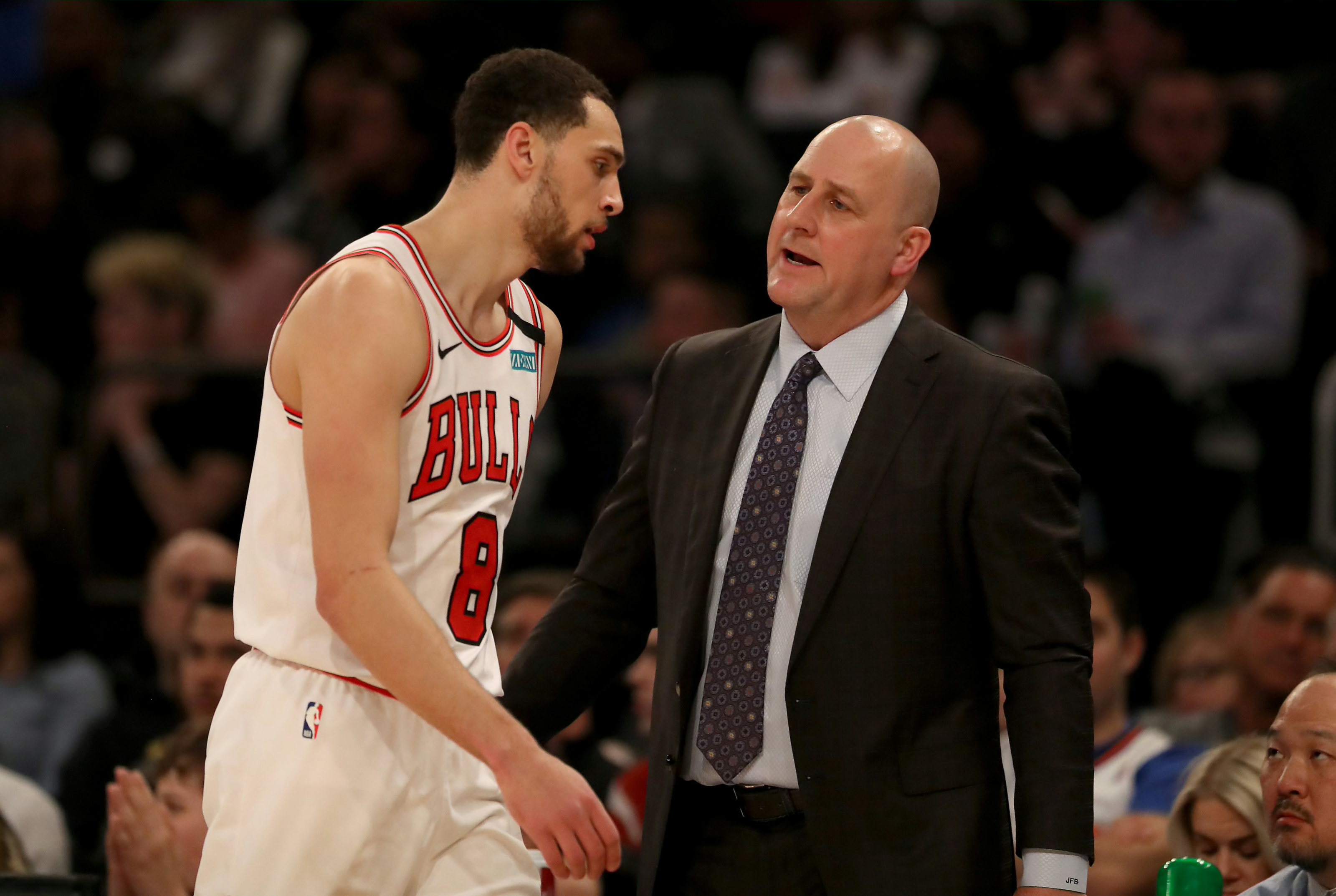
Chicago Bulls: Top 3 coaching candidates, per reportRyan Heckmanon June 16, 2020 at 10:00 am

Read More

Chicago Bulls: Top 3 coaching candidates, per reportRyan Heckmanon June 16, 2020 at 10:00 am Read More »

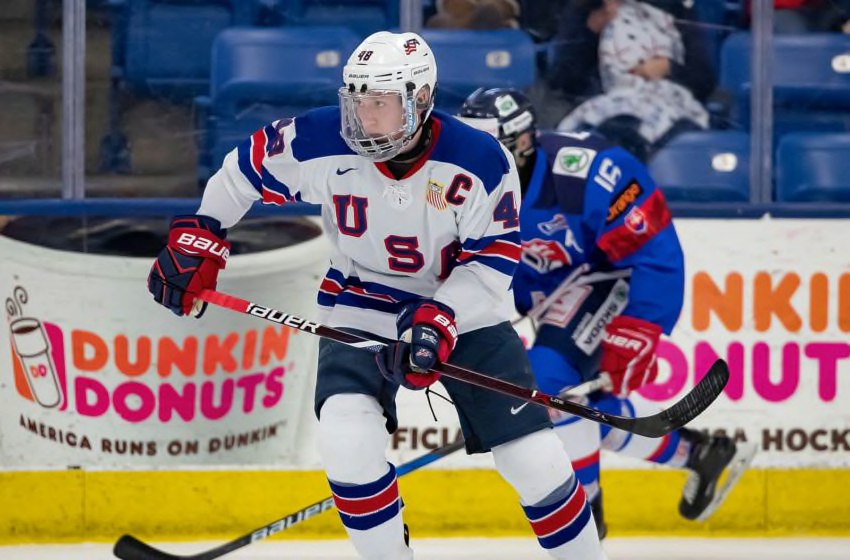
Chicago Blackhawks Draft Profile: Jake SandersonRyan Sikeson June 16, 2020 at 11:00 am

Read More

Chicago Blackhawks Draft Profile: Jake SandersonRyan Sikeson June 16, 2020 at 11:00 am Read More »