Chicago’s Best Places to Live: 2020 Editionon June 23, 2020 at 2:01 pm
Error fetching full content with error: 500 ([unable to retrieve full-text content])Read More
Chicago’s Best Places to Live: 2020 Editionon June 23, 2020 at 2:01 pm Read More »
Error fetching full content with error: 500 ([unable to retrieve full-text content])Read More
Chicago’s Best Places to Live: 2020 Editionon June 23, 2020 at 2:01 pm Read More »
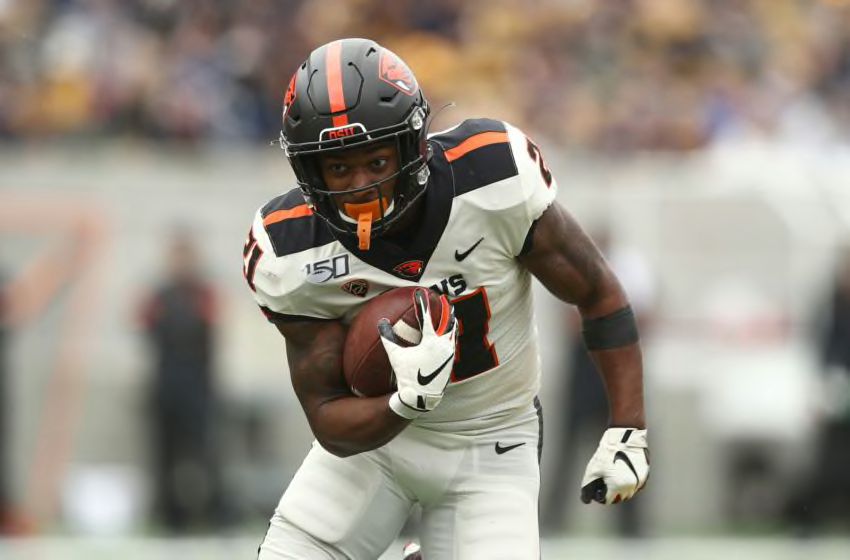
Recently, we discussed how the Chicago Bears are thin when it comes to depth at three key positions. One of them is running back, where the Bears currently have second-year starter David Montgomery, paired with Tarik Cohen as the only returning players from last season with legitimate experience at the position. Yes, there is fan-favorite Ryan Nall, but if the Bears were high on him, he likely would have gotten more than two touches last season.
Talent-wise, the team is more than set at the position. Montgomery is looking to have a breakout year, hopefully with an improved offensive line. Cohen, who had a down year in 2019, is hoping to get back to his 2018 form when he was one of the most exciting and dangerous weapons in the NFL.
But what happens if either of those players gets injured? Specifically, what if the Bears lose Montgomery for any length of time? Who would step in and carry the ball 20-25 times per game like Montgomery will be expected to do this year? Certainly, that is not a role Cohen can step into. Some have argued for the Bears to make a move in free agency, but to date, they have not. So perhaps they feel that option is already on the roster in Artavis Pierce.
Pierce is an undrafted free agent out of Oregon State Univerisity who combined for 1,042 yards (rushing and receiving) last season with eight touchdowns. He runs the 40 in the mid 4.4s (ran a 4.47 at Oregon State’s Pro Day) and is solidly built at 5-foot-11 and 208 pounds.
The fact that the team hasn’t gone out to get a veteran running back might bode well for Pierce. Perhaps the team feels he can step in to take over for Montgomery if necessary. That would be a tall order for any rookie, but especially one trying to learn the offense remotely without the benefit of being in Halas Hall.
That the team seem to think this highly about Pierce says a lot about not just the player, but also the person he is. He clearly has a high football IQ. The book on Pierce is that he is a solid back who does everything well even if he’s not elite in any particular aspect.

While he’s still a bit of a longshot to make the team as an undrafted free agent, the longer the team goes without bringing in another option the better his chances are of doing just that. Perhaps he can be another UDFA gem uncovered by the Bears.
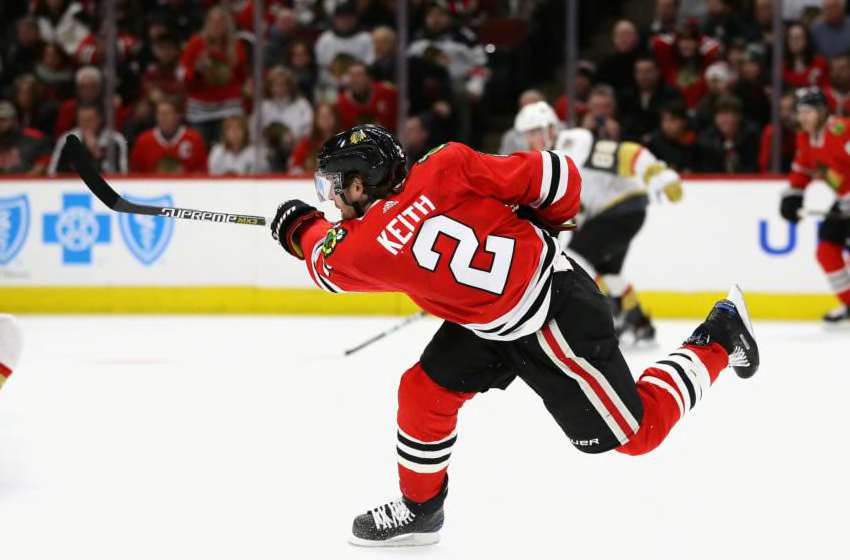
When the Chicago Blackhawks face off against the Edmonton Oilers in a couple of weeks it is going to be something special. Of course, a few things need to happen in order for the National Hockey League’s “return to play” tournament to go but if it does, it will for sure be exciting. Out of all of the “play in” matchups, Chicago vs Edmonton is probably the most intriguing.
Of course, the key to defeating the Oilers is going to be slowing down Leon Draisaitl and Connor McDavid. If that happens, Duncan Keith is surely going to need to be a part of it. He has been a key core piece for this team for a very long time now and has done everything a defenseman would ever want to do in an NHL career.
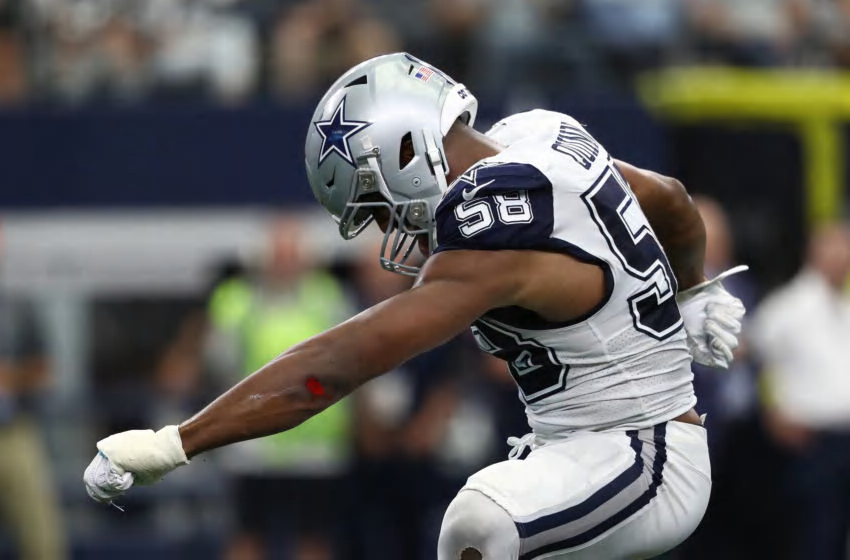
I probably wasn’t the only one who raised an eyebrow when the Chicago Bears announced their signing of pass rusher Robert Quinn. On one hand, that was a lot of money to spend. On the other, this defense just got even better — and that’s frightening.
Throughout the offseason, players have obviously been unable to meet, work out and practice in person thus far. But, that hasn’t stopped Quinn from absorbing as much information as humanly possible.
This past week, Bears outside linebackers coach Ted Monachino had some very simple and encouraging words regarding the team’s newest premier pass rusher.
“I’ve spent more time with Robert Quinn than I’ve spent with a lot of guys… Robert asks a lot of really good questions. He wants to be really good in this system and he wants that to happen right away.” (Quote via Hoge and Jahns podcast)
Quinn, a 9-year veteran, was a bit of a surprise signing for most fans. But, after soaking it all in, and knowing Quinn is as energized and inquisitive as he is, there is reason to believe the Bears defense is going to light up the NFC North in 2020.
Thinking about Quinn’s high expectations, paired with Khalil Mack on the opposite side, is a scary proposition. Take, for example, Mack’s history in the league and who he had on the other end.
In 2014 (Mack’s rookie year), he only totaled 4.0 sacks. The team-leader for the then-Oakland Raiders was Justin Tuck with only 5.0. The next year, Mack upped his sack total to a career-best 15.0, while the next closest was middle linebacker Malcolm Smith. As for the opposite pass rusher? How about 3.5 from Aldon Smith or 3.0 out of Denico Autry.
In 2016 and 2017, Bruce Irvin had 7.0 and 8.0 sacks respectively, to go along with Mack. In 2018 and 2019, Leonard Floyd had 4.0 and 3.0 sacks opposite of Mack.
With Quinn, you’re talking about a guy who has had double-digit sacks in four seasons and, over nine years, has averaged about 9.0 sacks per season.
Quinn has to be as hungry as ever, while getting set to play with the best defense he’s ever played on. Not to mention, he and Mack won’t be alone rushing the passer — hello, Akiem Hicks.
At 30 years old, Quinn has to be as excited and motivated as ever before with a chance to do something special. This Bears defense could be the best we’ve seen it since the 2006 Super Bowl year. Quinn’s expectations, along with the talent already on this unit, should have fans more than ready for some football.

As a former seventh-round pick of the Los Angeles Kings, the Chicago Blackhawks had to be thrilled when they acquired Dominik Kubalik in exchange for a fifth-round pick before the 2019-2020 season. The 24-year-old was just finishing up an impressive campaign in the National League, scoring 25 goals with 32 assists for 57 points in a 50-game sample size.
The left-winger was inserted on the third line to start and as he continued to pile up the goals, Jeremy Colliton moved him up to the top line alongside Jonathan Toews and Alex DeBrincat. He finished his first year in the NHL, leading all rookies with 30 goals while also accumulating 16 assists for 46 total points.
Perhaps the highlight of his season came in Tampa when he scored a hat trick in a 5-2 Blackhawks’ victory. That night, Kubalik scored his 27th, 28th, and 29th goals all in the third period in what would end up being one of the final regular-season games for the Blackhawks.
It would appear that his primary competition for the Calder Trophy – the NHL’s Rookie of the Year honors – are Vancouver’s Quinn Hughes and Colorado’s Cale Makar. Hughes tallied eight goals with 45 assists for 53 points in 68 games, while Makar scored 12 goals with 38 assists for 50 points in 57 games.
The pair of defensemen averaged at least 21 minutes on ice for their respective teams, but the interesting thing is that Kubalik’s production came with significantly less 14:22 average time on ice.
But looking at the previous winners, only 11 defensemen – out of a possible 86 winners – have won the award. And not since Aaron Ekblad during the 2014-2015 campaign – 12 goals with 27 assists for 39 points – has a defenseman been given the honors.
That said, Hughes had a terrific season, and Kubalik will have a tough time receiving more votes from the Professional Hockey Writers Association, but he made his case. I’d be curious to see what Kubalik’s stats would have looked like had he played on the top line all year, which would have obviously given his time on ice a noticeable uptick as well.
Regardless if Kubalik wins the award, he will be a priority for the Blackhawks this offseason, as he is set to become a restricted free agent once the new league year begins, which will reportedly occur on November 1.


As the coronavirus pandemic started to sweep across the globe, many people took animal companions into our homes. Some pets were fosters, others into their new forever homes. However, life under lockdown is weird, unnatural and strange to say the least- both humans and pets alike.
The dogs and cats already in our lives suddenly had to adjust to the concept of us being around nearly all the time. The animals entering into a new relationship with a human got to know this person in a way that’s not reflective of life is going to be moving forward. While we evalaute and strive to maintain our own physical, mental and psychological well-being, we need to think of our furry friends at the same time.
Around Memorial Day weekend, it became apparent that people, en masse, were violating stay-at-home orders. You saw the footage of people out enjoying the outdoors in large groups as the weather began to turn warm. The time away might actually be good for our cats and dogs. OurFitPets is a good resource for explaining pet behavior and the motivations behind their actions. The BBC has this fantastic video of a pet behaviorist explaining how animals will react to our eventual return to work (whenever that may be) and how promoting some distance right now in the home can end up being beneficial in the long run.

Shortly after Memorial Day weekend, the killing of George Floyd by Minneapolis police officer Derek Chauvin set off a wave of protests and demonstrations that this country has not seen, arguably, since 1968. Pent up inside for so long, with nothing really open and all major entertainment events completely wiped clean from the calendar for the foreseeable future, people needed somewhere to go, something to do and a purpose to keep their minds occupied.
The higher the unemployment numbers get every week, the more people we’ll see in the streets. And most of the time, they are not taking their pets with them.
This is good for the animals though. They need to get used to the idea of us not always being there. Eventually, we’ll all be leaving the house more and that’s a reality our pets need to be eased back into. It’s great that people are getting out and demonstrating, it conveys how strong the desire for change truly is.

It’s also wonderful to see more business, albeit slowly, open up again. We’ve all grown weary of our same four walls all the time. And our pets will benefit from a little social distancing from us once in awhile too.
Paul M. Banks runs The Sports Bank.net, which is partnered with News Now. Banks, the author of “No, I Can’t Get You Free Tickets: Lessons Learned From a Life in the Sports Media Industry,” regularly contributes to WGN TV, Sports Illustrated, Chicago Now and SB Nation.
You can follow Banks, a former writer for Chicago Tribune.com, on Twitter and his cat on Instagram.
Type your email address in the box and click the “create subscription” button. My list is completely spam free, and you can opt out at any time.
Filed under:
Current Events
Tags:
cats, coronavirus, covid, covid-19, dogs, lockdown, pets, quarantine, reopening
Meet The Blogger
Paul M. Banks runs The Sports Bank.net and TheBank.News, which is partnered with News Now and Minute Media. Banks, a former writer for the Washington Times, NBC Chicago.com and Chicago Tribune.com, currently contributes regularly to WGN CLTV and ChicagoNow.
He’s been a featured guest in dozens of media outlets including The History Channel. His work has been cited in hundreds of publications including the Wall Street Journal and Washington Post.
Completely spam free, opt out any time.
Recent posts
Latest on ChicagoNow
Posts from related blogs

Most recent post: Where are the black lives matters marchers for Mikhi James?

Most recent post: Don’t Ask Why Black Women Feel Unsafe, If You Are Going to Attack Them for Being Honest

Most recent post: Tear down the Confederate monuments. ASAP
More from News: Opinion
Read these ChicagoNow blogs


Read these ChicagoNow Bloggers


©2020 CTMG – A Chicago Tribune website –
Crafted by the News Apps team


Chicago Cubs second baseman and center fielder Jason Kipnis on June 6 placed his five-bedroom, 3,192-square-foot house in Northbrook on the market for $1.375 million.
A Northbrook native and a standout athlete at Glenbrook North High School, Kipnis, 33, has an extensive residential property portfolio. His primary Chicago-area residence is a five-bedroom, 7,000-square-foot mansion in Old Town that he bought in January for $2.8 million, as Elite Street exclusively reported in March.
Read more on the Chicago Tribune.
Filed under:
Uncategorized
Completely spam free, opt out any time.
Latest on ChicagoNow
Posts from related blogs

Most recent post: 10 years ago today from the Trib and Sun-Times: the Bears reach the Super Bowl
More from News: Media
Read these ChicagoNow blogs
Read these ChicagoNow Bloggers
©2020 CTMG – A Chicago Tribune website –
Crafted by the News Apps team


Back in early March, I don’t know if it was optimism or skepticism, but I was holding onto a ray of hope that Covid-19 would be overhyped. The talk of sheltering at home, self-quarantining, maybe this would last for a couple of weeks, but then everything would blow over. Go back to normal.
Note: To catch up on the previous posts in this story, here are Part 1, Part 2, and Part 3.
Then we started seeing the reports from Spain and Italy. My wife’s cousin lives in Madrid and when we talked with them over a Zoom call, we saw the bags under their eyes and this tired reality of being trapped inside for weeks on end. It felt like Game of Thrones. Covid is coming. The “if” became “when” and now it was just a matter of time before the U.S. started to look like Spain and Italy. Normal might not be here for a while.
New York was when it officially felt close to home. The pictures of exhausted healthcare workers with red marks on their faces. Hospitals running out of space. The daily press conferences with Andrew Cuomo pleading for more ventilators. Begging us to take the virus more seriously. Warning us that New York could be the harbinger of things to come.
Samer’s family is still in New York City. They kept working at the bagel shop, making special catered deliveries to NYU and local hospitals.
As the cases started to accelerate here in Chicago, Samer was also navigating the stress of keeping his shop open.
“We’re putting our lives on the line,” Samer said. “No matter what. We’re putting on masks, gloves, all of this, but you don’t know who’s walking into the store. There are drivers that we deal with too. They’re putting their lives out there. Everyone’s doing their best part.”
Sam Hurteau had an idea. This time it had nothing to do with Seinfeld or a pink gorilla. But the starting point felt surprisingly similar.
I received a text toward the end of April. “Hey, wanna run an idea by you…”
His idea: Connect local restaurants with healthcare workers. He’d organize a group of friends to send in donations that would pay for these catered lunches. It was pretty incredible how things naturally started coming together. First – a rehab team received a catered lunch from Hannah’s Bretzel. Then Twenty-five ER doctors at AMITA St. Mary & Elizabeth Med Center received snacks from Left Coast Food + Juice.
I met the idea with a Yes And. Already had a place in mind run by a guy who was the rare combination of doctor and restaurant owner.
After posting the Black & Caspian articles, I reached out to Sammi Saliba (a lot of Sam based names in this story) who serves as the Director of Marketing at the Lakeview East Chamber of Commerce. She’d helped me get Long Overdue set up a few months earlier as a new member. I asked her if there were any other local restaurants in Lakeview that might be good to write about. She introduced me right away to Soraya Rendon of Chilam Balam and Samer Asous of Taste of New York Bagels & Deli.
Setup an interview with Samer. Added Sam Hurteau to the call. Had a feeling this would be bigger than a blog post.

I think it was only a week after our call when Samer and the Taste of New York team fed 60 ER + ICU doctors and nurses at the Norwegian American Hospital. Samer wanted to support his mentor, Dr. Ivankovich, an Orthopaedic Surgeon at Norwegian. And Samer, never one to skimp on a delivery, made so much food that they also fed the Telemetry department.
“If there’s anything I can help with, let me know,” Samer sent via text after the delivery. “And please, extend my sincere appreciation to all the donors who helped us cater today’s lunch.”
The “Fun Friday” lunches kept rolling strong. May 14th, Sam collected more donations and delivered lunch from 90 Miles Cuban Cafe to 30 Pediatric Surgeons at Lurie Children’s Hospital, and then 75 ER doctors and nurses were fed at Northwestern. It was inspiring to see this flow of healthcare workers working around the clock to save lives, restaurants working hard to feed the healthcare workers, and friends supporting the restaurants. And it all started with an idea.
They say everything happens for a reason and I think that’s almost true. Maybe better put: Everything happens and we try our best to piece together the reasons.
Or what Søren Kierkegaard once wrote, “Life can only be understood backwards; but it must be lived forwards.”
And that’s the great mystery of being in the Flow. In the moment, we can’t see how all of these random things in life – both the good and the bad – will end up weaving together. Then, when you look back on it, there’s this thin line between fate and coincidence. Because yeah, there’s a case to be made that everything from these last four posts was just random coincidences and that – with the benefit of hindsight – I could neatly tie them together into one story. And that might be true. But I think it’s being in the Flow that helps us connect these dots and grow to appreciate the Author of Life.
All that being said, it’s still hard to trust the Flow. It feels too peaceful. Like we need to be working harder. Pursuing a defined goal. Following an established outline. Or, like I did, start out in the Flow, but gradually wander off the path. Not putting family and friends first. Forgetting to ask people for help. In the words of Tim Keller, things tend to fall apart when we let a good thing (in my case, working on Long Overdue) become an ultimate thing.
The funny thing is, whenever I realize I’ve lost the Flow, my first instinct is always to chart a course back. I have to work my way back into grace and flow. But the greatest surprise of all was to see these things had never really left. If anything, grace was chasing after me, not the other way around. The best way I can describe it is like that scene toward the end of Finding Nemo when the pelican comes crashing through the dentist’s window.
Nigel: Your dad’s been fighting the entire ocean, looking for you.
Nemo: My father? Really?
Nigel: Yeah, he’s traveled hundreds of miles, he’s battling sharks and jellyfish–
Nemo: Sharks? That can’t be him.
Nigel: Guess so. What was his name? Some sort of sport fish? Tuna? Trout?
Nemo: Marlin?
Nigel: That’s it! Marlin! The little clownfish from the reef.
Nemo: It’s my dad! He took on a shark!
Nigel: I heard he took on 3.
Gill: 3 sharks?
Bloat: That’s gotta be 4,800 teeth!
Nigel: See, after you were taken by a diver over there, your dad followed the boat like a maniac.
Nemo: Really?
Nigel: He’s swimming, and swimming, giving it all he’s got, and then three gigantic sharks capture him, and he blows them up and dives thousands of feet, and gets chased by a monster with huge teeth! He ties this demon to a rock, and what’s his reward? Het gets to battle an entire jellyfish forest! Now he’s with a bunch of sea turtles on the E.A.C., and the word is he’s headed this way right now…to Sydney!
When I’m caught in the flow, my face looks a lot like Nemo’s in that scene. I’m amazed by the pursuit and how these little pieces tie together in life. Good times. Hard times. Times when I’ve felt like I had all the answers and times when I felt like I’ve had none. Things that never seemed to make any sense and things that never felt like they would lead to anything good, those all became just as useful as the good stuff from the highlight reel.
Solomon said in Ecclesiastes: “Better one handful with tranquillity than two handfuls with toil and chasing after the wind.” I think that’s where the magic happens; saying yes to the Flow, even a small yes, then letting go. Slowing down to experience the way stories start weaving their way together over and over again. This fills me with an energy to keep writing, keep telling stories, helping others with their stories, which strangely leads me right back to Long Overdue. The answer after all of that wasn’t to stop working, I just had to let the work become fun again.
Because writing, Long Overdue, they’re good things, but they’re not the ultimate thing. They can only point me in the right direction. Back to the Author of Life.
This series will end up being partially a profile of the New York Bagel & Deli restaurant in Chicago, part reflections, and philosophy on how ideas come together. In case you missed Part 1, you can read that right here. And if you enjoy this type of style, you might enjoy the four-part series I did featuring Tango Sur and some Kierkegaard.
Despite the name, Medium Rare isn’t normally a food blog. But for the next several weeks, every Tuesday, I’ll be featuring great local restaurants around the Lakeview neighborhood in hopes that readers support these spots with pickup & delivery orders now and go in-person later this year. Other posts in the series include:
To subscribe to Medium Rare via email, just enter your email address in the box below. See you next week!
Filed under:
Christianity, Life
Tags:
anxiety, catered food, flow, healthcare workers, Holy Spirit, Taste of New York Bagels & Deli, writing
Meet The Blogger

I was born and raised in Midland, Michigan and moved here to Chicago a couple years ago after graduating from Hope College. I live in the city with my beautiful wife Ashley.
A little bit about me – I go to bed early, I enjoy greasy food and would wear sweatpants everyday if I were allowed to. I just signed up for a year-long Divvy membership, but could very well be the slowest bicyclist in Chicago.
I write the Medium Rare blog and will have a new post up every Monday.
Completely spam free, opt out any time.
Latest on ChicagoNow
Posts from related blogs

Most recent post: If marriage is salad, Paul Farahvar will have the fries!

Most recent post: This is probably my last Chicagonow post

Most recent post: Ten Google Search Terms For Parents (or Maybe Just Me)
More from Entertainment: Humor
Read these ChicagoNow blogs
Read these ChicagoNow Bloggers
©2020 CTMG – A Chicago Tribune website –
Crafted by the News Apps team

Filed under:
Uncategorized
Completely spam free, opt out any time.
Latest on ChicagoNow
Posts from related blogs

Most recent post: Not all heroes wear capes: The Anti-Cruelty Society Fosters

Most recent post: All Pet Foods are Not Created Equal and That Includes Raw

Most recent post: Foster the Possibilities: Learn How Fostering Pets Saves Lives
More from Lifestyle: Pets
Read these ChicagoNow blogs
Read these ChicagoNow Bloggers
Parsley — Petraits RescueChicagoNow Staffon June 23, 2020 at 2:21 pm Read More »

Not only is 2020 the Year of Chicago Music, it’s also the 35th year for the nonprofit Arts & Business Council of Chicago (A&BC), which provides business expertise and training to creatives and their organizations citywide. To celebrate, the A&BC has launched the #ChiMusic35 campaign at ChiMusic35.com, which includes a public poll to determine the consensus 35 greatest moments in Chicago music history as well as a raffle to benefit the A&BC’s work supporting creative communities struggling with the impact of COVID-19 in the city’s disinvested neighborhoods.
Another part of the campaign is this Reader collaboration: a series spotlighting important figures in Chicago music serving as #ChiMusic35 ambassadors. This week, we hear from visual artist, educator, and musician Damon Locks. Locks was a founding member of influential Chicago posthardcore band Trenchmouth, which split in 1996, and he still fronts the Eternals (where he plays alongside former Trenchmouth bandmate Wayne Montana). He’s been a vocalist with Exploding Star Orchestra, one of many hard-to-categorize groups led by cornetist and composer Rob Mazurek, and his latest album, 2019’s Where Future Unfolds, features a similarly ambitious group that he leads himself, the Black Monument Ensemble.
This interview was conducted by Ayana Contreras, who’s a DJ, a host and producer at WBEZ radio, and a columnist for DownBeat magazine.
Ayana Contreras: What’s your favorite Chicago music moment?
Damon Locks: The experiences in my list of [moments] were things that caused ripples that went on forever. So I’m not talking about when I saw Fred Anderson take apart Peter Brotzmann at the Empty Bottle, which was great. I’m talking about the emergence of Soul Train [which premiered in Chicago in 1970]. Even in Maryland, where I was from, we felt the effects of Soul Train when it expanded and became a nationwide show.
So I’m going to dig a little deeper with you. You said that you felt the ripples of Soul Train. Tell me about a way in which you felt those ripples.
Soul Train was kind of a beacon for fashion, movement, and culture. Every weekend, you would stand in front of the TV as a little kid and just watch it. You remember those giant TVs that were super huge? We’d stand in front of that TV and we would do the double bump or whatever. [It] was a way of finding out about new music. We’d practice the dance moves. You’d look at the costumes.
That was something that expressed a contemporary Black culture, but also was so affirming and representational. Every week you could turn on the television and there would be something that was expressing Black culture in this vibrant, Technicolor, surround-sound way.
Speaking of Chicago, what ultimately drew you here?
I was in New York, and I went to the School of Visual Arts. I was an illustration major. And at the time I wasn’t that happy in New York. It wasn’t what my imagination said it was going to be. There was a woman that I was interested in that came out to the Art Institute of Chicago, and I came to visit the Art Institute and I saw a whole school full of weirdos. And it was different than being in New York. It wasn’t organized.
So I was really attracted to that collection of weirdos, and I decided to come out here. Illinois was not a place that I thought I would go to. But once I got here, the experience of being able to make something without a lot of the baggage of New York seemed like a possibility. You could make connections and create something that wasn’t finished, in a way.
Yeah. I agree. Chicago is a place where you can will something into being while working through it if it’s got a few scraggly ends. So that leads me into my second question. What do you think it is about Chicago’s music and cultural scene that has made it so influential internationally?
I feel like in many ways, Chicago . . . they don’t keep their doors shut to you. If you’re putting in work, and if you ask for help, someone’s going to be like, “I have some resources. Why don’t you use these?” That has always been the case in Chicago for me. And I feel that musically, I feel that in the arts, I feel that on a bunch of different levels. v