Holy Hive call their sound “folk-soul,” and you couldn’t ask for a better demonstration of what that term means than the Brooklyn trio’s debut album, Float Back to You. Auspiciously released over Memorial Day weekend–the traditional kickoff to the summer season–this ethereal record blends the folky falsetto vocals of Paul Spring with deep shades of beachy 60s soul courtesy the funk skills of drummer Homer Steinweiss. Spring is a singer-songwriter with a 2013 children’s album under his belt, while Steinweiss is a former member of Sharon Jones & the Dap-Kings and a longtime session musician (that’s him on the annoyingly catchy Bruno Mars song “24K Magic”). After Spring and Steinweiss met at a family reunion–their girlfriends happened to be cousins–they started jamming together, homing in on the common ground between their seemingly disparate sonic worlds. The songs on Float Back to You are mostly variations on the same lazy-day theme, and though some of them run together on repeat listenings, the tight, soul-influenced rhythms of Steinweiss and bassist Joe Harrison consistently ground Spring’s upper-register singing. Among the more memorable cuts is “Oh I Miss Her So,” which features masterful cameos from harpist Mary Lattimore, whose strumming dances with Spring’s melody, and Roots trumpeter Dave Guy, who adds a solo on the bridge. The song makes me think of driving by the lake with someone special on a starlit summer night, so I guess Holy Hive’s magic is working on me. v
If you’ve ever wondered what Motown would sound like if it had been born not in Detroit but on the streets of Karachi or Kingston or in the surf dens of late-60s southern California, you might like Houston collective Khruangbin. On their new third album, Mordechai, bassist Laura Lee Ochoa, guitarist Mark Speer, and drummer DJ Johnson (their band name is the Thai word for airplane, which directly translates to “engine fly”) bank the soul-infused psychedelia and transnational rhythms of Khruangbin’s previous efforts in favor of an unrushed but risk-taking approach, which uses more of Ochoa’s powerfully reflective lyrics. The band developed much of the material on the album over three years of constant touring, before hunkering down to record in a studio they built in a converted barn between Houston and Austin. Jettisoning the 60s Thai pop of their 2015 debut, The Universe Smiles Upon You, and the Middle Eastern influences of 2018’s Con Todo el Mundo, the band evolve their gritty, sophisticated sound with dub- and soul-influenced tempos and a mashup of funky grooves, jazzy riffs, sweet R&B, surf rock, and pan-global flavors. Drawing on influences that make Khruangbin close neighbors to the likes of Roy Ayers, Bebel Gilberto, Thievery Corporation, and Allah-Las, Mordechai picks up where the band left off on their recent collaborative EP with soul singer Leon Bridges, Texas Sun–except this time Khruangbin provide the vocals. Propelled by bouncy wah-wah guitar and hip-hop beats, the catchy “Time (You & I)” drips with sunshine and cool breezes. It’s a serious contender for song of the summer–if the Beastie Boys had recorded “Hey Ladies” in the mid-1970s, it would’ve sounded like this. “Mother Bird Father Bird” and “One to Remember” provide some chill, the Stax-tinged “If There Is No Question” brings Memphis soul to Houston, and the hand-clap-heavy “Pelota” finishes the album with aplomb. Finely polished and stylishly executed, Mordechai is a deep album whose undulating rhythms and expansive sonic tapestries make for irresistible morsels of spicy pop goodness. v
We are heading out to Shamrock Park in Berrian Springs, MI today. By the time you get this, I’ll be traversing the Indiana Toll Road south, to EB I-65, and north up into Michigan. Here’s your rundown of picks from my latest Release Radar.
[embedded content]
HAIM has finally released their third album, Women In Music Pt. III, which has been a long time in the making. We have heard four strong songs, and today we get the rest of the batch produced by Rostam Batmanglij, of Vampire Weekend. I’m definitely getting that Rostam vibe on “Now I’m In It,” and “Don’t Wanna,” and can’t wait to hear the rest. This combo is lethal!
[embedded content]
This week Ray Lamontagne releases his 8th album Monovision. His first single off of it, “We’ll Get Through,” is his, folkie, bread and butter, while the second, “Strong Enough” was more rock and roll. I’m hoping that rock vibe continues. I can deal with a little Neil Young, but too much can bring the party down.
[embedded content]
Khruangbin has been all over Sirius XMU with their single “Time (You and I) and I love their style. Their new album Mordechai is out today, and it’s a breath of fresh air.
[embedded content]
The Spanish infused, flamenco of “Pelota” is just what the doctor ordered for some summer revival time.
[embedded content]
Good to see Dent May in the rundown this week, as well as Cut Copy, they are both consistent in their own right, and continue to carve their own paths.
[embedded content]
[embedded content]
Don’t forget about that jazz. “Hammerspace” by Andrew Vogt is a jam, with standout guitar and horns. Jack Jezzro, is back with “Moonlight In Vermont, and the Pink Martinis do their thing on “Let’s Be Friends.”
Show Me Chicago previews, reviews and expresses opinions on what’s happening in Chicago from Blockbuster Theater, to what’s new in dining, arts, and the neighborhoods.
There are still more questions than answers for college football this fall. (photo courtesy Illinois State University)
Even with Illinois in Phase 4 of its COVID-19 plan, college football in the state remains as much up in the air as a well-struck punt into swirling winds. So much is still unknown.
As July approaches, Division I athletes have been allowed to participate in voluntary activities for roughly a month. According to the NCAA Division I Council, schools were “expected to make decisions based on the health, safety and well-being of their student-athletes and in compliance with local, state and federal regulations.”
Patty Viverito, commissioner of the Missouri Valley Football Conference in which Illinois State, Southern Illinois and Western Illinois compete, serves on the council.
While Prairie State Pigskin emailed Viverito last week for an interview, no response was returned.
The Trump administration has made it clear that each state will decide its individual policies. The MVFC encompasses seven states (Illinois, Indiana, Iowa, Missouri, North Dakota, Ohio, South Dakota) while the Ohio Valley Conference, which Eastern Illinois is a member, consists of five states (Alabama, Illinois, Kentucky, Missouri, Tennessee).
Viverito told Todd Hefferman of The Southern Illinoisan in a mid-May story, “We will make a decision that makes the most sense for the most amount of people, and that’s going to be directed by states and municipalities, and where they are with COVID-19 and where we are with testing, and where we are with campuses open. It’s not going to be 100%, and I don’t think there’s any doubt if it’s less than 100% we could go.”
Kyle Schwartz, Ohio Valley Conference assistant commissioner for media relations, told Prairie State Pigskin, “Right now we don’t have finalized policies regarding COVID-specific items. Our administrators have talked it through and we have a health and safety working group with doctors, athletic trainers, etc. who have been working on policies for when competition begins.”
Thus, though some players are back on campus, what happens going forward is still a question mark.
Positive tests nationally
Anyone following college football has no doubt seen the number of positive COVID-19 tests among athletes.
Roughly one-third of Clemson’s roster has tested positive in the past month. Reports stated at least 30 of LSU’s players are currently in isolation after either testing positive or having contact with those who did test positive for the virus.
Closer to home, a recent si.com story stated that University of Illinois athletics officials have refused to release numbers or specific names of players that have returned to the Champaign-Urbana campus for voluntary workouts. U of I athletics officials are also refusing, citing medical privacy laws as the formal reason, to report any positive COVID-19 tests.
Illinois State is scheduled to open its season Sept. 4 against the U of I in Champaign.
Big Ten medical leaders have settled on a three-stage approach for easing into football, increasing in the frequency of testing with each stage: (1) return to campus, (2) return to practice and (3) return to competition.
Randy Reinhardt of The Pantagraph reported that approximately 60 ISU players are going through conditioning drills in small groups with members of ISU’s strength and conditioning staff. Reinhardt further noted that ISU coaches are not allowed to directly work with players until July 23. Coaches and players are still allowed to meet virtually.
Reinhardt’s story added, “Redbird players start each day with a COVID-19 screening. They are then given a colored bracelet to indicate they have been cleared for that day’s activity.”
Meanwhile, a recent si.com story stated that athletes rights advocates are concerned about the varying college reopening plans. Certainly money plays a role. On average, a polymerase chain reaction (PCR) test (which determines if a person is currently infected) can cost $100-200 each. To perform a requisite amount of testing on each athlete, prices can soar to more than $400,000, Mountain West commissioner Craig Thompson told SI last month. Other estimates go much higher.
A school’s insurance may cover the cost, but like many questions connected to the virus, that’s still unanswered.
Fans in the stands?
As Hefferman’s story noted, Phase 4 allows for gatherings of 50 people or more. Phase 5, the last one, would clear the way in the state to get back to what is considered normal.
“All the discussions we’re having right now are scenario-driven,” SIU athletic director Liz Jarnigan told Hefferman. “Everyone is very hopeful to have fans in the stands this fall, but everybody knows we have to be as realistic as possible. One of the scenarios for the fall would be no fans. That’s something certainly nobody wants. My hope for our community and Southern Illinois is that football comes as a celebration of our ability to come together and be united as a region.”
In Macomb, WIU head coach Jared Elliott hopes to have his team on campus for the involuntary workout period for mid-July.
“I kind of have all these different schedules in my mind, written down on paper, trying to plan, still nothing is concrete, I hope we’re soon, so maybe you have an idea, but we have different plans if we’re early July, mid July for our approach and how soon we can go,” Elliott told Scott Holland of the McDonough County Voice last week. “We will as a staff communicate, but until we get the green light, you don’t really know what you’re going to put in place, but it is important to know what and when you put things in place, we do have plans ready to go, so we’ll see what happens.”
No doubt, the same is true for EIU, SIU and ISU.
Money ball
As with virtually all aspects of the economy, the coronavirus has hit athletic departments hard. Across the nation, sports have been cut and athletic department budgets have been frozen or trimmed. Last week, for example, WIU announced it was suspending its swimming and diving programs.
Longtime FCS power Eastern Washington of the Big Sky Conference has been hard hit. Ryan Collingwood of the Spokesman (Wash.) Review tweeted that Eastern Washington’s athletic programs and administrative units will lose 30% of their operating budgets; administrators and coaches have been asked to take reductions in salary and roughly 12 vacant positions in the athletic department won’t be filled.
Traditionally, most FCS schools schedule annual games with FBS opponents to gain large financial guarantees that infuse money into the FCS athletic budgets.
According to a recent report by HERO Sports, three of the four Illinois FCS programs are set for these 2020 paydays:
Sept. 4 ISU at Illinois $450,000
Sept. 12 SIU at Wisconsin $500,00
Oct. 10 EIU at Kentucky $500,000
If these days aren’t played, the financial hit to the state athletic departments will certainly be felt.
Transfers
The summer months have traditionally been a time for college football programs to add transfers to their rosters.
While this will still continue to be the case this year, there comes added uncertainty that COVID-19 has delivered. After all, there were no campus visits or in-person evaluations of transfers.
“It’s difficult because like any other recruits they want to see your campus and facilities. They want to be around you a little bit. It’s going to be difficult, it won’t stop you from trying to do that [consider transfers]. Depending on when we go back, some of them may have to come sight unseen. That’s a risk for them and us,” ISU head coach Brock Spack told Prairie State Pigskin this spring.
For most programs, there was no spring practice. Thus a player who transferred during the winter did not get practice reps with his new team. Whether they get to practice with their new teams remains a question that the coming weeks will likely provide answers.
Blog co-authors Barry Bottino and Dan Verdun bring years of experience covering collegiate athletics. Barry has covered college athletes for more than two decades in his “On Campus” column, which is published weekly by Shaw Media. Dan has written four books about the state’s football programs–“NIU Huskies Football” (released in 2013), “EIU Panthers Football (2014), “ISU Redbirds” (2016) and “SIU Salukis Football” (2017).
Show Me Chicago previews, reviews and expresses opinions on what’s happening in Chicago from Blockbuster Theater, to what’s new in dining, arts, and the neighborhoods.
That’s essentially the response you get when you ask Chicago theater company administrators when they’ll be able to welcome back audiences to their “houses.”
For some theaters, digital content has been a means of keeping audiences engaged in lieu of COVID-19-canceled shows. But no matter how many views these streams get, they don’t even come close to making up for lost revenue generated by traditional runs. And while Illinois entered Phase 4 re-opening on June 26 — allowing for gatherings of 50 people or less — it’s a pyrrhic victory for Chicago’s theaters.
“Everybody knows 2020 is over as far as live performances go. The real fear is what’s going to happen in 2021,” said Ellen Placey-Wadey, the Gaylord and Dorothy Donnelly Foundation’s senior program director for arts and collections.
Some theaters already know: So far, COVID-19 casualties include the permanent closure of the Mercury Theatre, the comedy powerhouse iO, and Lou Conte Dance Studio. For those still standing, all planned live 2020 productions are canceled. With loans from the eight-week Payroll Protection Program (PPP) dwindling, and no shows on the horizon before 2021, everyone is on shifting sand. Streaming, theater operators say, doesn’t much improve the terrain.
Consider Theater Wit, where “Teenage Dick” went live online in April, the same week it was slated to open. The stream brought in about $27,000, according to artistic director Jeremy Wechsler. But traditional show runs generate about $55,000, he added, and once the shutdown started, Theater Wit started losing about $7,500 a week. He said he stopped paying rent in May on the company’s Lakeview space. His PPP loan covers staff through June 30, but after that, “we will be furloughing the majority of the staff, including me,” he said. “Even after we furlough the entire staff, projected revenue from streaming and donations do not make up the fixed costs of rent, utilities and insurance.”
Phase 4 provides little relief, Wechsler said: He’d have to limit audiences to 25 people and additional costs — virus testing costs, PPE equipment, cleaning — would make opening prohibitively expensive.
Theater Wit isn’t alone in trying to rise above the financial wreckage.
The House Theatre of Chicago earned $36,000 in one night by streaming their 2002 hit, “The Terrible Tragedy of Peter Pan,” said artistic director Nathan Allen. He’s not celebrating, however. “That success is in context of a roughly $300,000 – $400,000 loss in programming income,” Allen said. That loss represents 14% to 18% of the House’s $2.2 million 2020 budget.
The House and Theater Wit provide a snapshot of a bleak nationwide picture. Nationally, 12% of small arts’ businesses (less than 500 employees) don’t think they’ll ever recover to “normal,” pre-COVID-19 levels, according to a report from the National Endowment for the Arts. Another 57% say it will be at least six months before they’re producing at pre-COVID-19 levels. Between March and April, employment in the arts, entertainment and recreation sector fell from roughly 2.4 million to 1.1 million, a drop of 54.1%, the study said.
The smaller, itinerant theaters might have nominally better survival odds. Sideshow Theatre doesn’t rent or own a space or pay union rates since it’s a non-Equity house. It has only one full-time staffer. The company raised just over $11,000 streaming Kristiana Rae Colon’s “Tilikum,” and about $2,200 streaming Philip Dawkins’ “The Happiest Place on Earth.” (It donated the proceeds from “Tilikum” to the #LetUsBreathe collective.)
“We feel confident we’ll be able to survive the rest of the year,” said Sideshow artistic director Jonathan L. Green. “We will need to beef up our fundraising efforts this fall so we can keep the lights on, but because we’re not paying rent, mortgage or facilities costs, it will be easier for us.”
Porchlight Theatre’s “Sondheim @ 90″ stream featured David Cromer (clockwise from top row, left), Michael Weber, Jessie Mueller and Sean Allan Krill.”Provided
Porchlight Theatre also anticipates surviving, but not without making draconian cuts. While copyright laws mean the musical theater house can’t stream full shows, it’s been offering a variety of musical-themed streams, including “Musical Mondays,” which takes audience requests that Porchlight luminaries pre-record and dedicate. Other streams have included “Sondheim @90” and “Porchlight by Request.”
A PPP loan has “kept all but front of the house staff at full hours,” but come July, a 25% reduction in pay and hours will be necessary, at least through December, said Porchlight’s artistic director Michael Weber. “We are prepared to make deeper staff reductions and to consider layoffs. We can ensure survival, but not without lowering staff overhead,” he added.
For many theaters, Phase 4 won’t help much. “The economics don’t work” for Porchlight to return to live production in the 200-seat Ruth Page Center where it’s in residence, Weber said. “The big shows we had scheduled for the coming season are being moved to the 2021-2022 season, and we are taking a cautious approach to what we can produce in the 2020-2021 season. We are hoping to present smaller-scale titles in the winter and spring,” he said.
After cancelling the remainder of its 2020 performances, Lyric Opera of Chicago is providing some streamed content (from the Lyric orchestra performing Wagner from their homes to snippets of beloved operas) for its audiences, but it’s all free.
“We’re not viewing streaming as a way of generating revenue,” said Anthony Freud, general director, president and CEO of the Lyric. Its endowment “helps ensure the company’s continued survival,” he said. Since March, the Lyric has raised more than $9.6 million for its “Heroes’ Fund,” which was launched to counter COVID-induced losses.
After fiscal 2020 ends, the Lyric starts up its “For the Love of the Lyric” fund to replace the Heroes’ Fund. The Lyric did not get a PPP loan, although a consortium including the CSO, the Boston Symphony, Los Angeles Philharmonic, The Met and New York City Ballet, is lobbying for a change of rules in order to receive assistance, a spokesperson for the Lyric said.
At the Joffrey, artistic director Ashley Wheater anticipates losing half of the company’s annual earned income due to the cancellation of the remainder of its 2020 performances, including their long-awaited debut at the Lyric Opera House, the troupe’s new home for the next seven years. A PPP loan kept the dancers on payroll through June, Wheater said. The 2020/21 budget has been slashed by 50%, he added, including pay cuts of between 5% and 20%.
Wheater’s working with the New York Public Library to digitize the company’s Joffrey’s archives, but that process could take years. In the meantime, the COVID-19 shutdown will cost the company close to $13.6 million this year. That’s more than half of the Joffrey’s annual revenues, which Guidestar reported at $21.9 million for 2019.
The Neo-Futurists might be the only company in the country making as much streaming as it did with live productions On March 22, they launched “The Infinite Wrench Goes Viral,” available on Patreon starting at $3 a ticket. Live “Wrench” made about $2,200 weekly, and “Wrench Goes Viral” makes the same, said artistic director Kirsten Riiber.
“Are we at risk of losing a whole generation of artists? It’s an existential crisis,” said Greg Reiner, the NEA’s theater and musical theater director/performing arts. “Chicago might be in better shape than most because there are so many small, nimble, itinerant theaters there, and it could be easier for them to navigate this than the larger houses with rent and real estate.”
Who may be in their last season with the Chicago Bears? We examine.
The Chicago Bears have a challenging year ahead of them. After falling on their faces in 2019 and retooling a bit for the 2020 season, Matt Nagy and his squad have much to prove. It is time to either quiet the noise or prove to be exactly what many of the critics think they are — pretenders.
This is a prove-it year for the Bears. Was 2018 a mirage? It all needs to come together now. If it does, the rewards could be sweet.
We’ve spent a lot of time looking at this current offseason — more than any in recent memory, due to the lack of sports over the past few months. But, looking ahead to 2021, the Bears might look a little different.
There will be several players whom the Bears could choose not to bring back in 2021, and mostly because of their financial situation. They are already a bit tight on the cap right now (not too bad, but they could use some more room for next year).
After this season, I have no doubts that Ryan Pace will want to address the future of the quarterback position. Spoiler alert: Mitchell Trubisky probably won’t be back next season, unless he has one of the most outlandish turnarounds in 2020. With that said, the Bears will have to find a quarterback for the future.
RELATED PRODUCT
Chicago Bears Womens Glitter Low Top Canvas Shoe – 8
Whether they try to do that via free agency (unlikely) or the Draft is the following question. It will probably happen via the Draft, but the Bears will also need cash to extend Allen Robinson while, more than likely, filling another hole on the offensive line.
The following five players are all candidates to wind up on other teams next season, for one reason or another, but the majority of them have to do with cash.
The ChicagoBlackhawks’ Patrick Kane has been one of the league’s best since 2007.
Since the lockout in 2005, there has been a surplus of talent to enter the National Hockey League. The Chicago Blackhawks have reaped the benefits of that fact as they have added enough talent to win Stanley Cups in 2010, 2013, and 2015. It was an impressive modern-day dynasty let by some of the best players of the decade. One of those players that have been one of the league’s best players is Patrick Kane.
The two best players of the 2010s era were Sidney Crosby of the Pittsburgh Penguins and Alex Ovechkin of the Washington Capitals. Out of those two, they have combined for four Stanley Cups, three Conn Smythe Trophies, ten Rocket Richard Trophies as the league’s leading goal scorer, three scoring titles, and five MVPs.
It is a compliment to consider Patrick Kane amongst those two in the conversation for the best players of the era. Kane might be slightly short of those two but being in the conversations with them is the ultimate praise. All three of them were named “100 greatest players in NHL history” during the NHL’s centennial season.
Alexander Ovechkin has 706 goals and 572 assists for 1278 points in 1152 games. Sidney Crosby has 462 goals and 801 assists for 1263 points in 984 points. That level of scoring is absolutely ridiculous. There is little doubt that they are both top-ten players of all time. It has been fun to be alive during the era that these two guys were playing hockey.
Since being made the first overall pick in the 2007 NHL Draft, only Crosby and Ovechkin have more points than Kane. In that span, Ovechkin has 1080 points, Crosby has 1041 points, and Kane has 1022 points. They are the three leading scorers since that time. It is clear that Kane is almost as good as those two which is saying a lot about his production.
All of them have the team success to go along with the level of regular-season success that they have all had. The seven Stanley Cups are all proof of that team’s success. They have all also won the playoff MVP, regular-season MVP, and led the league in points. A guy that played for Chicago is in the conversation with guys like that and it has been a treat to watch.
Who’s missing Ravinia Festival? Maybe not the traffic or the extra stop on the Metra, but certainly the music, the performers and the alfresco dining.
Andrew Bird
Ravinia is inviting creative types and music lovers to picnic at home tonight (June 28) and enjoy the sounds of Andrew Bird as he streams his “Performance Now! concert live from the Old Style Guitar Shop in Los Angeles.
The performance kicks off at 7:00pm CDT. For a $20 fee you can invite friends and family to a virtual evening at Ravinia without even worrying about the weather.
Get out your linen table clothes, silver and candles. Then prepare (or takeout) your favorite picnic fare and some good reds and whites.
And you’re ready to go.
About Bird
Bird is an internationally acclaimed musician, songwriter, and composer who has released 15 records to date. Recording and touring extensively, he has performed around the world at festivals and renowned institutions including Ravinia, Carnegie Hall, the Sydney Opera House, and Walt Disney Concert Hall.
A TED Talks presenter, New Yorker Festival guest, and op-ed contributor to the New York Times, Bird will also debut on the cast of Fargo’s forthcoming installment, airing on FX later this year. Bird’s latest album, My Finest Work Yet, was nominated for “Best Folk Album” at the 2020 Grammy Awards.
A portion of the proceeds will benefit his longtime independent venue and promoter partners across the U.S., including Ravinia, a sponsor of the event.
Tickets
Fans can purchase tickets to the live-streaming event for $20 via Seated here. The stream will be available to watch for 72 hours.
If you would like to keep in touch with what’s happening in Chicago, like us on Facebook or subscribe to Show Me Chicago by email. To subscribe, type your email address in the box below and click the “create subscription” button. Our list is completely spam free, and you can opt out at any time.
Show Me Chicago previews, reviews and expresses opinions on what’s happening in Chicago from Blockbuster Theater, to what’s new in dining, arts, and the neighborhoods.
My quarantine bad habits include: sleeping in, too much wine, not enough exercise and a whole lot of cookies. (photo courtesy Kinga Cichewicz)
Let’s talk bad habits. A few months ago, we all lost the structure of our daily lives and had to start rebuilding new routines from scratch. For many of us, it was easy to either fall into old habits or develop new “bad” habits. Meanwhile, some of our good habits went flying out the window (oh how I miss you, weekly hot yoga class).
When that drastic shift occurred, there was no time for thoughtfulness with regard to new routines. All of the sudden, every aspect of your life was shoved into your home and the door was bolted up. Work, children, romance, exercise, leisure time, sleep. Not only did our homes become our everything, but we were forced to adjust with little warning and no guidance for how to effectively layer in all of these elements under one roof.
Now, if you’ve come anywhere near inspirational Instagram quotes or have a therapist, you know that the only constant is change. But all the essential oils in the world couldn’t make you zen enough for THIS level of change.
After a couple of months spent in our new reality, I had a chance to catch my breath and reflect. And what I saw wasn’t pretty. Hitting the snooze button as long as possible every morning. Bouts of exercise were few and far between. Snacking out of boredom. Coffee and more coffee. Wine and more wine. Cookies, lots of cookies. Too many days between a good hair-washing. Wash (or don’t wash), rinse, repeat.
While I know I’m not alone with some of these newly picked-up habits (alcohol sales have been soaring since March), I wondered to what extreme others were dealing with their own routine shakeups. I took to social media, as one does, to survey my loyal followers (including the most loyal of them all: cousins-in-law and my mother).
My suspicions were confirmed. ALL of the crappy habits I’d fallen prey to were also preying on other people across the country. Some of the top responses included:
Sleeping in – Yep, check.
Not enough exercise – Check.
More drinking and snacking than usual – I feel like I deserve it though?
Not showering – Yep!
Too much screen time for the kids – Fully understandable.
Quotable mentions include:
“Eating like a hobbit”
“Where do I begin”
“Crying in the shower”
“PJs doubling as day clothes”
“Making rice crispy treats in the microwave in individual servings”
That last one says it all. Other responses included too much social media, staying up late, and online shopping. If you can’t relate to any of these, what coronavirus-free planet are you living on, and how long will it take me to get there?
Needless to say, we’re all in the same boat. And I know what you’re thinking – how is this supposed to help me? Well, the good news is, while everything is a work in progress, I was able to break a couple of my bad habits recently.
This isn’t a blog where I’m going to tell you to do more yoga or eat more kale or whatever. What works for me is not going to necessarily work for you.
But here is what I think worked: I started doing more things that gave me energy. And I don’t mean protein shakes. I mean the things that make you feel like “Oh ok. Life makes sense in this moment.”
Ok I know that’s a little dramatic, but you know that feeling after a really good workout or the combination of chocolate and red wine or when your kid laughs really hard at a funny face you made? I started seeking out that feeling. I asked myself, what things gave me that feeling of contentment, even if it was fleeting? Could I do those things more?
For me, the things that give me energy to get up every morning are quality family time, writing, yoga, dance and soaking in some sun. I started writing, A LOT, on nights and weekends and trying to schedule more time for yoga – even 15 minutes – and one day I started waking up when my alarm clock went off (rather than snoozing three times) and washing my hair every other day (this is a lot) and I never looked back. (Ok let’s be real, I still snooze 5 minutes, but that is a huge improvement!).
According to one of my favorite podcasts, The Happiness Lab from Dr. Laurie Santos, the key to changing unwanted behavior lies in routine. From this recent episode on bad habits:
“Once we make the things we want to do habitual, they don’t require any more work.”
In Laurie’s words, you sometimes just have to hack your brain’s autopilot of unwanted habits in order to create new habits in their place. Once we form a new habit, we’ll continue to seek it out because we are reaping the reward (the endorphins from a good workout, the extra time you get when you wake up early, etc.).
I still have parts of my routine that I struggle with, and the number of cookies I consume daily, much like U.S. coronavirus cases, continues to increase. Who knows what life will look like in a few weeks (see: only constant = change). But that’s ok, because what we really need to do right now is be more forgiving of ourselves. Seeing the outpouring of replies on social media in response to this question broke my heart. With little time to dedicate to laying out new routines or identify where bad habits are forming, life can quickly become a swirl of days that go by with little thought, reflection or awareness. It sounds bad, but in reality, for some people, that’s just what life is right now. And that’s ok, because it’s not forever.
Maybe through all of this you’ve picked up some good habits too, ones that you hope will last way beyond silly old coronavirus. Like reading more with your kids, a nightly glass of wine on the deck, a new hobby or, my personal favorite, spontaneous snuggling with your dog in the middle of the day.
Show Me Chicago previews, reviews and expresses opinions on what’s happening in Chicago from Blockbuster Theater, to what’s new in dining, arts, and the neighborhoods.
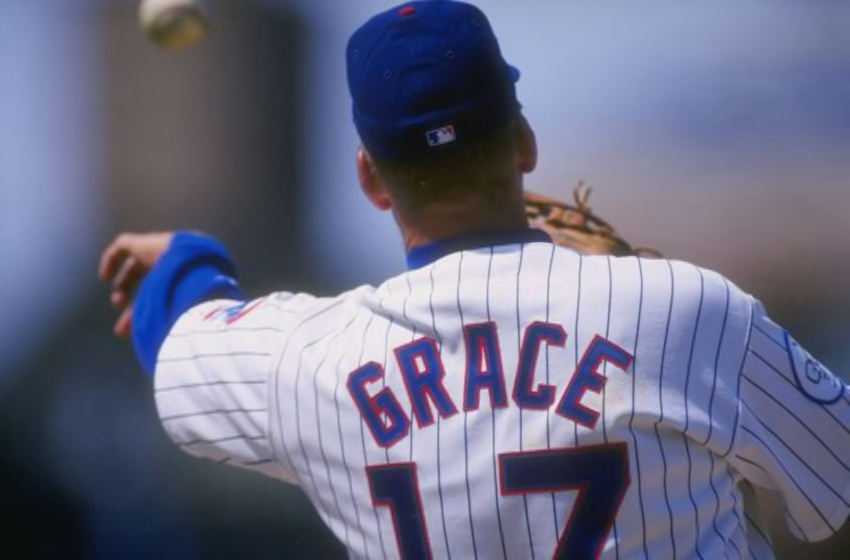
10 May 1998: Infielder Mark Grace of the Chicago Cubs in action during a game against the San Francisco Giants at Wrigley Field in Chicago, Illinois. The Giants beat the Cubs 3-0. Mandatory Credit: Matthew Stockman /Allsport
The Chicago Cubs have had some great players play for them and sometimes Mark Grace’s career gets overlooked by fans of the team.
A very good former Chicago Cubs player is celebrating a birthday today. Mark Grace turns 56 years old today so it is only fitting to look back on what made him such a great player for a long time. Grace spent the first 13 years of his career with the Cubs and was a very good player for pretty much the entire duration. After the 2000 season ended, Grace signed with the Arizona Diamondbacks where he would play for three years.
In his first year with Arizona (2001), he had his career highlight when he was a part of that team that won the World Series. Most of his career damage came with the Cubs but that certainly was a big part of his career as he was a part of the team that won the last game of the season. Grace was a member of some pretty bad Cubs teams over his career so getting that ring with Arizona near the end of his career had to feel really nice.
His career regular-season numbers are pretty good as well. He slashed .303/.383/.442 over those 16 years and compiled 173 home runs and 1146 RBIs on 2445 hits. The home run numbers were low but this man was a hitting machine. His career OPS of .825 isn’t bad and career WAR of 46.4 is also pretty nice. They aren’t Hall of Fame numbers by any means but he certainly should be remembered as a great player. The term “Hall of Very Good” comes to mind.
Mark Grace was fantastic in his rookie year for the Cubs. He finished second to Chris Sabo in the vote for 1988 National League Rookie of the Year which gave a lot of Cubs fans back then a lot of hope about this guy. He lived up to it for the most part. He was a top-20 MVP vote-getter four times in his 16-year career.
A lot of praise comes Grace’s way thanks to his ability to hit. It makes sense because he managed to have an average over .300 which is really impressive for a player that plays for a decade or more. With that said, he deserves a lot of recognition for how he played defensively as well. His skills at first-base earned him four Gold Glove Awards over his career. It was impressive to watch him be a good player in all areas for the Cubs.
Grace was never able to win the big one with the Cubs but he did get his ring later in his career with the Diamondbacks. It is also fun for some fans to know that their new coach, David Ross, hit his first career home run off Grace who was a position player pitching because his Diamondbacks were getting destroyed that day. Remembering all-time great players is important and Mark Grace certainly is one of those for the 1990s Cubs.