After being closed more than 3 months by COVID-19, Chicago’s Lincoln Park Zoo reopened (with online reservations) to the general public on Monday, June 29, 2020.
Show Me Chicago previews, reviews and expresses opinions on what’s happening in Chicago from Blockbuster Theater, to what’s new in dining, arts, and the neighborhoods.
Chicago home price appreciation still ranks last among major metropolitan areas
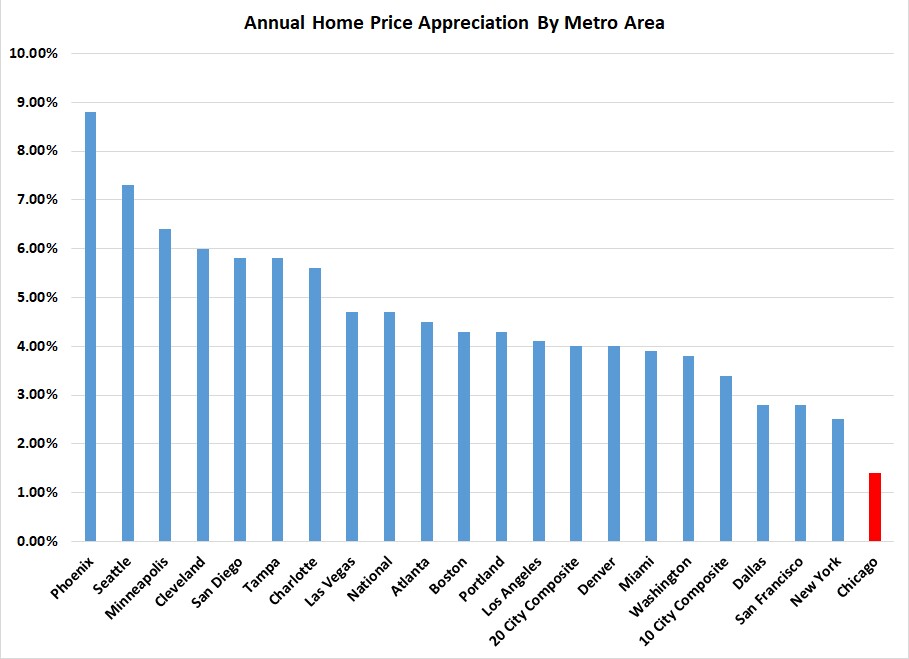
Another month has come and gone and once again Chicago area annual home price appreciation is the slowest among the 20 largest metro areas. This is according to the April Case Shiller home price indices released this morning by S&P CoreLogic. The graph below puts it in perspective. Chicago area single family home prices rose by just 1.4% over the last year while the national average was up by 4.7%. Even the second worst metro area – New York – was up a lot more at 2.5%. And 1.4% is slightly lower than March’s 1.5% appreciation rate. Sad.
Chicago ranks last among the top 20 metro areas for annual home price appreciation according to the Case Shiller index.
Craig J. Lazzara, Managing Director and Global Head of Index Investment Strategy at S&P Dow Jones Indices, pointed out that “The price trend that was in place pre-pandemic seems so far to be undisturbed, at least at the national level. Indeed, prices in 12 of the 20 cities in our survey were at an all-time high in April.” But not so much in the Chicago area.
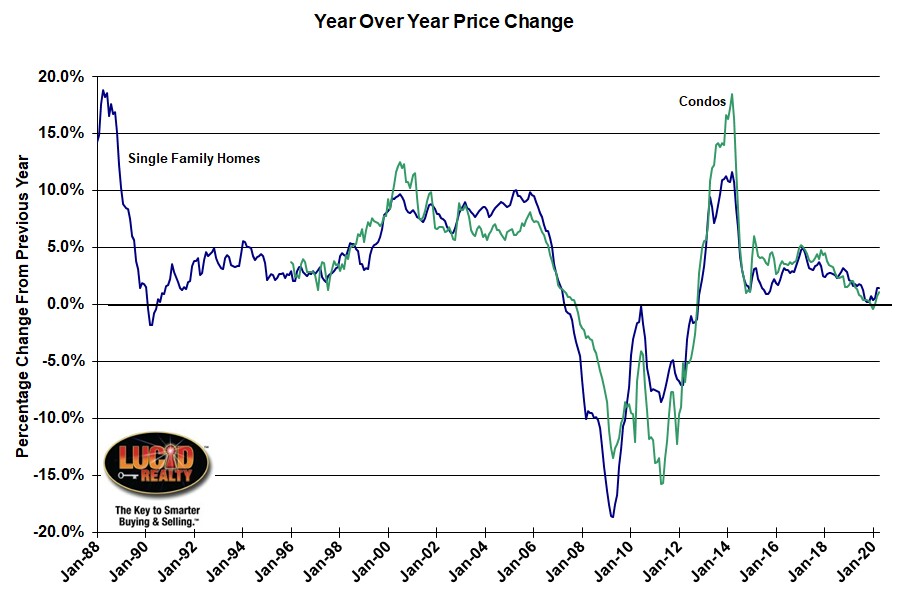
The graph below shows the historical annual appreciation rates for both Chicago area single family homes and condos. The good news is that Chicago area single family home prices have now risen for 90 consecutive months and we’re seeing a little bit of an increase in the appreciation rate off of the lows hit in October and November. Condos appreciated by 1.1% in April, which is the highest rate in 11 months.
Chicago area single family home prices have shown annual gains for 90 consecutive months but condo prices fell once again
Case Shiller Chicago Area Home Price Index By Month
The graph below shows the historical values of the Chicago area Case Shiller home price indices. April single family home prices rose by 1.1% from March and condo prices rose by 1.3% as we are in the seasonal upswing in home prices.
You can tell by just looking at the graph that price gains are petering out. Although single family home prices are up 42.2% from the bottom and condos are up 56.0% we still have not quite reached the peak of the bubble. Single family home prices are still 13.4% below peak while condos are 5.8% below peak. And we’re not even close to getting back to the red trendline based on pre-bubble prices. Single family home prices are running 28.2% below that benchmark.
From a historical perspective single family home prices are actually lower than they were during the entire period from September 2004 – October 2008 and condo prices are lower than the July 2005 – October 2008 period.
The Chicago real estate market still has a long way to go before catching up to bubble peak prices.
#CaseShiller #ChicagoHomePrices #HomePrices
Gary Lucido is the President of Lucid Realty, the Chicago area’s full service real estate brokerage that offers home buyer rebates and discount commissions. If you want to keep up to date on the Chicago real estate market or get an insider’s view of the seamy underbelly of the real estate industry you can Subscribe to Getting Real by Email using the form below. Please be sure to verify your email address when you receive the verification notice.
After 20 years in the corporate world and running an Internet company, Gary started Lucid Realty with his partner, Sari. The company provides full service, while discounting commissions for sellers and giving buyers rebates.
Show Me Chicago previews, reviews and expresses opinions on what’s happening in Chicago from Blockbuster Theater, to what’s new in dining, arts, and the neighborhoods.
2021 Kia K5 GT (Image courtesy of Kia Motors America)
Kia just revealed an all-new midsize sedan, which the automaker says will “disrupt and inspire.” While we won’t know if the 2021 Kia K5 is as fun and exciting as Kia claims until we drive it, there are a few things we think you should know right now.
1. It replaces the Optima
Optima is a well-known nameplate in the Kia brand, and rather than capitalize on that, Kia moves away from a real-word name and doubles down on an alphanumeric nomenclature. We’ve seen this before from the brand with the ultra-lux K900.
I find this a little bit weird given the automaker has other relatively new products, such as Seltos and Telluride, and they have actual names. Not sure if this indicates a sedan naming strategy moving forward or if it’s a one-off.
2021 Kia K5 GT (Image courtesy of Kia Motors America)
2. It’ll have available AWD
Once, upon a time all-wheel drive in a sedan was a rarity. Now, to compete with SUVs, it seems to be a necessity. From the press materials, however, it looks like it’s not an across-the-board option on the K5. It’ll only be available in the LXS and GT-Line trims.
Though the K5 is “coming soon,” an exact drop date for the AWD model hasn’t been released. The press materials say “later this year” and the press reveal said “before winter.” Hopefully they mean before winter in Chicago, which could be the beginning of October.
2021 Kia K5 GT (Image courtesy of Kia Motors America)
3. It’s built on an all-new platform
When Kia said K5 is all new, they meant it. The third-generation N3 is completely new, and the K5 is the first vehicle in the Kia lineup to be based on it.
It’s longer, lower and wider than the previous platform, which Kia says is optimized for sporty handling, responsiveness and stability.
2021 Kia K5 GT (Image courtesy of Kia Motors America)
4. It showcases the future of Kia’s design language
While the shape of the Kia Tiger Nose grille is familiar, pretty much everything else gets remolded on the Kia K5. It definitely has some Stinger DNA, but Kia adds a little edginess with the shark-skin inspired grille mesh design (on GT-line and GT) and the “heart beat” daytime running lights.
These lights are very unique, and similar to the DRLs on the new Telluride, you won’t mistake it for anything else on the road when you see it coming down the road.
The interior is clean and simple, and with an available red leatherette interior, it throws a little sexy into the mix.
2021 Kia K5 GT (Image courtesy of Kia Motors America)
5. The engine lineup is turbocharged
The Kia K5 will have two turbocharged engine options. The base engine is a 1.6-liter that delivers 180 horsepower and 195 pound-feet of torque (we see this engine also on the Seltos). The up-level 2.5-liter engine will deliver 290 horsepower and 311 pound-feet of torque.
I don’t much like the 1.6-liter engine on the Seltos, so I’ll be curious to see how it does with a Sedan. The up-level engine, which will be available on the GT model dropping later this year, however, should be interesting.
2021 Kia K5 GT (Image courtesy of Kia Motors America)
6. It’s packed with cool tech
This is the exciting stuff right here. As a next-gen vehicle, it the Kia K5 adds a lot of available technology, including wireless Apple Carplay/Android Auto, wireless charging and Bose premium audio.
It also has a lot of available safety tech. Standard features include automatic emergency braking, lane centering technology and a rear occupant alert. Optional tech includes blind spot avoidance, automatic reverse braking, parking sensors, navigation based adaptive cruise control, and Highway Driving Assist, which can change your speed based on posted limits.
2021 K5 GT-Line AWD (Image courtesy of Kia Motors America)
The bottom line
Like every other product Kia has put out lately, it looks cool. With some Stinger DNA, I hope that means it drives cool, too.
Pricing hasn’t been announced, which is a little weird given that Kia said the first models with the 1.6-liter engine will be available in a few weeks. For comparison’s sake, the outgoing Optima starts at $24,335.
If it can maintain a $25K base price, I think the 2021 Kia K5 has the potential to be a great Chicago vehicle — especially with that available AWD.
Show Me Chicago previews, reviews and expresses opinions on what’s happening in Chicago from Blockbuster Theater, to what’s new in dining, arts, and the neighborhoods.
Below is a press release from University of Chicago Medicine
Chicago Cubs right fielder Jason Heyward is donating $100,000 to University of Chicago Medicine to help alleviate hardships experienced by frontline healthcare workers during the COVID-19 pandemic and expand contact tracing efforts on Chicago’s South Side.
A five-time Gold Glove winner, Heyward joins the fight against the coronavirus pandemic through his family foundation, the Heyward Family Fund. Half of the donation supports UChicago Medicine’s Healthcare Heroes Fund, which helps offset hardship costs for frontline healthcare workers, such as childcare and eldercare, transportation, as well as temporary housing for workers. The remainder supports contact tracing efforts across the South Side, which has been disproportionately affected by COVID-19.
Contact tracing is a public health practice that reduces the spread of disease by interviewing those who test positive for COVID-19 and tracking down people who could have been exposed to the virus because of contact with someone who is sick. UChicago Medicine is partnering with the South Side Healthcare Collaborative (SSHC), a network of more than 30 federally qualified health centers and community hospitals on the South Side, to implement contact tracing.
“Through this donation, I want to help ease the personal burdens on our healthcare heroes and support efforts aimed at reducing the spread of COVID-19, especially in vulnerable communities hit hard by the virus,” said Heyward.
Funding would help UChicago Medicine to set up a team of workers to implement contact tracing—a time-consuming and labor-intensive process—on Chicago’s South Side, which has some of the highest confirmed rates of COVID-19 in the city. This area includes five ZIP codes in the UChicago Medicine service area.
“Jason’s gift will help us provide needed care to people disproportionately impacted by COVID-19,” said Brenda Battle, vice president of UChicago Medicine’s Urban Health Initiative and chief diversity and inclusion officer. “This support is critical to our efforts to prevent further spread in the community.”
Show Me Chicago previews, reviews and expresses opinions on what’s happening in Chicago from Blockbuster Theater, to what’s new in dining, arts, and the neighborhoods.
Premise: Lars (Will Ferrell) and Sigrit (Rachel McAdams) have dreamed of taking their bar band “Fire Saga” to the Eurovision Song Contest since they were both young. After the other Iceland finalists are blown up while partying on a ship, Fire Saga are the only competitors left standing and are given the chance to represent their country at Eurovision. Lars and Sigrit have a chance to win, if they can stay together.
Behind-the-Scenes: Will Ferrell co-wrote the script. Director David Dobkins previously worked with both Ferrell and McAdams on the 2005 blockbuster comedy Wedding Crashers. This film was originally set to be released in May, to coincide with this year’s Eurovision Song Contest. But, when the Eurovision event was cancelled due to the COVID-19 pandemic, Netflix pushed the movie’s release back to June 26.
The Good: When Ferrell plays a more central role in shaping a film to his comedic sensibilities, as he has here by co-writing, producing and starring, it usually helps the movie succeed. Chalk this one up as a success. Eurovision is not exactly a laugh riot, but it is consistently funny, and works surprisingly well as a romance. Ferrell and McAdams may not be an age-appropriate couple, but they both sell it and I wanted to see the two of them get together in the end (the mark of any worthy romcom). Credit to McAdams, who is one of the finest comedic actresses working today. Her character’s belief in Icelandic elves (yes, elves) pays richly comic dividends, but she also invests real dramatic stakes towards the end. The music performances and original songs are fun and frothy – if you enjoyed Pitch Perfect, you’ll find plenty to like here, and I’ve had the soundtrack on regular rotation since seeing the movie. There’s a gleeful “Song-a-Long” sequence around the 45-minute mark that is almost impossible to dislike. Dan Stevens gives another excellent supporting turn, and I appreciated the fact that his over-the-top character is never made out to be the villain.
The Bad: The script is too unfocused and the editing too lax – Eurovision easily runs about 20 minutes too long. The Icelandic accents are all over the place – Ferrell and McAdams get away with it, but just barely. The Eurovision musical acts scream for a number of fun celebrity cameos, but we don’t really get any.
Should You See It?: Yes. Eurovision may not be a particularly well-made film, but it’s stealthily kinda great, and perhaps the perfect antidote for these crazy times we’re living in. It aims to entertain and it does so. One of Ferrell’s best films in quite a while. I actually think this one would have succeeded in theaters, had that been an option.
Star Rating: ***1/2 out of 5 stars
Better Than: Semi-Pro, Blades of Glory
Worse Than:Pitch Perfect, Step Brothers
* * *
For more movie/TV commentary and other mischief, follow me on Twitter: @Hammervision and on Letterboxd: @Hammervision
Hammervision is movies. Hammervision is TV. Hammervision is the creative byproduct of a marriage built on a mutual love of all things popular culture. John and Julie Hammerle have been watching movies together since Face/Off was in the theaters. John is an attorney at a Chicago law firm. Julie is not. They have two kids and a dog named Indiana.
Show Me Chicago previews, reviews and expresses opinions on what’s happening in Chicago from Blockbuster Theater, to what’s new in dining, arts, and the neighborhoods.
Watch tonight in Chicago, Metro N & NW Suburbs & on Cable, Berkowitz & Martin w cameos by Jason Riley, Shelby Steele, Ted Dabrowski, Paul Vallas & Rep. Welch on City, IL & Nat’l public policy issues
Watch Jeff Berkowitz and Terry Martin, Executive Director of the Illinois Channel discuss tonight in Chicago and in the Chicago Metro North and Northwest suburbs some of the key City, State and National Public Policy issues.
The half hour show, taped on June 19, airs tonight in Chicago at 9:46 pm on Cable Ch. 21 (CAN TV).
The show also airs in 25 Chicago Metro North and Northwest suburbs at 8:30 pm:
-on Cable Ch. 19 in Buffalo Grove, Elk Grove Village, Hoffman Estates, parts of Inverness, Lincolnwood, Morton Grove, Niles, Northfield, Palatine, Rolling Meadows and Wilmette and
-on Cable Ch. 35 in Arlington Heights, Bartlett, Glenview, Golf, Des Plaines, Hanover Park, Mt. Prospect, Northbrook, Park Ridge, Prospect Heights, Schaumburg, Skokie, Streamwood and Wheeling
Terry and Jeff discuss the Black Lives Matter movement. Black Lives certainly should and do matter. But, what are the demands of the BLM movement? And, are those demands feasible and good or bad for America. State Rep. Chris Welch (D-Chicago), in a cameo, tells us what some of those demands are.
Jason Riley (WSJ and Manhattan Institute), in a cameo, discusses some of the foolish things Sen. Tim Kaine (D-VA) said about slavery. Shelby Steele (Hoover Institution) in a camero urges blacks to stop crying “Racism,” and start taking control of their own destiny, rejecting more than a half century of liberalism dominating the pitiful state of many American inner cities, controlled in large part by Democratic Party politicians.
Terry and Jeff also dig into the lessons & subtleties of George Floyd and Rayshard Brooks murder cases.
Jeff & Terry also discuss the surging Chicago shootings and gun homicides in the first half of 2020, and especially on the Father’s Day Weekend (102 shootings, 14 homicides- including 4 children).
Since most of those crimes are black on black, Jeff & Terry ask IF THOSE BLACK LIVES MATTER and where are the protests and where are the demands for accountability of State and Local politicians and officials such as Mayor Lightfoot, State’s Attorney Foxx, Cook County Board President Preckwinkle, Chief Judge Evans and Police Supt. Brown to stop those terrible criminal acts visited on blacks by blacks.
Ted Dabrowski and Paul Vallas have cameos discussing the extreme short-term and long-term fiscal messes of Chicago and Illinois governments, and how to fix them, including the State’s $420 billion pension hole for State. City, County and Village employees.
Wirepoints charts have cameos that are used during the show to discuss what the State and Feds did wrong on dealing with Covid19 and the how best to deal with Covid19 and the re-openings of the economy and the schools.
Gov Pritzker also has a cameo on the current IL re-opening of the economy and the fall re-opening of the IL schools for 2 million kids.
Jeff Berkowitz and Terry Martin chime in all of the above topics, including comments on the cameos.
Show Me Chicago previews, reviews and expresses opinions on what’s happening in Chicago from Blockbuster Theater, to what’s new in dining, arts, and the neighborhoods.
J Wade raps like an all-terrain vehicle, coasting across craggy instrumentals strewn with syncopated samples that could trip up lesser artists. The Chicago MC is part of an emerging collective and label called Creative Mansion, which also includes rapper Sidaka and producer Cloud Boy–the latter made most of the sample-heavy instrumentals on Wade’s new EP, Lily of the Valley. Wade’s impressionistic verses thread through the narrow spaces Cloud Boy leaves in his euphonic but erratic collages, and his performances create a sense of equilibrium despite the unstable sonic environment. He can pull you into his world with just a couple quick lines delivered with a restrained confidence; when Wade punctures the airy, stitched-together vocal samples of “All I Need” with lyrics about stretching out a Starter cap, I can picture him giving that hat the kind of attention and care he brings to Lily of the Valley. v
Not to make light of the profound suffering and loss of life during the COVID-19 pandemic, but it’s been a while since death and despair sounded as much fun as they do on Phantasma, the new third record by Georgia four-piece Vincas. These southern gothic firebrands have spent much of the past decade making maniacal death-punk and postpunk with a stomping garage-rock fury and a devil-may-care attitude straight from a 60s outlaw biker flick. On Phantasma, the group shake off some of the fuzz that fogged up the swampy 2016 LP Deep in the Well, leaning instead into their lusty, horror-laced storytelling. Slow-burning opener “Until It Rains Red” blends warm, doomy guitars and heartbeat drums while ominously warning of bad fortune ahead, and from there the band tear off into a world of hip-shaking, psych-fueled ecstacy. The title track is a smoldering tale of ghostly apparitions that hunger for the sweet taste of blood, while steamy taunts such as “I’ll build a bed from your bones” on “The Witch” sound fit for a dance club in hell. Bassist and front man Chris McNeal (who also plays in decidedly less vampiric postrock outfit Maserati) can deliver velvety croons with the swaggering command of John Doe or Nick Cave, then seamlessly shift into the hair-raising screams of “Bury Me Upside Down” or “I’m Taking You to Hell.” Vincas sometimes stretch a song to five minutes, and they like stylistic twists and turns, but they’re arguably most potent when they keep things tight and straightforward–the two-minute rockabilly-tinged rager “Dead Train” is a case in point. Despite the countless times rock ‘n’ roll has been declared dead, these morbid punks seem hell-bent on breathing new life into it. v
Gossip Wolf has Loved the delightfully cracked musical mind of Tijuana Hercules bandleader John Vernon Forbes since the 1990s, when he fronted local noise-rock killers Mount Shasta for a sizzling run of albums on Skin Graft Records. And it seems like Skin Graft feels the same way! On Friday, July 10, the label will drop Evening Dressings, a blistering seven-song Tijuana Hercules release full of what Forbes and company call “hillbilly trance.” Cut at Forbes’s Frogg Mountain Recording Studio, it features the bandleader on guitar, keys, synth, and theremin, plus Joe Patt on drums, Doug Abram on baritone sax, Mike Young on “junk percussion,” and Sam Crossland on keyboards. Tracks such as “Let’s Make Our Own Action” and “Gas Pump Woman” shuffle, stomp, glide, and stagger like a drunk couple on a sticky roadhouse dance floor.
In 2013, Chicago producer Miguel Baptista Benedict (aka Michael Benedict) released the impossible-to-pigeonhole album Super(b)-Child-Ran on Flying Lotus’s Brainfeeder label. Since then, the quality of his work has increased, but his fame hasn’t. “I have been releasing independently as to avoid the bureaucracy of the mainstream music industry,” he explains. His arresting discography mixes dystopian soundtrack atmospheres, noisy digital effects, and melancholy late-90s-style jazz and postrock. Highlights from Benedict’s Bandcamp page include May’s Voyage sur la Route and last year’s Lamprophonic Fringe Culture, a collaboration with drummer and producer Mitchell Blase Settecase that orbits a black hole of disintegrating electronics.
Last Friday, one of Gossip Wolf’s favorite local zines, The Sick Muse, published its 13th issue–also its first digital-only issue. Its contents include interviews with up-and-coming R&B artist LeSage Williams, indie-electro trio Pixel Grip, and high-energy rap duo Glitter Moneyyy. It’s free to download from thesickmuse.com. v
“So much of what Hamilton is about is how history remembers and how that changes over time.” – Lin-Manuel Miranda in the introduction to the filmed version of “Hamilton.”
The brilliance translates beautifully.
It would be impossible for “Hamilton” the movie to replicate the experience of seeing one of the greatest of all musicals in a live theatrical setting, but the filmed version of the Broadway sensation makes for immersive, exhilarating, magnificent cinema, almost sure to thrill first-time viewers as well as diehard fanatics who have seen the stage production once or twice or a dozen times.
Disney presents a film directed by Thomas Kail and written by Lin-Manuel Miranda. Rated PG-13 (for language and some suggestive material). Running time: 161 minutes. Streaming on Disney+ beginning Friday.
A little backstage info before we dive into the material itself. Per the New York Times, “Hamilton” the film was shot over a three-day period in June 2016, just before creator and star Lin-Manuel Miranda and other key performers were to depart the cast. Thomas Kail, who directed the stage production as well as this movie, placed some 100 microphones and installed nine cameras in the Richard Rodgers Theater, seven of which were hidden by drapes.
The movie we see comes across as a seamless, real-time capture of a single show, but it actually encapsulates two separate performances, as well as some sequences that were shot sans audience, with cameras onstage to capture close-ups and overhead shots. The technical wizardry is sensational, as is the lush and vibrant sound, the lighting and production design. A great-looking Broadway play has become a great-looking movie.
Daveed Diggs plays Lafayette, one of his two roles in “Hamilton.”Disney+
“Hamilton” was originally scheduled for an Oct. 15, 2021, theatrical release, but last month it was announced it would be streamed on Disney+ starting on July 3. (The timing is even more bittersweet but apt, given it was announced on Monday the Broadway shutdown will extend through the end of this year.)
After brief, Zoom-like comments from Miranda and Kail, we’re taken inside the Richard Rodgers Theater, and soon Leslie Odom Jr.’s Aaron Burr is singing:
How does a bastard, orphan, son of a whore and a
Scotsman, dropped in the middle of a forgotten
Spot in the Caribbean by Providence, impoverished, in squalor
Grow up to be a hero and a scholar?
And off we go on a rousing historical adventure about the life and times of one Alexander Hamilton (Miranda), a great mind and fierce warrior for freedom and social justice who is always assumes he’s the “smartest in the room,” and is probably right, though as Burr eventually cautions, that hubris “may be your doom.”
Not that anything will stop the young and greatly ambitious Hamilton, who will not throw away his shot and sings:
A colony that runs independently
Meanwhile, Britain keeps s—— on us endlessly
Essentially, they tax us relentlessly
Then King George turns around, runs a spending spree
He ain’t never gonna set his descendants free
So there will be a revolution in this century…
Even with a running time of 2 hours, 41 minutes (including the intros, a one-minute Intermission, and the closing credits featuring “My Shot [Rise Up Remix]” by the Roots featuring Busta Rhymes, Joell Ortiz & Nate Ruess), “Hamilton” is a meticulously streamlined vehicle, never stalling or taking unnecessary detours. With director of photography Declan Quinn providing angles that make us feel as if we’re in the balcony, then slightly off to the side, then behind the performers, occasionally even overhead, we can see every sweat bead on the actors’ faces as they perform physically demanding song-and-dance numbers while wearing vibrant but surely heavy period-piece costumes.
One of the coolest features of the production is a spinning circle of wood in the center of the stage, with a separate circle around THAT circle. The timing of the actors (most of whom had performed their roles hundreds of times by the time the cameras were brought in) is perfect as they maneuver in and out of the rotating circles (which are used sparingly so as not to overdo the technique) and even move set furniture around as they segue from one number to the next.
Leslie Odom Jr. is a standout as Hamilton’s eventual rival Aaron Burr.Disney+
Lin-Manuel Miranda, whose amazing mind is responsible for this timeless classic, is transcendent as the title character — but his performance is no less impressive than a half-dozen others, including Leslie Odom Jr. as Aaron Burr; Daveed Diggs in a dual role as the heroic French freedom fighter Lafayette and the preening Thomas Jefferson, portrayed as a political opportunist and narcissistic dandy who schemes against Hamilton; Phillipa Soo as Hamilton’s loyal and long-suffering wife, Eliza; Renee Elise Goldsberry as Eliza’s sister, Angelica, who sets aside her own love for Alexander so her sister can be happy, and as comic relief, Jonathan Groff as King George III, who scoffs at those revolutionary Americans as well as his own troops from across the pond.
It feels as if every other number in “Hamilton” is a show-stopper, from the famous “My Shot” to “The Story of Tonight” to “Helpless” (a showcase for the angelic and powerful female voices in the cast) to “Ten Duel Commandments” to the heartbreaking and glorious finale, “Who Lives, Who Dies, Who Tells Your Story.” Touching on everything from blind ambition to sacrificing oneself for a greater cause to political scandals to the lessons of history, “Hamilton” is a revolutionary masterwork about a great revolution.








:no_upscale()/cdn.vox-cdn.com/uploads/chorus_asset/file/20059801/hamiltondiggs.png)
:no_upscale()/cdn.vox-cdn.com/uploads/chorus_asset/file/20059802/hamilton_0604_38_b56dd09c.jpeg)
Leave a comment