click to enlarge

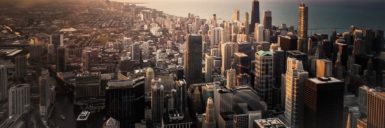
A stone’s throw from the kitsch and luxe of the Magnificent Mile, in a north-facing window on Ontario, the Indian god Ganesh merges with the figure of a child impaled through the frontal lobe with a martial pole. Beyond them, a tapestry hangs, where the silhouette of a lynched woman forms a dark blot against a wall of flames, rioters running beneath her feet. To the right, a shirtless boy with tattoos and scraped knees sits astride a bison with a child in his arms and a dusty American flag slung over one shoulder, while a few yards away fringed Vodou flags beaded by Haitian weavers glitter boldly on the wall. As you enter, you hear the faint strains of the national anthem and slip into a darkened chamber where a watercolor image of Colin Kaepernick takes a knee every two minutes. Upstairs, a mosque is intricately rendered in bullets, gun parts, and a repurposed cluster bomb, placed across from a menorah made of much the same. Flags, maps, guns, and currency are everywhere–upside down, right side up, dismantled, defaced, torn apart, woven together, and assembled, erupting in a fountain from the frame of a bicycle. You might almost forget that you’re standing in an architectural marvel: a city of roadblocks, choked off from its parks and waters, where just weeks ago bridges were raised to hem protesters into the tight island of its financial district. Or not.
“This We Believe,” which opened February 4 before shuttering for quarantine a little more than a month later, is 21c Chicago‘s blistering inaugural salvo, marking the arrival of our own museum hotel with more than a little shock and awe. It is a stunning vision that could not be more contemporary with the storm this country is weathering, a social uprising pressure-cooked in a pandemic. Dispel any notion of hotel art as a bit of soothing color for the bleary-eyed traveler en route from airport to minibar. Free and open to the public 24 hours a day, 21c Museum Hotel’s galleries have a mission that includes as much provocation as it intends service as a community cultural center. “The art is not decorative,” says chief curator Alice Gray Stites. “Art has a very strong role to play in nurturing a sense of community, healing people, and starting conversations that can shape that community–and by extension our culture. We want everyone who walks through the door to feel welcome, inspired, challenged, and represented.”
Originating in Louisville in 2006, 21c Museum Hotel was founded by art collectors Laura Lee Brown and Steve Wilson. Inspired by how the Guggenheim Museum Bilbao had transformed a derelict port in Spain into a global destination for art, the pair was determined to similarly revitalize Louisville, where a once-vibrant city center had been abandoned and fallen into disuse by flight into the suburbs. Yet reluctant to rely on taxes and donations or charge visitors for admission, they turned to a study of Louisville’s other needs. The answer? Hotel rooms. 21c Museum Hotel thus combines the presentation of contemporary art with an ethos of inclusion and the development of commerce to fund the enterprise, a radical vision that has since taken root and flourished beyond Kentucky as investors and developers across America have sought to sustainably bring art to their cities, opening a second location in Cincinnati in 2012 and rapidly expanding to Bentonville, Durham, Kansas City, Lexington, Nashville, and Oklahoma City. 21c Chicago is the ninth location in what they consider to be a single multi-venue museum.
“When we open a new location, planning the inaugural exhibition averages about two years, including renovations and the design process,” says Stites. Aiming to reflect events in the world, other exhibitions have addressed themes such as labor (“Labor and Materials,” 2016-17 in Oklahoma City) and the refugee crisis (“Refuge,” 2018 in Kansas City, currently installed at 21c Bentonville). “Our focus turned to Chicago in 2018, around the midterm elections. The level of rancor, divisiveness, and polarization–not only in this country but around the world–was becoming evident. A lot of artists were addressing issues of allegiance, of people clinging to certain beliefs and denying the rights of others. The moment that we’re living in right now reflects the bubbling to the surface of our long-embedded historical challenges. ‘This We Believe’ has works that look backwards and forwards and creates a platform to unpack the question, ‘How did we get here?’ That was the original curatorial intent, though [we are now] at a vantage point far ahead of where we were.”
“Contemporary artists are visionary witnesses,” says Stites. “Their work reflects not only what is going on in the immediate present but often anticipates what is coming. That’s why at 21c we believe art can shape the future. At this moment of public health and crisis of justice, we should be looking to artists to provide the road map.” As one striking example, Stites cites American artist Kara Walker’s 2008 A Warm Summer Evening in 1863. “It’s a textile of a girl looking like she’s been lynched, over an image from Harper’s Pictorial History of the Civil War that shows a draft riot in New York City. The draft riot was not simply because white men in New York didn’t want to fight for emancipation, but also because they feared emancipation would drive them out of their jobs. We’re still dealing with what wasn’t dealt with historically.”
Another piece that observes our moment with astonishing clarity is National Anthem, an animation based on footage of athletes protesting police brutality by Kota Ezawa that debuted at the Whitney Biennial in 2019. Watercolor images of linked arms and kneeling men softly flicker, logos and faces recognizable yet abstracted as the anthem plays with requiem-like solemnity. No voices are heard until the fans’ distant cheers meet the players’ piercing gazes, marking the tension of this moment of stillness. “I never felt the connection to patriotism . . . I never knew what flag I should wave,” Ezawa, an Oakland-based naturalized American citizen of Japanese and German descent, said. “These national anthem protests somehow touched something in me, where I all of a sudden felt very connected to the US and to what these players were doing . . . I perceived it as an unusual act of patriotism. If you stage a protest on such a large platform, in front of millions of people, it can only because you somehow care about the place or the country that you are supposed to represent.”
click to enlarge

More chilling is a 2018 sculpture by New York-based Chilean artist Sebastian Errazuriz. Made of 3D-printed plastic painted to look like alabaster, The Police State features figures of the present leaders of Russia, China, and the US, arranged on a platform not unlike the Lincoln Memorial. With flowing fabric draped over their suits and ties like fraternity pledges playing at tableau vivant, Xi Jinping sits in the place of honor, flanked by Putin and Trump, who are missing their forearms like so many purloined Venuses. “The US and Russia will be handicapped . . . because China, having gathered the most data through machine learning, will have the greatest amount of A.I. and thus the most global power,” notes the wall label. “We’re creating a new mythology for the end of human times,” Errazuriz says on his website. “In times of crisis, mass unemployment, and riots, we will have to have a police state that is stronger at enforcing the will of those in power, and unfortunately that means that we will live in a society that will be willing to sacrifice a lot of their freedoms and liberties in order to have the illusion of security.”
In addition to artworks that witness and critique the past and present, several pieces in “This We Believe” present a vision of a potentially hybrid and pluralistic future. Two that Stites describes as especially optimistic are the sculptures Umbilical Progenitor (2018) by Zak Ove and Moisa: Sospensione Mosaica (2009) by Maimouna Gueressi. Looming at just slightly superhuman scale (86 inches and 90 inches high, respectively), the two figures–one a barefoot space traveller in an illuminated Mende ritualistic helmet mask, the other a white horned woman levitating inches above the ground–combine religious and secular symbols, as well as masculine and feminine features, to create futuristic shamans tethered to human history, culture, and spiritual practices. “They show how one can have a multiplicity of beliefs without pledging allegiance to only one at the tremendous expense of others,” says Stites.
“They represent the need for a pluralistic future where one can have conflicting ideologies and identities existing simultaneously in one person’s being,” adds 21c Chicago museum manager Adia Sykes.
“If we are going to start healing, it’s our duty to get more comfortable with being more uncomfortable,” says Stites. “Police brutality and the legacy of racism that is so corrosive and painful have been difficult, challenging, uncomfortable topics for people to engage around. James Baldwin has said, ‘Not everything that can be faced can be changed, but nothing can be changed until it is faced.’ Until we look honestly at these issues and their ramifications–legally, socially, and culturally–until we look directly and squarely at ourselves in this moment, we can’t look forward to a better day. Art can allow us to do that.”
Sykes notes, “‘This We Believe’ is an empty container for you to fill. What is ‘this?’ Who is this ‘we?’ The intentionality behind that vagueness is really inspired. It leaves a lot of space for a viewer to come in and have their beliefs challenged. That’s the beauty of this openness.” v
Read More








Leave a comment