Yesterday, I came across a reworked version of Neil Young’s “Looking For A Leader.” He changed some of the words to make them relevant for 2020. I started thinking about if there are other songs about Donald Trump. Hmmm….man, there sure are.
Instead of using older, worn-out classic rock tunes, Joe Biden should use some of these at his rallies? WOW….wouldn’t that burn Don’s ass?!
My so called friends think it’s time to edit this section. After four years, they may be right, but don’t tell them that. I’ll deny it until they die!
I can’t believe I’ve been writing this blog for four years.
It started as a health/wellness thing and over the years has morphed to include so many things that I don’t know how to describe it anymore.
I really thought this was going to be the final year of the blog but then Donald Trump came along. It looks like we’re good for four more years..God help us all!
Oh yeah…the biographical stuff. I’m not 60 anymore. The rest you can read about in the blog.
Neighborhoods near Chicago’s city limits on the South, Southeast, Southwest, and West sides have a well knownlongstandingtransportation access problem, creating disparity in commute times to available jobs. Transit inequality severs a part of the city’s talent pool and slows regional job growth, and although the loss of economic opportunity is hard to measure with any accuracy its magnitude compounds over time.
Enter The Jitney
Chicago’s transit inequality is not an intractable problem. If we will only look, countries throughout the world demonstrate a tried and true solution for transporting dispersed urban populations to job centers. Residents in Africa, Eastern Europe, Latin America, and Asia hire private share taxi minibuses for transportation throughout areas of dispersed density. They’re known as jeepneys in the Philippines, tap taps in Haiti, moniyot sherut in Irael, public light buses in Hong Kong, louage in Tunisia, danfo in Nigeria, fula fula in Kinshasa, angkutan kota in Indonesia, taxis in Iran, Songthaews in Thailand, shuttle vans in New Zealand, dolmuş in Turkey, taxis collectifs in Quebec, Colectivos in Argentina, peseros in Mexico, ruleteros in Guatemala, or Jitneys in Chicago. In former Soviet countries they are called “marshrutkas,” and even as so many other public services have fallen apart they continue to work remarkably well.
Marshrutkas at a Russian train station, waiting to take passengers in any number of directions.
Where they are allowed, “Jitneys” or “Dollar Vans” are successful in the US, too. But in the early 20th Century streetcar companies successfully lobbied for bans in most cities. For a brief primer, here’s a quick overview. Here’s how they successfully operate in Queens. A share taxi solution could be implemented in Chicago for little cost, and over a timeline barely longer than it takes to write an ordinance.
The right tool for the job
Chicago’s challenge is that the South and West sides are much larger, much less dense, and much less wealthy than the North side, creating transit demand that isn’t concentrated along logical corridors but rather blanketed throughout vast areas. This is exactly the same problem that share taxis address in so many of the world’s communities. They are self-directed rather than precisely scheduled, meaning they dynamically respond to changing demand patterns through the days, months, and years. They are smaller than full size buses and can more easily run full, meaning they seldom operate at a loss, even in areas without density. Their numerous number and smaller size allows them to more precisely match demand – like a screen with a higher resolution and smaller pixels – avoiding resource waste. Finally, they would represent a low barrier to entry entrepreneurial opportunity for Chicagoans all over the city.
Jitneys are not new to Chicago, but they’ve never been fully unleashed. The Tribune ran a story about the 1950s “Jitney war” in Bronzeville, in which Jitneys were providing critical transportation services that racist bus drivers refused to provide. In 1994 Crain’s reported that the city was considering allowing more Jitneys to serve South side neighborhoods, but this effort was shut down by CTA and taxicab lobbies the same way previous ones had been.
Dollar Vans lined up in Brooklyn.
The current problem is that Chicago bars jitneys (Chp 9-114-350(a)) and ride share vehicles (Chp 9-115-100(b)(1)) in excess of 9 seats from operating in the city. It bars jitneys from particular profitable areas such as downtown and the airports, and leaves enormous amounts of discretion in the hands of the Business Affairs and Consumer Protection commissioner to ban additional routes, fix prices as low as desired, and administratively add further regulations, creating significant legal uncertainty. Furthermore, the city’s ridesharing ordinance – molded extensively by the taxicab lobby – does not inspire confidence that further regulations will maintain a low barrier to entry for nascent transportation entrepreneurs.
Low Barriers To Entry Alleviate Inequality
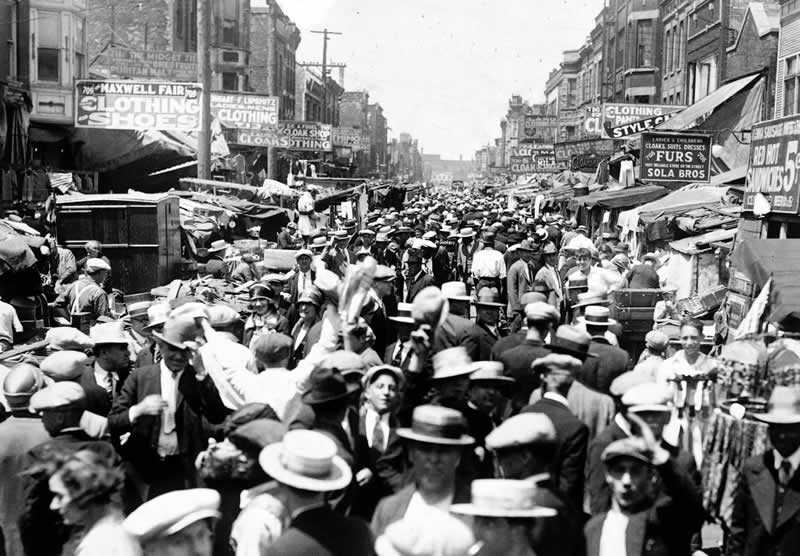
Once located in a dense neighborhood, Maxwell Street Market lowered barriers to entry for entrepreneurs and customers. Chicago Blues resulted from the constant collisions of creativity.
Every entrepreneur faces a number of barriers to entry when considering a business, including financial requirements, needed knowledge, legal and regulatory restrictions, supply and operational logistics challenges, accounting and records keeping set up costs, the need to secure space from which to operate, and so on. Lowering these barriers to entry is the key to increasing economic mobility. A resident with an import and retail idea can try and sell at temporary, low-rent Maxwell Street Market and see how people respond. A budding restaurateur can start in a relatively inexpensive, mobile food truck.
Prioritizing lower barriers to entry as a key part of equitable economic development efforts would have significant policy implications. Maxwell Street should probably be moved to Woodlawn, where it would do more good. Better yet, there should be additional outdoor street markets throughout Chicago’s neighborhoods, and in many neighborhoods they shouldn’t be taxed. The city should start pushing south side developers to build European-style flea market halls with permanent micro-retail booths. Manufacturing makerspaces and incubators should be a critical city-sponsored infrastructure component in all Chicago neighborhoods.
Additionally, it’s critical that the city carefully writes ordinances in consideration of small time entrepreneurs risking their life savings to climb the first rungs of the economic ladder. This means ignoring restaurant lobbies that want food truck locations highly restricted, and taxicab lobbies that want rideshares heavily regulated.
Consider the barriers to entry for a Chicagoan who loses their job just after buying a car, and decides to use their vehicle as a rideshare. This Chicagoan shouldn’t have to be fingerprinted, or get two different kinds of licenses, or take online classes, or face fines because they can’t afford full ADA upgrades to their automobile, or be barred from operating because last year they moved from Hegewisch to Whiting, Indiana. The origins of these rules are plain; the ridesharing ordinance actually says this newly self-employed rideshare driver can’t pick up people giving hailing gestures, and has to submit to regular city inspections verifying there’s no visible rust on their vehicle.
This Tennessee flea market includes permanent booths, lowering barriers to entry and dropping the cost of starting a business to thousands of dollars rather than tens or hundreds of thousands.
Systemically Unequal
When the 14th Amendment was first passed, the right to earn a decent living was considered a key part of the “privileges or immunities” of citizenship. A free person owns his/her own body, and can engage in commerce. The City of Chicago should debate proposed regulations in these terms: “Will this bar the gates to poor Chicagoans, and prevent them from earning a living? Does this raise the barriers to entry above the level many can reach?“
Chicago’s neighborhoods desperately need a city council that prioritizes lowering the barriers to entry and the costs of a job. The ability to get to work is a linchpin piece of this, and in pursuing real solutions the underperforming system may need to be shaken up.
Just like people, systems reveal their priorities through their actions. Subordinating the clear significant need of the populace to political lobbies is in my view clear evidence of the same systemic racism and classism that also infects the criminal justice system. The system does not produce incentives that get results for those without clout, and nobody seems interested in changing the incentives to attain better results. Avoiding reform also demonstrates a lack of trust in the people. An alderman should believe – should know in his/her heart – that if he/she stands up to special interests in defense of constituents’ rights, they will have his/her back.
Much like share taxis, food truck courts drop barriers to entry both for neighborhood services and for entrepreneurs. Pictured is San Francisco’s SOMA StrEAT Food Park – Source: insidescoopsf.sfgate.com
Reform would of course require navigating the certain opposition of the transportation unions and taxicab lobby, which would fear the competition. A politician may well consider jitneys to be a path of excessive political resistance.
Consider the relevant question, however:
Is the city or state likely to be able and willing to fund a fully public system of a jitney-equivalent service level?
Since with the right policy there would be an explosion of affordable transportation options throughout all areas of the city, equivalent service means the addition of thousands or perhaps tens of thousands of buses throughout Chicago. In the face of the many other demands upon limited public funds, we should be honest with ourselves about the public’s ability to provide an equivalent service level. In urban Ukraine marshrutkas are in many areas more numerous than cars, and they run with passenger loads 2 or 3 times higher than the Chicago’s arbitrary 9-person cap. There’s no public solution that can match this level of service.
Reform is Needed
In enacting real reform, the council could make certain that all areas of the city are covered. In applying for a license (which should be unlimited in number), the driver would have to share their location when driving. In exchange for driving on a profitable well served route, a driver would need to also drive an underserved route. The city would make a trade: Belmont in exchange for Marquette, or Damen in rush hour in exchange for Damen in the wee hours. The share taxi data correlated with population statistics should create a robust data set and result in a calculation of each route’s and time’s relative public value. Note that route trading isn’t a new idea, and has been successfully implemented in Eastern Europe.
Effective reform is urgent; when a city consistently fails to help its residents attain a better life, it fails at the chief economic purpose of a city. And people leave. Chicago has gained and then lost a million people since 1920, and its remaining population is both more concentrated in or near downtown and further dispersed throughout the urban periphery. The economic geography of the city is much different than when the transit system was built. Even with the red line’s Southern extension, many wards will remain underserved by city buses.
Faced with the reality of scarce public resources, outside-the-box approaches like share taxis are the most realistic, practical way of providing equitable transit throughout all of Chicago’s communities. A system of share taxi route trading would make Chicago a national model in public transportation, much like Minneapolis has become in some circles for their zoning reform measures. The city is geographically vast, but “Jitneys” throughout the world have a track record of effectively addressing widely dispersed transportation demand. They would work here, too.
It will take courage and foresight, but I encourage Aldermen in underserved wards to consider jitneys for the good of Chicagoans throughout their districts. These include Ward 17, Ward 34, Ward 13, Ward 10, Ward 6, Ward 7, Ward 9, Ward 41, Ward 50, Ward 18, and Ward 38.
In observing an effective solution deployed around the world, transit inequality should be unacceptable in 2020 Chicago; every Chicagoan could and should have reasonable access to any available good job in Chicago, irrespective of its particular location. Jitneys are a proven solution, within easy reach if we have the will to do what is right and insist on equal opportunities for all.
IIT produced engineer with the ambition to develop property in Chicago and help return some of the Chicago sense of place to areas of the city that are losing it. Investors and engineers solve problems for a living, so I offer my strong opinions on what these are and how they might be solved.
A few days ago I was having a conversation with a friend of mine who happened to be a reporter in Chicago for over 45 years. The subject suddenly changed from baseball to the present conditions in Chicago. He had witnessed first hand the last two lootings and violence that have struck the city on the Magnificent Mile and the Downtown area of Chicago, not as a reporter but as a resident. He said something to me that jolted me from my thoughts about baseball. “I can’t figure it out, the criminal element is very bold, it instills doubts about the future.” This from a guy who has covered every incident a big city has to offer for over 45 years. I thought well maybe he’s thinking this way because he witnessed the mayhem in person and he wasn’t as seamed all over by the scars of violent behavior as an ex-Marine and a veteran Chicago cop who was subjected to a steady diet of man’s inhumanity to man on a daily basis.
In Chicago again yesterday an attempt was made to march on the Dan Ryan Expressway, another radical group of about 200 people was easily repelled by the Chicago and Illinois State Police. Within a few hours, they had marched to Chicago’s downtown area where they again clashed with the Chicago police resulting in 18 more Chicago cops being injured and 24 arrests. One wonders under these conditions how many more Americans feel like my friend does. Obviously confused, disoriented, and discouraged thinking about the future. When did it become racist to respect the country’s National Anthem or Mt. Rushmore?
At what point did George Washington, Abraham Lincoln and Thomas Jefferson become moral monsters who have to be erased, or that all police officers are racist thugs? Why are the rioters and looters allowed to terrorize people, destroy and steal property with impunity? Why are our leaders not enforcing the laws? In my opinion, it’s deeper than incompetent leadership. Chicago and Cook County politicians are rife with incompetence and clueless leadership, but it seems a lot deeper than that. The consequences of that clueless leadership are starting to take place. Macy’s Department store located in the toney Water Tower shopping area has announced they are getting out. They have been in residence since day one of Water Towers’ existence. Eight floors of a once-bustling shopping destination, have had enough. United Airlines has announced that it is moving key elements of its management out of the Willis Tower sighting the safety of its employees. For most people in the Chicago area watching the Ronald McDonald House being viciously attacked by looting thugs while confused parents and loved ones of serious child cancer patients cowered helplessly inside could not help to feel both sorrow and immense anger.
Nothing was spared — the looting went on and on for at least 4 hours — until most shelves were emptied and the loot was tossed into U Haul trucks and vans and driven back to the neighborhoods they came from. All in the name of peaceful protest. Another shameful day in the history of a city that was so unprepared no amount of words by any politician could deflect blame. Anything they could say would be tantamount to pouring syrup on a pile of crap and telling the public it was pancakes.
I know it’s a beautiful Sunday morning for most of you folks and forgive me for delivering such shameful news but as Edmund Burke once said “THE ONLY THING NECESSARY FOR THE TRIUMPH OF EVIL IS FOR GOOD MEN (AND WOMEN) TO DO NOTHING” It’s difficult to go on to the entertainment pages and the funnies when a once-great City is under attack before your eyes. These are also the SHAMEFUL NUMBERS that evil is triumphing over and the silence is sickening. Since January 1st of this year, Chicago Murders and shootings are up over 139%. See the numbers above and the disgust just grates one’s soul. 478 souls have been murdered and 2,511 have been wounded, 58 of those were pre-teens, babies, toddlers, and several under 10 years of age shot down on Chicago’s streets. While the City leaders come under attack for all the looting and rioting the silence is ignoring the evil that just keeps rolling along. Look at the quote above. INDEED! HOW MANY MURDERS OF CHILDREN DOES IT TAKE TO MAKE A CITY’S SOUL ROT?
Bob Angone is a Marine VETERAN and a retired Chicago Police Lieutenant. He worked his entire Career covering the streets of Chicago as a Tactical Officer, Tactical Sergeant, and Tactical Lieutenant. His last assignments were in special Functions, he was the C/O of the CPD Swat teams his last five years and was an HBT (Hostage Barricade Terrorist) Sergeant for 10 years.
For one of my sports heroes – an honor I wish could have been bestowed while she was still with us but it’s nice to know her many many accomplishments live on….this one’s for you Coach!
Following is the story from USA Today…
“The late Pat Summitt, legendary for her coaching and leadership of University of Tennessee women’s basketball for 38 seasons and serving as a trailblazing role model for women all over the world, has been named to USA TODAY’s “100 Women of the Century.”
The news organization selected 100 influential women who’ve significantly impacted our country for a list to commemorate the 100th anniversary of the 19th amendment. The establishment of that amendment gave female citizens the right to vote in the United States in 1920.
From the world of sports, Summitt is in the company of Billie Jean King, Althea Gibson, Wilma Rudolph, Florence Griffith Joyner, Serena Williams and Venus Williams among others. The compilation is a who’s who of women who’ve shattered barriers, provided examples and created opportunities for those who followed.
Summitt accumulated a 1,098-208 (.840) record at UT from 1974-2012, winning eight NCAA national championships, directing her teams to 18 NCAA Final Fours and winning a combined 32 (16 regular season/16 postseason) Southeastern Conference Championships. Every player who completed her basketball eligibility at Tennessee under Summitt’s tenure earned a college degree.
While representing her country, Summitt earned a silver medal as a co-captain/player (1976) and later led her U.S. team to gold as a head coach (1984) at the Olympic Games.
Named the Naismith Coach of the Century in April 2000, Summitt was inducted into the Naismith Memorial Basketball Hall of Fame in Springfield, Mass., on Oct. 13, 2000, the first time she was eligible for the Hall’s ballot. A little more than a year earlier, Summitt was inducted into the Women’s Basketball Hall of Fame in the 1999 inaugural class.
Affirmation that Summitt’s impact extended far beyond the hardwood came on May 29, 2012, when she received the Presidential Medal of Freedom from President Barack Obama during a ceremony at the White House. That honor is bestowed by the President of the United States to individuals who have made exceptional contributions to the security or national interests of America, to world peace, or to cultural or other significant public or private endeavors.”
Born in San Diego – raised in Chicago’s northern burbs. Lifelong Cubs, Bears & Bulls fan – Chicago Sky fan. Member professional golf media since 1996; golf professional; freelance photojournalist. School – UW Madison; former Marketing Director-booking agent for pro athletes for speeches, appearances and promotional work; I love sports of all kinds and work with several groups that provide sporting opportunities for Chicago’s inner city and under-served kids. Played tennis in high school and college – switched to golf for fun and then as a profession. Have been published in many national and regional sports publications – both words and photos. I believe in the power of sports to transform one’s life both personally and professionally.
Not saved by the bell! The 2020 school season is right around the corner, but since we’re in the middle of a pandemic, heading back to the hallways is not the reality for many students. Remote learning is currently the landscape for the majority this year. Since we’re all navigating our “new” normal, I decided to take the guess-work out of items that a parent may or may not need to add to their “Back To School” shopping list.
I got the chance to display these unique products on CBS 2 Chicago. There was an array of products! I included products covering different price points and age ranges– there’s something in this list for everyone. Below is a detailed breakdown including the video of what was featured and links to purchase some of those products.
Whether returning to the classroom or continuing their education at home, the “back-to-school” season can be a tough adjustment for kids after the long summer. Touchpoints are non-invasive, easy to use wearables that can help ease “back to school” stress, boost mental performance and focus of students, and improve sleep.
TouchPoints use gentle, haptic, micro-vibrations to alter the brain’s stress patterns and bring you back to logical, rational thinking which allows you to think more clearly and focus on the task at hand. Along with reducing stress in over 70% of users in just 30 seconds, TouchPoints have been shown to help improve focus by 50% in a double-blind placebo-controlled study.
SnapCalc is an app that can help with at-home learning. Not only can the app help you solve math problems in a matter of seconds – it teaches how to get that answer by showing you the step by step solution.
Created by a mom of five and an avid traveler, LLH is a monthly subscription kit that helps educate through cultural exploration and life skills. The kit has everything needed to provide children with days of entertainment and learning disguised in play. From 3D puzzles, recipes, stickers, flags, and more, Little Learning Hands is a great resource to give parents some relief without the guilt of screen time as well as supplement learning in a fun and engaging way.
Eliminate distractions, with these premium quality noise-canceling headphones. Shure enShured (pun intended) that they made headphones to cater to an audio master! That’s not to say a novice wouldn’t get listening pleasure out of these headphones but they come loaded with wireless studio-quality sound, long-wearing comfort and durability, 20 hours of battery life, and the ability to adjust the noise-canceling headphone. This will take any zoom meeting or learning to the next level.
Get Updates on Celebrity Interviews, trendy Beauty & Fashion Tips, and coverage of Live Events
Meet The Blogger
Nekia Nichelle
Nekia Nichelle is a digital and broadcast journalist covering entertainment, lifestyle, beauty and pinch of fashion.
She has interviewed celebrities such as John Legend, Halle Berry, Jenny McCarthy, Brandy, Queen Latifah, Katie Couric and more.
When she’s not blogging, she can be heard on 107.5 WGCI, V103 and WLIT 93.9FM, as well as other stations, keeping you informed on all the traffic snafus during your morning commute.
Stay social with her on:
Instagram, Twitter, Facebook and Snapchat: @NekiaNichelle
Facebook Fan Page: @IamNekiaNichelle
“President Donald Trump on Thursday promoted a false and racist theory that Sen. Kamala Harris, the first woman of color on a major political party general election ticket, and who was born in California, is not eligible to be vice president because her parents were immigrants” { ABC news}
I’m Jerry Partacz, happily married to my wife Julie for over 40 years. I have four children and eleven grandchildren. I’m enjoying retirement after 38 years of teaching. I now have an opportunity to share my thoughts on many things. I’m an incurable optimist. I also love to solve crossword puzzles and to write light verse. I love to read, to garden, to play the piano, to collect stamps and coins, and to watch “Curb Your Enthusiasm”.
Available starting today, August 14, on the Music Box Theatre virtual cinema link is the extremely timely documentary “Represent.” The film follows three women in the Midwest running for local public office and going up against the entrenched political machines in their respective cities.
No area of the country has more swing states than the Rust Belt/Great Lakes region, and perhaps no demographic will be more impactful this election cycle than women. Represent opens with a montage of tv newsers talking up the “year of the woman in politics” trope, in several years past.
The montage serves to showcase what a meaningless cliche that narrative is almost on par with how the media tells us every four years that the current Presidential election is the most important one ever. That said, the virtual release fell on August 14, 2020 to coincide with the 100th anniversary of the passage of the 19th Amendment, which guaranteed and protected women’s right to vote.
Myya Jones is a Black 22-year-old Michigan State graduate and lifelong native of Detroit who ran for mayor of the Motor City. After her defeat, she than ran for state representative at the age of 23. She found herself encountering opposition from all sides, as most people didn’t take her credentials seriously, due to her young age and inexperience.
Numerous scenes in Represent depicting her journey are reminiscent of the films of Michael Moore, a Flint, Michigan native who often brings his work back home.
Bryn Bird is a white woman and progressive in the ultraconservative rural Ohio town of Granville. Running for township trustee she comes up against Granville’s right-wing “old boys network” and all the challenges that comes along with trying to unseat the establishment. She wins, the only woman of the three who does, but it comes with a price.
The town trustee salary is tiny, and as she continues to work her farm, she sees business take a real hit. Her liberal views don’t fit in an overwhelmingly conservative town and it shows by the number of suppliers and partners who take their business elsewhere.
Julie Cho is a Korean immigrant and conservative Republican running for state representative right here in Evanston. Up against a popular Democratic incumbent, Cho never really had a chance, but she finds major issues within her own party too. Cho is more of a John Kasich, Mitt Romney style “Republican classic” and that is a dying breed within today’s GOP.
She also seeks to end gerrymandering, leading to the people she encounters wondering aloud “are you really a Republican?”
For information on Represent, click here. If you want to see the film in person at the Music Box, remember, due to reduced capacity and socially distanced seating in both Music Box theaters, the Theater 2 Screening Room will only seat 18 patrons.
Also, all ticket purchases must be made online and in advance.
Paul M. Banks runs The Sports Bank.net and TheBank.News, which is partnered with News Now and Minute Media. Banks, a former writer for the Washington Times, NBC Chicago.com and Chicago Tribune.com, currently contributes regularly to WGN CLTV and ChicagoNow.
He’s been a featured guest in dozens of media outlets including The History Channel. His work has been cited in hundreds of publications including the Wall Street Journal and Washington Post.
Outside my window I can hear the radio And I know that motor wagon is ready to fly ‘Cause it’s almost Saturday night
My significant other has a thing about Saturday night. She calls it Date Night USA! It’s a night to head out on the town. For us, that usually means going out to dinner, followed by a movie or listening to some live music. Your Date Night USA may be different, but the point is that Saturday is a night for having some fun with the people you like/love.
Saturday nights changed in March. Covid-19. Pandemic!
When you’re under a stay at home order, that means you stay home every night. Not just Sunday through Friday…Saturday, too! You’re home Every. Single, NIGHT!!!
In the early days of the pandemic, it was easy. Everything was closed. Even if you wanted to out, where were you going to go? Five months later, things have somewhat opened up. But, still no movies. Still no concerts. Another summer Saturday night at home is coming up. Sigh!
I realize that in the grand scheme of life in 2020, this complaint is trivial. Yes, I know millions have become ill with Covid-19 and more than 160,000 have died. Yes, I know millions have lost their jobs and are struggling financially. But you can be sympathetic to their plight, thankful it hasn’t to you, and still miss the things that were good in your life and are no longer there.
Since March, we’ve been renting a movie every Saturday. It’s been good and in 2020, it’s really the best we can do. But, I look forward to that future Saturday night when we can put down the remote control, drive over to the multiplex, get some overpriced popcorn and drinks and watch a movie on a big screen with a lot of other people. Until then, I guess I’ll continue to miss Saturday nights.
Outside the ringin’ The night train is bringin’ me home When you hear that locomotion get ready to ride ‘Cause it’s almost Saturday night
[embedded content]
*Song lyrics from “Almost Saturday Night” by John Fogerty
My so called friends think it’s time to edit this section. After four years, they may be right, but don’t tell them that. I’ll deny it until they die!
I can’t believe I’ve been writing this blog for four years.
It started as a health/wellness thing and over the years has morphed to include so many things that I don’t know how to describe it anymore.
I really thought this was going to be the final year of the blog but then Donald Trump came along. It looks like we’re good for four more years..God help us all!
Oh yeah…the biographical stuff. I’m not 60 anymore. The rest you can read about in the blog.
If you are looking to try something different regarding nutrition, you may want to consider a plant-based diet. A plant-based diet consists of eating foods derived from plants. These foods include vegetables, grains, nuts, seeds, legumes and fruits. Being on a plant-based diet does not mean you have to be a vegetarian. You can be a flexitarian or semi-vegetarian occasionally eating meat or you can be a pescatarian who eats fish.
There are numerous benefits to a plant-based diet. On a plant-based diet you consume fewer calories than you would on an animal protein diet. Foods derived from plants typically have fewer calories than animal products. Plant foods are low in saturated and trans fats. Reducing these fats will help you lower the risk of heart disease. Eating plant-based foods also provides you with fiber. Fiber assists with controlling cholesterol and helps prevent constipation.
Plant foods contain vitamins C and E which are antioxidants. They help protect cells in the body from damage by free radicals. Free radicals are molecules that cause aging, tissue damage and can lead to diseases. Plant foods contain phytochemicals. Some scientist believe that phytochemicals assist with the prevention of some diseases including diabetes, cardiovascular disease and high blood pressure.
You can get protein from plant-based foods. Some plant-based foods that include protein are chickpeas, black beans, quinoa, almonds, sunflower seeds and peas. If you eat meat, you should eat small portions. A portion of meat is about the size of a deck of cards. Consider your meat as a garnish instead of the main part of your meal. I know that goes against the way most of us were taught to eat. Meat was the most important part of the meal and vegetables were considered a side.
I am not saying that starting a plant-based diet is easy. It will take some research and deciding what plant foods are best for you. You may need to speak with your doctor or a dietitian. Eating Well has an article regarding a plant-based diet for beginners. The article has links to recipes and a sample menu plan. http://www.eatingwell.com/article/7775696/plant-based-diet-for-beginners-your-guide-to-getting-started/
I have been interested in preventive medicine since my childhood. In the 70s, my aunt would take me with her to meet with a doctor who emphasized preventive medicine. A lot of the things that doctor discussed then has become standard today.







Leave a comment