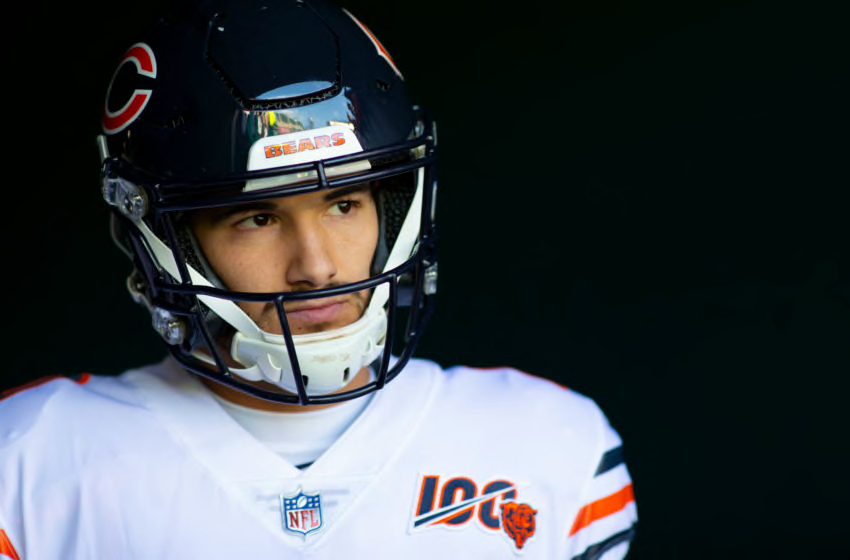
ChicagoBears (Photo by Nam Y. Huh-Pool/Getty Images)
The Chicago Bears need some of their big boys to step up if they’re going to start 1-0.
The Chicago Bears need to win in week one. They haven’t done that in a long time, even in 2018 when they went to the playoffs as NFC North champions. Hopefully, they are able to turn that trend around as they play the Detroit Lions on Sunday afternoon. It is a good challenge for the Bears as they try to prove a lot of people wrong this year.
Not a lot of people see the Lions as a great test but there are some people who believe they are going to take a big step this year. They have a lot of talent on both sides of the ball but we have to see if they can put it together on the field. The Bears and Lions both have a chance to be good and they both have a chance to be bad. It will depend on who gets their top guys to play well for the majority of the year.
Speaking of playing well, you would think that each team will have good performances on both sides of the ball in the game. The Bears, if they want to win, should at least be able to see some production from their top players. It is very important to win this game and get the season off to a good start and beating the Lions will depend on good performances from both the offense and defense. These are the players that you can expect to lead the team on their respective sides of the ball:
The ChicagoBears quarterback is in a tough spot Sunday.
When the Chicago Bears take the field on Sunday to face the Detroit Lions, all eyes will be on quarterback Mitchell Trubisky. After winning the quarterback competition over Nick Foles in training camp, expectations are incredibly high for the fourth-year signal-caller. But is it possible he is walking into a lose-lose situation in Week 1? More on that in a minute.
Moreover, Trubisky’s history against the Lions has been lights out. For a variety of reasons, including the Lions insistence on playing mostly man coverage and refusal to blitz, Trubisky has lit them up.
His career numbers against them deviate so significantly from the mean, the fans have often joked that he’d be the MVP if he only had to play Detroit. In his career, he’s 3-0, throwing for 866 yards, nine touchdowns, and one interception. Those are darn good numbers, and fans would kill for that kind of production against the rest of the league.
However, is it possible his success against the Lions puts him in a bit of an unwinnable situation? Let’s say Mitch goes out on Sunday and puts forward another very good performance against the Lions. To use a Wall Street analogy, has the good news already been baked into the stock price? In other words, are fans already expecting a solid performance against the Lions such that they will dismiss it as such?
While it would be unfair to Mitch to discount a good performance, it would be equally unfair to reach the conclusion that he’s “back” after one performance.
On the flip side, however, what if he has a poor performance? In that scenario, fans could become apoplectic. If Mitch bombs against a team he’s handled comfortably in the past, the doubt amongst fans will continue to grow. It would be fair to be concerned if this happened. Sure, you could use the excuse that he had no preseason games, but this is year four, and fans won’t be accepting of “excuses.”
Unfortunately for Mitch, there is very little he can gain from Sunday’s game in the eyes of the fans. Fortunately, for him, that’s not what matters. What matters is that he continues to progress and strings together multiple quality performances. That starts with a good one in Detroit, but even if that happens, there will still be a lot to prove. Now if he falters, well then, it’s best we all stay off Twitter.
6.5 million cases of Covid-19 in the United States.
196,000 Covid-19 deaths in the United States. Let’s play college football!
Louisiana Tech vs Baylor postponed because of Covid-19.
TCU vs SMU because of Covid-19. Let’s play college football!
Vanderbilt announces all fall sports will be played without fans.
Iowa St, which originally was going allow 25,000 fans to attend, now will play football without fans. Let’s play college football!
Memphis has paused football activities due to positive Covid-19 tests.
Penn State has paused multiple team’s activities due to positive Covid-19 tests. Let’s play college football!
Twenty-two schools have cut at least one athletic program because of financial issues due to Covid-19.
Stanford leads the way with eleven programs eliminated. Let’s play college football!
Fifteen percent of college athletes diagnosed with Covid-19 show signs of heart inflammation after recovery.
Other athletes have suffered from lung disease, low levels of oxygen, and kidney and liver failure. Let’s play college football!
The Mountain West, Mid-American, Big Ten, Pac-12, Ivy, and every FCS conference has postponed of canceled fall football.
The ACC, SEC and Big 12 think they know better. Let’s play college football!
The University of Mississippi-430 cases of Covid-19.
The University of Alabama-500Plus cases of Covid-19.
The University of North Carolina-1106 cases of Covid-19.
Clemson University-400 new cases of Covid-19 this week. Let’s play college football!
Dabo Swinney, Clemson head coach-$9,315,600 salary.
Nick Saban, Alabama head coach-$8,857,000 salary.
Jim Harbaugh, Michigan head coach-$7,504,000 salary.
Jimbo Fisher, Texas A&M head coach-$7,500,000 salary.
NCAA college football player-$0.00 salary. Let’s play college football!
We’re in the midst of a pandemic.
There’s no vaccine.
Twenty-two students on the field making contact with each other on every play.
Another hundred on each sideline with little social distancing. Let’s play college football!
Add all this together and it’s a recipe for disaster, but
MONEY, MONEY, MONEY!!! LET’S PLAY COLLEGE FOOTBALL!!!!!
My so called friends think it’s time to edit this section. After four years, they may be right, but don’t tell them that. I’ll deny it until they die!
I can’t believe I’ve been writing this blog for four years.
It started as a health/wellness thing and over the years has morphed to include so many things that I don’t know how to describe it anymore.
I really thought this was going to be the final year of the blog but then Donald Trump came along. It looks like we’re good for four more years..God help us all!
Oh yeah…the biographical stuff. I’m not 60 anymore. The rest you can read about in the blog.
I was researching my RokBlok Record Player post when I came across Run-DMC’s “Rockbox” video. Can you see where the cross-reference happened? Anyway, I love this song. It’s the perfect collision of rap and rock, and at the time, it sounded so fresh. There was nothing like it.
As I watched the video, I delved into the comments and realized there’s a lot more story behind the song and video for RUN-DMC’s “Rock Box.”
[embedded content]
For all you sucker mc’s perpetratin’ a fraud
Your rhymes are cold wack and keep the crowd cold lost
You’re the kind of guy that girl ignored
I’m drivin’ caddy, you fixin ‘a ford
The music industry didn’t even consider hip hop a genre in the early ’80s, and the whole rap-rock phase would take years to fully catch on. Though the Beastie Boys, and several others along the way, toyed with the idea, it was RUN-DMC who pioneered this style on that fateful recording in the spring of 1984.
[embedded content]
As the story goes, Profile Records saw some success with RUN-DMC’s first two singles, “Hard Times” (1983) and “It’s Like That” (1983), and wanted the rap group to record a full album.
Influenced by the loud guitars and heavy rhythms of the metal band Riot, who was finishing up recording their album in the studio before RUN-DMC took over, producers Larry Smith and Russell Simmons decided to try their hand at a similar sounding beat for the up and coming rap crew. They enlisted the help of their friend Eddie Martinez to record guitar chops over the track they would come to call, “Rock Box.”
[embedded content]
Upon listening, Profile Records president Cory Robbins was not feeling it, saying the song sounded “weird” with the guitars, so they recorded another version without them. Though Kool DJ Red Alert played this version on his New York radio show, it was Smith’s version, with the distorted guitars, that became the more popular version. Isn’t it ironic, don’t you think?
Fun fact #1: The first video Profile Records produced, “Rock Box,” was the first video RUN-DMC ever made, and it was also the first rap song to get regular rotation on MTV.
Fun fact #3: On the making of the “Rock Box” video, DMC says, “We weren’t into it. It was just something we were told to do. And the director had the idea to have some little boy chasing after Run-DMC, to show that we had appeal to the younger generation. A little white boy, too.”
Here is my twin sister with her new baby Boston Terrier puppy Gizmo! He welcomes her home now from all of her chemotherapy infusions and trips!
This blog post is the 29th in a series about my (and twin sister’s) preventative breast cancer screening journey that began when we were 30 years old in July 2019. Here is a list of all of the posts written about our journey at Mayo Clinic’s Breast Clinic in Rochester, Minnesota, to date. To keep tabs on new posts, sign up for the “A Daily Miracle” email list at this link.
It’s been an exciting week! My twin sister has now completed 6 of her 14 T-DM1 infusions, so she’s 42.9% of the way done with her post-operative chemotherapy regimen! She did great at her 6th infusion! Thanks again to to some healthy eating–she and her husband have been intentional about eating lots of leafy greens and high-protein/iron foods every week–and exercising, she kept her numbers up so she could go ahead with her 6th infusion on time (praise the Lord!!)! Also, one of her favorite nurses was working and she didn’t have any reactions to any of the drugs! We are all SO thankful that she continues to feel well the week after her infusion, with little to no side effects. Thank you SO much for your continued prayers for joy, strength, and healing! 🙂
Speaking of healthy eating, here are my sister and her husband eating up some delicious breakfast at Pescara, one of our favorite restaurants in Rochester!, before her chemo infusion last Friday!
In addition to a great 6th chemotherapy infusion, my twin sister had an echocardiogram to check on her heart health, which she has every three months that she’s going through her chemotherapy regimen because the chemo she’s on can be hard on your heart. Everything looks good with her heart so far!
She also had a second opinion appointment with a corneal specialist at Mayo Clinic this past Thursday, September 3rd.
Here is my twin sister and her husband with their new baby Boston Terrier “Gizmo,” catching a snooze between their trips to Mayo Clinic Rochester this past week!
AND, all of this is happening while she and her husband are raising their baby Boston Terrier puppy, “Gizmo!” (He has his own Instagram channel @gimme_mo_gizmo which you should follow if you want to see lots and lots of the cutest puppy ever photos.) I promise to include lots and lots of puppy photos in this blog post!
Here is my twin sister all ready to see an eye specialist at Mayo Clinic the day before her 6th infusion of T-DM1!
A second opinion on her corneal cysts from a Mayo Clinic corneal specialist
“I see we have a very interesting thing happening to your corneas!,” the specialist announced as he headed into my sister’s exam room at Mayo Clinic.
Anyway: The Mayo Clinic corneal specialist agreed with the specialist my twin sister has been seeing in the city that the cysts causing blurred vision on my sister’s corneas are “almost certainly” related to her taking Tamoxifen on a daily basis. However, he said “this is NOT a permanent issue,” and the corneal cysts will go away when she’s finished taking Tamoxifen in 5 years!
I promised lots of puppy photos, so here is another one, of Gizmo snuggling on my lap while I was puppy sitting during my sister’s chemo infusion last Friday!
The Mayo corneal specialist also said that while it is unusual for Tamoxifen to cause side effects in the eye, when they do usually see it, it’s in the retina. He said the cornea is a “much better place to have cysts than the retina,” and that it’s good that the cysts are around the outside of her corneas because that means the center of my sister’s eyes are spared!
While, unfortunately, he doesn’t know of a “cure” to the problem–for example, if they went in with laser surgery to remove the cysts, they would just come back–he agreed that lubricating eye drops are a good idea to continue at this time to see if those help the cysts clear up at all. That’s because both Tamoxifen and TDM1 can cause dryness of the eyes, so eye drops aim to increase tear production and help with that problem. As winter arrives, he wants her to increase the usage of those drops as needed since the air will become more dry.
In the meantime, he wants to see her back in 2-3 months to make sure her eyes are staying the same or getting better, and wants her wearing glasses that whole time. He said that large, hard contact lenses may be the best option for her eyesight going forward because soft contact lenses carry the risk of causing small abrasions that could become infected while large hard lenses don’t rest on the cornea but rather around it. He said they could explore that option further down the road.
He also got in touch with my sister’s oncologist at Mayo and they agreed they will follow her as a “case study” for the next 5 years!
I got a beautiful quilt from my church’s quilting ministry in honor of my breast cancer journey!
Trusting God one day at a time
This past week I was gifted a quilt from my church’s quilting ministry in honor of my breast cancer journey! My twin sister received one during her chemotherapy regimen earlier this year, and we are grateful for reminders like these of God’s presence in the midst of anxiety-ridden trials! (We also received beautiful quilts made and delivered with love by our Aunt Jeanne last December. Those are pictured in this blog post I wrote right after my double mastectomy. 🙂)
The inscription on the quilt from my church’s quilting ministry reads from Psalm 27:14: “Wait for the Lord, be of good courage, and He shall strengthen your heart; Wait, I say on the Lord.”
I love that verse. It speaks right to my heart–because I hate waiting. But I know it’s what God calls us to do (sometimes). I’m still learning and, again!, am so thankful for these little reminders of God’s faithfulness! <3
The inscription on the quilt reads from Psalm 27:14: “Wait for the Lord, be of good courage, and He shall strengthen your heart; Wait, I say on the Lord.”
I bring my quilt almost everywhere with me and took a photo with Gizmo and the quilt today because they are kind of the same colors!
Another puppy photo! Isn’t he just the cutest!!!
Next steps
My twin sister has her seventh infusion of T-DM1 (HALFWAY THERE!!!) on Friday, September 25th. Then, sometime in December, I will have my one-year survivorship consultation at the Mayo Clinic Breast Clinic in Rochester, Minnesota, and my baby sister will go in for another preventative baseline MRI! We’ll see if we can schedule our appointments on the same day 🙂
Thank you all for your continued prayers for 1) My twin sister’s corneal cysts to disappear completely; 2) For no reactions to her new chemo drugs; 3) For my twin sister’s COMPLETE healing and 100% effectiveness of the chemotherapy and hormone treatment so her cancer never ever comes back!! 4) Side effects to continue to be minimal / nonexistent!!, 5) For her joy and peace amid the crucible that is chemotherapy and cancer survivorship.
Even in the midst of trials, we are choosing to remember and celebrate that God is good all the time!
Here is my twin sister all smiles knocking out her 6th infusion of T-DM1/Kadcyla! We are so grateful for her strength, joy, and trust in the Lord!
Sister Christian is a blogger, reporter, editor and follower of Jesus Christ seeking to find little miracles each and every day. She especially loves finding Jesus in art, music and culture. Learn more about her on Twitter @adailymiracle, and on Facebook as “A Daily Miracle.” Send an email to [email protected] with any comments, concerns or suggestions!
Illinois State football’s new director of operations, Holden Boyle, spent the past three years at Western Illinois. (Photo by GoRedbirds.com)
Holden Boyle retired from his athletic career when he got to high school.
Yet the 25-year-old, who was born in Elk Grove Village and grew up in Arizona, has been an integral part of two of Illinois’ four FCS football programs as the director of operations.
Holden Boyle
Boyle began his career in “ops” at Western Illinois in Macomb, where he spent three years. In June, he took over as Illinois State’s director of operations.
He began working in sports during college at Arizona State by answering phones and doing “grunt work.”
Boyle, who finished his college career with a 4.0 grade-point average, said he has embraced the detail-focused work and connections with players and coaches that his job entails.
“I don’t have a wife,” he said. “I don’t have kids. So, my job is my baby. It’s what wakes me up in the morning, and it’s what I go to bed thinking about.”
As part of Prairie State Pigskin’s regular Moving the Chains feature, Boyle discussed his upbringing in Arizona, how much he enjoys Halloween, the meal he misses most in Macomb and his changing musical tastes.
What sports or activities were you involved in growing up?
I went to Boulder Creek High School (in Anthem, Ariz., north of Phoenix) and I did not play any sports there. I had played sports up until eighth grade and realized I’m just an average player and not good enough to get a scholarship anywhere, so I’m just going to hang it up and focus on academics. I was involved in National Honor Society and was part of the school newspaper, the Boulder Creek Chronicle. Throughout high school, I wanted to be a reporter for ESPN. I figured getting involved in journalism was a good start.
What did you study at Arizona State?
I double majored in sport management and business management. In my junior year, I decided that just in case this whole sports route doesn’t work out, a general business degree would be beneficial.
How did you become involved with ASU athletics?
After my freshman year, I got a job as a student worker. I was basically the first person you saw when you walked into the Sun Devil athletic building. Anytime you called the general athletic number, I was the person you talked to. We got a lot of nasty phone calls. At that time, the head football coach was Todd Graham. There were people calling for his head. I did that job for about a year and a half. After that I was doing an internship with the Phoenix Suns, selling tickets. There were 45 of us from the sports business major program from ASU that they picked. They basically said that whoever sells the most tickets gets an internship over the summer. I actually won the competition. I sold 268 season tickets. I interviewed for the internship on a Thursday. They called me back on Monday and let me know I did not get the internship. I spent six months selling tickets and it didn’t pan out.
After selling NBA tickets, how did you get involved in ASU’s football program?
After not getting the internship, I went to my boss, who was the HR director for ASU athletics. I said, ‘I want to help with a sport. I don’t care what sport it is. I just want to help with a team.’ I told her that football would be awesome. I got hooked up with our operations coordinator at ASU and started volunteering. I would work from 8 a.m. to noon for HR, go to class for a couple hours and from 3-7 p.m., I’d work with ASU football.
What kind of jobs did you have with the football program?
I was helping with operations and recruiting, helping with recruit letters. I was attached at the hip to the ops guys, so I did any day-to-day task and a lot of grunt work. I was stocking the coaches’ locker room fridge every morning. I washed Coach Graham’s golf cart every other day. I was answering phones.
What drew you into the operations side of football?
Before working with ASU football, I had no idea what operations was. It’s a broad and vague term. I loved it right off the bat. I like to think of myself as a very organized and detail-oriented person. Seeing the work of the ASU (operations team) helped guide me and gave me the path that I’m on right now.
How did you end up in Macomb at WIU?
I graduated from ASU in the spring of 2017. I applied for a handful of jobs. One of our former directors of operation at ASU, John Wrenn, told me about Western Illinois looking for an ops guy. I applied and within 30 minutes, I had an interview the next week. It went pretty quickly. When I got the job, they told me there were 90-plus other people that applied. And John Wrenn, who got me hooked up with Western, is a former player at Western and is in WIU’s athletic hall of fame. I graduated with a 4.0 from ASU, and the head coach at the time, Charlie Fisher, liked the academic side. My first week there, he said, ‘Holden, I hired you because I like hiring guys who are smarter than me.’
Do you still have family in Illinois?
I kind of came full circle, from being born in Illinois to spending 20 years in Arizona then coming back to Illinois. Most of my family is actually still here. It was just me, my mom and my little sister out in Arizona. My dad, stepmom and two half-sisters live in Arlington Heights. Nearly all of my aunts and uncles and cousins all live in Naperville.
What are some things that people may not know about your job?
Even my own family doesn’t know what I do, to be honest with you. They understand that ‘he helps with hotels and buses and travel,’ but they don’t know about the day to day. The easiest way I like to explain it to people who aren’t familiar is that my job is everything that is not X’s and O’s. If it’s anything related to housing or meals or a parking pass, I’m the person you come to. It’s a lot of the minutiae. I’d say at least 75% of what I do from day to day is just communication. I’m attached to my phone. It’s glued to my hip. I get tons of emails, phone calls and texts every day. We just changed something in our practice plan for tomorrow, so who’s in charge of communicating the plan to all the coaches? That’s me. I’m making sure everybody’s on the same page. Little things come up and somebody’s got to fix them. The head coach is too busy. The defensive coordinator is not going to help you get a parking pass or find out who your roommate is.
So someone in your role has to enjoy detail work?
When Illinois State football hits the road, Director of Operations Holden Boyle will play an integral role. (Photo by Barry Bottino)
I really do. I love the nitty-gritty details. I love operations because I get to see everything from a different perspective. It’s rewarding. I take a lot of pride in my job. Right now, I’m making a spreadsheet all the hotel options in the (Missouri Valley Football Conference) for when we go to away games. That might sound tedious and boring, but I love that. I love looking at hotel layouts and seeing what’s going to work, where our meals are going to be.
What makes working for two FCS programs that are geographically close a unique experience?
The biggest advantage I’ve found is the familiarity with the conference. All the hotels we stayed at with Western, I’m familiar with. I’m familiar with each stadium. It’d be different if I went to a school in the Big Sky (Conference). It would be a whole new ballgame. I was able to get my feet wet at Western and see how the Valley worked and take all my experiences and translate them here to ISU. But every place is different. At Western, it’s very blue collar. We were the underdogs. Here at ISU, you have some more resources and tools at your disposal. One of the interesting things I’ve found here is that a lot of the staff are all people who graduated from ISU. So people who work at ISU stay at ISU and want to be here for the long term.
What’s one restaurant you would sneak off to get a meal the next time ISU plays in Macomb?
If I had time, I’d be going over to Chick’s on the Square and ordering probably two or three Lip Fries (waffle fries covered with buffalo chicken, cheddar jack cheese and ranch dressing). I’ve been craving Chick’s ever since I left.
Having lived in two states, what are your favorite sports teams or athletes?
My favorites are Arizona teams and Illinois teams – Bears and Cardinals for football, Bulls and Suns for basketball, Cubs and Diamondbacks for baseball. Growing up, I was a huge Walter Payton fan. And you can’t live in Illinois without being a Michael Jordan fan. I’ve got a little man cave that’s completely filled with Walter Payton and Michael Jordan memorabilia.
What’s the best thing on TV that you’ve enjoyed during the COVID-19 quarantine?
With sports coming back, anytime I can catch an MLB game or a playoff basketball game (is great). I love all sports. Anytime I’m not in the office, I’ve got a game on.
As Halloween approaches, what are your best memories from growing up?
Halloween is by far my favorite holiday. Growing up, my mom and stepdad went all out. Our whole house was decorated. We would give out the full-sized candy bars. Out in Arizona, there was a Hostess factory outlet store, so we would go and buy a bunch of Twinkies and Ding-Dongs and Sno-Balls (for trick or treaters). If I have a favorite candy, it’s always going to be Reese’s. Lately I’ve been on a gummy bear kick. And who doesn’t love a good Snickers?
When you’re walking around campus at ISU, what is playing in your headphones?
I listen to everything. My music range is pretty broad. If you would have asked me what I listened to before I got to Macomb, I would’ve told you anything but country. But being in Macomb, I really enjoy country music now. I’m a big fan of Chris Stapleton.
You have a unique first name. Is there a story behind your parents naming you Holden?
I’ve asked my mom about that. Growing up, I hated my name. People would mispronounce it. They would say Colton or Colden. A lot of people think it came from the book “The Catcher in the Rye” and (the lead character) Holden Caulfield. My mom told me she had to read that book in high school, and she hated the name and hated the book. She thought it was an ugly name. Fast forward to when she was seven or eight months pregnant, and she heard the name on the radio. It just stuck. She loved it. My dad fought her a little bit on it. But my mom ended up winning.
Blog co-authors Barry Bottino and Dan Verdun bring years of experience covering collegiate athletics. Barry has covered college athletes for more than two decades in his “On Campus” column, which is published weekly by Shaw Media. Dan has written four books about the state’s football programs–“NIU Huskies Football” (released in 2013), “EIU Panthers Football (2014), “ISU Redbirds” (2016) and “SIU Salukis Football” (2017).
This weekend, just about the time when–minus the virus–we would have been plopping our posteriors into cushy new seats installed over the summer at the Lyric Opera House and settling in for a double bill of love gone tragically but so operatically wrong (Cavalleria rusticana and Pagliacci), Lyric is inviting us to boot up the laptop for something cheerier.
For the Love of Lyric is a multigenre, online concert conceived and led by soprano Renee Fleming. It’ll be streaming for the public at 6 PM local time Sunday, with Fleming joined (virtually) by Chicago-based Grammy winner Heather Headley, Ryan Opera Center alumna J’Nai Bridges, sopranos Ailyn Perez and Julia Bullock, and bass Soloman Howard. It’s free, on the Lyric’s YouTube and Facebook pages
The one-hour program includes Headley’s rendition of “Shadowland,” from her Broadway role as Nala in The Lion King; Bullock and Fleming in a long-distance duet; Howard’s rendition of the rousing “Lift Every Voice and Sing,” and Bridges with the Chicago Children’s Choir. The sure-to-be-majestic closer is Aaron Copland’s “The Promise of Living” from The Tender Land, performed by members of Lyric’s Ryan Opera Center. Music director and pianist Doug Peck will accompany parts of the program that were filmed on the Lyric stage, an empty house in the background.
To hear opera with even the best of piano accompaniment is to realize how much the orchestra brings to it; we’ll be reminded that we’re missing the Lyric Opera Orchestra, along with the sterling acoustics inside the opera house and the thrill of in-the-flesh performance. Still, until we can put our butts in those new seats . . . v
On their debut album, Cliff, Chicago duo Big Branch combine warm vocal melodies with kitchen-sink instrumentals inspired by the dusty samples of underground rap. The record’s ramshackle sound recalls Beck circa “Loser” or Dubya-era TV on the Radio, a hybrid style the group calls “hop ‘n’ roll.” Vocalist Jamal Semaan and guitarist and producer Rob Lorts originally went by the name Grimms & Blacknight, and they wrote the songs on Cliff during a 2016 DIY tour. After coming home to financial hardship and health problems, they revitalized themselves with a new band name and a more guitar-heavy sound. Big Branch recorded Cliff with producer Brian Deck, who also contributes percussion–it shares the foreground with Lorts’s guitar playing, such as the wiry lines that supplement the chorus on “Something Out There.” Semaan’s conversational vocals sound great paired with harmonies from Ohmme’s Macie Stewart, who guests on a couple tracks on vocals and violin–they’re especially good together on lead single “Spit It Out,” where the singers plead for more direct communication even as they prepare to wince at the unfiltered truth. But the front man hasn’t abandoned rap. Midway through “Bubblegum,” Semaan drops into an unexpected rhythmic pocket amid a cacophony of overlapping guitars and cymbals. The song doesn’t employ traditional drum-kit patterns–instead Semaan’s voice provides the rhythmic bedrock, anchoring the layers of instrumentation. It’s a sophisticated gambit that was worth all of the time Big Branch spent in flux. v
In a recent interview with the Yale Center for Faith & Culture’s podcast For the Life of the World, pianist Julian Reid described the way mourning informed the thematic underpinnings of The Eternal Boombox, a new self-released EP by his Chicago-based band, the JuJu Exchange. The members of this jazz combo also draw upon their experiences outside jazz: Reid is assistant music director for Kelley Chapel United Methodist Church in Decatur, Georgia; his drummer brother, Everett, studied jazz and performing arts technology at the University of Michigan; and producer and trumpeter Nico Segal is a crucial member of Chance the Rapper’s band, the Social Experiment. Each of the five songs on The Eternal Boombox corresponds with a stage of grief from the Kubler-Ross model: denial, anger, bargaining, depression, and acceptance. The second track, “Avalanche,” is definitely the “anger” track, with ice-sheet synth melodies and a rush of crunching electronic percussion fit for drum ‘n’ bass. As Reid told For the Life of the World, “Music cultivates in me–and cultivates in my colleagues–a sensibility of having a sense of self and being connected to a greater whole.” That sensibility guides the JuJu Exchange as they blend genres throughout The Eternal Boombox, and it propels them through the darkest shades of grief. On the fourth track, “And So On . . . ,” they evoke depression with a small symphony, and Reid’s flamboyant gospel-flecked piano pierces a despondent string passage like a sunbeam cutting through fog. v