There is a possibility that the ChicagoBlackhawks don’t have Ed Olczyk back next season.
The Chicago Blackhawks are well known for having one of the best broadcast teams in all of hockey. Pat Foley and Ed Olczyk are one of the best duos in the league for a lot of reasons. Foley’s excitement and enthusiasm for the team and game are well shown through his broadcasts and then Mr. O does some great color commentary to complement the game that Pat describes. Olczyk is especially good at his job and that is why he is the leading color commentator for NHL on NBC as well.
There is a chance, however, that he is not back in that position next year. He probably won’t be done in that seat forever as he can get it whenever he wants it back but something else might be in his future. Nothing is set in stone or anything but there are a whole lot of rumors about hockey ops jobs that are available to him to take a look at.
He has been an NHL coach in the past and there are also rumors of him being involved in a couple of other general manager positions. Selfishly, it would be nice for him to stay with the Hawks as a broadcaster but he is certainly deserving of a much higher position with an organization. The Hawks could even use him as a general manager right now as the man currently in that seat isn’t doing all that good of a job.
Eddie famously had cancer a couple of years ago and has been treated for it. It isn’t fun to think about those scary times but he has made it through healthy and is back doing his job full time. It seems like he is ready to take a role with another NHL team and take a chance here. Don’t be all that surprised if he leaves the booth to pursue another opportunity at some point this offseason. There are plenty of reliable sources that have fed that information.
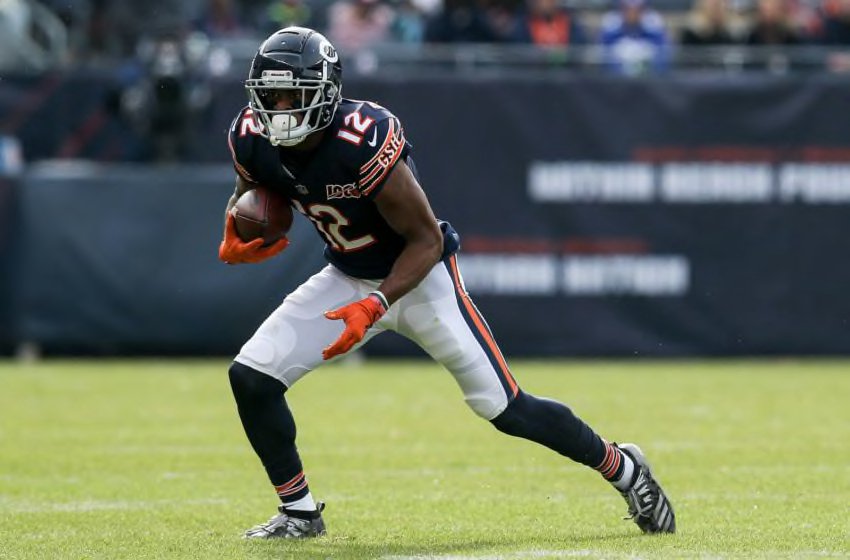
We’re only in Week 2 of the 2020 NFL season, but Ryan Pace is already showing that his time with the ChicagoBears should be up soon.
It’s been a roller coaster week for Chicago Bears fans. After enduring a brutal first three quarters in their Week 1 matchup against the Detroit Lions, Mitch Trubisky and Company led a 21-point comeback in the fourth quarter.
Then on Tuesday, No. 1 wide receiver Allen Robinson reportedly asked for a trade. Then he reportedly didn’t.
Almost immediately after reports surface of the trade request that wasn’t, numerous teammates came forward in support of an extension for Robinson.
Regardless of whether or not Robinson did or did not request a trade, Robinson has every right to be upset that he hasn’t earned an extension from the Bears.
Last year, AR was 7th overall in receptions across the NFL. Of those seven players, all but 34-year-old Julian Edelman were signed through at least 2024. Robinson remains a free agent after the 2020 season.
Plain and simple, Robinson and the Bears shouldn’t be in this situation. Instead of celebrating a division win and prepping for their home opener against the New York Giants, the first half of Week 2 has seen players and fans turning against the front office and expressing their displeasure towards Robinson’s contract situation.
It’s evident that at least some players aren’t exactly thrilled with Pace’s performance as of late.
Unfortunately, the Robinson saga is far from Pace’s only blemish on his record.
For starters, the team hasn’t been able to find an adequate place kicker since the departure of Robbie Gould. Heck, it may be time to start a Bears kicker jersey much like the infamous Cleveland Browns quarterback jersey.
Pace also has struggled with draft day decisions, often trading up and sacrificing picks for players who didn’t exactly pan out. Most notably, Pace gave up two thirds and a fourth to move up to No. 2 to select QB Mitch Trubisky.
Spoiler alert: it wasn’t worth it. It was clear that the 49ers weren’t going to select a QB at No. 2, and taking was Trubisky over fellow QBs Deshaun Watson and Patrick Mahomes was…well, that’s all we have to say about that.
All that after signing quarterback Mike Glennon just mere weeks prior.
You would think that Pace’s quarterback blunders would end there, but yet here we are. In just a few months, the Bears declined Trubisky’s fifth-year option, traded for Nick Foles (of course they gave up a draft pick) and then opted to start Trubisky over Foles despite paying Foles noticeably more.
Sure, Trubisky beat the Lions in the fourth quarter. But not without some tremendous help from Anthony Miller and Allen Robinson on toss-up throws that could have gone either way.
All while Nick Foles makes $12 million to sit on the bench.
Oh, and Cam Newton signed with the Patriots for one million dollars. One. That’s it.
But go ahead and continue to let Trubisky miss his receivers by ten yards and refuse to pay his No. 1 receiver that helped save Trubisky’s ass in Week 1, Pace. You’re doing good, sweetie.
It’s time for the Bears to move on from Pace. He’s sacrificed countless draft picks. He’s remained obsessed with Trubisky while paying Foles, Glennon, and probably Jim McMahon for all we know.
In case you weren’t counting, that’s about strike seven against Pace.
While Pace should be commended for building a championship defense, he’s neglected the offense by refusing to extend Robinson and continuing to give Trubisky countless opportunities.
Here we are in Week 2 and the Bears clearly have discord as a result of Pace’s incompetence. In a year where the Bears could contend for a playoff spot, they already have distractions caused by the GM himself. That’s…not great, Bob.
It’s time to move on from Pace, fix the offense situation and take advantage of the championship window that the Bears could have with the right quarterback and offense.
A recent report suggests just how much money Allen Robinson wants from the ChicagoBears.
Chicago Bears fans have had a tumultuous start to the 2020 NFL season. For the first three quarters of Week 1’s tilt against the Detroit Lions, this Bears team sputtered. Everyone knows what happened in the fourth, though.
The Bears made a miraculous comeback, scoring three times in that quarter.
Fans couldn’t have enjoyed the victory for more than 18 hours or so, before news broke that wideout Allen Robinson had removed all his Bears content from Instagram. Before we knew it, more news broke that he had inquired about a trade.
The trade report was later squashed by Robinson’s agent, but he is still upset with his lack of a new deal.
ESPN’s Dan Graziano wrote a piece on Robinson’s contract, and why it is a tricky situation. Graziano talked about other late contracts at the wide receiver position and where Robinson stands in the middle of them all.
Recent contracts handed out include Los Angeles Rams top red zone threat Cooper Kupp, Kansas City Chiefs burner Tyreek Hill, Los Angeles Chargers number one option Keenan Allen and a contract already in the books for a little while, Odell Beckham Jr. of the Cleveland Browns.
If Robinson were to get paid in the Kupp range, he’s looking at $15-$16 million annually. But, if he wants top dollar, he’s looking at Allen’s extension which was reported at $20 million annually.
According to Graziano, Robinson feels he is worth the same chunk of change as a guy like Beckham, which would put him around $18 million per season. At the moment, Robinson is finishing the third and final year of his original 3-year, $42 million contract with the Bears — a $14 million per season average.
While it might seem outlandish to some that Robinson wants to be paid like Beckham, the reality is, he deserves that money. Robinson has finished towards the top of the NFL in targets, receptions and contested catches over his three years in Chicago. There may not be a more well-rounded wide receiver in football than Robinson.
The big question is, will Pace step off his high horse and pay the man?
If you ask just about any fan, they would tell you Robinson has earned that money. If you ask just about any expert or beat reporter, they would tell you the same.
Robinson, amidst all of this controversy, stated his desire to be in Chicago. He told the media his spirit has never wavered. He loves the fans. He loves the locker room. He loves the city.
It sounds like the ball is 100 percent in Pace’s court. Robinson has no reason to sell himself to the Bears brass any more than he already has with his work on the field. Now, it’s up to Pace to get the deal done.
I’m only on page 227 out of 503 (before the sources and bibliography) in Erik Larson’s book “The Splendid and the Vile: a Saga of Churchill, Family and Defiance During the Blitz” (New York: Crown, part of Penguin Random House, 2020). But even apart from the two times when I’ve laughed out loud already, I’ve found a chapter that I’ll remember throughout the book: Chapter 36, Teatime.
I read it with my late father’s voice in my mind’s ear. Especially in the last few years of his life, he told me often that the most comforting sentence in the English language is “I’ll put the kettle on.” With today’s cooling breezes reminding me that I’d like to warm up, it’s good weather again for hot tea, so I’ll be putting my kettle on more often after a summer of putting tea bags and water in the fridge to make “sun” tea.
A mention of the institution of tea rationing and the arguments over it sent me to my cabinet on Friday night. Cabinet secretary Frederick Lindemann, known as “Prof,” wrote to Winston Churchill in August 1940 opposing the limit of the tea ration to two ounces a week.
I have just tested a tin box of loose tea in my cabinet, which held four ounces of loose tea when I opened it. If I decide to put tea bags into it when I finish using the loose tea, I will have trouble fitting more than 21 bags into the four-ounce box. If I were drinking tea all seven days of the week, that’s one tea bag per meal, and if I followed the British system of having breakfast, lunch, tea-as-meal (around 4 p.m.) and a light, late supper, I’d need to re-use at least one bag. That’s with a four-ounce supply. The ration in 1940 Britain was half of that.
Lindemann’s effort didn’t succeed, and tea was rationed to two ounces a week. As Larson puts it, “The tea ration, eventually raised to three ounces a week, would remain in effect until 1952. In the meantime, people dried their used tea leaves so they could steep them again.”
Larson describes Lindemann’s effort to get a larger tea ration enforced as “a caring for the common man’s experience of the war” and adds that “The one universal balm for the trauma of the war was tea. It was the thing that helped people cope.” (I see the point. I think I first heard Dad describe “the most comforting sentence in the language” after my mother’s death, when making tea together and drinking it were soothing rituals.)
“Tea underpinned morale,” Larson wrote — not exactly news to me. I can drink coffee, but I don’t make a habit of it, and when I do get into a coffee habit, it can be painful to break. (I like to keep my body guessing about just how much caffeine is coming.)
For me at least, tea is easier to use in different concentrations and varieties. I still like it with milk at times, although I don’t drink the “milk with a suntan” that my college roommate named my tea when I first took up drinking it. From what I’ve read about the soporific effects of warm milk, I think milk adds to the comforting effect of tea.
So I’ll be putting the kettle on as I continue with “The Splendid and the Vile,” whether it’s to remember family members, favorite places, or terrible events — it’s still a war story — or to get over style quibbles. (Fellow purists, look out: Larson refers to the prime minister’s residence as “10 Downing” much more than the U.K. style of “No. 10” or “Downing Street.”)
I think the book’s going to wind up on my list of Sustaining Books. If I had a list of Sustaining Drinks, tea would be high on it.
I moved to Chicago from the south suburbs in 1986. I have diverse interests, but I love writing about what I’m interested in. Whether it’s a personal interest or part of my career, the correct words to get the idea across are important to me. I love words and languages — French and Scottish words enrich my American English. My career has included years as a journalist and years working in museums, and the two phases were united by telling stories. I’m serious about words and stories. So here I am, ready to tell stories about words and their languages.
I’m up to my tenth review of a Black Is Beautiful collaboration beer, started by Weathered Souls Brewing of San Antonio, TX to raise funds and awareness for Black issues and social justice causes.
I’ve almost hit all the local brewers with beers that are canned. Now I’m left with several cans available if anyone wants to trade for some beers from outside my area. Meantime, I’ve been getting some beers sent as promotions by their brewers again, so I’m back to some other beers shortly.
This iteration comes from More Brewing of Villa Park and Huntley, IL. Their version is an 11% abv brew, which I think the strongest one I’ve had. It’s made with two blends from Chicago’s Dark Matter Coffee: Ethiopian Yirgacheffe Natural & San Jeronimo Miramar Sarchimor Honey coffees. Hey, watch the video to see if I pronounce them correctly.
More Brewing is directing proceeds to the Chicago Freedom School, which is dedicated to “provides training and education for young people and adult allies to create a just world.”
There’s a sweet coffee liqueur smell as I pour into the glass. The beer pours black with brownish highlights, and a nice thick tan head. The Kahlua impression is in the taste big time, too. Sweet coffee notes, and malty beer with noticeable alcohol. Nothing overdone, no extra bitterness or astringency. A smooth sweet coffee beer good for dessert.
Fresh Beer Events, occasional bacon, but always spam free, opt out any time.
Meet The Blogger
Mark McDermott
Writer, trivia maven, fan of many things. I thought to learn all there is to know about beer as a way to stay interested in learning. It is my pleasure to bring Chicago’s craft beer scene to you.
Eastern Illinois head coach Bob Spoo (left) and Illinois State head coach Brock Spack (right) pose with the inaugural Mid-America Classic traveling trophy in 2011.
The following is the first in a series that highlights each of the four Illinois FCS head coaches as they share thoughts and memories about their mentors. Today’s featured coach is Illinois State’s Brock Spack, in his 11th year leading the Redbirds.
Two names jump out immediately for Brock Spack when asked to name his coaching mentors: Bob Spoo and Joe Tiller.
“Those two guys were instrumental in my life,” Spack told Prairie State Pigskin. “Coach Spoo gave me a break early in my career. Coach Tiller really launched my career to where it is today. I was the youngest or one of the youngest coordinators back in 1995 (at age 32 under Tiller). Now guys are head coaches at that age, but back then that was pretty young (to be where I was at).”
Now 58, Spack recalls leaving his native Rockford to attend Purdue University where he met the two men who would help determine his life’s work.
Spoo, a Chicago native and former Purdue quarterback, first made a name for himself coaching in his hometown’s Catholic League. He later returned to West Lafayette, Ind. where he coached and developed quarterbacks for nine seasons.
Tiller, a native of Toledo, Ohio, became Purdue’s defensive coordinator under head coach Leon Burtnett in 1983. He had previously coached at Montana State and Washington State as well as in the Canadian Football League.
Spack reminisced about each man and the impact they had upon him.
Spoo support
“He was very organized; he was a deep thinker,” Spack said of Spoo. “He was an offensive coach. When I was at Purdue, he coached a lot of great quarterbacks there. “
Spack cited the likes of Boilermaker greats and future pro quarterbacks Mark Herrman, Jim Everett and Scott Campbell as examples.
But, Spack, first a linebacker and later a graduate assistant, saw Spoo as more than just a coach on the other side of the ball.
Bob Spoo
“I remember him going over a philosophy in front of our entire staff. He was really clear. He was well-read and had quotes from certain books that he shared. I remember the time he took to do that. He thought that was even more important than coaching football,” Spack said.
Yet, that doesn’t mean there weren’t conflicts.
“I remember Coach Spoo when I was a player,” Spack recalled. “It was a practice and the offense ran a crossing route and I dropped the receiver. God, he was so mad at me. I’ll never forget how mad he was at me. When I got older I figured it out. You’ve got to protect the guys who can’t protect themselves. I was a young player; I was an idiot. Obviously he never held a grudge because he hired me down the road.”
Starting out
“I coached for both guys when they were head coaches. Coach Spoo was the first one to become a head coach, down at Eastern Illinois (in 1987). I was a GA (graduate assistant) at Purdue after I got done playing there. I went to Wabash (Ind.) College (as an assistant coach) my first year removed from being a GA,” Spack said. “About five months into it I got a call from Coach Tiller that Coach Spoo might be getting the job at Eastern and that I should be ready for a phone call. Sure enough, he did call and he hired me (as linebackers coach). It was a great experience for me.”
Spack spent four seasons at EIU under Spoo. The two later squared off against each other when Spack became Illinois State’s head coach and a traveling trophy was established for what became known as the Mid-America Classic, the annual rivalry game between the Redbirds and the Panthers.
Tiller tales
“Then I went back to Purdue for a couple of years as a linebacker coach and then Coach Tiller called when he was the head coach at Wyoming,” he said.
Spack served as Tiller’s defensive coordinator at Wyoming before the duo returned to Purdue when Tiller was hired as Boilermakers’ head coach in 1997. Spack stayed with Tiller until he hired as Illinois State’s head coach for the 2009 season.
“I was around him the longest,” Spack said of Tiller. “I played underneath him my senior year, then I was a GA for two and I was a coordinator for 14 years under him (two at Wyoming and 12 at Purdue).
Purdue head coach Joe Tiller (left) and defensive coordinator Brock Spack (right). (photo courtesy The Exponent)
“He would probably be the most influential. He was also a deep thinker, a big picture guy. A very tough guy when it comes to believing in toughness. He could be stubborn to a point.”
Spack also found out quickly how to a point Tiller could be.
“I was at Wyoming and had just become a coordinator,” Spack shared. “I was conscientious; I wanted to do a really good job. This story kind of sums him up. He was reading the stock market report in USA Today one morning in his office. He did that every day. I walked into his office and said, ‘Hey, Coach, you got a minute?’ He looked up with his glasses down on the bridge of his nose. He had a grease board in his office. I said, ‘I’m really struggling with our goal line defense, something’s just not right. Here, let me draw it up for you.’
“He let me draw it up. Then he took his index finger and pushed his glasses up on his nose and said, ‘You know, if I have to help you with this decision, one of the two of us is unnecessary, and I’m not going anywhere.’ He picked his newspaper back up and started reading it again. In other words, ‘I hired you to do a job, I hired you to make decisions. You make that decision.’ I walked out. I got his message. Don’t be coming in here with all your problems. I hired you; you take care of them.”
Lessons learned
The coach that Brock Spack is today — the one who has won 84 games along with two shares of the Missouri Valley Football Conference crown and a national championship game appearance — owes much to Spoo and Tiller.
Of Spoo Spack said, “I learned how to develop young coaches. You have to give them a break. He was really good that way to me . . . He also gave me the opportunity to finish my master’s (degree). He was empathic to my personal goals.”
Joe Tiller & Drew Brees (photo courtesy Purdue University Athletics)
As for Tiller, Spack said, “He was really good with personnel. He was a personnel director up in the Canadian Football League. That’s where he made his bread and butter. When we were at Wyoming and Purdue, that’s something that we did really well. We put the kids in the right spots. He got the playmakers in position to make plays. He would tell us, ‘If I tell you to play a guy, you’d better play him. I’m not going to ask you twice.’ He was big on that. I learned a lot about personnel from him.
“He was a great guy to work for. I spent a lot of time around him. He was a man’s man. He was tough now. These kids today would really struggle with him. He could probably coach today, but he’d have to have the right kids around him. These (modern) guys would not know what hit ‘em if they had to play for Joe Tiller right now. It would be a whole different deal for them.
“He wasn’t really a yeller and a screamer. Coach Spoo had a really deep voice. When he talked, everybody listened. Coach Tiller really didn’t raise his voice very often, but when he did people were like, ‘Whoa!’ He didn’t swear that often, but when he did it was like going to a drill sergeant in the Marines. He could swear with the best of them when he was none too happy. Pretty calm for the most part. You really had to work to get in this doghouse, but if you got there you had to really work to get out.”
The passing of two who meant so much
Both of Spack’s mentors have passed — each in the midst of a head football coach’s busiest time. Tiller went first in late September 2017, and Spoo followed in the following October.
“It was difficult because of the timing of everything,” Spack said. “Coach Spoo lived a pretty long life. He was 80 when he passed away. His daughter (Susie) is a vet up in my hometown and so he lived up there once he was done coaching. He coached for a very long time. He was a person who didn’t have a lot of hobbies outside of football. He liked reading. He liked going to movies. He wasn’t a big golfer or anything like that. He was a good athlete but didn’t really get into that.
“Coach Tiller had his place out in Wyoming and loved to work around his ranch. He died really young; to me, 74 is pretty young. He was only nine years removed from coaching. I wonder if he had to do it again if he would retire a little earlier and spend a little more time there. He fought a disease for a long time and kept it quiet from people. People didn’t realize how serious it was. Those days when those guys died were tough.”
Asked if seeing his two mentors die ever made him think about retiring from coaching sooner rather than later, Spack said, “Yeah, that’s an interesting question. I don’t have Coach Tiller’s money, but lessons well learned. Coach Tiller may have thought about that, but he never told me, but his wife has mentioned it. I don’t know if he really believed that or not.”
Final thoughts
After pondering the last question, Spack concluded, “I would be curious to see how both those guys would react to where we’re at right now. I can’t imagine what they would do. They couldn’t believe that a virus brought college football to a stop. And all the stuff with players these days. Players are difficult; it’s not easy. Both of them were chain of command guys. I don’t know how they would respond to this stuff going on today.”
Blog co-authors Barry Bottino and Dan Verdun bring years of experience covering collegiate athletics. Barry has covered college athletes for more than two decades in his “On Campus” column, which is published weekly by Shaw Media. Dan has written four books about the state’s football programs–“NIU Huskies Football” (released in 2013), “EIU Panthers Football (2014), “ISU Redbirds” (2016) and “SIU Salukis Football” (2017).
There’s a simplicity to “Stella Brown,” that can be amazing at times. There’s a Strokes vibe for certain, but I hear many other influences after several listens.
[embedded content]
The kids are getting into it too, which is exciting to see. Good music will always live on.
[embedded content]
What’s even more exciting is Jelani’s back catalog of music that we can delve into, where he runs through styles reminiscent of Blur, Frank Ocean, and Interpol. I love that he tries his hand at pop, rap, reggae, and rock. Jelani Aryeh is nothing if not versatile.
[embedded content]
He’s a cool cat who’s been paying dues for a while now, so it’s time we all start paying attention to the man and his music.
[embedded content]
I think we will, as he’s getting a lot of radio play on SiriusXMU and garnering a nice little cult following.
Who makes Chicago’s best burger? The debate continues.
For over a decade Chicago Gourmet’s Hamburger Hop has been fanning the flames of this ongoing debate with their annual Hamburger Hop.
The ‘Hop’ a popular part of Chicago’ Gourmet’s annual September Food Festival pits 15 of Chicago’s best chefs against each other to see who makes the best burger.
CAN’T DTOP THE HOP
This year, with the pandemic overshadowing everything, the folks behind Chicago Gourmet and the Hop went full speed ahead with the newly themed “Can’t Stop the Hop”–a 13 day competition with more than 100 chefs firing up their grills in a very hot competition.
From September 1-13, the chef competitors presented tasty burgers for dine-in, delivery or carry out. Food lovers were encouraged to hop around town, or visit the DoorDash app or website, and try as many burgers as possible. Based on flavor and overall presentation they voted for their favorite at chicagogourmet.org.
AND THE WINNER IS…
Sam Toia, Illinois Restaurant Association; Chef Jose Rivera, Black Barrel Tavern; Lin Brehmer, 93XRT
The WINNER of this year’s newly envisioned Hamburger Hop is Chef Jose Rivera of Black Barrel Tavern (1061 W. Madison St.; Chicago).
Chef Rivera’s impressive Black Barrel Burger featured two (2) black Angus patties, flattop-grilled, and topped with white American cheese, caramelized onions, tomatoes and spring mix. The burger was dashed with house spread sauce and served on a brioche bun.
In being crowned the winner, Chef Rivera received a personal visit on Tuesday, September 15 from long-standing Hamburger Hop judge and media personality Lin Brehmer of 93XRT, and Illinois Restaurant Association President and CEO Sam Toia. He received a winner’s trophy, magnum of fine wine from wine sponsor Josh Cellars, a Yeti cooler filled with premium meat and seafood from Buckhead Meat of Chicago…and bragging rights for a lifetime.
MORE
The CHICAGO GOURMET Food Festival cintinues through September 30 with GO GOURMET.
Subscribe to Chicago Eats by email
If you would like to keep in touch with what’s happening in Chicago, like us on Facebook or subscribe to Chicago Eats by email. To subscribe, type your email address in the box below and click the “create subscription” button. Our list is completely spam free, and you can opt out at any time.
Snow is a four-month-old white smooth coat guinea pig looking for a loving guardian with her friend Fluffy, a one-year-old Abyssinian guinea pig.
Both girls came into rescue alone and barely moving as the only pig in their cage. When they met, they jumped in the air, chased each other around, and even snuggled and groomed one another.
Guinea pigs are happiest in pairs, and these girls get along well.
Guinea pigs eat a diet of unlimited Timothy and Orchard hays, pellets and fresh vegetables including romaine, red leaf and green leaf lettuces, cilantro, cucumbers, carrots, tomatoes, etc. Guinea pigs, just like humans, can’t manufacture their own vitamin C, so they need to supplement with red pepper and many other vitamin C-rich foods. The girls’ favorite are cherry tomatoes!
Please read up on guinea pig care and diet before adopting by visiting this excellent web site http://www.guinealynx.info/.
Fluffy and Snow would love a home with people who will handle them daily, keep them well fed, and keep their habitat nice and clean.
If you’re interested in possibly adopting Snow and Fluffy, please contact [email protected] for an adoption application.
They are being fostered in Chicago’s Andersonville neighborhood.
Their adoption fee of $75 as a pair benefits the Friends of Petraits Rescue. For an additional $100, we’ll include a package of absolutely everything you need to care for them including a large cage, pellets, hay, litter, hidey huts and water bottles.
And, yes … Friends of Petraits is handling masked, minimum contact, socially distant adoptions.
701 Plamondon Road, Wheaton: $1,849,000 | Listed July 17, 2020 (Portraits of Home)
This 5,707-square-foot Wheaton home has five bedrooms and sits on 1.89 acres. Custom-designed structural beams and heated wide-plank oak floors make for a striking great room, where a floor-to-ceiling stone fireplace serves as the centerpiece in the 2½-story room. The primary bedroom suite touts its own private staircase and a bathroom with a steam shower and standalone tub. On the lower level, heated floors throughout accentuate entertainment space joined by a wine cellar, a professional-level bar, and a gym. The home has five bathrooms and two half-bathrooms. Outside, a screened porch and tiered blue stone terrace with a fireplace and outdoor kitchen complete the home.
Agent: Mark Plunkett, of Coldwell Banker Realty, and Niles Patel, of Core Luxury Real Estate Inc., 630-384-9084






 This iteration comes from


 Chicago’s Favorite Food Critics and Bloggers


2 comments