In Week 2, Chicago Bears quarterback Mitch Trubisky needs to attack the New York Giants in key areas.
What a week it has been for the Chicago Bears and their fans. After an offseason unlike we’ve seen before, the Bears finally took the field in a real, live football game this past Sunday. Fans had been waiting for what felt like a decade to see this team in action.
Against the Detroit Lions, the Bears struggled early on offense. Defensively, they held the Lions in check for the first quarter and a half. But, in terms of their ability to score points, the team had a tough time doing just that.
After three atrocious quarters, the Bears’ offense came alive in the fourth quarter. Led by fourth-year quarterback Mitch Trubisky, the Bears scored three straight touchdowns to end up shocking Detroit and came away 1-0.
Despite the win, there are still many reasons to be weary of this team. Pass rusher Robert Quinn had missed the majority of practices leading up to kickoff and thus sat out with an ankle injury. The pass rush was nearly non-existent overall. Thankfully, Quinn looks like he could suit up this weekend.
Wide receiver Allen Robinson has had ongoing contract issues with the Bears, which really surfaced this week in a big way.
And then there’s the curious case of Trubisky, who somehow became a different quarterback with about nine minutes remaining in the game on Sunday. If the Bears could get an entire game which looked like that Trubisky, they would be just fine. He was getting the ball to his key playmakers in moments when it mattered most.
Speaking of which, the Bears take on a vulnerable New York Giants defense in Week 2. Trubisky has a chance to continue his feel-good story if he is able to start fast against New York. But, it’s going to take him choosing the right reads and targeting his best weapons. If he gets the following three players involved heavily on Sunday, he’ll continue to be the hot hand in Chicago’s quarterback room.
CHICAGO, ILLINOIS – NOVEMBER 24: Saquon Barkley #26 of the New York Giants runs with the ball while being tackled by Leonard Floyd #94 and Eddie Jackson #39 of the Chicago Bears in the second quarter at Soldier Field on November 24, 2019 in Chicago, Illinois. (Photo by Dylan Buell/Getty Images)
The ChicagoBears need to do a good job against the run in week two or they will lose.
The Chicago Bears are going into a huge week two matchup with the New York Giants. This is their second week in a row where they are going into the game where they should be able to beat their opponent without much issue. Well, we saw how that worked out in week one as they probably didn’t even deserve to win that game against the Lions. They were a dropped touchdown or miracle fourth quarter away from starting the season 0-1.
One key to having a better week is doing a better job of containing the running game. The Detroit Lions pretty much had their way with the Chicago defense. They had 138 total yards rushing. Matthew Stafford had 23 yards on five carries, Kerryon Johnson 14 yards on seven carries, and D’Andre Swift had eight yards on three carries. None of those are awesome but 35-year-old Adrian Peterson was able to get 93 yards on 14 carries.
Petterson is a legendary running back but he isn’t what he was back when he was on the Minnesota Vikings. The Bears know all about him from those days but they still allowed him to dominate the game. With some of the names the Bears have on defense, you should be able to expect them to be better in that area.
Well, if they were that bad against an aging Peterson, how are they going to do against Saquon Barkley? That guy is one of the best running backs in the NFL and he has the ability to dominate games for the Giants. If the Bears don’t play him better than they played Peterson, they are going to have a very bad time.
The Pittsburgh Steelers did almost too good of a job against Barkley’s running attack on Monday Night Football in week one. Giants quarterback, Daniel Jones, led the team in rushing with 22 yards on four attempts. Dion Lewis managed to have one yard on one carry. Barkley had an abysmal six yards on 15 carries. That is something the Bears would love to see happen again.
In order for that to be the case, you need to get to him before he even reaches the line of scrimmage. Numbers that bad is probably unrealistic but they can try and repeat the ability to keep him grounded. They are perceived to have a really good defense but they didn’t show it in week one. This is their chance to take advantage of a bad offensive line and show some life against the run game. If they do that, it could be the key to starting the season 2-0.
President Trump, as he would appear as a Supreme court Justice
SATIRE
Washington, DC
Acting just hours after the death of the beloved Supreme Court Justice Ruth Bader Ginsburg, President Trump indicated that he would submit his own name to Senate Majority Leader Mitch McConnell as her replacement.
In a rambling statement on the White House lawn, and responding to questions by reporters, Trump stated “I had the utmost respect for Granma Ginny, but I was just waiting for her to die. Cryin’ Chuck wanted her living, but she was too weak to fight cancer, something millions of good Republicans fight every day. There are no dead heroes on the Supreme Court. I will be a living hero, and I am going to live a long, very long, time.”
When asked how this impacted his role as President, Trump stated that he felt no conflicts in maintaining both positions. “My legal experts, the great minds Sean Hannity, Tucker Carlson, and Rudy Giuliani, agree with me that nowhere, nowhere in our Constitution, our wonderful, wonderful Constitution, does it say a President can’t be on the Supreme Court. And believe me, I read the whole thing every night.”
In response to questions as to which judges he would model himself after he listed several including “the guy from Night Court who also did magic tricks and the first one from The People’s Court,” but not Judge Judy, who he said, “was just a hotter version of Nervous Nancy (Pelosi).” Asked to name his favorite current Supreme Court Justice, President Trump was unable to name any, forgetting both Neil Gorsuch and Brett Kavanaugh, both nominated by him and appointed during his own term.
Responding to a question about his thoughts on legal precedents, Trump clearly stated his position that “I am the legal President, I beat Crazy Hillary by 4 million votes, at least, and probably much, much more. And when I am on the Supreme court I can make sure that I will be legally elected one or maybe two, I haven’t decided yet, times.”
Senate Majority Leader McConnell, reached by telephone at his Kentucky home, stated that the appointment process would proceed swiftly to ensure that the “American people are never without a full Supreme Court for more than a matter of weeks,” blaming President Obama for the long gap following the death of Antonin Scalia in 2016. “He was only going to be in office nine more months so he had no right to choose the next Justice. I made sure he couldn’t. This is totally different.” When asked how it was different, McConnell said his wife, Secretary of Transportation Elaine Chao, needed him in the kitchen and hung up the phone.
In related news, the family of the late Justice Ginsburg requested that no members of the Trump family attend her memorial service “in keeping with the wishes of half of America.”
Like what you read here? Add your name to our subscription list below. No spam, I promise!
___
Hi! I am Les, a practicing pathologist living in the North Suburbs and commuting every day to the Western ones. I have lived my entire life in the Chicago area, and have a pretty good feel for the place, its attractions, culture, restaurants and teams. My wife and I are empty-nesters with two adult children and a grandchild. We recently decided to downsize, but just a bit! I will be telling the story of the construction of our new home, but also writing about whatever gets me going on a particular day. Be sure to check out the “About” page to learn more about where we plan to go with this blog!
Another Cubs win, another great effort by the pitching staff. In a way this past week has felt like the opening week of the season. Sure, the bullpen has been more reliable and the offense more inconsistent, but the Cubs rotation feels… dependable again.
Kyle Hendricks was maybe as good last night as he was in the season opener. His curveball, the pitch he worked on over the offseason, the pitch we all hoped would help re-establish him as a true ace was dynamic. He utilized it early and often, 29 times in all, 10 more times than his changeup. It helped him to a season high 10 Ks.
When Hendricks has the option of throwing all four of his pitches in any count, opposing lineups are in real trouble.
Yu Darvish may be battling a little inconsistency right now, but Hendricks is really finding his groove as we approach the playoffs. And its not like Darvish has been bad his last couple of times out. He’s just slipped from great to good. There is every expectation for those two to give the Cubs the necessary one-two punch to start off (and hopefully finish off) the Cubs opening round playoff series.
With that in mind, this week I’ve been bouncing some ideas around my head for how I think the Cubs Postseason roster will shake out.
Options: Adbert Alzolay, Jose Quintana, Tyler Chatwood,
We know who the two guys at the top are going to be. A four man rotation won’t be necessary until round two, but for round one, it is possible only two will be needed. If a Game 3 is played, then Jon Lester will be given the ball. He’s been hit or miss this year, but he’s looked better lately, and the Cubs will almost certainly count on Big Game Jon to rise to the occasion once again. He’s earned the right, and it is not like anyone else has emerged as a clearly better option.
That doesn’t mean they can’t be creative. Alec Mills ran into a rough patch in the middle of the abbreviated season, but he also has been better of late. You may have heard something about that earlier this week. In a do-or-die Game 3 the Cubs can pull the plug on Lester at any point in order to hand the ball off to Mills. Even that may not be necessary though. If Darvish and Hendricks pitch deep into Games 1 and 2, the Cubs could turn the game over to the suddenly fairly sound bullpen as early as the 4th or 5th inning.
If all seven of the Cubs starting pitchers are healthy, they could all make the postseason roster. Mills, Chatwood, Quintana, and Alzolay have at least limited relief experience. Chatwood and Q won’t be fully stretched out, but along with Alzolay, they give the Cubs a ton of flexibility to piggyback a couple of them off Lester and Mills in Round Two, and still leave one avaialble as a long man in case Darvish or Hendricks get bounced early.
Bullpen
RHP locks: Jeremy Jeffress, Craig Kimbrel, Rowan Wick, Ryan Tepera, Jason Adam, Duane Underwood Jr.
Additional Options: Tyler Chatwood, Adbert Alzolay, Dan Winkler, Colin Rea, Dillon Maples, Tyson Miller, Pedro Strop (NR)
These aren’t exactly names opposing teams and fans fear, but each guy offers valuable skills if they are locked in come playoff time.
Jeremy Jeffress has veteran wiled his way to being the Cubs most reliable bullpen arm up to this point. He’s gotten the job done in high leverage spots, even if it isn’t always pretty. Ideally, he will not be the Cubs top option come playoff time though.
Craig Kimbrel is re-establishing himself over the final month. I doesn’t necessarily even want him to regain the closer job. The Cubs are better off if he can fill the role C.J. Edwards once did as a 7th or 8th inning guy who can match up against the heart of the opposition’s lineup. Use your best guy against the heart of the opposing teams order, regardless of the inning.
Rowan Wick has essentially replaced Steve Cishek. He isn’t always dominant, but he suppresses home runs and usually doesn’t beat himself. He makes the opposition earn it.
The one guy who has consistently missed bats out of the Cubs pen this year is Ryan Tepera. If Kimbrel regresses, a lot of weight will fall on the right arm of Tepera. He’ll likely be tasked with facing situations in the middle innings when the Cubs absolutely need a strikeout.
The good news is, another option has emerged. Jason Adam, he of the elite spin rates and dynamic four-pitch mix, has begun throwing more strikes as the season goes on. If he continues throwing this reliably, he could displace Tepera as the fourth option come the playoffs.
Duane Underwood Jr. has also secured a postseason slot. His fastball velo has returned, but most importantly, he’s gotten the feel for his changeup back. And he’s begun relying on his secondaries rather than his fastball. That was always his best path to MLB success, and it appears Underwood and the Cubs have finally realized it.
LHP locks: Andrew Chafin, Jose Quintana (assuming both are healthy)
Additional Options: Josh Osich, Kyle Ryan, Rex Brothers, Justin Steele, Brailyn Marquez (NR), Matt Dermody (NR), Danny Hultzen (NR), Burl Carraway (NR)
This is where the real questions lie. If healthy, Chafin and Quintana offer the Cubs their most experienced options, and both still possess enough stuff to deliver the necessary results. If they aren’t available for Round 1, things get a little dicey. Kyle Ryan has lost the trust he earned last season. His velo is down and his GB rate up. Josh Osich has been okay, but hardly a reliable option. The same goes for the consistently inconsistent Rex Brothers. If it came down to a choice between those three right now, I’d probably go with Brothers and then cross my fingers he could throw strikes when/if called upon.
The wild card is Brailyn Marquez (and maybe Justin Steele). The White Sox summoned their triple digit throwing lefty prospect last night, and I have to wonder if the Cubs will consider doing the same over the next few days. Their lead in the Division appears safe, and so I hope the Cubs will utilize that advantage to experiment a bit prior to the postseason. Brailyn Marquez doesn’t need to be “ready.” Even if he can only deliver five some-good-some-bad innings come playoff time, he could bring a missing element to team.
Best Guess
Assuming 14 pitchers, and full health…
Rotation: Darvish, Hendricks, Lester, Mills (BP in Round 1)
That leaves one final spot which IMO should go to Marquez, and if not him, than Alzolay. Get a youngster some playoff experience. Use the expanded roster on a potential game changer. A Dan Winkler, Colin Rea or Josh Osich are not that.
*One or more of Osich/Ryan/Brothers may have to fill in for Chafin and/or Quintana anyway. Alzolay would be my first choice to replace Chatwood.
On Friday, indoor service is back on the menu at bars and restaurants across Chicago’s far south suburbs after an improved COVID-19 testing positivity rate prompted Gov. J.B. Pritzker to lift restrictions on Will and Kankakee counties.
Here’s what happened in the fight against the coronavirus in Chicago, the state and the nation.
News
8:45 p.m. Homecoming in the COVID era: No football or dance, but event still puts ‘smiles on … faces’
Tyler LaRiviere/Sun-Times
Fall school festivities might look different than ever before this year, but that doesn’t mean they can’t still be fun.
Dozens of students and parents showed up Friday afternoon to Leo High School in Auburn Gresham for a twist on the usual homecoming celebration.
There was no football game or dance. Instead, teachers and staff at the private all-boys Catholic school handed out hot dog lunches, school supplies, T-shirts and backpacks, while parents picked up first quarter progress reports for their kids.
7:45 p.m. Trump Administration’s plan to bring EPA workers back is unsafe, union says
The Trump Administration is taking steps to bring hundreds of employees at the U.S. Environmental Protection Agency in Chicago back to their offices in the coming weeks, putting them at risk of becoming infected with the coronavirus, the workers’ union charges.
The EPA is moving toward a phased return to work without taking appropriate precautions, said Nicole Cantello, president of the American Federation of Government Employees Local 704. While President Donald Trump has been pushing workers in all industries to go back to work for months, part of the motivation, she suspects, is tighter control of employees amid the administration’s ongoing efforts to weaken environmental protections.
6:45 p.m. Mexican restaurants scramble, get creative to survive during tough pandemic times
In the decade that Kevin Suarez has worked at Mi Tierra Restaurant in Little Village, he has seen the popular business go through a change of ownership, a fluctuating local economy, several makeovers and a variety of clientele and performers.
But never has the survival of the Mexican restaurant been so precarious as during the COVID-19 pandemic.
“It affected us because this restaurant has a lot of capacity and many employees on staff,” he said. “In the beginning we laid off a lot of people and we’re practically counting this year as a loss.”
Latino restaurants had no choice but to adapt to the public health crisis. For many immigrant owners, their businesses are their only lifelines. It was do or die.
5 p.m. Northwestern graduate students host virtual, monthly science talks with seniors
Olga Ricketts-Peart is not what she calls a “science person.” But she loves science anyway.
The 77-year-old has been attending “Science with Seniors,” a program offered at the Levy Senior Center in Evanston that’s gone online in the past few months due to the COVID-19 pandemic.
The third Thursday of each month, graduate students from Northwestern University meet virtually with seniors from the Levy Center for lectures on science and technology, topics that range from sleep to solar cells.
4:15 p.m. Latino officials call for more workplace enforcement, less victim-blaming in COVID-19 fight
Francisco Anzures learned he was sick with the coronavirus in May after his employer had him take a test.
For one week, the factory where he worked in the southwest suburbs was shut down for cleaning. For two weeks, the Back of the Yards resident received paid time off, at his $15-per-hour wage. And for two months, he stayed home sick, isolating himself from his wife and two kids while his family lost their source of income.
Anzures never went to the hospital because he has no insurance and feared he wouldn’t ever return home.
While he was sick, Anzures said he could barely eat. He struggled to breathe. One night, he feared he would die.
“I thought that I wouldn’t survive,” he said, speaking in Spanish. “It was taking me too much effort to breathe. It’s something so horrible that I wouldn’t wish on anyone.”
3:30 p.m. Mayor: It’s likely Soldier Field will remain empty this season
Mayor Lori Lightfoot said the odds of Bears fans returning to Soldier Field this season are less than 50 percent.
In an interview with “Mully and Haugh” on WSCR-AM on Friday morning, Lightfoot said that “we’re no nowhere near at a place where we can even realistically talk about fans coming back to Soldier Field.”
The Bears will not have fans inside Soldier Field for their home opener Sunday. The team just last week said it hopes that will change later in the season.
Lightfoot, though, sounded frustrated by a lack of communication with the team.
2:45 p.m. Pritzker OKs indoor dining in Will, Kankakee counties, crediting COVID-19 improvement to ‘neighbors doing right by neighbors’
Indoor service is back on the menu at bars and restaurants across Chicago’s far south suburbs after an improved COVID-19 testing positivity rate prompted Gov. J.B. Pritzker on Friday to lift restrictions on Will and Kankakee counties.
The eased coronavirus guidelines were set to kick in Friday evening, also allowing gatherings to increase from 25 to 50 people. The Democratic governor called it a “testament to the entire state and to the power of community” as he dished out the good news at an unrelated news conference in Rock Island.
1 p.m. We asked: How has the pandemic affected you financially? Some of the answers were heartbreaking.
Like a lot of Illinoisans, the coronavirus pandemic has hit Nicholas Senffner hard.
Restaurants and bars shutting down took a big toll on the 37-year-old, who owns a window-cleaning business that operates all over Chicago and the suburbs.
“It’s completely killed us, the way they shut down the restaurants,” said Senffner, of Lockport. “They’re not getting their windows cleaned if they’re not making money.”
Senffner says he built his business over 15 years and normally would work 12 hours a day five days a week. Now, he’s lucky to get two or three days of work each week: “Last year, I was a six-figure company,” he said. “This year, we’re barely pushing five.”
It’s meant laying off two employees and cutting back things like visiting his family in Colorado.
“It was horrible, I mean, this was 15 years of hard work, of day in and day out of building routes and gaining customers, making sure that everything ran like clockwork. I watched my whole world fall apart.”
He doesn’t think business will ever return to what it was, given that many of his customers were mom-and-pop shops that have permanently closed, some having taken a double hit from the pandemic and from looting after the death in Minneapolis of George Floyd while being restrained by a police officer.
“It hasn’t been easy. I’m just trying to ride this year out until it’s all over with, and they get back to work.”
12:03 p.m. Survey finds teens will follow COVID rules, but want specifics
America’s teens and young adults have a crucial role in containing the spread of COVID-19, but a series of youth surveys suggests that many misunderstand social distancing guidelines and want clearer advice on how to safely live their lives.
This is especially relevant now that universities are back in session and many campuses are seeing COVID-19 outbreaks.
Over the last several months, a team at the University of Michigan has conducted several national text-message surveys of more than 1,000 American youth ages 14-24 to better understand what they are going through during the pandemic.
The responses by young people in their surveys suggest that they are taking the pandemic seriously, but want more concrete guidance: advice that gives them safe ways to socialize, not just rules for what they can’t do
8:43 a.m. Dentists see surge of oral health problems, and the pandemic is likely to blame
Stress and isolation brought on by the pandemic are certainly bad for our mental health, and dentists say they’re seeing evidence our oral health is suffering, too.
Dentists say reports of a huge spike in cracked teeth are just the start of the problem.
“It’s like a perfect storm,” says Dr. Michael Dickerson, an independent practice owner with Aspen Dental in Tarpon Springs, Florida, who says the patients he sees need “a ton of work.”
One factor in the upswing: The first patients to go back to the dentist after widespread stay-at-home orders were likely the most in need.
Also, before shutdowns, lockdowns and quarantines, “Your day had a rhythm to it,” American Dental Association spokesman Dr. Matthew Messina says. When that rhythm is interrupted, it’s easy to forget “simple little things like oral hygiene.”
Other factors leading to dental problems: Teeth grinding due to stress is probably up. Brushing and flossing are probably down as good habits slip and social outings decline. Routine cleanings have been put off.
2:30 p.m. Remote learning compounds longstanding challenges facing bilingual students like me
Sometimes it’s difficult to consider being bilingual an advantage.
The road to achieving what is seen as a powerful skill leaves a mark. For a Mexican like me, it’s imposter syndrome.
Picture laughter erupting from a second grade class after a non-English speaker can’t respond to a question like, “Is your birthday coming up?” Or a 9-year-old practicing the word “world” for two weeks because it will come up in conversation some way or another. Seriously. Try it. Your tongue does about four movements for a word with one syllable.
7:47 a.m. Rosh Hashanah livestreamed in COVID-19 era
The Jewish year of … checking … 5781 begins at sundown Friday, and is a reminder that the Chosen People are not newcomers at celebrating holidays during hard times. As grim as the COVID pandemic has been, it doesn’t hold a candle to Babylonian captivity or Roman persecution, the Inquisition or the Holocaust.
Not yet, anyway.
The business of maintaining Jewish identity, already under siege by modern life, is complicated in the Plague Year of 2020 as Judaism celebrates Rosh Hashanah — literally, “head of the year” — and then atones for sins in the year to come at Yom Kippur nine days later.
“This is an interesting year, unlike any other,” said Rabbi Steven Lowenstein, whom I called because his synagogue, Am Shalom of Glencoe, is one of many streaming high holiday services.
Wicker Park rapper Judy knows that with the right delivery, his subtle groans can be just as compelling as his lyrics. On “Inside Grey,” from his new Ard Bet (Wing Hoe), his words slide out of his mouth with the battered weariness of a twentysomething who’s lost count of the number of late nights he’s misspent on one bender or another, but he counterbalances the song’s dark themes with an intuitive grasp of melody. Judy’s austere soundscapes can be downright chilly, but the understated playfulness of his performances injects his sparsely arranged, nearly monochromatic songs with bursts of color. On “Don’t Worry,” he unloads a drizzle of brief, brittle bars atop a maudlin organ melody and a skipping, skeletal beat, but when he begins to sing, his full-throated AutoTune shout streaks through the song like a rainbow after a summer downpour. v
With the winter months rapidly approaching, the city of Chicago is frantically trying to figure out what they are going to do with restaurants and bars. As (mildly) successful outdoor dining has been in keeping establishments operable, the harsh winter of Chicago will make that untenable. Thus, we have the City of Chicago Winter Dining Challenge.
As of writing this, it seems as though Mayor Lori Lightfoot and the city of Chicago have no real plan for indoor dining at restaurants for the upcoming winter season. That’s why they are turning to you, the citizens, to help decide how you want to eat this winter.
Advertisement
Again, there’s ZERO @ChicagosMayor plan presently to prevent this building wave of closing notices from becoming an Extinction Level Event for your favorite neighborhood bars and restaurants.
And no, I do not consider an $15,000 outdoor dining design contest a “plan” https://t.co/o4BzvZosfb
OpenIDEO, along with Chicago, is hosting a City of Chicago Winter Dining Challenge where anyone can submit their ‘idea’ for how restaurants in Chicago should conduct outdoor dining this winter amidst the COVID-19 pandemic. And rather than give you any more information on something that every other outlet has already touched on, we decided to scroll the depths of the submission pool to find some of the worst, most absurd, Chicago Winter Dining Challenge submissions people have sent in.
They’re glorious and insane and beautifully out of control. Here are six of our favorites!
Advertisement
Image Credit: Amy Shouder Submission
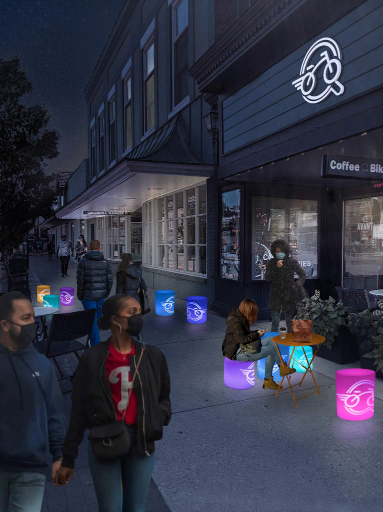
Heated Outdoor Glow Chairs
Something tells us the concept for heated outdoor glow chairs isn’t going to solve the indoor dining problem at restaurants in Chicago this winter. Sure they might have a toasty bum but that’s going to do nothing to protect them from the brutal winter winds. And let’s also be honest with ourselves here, the glow in the dark aspect is more lame than it is inventive. Imagine driving down Halsted and seeing a group of three sitting on a yellow, purple, and orange seat.
The next thing you know your head is turning to the right because it’s kind of eye-catching and you want to count the colors of the rainbow and then…SMACK. You’re now in a car accident because someone in 28-degree weather wanted Cafe Ba Ba Reeba and felt it was a good idea to sit on some glorified glow sticks.
Advertisement
The conceptualization is actually well thought out even if it is kinda terrible. There is just so much going on here and all of it feels like it’s prepared to just combust at any given moment.
Rats run this city. In fact, rats are probably the largest demographic accounting towards the population in Chicago. This is clearly a fake submission but it’s also a hilarious submission to the Chicago Winter Dining Challenge. That’s evidenced by the image above.
Interested in the equity of the project? No worry, rats from every background and from every part of the city will be utilized to fix the indoor dining issue in Chicago. We don’t discriminate against rats here. Curious about the research that went into this? It doesn’t take a peer-reviewed study to know that Rats with Radiators is a spectacular idea.
Advertisement
However, perhaps the most important aspects of this pitch for the Chicago Winter Dining challenge includes safety. If you must know, all rats will be temperature checked before being issued their radiators. This is important to note, as humans aren’t the only ones on the hook for this safety thing. Like everyone in Chicago, background and experience lies in having a yard with too many rats.
Constitutional Monarchy! We literally can’t even keep up with this anymore.
You are guaranteed to light your legs on fire in the ‘Firetable’ mock-up made for the Winter Dining Challenge in Chicago. For real, who thought that a standard picnic table with a live fire underneath would be a safe way to dine outdoors at restaurants. Do you know how many times we’ve scratched our knees at a table? I see a zero percent chance that no one burns themselves substantially in this design. It almost looks like joke table that you’d see in a high school cafeteria with the trouble maker kids who just light some stuff on fire and put it underneath the lunch table.
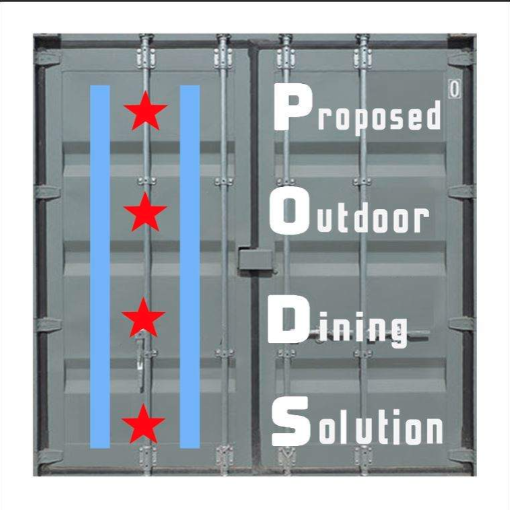
Like the band, the idea of P.O.D. isn’t bad in theory until you look at the specs and realize that it too looks like a place where you’d discover the souls of the youth of the nation.
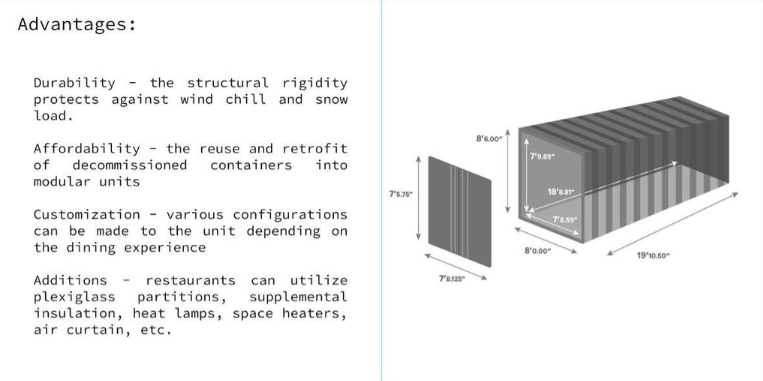
You like that line? Well good, because you won’t like this design. It’s quite literally a shipping container converted into a place to eat which feels ominously murderous. It’s proposed by James and Blake Hospitality which sounds like the name of the company you’d create for your senior year home economics project and likely get a C+ on. The advantages list Durability, Affordability, Customization, and Additions which stands for DACA, although we don’t believe anyone is dreaming about this design winning.
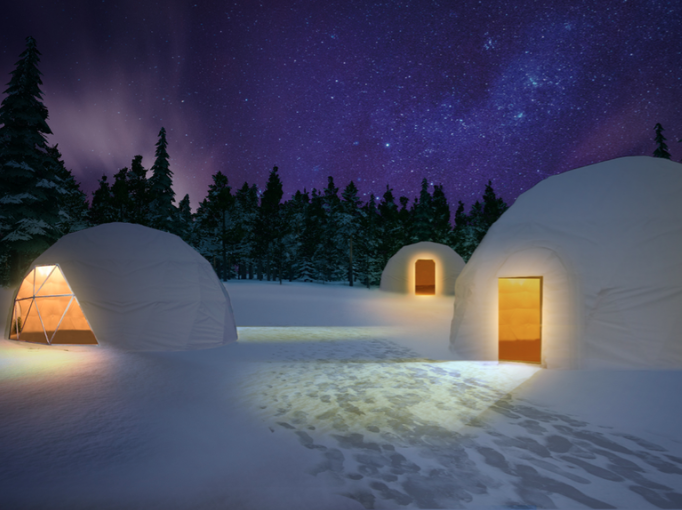
Well, if you think about it, this idea for the Chicago Winter Dining Challenge would be entertaining for kids wanting to turn a summer lemonade stand into a winter hot cocoa stand. Igloos are neat and fun to make but we’re not sure if the designer here thought about the practicality of it from a size and heat/warmth standpoint. Also, have you seen Chicago’s snow? None of it is that white and in reality it’s super gross so you can miss us with the idea of making a snow igloo a thing that we eat a decent meal out of this winter.
A couple highlights from the submission include citing that this is already done in Japan and that the instructions might be somewhere and the fact that everyone can participate in making it. This person really thought out the whole, ‘let’s-get-Chicago-back-to-work’ thing.
This final submission for outdoor dining at restaurants in Chicago is so cynical it hurts. This is the ‘suck it up, you millennial!’ version of “I used to walk uphill both ways to school in the -43 degree cold with nothing more than a pair of cardboard boxes for shoes.” We can just feel the person who wrote this shaking their clenched fist in my direction as they try and convince the world that be happy and get used to Chicago cold is the right move here. Listen, we’re from Chicago and perhaps we do overreact to winters here a little too much so the general premise is understood, but c’mon. There is no way we’re letting this whole community cold counseling thing fly in a public submission board.
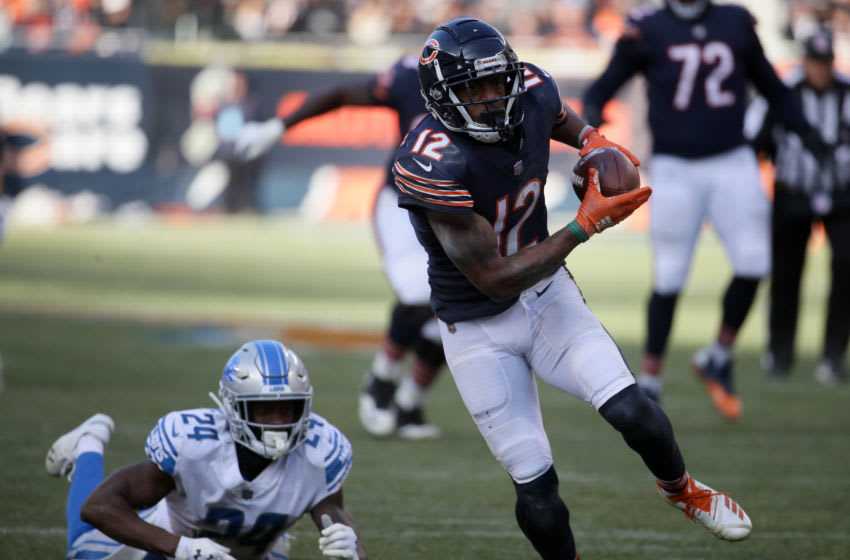
The ChicagoBears and Allen Robinson are in the middle of a contract dispute. Per reports, the dispute is over $2,000,000.
Allen Robinson has turned his career around since signing with the Chicago Bears in 2018. He has helped both Mitchell Trubisky and Chase Daniel look even better when throwing the ball to Robinson. He’s been a very reliable player.
Robinson’s current deal is a three-year deal worth $42,000,000 ($14,000,000 per season) that ends after this season. Dan Graziano of ESPN reports that Robinson wants “around $18,000,000” next year, with the Bears only offering him $16,000,000.
Robinson just turned 27-years-old, he is in the prime of his career. Losing him over a $2,000,000 difference isn’t worth it. Ryan Pace gave Mike Glennon a three-year, $45,000,000 deal in 2017. If he’ll pay Glennon $15,000,000 to play quarterback for four-games, Robinson can get $18,000,000 to play the majority of the season.
Since joining the Bears, Robinson has played in 30-games. He has a 65.8% catch rate, along with 11-touchdowns and 1,975 yards. Last season, he was snubbed of the Pro-Bowl after leading the team in yards with 1,147, alongside 7-touchdowns.
Trubisky recently told the media that Robinson is his guy:
“Allen’s just so reliable, you go to him in any situation. When he’s not open, he’s still open. That’s my guy.”
All of Robinson’s teammates are going on social media to express them wanting Robinson to stay in Chicago for the long-haul. No matter who the quarterback is, Robinson has been very reliable in all situations. It would be a shame if Pace let him walk away over $2,000,000.
#Bears chairman George McCaskey on @wgnradio on Allen Robinson’s contract situation:
“Ted (Phillips) gave me an update yesterday and we’re very optimistic.”
The good news is, the front office is feeling very optimistic about getting a deal done with Robinson.
The argument that is being made is that the contract is along the line of Tyreek Hill and Odell Beckham Jr.’s. If the argument is that those two are better than Robinson, compare their stats from last season.
Robinson: 98-receptions, 7-touchdowns, and 1,147 yards.
Hill: 58-receptions, 7-touchdowns, and 860 yards.
Beckham Jr.: 74-receptions, 4-touchdowns, and 1,035 yards.
The numbers speak for themselves. Robinson plays a big role in the Bears offense. Losing him would be a big blow to the team, whether it’s via trade during the season or during the offseason in free agency.
Robinson struggled a bit in 2018 but shined in 2019. He was the only player on offense last season that showed progression. The rest of the offense, including both quarterbacks, regressed.
The longer Pace waits to re-sign Robinson, the more money he could be worth. The two parties should meet in the middle and sign a deal a four-year deal worth $68,000,000 ($17,000,000 per season). Robinson excelled expectations and improved from Year 1 to Year 2. Pace offered him a raise, Robinson wants more – just meet in the middle and sign that contract. Robinson has earned it.
Actor and singer, TC Carson of Living Single, Greenleaf, Black Lightning, and TV One’s newest movie Coins for Love (starring Essence Atkins, Stephen Bishop, and Karon Joseph Riley and premiered on TV One) has created a message song of love with hopes of bringing people together after the recent civil unrest.
The song, “Come Together”, is an original song written, in part, by Mr. Carson and was originally released on his album Truth in 2002, but there was never a visual attached. Now, this single and video is re-released on all digital platforms as a new release for his initiative to bring people “together”.
With the release of this new video, we decided to get on IG Live and chat with TC Carson about his new music, Living Single, and more.
Get Updates on Celebrity Interviews, trendy Beauty & Fashion Tips, and coverage of Live Events
Meet The Blogger
Nekia Nichelle
Nekia Nichelle is a digital and broadcast journalist covering entertainment, lifestyle, beauty and pinch of fashion.
She has interviewed celebrities such as John Legend, Halle Berry, Jenny McCarthy, Brandy, Queen Latifah, Katie Couric and more.
When she’s not blogging, she can be heard on 107.5 WGCI, V103 and WLIT 93.9FM, as well as other stations, keeping you informed on all the traffic snafus during your morning commute.
Stay social with her on:
Instagram, Twitter, Facebook and Snapchat: @NekiaNichelle
Facebook Fan Page: @IamNekiaNichelle
Florida is a colorful state, unlike any other in America. It’s been called many things in recent years, often in a manner that makes it a punchline. Laugh all you want at “Florida man….” and his exploits, but once again it’s one of the most critical states in this November’s Presidential election.
The Sunshine State decided the 2000 election, and it has been in very influential in every election since. The extremely unique economic and cultural make up of the population lends itself to being the ultimate “purple state” with red counties, blue counties and magenta counties. As a whole “magenta” is the best way to describe it.
As you can see in this race tracker, the 2020 US Presidential election odds show Florida to be a dead heat. Both incumbent Donald Trump and challenger Joe Biden are given odds of -120 to win the state. Upon examination of the 14 most-recent state polls, seven list it as a toss up. None of the polls favor Trump taking his “home,” at least from a voter registration standpoint, state.
The best central hub on the internet for following the Electoral College race in Electoral-Vote.com as it has an interactive map with the latest state by state polling. It also shows each state’s winners back to 1992. They show Biden up 50%-47%, but computing the Florida A, Monmouth and St. Pete polls. Trump won the Gulf State by just one point last time, Barack Obama won it both times he was on the ballot, with George W. Bush taking it twice as well.
Bill Clinton won it in 1996, but lost there in 1992. That marked the last time a candidate won the state, but lost the election.
What’s most telling about those seven results is how all of them were decided by six points or fewer, with but two being decided by just two points or less!
So it’s the ultimate “within the margin of error” state, but that doesn’t mean it’ll decide the winner. Trump, despite losing the popular vote by about three million, won the 2016 election because he flipped six states that voted for Barack Obama in 2012: Florida, Ohio, Michigan, Pennsylvania, North Carolina and Wisconsin.
Of the aforementioned states that Trump turned red last time out, North Carolina and Ohio join Florida in the toss-up category, while the other three expected to turn back blue. North Carolina and Ohio, while in the margin of error, are still leaning towards Biden right now.
In other words, Biden can likely afford to lose Florida, but Trump cannot. Of course, sleep on the sunshine state at your own peril! Just ask Al Gore, who made some interesting comments about this election during a Zoom call we joined a couple weeks ago. Gore won the popular vote but lost the election due to the messy chicanery and overall disaster that was the Florida election in 2000.
Paul M. Banks runs The Sports Bank.net and TheBank.News, which is partnered with News Now and Minute Media. Banks, a former writer for the Washington Times, NBC Chicago.com and Chicago Tribune.com, currently contributes regularly to WGN CLTV and ChicagoNow.
He’s been a featured guest in dozens of media outlets including The History Channel. His work has been cited in hundreds of publications including the Wall Street Journal and Washington Post.



:no_upscale()/cdn.vox-cdn.com/uploads/chorus_asset/file/21894910/merlin_93116703.jpg) Tyler LaRiviere/Sun-Times
Tyler LaRiviere/Sun-Times
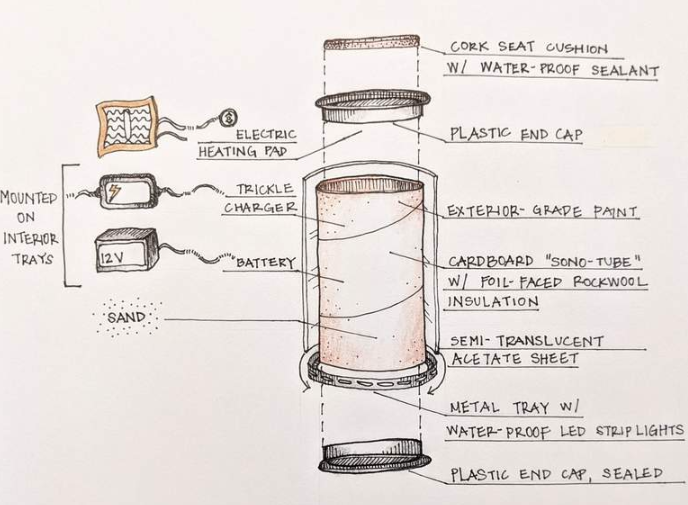 The conceptualization is actually well thought out even if it is kinda terrible. There is just so much going on here and all of it feels like it’s prepared to just combust at any given moment.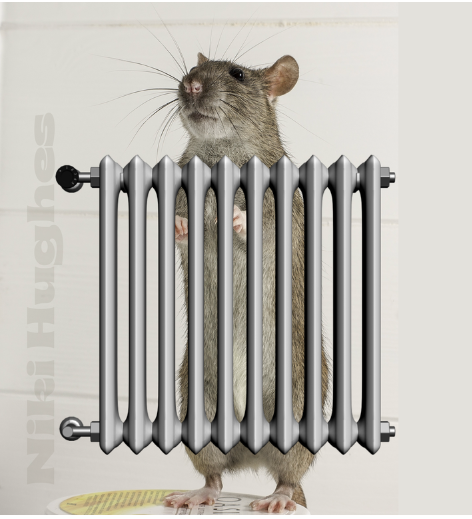

 Building an Actual Igloo with City Snow



lesraff
January 17, 2020 at 12:00 am