Videos

Fire set to welcome fans at Soldier Fieldon March 24, 2021 at 5:00 pm

The Fire will finally welcome fans to Soldier Field.

After meetings between team executives and local officials, it was announced Wednesday that the Fire will be hosting supporters this year, beginning with their April 17 opening-night match against the New England Revolution when approximately 7,000 seats will be available. The 100 and 200 levels will be open that evening, fans will be required to wear masks or facial coverings, and there will be spaced seating pods to ensure safe social distancing. Other safety precautions include no tailgating and fully mobile ticketing.

Season-ticket holders can purchase seats April 5, other 2021 ticket holders can buy them April 6, and they will be available to the general public on April 7.

“Today is an exciting day for the club,” Fire owner and chairman Joe Mansueto said in a news release. “We’d like to thank Mayor Lori Lightfoot and Governor J.B. Pritzker for their leadership and guidance throughout the past year. We are looking forward to April 17, when fans will be able to cheer on the team in-person at Soldier Field. We welcome all Chicagoans to come see a game this year.”

The Fire are taking a phased approach and will have the ability to increase attendance to 25% of Soldier Field’s 61,500 capacity, which is 15,375 fans.

“One of the most exciting parts about our city being able to safely reopen is regaining our ability to get back to Soldier Field to cheer on beloved teams such as Chicago Fire FC,” Lightfoot said in a news release. “This announcement was made possible by the many months we have spent planning, strategizing and evaluating how to welcome fans back into the stands and we will continue to work in close partnership with the Chicago Fire FC team to prioritize fans’ health and mitigate risk.”

With vaccines becoming more available and the Cubs and White Sox getting clearance to bring fans into their ballparks, Wednesday’s news isn’t surprising. But that doesn’t diminish its value to the Fire.

After buying their way into an amended lease with the village of Bridgeview in 2019 that allowed them to leave SeatGeek Stadium and move back to the city, the Fire relentlessly hyped their scheduled March 21, 2020, home opener against league powerhouse Atlanta United. That gala affair, which the team said was tracking toward a sellout, was postponed March 12 of last year when MLS suspended its season for 30 days.

When the Fire finally played their home opener on Aug. 25, it was in front of 60,000 empty blue seats accompanied by piped-in crowd noise against also-ran FC Cincinnati. Now a year later, the Fire will play in front of some home fans.

“If there’s fans in (Soldier Field), it will be even better and hopefully at one point it will be even full and that will be amazing,” coach Raphael Wicky said earlier this month. “I’m pretty sure that our fans will push us to get even stronger. I think that’s always a big difference when you have home games with your fans behind you and pushing you. We are very excited and hopefully we can have fans.”

No, the atmosphere won’t be what the Fire hoped and a few thousand tickets won’t make up for the lost revenue or be a true test of whether the team’s marketing is helping them gain attention, but it’s something.

“It was a very weird process starting the season, having no fans, and then throughout the year,” goalie Bobby Shuttleworth said earlier this month. “You could start to kind of get used to it, but it never really feels correct or like it’s supposed to be. So I think, I know me personally, I’m very, very excited to play in front of fans regardless of the amount and hopefully as the season goes on, we can get more and more fans in there safely.”

Read More

Fire set to welcome fans at Soldier Fieldon March 24, 2021 at 5:00 pm Read More »

How states are seeking to loosen controls on guns; here’s a look at efforts nationwideon March 24, 2021 at 5:00 pm

Mass shootings in Atlanta and Boulder, Colorado, that left at least 18 people dead have reignited calls by gun control advocates for tighter restrictions on buying firearms and ammunition.

But with Democrats in control of the federal government, Republican-run state legislatures have been making it easier to obtain and carry guns.

Here’s a look at how the politics of gun legislation are playing out this year:

MIXED PROSPECTS FOR NEW LAWS

The Democrat-controlled U.S. House of Representatives adopted measures this month to expand background checks to all gun purchases and expand the time to to vet people flagged through nationwide background checks.

To pass in the Senate, though, the support of every Democrat would be needed. And that’s not a sure thing.

States led by Democrats are pushing to expand some gun control laws.

Maryland lawmakers overrode a veto from Republican Gov. Larry Hogan on a bill to require background checks for all sales and transfers of rifles and shotguns. Previously, checks were required only for sales of handguns and long guns by licensed firearms dealers.

In Washington state, a proposed ban on high-capacity magazines has stalled. But a measure to ban carrying weapons openly at the state Capitol or during permitted demonstrations has cleared one house of the Legislature and awaits a vote in the other.

California lawmakers are expected to require individual identifiers on all bullet casings to include weapons used by law enforcement. Proponents say this would help investigate shootings by police and make it easier to solve crimes. Critics say it’s based on unworkable technology.

And at least five states have bills that would require or expand waiting periods before the purchase of a gun.

NULLIFYING, PREEMPTING LAWS

Lawmakers in at least a dozen states have introduced legislation to prohibit police officers from enforcing any federal gun-control laws that might be passed by Congress and signed by President Joe Biden. Some of the bills would make officers who do so subject to lawsuits or criminal charges.

Courts struck down similar nullification laws passed in Republican-controlled states when President Barack Obama was in the White House.

Some states also are considering bans on future laws or local ordinances that would restrict gun rights.

In New Hampshire, Republican lawmakers are pushing for a state constitutional amendment that would block the Legislature from restricting gun rights. That would need voter approval. Another bill would block local governments from restricting firearms.

ALLOWING GUNS IN MORE PLACES

Several states are expanding where people can take their guns.

In Tennessee, most adults over 21 would be allowed to carry firearms — concealed or in the open — without a permit under a measure advanced by that state’s Senate this month.

Most states require background checks and firearm safety training for people who want to be allowed to carry weapons in public. But 15 states already have laws allowing permitless carry for concealed guns. Nine states are considering measures to allow or expand the practice. One was sent Monday to Iowa Gov. Kim Reynolds, a Republican, for her signature.

In Montana, Gov. Greg Gianforte, the first Republican to hold the job in 16 years, signed a bill that relaxes gun restrictions. It allows concealed firearms to be carried in most places without a permit and expands the list of places where guns can be carried to include university campuses and the state Capitol. Similar measures are being pushed in Oklahoma and West Virginia.

‘STAND YOUR GROUND’ GAINS TRACTION

In January, Ohio Gov. Mike DeWine, a Republican, signed a “Stand Your Ground” bill that eliminates an individual’s duty to retreat before using force.

DeWine acted despite his criticism of Republican lawmakers for ignoring his own legislation seeking to toughen background checks and boosting penalties for felons committing new crimes with guns. The governor proposed those measures after a 2019 mass shooting in Dayton.

A “Stand Your Ground” measure has been approved by the South Dakota Legislature and awaits Republican Gov. Kristi Noem’s signature.

STATE OF THE COURTS

A federal judiciary system that is more conservative after nominations by former President Donald Trump gives gun-rights advocates hope that pro-gun measures will be left intact by courts and restrictions will be tossed out.

One big test has been in California. In 2016, voters there approved a measure banning magazines holding more than 10 rounds of ammunition.

Two federal courts have struck down the restriction. Last month, the 9th Circuit Court of Appeals agreed to have 11 judges consider the case.

Last June, the U.S. Supreme Court declined to hear challenges to several gun-control laws. Since then, liberal Justice Ruth Bader Ginsberg has died and her former seat has been filled by a conservative Trump appointee, Amy Coney Barrett.

Read More

How states are seeking to loosen controls on guns; here’s a look at efforts nationwideon March 24, 2021 at 5:00 pm Read More »

Woman, child seriously hurt in Clearing fireon March 24, 2021 at 5:43 pm

A woman and a boy were seriously injured Wednesday in an apartment fire in Clearing on the Southwest Side.

About noon, firefighters pulled out the pair from a home in the 6600 block of West 63rd Street, Chicago Fire Department spokesman Larry Merritt said.

The boy was taken in serious-to-critical condition to Comer Children’s Hospital, the fire department said on Twitter. His condition stabilized.

The woman was taken to Christ Medical Center in Oak Lawn in critical condition, the department said.

Merritt was not able to provide further details on the fire.

Read More

Woman, child seriously hurt in Clearing fireon March 24, 2021 at 5:43 pm Read More »

Colorado shooting suspect prone to rage, delusions: officialson March 24, 2021 at 4:19 pm

BOULDER, Colo. — Law enforcement officials and former associates of a 21-year-old man accused of killing 10 people at a Colorado supermarket have described the suspect as prone to sudden rage — and disclosed that he was suspended from high school several years ago for a sudden attack on a classmate that left the student bloodied.

Ahmad Al Aliwi Alissa, from the Denver suburb of Arvada, was booked into jail Tuesday on murder charges a day after the attack at a King Soopers grocery in Boulder and is scheduled to make his first court appearance Thursday.

He will be advised at the hearing of the charges he faces and his rights as a defendant. He would not be asked to enter a plea until later in the judicial process.

Alissa bought a Ruger AR-556 pistol — which is technically a pistol though it resembles an AR-15 rifle with a slightly shorter stock — on March 16, six days before the attack, according to an arrest affidavit. Investigators have not established a motive, said Boulder County District Attorney Michael Dougherty.

Authorities have not disclosed where the gun was purchased. An AR-15-style gun was recovered inside the supermarket and believed to have been used in the shooting, said a law enforcement official briefed on the shooting who was not authorized to speak publicly and spoke to The Associated Press on condition of anonymity.

A green tactical vest and a hand gun were also recovered inside the grocery store after the suspect removed most of his clothing shortly before he was taken into custody.

Among the dead was Boulder police Officer Eric Talley, 51, who was the first to arrive after responding to a call about shots fired and someone carrying a gun, said police Chief Maris Herold.

The law enforcement official who was briefed on the shooting said the suspect’s family told investigators that Alissa had delusions and that they believed he was suffering some type of mental illness. The relatives described times when Alissa told them people were following or chasing him, which they said may have contributed to the violence, the official said.

After the shooting, detectives went to Alissa’s home and found his sister-in-law, who told them that he had been playing with a weapon she thought looked like a “machine gun” about two days earlier, according to an arrest affidavit.

No one answered the door Tuesday at the Arvada home believed to be owned by the suspect’s father. The two-story house with a three-car garage sits in a relatively new middle- and upper-class neighborhood.

When he was a high school senior in 2018, Alissa was found guilty of assaulting a fellow student in class after knocking him to the floor, climbing on top of him and punching him in the head several times, according to a police affidavit.

Alissa “got up in classroom, walked over to the victim & ‘cold cocked’ him in the head,” the affidavit said.

Alissa complained that the student had made fun of him and called him “racial names” weeks earlier, the affidavit said.

An Arvada police report said the victim was bloodied and vomiting after the assault. Alissa was suspended from school and sentenced to probation and community service.

One of his former high school wrestling teammates, Angel Hernandez, said Alissa became enraged after losing a match during practice, letting out a stream of invectives and yelling that he would kill everyone. Alissa’s coach kicked him off the team because of the outburst, Hernandez said.

“He was one of those guys with a short fuse,” Hernandez said. “Once he gets mad, it’s like something takes over and it’s not him. There is no stopping him at that point.”

Hernandez said Alissa also acted strangely at times, turning around suddenly or glancing over his shoulder.

“He would say, ‘Did you see that? Did you see that?'” Hernandez recalled. “We wouldn’t see anything. We always thought he was messing with us.”

Arvada police investigated but dropped a separate criminal mischief complaint involving Alissa in 2018, said Detective David Snelling. Alissa also was cited for speeding in February.

After dark Tuesday, about 100 people mourned at a makeshift memorial set up for those killed in the supermarket nearby — adorning it with wreaths, candles, banners reading “#Boulderstrong” and 10 crosses with blue hearts and the victims’ names.

Four girls huddled in the cold, one crying as she reminisced about how they had protested the 2018 shooting at Marjory Stoneman Douglas High School in Parkland, Florida. Others recalled the 1999 massacre at Columbine High School and the 2012 Aurora movie theater massacre.

Homer Talley, 74, described his son Eric as a devoted father who “knew the Lord.” He had seven children, ages 7 to 20.

The other dead were identified as Denny Stong, 20; Neven Stanisic, 23; Rikki Olds, 25; Tralona Bartkowiak, 49; Suzanne Fountain, 59; Teri Leiker, 51; Kevin Mahoney, 61; Lynn Murray, 62; and Jodi Waters, 65.

Leiker, Olds and Stong worked at the supermarket, former co-worker Jordan Sailas said.

Kim Cordova, president of the United Food and Commercial Workers Local 7, which represents more than 30 store employees, said workers did their best to get customers to safety.

“They grabbed everybody they could and they brought them to the backroom or to other areas of the store to hide or got them out through the back dock,” Cordova said. “And these poor grocery workers have just been through hell in general working through COVID this entire last year of the pandemic.”

Monday’s attack was the seventh mass killing this year in the U.S., following the March 16 shooting that left eight people dead at three Atlanta-area massage businesses, according to a database compiled by the AP, USA Today and Northeastern University.

It follows a lull in mass killings during the coronavirus pandemic in 2020, which had the smallest number of such attacks in eight years, according to the database, which tracks mass killings defined as four or more dead, not including the shooter.

In Washington, President Joe Biden called on Congress to tighten the nation’s gun laws. Senate Majority Leader Chuck Schumer vowed to bring forward two House-passed bills to require expanded background checks for gun buyers. Biden supports the measures, but they face a tougher route to passage in a closely divided Senate with a slim Democratic majority.

___

Associated Press writers Michael Balsamo in Washington, Jim Anderson in Denver and AP staff members from around the U.S. contributed to this report. Nieberg is a corps member for the Associated Press/Report for America Statehouse News Initiative. Report for America is a nonprofit national service program that places journalists in local newsrooms to report on undercovered issues.

Read More

Colorado shooting suspect prone to rage, delusions: officialson March 24, 2021 at 4:19 pm Read More »

Haunted by mass violence, Colorado confronts painful historyon March 24, 2021 at 4:45 pm

DENVER — Dawn Reinfeld moved to Colorado 30 years ago to attend college in the bucolic town of Boulder. Enchanted by the state’s wide-open spaces, she stayed.

But, in the ensuing decades, dark events have clouded her view of her adopted home. The 1999 massacre at Columbine High School. The 2012 massacre at the Aurora movie theater. On Wednesday, Reinfeld was reeling from the latest mass shooting even closer to home, after authorities say a 21-year-old gunned down shoppers at a local grocery store.

“I could see at some point leaving because of all this,” said Reinfeld, a gun control activist. “It’s an exhausting way to live.”

Colorado has long been defined by its jagged mountains and an outdoor lifestyle that lure transplants from around the country. But it’s also been haunted by shootings that have helped define the nation’s decades-long struggle with mass violence. The day after the latest massacre, many in the state were wrestling with that history — wondering why the place they live seems to have become a magnet for such attacks. Why here — again?

“People now say, ‘gee, what is it about Colorado?'” said Tom Mauser, whose son Daniel was killed at Columbine High School in 1999.

Mauser, now a gun control advocate, was fielding phone calls in the wake of the new attack — among them was a panicked call from a friend whose daughter was shopping in the supermarket and just escaped the shooting. Again, the violence felt so close.

“It just effects so many people. It’s become pervasive,” he said.

Colorado isn’t the state with the most mass shootings — it ranks eighth in the nation, in the same tier as far larger states like California and Florida, according to Jillian Peterson, a criminology professor at Hamline University in Minnesota.

But it is indelibly associated with some of the most high-profile shootings. The massacre at Columbine High School is now viewed as the bloody beginning of a modern era of mass violence. The Aurora shooting brought that terror from schools to a movie theater.

And there are others with less national prominence. In 2006, a gunman killed a 16-year-old girl after storming a high school in the mountain town of Bailey. The next year, a gunman killed four people in two separate attacks on evangelical Christian churches in suburban Denver and Colorado Springs. Three people died during a 2015 attack on a Planned Parenthood clinic in Colorado Springs. In 2017, three people were killed at a Walmart by a shooter whose motives were never known. In 2019, 18-year-old Kendrick Castillo was killed fending off an armed attack by two classmates at a suburban Denver high school.

The search for answers leaves no easy explanations. Despite its Western image, Colorado has a fairly typical rate of gun ownership for the country, and its populated landscape has more shopping centers than shooting ranges. It’s close to the middle of the pack in terms of its rate of all types of gun violence — 21st in the country, according to Centers for Disease Control and Prevention data.

Peterson, who has written about mass shootings as a viral phenomenon where one gunman is inspired by coverage of other attacks, says the Columbine attack may be one reason Colorado has suffered so much. Two student gunmen killed 13 and “created the script” that many other mass shooters seek to emulate. The attackers died in the massacre but landed on the cover of Time Magazine and were memorialized in movies and books.

“Columbine was the real turning point in this country, so it makes sense that, in Columbine’s backyard, you’d see more of them,” Peterson said.

The attack was nearly a generation ago — the man police named Tuesday as the gunman in the Boulder massacre, Ahmad Al Aliwi Alissa, was born three days before the Columbine shooting.

Like many young Coloradans, Esteban Luevano, 19, only learned about Columbine in school, as a tragedy that occurred before he was born. But its long shadow terrified him as a child who wondered whether gunmen could storm his school, too.

Then, when Luevano was 11, another gunman opened fire at a movie theater near his house in Aurora, east of Denver and on the opposite side of the metro area from Columbine’s leafy suburbs. Twelve people were killed and 70 wounded.

The theater was remodeled after the attack. It sat empty on Tuesday, shuttered during the pandemic, as snow began to swirl and Luevano bundled up to head into a mall across the street. He was still reeling from the idea that the latest Colorado community to join the grim brotherhood was the tony, college town of Boulder.

“It’s pretty fancy, so it kind of shocked me that someone would shoot out there,” Luevano said.

Colorado has taken some action to restrict access to guns.

After each of Colorado’s biggest massacres, the local gun control movement has gained heartbroken new recruits. Survivors of Columbine and family of the victims there helped push a ballot measure that required background checks for guns purchased at gun shows. After the Aurora attack, the state’s newly Democratic Legislature passed mandatory background checks for all purchases and a 15-round limit for magazines.

Those measures led to the recall of two state senators, but the laws endured. After the 2018 Parkland shooting in Florida, the Colorado Legislature passed laws allowing for the confiscation of guns from people engaged in threatening behavior. There has been rebellion from some rural sheriffs, but no recalls now.

Three years ago, the city of Boulder went further and banned assault weapons. A court blocked the measure just 10 days before Monday’s rampage.

Gun control activists say one place to observe the impact of mass shootings is in the state’s politics. The Republican congressman who represented Aurora was replaced in 2018 by Democratic Rep. Jason Crow, a gun control proponent. In November, the Democratic governor who signed the post-Aurora gun control measures, John Hickenlooper, won a U.S. Senate seat from Colorado’s last major statewide elected Republican.

Still, the appetite for gun rights supporters has not dissipated completely. Coloradans last year also elected Lauren Boebert, a Republican from a rural district who said she wanted to carry a firearm on the floor of the House of Representatives.

Democrat Tom Sullivan, whose son Alex was killed during the Aurora shooting, was elected to a previously-Republican state house district in 2018. On Monday afternoon, he was out with a friend and didn’t hear about the latest attack until he came home.

When he did, he turned on the television to watch, something he described as a “pause” to take in all the pain and life stories of the victims.

“It’s not that we’re numb to this, it’s that we have a lot of practice,” Sullivan said in an interview.

Sullivan argued that Colorado doesn’t have an unusually high number of mass shootings. It’s just that the relatively wealthy state’s backdrop makes the attacks more sensational. “The ones that are happening here in Colorado are happening in a little more affluent areas,” Sullivan said. “It’s happening in other places, too, we just can’t get people to report on that.”

Not all touched by the state’s history of massacres have become gun control backers. Brian Rohrbough, whose son Daniel was killed at Columbine, said he gets frustrated every time political activists pick up the issue after massacres. Instead, the solution is moral education, he argues.

“We’re reaping what we’ve sown because we’re afraid, as a state, as a country, to call evil evil,” Rohrbough said.

Read More

Haunted by mass violence, Colorado confronts painful historyon March 24, 2021 at 4:45 pm Read More »

Automation is saving jobs during pandemicon March 24, 2021 at 4:49 pm

Workers have long feared automation would take their jobs. COVID-19 has intensified those worries.

“Machines don’t fall ill, they don’t need to isolate to protect peers, they don’t need to take time off work,” said Oxford University researcher Daniel Susskind in an interview with TIME.

In other words, automation is pandemic-proof. But despite the common narrative, automation isn’t a competitor for humans’ jobs. In fact, particularly for small businesses, it can be a lifeline. Automation increases efficiency and frees up humans to do the things only they can do, like think creatively. That has helped preserve — and even create– jobs during the pandemic.

Small business owner Michael Alexis experienced this firsthand. His business Museum Hack, which leads tours of museums, started with humble roots in New York and quickly expanded nationwide. Then, unexpectedly, business came to a crashing halt overnight.

At the beginning of the Covid-19 outbreak in the United States last February, Museum Hack went from a $2.8 million per year business to zero in just three days. lost $2.8 million in revenue in just three days. With no new leads coming in and museums closed indefinitely, Michael had to act quickly.

As cities across the United States began shutting down and offices turned to remote work, Michael noticed that Google searches related to virtual team-building were increasing. Michael had already built a team experienced at developing and leading events, so he made a decision to pivot the company’s business model to virtual events — and give them a chance at survival.

Thus, TeamBuilding.com was born. But to support the pivot, he needed efficient and accurate systems in place. Systems that would allow him to quickly process inquiries from potential customers and get his team focused on what they do best — hosting Zoom office games and enjoying s’mores over a virtual campfire with clients. So, he turned to automation.

Michael was able to implement complex and necessary systems. That included lead sorting, which notified team members of qualified leads immediately so that they could close more deals. This process wouldn’t have been possible without automation. “We never did lead sorting before,” said Michael. “When we had a smaller sales team, they manually figured out who would take each lead based on turn.” Ultimately, it allowed TeamBuilding.com to accrue so much business, they needed to hire 100+ more teammates.

Austin Gray, who runs The Perk — a coffee shop in Winter Park, Colorado — faced a similar predicament when the pandemic struck. When the state required non-essential businesses to close except for pick-up, Austin had to figure out how to continue serving his customers.

No one orders coffee by phone, so automation became crucial. In a matter of hours, he built an online ordering system. Customers simply filled in a form with what they wanted on the company’s website and that information automatically populated a spreadsheet at the shop. Baristas could once again safely create beverages and The Perk, in turn, could stay in business.

In both of these cases, automation proved to be a complement to human creativity. People have a limited amount of mental energy. Why waste it on mundane tasks? Automation can take care of the hundreds of tiny decisions involved in everyday operations — and thereby enable workers to spend their time on more complex endeavors.

Even after the pandemic passes, we’ll live much more of our lives online. Small businesses are already beginning to prepare for that reality.

Customers may no longer want to pick out a bottle of wine in person. So the local wine shop may need automation to facilitate sales on its website. Sandwich shops will have to do more than put out a fishbowl for business cards at the cash register. They’ll have to send customers a thank you email after purchase and invite them to sign up for their email newsletter.

Automation will never match humans’ creativity. And it doesn’t have to. It can tackle mundane tasks and allow us to concentrate on developing the big new ideas that enable small businesses to prosper. The sooner small businesses embrace automation, the better off they’ll be.

Wade Foster is the co-founder and CEO of Zapier.

Read More

Automation is saving jobs during pandemicon March 24, 2021 at 4:49 pm Read More »

NHL referee out after saying he wanted to call a penalty against Nashvilleon March 24, 2021 at 3:15 pm

NASHVILLE, Tenn. — Tim Peel’s career as an NHL referee is over after his voice was picked up by a TV microphone saying he wanted to call a penalty against the Nashville Predators.

The league on Wednesday announced that Peel “no longer will be working NHL games now or in the future.” The 54-year-old Peel had already made plans to retire next month.

“Tim Peel’s conduct is in direct contraction to the adherence to that cornerstone principle that we demand from our officials and that of our fans, players coaches and all those associated with our game expect and deserve,” NHL vice president of hockey operations Colin Campbell said in a statement. “There is no justification for his comments no matter the context or intension.”

The NHL determined it was Peel’s voice that was heard on the TV broadcast of the Predators home game against the Detroit Red Wings after Nashville forward Viktor Arvidsson was issued a minor tripping penalty five minutes into the second period.

“It wasn’t much, but I wanted to get a (expletive) penalty against Nashville early in the,” the unidentified official was heard saying before the microphone was cut. Peel worked the game with referee Kelly Sutherland.

The Predators won 2-0 and were called for four penalties, compared with the Red Wings’ three.

Predators coach John Hynes said after the game that it didn’t matter how he felt about what the official said. “But the referees are employees of the league and rather than me comment on it, it’s an issue that I think the league will have to take care of,” Hynes said.

He said his team, now 5-3-1 over its past nine games, has been working to avoid excuses after going through a 16-day road trip that was the longest in franchise history. Hynes has been pushing his players to control what they can.

“You’re not so much worried about what’s going on in those situations as we’ve got to be able to kill the penalty, we’ve got to be ready to play, and that’s what I really liked about our team’s reaction to that situation,” Hynes said.

Read More

NHL referee out after saying he wanted to call a penalty against Nashvilleon March 24, 2021 at 3:15 pm Read More »

This West Garfield Park Studio is Putting Beans on Toteson March 24, 2021 at 3:25 pm

In January, designer Takara Beatheagudell launched a line of bean bags from her namesake West Garfield Park studio. Not the kind you toss during lawn games, but rather polyester totes ($28) printed with images of all manner of legumes — red, black, pinto, and green pea. As she has with all her designs during her 40-plus-year career — one defined by statement brooches, geometric earrings, and asymmetric jackets — Beatheagudell drew inspiration for the carryalls from sensory memories. Growing up in Bronzeville, she’d watch her mother spread out black-eyed peas in a mosaic-like pattern on an aluminum table on the first of every year. Together they’d pick out the cracked, chipped, and imperfect ones before cooking. “The black-eyed peas represent prosperity and hope for the new year,” Beatheagudell says. “And on the bags, you can just see how gorgeous they look.” Linger you might on the mile-long Rancho Gordo Bean Club waitlist, but in the meantime, Beatheagudell’s designs will let you show the world that your split pea love transcends pandemic trends. shoptakara.com

Read More

This West Garfield Park Studio is Putting Beans on Toteson March 24, 2021 at 3:25 pm Read More »

Senior year has been salvaged for Antioch’s talented Kaliakmanis brotherson March 24, 2021 at 2:16 pm

Athan and Dino Kaliakmanis share a few things, including a last name and a college destination.

But the Antioch brothers, both seniors bound for Minnesota, are very different in their approaches to life.

“My brother is very outgoing,” said Dino, a wide receiver. “He’s very energetic, He loves to bring a light into the room.

“I’m not outgoing. I’m very quiet.”

“They’re polar opposites, personality-wise,” Anrioch coach Brian Glashagel said. “Dino is quiet, he’s just non-stop 100 mph in every drill. Doesn’t say a word, leads by example. You don’t have to tell Dino to run hard.”

Athan, a quarterback, doesn’t need to be pushed either. The transformation of his body since his junior season — which ended prematurely with a broken collarbone — is proof of that.

“I put on 30 pounds since the last time I played football,” Athan said before the Sequoits opened their season with a win over Grayslake Central. “It’s not fat,

“I worked so hard, harder than I ever have worked to leave Antioch the best I’ll be.”

He has no doubt his brother will do the same.

“What happens in the dark shines in the light,” Athan said. “Dino is a different animal this year. He’s a different player this year.”

Having one more high school season before going off to play in the Big Ten puts a capper on the Kaliakmanis brothers’ unusual journey.

“The guys on my team, I literally grew up with,” Athan said, “I’ve known them since kindergarten.”

But he and his brother weren’t always teammates with the current Sequoits; they played as freshmen at Carmel before transferring back home.

Glashagel knew about them for years. Like other high school coaches, he hears about up-and-comers all the time. Some pan out in high school, some don’t.

Antioch football's Dino Kaliakmanis (30) plays wide receiver, and his brother Athan (7) plays quarterback for the Sequoits.
Antioch football’s Dino Kaliakmanis (30) plays wide receiver, and his brother Athan (7) plays quarterback for the Sequoits.
Allen Cunningham/For the Sun-Times

“I was always trying to get out to see a couple of youth games,” Glashagel said.

But then one day, he got some interesting news from Andy Bitto, then the Carmel coach and now an assistant at Antioch: the Kaliakmanis brothers were coming home.

Glashagel knew he had something special when college coaches were coming to Antioch to watch their new quarterback, who wasn’t even a high school sophomore yet.

That was then. It’s even better now.

“When he throws the ball in the gym, it’s humming,” Glashagel said.

Now Athan is throwing to Dino in real games for the first time since the fall of 2019, and to them, it feels like a fitting way to wrap up this chapter of their lives.

“I never thought I was going to have this opportunity again.” Athan said. “Even though I’m going to play college football, I’m lucky to play high school football.”

Especially with this group.

“This is probably the best team Antioch has ever had,” Athan said,

“If it wasn’t for COVID, who knows what would have happened?” Dino said. “These past 16 months … have had a lot of ups and downs.”

But now the Sequoits finally are back playing, and the arrow is definitely pointing up.

Read More

Senior year has been salvaged for Antioch’s talented Kaliakmanis brotherson March 24, 2021 at 2:16 pm Read More »

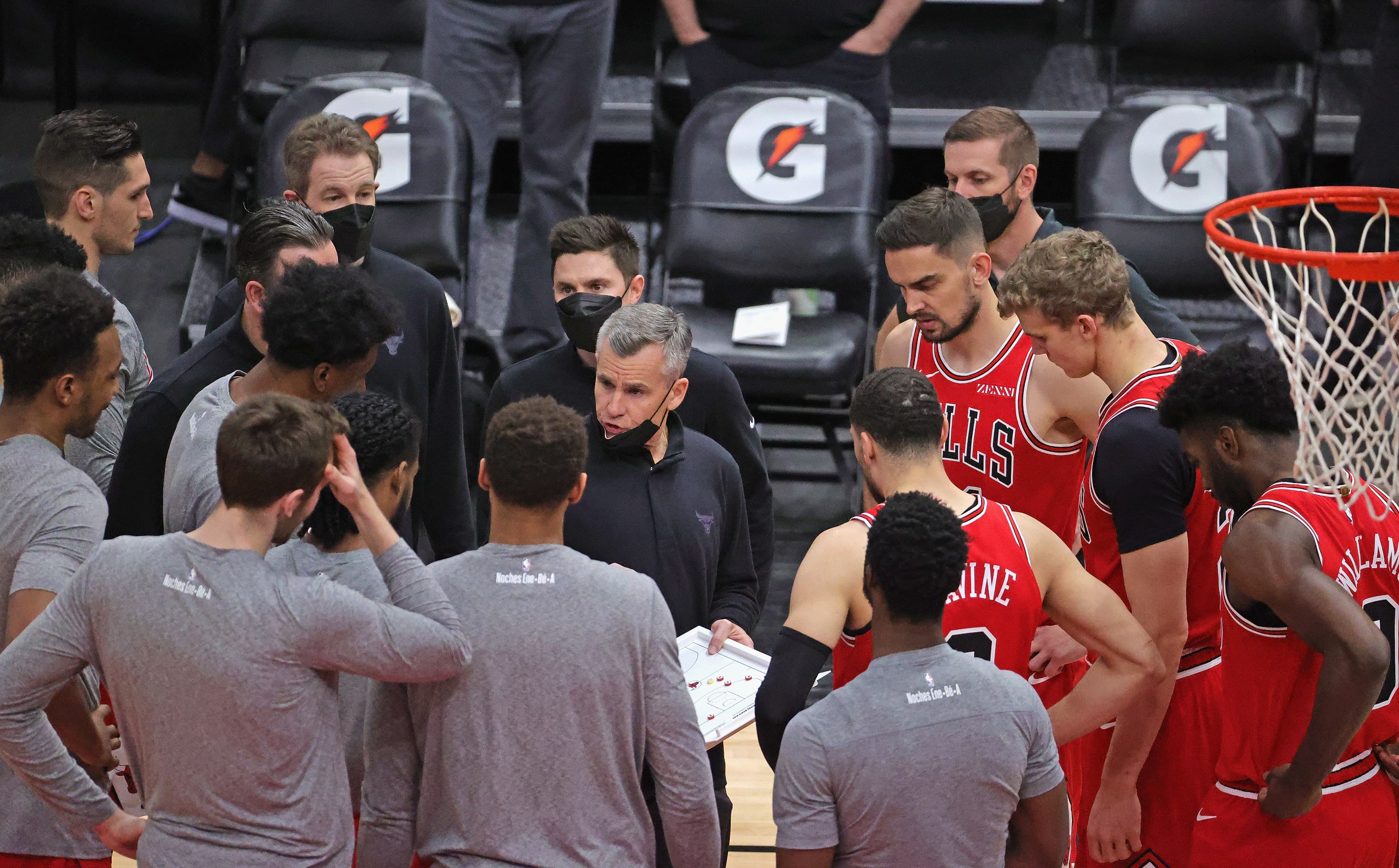
Chicago Bulls: There’s potential for splash trade deadline dealson March 24, 2021 at 1:00 pm

Read More

Chicago Bulls: There’s potential for splash trade deadline dealson March 24, 2021 at 1:00 pm Read More »