The twist Deli favorites with Middle Eastern and Texan influences The skinny Billy Caruso has dipped into Jerusalem’s culinary melting pot, using, for example, labneh as a bagel spread (try the thyme and sea salt bagel slathered with charred strawberry and honey labneh) and making brik, a Tunisian pastry filled with potato and egg. His Austin, Texas, roots are on display, too, most notably with the pastrami, which he makes like the barbecue joints by giving a whole brisket (not just the flat) an extra-long smoke over oak and applewood. Try it in the Reuben with sauerkraut and Gruyère ($16). Must order The matzo ball soup ($13), made with blue corn matzo balls, loaded with shredded chicken and veggies, and topped with a radish and herb salad
Jeff & Judes
1024 N. Western Ave., Humboldt Park
The twist Southern takes on deli classics, plus a standout bakery program The skinny Ursula Siker grew up in Los Angeles, a city with a rich deli culture. She named this spot after her parents and took inspiration from their backgrounds (her dad comes from a Jewish family in Pittsburgh and her stepmom is from North Carolina). That means bites like a sweet potato and pimiento cheese knish ($8) alongside a thick corned beef Reuben on housemade marble rye ($18). Don’t miss the clever baked goods: Siker transforms her cinnamon challah into bread pudding ($8) and fills rye hamantaschen with cream cheese, red onion, and dill and crusts them with everything bagel spice ($7). Must order The fried chicken sandwich ($10), an übercrisp thigh brined in buttermilk and pickling spices and dredged in matzo. It’s finished with mayo and bread-and-butter pickles and served on a potato bun.
Sam & Gertie’s
1309 W. Wilson Ave., Uptown
The twist Vegan versions (you heard right!) of deli staples The skinny Andy Kalish may have named his restaurant after his grandparents, but the place is not exactly old-school. He re-creates traditional deli offerings like whitefish, corned beef, and chopped liver using beans, veggies, and other plant-based ingredients. Take his “pastrami,” which you can get with mustard on rye ($12.75) or as a Reuben (the Levin, $14.75); he combines wheat gluten with three types of beans (white, red, and garbanzo) to add texture and color, plus a secret seasoning blend that imparts a smoky, peppery bite. Must order The Fishman ($13.75), a tangy smoked “whitefish” salad (made with hearts of palm, vegan mayo and cream cheese, green onions, and dill) on an onion bun with lettuce, tomato, onions, and capers
I’m Jerry Partacz, happily married to my wife Julie for over 40 years. I have four children and eleven grandchildren. I’m enjoying retirement after 38 years of teaching. I now have an opportunity to share my thoughts on many things. I’m an incurable optimist. I also love to solve crossword puzzles and to write light verse. I love to read, to garden, to play the piano, to collect stamps and coins, and to watch “Curb Your Enthusiasm”.
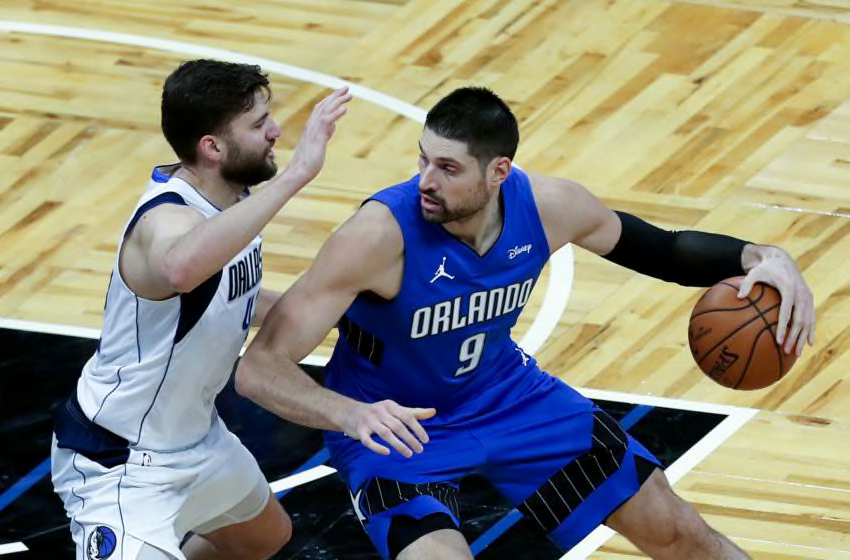
The two first-round picks the Bulls are going to trade to the Magic include their first-round selection for the upcoming 2021 draft (top-4 protected), and their first-round pick for the 2023 draft. Remember, per the Stepien rule, teams cannot trade back-to-back first-round selections, so they had to skip a year in drafts.
The Orlando Magic said going into the trade deadline period they would need an “overwhelming offer” to give up Vucevic to any team. NBA teams already knew that Aaron Gordon and Evan Fournier were on the table, but the Magic were resistant to giving up their star center.
Arturas Karnisovas, the Bulls’ Vice President of Operations, and Marc Eversley, general manager, shocked the world on Thursday morning with a trade to add a second Eastern Conference all-star to their lineup.
Here’s the deal: The Bulls land Nikola Vucevic and Al Farouq Aminu for Otto Porter, Wendell Carter Jr., and two first-round picks. Huge addition for Chicago, who remains in pursuit of Lonzo Ball. The Magic are moving toward a rebuild now with Aaron Gordon deal on deck.
The Bulls finally got the cornerstone piece they need to fulfill the frontcourt. Vucevic is a two-time all-star for a reason. This season he is averaging 24.5 points, 11.8 rebounds, and 3.8 assists per game. He is shooting 48 percent from the field, 40.6 percent from behind the arc, and 82.7 percent from the charity stripe.
He is not only a great scorer and rebounder, but he is also an excellent interior defender, which is something the Bulls have needed in their lineup. The Bulls give up 50.4 points in the paint per game to their opponents, which ranks near the bottom of the NBA. Vucevic has an unbelievable career defensive rating of 105 and averages a career positive defensive box plus/minus.
Another important aspect of Vucevic’s game is the fact that he can help the Bulls further improve their pick-and-roll offense. He is versatile from his range to be the roller in pick-and-roll situations and dominate the paint, but to pick-and-pop out to shoot from distance.
Nikola Vucevic leads the NBA in pick and pop scoring by a wide margin. He has shot an eFG% of 55% in catch and shoot situations, 61% finishing around around the rim, and 49% going one-on-one in the post this season.
The Bulls are giving up Wendell Carter Jr., who has been struggling this season causing him to get benched along with Coby White. Carter is averaging 10.9 points, 7.8 rebounds, and 2.2 assists per game. Carter is inefficient in defending the paint is in constant foul trouble.
Otto Porter Jr. is taking up around $28 million in cap space and is in the final year of his deal. He has missed nearly 20 games this season and missed nearly the whole season last year due to injury. His age is taking a toll on his body and he’s hardly efficient off the bench, only as a catch-and-shoot three-point shooter.
The concern with this trade is the fact that the Bulls have given away two first-round picks to acquire Vucevic, who is now a 30-year old NBA veteran. However, the Bulls have continuously gotten high picks in the draft, from the fourth last draft, and seventh in the two before.
It’s time for the Bulls to bring in savvy veterans that can bring leadership and experience to this extremely young team. Remember, going into this season, the Bulls had a younger average age in their starting five than the University of Wisconsin’s men’s basketball team.
It’s a new era for the Bulls under Karnisovas and Eversley, and the Bulls are still trying to acquire Lonzo Ball from the Pelicans to round out their starting lineup with a true point guard. Stay tuned, Chicago.
There are many fine restaurants in Springfield. Saputo’s, the Italian bistro where former House Speaker Michael Madigan dined every evening at precisely 7 p.m., always sitting at the same table and drinking the same wine. Loukinens’ on 4th, where you can always be sure to spot legislators and lobbyists cutting deals over pan-seared Chilean Sea Bass. The last time I visited our state capital, though, I only wanted to eat at the Cozy Dog Drive In, the home of Illinois’s most important culinary innovation, the corn dog.
Illinois has a state snack food (popcorn), a state vegetable (sweet corn), and a state grain (corn). If the state had a hand-held meal, it would be the corn dog. The corn dog is Illinois on a stick: a hot dog, representing Chicago’s meatpacking heritage, wrapped in a cornmeal shell, representing the crop that carpeted over the prairie. Illinois grows 1.8 billion bushels of corn a year, second only to Iowa.
Surprisingly little of that corn goes into making corn dogs, though. Corn dogs are ubiquitous at the State Fair, sold at every other food stand on the midway, along with Lemon Shake-Ups. Every summer, the American stomach emits an enzyme enabling it to digest foods that would be inedible the rest of the year. The corn dog has, mostly, been relegated to the “fair food” category, along with funnel cakes, elephant ears, blooming onions, and chocolate-covered bacon. It’s not easy to find a corn dog in a restaurant, even in hot-dog crazy Chicago.
In 2018, the Tribune’s Nick Kindeslperger lamented that “if you want a corn dog, that battered and fried dish you eat on a stick, you’ll have to put in some real effort, and what you get might not be worth it…. As recently as six years ago, my current Tribune colleague, Louisa Chu, enthused on WBEZ about a “corn dog renaissance” in Chicago. But most of the restaurants either closed (Franks ‘n’ Dawgs, Wiener and Still Champion) or removed the corn dogs from their menus (Bangers and Lace, Old Town Social), leaving a handheld-fried-food hole in our scene.”
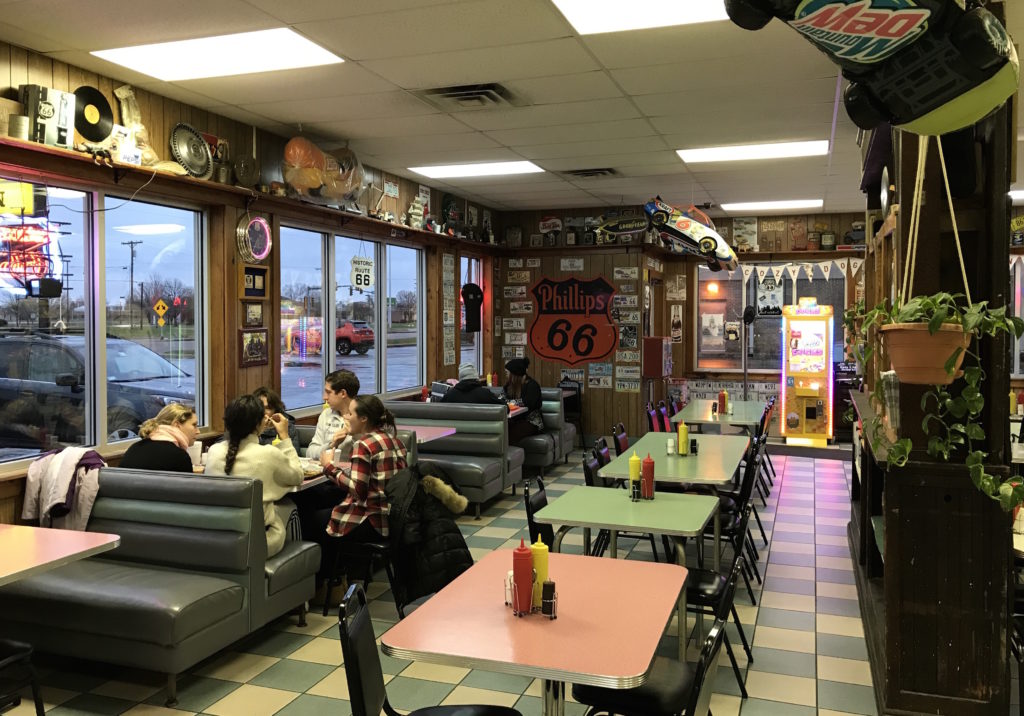
After much searching, I located a corn dog at Wolfy’s, 2734 W. Peterson Ave., in West Rogers Park. However, it was a minor offering on a hot-dog heavy menu—undersized, and not especially crunchy. If I wanted a real Illinois corn dog, I was going to have to go to the source. That’s how I ended up at Cozy Dog. A kitschy diner founded in 1946, Cozy Dog advertises itself with an illuminated sign depicting two hot dogs in connubial bliss. Appropriately enough for a purveyor of an all-American meal, it’s located in a strip mall on Route 66, and sells highway memorabilia along with hot dogs.
Cozy Dog bills itself as the “Birthplace of the Corn Dog,” with a poster depicting a nurse feeding mustard to a baby corn dog. According to a handwritten history on the restaurant’s wall, though, Cozy Dog founder Ed Waldmire actually discovered the concept “at a roadside cafe in Muskogee, Oklahoma,” while driving from his hometown of Springfield to the army air base where he was stationed in Amarillo, Texas. Ed ordered “a row of 3 wieners laid down in a hot iron, covered with a batter, & closed up to cook.”
Cozy Dog in Springfield, Illinois, along Route 66.
Photograph: Chicago Tribune
That was certainly around when the delicacy took off. Proto-corn-dog molds emerged in the patent records in 1910, but for baking, not frying. (There’s your problem.) The act of consuming fried corn dogs really entered the historical record in the 1940s, in Florida, Oregon, Texas, Minnesota. A May 1940 ad for the Silver Dollar Restaurant, north of Ada, Oklahoma, described its corn dog as the “Sandwich Sensation Now—Different” and “Worth Driving Miles For.” (Ada’s just a couple hours from Muskogee.) Minnesota’s famous Pronto Pup was trademarked in 1942 — a Tribune writer described it in 1946 as the “postwar version of the hot dog.” Corn dogs were in the air.
Ed loved the corn-coated wieners, but thought the cooking time was too long for a short-order restaurant. When he returned home to Springfield after his discharge, he began tinkering with “a rack that would clamp a flat stick. The impaled weiner could then be dipped & coated in batter, then the rack (ultimately designed to clamp 3 “dogs”) set into a fryer — with the dogs submerged just up to the base of the stick.”
Thanks to that technological innovation, Ed could sell corn dogs as fast as he could fry ’em. After years of wartime rationing, they were a huge hit with a public “dying to try something new,” Ed told the State Journal-Register. “You could have sold anything then. And Cozy Dogs— at first we called them Crusty Curs—were the biggest thing to hit the State Fair then. We couldn’t make them fast enough.”
The name change helped secure the corn dog’s position in Illinoisana. Crusty Cur sounds like a seedy waterfront tavern, Cozy Dog a homey restaurant. Even after 70 years of success, Cozy Dog is almost pretentiously unpretentious. The menu is spelled out with plastic letters affixed to a grooved board, as at all real hot dog stands. A Cozy Dog is $2.25, a bargain even Downstate. I ordered one and took it to a booth by the window, with packets of mustard. In Illinois, we don’t even put ketchup on corn dogs.
The thrill of a corn dog is the gustatory contrast between the shell and the reward at the center. I bit into the crispy cornmeal batter, tasting a cereal sweetness, and then my teeth found the soft hot dog. I can’t say “juicy.” It wasn’t the plumpest, most succulent hot dog, but it didn’t need to be, since it was only doing half the work. As the meat and the meal mingled in my mouth, I struggled to come up with a word that described the combination of two so very different foods, impaled together on the same stick. I could only think of one.
I knew just about every familiar slur hurled at the Polish kids in my class at Passaic Senior High School. Ditto the adaptations for the Italian kids. And the dozen or so especially demeaning insults reserved for blacks and Asians. Plus the unique taunts set aside for the artsy classmate who couldn’t throw a ball worth a crap.
No doubt I used them all. They were part of the vocabulary of the time, common-usage words that identified the members of an ethnic minority branded by its differences; words that were particularly hurtful when they landed on a kid who didn’t feel different at all.
I also know every demeaning, hateful, denigrating insult ever slapped in the face of Jews since the reign of Emperor Constantine in 337AD. Reading “The Merchant of Venice” as a son of Shylock made English class an ignominious nightmare and the walk to my seat a mortifying gauntlet of slander and spital.
That was the culture that existed ‘back then.’
Thankfully in the years that have passed I and an evolving zeitgeist have had our eyes opened wide. The views we accepted without a second thought when we saw the world of our careworn parents’ limited horizons, have expanded. We have grown in understanding how and why prejudicial attitudes were formed, and as we expanded our outreach, outlooks changed.
Over the course of time I evolved. It’s taken decades but I no longer am a troglodyte. I am “woke.” Before its demise last April I really did read Playboy for the articles.
So my question is, would it be fair to report me to the MeToo police based on my lustful comment at the seventh grade, co-ed swimming party when Helene Newman wore a bikini that revealed the hormonal maturity of a Playboy cover girl?.
A young African American journalist named Alexi McCammond stood at the sharp point of that query with her new job as editor-in-chief of Teen Vogue dependent on the answer. Accomplished at just 27 years old she had worked at Axios covering the 2018 midterms and Joe Biden‘s 2020 presidential campaign. She could be seen often as a contributor on MSNBC and NBC and the National Association of Black Journalists named her its emerging journalist of the year.
But then some racist and homophobic tweets were unearthed and McCammond was toast after social media outcry and several staffers at the magazine demanded she be ousted. “Unearthed” is the right word, the tweets in question were buried in her teenager’s hard drive, written when she wasn’t old enough to vote.
McCammond already had adamantly apologized for the tweets in question years ago, calling them idiotic, harmful and racist. And she had acknowledged having written them to Conde Nash management during her interview for the job. To no avail. She was forced to resign.
As I see it, as a traveler on the road to redemption, these woke witch hunters are blind to what is at stake. They are mistaking a teachable moment as a time for a self-righteous tar brushing. If they truly were awake to what is needed in today’s tectonic shifts in cultural and societal values, they would opt for compassion and open their hearts to forgiveness.
We all evolve from our high school years. Working a real job or perhaps going to college provides a different worldview. We take on responsibilities and become adults. Undoubtedly that was Ms. McCammond’s arc after attending the University of Chicago before joining Axios.
https://4fc4b41b7778186697a333547f5aeba8.safeframe.googlesyndication.com/safeframe/1-0-37/html/container.html She made amends. She took responsibility. Cancel culture should not have taken away her second chance. What is the point of sewing a scarlet A on her work apron?
I hope a clear thinking company hires Alexi McCammond. She’s earned the right to validate her rehabilitation.
In the course of a long business career I held many titles familiar to the corporate world. But as I quickly learned the lofty nameplates no longer apply when your career comes to a close and you move from the corner office to a corner of the den. The challenge was to stay vital and active rather than idling on the sidelines. I had to create a new foundation upon which to build life’s purpose and joy.
I stopped adding up my stock portfolio as a measure of my net worth and developed a healthy self esteem independent of applause from others.
I am the co-author of The In-Sourcing Handbook: Where and How to Find the Happiness You Deserve, a practical guide and instruction manual offering hands-on exercises to help guide readers to experience the transformative shift from simply tolerating life to celebrating life. I also am the author of 73, a popular collection of short stories about America’s growing senior population running the gamut of emotions as they struggle to resist becoming irrelevant in a youth-oriented society.
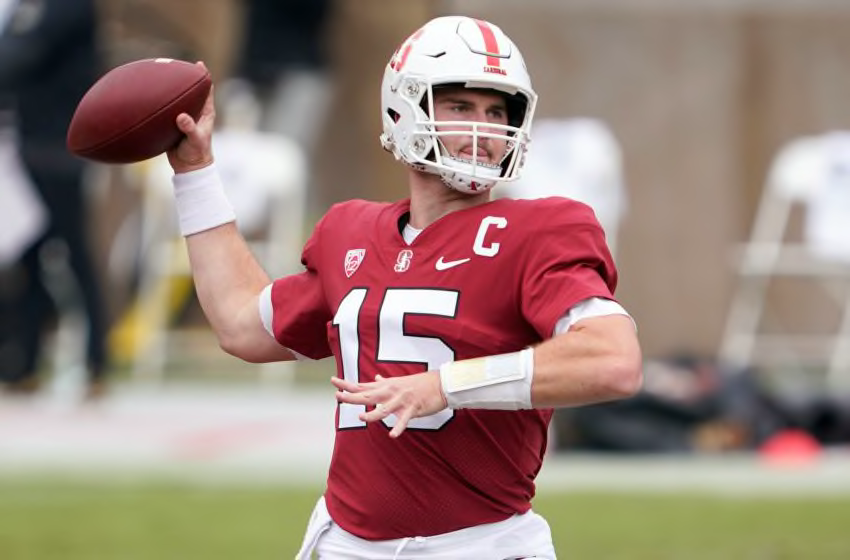
STANFORD, CALIFORNIA – NOVEMBER 14: Davis Mills #15 of the Stanford Cardinal warms up prior to the start of an NCAA football game against the Colorado Buffaloes at Stanford Stadium on November 14, 2020 in Stanford, California. (Photo by Thearon W. Henderson/Getty Images)
The Chicago Bears quarterback situation is a daily hot topic. For as much derision that’s been thrown towards the Andy Dalton signing, he was an above-average starting quarterback for 8 seasons with three Pro Bowls to his name. Since Dalton is on the back nine of his career, he can be an excellent placeholder but it certainly sets the table for the Bears drafting a QB.
All the big names have been bandied about but the Bears will have to shoot into the Top 10 (if not Top 7) to get a crack at Wilson or Fields, both of which have their pros and cons due to either one season of work or lack of completion in the case of Fields. The only possible name that may fall even close to pick 20 is North Dakota’s, Trey Lance.
One player who has literally and figuratively flown under the radar but possesses much more pedigree is Stanford’s, Davis Mills. It seems highly unlikely for a former five-star recruit like Mills to have fallen through the cracks but due to a litany of knee injuries, that’s exactly what happened. In fact, he has just wrapped up his senior year and has only played in 11 games in his four seasons.
For those that follow rivals, does a five-star ranking guarantees a successful NFL career? Not in all cases but it provides some legitimacy. For every Hunter Johnson who transferred from Clemson and flamed out at Northwestern, there have been big hits.
Mills was the number one pocket QB in what ended up being quite the uninspiring class of QB’s, save for maybe former Georgia QB Jake Fromm, current Miami Dolphin Tua Tagovailoa, and buried way down on the rankings, the 18th overall QB prospect overall that year, Alabama’s Mac Jones.
Stanford is known to churn out Offensive linemen, tight ends, and the occasional running back (besides Christian McCaffrey). Since Andrew Luck, luminaries at the QB spot like KJ Costello and Kevin Hogan have gone unnoticed by NFL Scouts. Mills may be very different in this case. He has put up very good tape, making throws that fall in sync with his “pedigree”.
This isn’t a case of a four-star QB blooming in college, it just might be a talented guy with minimal reps. As well, his reps have considerably more value because Stanford plays in a pro-style offense instead of the very common one read spread offenses now ubiquitous throughout college and trickling into the pros.
Mills has been looked upon as a mid-round pick and with QB’s showing any semblance of ability being pushed up the draft board out of sheer demand, the Bears may get a great value. In this case, the Bears would be banking on past pedigree instead of the quantity of college production.
The Chicago Cubs have a little bit of a competition going on at second base right now. Some people probably think that Nico Hoerner went into the offseason with the job locked up but David Bote wants it too. It appears that Kris Bryant is going to be playing third and Joc Pederson is in left so that only leaves second for Bote. They have been trying to settle it during spring training and the decision isn’t really easy.
The Chicago Cubs have two really good options for the second base job but who will win it?
David Bote has been with the Cubs for a few years now. They have also used him in many different positions. He has had some big moments with his bat as well so there is no doubt that he provides value to the club. Whether he wins this starting job or not, he will still have a big impact on the Cubs roster in 2021.
Nico Hoerner has been seen as the future of the position for the Cubs. Hoerner was the 24th overall pick of the first round in the 2018 MLB Draft. Using a selection like that on him clearly tells you what you need to know about how the Cubs see him. His development has been one of their top priorities since the day they drafted him.
Hoerner’s bat is still coming along but his defense has been really good. Going into spring training, he was known for the glove while Bote was more known for the bat. Well, Nico’s bat has been tremendous. He is doing everything he can to win this job. He is slashing .355/.412/.613 so far with one home run, five runs batted in, and three stolen bases. That is very good production from a good eight (or nine) hitter in the National League if he can carry it into the regular season.
The thing making this hard for the Cubs is that David Bote is also having an incredible spring. He is slashing .344/.417/.781 with three home runs and eight RBIs. Both of them are doing everything that you want to see from a guy competing for one last starting role.
What is going to end up happening? Well, we don’t know yet. It is a safe bet to say that both of them are going to get their fair share of playing time in 2021. With the removal of the DH from the National League after trying it in 2020, you can expect whoever isn’t starting that day to come in and pinch-hit at times. Each of them would benefit from them adding that DH back before we get going. Hopefully, each of them is able to have a good year in whatever role they are assigned and help their team win games.
Bill Jean King was named a strategic advisor on gender equality for First Women’s Bank, the financial institution announced Wednesday. | Jeff Spicer/Getty Images
Tennis legend and fierce women’s rights activist Billie Jean King joined a new team this week, becoming an investor and adviser for a new Chicago-based bank hoping to close the the gender gap in access to capital.
Tennis legend and fierce women’s rights activist Billie Jean King joined a new team this week, becoming an investor and adviser for a new Chicago-based bank hoping to close the the gender gap in access to capital.
King was named a strategic adviser on gender equality for First Women’s Bank, the financial institution announced Wednesday.
“A critical step toward achieving gender equality is creating economic parity and financial inclusion, which requires closing the racial and gender gaps in access to capital,” King said in a statement. “I look forward to joining First Women’s Bank as we work to bridge those gaps and empower women from all walks of life to reach their full potential.”
First Women’s Bank, which is set to launch this summer, is an innovative women-owned, led and focused online bank that aims to provide more financial resources to female business owners, who often get passed over for conventional business loans.
The bank’s market research found 16% of all conventional business loans go to women-owned businesses.
“We are thrilled and honored to welcome Billie Jean to First Women’s Bank,” the bank’s president and CEO Marianne Markowitz said in a statement. “She is a legendary sports icon, an accomplished business woman and a devoted advocate for equality. Billie Jean’s support both as an investor and adviser will help us fulfill our mission to grow the economy and advance the role of women within it.”







Leave a comment