
HAPPY EASTERon April 3, 2021 at 2:32 am
HAPPY EASTERon April 3, 2021 at 2:32 am Read More »
Authorities on Friday said police body camera and other videos that captured an officer’s shooting of a 13-year-old could be released “as soon as possible” — reversing a previous statement — although they did not say when the footage would be made available.
Initially, the Civilian Office of Police Accountability, which investigates all police shootings, said state law prohibited the release since the shooting early Monday morning in Little Village involved a minor, who has been identified as Adam Toledo. But it later said it was reviewing the law, after Mayor Lori Lightfoot, Police Supt. David Brown and others called for the release.
“COPA has determined that certain provisions of state law intended to protect the confidentiality of juvenile records do not prohibit the agency’s release of material related to its investigation of a Chicago Police Officer’s fatal shooting of 13-year old Adam Toledo,” the agency said in a statement Friday. “COPA’s General Counsel concluded that the Juvenile Court Act does not bar publication of the body worn and third-party video camera footage the agency has obtained to date.”
The statement said COPA will follow “established city policy, which requires public posting of material at the earliest point possible but no later than 60 days after the incident.” It said officials were working with the Toledo family to arrange a viewing of the “troubling video footage.”
COPA spokesman Ephraim Eaddy said the video will be made public soon.
“As soon as possible, we’ll be looking to release it,” he said.
The announcement came as police on Friday released more information in an attempt to explain why authorities took days to identify Adam and release details of the shooting.
The public didn’t learn Adam’s identity and age until Thursday, days after he was killed in what police called an “armed confrontation.” Even Adam’s mother Elizabeth didn’t learn he had been killed until Wednesday, when she was asked to go to the Cook County medical examiner’s office and identify him.
Police spokesman Don Terry said his family first reported Adam missing last Friday, days before the shooting. But on Saturday, in a follow-up interview, detectives were told he had returned home safely, Terry said. Police then removed Adam from a missing persons database.
His family did not report him missing again, Terry said.
At 1 p.m. Wednesday, two days after the shooting, detectives attempting to identify the body — which had no ID — found the inactive missing report and contacted his mom at 1 p.m., believing the body may be Adam, Terry said. Adam’s mom then told police that he had been missing for a second time, and was last seen by her over the weekend, police said.
At 3:30 p.m. Wednesday, detectives then asked Adam’s mom to come to the morgue and identify Adam, Terry said.
:no_upscale()/cdn.vox-cdn.com/uploads/chorus_asset/file/22414994/BOYKILLED_043021_3.jpg)
Elizabeth Toledo on Friday said she was still waiting for more answers after her conversation with police on Wednesday, and said she was still waiting to learn when she can see the video.
“I haven’t heard nothing from the police department. They haven’t reached out to me,” Elizabeth Toledo said. ” … I am kind of upset because I want to know what happened.”
Police initially said officers responded to reports of gunfire at 2:30 a.m. Monday and found Adam and a man in an alley to the west of the 2300 block of South Sawyer Avenue. An officer chased Adam, who police said was armed, and then shot him in the chest behind Farragut Career Academy High School. Police shared a photo of a gun allegedly recovered at the scene.
The other person who ran from police, 21-year-old Ruben Roman Jr. of Edgewater, was arrested and charged with resisting arrest, police said.
Toledo said she doesn’t know Roman Jr. and said her son had not previously been in trouble.
She said she was with her son all day Sunday and that he later spent time with his girlfriend, but that at some point that day her son left his girlfriend. The mother said his girlfriend also doesn’t know where Adam went in the hours before he was killed.
“We were both clueless,” Toledo said.
In a televised news conference Friday, Toledo asked why the officer opened fire if there was another way to apprehend Adam, who had four siblings.
“He was a little boy. Obviously he was going to get scared. Why did he [shoot] at him if they’re other ways?” she said.
Toledo has set up a GoFundMe page for memorial expenses.
“Another angel has gained his wings way too soon,” Toledo wrote on the page.
By 4 p.m. Friday, more than 1,200 donations totaling more than $35,000 had been pledged.
“I just wanted to thank everyone that donated and gave their support. I really appreciate that from the bottom of my heart,” she said. “On behalf of Adam Toledo, I’m very grateful for everyone helping me through this. It’s been so hard.”
Would-be bettors beware: For any Illinois sports fans who don’t feel like driving to a casino — and who have been hedging about signing up for an online sports betting account for the past nine months — now would be a good time to fire up the gambling apps.
For most of the COVID-19 pandemic, Gov. J.B. Pritzker has waived a provision of the state’s gambling law that requires bettors to sign up in person at a casino before they can lay wagers on the mobile apps that draw the vast majority of legal bets.
But that’ll end Sunday because it’s a precaution that’s “no longer needed,” according to the governor’s office — even as his public health team scrambles to stave off a third surge of the virus.
Analysts of the burgeoning industry are none too pleased, saying it “puts the brakes” on a rapidly growing Illinois market that has attracted almost $1.6 billion in wagers and generated almost $28 million in tax revenue since the state’s first legal bet was placed days before the coronavirus shutdown in March 2020.
With the state’s 10 casinos closed and a massive hole growing in the state budget, Pritzker issued an executive order in June giving Illinois’ 10 new sportsbooks the green light to let customers sign up for accounts from their phones.
The law that introduced legal sports betting to Illinois — signed by Pritzker in 2019 — had been written with the in-person registration requirement to give brick-and-mortar casinos a head start over online gambling giants such as FanDuel and DraftKings, which previously operated in the state under dubious legal circumstances.
But Pritzker’s pandemic order allowed the online sports betting industry — both the existing internet giants and the new casino sportsbooks — to leap to a lucrative Illinois launch once professional athletes started returning to the field last summer. More than 95% of the dollars bet so far in the state have been wagered online.
The governor extended his order in a series of updates to his ongoing statewide disaster proclamation due to the virus, but he left out the sports betting with the latest version that goes into effect this weekend. That means it’s back to in-person registration.
“Illinois is currently in phase four with vaccination rates rapidly increasing and casinos around the state have reopened with safety guidelines in place, so the suspension of in person sports betting registration requirements is no longer needed,” a spokeswoman for the governor said in an email Friday.
Illinois casinos are back open at half capacity, while the state’s rolling average infection rate has jumped by two-thirds over the past three weeks. Not even 18% of residents are fully immunized.
:no_upscale()/cdn.vox-cdn.com/uploads/chorus_asset/file/22417178/SPORTSBOOK_031020_22.jpg)
The in-person requirement could give an advantage to Chicago-area sportsbooks at Rivers Casino in Des Plaines and at Hawthorne Race Course, which also has two suburban off-track betting sites where sports bettors can register.
And it’s an immediate roadblock for the major online-only companies. Chicagoans will have to drive all the way to the Par-A-Dice Casino in East Peoria to register with FanDuel, or even farther to the Casino Queen in East St. Louis to register with DraftKings.
PlayUSA.com analyst Dustin Gouker called it a “poor choice” to bring back the requirement as statewide handles set new records each month.
“Reversing that now essentially puts the brakes on that growth, and will artificially suppress online gaming in Illinois for as long as it is in place,” Gouker said.
State Rep. Mike Zalewski, D-Riverside, who spearheaded the 2019 sports betting sports betting legislation, suggested lawmakers could take another look at the controversial provision.
“It’s important to remember that without the in-person registration requirement, sports betting would have never been legalized in 2019 as it was a pivotal aspect of an agreement among all the stakeholders,” Zalewski said in a text message. “That being said, the strong revenue numbers generated reflect that Illinois should have a robust online marketplace with no restrictions. I’m hopeful we can continue to modify the law and keep Illinois one of the most successful sports betting states in the country.”
Prospective online bettors have until 11:59 p.m. Saturday to sign up from home or anywhere else with internet or a cellphone signal. After that, they’ll need to go to a casino.
Pritzker closes book on mobile sports betting registrationon April 3, 2021 at 12:00 am Read More »
Drivers for ride-hailing companies Friday called on their employers for more protection following last month’s murder of an Uber driver in Lawndale.
The Independent Drivers Guild Chicago is asking Uber, Lyft and other ride-hailing business to require passengers to upload a photo of their drivers’ licenses, state IDs or passports to their account profiles.
They are also asking that passengers be mandated to upload a “selfie” before starting a trip and for the installation of a voice-activated panic button that would allow drivers to alert police if they are attacked.
“Uber can easily implement these common-sense measures,” said Kevin Nelson, who organized Friday’s demonstration at Uber’s Greenlight Hub, at 1401 W North Ave.
“As a driver, we’ve all had to submit our license, insurance, have background checks run on us, so they can’t say that the technology doesn’t exist to be able to do it…. They are failing and they are refusing.”
:no_upscale()/cdn.vox-cdn.com/uploads/chorus_asset/file/22417457/2Zinya_Salfiti_Chicago_Sun_Times.jpg)
Although riders are encouraged, they are not required to upload a photo to their accounts. So in most cases, drivers can only view the passenger’s name and rating before accepting a ride.
The drivers also said there has been a noticeable surge in prices and decrease of available drivers because of the coronavirus pandemic and increase in carjackings.
Ja’Mal Green, who joined the drivers Friday, said, “What we are asking for is sensible… to stop the corporate greed and understand that those who are helping you, who are helping to enrich you. They should get the real support that they need.”
Uber launched the “Safety ToolKit” emergency in-app in 2018 and recently added a 911 feature that sends location, license plate, and car model to a dispatcher, according to Uber. Lyft also has an emergency help feature that connects drivers with ADT Security Services.
:no_upscale()/cdn.vox-cdn.com/uploads/chorus_asset/file/22417469/Zinya_Salfiti_Chicago_Sun_Times.jpg)
Bryant Greening, co-founder of the LegalRideshare law firm, said for years drivers have been “harassed, battered, assaulted, murdered.”
“Everyday we have to tell them that we’re trying to make policy change, we’re trying to talk to legislators, we’re trying to talk to City Council,” Greening said. “They [ride-hailing companies] should be active in this process…cooperating with law makers…changing their apps… changing their policies….Enough is enough.”
Javier Ramos, a 46-year-old ride-hailing driver, was shot to death by a passenger who carjacked him late last month in the 3700 block of West Douglas Boulevard, police said.
Friday, Ramos’ cousin, Hortencia Ramos, said the family has yet to receive a phone call or condolences from Uber.
She said even a few words “to help a grieving father and family” and “to help us find the person or people who did this” would have been appreciated.
Ride-hailing drivers ask companies for more protectionon April 3, 2021 at 12:18 am Read More »
David Bote’s journey with the Cubs over the last four years has been a unique one. He burst onto the scene in 2018 after his walk-off grand slam against the Nationals and establishing himself as a Major Leaguer. Bote looked like he was on his way to getting shot sooner rather than later.
Despite his early success, the 27-year-old infielder hadn’t gotten an opportunity to play everyday, which is the goal of every big leaguer. While he settled nicely into his role coming off the Cubs’ bench, 2021 opened a new door.
Bote got a real opportunity to win the Cubs’ second-base job during spring training and not only did perform well during the camp, he won the job. While having the job after his journey is still setting in.
“If you tell nine-year old David, he’s probably freaking out,” Bote told the Sun-Times. “But as you go through this process, and start learning about yourself, you start pushing the boundaries of your capabilities and growing. I use this analogy of just being a river and just going. You continue to move, continue to grow. You go over boulders, you go under bridges, you make your path, every once in a while, you’re going to kind of go into a lake, and you pool up and overflow and keep moving into the sea. It’s kind of how I picture the journey and enjoying that process.
“All those cliches, for me, are not cliches. That’s real. One of the things I reflected on was that I got a long way to go. But also, look how far I’ve come. That’s kind of a moment thing. And then you move out of it and you go, ‘Alright, this moment, now. Let’s push it. Let’s keep pushing yourself, keep pushing your mind.’ That’s how I’ve approached it these last couple months.”
Winning the job is only half the battle, keeping the job is the other half of the equation. The Cubs have given Bote the keys to the job at second base, but they’ve also built depth at the position. Infielder Eric Sogard is currently the backup second baseman and Hoerner, who many believe is the future, is waiting in the wings at the team’s alternate site.
“It’s David Bote’s turn,” manager David Ross said. “I think David had been hearing the message for a long time that it’s someone else’s turn. So now David gets an opportunity.”
Knowing that players are waiting to take a job if you falter can affect a player’s psyche. Bote is self-admittedly more into the mental aspect of the game at this point in his four-year career with mental strength being one of the things that he feels helps reap success. Something that Cubs’ hitting coach Anthony Iapoce is also a big proponent of.
But even players who are locked-in mentally have to balance their results and on-field success, especially in a performance-based business like baseball, right?
“I’ve tried balancing it, and it doesn’t work [for me],” he said. “I have to go all-in [mentally] or nothing. I can’t control [numbers]. That’s a trap of pressing and getting caught up on results. I can’t control that. Today does not care about yesterday’s successes, and it does not care about yesterday’s failures. Today’s the only day that I can control. I can’t even control if I hit the ball hard or if he’s gonna throw me a strike or if it’s a hit or an out.
“So to try and balance that with this being a results-based business, I can’t. I can’t balance it. I’m going all-in on one way.”


Do you remember the person who resided in the White House from 2017 until January 20, 2021? Do you remember the words that constantly came out of his mouth beginning on November 4th? Voter Fraud! Voter Fraud! Voter Fraud! Over and over and over again.
It was a big lie and even though his supporters didn’t really believe it, they backed him and the lie up.
In response to the big lie, state legislatures run mostly by Republicans have made been trying to pass new laws that make it more difficult to vote. The laws have not so subtly been aimed at heavily populated African-American areas.
The one state that has received the most attention is Georgia. The lowlights of their new law include lesser days and hours for early voting, the state legislature taking over control of local election boards and penalties including imprisonment for bringing food and water to voters waiting in long lines.
All this was done not to make voting more secure, but to insure that Georgia Republicans do not lose more elections like the ones that flipped the Senate in January. The outrage was immediate.
We heard responses from Delta Airlines and Coca Cola, two of Georgia’s biggest companies. Next, on Friday afternoon, Major League Baseball announced that this year’s All-Star game, which was scheduled to be held in Atlanta would be moved because of the new voting law. Baseball commissioner Rob Manfred issued this statement:
“I have decided that the best way to demonstrate our values as a sport is by relocating this year’s All-Star Game and MLB draft. Major League Baseball fundamentally supports voting rights for all Americans and opposes restrictions to the ballot box. Fair access to voting continues to have our game’s unwavering support.”
Naturally the response from the Republican politicians was one of shock and disdain. You heard the word ‘woke’ multiple times.
It looks like the ones who really need to be awakened are the ones writing these laws. What did they really think was going to happen? Did they really think that these national major corporations would buy into their blatant racism?
Just remember that all this started because of a big lie by someone whose ego would not let him accept an electoral defeat. That ego cost Georgia two Senate seats and now a baseball game. Also, remember that when he was elected we were told that elections have consequences. Well, laws that are racist and disenfranchise voters also have consequences. Those consequences started on Friday.
Type your email address in the box and click the “create subscription” button. My list is completely spam free, and you can opt out at any time.
Filed under:
Uncategorized
Meet The Blogger

My so called friends think it’s time to edit this section. After four years, they may be right, but don’t tell them that. I’ll deny it until they die!
I can’t believe I’ve been writing this blog for four years.
It started as a health/wellness thing and over the years has morphed to include so many things that I don’t know how to describe it anymore.
I really thought this was going to be the final year of the blog but then Donald Trump came along. It looks like we’re good for four more years..God help us all!
Oh yeah…the biographical stuff. I’m not 60 anymore. The rest you can read about in the blog.
Completely spam free, opt out any time.
Tags
Categories
Latest on ChicagoNow
Posts from related blogs

Most recent post: Should You Monitor Your Saturated Fat Intake?

Most recent post: CHOOSE PROGRESS

Most recent post: When Is It Time To Replace Hearing Aids?
More from Lifestyle: Wellness
Read these ChicagoNow blogs


Read these ChicagoNow Bloggers


Like elections, racist laws have consequenceson April 3, 2021 at 12:48 am Read More »

The decision is in response to Georgia lawmakers enacting new voting-rights restrictions.
NEW YORK — Atlanta lost Major League Baseball’s summer All-Star Game on Friday over the league’s objections to sweeping changes to Georgia voting laws that critics — including the CEOs of Atlanta-based Delta Air Lines and Coca-Cola — have condemned as being too restrictive.
The decision to pull the July 13 game from Atlanta’s Truist Park amounts to the first economic backlash against Georgia for the voting law that Republican Gov. Brian Kemp quickly signed into law March 25.
Kemp has insisted the law’s critics have mischaracterized what it does, yet GOP lawmakers adopted the changes largely in response to false claims of fraud in the 2020 elections by former President Donald Trump and his supporters. The law includes new restrictions on voting by mail and greater legislative control over how elections are run.
MLB Commissioner Rob Manfred made the decision to move the All-Star events and the amateur draft from Atlanta after discussions with the Major League Baseball Players Association, individual players and the Players Alliance, an organization of Black players formed after the death of George Floyd last year, the commissioner said in a statement. A new ballpark for the events wasn’t immediately revealed.
“I have decided that the best way to demonstrate our values as a sport is by relocating this year’s All-Star Game and MLB draft,” Manfred said. “Major League Baseball fundamentally supports voting rights for all Americans and opposes restrictions to the ballot box.”
Kemp called it a “knee-jerk decision” that means “cancel culture and woke political activists are coming for every aspect of your life, sports included.”
Georgia state House Speaker David Ralston, a powerful Republican who backed the voting law changes, said the baseball league’s decision “robs Georgians of a special celebration of our national pastime free of politics.” Like other Republicans in the state, he vowed to stand behind the new law.
The new Georgia law adds strict identification requirements for voting absentee by mail, limits the use of ballot drop boxes and makes it a crime to hand out food or water to voters waiting in line, among many other provisions. Georgia Republicans say changes were needed to maintain voter confidence in the election system.
Democrats and voting rights groups say the law will disproportionately affect communities of color. On Wednesday, two of Georgia’s most prominent business leaders sided with the law’s opponents.
Delta CEO Ed Bastian labeled the law “unacceptable,” while Coca-Cola chief executive James Quincey called the legislation a “step backward.”
After MLB pulled the All-Star Game out of Atlanta on Friday, the Atlanta Braves issued a statement saying the team was disappointed.
“This was neither our decision, nor our recommendation and we are saddened that fans will not be able to see this event in our city,” the team said. “The Braves organization will continue to stress the importance of equal voting opportunities and we had hoped our city could use this event as a platform to enhance the discussion.”
Meanwhile, Stacey Abrams, who has championed voting rights since her narrow election loss to Kemp in 2018, blasted the new law. The Democrat is being closely watched to see if she seeks a rematch against Kemp in 2022.
“Georgia Republicans must renounce the terrible damage they have caused to our voting system and the harm they have inflicted on our economy,” Abrams said. “Our corporate community must get off the sidelines as full partners in this fight.”
Atlanta Mayor Keisha Lance Bottoms, a Democrat, said she supports the MLB’s decision. Atlanta will no doubt share in the economic loss, though the Braves’ home stadium is now located outside the city, in suburban Cobb County.
“Unfortunately, the removal of the MLB All-Star Game from Georgia is likely the first of many dominoes to fall until the unnecessary barriers put in place to restrict access to the ballot box are removed,” Bottoms said in a statement.
The relocation of high-profile sports events from cities in response to social issues has a long history in the U.S.
The NFL originally awarded the 1993 Super Bowl to Sun Devil Stadium in Tempe, Arizona, but decided in March 1991 to move it to Pasadena, California, after the state failed to make Martin Luther King Jr. Day an official holiday. Arizona became the last state to adopt an MLK Holiday when voters approved it in November 1992.
The NBA first scheduled its 2017 All-Star Game at the Spectrum Center in Charlotte, North Carolina, then shifted it in July 2016 because of its objections to a North Carolina law that limited anti-discrimination protections for LGBTQ people. The law was partially repealed in 2017, and the 2019 All-Star Game was held in Charlotte.
The NCAA executive committee decided in 2001 to ban awarding championship sites in advance to states that displayed the Confederate flag but did not alter events whose sites were determined by seeding or ranking. That was expanded last June by the renamed body, the Board of Governors, to prevent any NCAA championship event from being played where the flag had a prominent presence. Mississippi Gov. Tate Reeves signed a law less than two weeks later to retire the flag.
This year’s All-Star Game will include honoring Hank Aaron, the Braves’ Hall of Famer and former career home run champion who died on Jan. 22 at age 86.
“We will continue with our plans to celebrate the memory of Hank Aaron during this season’s All-Star festivities,” Manfred said. “In addition, MLB’s planned investments to support local communities in Atlanta as part of our All-Star legacy projects will move forward.”
MLB canceled last year’s All-Star Game, which had been scheduled for Dodger Stadium in Los Angeles, due to the late and shortened season caused by the coronavirus pandemic. The 2022 game will be played at Dodger Stadium.
The 1972 All-Star Game was played at Atlanta-Fulton County Stadium, and the 2000 All-Star Game was at Atlanta’s Turner Field.

The bell tolls for three nights of Ken Burns and Lynn Novick’s definitive biography of the literary lion from Oak Park. It airs Monday-Wednesday on WTTW-Channel 11.
The one-paragraph bio of Ernest Hemingway boils down to:
Great writer. War wounds. Toxic masculinity. Nobel Prize. Hunter. Fisher. Boxer. Four wives. Punchy sentences. Alcoholic. Macho persona. Plane crashes. Barroom storyteller. Suicide.
Leave it to the legendarily thorough and consistently brilliant Ken Burns and Lynn Novick to go far beyond the easy (albeit accurate) clichés and deliver the definitive biography of arguably the most famous and accomplished and celebrated writer of the 20th century in the three-part, six-hour documentary series “Hemingway” on PBS Monday through Wednesday.
This is a must-watch experience for devotees who have devoured such classics as “A Farewell to Arms,” “For Whom the Bell Tolls” and “The Sun Also Rises,” and it’s essential viewing for those only passingly familiar with Hemingway as a pop culture figure who might be motivated to sample his works after watching the series.
(Dear friend: If you haven’t read the aforementioned works, please do. I can’t imagine you’ll be disappointed. Whereas some writers’ work doesn’t age gracefully with the passing of the decades, Hemingway’s unique prose continues to burst from the pages.)
Episode One, titled “A Writer,” covers the first 30 years of Hemingway’s life, including his childhood in Oak Park and his work as a cub reporter at the Kansas City Star, with its style guide that Hemingway said was a lifetime influence on his writing. (We get a great screenshot of The Star’s style guide, which begins: “Use short sentences. Use short first paragraphs. Use vigorous English. Be positive, not negative,” and continues with, “Watch your sequence of tenses.”)
We follow Hemingway (through a treasure trove of still photographs and eventually some grainy but engrossing film footage) as he signs up to be an ambulance driver in Italy in World War I and sustains serious injuries from mortar fire.
On his return home, Hemingway took to wearing his uniform around Oak Park and Chicago and embellishing the stories of his wartime experience — a habit he continued throughout his life.
/cdn.vox-cdn.com/uploads/chorus_asset/file/22414938/S0374.jpg)
Longtime Burns-doc narrator Peter Coyote once again contributes his soothing and familiar voice, and Jeff Daniels does a beautifully nuanced job of reading Hemingway’s prose and letters. Daniels doesn’t sound anything like the real Hemingway, as heard on old audio and TV interview recordings, and that’s just fine. He reads Hemingway’s words in an understated, conversational tone that makes us feel as if we’re sitting across the big man in a Key West bar.
Keri Russell voices Hemingway’s first wife, Hadley Richardson, with Patricia Clarkson later joining the proceedings as Pauline Pfeiffer, wife No. 2.
Meryl Streep is Hemingway’s third wife, Martha Gellhorn, and Mary-Louise Parker is wife No. 4, Mary Welsh.
These fine actors, while never seen, are invaluable contributors. Their voices are familiar, but they disappear into the remarkable real-life characters they’re portraying.
/cdn.vox-cdn.com/uploads/chorus_asset/file/22414954/S0087.jpg)
Episode Two, “The Avatar,” explores the period from 1929 to 1944, as Hemingway becomes the most famous and successful author in America and takes up residence in a spacious manor in Key West, Florida. (His second wife Pauline came from money, and her uncle paid for the house as well as Hemingway’s beloved fishing boat.)
There are fantastic visuals of the movie star-handsome, burly Papa landing big fish and drinking big drinks and doting on his young children — and reveling in his fame and his ever-expanding macho image, as his tall tales grew taller.
Says Michael Katakis, a writer and the manager of Hemingway’s estate: “He made the mistake that all myth-makers do — he thought that he could control it — and there comes a time that you can’t anymore. It’s taken on a life of its own. It became very exhausting to be Hemingway.”
Katakis is just one of many interview subjects who offer thoughtful insights. We also hear from Hemingway biographer Mary Dearborn, the Cuban writer and journalist Leonardo Padura, the Irish writer Edna O’Brien and Hemingway’s son Jack, among others.
In one of Sen. John McCain’s final interviews, he speaks of how Robert Jordan, the protagonist of “For Whom the Bell Tolls,” was a great inspiration. “Robert Jordan is as real to me as you are,” McCain says. “I always wanted to be Robert Jordan.”
Episode Three, “The Blank Page,” chronicles Hemingway’s final two decades, in which he suffered a series of physical injuries, drank ever more heavily and battled depression so severe he checked into the Mayo Clinic for treatment more than once. (Publicly, it was said Hemingway was being treated for high blood pressure.)
We also hear surprising revelations about Hemingway’s interest in androgyny — he and his fourth wife Mary Welsh would role-play and switch gender identities behind closed doors — and learn of his increasingly paranoid and delusional fantasies.
By the time Hemingway took his own life in 1961, as his father had before him some 33 years prior, those closest to him were devastated but not surprised. It had been a long time coming.
Hemingway was obsessed with death but also with his legacy and whether his works would live on through the decades. On that count, he had nothing to worry about.

Nagy, hired in 2018 to mold the second-year quarterback, was asked what went wrong the last three seasons.
Those waiting for Ryan Pace to cap Mitch Trubisky’s Bears career with a long-awaited public mea culpa were left to thumb through their Latin dictionary for, well, whatever the opposite of that is.
Head coach Matt Nagy, though, acknowledged the Bears — and not just Trubisky — dropped the ball. It wasn’t a mea culpa, but a we-a culpa — as in, we didn’t do enough.
“When you look back at the relationship side, the communication side,” Nagy said Friday. “You always want to go back and say, ‘OK, could I have done more in a certain way of communicating? Maybe a different way of how you learn who he is …
“I’m always gonna start with myself and say, ‘OK, where could I have gotten better?’ I just feel like some of it there, is, me being able to … As I built this staff and we have different parts to the coaching staff and how they deal with the quarterback position — the coaching side, the on-the-field, the game-day, etc — I just feel like in general, that’s probably where I would have started.
“I learned through it. And I’m sure Mitch did, too. Again, there’s a lot of other teams that have been in similar situations throughout the years.”
Few teams have to carry the baggage, though, of trading four picks to move up spot and draft Trubisky instead of Patrick Mahomes or Deshaun Watson. A split was probably best, both for the Bears and for the player with the outsized expectations.
The Bears never doubted Trubisky’s effort or attitude. But Trubisky’s landing place — as a Bills backup, for one year and $2.5 million — reflects how far he’d fallen in the eyes of the league.
Nailing a first-round pick at quarterback opens championship windows. Nagy acknowledged the tremendous financial advantage of being able to pay a rookie scale for the most expensive position in the sport: teams can spend at other spots.
The 2019 Chiefs won the Super Bowl with Mahomes on a rookie deal; the 2018 Rams went to the Super Bowl with Jared Goff on his first contract. Russell Wilson — trigger warning, Bears fans — won a Super Bowl and lost another before signing his first contract extension.
“The quarterback position has changed in this league in the last five to six years,” Nagy said. “And right now, there’s just so much instant gratification that’s wanted and needed. People want it right away, especially, too, when you can hit on a quarterback that’s cheap in their first four years.”
Nagy, hired in 2018 to mold the second-year quarterback, was asked what went wrong the last three seasons.
“You come here, different things happen,” he said. “But the kid worked so hard. He won a lot of football games for us. And when I say I’m indebted to him, there’s so many different conversations — and good conversations — that we had and things we worked through throughout those three years.
“For different reasons, it didn’t work out. But I certainly appreciate the way that he handled everything. And I’m sure he’s learned a lot. I know I’ve learned a lot.”
Pace, meanwhile, said merely that Trubisky “battled” and “sacrificed a lot for this team.” As for why the Bears didn’t bring him back, the general manager said “there’s a lot of factors and multiple people involved.” When asked why new starter Andy Dalton fit the scheme better than Trubisky did, Pace said he wanted to look forward.
He doesn’t get to dictate when the Trubisky discussions stop, through. And they won’t stop simply because he’s in Western New York — or because there’s finally finality to his Bears career.
“It’s hard to go through these processes,” Nagy said. “I care so much about him.
“It didn’t work out here.”
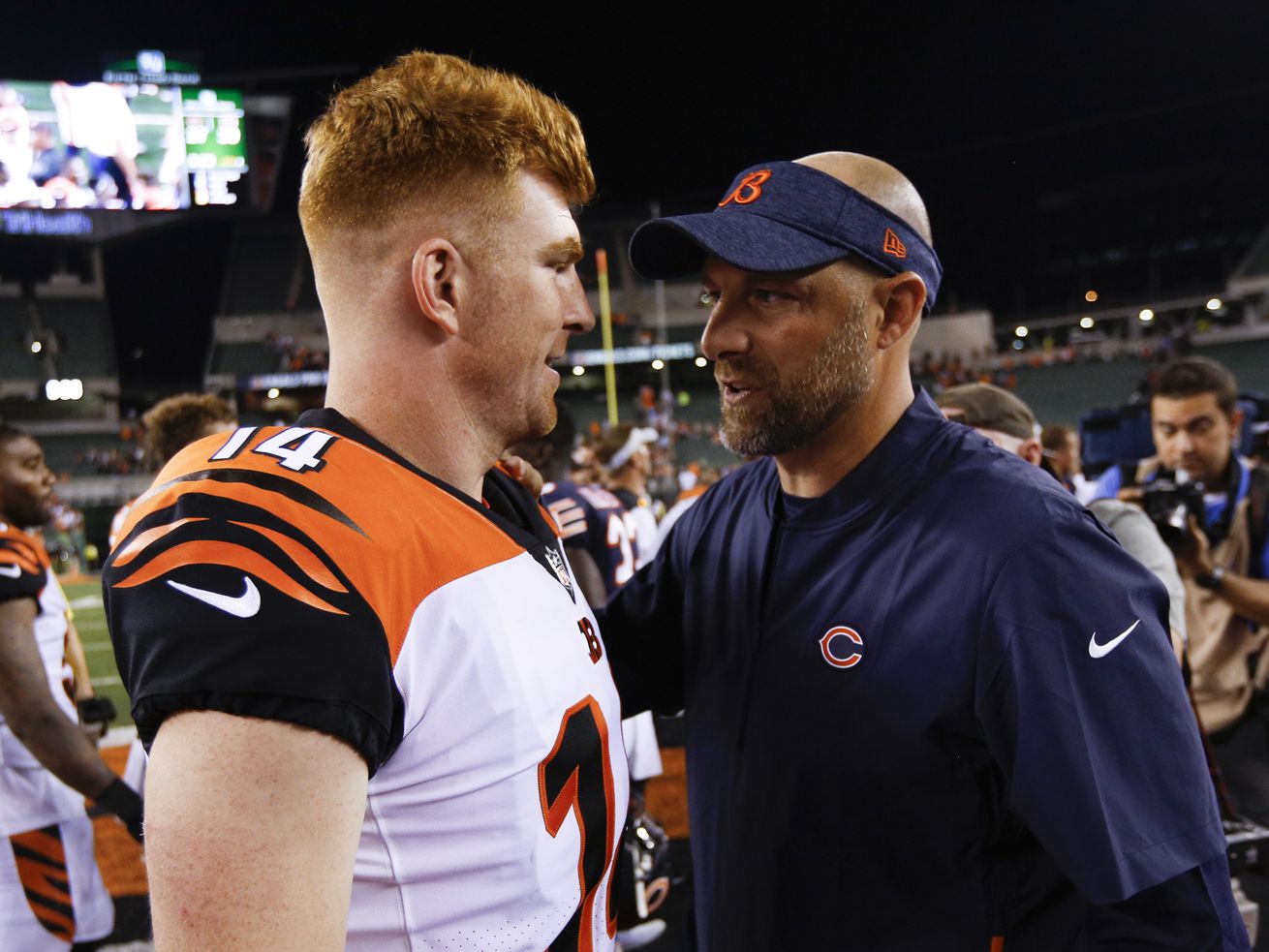
Other than Andy Dalton at quarterback, the Bears don’t look much different than the team that went 8-8 last season. And Dalton’s last few seasons call into question whether he’s an upgrade over Mitch Trubisky.
There are still spare parts to scoop up in free agency and the Bears have three valuable draft picks at the end of the month, but the bulk of their offseason renovations are done. And in the end, it’s very difficult to make the case that they’ve positioned themselves to jump from backsliding into the playoffs at 8-8 to being a legitimate contender.
That argument is so beyond believability, in fact, that general manager Ryan Pace isn’t trying to sell it. Instead, he’s out to explain the limitations that led to a lackluster offseason highlighted by the signing of Andy Dalton — a quarterback who would be a backup on almost any other team.
“We challenged ourselves in free agency, really with limited space, to get better, and I thought our pro scouts and our coaches did a really good job adding valuable pieces,” Pace said Friday. “Were we big spenders in free agency? No. But I thought we addressed a lot of needs.”
He started by mentioning that he re-signed kicker Cairo Santos, offensive lineman Germain Ifedi (likely a backup if they land an instant starter in the draft) and backup defensive lineman Mario Edwards. The Bears also kept wide receiver Allen Robinson by using the franchise tag against his wishes.
From there, he listed his offseason treasures: Angelo Blackson, Jeremiah Attaochu, Desmond Trufant, Christian Jones, Elijah Wilkinson, Damien Williams.
Which of those names excites you? How many had you even heard before?
The name that would’ve made a difference is Russell Wilson. He would’ve fast-tracked the Bears to Super Bowl contention. Without him, even Pace seems to accept that expectations for next season need to be recalibrated.
He is banking on meaningful improvement from young players like tight end Cole Kmet, wide receiver Darnell Mooney and running back David Montgomery. While it’s reasonable to expect those players to develop, none are surefire stars.
In reality, everything seems to be riding on one offseason move: Dalton. And there’s justifiable debate over how much better he is than Mitch Trubisky, if at all. The Bears seem certain he’s more than a micro-upgrade despite his 86.5 passer rating over the last five seasons.
At 33, Dalton’s high end is to be serviceable. That might be enough for the Bears to be decent and sneak into the playoffs again, and chairman George McCaskey will have to decide whether he accepts that as sufficient progress to keep Pace and let him oversee what is — if they’re even on the right course to begin with — a multi-year timeline for the team to be legitimately relevant.
That idea can’t sit well with anyone who has watched the Bears meander to 42-54 and no playoff wins under Pace’s watch the last six seasons.
Keep in mind that Pace is referring to two things when he talks about the obstacles the Bears faced this offseason. The first is the drastically reduced salary cap that affected every team in the NFL, not just his. The second is that the Bears would’ve been tight on space anyway because several of his ill-fated decisions.
Big misses on Trubisky and Nick Foles at quarterback have proven expensive. Outside linebacker Robert Quinn, who had two sacks in 548 snaps last season, has the second-biggest salary-cap hit on the team next season. Mistakes at tight end and on the offensive line were costly, too.
And next thing you know, Kyle Fuller, one of the top cornerbacks in the NFL, is out the door. The Bears can’t afford him on their ledger, but they also probably can’t afford to go without him on the field. Expect a thank-you card from Aaron Rodgers.
If the Bears are better than they were when they trudged out of the Superdome three months ago, that improvement could be measured in millimeters. And that leaves a long way to go.
