Videos

Lightfoot vows to hunt down adult she says put gun in Adam Toledo’s handFran Spielmanon April 6, 2021 at 2:31 am

Mayor Lori Lightfoot speaks to reporters on Monday, April 5, 2021 during a press conference with updates to the Adam Toledo shooting at New Life Church in Little Village.
Mayor Lori Lightfoot speaks to reporters about the fatal shooting of Adam Toledo by Chicago police. Lightfoot and other Chicago officials appeared at a news conference Monday at New Life Church in Little Village, where Adam was shot last week. | Tyler LaRiviere/Sun-Times

“An adult put a gun in a child’s hand. A young and impressionable child,” Mayor Lori Lightfoot said a news conference Monday. “This happens way too often in our city. And it’s way past time for us to say, ‘No more.’”

Mayor Lori Lightfoot vowed Monday to hunt down and hold accountable adults responsible for “putting a gun into the hands” of a 13-year-old shot and killed by Chicago police last week.

In promising to hold adults accountable for the circumstances surrounding Adam Toledo’s death, Lightfoot went further than the Chicago Police Department has been willing to go.

The department has said only that a gun was found near Toledo’s body. Neither police nor the Civilian Office of Police Accountability, which is investigating the shooting, has said Toledo was holding the gun or aiming it at police when he was chased, shot and killed.

“Let’s be clear. An adult put a gun in a child’s hand. A young and impressionable child. And one who should not have been provided with lethal force. A weapon that could and did irreparably change the course of his life,” the mayor said.

“This happens way too often in our city. And it’s way past time for us to say, ‘No more.’ I have directed the superintendent and the chief of detectives to use every resource to track down the origins of this gun — through tracing, fingerprinting and DNA and any other means — and to find the person responsible for giving it to Adam. I want to bring that person or persons responsible for putting that gun in Adam’s hands to justice.”

Elizabeth Toledo and son Adam are pictured in this family photo.
Provided
Family photo of Elizabeth Toledo and her son Adam.

Lightfoot did not accuse Chicago street gangs of putting the gun in Adam Toledo’s hands. But she came close.

“Gangs are preying on our most vulnerable, corrupting these young minds with promises of familia and lucre. Like good shepherds, we have to better tend to our flocks to keep the wolves at bay. And when the wolves dare try to take one of ours, we must hit them hard with the staff of a community united against the evils that threaten our youth,” the mayor said.

Lightfoot urged the news media to give Elizabeth Toledo, Adam’s mother, the “respect and space” she needs to grieve the loss of her son and make sense of what happened.

Having lost her own brother “to the streets,” Lightfoot said the Toledo family “needs our support … not our withering judgment.”

“Let us not forget that a mother’s child is dead. … None of us have walked in Ms. Toledo’s shoes and none of us will,” the mayor said.

“This is a complicated story. But it is not my story to tell.”

Ald. George Cardenas (12th) promptly ignored that admonition.

Cardenas said his community is “torn,” asking, “How is it possible that this 13-year-old is in an alley at 2:30 in the morning” when he should have been at home sleeping.

“There’s no passing judgment on this family, on this mom. I can only imagine what she went through. Maybe she didn’t have the tools and the resources,” Cardenas said.

“Maybe the school probably knew something about this young man — or the teachers, or the counselor. Somebody in the neighborhood knew something that this young man was going through, but couldn’t say anything,” he added.

“This young man had nobody. It’s sad to say. Nobody that could help him, except a gang. So, shame on us. I own that,” the alderman said.

The Civilian Office of Police Accountability has said police video from the scene of the shooting will be released as soon as possible, but only after the Toledo family had the opportunity to see it first. COPA said officials were working with the Toledo family to arrange a viewing of the “troubling video footage.”

However, the Toledo family, in a statement released Monday by attorneys, said it had not received confirmation of a time to view the video.

Also on Monday, Lightfoot said she has directed CPD Supt. David Brown to draft and implement a new foot pursuit policy in time for the traditional summer surge of violence, a move that drew praise from the American Civil Liberties Union of Illinois.

Noting that Adam Toledo was shot and killed during a foot pursuit, the mayor said such chases present a “significant safety issue” — for police, those pursued and for innocent bystanders.

“It is one of the most dangerous things that they engage in. They often get separated from their partners. Communication is difficult. You’re running through a dense, urban environment. An alley, a street, a backyard,” Lightfoot said. “It’s way past time that we reckon with this reality that happens literally multiple times every day across many neighborhoods in our city, hundreds of times a year.”

Ald. George Cardenas (12th) speaks to reporters at New Life Church in Little Village on Monday, April 5, 2021 about the shooting of Adam Toledo by Chicago police.
Tyler LaRiviere/Sun-Times
Ald. George Cardenas (12th) speaks to reporters at New Life Church in Little Village on Monday about the shooting of Adam Toledo by Chicago police.

The city, in fact, has been reforming the foot-chase procedures since the Department of Justice in 2017 issued a damning report about “poor police practices” in Chicago, including “tactically unsound foot pursuits.”

The report said such pursuits sometimes ended in police shooting people they were chasing just because they ran away — not because they were suspected of a serious crime. Adrenaline and fatigue were listed as factors in cops shooting people in foot chases, the report said.

That Justice Department report led to a court-ordered consent decree requiring hundreds of reforms to police practices, including foot chases. The latest report from an independent monitor said the police were close to complying with those requirements for foot chases, including better training and tracking foot pursuits that end in the use of force.

Between March 2020 and the end of the year, there were more than 1,300 such pursuits, 382 of which involved the use of force by a police officer, the monitor’s report said. The ACLU said the city and police department have “resisted repeated calls” from criminal-justice advocates to reform the way it does foot pursuits, saying it is “long overdue.”

Also Monday, Brown was asked about an “officer safety alert” warning officers that the narcotics unit has learned that some Latin Kings were “instructed by ranking members to shoot at unmarked police vehicles.”

The alert, sent out Thursday, said factions of the gang planned to retaliate following the fatal shooting of Adam Toledo at about 2 a.m. March 29 in an alley in the 2400 block of South Sawyer.

The approximate location where Chicago police killed 13-year-old Adam Toledo, in an alley near 24th Street and South Sawyer Avenue.
Tyler LaRiviere / Sun-Times
The approximate location where Chicago police killed 13-year-old Adam Toledo, in an alley near 24th Street and South Sawyer Avenue.

“We’re in agreement with the Toledo family in calling for peace. That they would not be representing Adam’s death in the most appropriate way if anyone is calling for violence,” Brown said.

“I want to answer that question specifically by holding up the family’s concern that no one retaliate, no one metes out any type of violence.”

Lightfoot was asked how concerned she is about the threat to police officers’ safety. She pointed to the “unprecedented number” of 79 officers shot at last year. She can’t remember it being that high in the last 20 years.

“My hope is that these gang members aren’t foolish enough to do something. But I am determined. We will find the person who put this gun in Adam’s hand. We will not be deterred by threats from gang members,” she said.

“An adult must be [held] responsible for putting a gun in a child’s hand. We have an obligation to his family, to this community and all over our city to say to gang members and others, ‘We will not tolerate you using our children as pawns and setting them up for a life of misery.’ That’s what’s happening in way too many communities. And here’s where we must, must draw the line.”

Protesters gathered Monday, April 5, 2021 outside New Life Church in Little Village, where Mayor Lori Lightfoot and CPD Supt. David Brown held a news conference to discuss the fatal shooting of Adam Toledo.
Protesters gathered Monday outside New Life Church in Little Village, where Mayor Lori Lightfoot and CPD Supt. David Brown held a news conference to discuss the fatal shooting of Adam Toledo.

Read More

Lightfoot vows to hunt down adult she says put gun in Adam Toledo’s handFran Spielmanon April 6, 2021 at 2:31 am Read More »

Adam Toledo remembered as kid with ‘big imagination’ and an affinity for shows about zombiesMitch Dudekon April 6, 2021 at 2:35 am

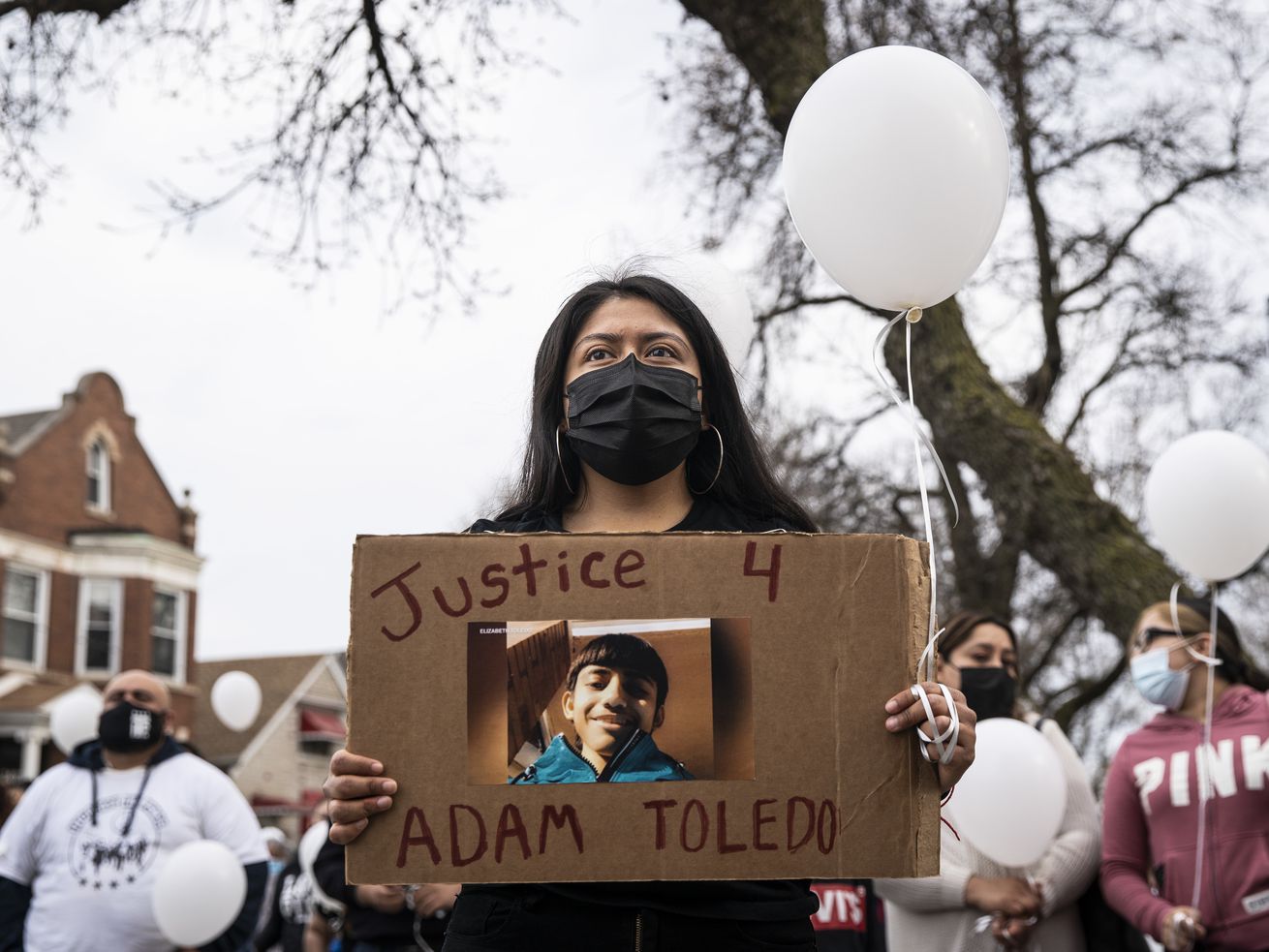
Ana Solano, 26, of Little Village, joins dozens Monday afternoon at a vigil for 13-year-old Adam Toledo near the location of the shooting at West 24th Street and South Sawyer Avenue in Little Village.
Ana Solano, 26, of Little Village, joins dozens Monday afternoon at a vigil for 13-year-old Adam Toledo near the location of the shooting at West 24th Street and South Sawyer Avenue in Little Village. | Ashlee Rezin Garcia/Sun-Times

The teen loved Zombie flicks so much that he even had a bag packed and ready to go in case the zombie apocalypse arrived.

Adam Toledo’s mother did not attend a vigil for her 13-year-old son Monday evening because she didn’t feel up to it, but she sent a statement that was read to about 150 people holding white balloons.

“He had a big imagination and curiosity since he was a little baby. He was goofy and always cracking jokes, making everyone laugh. He loved animals and riding his bike,” Elizabeth Toledo said in the statement.

“Adam was really into zombies. And the zombie apocalypse. He even had this zombie apocalypse bag packed and ready to go. Some of his favorite movies and TV shows were “Cloudy with a Chance of Meatballs,” “Ghostbusters,” “SpongeBob SquarePants,” “Toy Story,” “Cars,” “The Walking Dead,” she said.

His palate favored Taco Bell, pizza, chicken wings, chips and candy, she said.

“May he rest in peace,” she said.

The statement was read by Jacqueline Herrera, who serves as violence prevention director of the Little Village based community organization Enlace Chicago. Hundreds of white balloons were released moments later.

Toledo was shot by a Chicago police at about 2 a.m. March 29 in an alley in the 2400 block of South Sawyer Avenue in what police described as an “armed confrontation.”

Ald. George Cardenas (12th) said of Toledo: “This young man had nobody. It’s sad to say. Nobody that could help him, except a gang. So, shame on us. I own that,” the alderman said.

Through a separate statement released Monday through an attorney, the Toledo family, in an apparent refutation of Cardenas’ comments, said they wanted to “correct the hurtful and false mischaracterization of Adam as a lonely child of the street who had no one to turn to.”

The statement continued: “This is simply not true. Adam was a loved and supported 13-year-old boy. He lived with his mother, his 90-year-old grandfather and two siblings. His father was in his life. They all loved him very much. The Toledo family is a close-knit family. They look after each other. Adam attended Gary Elementary School where he had the support of his teachers and his classmates. Adam was not alone.”

On Monday, Mayor Lori Lightfoot compared gang members who prey on the city’s youth to wolves.

“Like good shepherds, we have to better tend to our flocks to keep the wolves at bay,” she said.

Micaela Cruz, 35, attended the vigil Monday and said that gangs are a sad reality in Little Village that some kids can’t escape because they don’t know anything else.

“They need therapy, this to them is life,” said Cruz, who works as an Uber driver. “It’s messed up,” she said.

Matt DeMateo, pastor at New Life Community Church, organized the vigil along with Enlace Chicago.

“We cry out for justice for Adam, his life was taken too early,” DeMateo said.

Read More

Adam Toledo remembered as kid with ‘big imagination’ and an affinity for shows about zombiesMitch Dudekon April 6, 2021 at 2:35 am Read More »

2 hurt in Geneva fireSun-Times Wireon April 6, 2021 at 2:41 am

A fire erupted at a home April 4, 2021, in Geneva.
A fire erupted at a home April 4, 2021, in Geneva. | Adobe Stock Photo

The house was deemed uninhabitable after the blaze.

Two people were injured after a fire broke out at a home Sunday in west suburban Geneva.

Crews responded about 11:17 p.m. to a home which had been divided into two apartments in the 100 block of Woodlawn Street after tenants found smoke coming from a unit on the first-floor, Geneva fire officials said.

Firefighters located the blaze in the bathroom of the apartment, and brought the fire under control about 10 minutes after arriving, officials said.

A woman was taken to Northwestern Medicine Delnor Hospital after suffering a minor burn injury while trying to put the fire out with an extinguisher, officials said. A man was treated at the scene for smoke inhalation.

The four other tenants managed to escape their apartments without injuries, officials said.

The bathroom where the fire started was destroyed, and both apartments sustained minor water and smoke damage, officials said. The house was deemed uninhabitable at this time.

According to preliminary information, the cause of the fire was determined to be electrical, fire officials said.

Read More

2 hurt in Geneva fireSun-Times Wireon April 6, 2021 at 2:41 am Read More »

Redeveloping White Sox parking lots could be home run for Chicagoon April 6, 2021 at 12:59 am

We’ve yet to be convinced of Chicago’s need for One Central, the $20 billion development proposed for the space atop the Metra railyards west of Soldier Field.

Does the city really desire yet another developer-driven megaproject within the shadow of downtown, let alone one that would come with a $6.5 billion transit hub — billed somehow as boon to the South Side — paid for by state taxpayers?

While Landmark Development President Bill Dunn continues to make his argument for One Central, we think there’s a prime and largely overlooked spot for another big, stadium-side residential development project that could take advantage of its proximity to rail and transit.

And if done right, this redeveloped site could truly be a boon to the South Side: The 70 acres of state-owned surface parking surrounding Guaranteed Rate Field.

From parking lots to a neighborhood

The White Sox got a famously sweet deal back in 1987 when city and state officials agreed to build the team a new, tax-supported, $140 million stadium — and to demolish beloved old Comiskey Park — in a bid to keep the baseball franchise from relocating to Florida. The Illinois Sports Facilities Authority was created 33 years ago to build, own and maintain the stadium.

The new Sox stadium opened with at least two strikes against it: It was harsh and severe-looking — a ball of concrete at a time when new major league baseball facilities were being built to look like the traditional ballparks of yesteryear –and surrounded by flat surface parking, rather than a neighborhood.

The stadium’s looks have been significantly improved since its 1991 opening. But it’s still marooned in a landscape of parking lots equal to three times the size of Millennium Park.

And that’s largely because the White Sox and team owner Jerry Reinsdorf, though only renters, have successfully chased away any talk of redeveloping the lots over the years, thanks to a contractual relationship with ISFA that gives the Sox owner-like sway over the stadium, the facility, its concessions and its parking lots.

But that time is over. Finding a way to finally turn all that asphalt and concrete into a walkable, transit-oriented neighborhood with some structured parking and that great baseball stadium at its core makes good sense.

For that matter, the same can be said of the surface parking around the United Center. It’s a cash cow for its owners but does nothing for Chicago’s West Side. It’s time for a change there also.

Located within a short walk of the CTA’s Red Line and Green Line and Metra’s 35th Street station — and an Amtrak corridor running along the parking lots’ western edge — the White Sox lots hold the promise of becoming an exciting addition the city’s tapestry of neighborhoods.

Architect Philip Bess called for this approach in his 1987 alternative plan for Comiskey. He was right and time has only confirmed it.

Such a project would be of real benefit to the South Side, more so than One Central, which would be closer to State and Madison than, say, 47th Street and King Drive.

The ISFA didn’t return our calls for comment, but we’re hoping the city/state agency is having serious discussions about the future of this land.

We also urge Gov. J.B. Pritzker and Mayor Lori Lightfoot to hurry up and fill the vacant position of ISFA chief executive officer, preferably with someone who can make quality redevelopment of the lots a priority.

A success at the ballpark would mean a potential and much-needed win for the South Side — and the city.

Send letters to [email protected].

Read More

Redeveloping White Sox parking lots could be home run for Chicagoon April 6, 2021 at 12:59 am Read More »

No limit? Republican Gary Rabine ups the ante in high-stakes governor’s raceon April 6, 2021 at 1:10 am

SPRINGFIELD — Four years after the Illinois race for governor broke national records for self-financing candidates, next year’s contest is shaping up to be another duel of the deep pockets.

Millionaire businessman Gary Rabine notified state election officials over the weekend that he had donated enough of his own cash to his newly minted gubernatorial campaign to lift all fundraising caps on the race.

The $250,390.04 the suburban Republican has kicked in pales in comparison to the $35 million that Democratic Gov. J.B. Pritzker pumped into his own war chest last month.

But under Illinois’ arcane campaign finance laws, Rabine’s contributions triggered the lifting of the caps, because they were made within a year of the 2022 primary. Pritzker’s fell just outside that window.

And while the trigger that Rabine tripped is designed to help other candidates in the race without personal fortunes, it also benefits Rabine, allowing him to accept contributions of any amount from other donors — and sending a signal of its own.

“On the one hand, now his poker buddies can kick in a couple 100 grand apiece, and he can try to get somewhere close to what Pritzker’s got,” said Chris Mooney, a professor of Illinois state politics at the University of Illinois at Chicago. “On the other, he’s trying to scare people off in the Republican primary. He’s making the bet that he can get more rich people to donate to him than all the other candidates.”

Businessman Gary Rabine poses for a portrait at Rabine Group offices in Schaumburg last week.
Anthony Vazquez/Sun-Times file

The caps were part of a series of reforms enacted after former Gov. Rod Blagojevich was impeached and removed from office.

So that others in the race can fairly compete against uber-wealthy self-financing candidates, state law says once any gubernatorial hopeful kicks in more than $250,000, all candidates in the race — including the wealthy one — can accept donations of any amount.

Mooney calls the reforms a “paper tiger” and said the caps “are some of the loosest in the country, and that is by design.”

“The caps that do exist are easy to break, and then candidates can just loan their own campaign whatever the limit is for that particular office, and they break the cap, and then they can get as much money from big donors as they want,” he said.

And even though the $35 million that Pritzker contributed on March 12 didn’t lift the caps, it signaled that the billionaire hotel heir is preparing for another costly battle.

Pritzker spent a record-breaking $171.5 million in his 2018 bid for governor, breezing past Republican Meg Whitman, who set the previous self-financing record of $144 million in 2010 for her failed bid for California governor.

Gubernatorial candidate J.B. Pritzker and his running mate, Julianna Stratton, celebrate their win in the Democratic primary in 2018.
Ashlee Rezin Garcia/Sun-Times file

Rabine is not signaling any plans to challenge those records.

A campaign spokesman has said the Bull Valley businessman is willing to spend up to a million dollars of his own money.

When he launched his bid for governor last week, Rabine had donated $250,000 to his campaign, but decided to donate another $390.04 last week. That removed all caps from the race and allowed Rabine and his opponents to court big checks from wealthy donors throughout the campaign.

“I’m self-funding a very small part of our overall campaign budget to get things off the ground,” Rabine said in a statement Monday. “I’ve made a lot of friends in Illinois and across the country over the years. I’m confident people are willing to invest significant financial resources to support my vision to cut property taxes, create thousands of jobs, and serve Illinois families.”

Republican businessman Gary Rabine speaks to supporters as he launches his gubernatorial run at Rabine Group offices at 900 National Parkway in Schaumburg last week.
Anthony Vazquez/Sun-Times file

Whether Rabine’s move leads to big bucks from big donors remains to be seen. But so far, it’s not scaring off any of his GOP rivals.

State Sen. Darren Bailey said he’s “outraised every Republican in this race so far.” According to state election filings, the Republican hopeful from downstate Xenia has raised $503,714.29, just short of double Rabine’s $278,390.04 total.

“We all know no one spends money better than Governor Pritzker, and it’s going to take a lot of work, not just money to win,” Bailey said in a statement. “My campaign is building a grassroots movement to fight for working Illinoisans. We’ve had thousands of people join us across the state who are tired of high taxes and out-of-control spending — people who feel forgotten by political elites and country club politicians, and they want change.”

State Sen. Darren Bailey, R-Xenia, left; former state Sen. Paul Schimpf, R-Waterloo, right.
Facebook

“We have been traveling across the state meeting voters face to face, and I can guarantee no one in this race will outwork me and we will fire Pritzker next November.”

The third announced candidate, former state Sen. Paul Schimpf of Waterloo, has raised $179,529, calling the sum “tremendous” in a statement and saying he will “not have to rely on self-funding” to win.

Read More

No limit? Republican Gary Rabine ups the ante in high-stakes governor’s raceon April 6, 2021 at 1:10 am Read More »

Pritzker signs firefighter pension fix that Lightfoot blasts as ‘fiscally irresponsible’ product ‘of cutting back room deals’on April 6, 2021 at 1:18 am

Gov. J.B. Pritzker signed a bill aimed at fixing pensions for thousands of Chicago firefighters on Monday, rejecting Mayor Lori Lightfoot’s call to veto the legislation that she called “highly problematic.”

The governor argued the pension fix ensures “certainty and fair treatment” for hardworking firefighters, but Republican lawmakers and fellow Democrat Lightfoot counter that it will sock already strapped taxpayers with another property tax increase.

The new law removes the “birth date restriction” that prohibited roughly 2,200 active and retired firefighters born after Jan. 1, 1966 from receiving a 3% annual cost of living increase.

Instead, those firefighters got half that amount, 1.5% — and it is not compounded.

Pritzker said he’s “always believed that hardworking men and women who have earned their pension shouldn’t pay the price for local or state budget challenges.”

In his statement, the governor said the new law “creates a system that gives all firefighters certainty and fair treatment. And to make sure that the city can meet its obligations, my administration is working to sell the James R. Thompson Center, which will return to the city’s property tax rolls and is projected to generate $45 million annually for the city and its sister agencies.”

Chicago Fire Department firefighters carry a house while trying to put out an extra-alarm fire in the Bridgeport neighborhood in February.
Pat Nabong/Sun-Times file

Lightfoot issued her own statement, saying she was “disappointed” that Pritzker signed “a bill that will result in a deeper financial burden to the taxpayers of Chicago.”

While first responders deserve to be “appropriately compensated for their work both now and into retirement” signing off on this “unfunded mandate into law is the exact wrong way to accomplish this goal,” the mayor’s statement continued.

“A key missing element is an accompanying revenue stream from Springfield to pay for this $18-30 million annual new financial obligation,” Lightfoot said. “This bill is fiscally irresponsible and validates a Springfield practice of cutting back room deals without full transparency and debate.

“As Mayor, I have a responsibility to ensure a stable financial future for our city and this bill substantially undercuts those efforts. This is a time where we must continue to be hyper-diligent around our present and future financial wellbeing. Springfield must start listening to cities.”

Mayor Lori Lightfoot, surrounded by members of the Chicago Fire Department, in the West Pullman neighborhood last week.
Mayor Lori Lightfoot, surrounded by members of the Chicago Fire Department, walks to a news conference and ribbon cutting ceremony for Engine Company 115’s new firehouse in the West Pullman neighborhood last week.
Pat Nabong/Sun-Times file

Back in February, the mayor sent Pritzker a letter urging him to veto the bill, arguing that it’s “highly problematic to implement this change at a time when 10 percent of Chicagoans have lost their jobs, many of whom have faced difficulty putting food on the table and are housing insecure.”

“This huge increase in unfunded liabilities would necessarily mean another property tax hike for Chicagoans, which would regrettably add to the overwhelming economic duress that so many or our neighbors are facing,” Lightfoot wrote at the time.

Lightfoot’s $12.8 billion budget for the fiscal year includes a $94 million property tax increase, followed by annual increases tied to the consumer price index.

State Sen. Robert Martwick — a frequent foe of Lightfoot’s — introduced the legislation, which was passed with few hours remaining in the General Assembly’s January lame duck session.

The Northwest Side Democrat told the Sun-Times the bill actually protects taxpayers by forcing city officials to face and deal with unpleasant realities.

Then State Rep. Robert Martwick in the Illinois House in 2019.
Ted Schurter/The State Journal-Register via AP

The city is “sprinting towards the edge of the cliff with no idea how to slow down,” Martwick said. He cautioned that the “best thing for taxpayers is — always has been, and always will be — confronting your problems as they exist and not kicking the can down the road.”

“What this bill does is it makes the city confront necessary, albeit really difficult, decisions about what they need to do with their finances, so that they can live up to the commitment to fund their pensions properly,” Martwick said.

“The firefighter fund sits at 17% funded, functionally almost insolvent,” he said. “If you’re looking to protect taxpayers, the best thing that you can do for them is stop the practices that put you in this big fiscal hole in the first place. In other words, you know you’re going to be on the hook for these benefits, you might as well put the money in timely.”

But Republicans agreed with Lightfoot.

“Chicago taxpayers are on the hook for an additional $850 million thanks to Governor Pritzker signing HB2451 into law today,” House Deputy Minority Leader Tom Demmer, R-Dixon, said in a statement. “As if the $44 billion in pension debt they already owe wasn’t enough, today’s action by Governor Pritzker makes a property tax increase inevitable.

“Further, the Governor continues his bad habit of spending hypothetical revenue by suggesting that the sale of the James R. Thompson Center will be the magic cure for yet another financial problem.”

Read More

Pritzker signs firefighter pension fix that Lightfoot blasts as ‘fiscally irresponsible’ product ‘of cutting back room deals’on April 6, 2021 at 1:18 am Read More »

Man killed in West Pullman shootingon April 6, 2021 at 12:04 am

A man was shot to death Monday in West Pullman on the Far South Side.

Two people fired shots at the 21-year-old about 3:50 p.m. as he ran south in the 12000 block of South Lowe Avenue, Chicago police said.

The man was struck multiple times in the body and taken to Christ Medical Center in Oak Lawn, police said.

The Cook County medical examiner’s office said the man died at the hospital less than an hour after he was shot. His identity has not been made public.

Area Two detectives are investigating.

Read More

Man killed in West Pullman shootingon April 6, 2021 at 12:04 am Read More »

What does the Sam Darnold trade mean for the Bears?on April 5, 2021 at 10:53 pm

The Bears and Panthers sit near each other on the NFL’s most miserable merry-go-round — quarterback-starved and poring through other franchises’ trash cans to try to solve the most elusive riddle in sports.

The Bears traded for Nick Foles last year — a backup whose contract is now a liability — and signed Andy Dalton to a one-year, $10 million deal last month.

One year and two weeks ago, the Panthers handed free agent quarterback Teddy Bridgewater a three-year, $63 million contract. Monday, the Panthers gave up on him after 15 starts, trading three draft picks — a sixth-rounder this year and second- and fourth-round picks in 2022 — for Jets passer Sam Darnold.

Darnold is the most tempting of the four. He won’t turn 24 until June, making him seven months younger than Joe Burrow, last year’s top selection. The former No. 3 draft pick from USC has the pedigree, but a price tag that comes with it. The Panthers will certainly pick up Darnold’s fifth-year option for 2022, a fully guaranteed $18.9 million.

It would have been fascinating had the Bears tried the same tack, giving coach Matt Nagy a chance to revive Darnold’s career. But trading picks — even those a year into the future — runs counter to the Bears’ current approach of trying to support a middling quarterback with draft help. For all the criticisms of Dalton, he merely cost them money.

Removing Darnold from the Jets circus — former Bears coordinator Adam Gase oversaw what might be the two-year nadir of the franchise — will make Darnold better. Of the four starting quarterbacks traded this offseason, Darnold was the most polarizing; a sampling of league sources earlier this offseason produced more non-believers than intrigued parties.

Monday’s trade, though, can still impact the Bears’ quarterback picture.

The Panthers are set to draft eighth later this month; they likely determined their preferred college quarterback wasn’t going to last until then. If one of the five likely first-rounders does, the Panthers could trade the pick to a quarterback-needy team. To get from the Pick 20 to 8, though, might prove too costly for the Bears.

Unless the Seahawks change their minds about Russell Wilson or the Deshaun Watson’s legal problems are settled quickly. Bridgewater could be be the last significant quarterback traded this offseason. The Bears checked in on him last offseason, and he’s now eminently available.

“We’re going to find the right place [for him,]” Panthers general manager Scott Fitterer told reporters Monday, “whether it’s here or somewhere else.”

The Bears certainly wouldn’t consider trading for Bridgewater unless they reworked his contract to lower his $17 million base salary. They did something similar with Foles last year. Remember him? Foles would have to be traded if the Bears wanted Bridgewater. Even if the cap-strapped Bears could afford Bridgewater, that’s a lot of financial gymnastics to acquire a player who won as many games in 15 starts last year as Dalton did in nine.

The Jets, meanwhile, will jump back on the same merry-go-round; only three years after taking Darnold third, they’re certain to pick a quarterback with the No. 2 overall pick.

Read More

What does the Sam Darnold trade mean for the Bears?on April 5, 2021 at 10:53 pm Read More »

Police chief: Kneeling on George Floyd’s neck violated policyon April 5, 2021 at 11:16 pm

MINNEAPOLIS — The Minneapolis police chief testified Monday that now-fired Officer Derek Chauvin violated departmental policy — and went against “our principles and the values that we have” — in pressing his knee on George Floyd’s neck and keeping him down after Floyd had stopped resisting and was in distress.

Continuing to kneel on Floyd’s neck once he was handcuffed behind his back and lying on his stomach was “in no way, shape or form” part of department policy or training, “and it is certainly not part of our ethics or our values,” Police Chief Medaria Arradondo said on Day Six of Chauvin’s murder trial.

Arradondo, the city’s first Black chief, fired Chauvin and three other officers the day after Floyd’s death last May, and in June called it “murder.”

While police have long been accused of closing ranks to protect fellow members of the force charged with wrongdoing — the “blue wall of silence,” as it’s known — some of the most experienced officers in the Minneapolis department have taken the stand to openly condemn Chauvin’s treatment of Floyd.

As jurors watched in rapt attention and scribbled notes, Arradondo testified not only that Chauvin, a 19-year veteran of the force, should have let Floyd up sooner, but that the pressure on Floyd’s neck did not appear to be light to moderate, as called for under the department’s neck-restraint policy; that Chauvin failed in his duty to render first aid before the ambulance arrived; and that he violated policy requiring officers to de-escalate tense situations with no or minimal force if they can.

“That action is not de-escalation,” the police chief said. “And when we talk about the framework of our sanctity of life and when we talk about our principles and the values that we have, that action goes contrary to what we are talking about.”

Arradondo’s testimony came after the emergency room doctor who pronounced Floyd dead said he theorized at the time that Floyd’s heart most likely stopped because of a lack of oxygen.

Dr. Bradford Langenfeld, who was a senior resident on duty that night at Hennepin County Medical Center and tried to resuscitate Floyd, took the stand as prosecutors sought to establish that it was Chauvin’s knee on the Black man’s neck that killed him.

Langenfeld said Floyd’s heart had stopped by the time he arrived at the hospital. The doctor said that he was not told of any efforts at the scene by bystanders or police to resuscitate Floyd but that paramedics told him they had tried for about 30 minutes and that he tried for another 30 minutes.

Under questioning by prosecutors, Langenfeld said that based on the information he had, it was “more likely than the other possibilities” that Floyd’s cardiac arrest — the stopping of his heart — was caused by asphyxia, or insufficient oxygen.

Chauvin, 45, is charged with murder and manslaughter in Floyd’s death May 25. The white officer is accused of pressing his knee into the 46-year-old man’s neck for 9 minutes, 29 seconds, outside a corner market where Floyd had been arrested on suspicion of trying to pass a counterfeit $20 bill for a pack of cigarettes.

Floyd’s treatment by police was captured on widely seen bystander video that sparked protests around the U.S. that descended into violence in some cases.

The defense has argued that Chauvin did what he was trained to do and that Floyd’s use of illegal drugs and his underlying health conditions caused his death.

Nelson, Chauvin’s attorney, asked Langenfeld whether some drugs can cause hypoxia, or insufficient oxygen. The doctor acknowledged that fentanyl and methamphetamine, both of which were found in Floyd’s body, can do so.

The county medical examiner’s office ultimately classified Floyd’s death a homicide — a death caused by someone else.

The report said Floyd died of “cardiopulmonary arrest, complicating law enforcement subdual, restraint, and neck compression.” A summary report listed fentanyl intoxication and recent methamphetamine use under “other significant conditions” but not under “cause of death.”

Prosecutor Steve Schleicher noted that while some people may become more dangerous under the influence of drugs or alcohol, some may actually be “more vulnerable.” Arradondo agreed and acknowledged that this must also be taken into consideration when officers decide to use force.

Before he was pinned to the ground, a frantic Floyd struggled with police who were trying to put him in a squad car, saying he was claustrophobic.

Arradondo said officers are trained in basic first aid, including chest compressions, and department policy requires them to request medical assistance and provide necessary aid as soon as possible before paramedics arrive.

“We absolutely have a duty to render that,” he said.

Officers kept restraining Floyd — with Chauvin kneeling on his neck, another kneeling on Floyd’s back and a third holding his feet — until the ambulance got there, even after he became unresponsive, according to testimony and video footage.

The officers also rebuffed offers of help from an off-duty Minneapolis firefighter who wanted to administer aid or tell officers how to do it.

Langenfeld testified that for people who go into cardiac arrest, there is an approximately 10% to 15% decrease in survival for every minute that CPR is not administered.

Nelson noted on cross-examination that department policies direct officers to do what is reasonable in a given situation. He asked whether officers need to take the actions of a crowd into account, and Arradondo agreed. Nelson has suggested that onlookers — many of whom were shouting at Chauvin — might have affected officers’ response.

Nelson also questioned whether Chauvin’s knee was on Floyd’s neck, playing a few seconds of bystander video side-by-side with footage from an officer’s body camera that Arradondo agreed appeared to show Chauvin’s knee on Floyd’s shoulder blade.

But prosecutors quickly got Arradondo to note that the clip played by Nelson depicted only the few seconds before Floyd was moved onto a stretcher.

Minneapolis police Inspector Katie Blackwell, commander of the training division at the time of Floyd’s death, also took the stand Monday.

She said Chauvin, whom she’s known for about 20 years, received annual training in defensive tactics and use of force, and would have been trained to use one or two arms — not his knee — in a neck restraint.

“I don’t know what kind of improvised position that is,” she said, after being shown a photo of Chauvin with his knee on Floyd’s neck.

She said Chauvin also was a field-training officer, receiving additional training so he would know what prospective officers were learning in the academy.

The city moved soon after Floyd’s death to ban police chokeholds and neck restraints. Arradondo and Mayor Jacob Frey also made several policy changes, including expanded reporting of use-of-force incidents and attempts to de-escalate situations.

Read More

Police chief: Kneeling on George Floyd’s neck violated policyon April 5, 2021 at 11:16 pm Read More »

CBS 60 Minutes plants a shiv in Florida’s Gov. DeSantis in a wildly biased reporton April 5, 2021 at 8:21 pm

The Barbershop: Dennis Byrne, Proprietor

CBS 60 Minutes plants a shiv in Florida’s Gov. DeSantis in a wildly biased report

Read More

CBS 60 Minutes plants a shiv in Florida’s Gov. DeSantis in a wildly biased reporton April 5, 2021 at 8:21 pm Read More »