A Chicago man admitted to a federal judge Thursday that he set fire to a Chicago police SUV amid rioting downtown last May, and that he bought fireworks and lighter fluid in anticipation of protests in the wake of the Minneapolis police killing of George Floyd.
Jacob Michael Fagundo, 23, now faces a likely sentence of eight to 14 months behind bars after pleading guilty to obstructing law enforcement amid a civil disorder. U.S. District Judge Robert Gettleman set Fagundo’s sentencing for July 14.
Prosecutors filed federal charges against Fagundo in connection with the incident late last month. Other federal prosecutions stemming from last summer’s unrest have led to a recent series of guilty pleas as well as a sentencing.
Fagundo told the judge he is about to finish his bachelor’s degree at the School of the Art Institute of Chicago. He said he was laid off in March 2020 after working as a gallery technician at the school.
Jacob FagundoChicago Police
Assistant U.S. Attorney John Cooke told the judge Thursday that Fagundo bought fireworks, lighter fluid and other products at a department store on May 29, 2020, ahead of the George Floyd protests. The next day, Cooke said Fagundo joined with others and spray-painted a Chicago police vehicle.
The evening of May 30, 2020, Cooke said Fagundo discovered the CPD SUV in a garage at 30 E. Kinzie St. The prosecutor said Fagundo and others shattered some of the vehicle’s windows, including its rear windshield. Then, about 6:45 p.m., Cooke said Fagundo lit a firework and tossed it through the SUV’s rear window frame.
Fagundo fled when police arrived, Cooke said. The prosecutor said the vehicle was a total loss, and it cost CPD $58,125 to replace it. The judge is expected to order Fagundo to pay that amount in restitution at sentencing, giving him credit for any amount he paid in the meantime.
Another man, Timothy O’Donnell, is also charged in federal court with setting fire to a CPD vehicle while wearing a Joker mask during last May’s riots. Though that case is still pending, others have recently begun to progress through Chicago’s federal court.
Brandon Pegues pleaded guilty to a gun charge late last month,admitting he fled police near downtown early on May 31, 2020, only to fall and drop what turned out to be a loaded 9 mm semi-automatic pistol. A prosecutor said police also found a hammer on Pegues.
Also last month, a judge gave more than three years in prison to D Angelo D. Chester, who prosecutors said ran and tossed a gun after police spotted him at 9:24 p.m. on June 3, 2020 — 24 minutes after the 9 p.m. curfew Mayor Lori Lightfoot set as a result of the rioting. The judge pointed to Chester’s criminal history in handing down the sentence.
On Wednesday, Matthew Rupert of Galesburg pleaded guilty in federal court in Minnesota to setting fire to a Sprint store in Minneapolis. Rupert was arrested in Chicago on May 31, 2020 and accused by the feds of traveling to Minneapolis and then Chicago to loot and riot.
WASHINGTON — President Joe Biden, in his first gun control measures since taking office, announced a half-dozen executive actions Thursday aimed at addressing a proliferation of gun violence across the nation that he called an “epidemic and an international embarrassment.”
“It is actually a public health crisis,” Biden said during remarks at the White House.
Greeting the families of gun violence victims and activists, he assured them: “We’re absolutely determined to make change.”
His Thursday announcement delivers on a pledge Biden made last month to take what he termed immediate “common-sense steps” to address gun violence, after a series of mass shootings drew renewed attention to the issue. His announcement came the same day as yet another shooting, this one in South Carolina, where five people were killed.
But Thursday’s announcement underscores the limitations of Biden’s executive power to act on guns. They include moves to tighten regulations on homemade guns and provide more resources for gun-violence prevention, but fall far short of the sweeping gun-control agenda Biden laid out on the campaign trail.
Indeed, the White House has repeatedly emphasized the need for legislative action to tackle the issue. But while the House passed a background-check bill last month, gun control measures face slim prospects in an evenly divided Senate, where Republicans remain near-unified against most proposals.
Biden is tightening regulations of buyers of “ghost guns” — homemade firearms that usually are assembled from parts and milled with a metal-cutting machine and often lack serial numbers used to trace them. It’s legal to build a gun in a home or a workshop and there is no federal requirement for a background check. The goal is to “help stop the proliferation of these firearms,” according to the White House.
The Justice Department will issue a proposed rule aimed at reining in ghost guns within 30 days, though details of the rule weren’t immediately issued.
A second proposed rule, expected within 60 days, will tighten regulations on pistol-stabilizing braces, like the one used by the Boulder, Colorado, shooter in a rampage last month that left 10 dead. The rule will designate pistols used with stabilizing braces as short-barreled rifles, which require a federal license to own and are subject to a more thorough application process and a $200 tax.
The department also is publishing model legislation within 60 days that is intended to make it easier for states to adopt their own “red flag” laws. Such laws allow for individuals to petition a court to allow the police to confiscate weapons from a person deemed to be a danger to themselves or others.
The department also will begin to provide more data on firearms trafficking, starting with a new comprehensive report on the issue. The administration says that hasn’t been done in more than two decades.
Biden is also nominating David Chipman, a former federal agent and adviser at the gun control group Giffords, to be director of the Bureau of Alcohol, Tobacco, Firearms and Explosives.
David Chipman speaks at a House Judiciary Committee hearing on assault weapons on Capitol Hill in Washington Sept. 25, 2019.Andrew Harnik/AP
The Biden administration will also make investments in community violence intervention programs, which are aimed at reducing gun violence in urban communities, across five federal agencies.
Officials said the executive actions were “initial steps” completed during Garland’s first weeks on the job and more may be coming.
The ATF is currently run by an acting director, Regina Lombardo. Gun-control advocates have emphasized the significance of this position in enforcing gun laws, and Chipman is certain to win praise from this group. During his time as a senior policy adviser with Giffords, he spent considerable effort pushing for greater regulation and enforcement on ghost guns, changes to the background check system and measures to reduce the trafficking of illegal firearms.
Chipman spent 25 years as an agent at the ATF, where he worked on stopping a trafficking ring that sent illegal firearms from Virginia to New York, and served on the ATF’s SWAT team. Chipman is a gun owner.
He is an explosives expert and was among the team involved in investigating the Oklahoma City bombing and the first World Trade Center bombing. He also was involved in investigating a series of church bombings in Alabama in the 1990s. He retired from the ATF in 2012.
The White House fact sheet said Chipman has worked “to advance common-sense gun safety laws.”
During his campaign, Biden promised to prioritize new gun control measures as president, including enacting universal background check legislation, banning online sales of firearms and the manufacture and sale of assault weapons and high-capacity magazines. But gun-control advocates have said that while they were heartened by signs from the White House that they took the issue seriously, they’ve been disappointed by the lack of early action.
With the announcement of the new measures, however, advocates lauded Biden’s first moves to combat gun violence.
“Each of these executive actions will start to address the epidemic of gun violence that has raged throughout the pandemic, and begin to make good on President Biden’s promise to be the strongest gun safety president in history,” said John Feinblatt, president of Everytown for Gun Safety.
Feinblatt in particular praised the move to regulate ghost guns, which he said “will undoubtedly save countless lives,” and lauded Chipman as an “invaluable point person” in the fight against illegal gun trafficking. He also said the group is looking forward to continuing to work with the Biden administration on further gun control measures, but it’s unclear what next moves the White House, or lawmakers on Capitol Hill, will be able to take.
Biden himself expressed uncertainty late last month when asked if he had the political capital to pass new gun control proposals, telling reporters, “I haven’t done any counting yet.”
For years, federal officials have been sounding the alarm about an increasing black market for homemade, military-style semi-automatic rifles and handguns. Ghost guns have increasingly turned up at crime scenes and in recent years have been turning up more and more when federal agents are purchasing guns in undercover operations from gang members and other criminals.
It is hard to say how many are circulating on the streets, in part because in many cases police departments don’t even contact the federal government about the guns because they can’t be traced.
Some states, like California, have enacted laws in recent years to require serial numbers be stamped on ghost guns.
The critical component in building an untraceable gun is what is known as the lower receiver, a part typically made of metal or polymer. An unfinished receiver — sometimes referred to as an “80-percent receiver” — can be legally bought online with no serial numbers or other markings on it, no license required.
A gunman who killed his wife and four others in Northern California in 2017 had been prohibited from owning firearms, but he built his own to skirt the court order before his rampage. And in 2019, a teenager used a homemade handgun to fatally shoot two classmates and wound three others at a school in suburban Los Angeles.
Associated Press writer Lisa Marie Pane in Boise, Idaho, contributed to this report.
Kudos to the Chicago Park District for expanding the Montrose Beach Dunes Natural Area on the city’s North Side. The additional 3.1 acres will provide more permanent protection for endangered piping plovers Monty and Rose and an array of other rare flora and fauna.
This is a big win for Chicago’s breeding birds as well as the many species that utilize the area as a crucial stopover on their way north to the Arctic. This is also a moment to think about what’s possible when we know that bird populations have declined by as much as 30% since the 1970s.
SEND LETTERS TO:[email protected]. Please include your neighborhood or hometown and a phone number for verification purposes. Letters should be 350 words or less.
Too often, we have needed to defend the environment against attacks rather than seek opportunities for expansion. In this case, we have something to celebrate in a time when nature has provided an outlet for so many during the COVID-19 pandemic.
The park district has made investing in native ecosystems a priority as natural areas now encompass 1,919.9 acres of the district’s approximately 8,800 acres. The benefits of these areas are many. The dune area at Montrose, for example, is home to a globally rare panne habitat that acts as a natural barrier against erosion while storing precious carbon in the fight against climate change.
This is a victory for natural areas and for park visitors from all over the city. It shows the promise of what is possible in a high-traffic urban area with a variety of uses such as those at Montrose Beach. It also shows what’s possible when a group of citizens comes together to rally around the environment and make their voices heard.
A special thank you to Volunteer Site Steward Leslie Borns for her years of work and to Ald. James Cappleman for his strong support of the habitat addition.
Bob Dolgan, maker of the the documentary film “Monty and Rose.”
A slap in the face to the police
On Dec. 17, 2018, Edward Brown found a handgun and test-fired it on the Metra tracks on the South Side. Two police officers, Conrad Gary and Eduardo Marmolejo, arrived to investigate the shots fired and were struck and killed by a train as they chased Brown.
This was a reckless and irresponsible act by Brown. He should have faced many years in prison. Yet, I am sorry to see, he was sentenced this week to just one year in prison.
If a homeless person were to light a fire in a vacant building to keep warm and the fire spread and killed a firefighter, the person would be charged with arson and murder. And he would not be sentenced to just a year in prison. Though the fire was just a reckless act, like Brown firing the gun.
Officers Gary and Marmolejo are gone forever, whereas Brown still has a full life ahead of him once he’s out prison. This is a slap in the face to the families of the deceased officers and to all Chicago police officers.
For a city of just over 100,000 souls, Lansing, Michigan, has an outsized basketball tradition. It all starts, of course, with Earvin Johnson, who was nicknamed Magic by a local sportswriter when he was still at Everett High School. Magic won a state championship with Everett, a national championship with Michigan State, and then an NBA title with the Los Angeles Lakers — all in a four-season span.
A few years after Magic left Michigan State, his old coach, Jud Heathcote, recruited an undersized forward from Washington, D.C., named Carlton Valentine. Heathcote would remember Valentine as “a good enough player” whose teams went 21-38 his junior and senior years. Valentine played five years in Sweden before returning to Michigan to marry a local schoolteacher, raise two sons, and coach high school basketball.
The good-enough player turned out to be great at molding young basketball talent, starting with his sons Drew and Denzel. When they were boys, he pushed them through the “square-up drill”— a pull-up jumper off one dribble — for hours and hours. When they were young men, he coached them at J.W. Sexton High School, where Denzel won two state championships. (One of Denzel’s teammates was Bryn Forbes, who now plays for the Milwaukee Bucks.)
Drew and Denzel are now both big names in Chicago basketball. Denzel is a role-playing guard for the Bulls. This week, Drew was named head coach at Loyola University — at 29, the youngest coach in NCAA Division I. Growing up in a basketball family from a basketball town helped him get there.
“I think it was just the consistency that he coached with every day — the passion and the fire that he coached with was inspiring for all the players,” Drew said of playing under his father in high school. “We probably spent 30 minutes a day on just jumping to the ball, simple defensive positioning, and the simple fundamentals from a defensive standpoint are things that have still stuck with me to this day, and that’s kind of where I got my passion for that side of the ball.”
Drew played college basketball at Oakland University, a mid-major team in the Horizon League. Denzel was the more talented player, Drew the better leader. After those state titles at Sexton, Denzel was recruited to Michigan State, his father’s alma mater. The two brothers’ skills ended up complementing each other. From 2013 to 2015, Drew served as a graduate assistant under Spartan coach Tom Izzo. Every day, he drilled his brother on basketball fundamentals, just as their father had drilled them as boys.
“I would say we both kind of took off when we were with each other,” Drew said. “He’s always been a really good player, and he really improved himself. Going from his freshman year to his sophomore year at Michigan State, he really took off, and then he made another huge jump going from his sophomore to his junior year, and those were my two years. I think when he kind of made the biggest jump was when I was around him, and it also benefited me because I had somebody that trusted me and knew that I had his best interests. I think one thing we really worked on was his shooting. He wasn’t a great shooter originally. We really worked on his off-the-dribble 3s. That’s a shot that he’s really gotten good at. That’s kind of where the game has went, and I think he kind of got ahead of it.”
In 2015, Michigan State went to the Final Four of the NCAA basketball tournament. In 2016, Denzel was a lottery pick for the Bulls. Developing Denzel into an elite player made Drew believe he had a future in coaching.
“It just gave me a ton of confidence that I could do it, that I was good enough, and I could coach high level players,” Drew said.
For ambitious young Lansingites, moving to Chicago is a rite of passage. (Eight North Side bars cater to Michigan State graduates.) Denzel beat Drew here by a year. Drew spent two years as an assistant coach at Oakland University before outgoing Loyola coach Porter Moser hired him in 2017, eventually naming him de facto defensive coordinator. The fact that Denzel was playing for the Bulls helped sell Drew on Chicago.
“It wasn’t the main reason, but it was like a consolation prize,” Drew said. “I wouldn’t have come to Chicago if Coach Moser didn’t have such a great vision for the program, but the fact that my brother was here was an added bonus. The fact that we’re doing what we’re doing what we’re doing under the age of 30 in the same city with one another, the fact that it’s one of the biggest cities in the country, it means a lot. We’re super happy for each other, we’re super proud of each other.”
Drew’s parents have moved to Florida, so he only goes back to Lansing a few times a year. Chicago is home now. He and his wife, Taylor, live in Roscoe Village and are expecting their first child in July. He wouldn’t have made it to a big-time program in a big city, though, without the lessons he learned in a small town that has given the world so much great basketball.
When the seed of shame is planted, the roots of toxic, negative feelings about yourself spread and impact your very identity as a person. You must dig it out, no matter the depth of pain that accompanies your self-revelation. Until the exorcism, you will think of yourself as worthless and unlovable and not entitled to joy and fulfillment.
Strong words. But shame is a fierce obstruction to love and without love, life is a barren slog. Shame degrades you, seeping into your pores, corroding your self-image and preventing you from practicing loving kindness to yourself and others.
Sometimes shame comes from a misguided childhood, scalded by parents’ taunts – “you are so stupid” – when nurturing understanding is needed – “it’s okay, mistakes happen.”
Sometimes shame comes from “our bad self” who we blame for being unaware of social norms or falling short of ‘acceptable standards’ of behavior or making selfish decisions that leave us wallowing in guilt, feeling basically flawed and undeserving.
I couldn’t begin to imagine the shame and regret that followed my divorce. Watching my kids flounder in confusion, shifting loyalties as they ricocheted from parent to parent, I took on a disproportionate amount of the blame for their unhappiness despite a hundred and one reasons to think otherwise. The shame and regret I felt put a damper on my ability – and this is interesting, my willingness – to enjoy life’s joys for years afterward. I couldn’t release myself from my feelings because they were literally defining me.
Life changed for the better when I accepted that mistakes, failures and yes, divorce, are part of the human experience. I opened myself to the painful process of talking about the shame I felt, revealing it, confronting it, and dissolving it.
Ridding myself of shame’s abscess was like a Mohs procedure, the micrographic surgery to remove the tumor of a pre-cancerous growth. The surgeon scraps around the affected area attempting to get all the bad stuff with minimal invasiveness. The patient waits around until the test is completed.
“Nope, didn’t get it all, there is more around the edges, we’ll have to keep digging,” is what you don’t want to hear.
Another scraping is performed and on and on until they get it all.
Shame is like that cancerous growth. If you don’t get it all, slowly it will grow again and if it spreads widely enough, employing the metaphor to the brink, you will die.
We must learn to nurture ourselves with caring and compassion for our own existential feelings. And accept that others have free will to be open or closed, loving or unloving — that you are not the cause of their feelings and behavior. I look back at my missteps and see them for what they were: steppingstones on the path to who I am now.
Today, thirty-three years into my marriage to the soulmate of my life, I’m much better at caring for myself, which is hard to do for most of us. I’ve given myself some slack for untoward behavior that took place decades ago. And there’s a lot more room for me to experience life, lovable, loved and loving.
In the course of a long business career I held many titles familiar to the corporate world. But as I quickly learned the lofty nameplates no longer apply when your career comes to a close and you move from the corner office to a corner of the den. The challenge was to stay vital and active rather than idling on the sidelines. I had to create a new foundation upon which to build life’s purpose and joy.
I stopped adding up my stock portfolio as a measure of my net worth and developed a healthy self esteem independent of applause from others.
I am the co-author of The In-Sourcing Handbook: Where and How to Find the Happiness You Deserve, a practical guide and instruction manual offering hands-on exercises to help guide readers to experience the transformative shift from simply tolerating life to celebrating life. I also am the author of 73, a popular collection of short stories about America’s growing senior population running the gamut of emotions as they struggle to resist becoming irrelevant in a youth-oriented society.
After its last two regular-season opponents opted out, Southern Illinois has added Southeastern Louisiana to its spring schedule in an intriguing matchup of ranked FCS teams with playoff aspirations. (photo courtesy siusalukis.com)
In an effort to keep its playoff hopes alive, Southern Illinois has landed a game with a Top 20 opponent.
The Salukis, ranked No. 16 in the latest Stats Perform FCS poll, will host 19th-rated Southeastern Louisiana in Carbondale April 17. Kickoff is set for noon.
The matchup works out well for both teams and their desire to gain a win against a quality opponent and improve their playoff stock. The NCAA will announce the 16-team postseason bracket April 18. There are six at-large spots in the spring playoff field.
The game replaces the Western Illinois contest, which was originally scheduled for April 10, but was canceled when the Leathernecks opted out of their season Monday.
SIU head coach Nick Hill said the game came together when Southeastern Louisiana head coach Frank Scelfo reached out, upon seeing Hill’s comments about teams opting out.
“I’m super-thankful for coaches like Coach Scelfo,” Hill said on siusalukis.com. “He told me he really appreciated my statement, and that he felt the same way. They feel like they’re a playoff team, too, so this game is a great opportunity to showcase two outstanding football programs that love to play football.”
Scelfo said, “We’re excited to have an opportunity to travel to Southern Illinois and play. We’re thankful for the opportunity to give our student-athletes an opportunity to compete.”
SIU carries a 4-3 record into the game; Southeastern Louisiana is 3-2.
Southeastern Louisiana is located in Hammond, La. and is a member of the Southland Conference. The game will mark the first meeting between the schools.
Southeastern Louisiana will make the eight-hour bus trip to Carbondale for the game.
The Salukis are 7-6 all-time against Southland Conference opponents. The last time SIU played a Southland school was a 24-12 victory over Central Arkansas in 1996.
Originally scheduled for the WIU game, the contest versus the Lions will be billed as SIU’s annual “Blackout Cancer” game, sponsored by Southern Illinois Healthcare. The Salukis will wear special black jerseys with names on the back that were selected by winning jersey bidders. Bids raised $31,896 this year for the Coach Kill Cancer Fund, bringing the 10-year total of the charitable event to $364,023.
Blog co-authors Barry Bottino and Dan Verdun bring years of experience covering collegiate athletics. Barry has covered college athletes for more than two decades in his “On Campus” column, which is published weekly by Shaw Media. Dan has written four books about the state’s football programs–“NIU Huskies Football” (released in 2013), “EIU Panthers Football (2014), “ISU Redbirds” (2016) and “SIU Salukis Football” (2017).
The Chicago real estate market is so hot that it’s channeling the real estate bubble
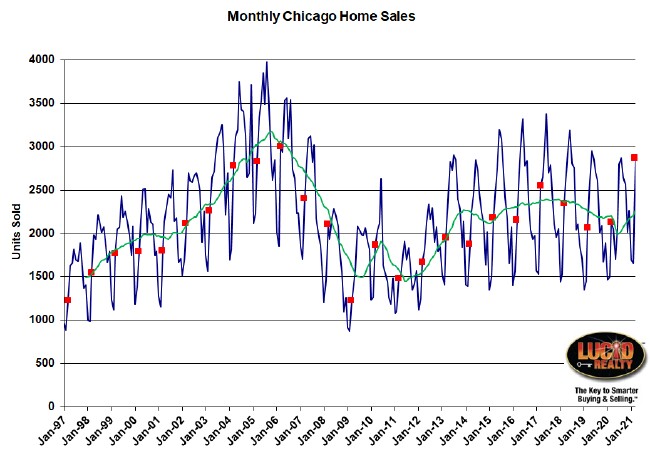
First, let me be clear that closings in the Chicago real estate market were not depressed in March of last year. In fact, sales were up 2.8% over the previous year because those contracts had been written mostly in February and earlier, before things got ugly. So, when I tell you that closings this March were up 38.3% that’s a real significant gain that you can see in historical perspective in the graph below. In fact this was the second highest March sales on record (within the 25 years of data I’ve been tracking). The previous record was in 2006 at the height of the housing bubble.
And a 38.3% increase is the largest percentage gain in about 8 1/2 years. To the folks on Cribchatter I would say that that’s a hot market. I would also point out to them that, once again, the bulk of the growth was in attached homes, which were up 44.7% while detached homes were up 19.6%. Detached home sales are almost certainly depressed by lack of supply, which we will get into later.
In about 2 weeks the Illinois Association of Realtors will give their version of events and will announce a 35.7% pop over last year. Still impressive.
Chicago home sales have been declining now for several years but the Coronavirus really tanked the market in May and June. The market returned to more normal levels starting in July.
Chicago Home Contract Activity
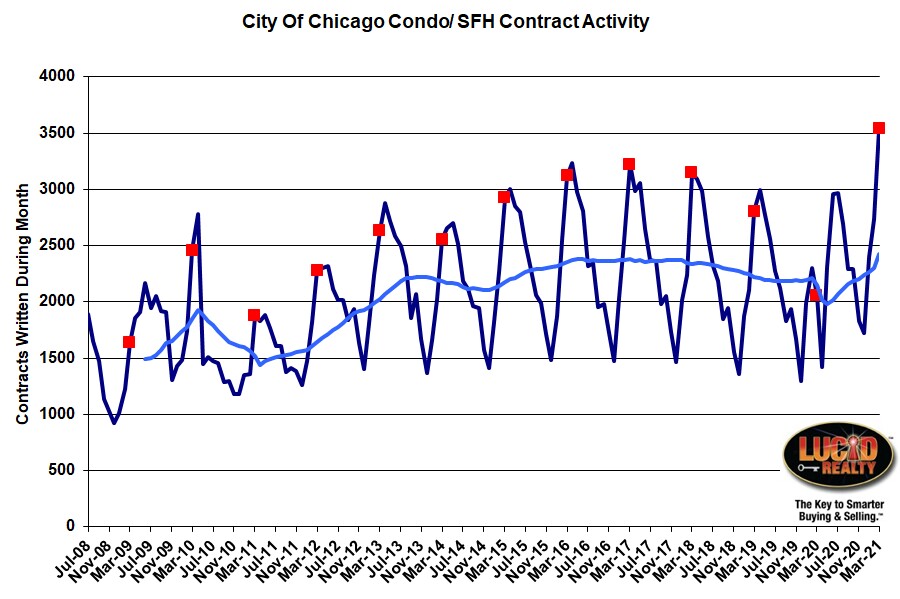
Sure, contract activity was depressed last year so that takes some of the wind from the sails of bragging about a 72.7% increase this year. However, if you look at the graph below you can clearly see that we set another 13 year record in contract activity this year, beating previous years by a lot. This was also the 10th straight month of year over year increases.
Chicago home sale contract activity blew past all previous years, hitting another record high for this time of year after plummeting to record lows because of Coronavirus issues.
Pending Home Sales
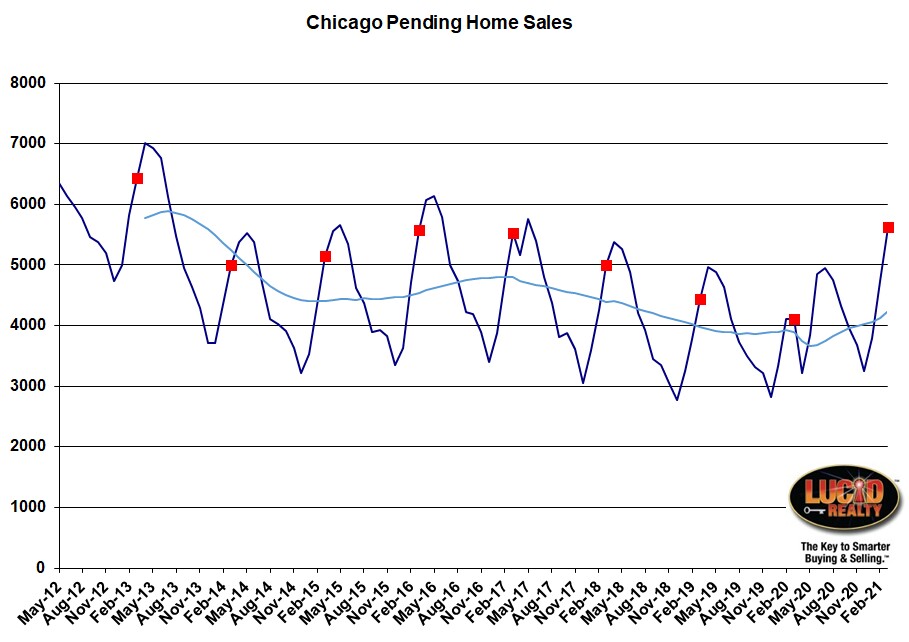
And it’s not like we hit the record closings by drawing down pending home sales because that metric hit an 8 year high in March with a 1522 unit increase over last year. In other words we had more than enough contracts written in March to feed same-month closings and the leftovers are stockpiled for future months. And to put the increase in pending home sales in perspective, it’s a little less than half of what might close in April so it gives us a lot of cushion.
After hitting historic lows the backlog of homes likely to close in the next 1 – 2 months has reached the highest levels in 8 years.
Distressed Home Sales
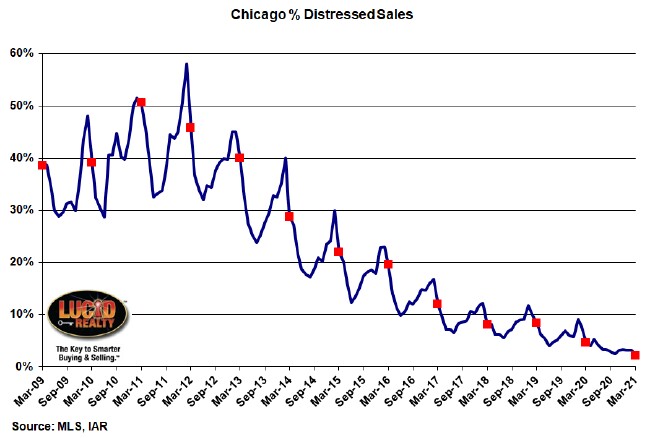
The perpetually extended foreclosure moratorium continues to put a lid on distressed home sales. As a percentage of all sales they continue to find new lows, hitting 2.2% this year, compared to 4.7% last year.
Since the housing crisis the percentage of home sales that are distressed has steadily declined.
Chicago Home Inventory
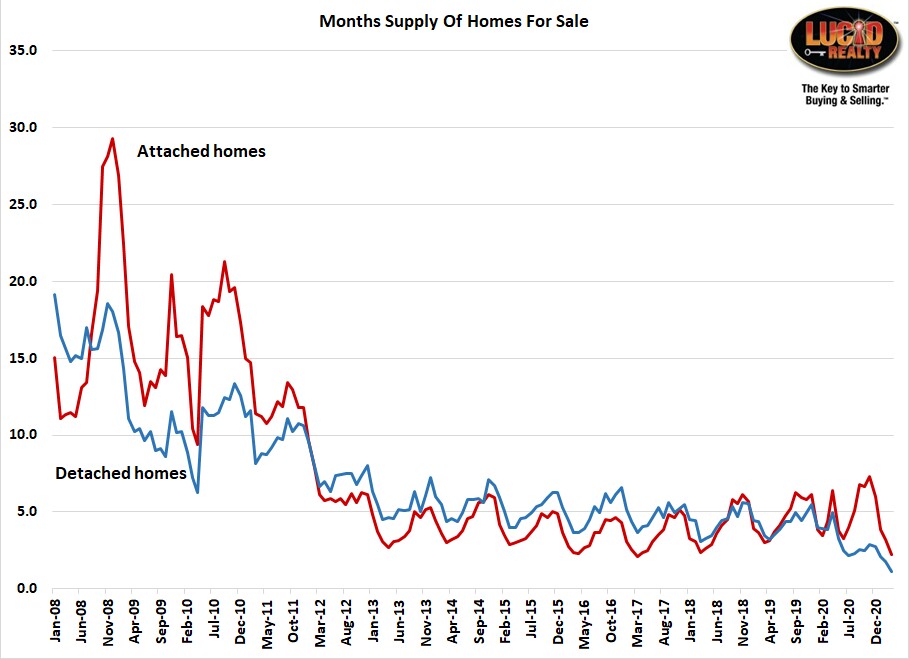
In order to capture the weird dynamics of home inventory in this market I continue to do my own inventory calculation based on homes for sale compared to contracts written during that month. My calculation shows that the inventory situation is exceptionally bad if you are a detached home buyer. We hit another record low of only 1.1 months of supply, which is put in stark historic perspective in the graph below.
However, attached inventory is also starting to drop precipitously, hitting a 2.3 month supply – at the lower end of the range for other March attached inventory levels. That’s because of the dramatic increase in condo sales despite more condos actually being on the market.
After a big Coronavirus induced spike in April 2020 the inventory of homes for sale dropped back down. Detached inventory keeps setting new record lows while attached inventory is dropping to the lower end of the historic range.
Chicago Home Sale Market Times
Higher sales and lower inventory levels are nice but if you really want to know how hot a market is you need to look at how fast stuff is selling and how prices are trending. I deal with pricing in my monthly Case Shiller posts and it’s been trending nicely with high single digit growth rates lately. But the graph below looks at market times and that is also flashing HOT.
For attached homes the average market time was only down slightly in March – from 103 days last year to 99 days this year. On the other hand detached homes sold much faster on average this year, dropping from 105 days to 73 days. What’s even more impressive is that median market times for detached homes dropped from 69 days last year to only 26 days this year. In other words half of the homes that sold in March went under contract in less than 27 days.
When the pandemic first hit Chicago market times rose but now they are actually quite a bit lower than last year.
Gary Lucido is the President of Lucid Realty, the Chicago area’s full service real estate brokerage that offers home buyer rebates and discount commissions. If you want to keep up to date on the Chicago real estate market or get an insider’s view of the seamy underbelly of the real estate industry you can Subscribe to Getting Real by Email using the form below. Please be sure to verify your email address when you receive the verification notice.
After 20 years in the corporate world and running an Internet company, Gary started Lucid Realty with his partner, Sari. The company provides full service, while discounting commissions for sellers and giving buyers rebates.
Join Draft Dr. Phil and Shayne “The Smartest Man” as they talk rookies and options for the Bears with the creator of the Rookie Scouting Portfolio, Matt Waldman! NFL Draft prospect UCF Football’s CB Tay Gowan stops by the show to talk about his path to the draft in a deep dive you won’t want to miss.
A driver opened fire during a traffic stop Thursday morning, wounding an Oak Park police officer before being shot in return.
They were both hospitalized with serious injuries but were expected to survive, according to Oak Park spokesman David Powers.
The shooting started after the Oak Park officer showed up to assist Forest Park police with a traffic stop about 7 a.m. on Harlem Avenue over Interstate 290, Powers said in an email.
Preliminary information showed the driver of the vehicle exited and began firing, Powers said. The Oak Park officer returned fire and shot the driver, he said.
The officer and driver were taken to Loyola University Medical Center in Maywood, Powers said.
State police closed interstate ramps at that location as authorities investigated the shooting.
As published in the Chicago Daily News. sister publication of the Chicago Sun-Times:
“Like anybody, I would like to live a long life. Longevity has its place. But I’m not concerned about that now. I just want to do God’s will. And He’s allowed me to go up to the mountain. And I’ve looked over. And I’ve seen the promised land. I may not get there with you. But I want you to know tonight, that we, as a people, will get to the promised land.”
The day after Dr. Martin Luther King Jr. spoke those poignant words, an assassin fatally shot him on April 4, 1968, as he stood on the balcony of his Memphis motel.
King’s death shocked the nation, and the Chicago Daily News snapped into action to honor him.
“A man went forth with gifts./ He was a prose poem./ He was a tragic grace./ He was a warm music,” she wrote.
Another front-page short published that day described how residents in Chicago’s Black neighborhoods mourned together by turning on their car headlights on Friday night. The brief offered few details, but it was “apparently meant to symbolize a funeral procession for Dr. King.” The gesture spread to other neighborhoods across the city.
The Daily News also sent reporter Robert Gruenberg down to Memphis to cover the fallout. While he was there, Gruenberg took a tour of the nearby flophouse where the sniper took his shot at King.
“By standing in the bathtub of the second-floor bathroom, the assassin would have had a clear view of the motel balcony on which Dr. King was standing when he was shot,” Gruenberg wrote.
The reporter described the 16-room flophouse as “something out of a bad old movie. Inside the common bathroom, he observed just one exposed lightbulb and a dirty towel “draped around the pipe.” The linoleum floor looked worn-out.
Gruenberg even scored an interview with landlady Bessie Brewer, who told him the assassin “gave the name ‘John Willard’ and spoke with a Southern accent.”
Brewer said she originally showed the assassin to a $10-a-week room, but he told her “I just want a sleeping room.” Instead, she led him to a “ramshackled $8.50-a-week room in another wing that was near Dr. King’s motel.” He took it without looking inside, Brewer told Gruenberg.
The room, the reporter said, “contains dirty, broken furniture and has smoke-stained walls. The door is broken and a piece of wire is used for a door handle.”

:no_upscale()/cdn.vox-cdn.com/uploads/chorus_asset/file/22429816/Jacob_Fagundo__22.jpg)
:no_upscale()/cdn.vox-cdn.com/uploads/chorus_asset/file/22429864/AP21097760253459.jpg)




Leave a comment