The ChicagoBlackhawks have been one of the most active teams in the National Hockey League on trade deadline day 2021. It was assumed that a few guys would be traded away as they are on expiring contracts. They also made a few trades to acquire youngsters that came out of nowhere. Carl Soderberg was […]
Carl Soderberg scored 15 points in 34 games with the Blackhawks before being traded Monday. | AP Photo/Chris O’Meara
The Hawks acquired Ryder Rolston, the Avs’ fifth-round draft pick last year currently playing for Notre Dame, and minor-leaguer Josh Dickinson in exchange for Soderberg.
The Blackhawks’ parade of trades continued Monday afternoon as they recouped a few small assets for Carl Soderberg.
Soderberg, a pending unrestricted free agent, was dealt to the Avalanche in exchange for prospect Ryder Rolston and minor-leaguer Josh Dickinson.
Hawks general manager Stan Bowman has now made three deadline-day moves, acquiring Adam Gaudette from the Canucks and selling off both of his notable UFAs, Janmark and Soderberg.
Rolston, 19, was the Avs’ fifth-round pick in the 2020 draft and recorded six points in 28 games as a freshman wing at Notre Dame this past season. He’s not a highly-touted prospect but has some value, and the Hawks likely saw him often this season while scouting Notre Dame teammate Landon Slaggert.
Dickinson, 23, has spent the majority of the past three seasons in the ECHL. His contract expires this summer and he’ll likely be released then.
Soderberg scored 15 points in 34 games for the Hawks this season, even scoring a goal Saturday against the Blue Jackets, but seemed likely to be traded. The 34-year-old veteran center returns to Colorado, where he played from 2015 to 2019.
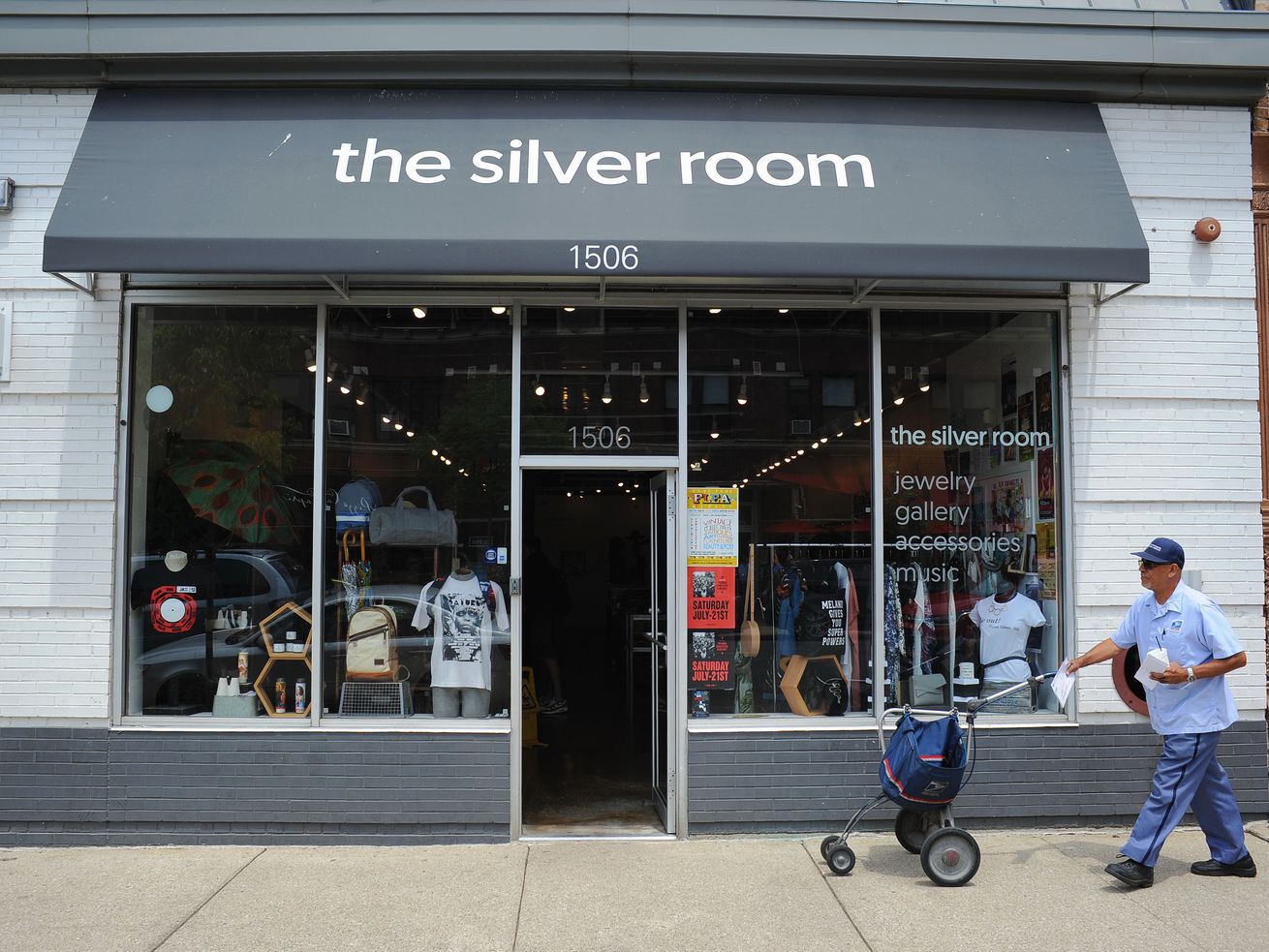
The Silver Room is a Hyde Park-based boutique specializing in creative jewelry and accessories and also hosts arts shows and music parties. | Sun-Times file
Eric Williams, the owner of the Silver Room in Hyde Park, made the announcement Monday.
One of the main events on summer’s social calendar for many Black Chicagoans — particularly South Siders — is gone for 2021.
The Silver Room Block Club Party, which normally takes place in July, is canceled for consecutive summers amid COVID-19 and business concerns.
Eric Williams, the owner of the Silver Room in Hyde Park, made the announcement Monday on the podcast “Randomly Selected.”
He attributes the 2021 cancelation to rising COVID-19 cases and the lack of business due to the pandemic, which slowed the preparation for the Block Party down to a halt.
On Sunday, state health officials announced 2,942 new and probable COVID-19 cases, bringing statewide pandemic totals to 1,279,772 cases.
“These events take about a year to plan,” said Williams, adding he didn’t want to rush an event so many Chicagoans look forward to. “Usually, I’ll start thinking about the Block Party in September; it’s always the third Saturday in July. Come September, you’re thinking about the following year. You have to think about who’s performing, start trying to secure equipment and all the logistics — it’s too much to do in two months.
“And because we were closed — the retail store — for almost three months, my focus was getting my store back open, and getting that business going. So many retail stores have closed especially the ones that are in the Black community.”
Rohan AyindeEric Williams, founder/owner of the Silver Room.
Later in the podcast, host Mario Smith asked Williams if the popular event intends to stay in Hyde Park after the previous iteration was hosted in Wicker Park.
Williams’ reply: “I don’t know.”
And what can longtime fans of the annual Block Party do to possibly ensure an event for 2022?
Williams encourages them to schedule their COVID-19 vaccine appointments.
“I think we have to get through this pandemic first and foremost,” said Williams. “For those who want to get vaccinated, go ahead and do that. For those who don’t, let’s make sure that we would be safe. I think we’ll be in a lot better place next year. We’re still in a place where some people don’t feel comfortable going out. And, also, there’s no way you can have social distancing at the Block Party — it’s just impossible. Because of the increased crowd size the last several years, there’s going to be even more people coming, so let me take the year off and really think about how this can look the next year.”
Bears running back David Montgomery eclipsed 1,000 rushing yards last year. | AP Photos
Two years and two weeks ago, the Bears’ running backs made up their worst offensive position group. Now, the running back room might be the best.
Part 2 of a 10-part series previewing the NFL Draft and analyzing the Bears’ needs.
Two years and two weeks ago, the Bears’ running backs made up their worst offensive position group. General manager Ryan Pace had just traded Jordan Howard to the Eagles rather than pay the inflated final year of his rookie deal. That left the newly signed Mike Davis, who’d started only nine games in four years in Seattle and would later earn 11 whole carries in his Bears career, to join Tarik Cohen in the backfield.
Now, the running back room might be the best among Bears offensive groups.
David Montgomery is coming off a breakout second season in which his 1,070 rushing yards trailed only Derrick Henry, Dalvin Cook, Jonathan Taylor and Aaron Jones. More than half that total — 598 yards — came in Montgomery’s last six regular-season games, when he reaped the dual benefits of a solidified Bears offensive line and inferior opposing defenses.
Cohen is expected to be healthy after having surgery to repair his torn right anterior cruciate ligament in October. In his two healthy seasons under coach Matt Nagy, he’s caught 150 passes.
Damien Williams, signed to a one-year free-agent deal last month, will be the Bears’ third running back. The last time stepped on a football field, Williams became the first player eve to run for at least 100 yards and score both a rushing and receiving touchdown in the Super Bowl.
Williams sat out last season due to coronavirus concerns, in part to help care for his mother with Stage 4 cancer. The Chiefs cut him in March.
Williams will soon learn that it was easier to shine in the Chiefs’ revolutionary offense than that of Bears head coach Matt Nagy, who has struggled for three years to establish a consistent rushing threat. But Williams’ elite speed will give the Bears a different dimension both as a runner and a pass-catcher — and provide new running backs coach Michael Pitre with an every-down rushing option, too, were Montgomery to get hurt. That’s an upgrade over Cordarrelle Patterson, the return ace who never quite fit as an offensive piece. In the one game Montgomery missed due to a concussion last year, Patterson averaged 2 ½ yards on 12 rushes in a loss to the Vikings.
Throw in special teamer Ryan Nall and second-year rusher Artavis Pierce, and the Bears have no reason to pursue a running back in the draft.
This year’s crop isn’t a particularly deep one for running backs, anyway. Alabama’s Najee Harris and Clemson’s Travis Etienne are the only two with a chance of being picked in the first round. They’ve combined for 1,324 career rushes over the past four years with the college game’s two most decorated programs.
The Bears won’t do their shopping at the high end of the draft. In fact, they probably won’t shop for a running back at all.
RUNNING BACK
Grading the Bears’ need: Low. Two years ago, the Bears drafted David Montgomery. In the last nine months, they’ve given Tarik Cohen a three-year contract extension and signed Damien Williams to a one-year deal.
On the roster: David Montgomery, Tarik Cohen, Damien Williams, Artavis Pierce, Ryan Nall
The five best prospects: Clemson’s Travis Etienne, Alabama’s Najee Harris, North Carolina’s Javonte Williams, Memphis’ Kenneth Gainwell and Ohio State’s Trey Sermon.
Keep an eye on: Whether history repeats itself. Last year, Clyde Edwards-Helaire, an undersized lightning bolt from LSU, became the first running back selected when the Chiefs used the last pick of the first round on him. At 5-10, Etienne is three inches taller than Edwards-Helaire, but just as quick. He’d fit nicely in the Buccaneers’ running back room when they make pick No. 32.
Close to home: Michael Pitre, the Bears’ new running backs coach, has a pupil who figures to be taken on Day 3: Oregon State’s Jermar Jefferson. Pitre served in the same role for the last three years with the Beavers, who boast alums Artavis Pierce and Ryan Nall in the Bears’ running backs room. Jefferson was the Pac-12 Freshman Offensive Player of the Year after Pierce got hurt in 2018. Despite playing in only 27 games, he left Corvallis, Oregon, ranked fifth in program history in rushing yards, rushing touchdowns and 100-yard-plus performances.
People run as police attempt to disperse the crowd at the Brooklyn Center Police Department, late Sunday in Brooklyn Center, Minn. | AP
Brooklyn Center Police Chief Tim Gannon described the shooting as “an accidental discharge.” It happened as police were trying to arrest the man on an outstanding warrant.
BROOKLYN CENTER, Minn. — The police officer who fatally shot a Black man during a traffic stop in a Minneapolis suburb apparently intended to fire a Taser, not a handgun, as the man struggled with police, the city’s police chief said Monday.
Brooklyn Center Police Chief Tim Gannon described the shooting as “an accidental discharge.” It happened as police were trying to arrest the man on an outstanding warrant.
“I’ll Tase you! I’ll Tase you! Taser! Taser! Taser!” the officer is heard shouting on her body cam footage released at a news conference. She draws her weapon after the man breaks free from police outside his car and gets back behind the wheel.
After firing a single shot from her handgun, the car speeds away, and the officer is heard saying, “Holy (expletive)! I shot him.”
Gannon said at a news conference that the officer made a mistake, and he released the body camera footage less than 24 hours after the shooting.
The footage showed three officers around a stopped car, which authorities said was pulled over because it had expired registration tags. When another officer attempts to handcuff Wright, a second officer tells Wright he’s being arrested on a warrant. That’s when the struggle begins, followed by the shooting. Then the car travels several blocks before striking another vehicle.
“As I watch the video and listen to the officer’s command, it is my belief that the officer had the intention to deploy their Taser but instead shot Mr. Wright with a single bullet,” Gannon said. “This appears to me from what I viewed and the officer’s reaction in distress immediately after that this was an accidental discharge that resulted in the tragic death of Mr. Wright.”
The state Bureau of Criminal Apprehension was investigating.
A female passenger sustained non-life-threatening injuries during the crash, authorities said. Katie Wright said that passenger was her son’s girlfriend.
Gannon would not name the officer but described her as “very senior.” He would not say whether she would be fired following the investigation.
“I think we can watch the video and ascertain whether she will be returning,” the chief said.
Court records show Wright was being sought after failing to appear in court on charges that he fled from officers and possessed a gun without a permit during an encounter with Minneapolis police in June. In that case, a statement of probable cause said police got a call about a man waving a gun who was later identified as Wright.”
Brooklyn Center Mayor Mike Elliott called the shooting “deeply tragic.”
“We’re going to do everything we can to ensure that justice is done and our communities are made whole,” he said.
Speaking before the unrest, Wright’s mother, Katie Wright, urged protesters to stay peaceful and focused on the loss of her son.
“All the violence, if it keeps going, it’s only going to be about the violence. We need it to be about why my son got shot for no reason,” she said to a crowd near the shooting scene in Brooklyn Center, a city of about 30,000 people on the northwest border of Minneapolis. “We need to make sure it’s about him and not about smashing police cars, because that’s not going to bring my son back.”
APPeople gather in protest on Sunday in Brooklyn Center, Minn. after the family of Daunte Wright, 20, said that he was shot by police.
Protesters who gathered near the scene waved flags and signs reading “Black Lives Matter.” Others walked peacefully with their hands held up. On one street, someone wrote in multi-colored chalk: “Justice for Daunte Wright.”
Katie Wright said her son called her as he was getting pulled over.
“All he did was have air fresheners in the car, and they told him to get out of the car,” Wright said. During the call, she said she heard scuffling and then someone saying “Daunte, don’t run” before the call ended. When she called back, her son’s girlfriend answered and said he had been shot.
Shortly after the shooting, demonstrators began to gather, with some jumping atop police cars. Marchers also descended on the Brooklyn Center Police Department, where rocks and other objects were thrown at officers, authorities said.
President Joe Biden was briefed on the shooting, and the White House has been in touch with the governor, mayor and local law enforcement, White House press secretary Jen Psaki said.
“We were incredibly saddened to hear about the loss of life at the hands of law enforcement in Minnesota yesterday,” she said.
National Guard troops and law enforcement officers continued to guard the front of the police department on Monday morning. Police were erecting a concrete barrier as Minnesota State Patrol officers joined the line in front of the precinct.
Several people and reporters watched from across the street as traffic returned to normal on the street where protesters were met with tear gas the night before. One man yelled at the officers using a megaphone as others flew Black Lives Matter flags.
About 20 businesses were broken into at the city’s Shingle Creek shopping center, Minnesota Department of Public Safety Commissioner John Harrington said at a news conference.
The National Guard was activated, and Brooklyn Center Mayor Mike Elliott announced a curfew that expired shortly before daybreak.
The trial of Derek Chauvin, the former Minneapolis officer charged in Floyd’s death, continued Monday. Floyd, a Black man, died May 25 after Chauvin, who is white, pressed his knee against Floyd’s neck. Prosecutors say Floyd was pinned for 9 minutes, 29 seconds. The judge in that case refused Monday to sequester the jury after a defense attorney argued that the panel could be influenced by the prospect of what might happen as a result of their verdict.
More National Guard members and state law enforcement personnel were to be deployed around the Twin Cities and in Brooklyn Center in addition to teams already in place for Chauvin’s trial at the Hennepin County courthouse in Minneapolis, Harrington said.
——
Associated Press writers Scott Bauer in Madison, Wisconsin, and Jonathan Lemire in Washington contributed to this report.
___
Mohamed Ibrahim is a corps member for the Associated Press/Report for America Statehouse News Initiative. Report for America is a nonprofit national service program that places journalists in local newsrooms to report on undercovered issues.
Both MLB’s decision to relocate the July 13 game and the many corporate press releases issued about the voting law drew a swift rebuke from Republicans, who vowed boycotts of baseball and the products these companies produce. The Senate minority leader even threatened retribution if companies didn’t stay out of politics — with an exception for campaign contributions.
To help understand why, consider this: MLB’s decision is estimated to cost Georgia as much as $100 million in lost economic activity.
Corporations understand that the jobs and tax revenue they can provide — or withhold — give them power at the negotiating table. Other states are all competing for the same investments. Tesla, for example, agreed to build a factory near Reno, Nevada, in 2014 in exchange for $1.4 billion in state benefits after a bidding war.
National Football League teams have been especially ruthless in their negotiations with cities and states and have demanded hefty taxpayer subsidies for new stadiums. By threatening to move to another city, team owners can extract hundreds of millions of dollars in new benefits.
The dynamic is easy to understand. State lawmakers usually cater to corporations because they want to attract business investment and keep it.
When corporations leave, they can cause property values to stagnate and tax revenue to plunge — as happened to Hartford, Connecticut, a few years ago after several large insurance companies abandoned the city.
How corporations use their leverage is up to them. They can seek to feed their bottom lines or to advance social causes. Traditionally it’s the former. For example, many U.S. companies lobbied for a $1 trillion corporate tax cut in 2017.
In 2015, the threat of corporate boycotts caused then-Gov. Mike Pence to support changing an Indiana law that would otherwise have allowed anti-gay discrimination in the name of religious freedom.
Something similar happened in 2016 when Georgia’s governor bowed to corporate pressure and vetoed a bill that would have legalized discrimination against same-sex couples on religious grounds.
And again in 2017, North Carolina partially repealed a law that targeted transgender people over concerns that boycotts — such as by PayPal, the NCAA and former Beatle Ringo Starr — would cost the state $3.76 billion over a dozen years.
Those boycotts, of course, did not end efforts to restrict LGBTQ rights at the state level, but they demonstrated that when corporations band together, they are capable of exerting enormous economic and political pressure to advance social causes.
And that possibility is likely on the minds of Georgia lawmakers following the MLB’s All-Star Game decision.
Words and deeds
Despite the apparent leverage companies yield, it’s not simple for most companies to just get up and leave.
For example, Delta — whose largest hub is in Atlanta — benefits from a tax break on jet fuel. And Coca-Cola’s ties to Georgia are deep and long-standing, dating back to a soda fountain in Atlanta in 1886. Companies don’t sever such ties or give up generous tax breaks easily — and neither Delta nor Coke has even suggested that it might.
But if the many companies that publicly objected to the law want to have an impact on policy — and see the law changed or repealed — money has to be at stake, as I learned in my own research on how North Carolina changed its 2015 law only after companies began boycotting the state. Delta and Coca-Cola employ thousands of people and generate billions of dollars in economic activity in the state. That’s serious leverage they could use if they felt the voting rights issue was important enough.
Words and press releases alone usually aren’t enough.
Making a difference
Ultimately, this threat of lost business is what makes corporations a formidable adversary. The question, then, is what it would take for them to leave Georgia.
Without knowing MLB’s internal deliberations, I cannot say why the league dropped Atlanta with so little hesitation, but there are some likely possibilities.
First, just as a matter of timing, MLB may have been concerned about holding the All-Star game in the midst of a political controversy, drawing unfavorable attention, especially in light of its own recent commitment to have zero tolerance when faced with racial injustice. MLB may have also taken an opportunity to show solidarity with its players, given the high-profile advocacy for social causes of many professional athletes. Research suggests that employee diversity is an important consideration for corporations on matters of social justice.
Finally, just as a practical matter, moving the All-Star game may have offered MLB some public relations benefits at relatively low cost to itself.
And those same reasons are likely why other sports leagues — such as the NCAA in North Carolina and the NFL with the 2016 Georgia bill — are often out front on these types of social issues. Georgia should not count on any backlash subsiding soon; the NCAA withheld championship games from South Carolina for 15 years until the state removed the Confederate flag from the Statehouse grounds.
For now, MLB’s decision has not prompted the kind of mass corporate revolt that could force change. It’s unclear, in particular, whether any Georgia-based corporations will follow MLB’s lead by removing business operations from the state. The voting law that passed is actually less restrictive than earlier versions of the bill, suggesting that criticism — including from companies — likely had some impact. Lawmakers may have made some changes precisely to avoid sparking a stronger corporate response.
But if companies like Delta and Coca-Cola really want to make a difference and use their leverage on this issue, they will need to go beyond words. Their actions would speak much louder.
Benjamin Means is a professor of law at the University of South Carolina.
I was not surprised reading the Sun-Times story about coronavirus relief money being used to purchase guns. I am sure further research would find, thanks to the relief checks, an increase in the purchase of pizzas, sugary drinks, cupcakes and sweetened breakfast cereals. People probably bought more tobacco, too.
It took a long time for unsafe foods and drugs to be be regulated by the government and even longer for tobacco to be declared a public health hazard.
While many people are applauding President Joe Biden for his executive action on ghost guns and red flags laws, it is painfully obvious that this is not enough. The criminally easy availability of guns has made all of us unsafe in our homes and schools and hospitals and movie theaters and grocery stores. And it will continue to be so until guns are declared a public health hazard.
George Tafelski, West Elsdon
SEND LETTERS TO:[email protected]. Please include your neighborhood or hometown and a phone number for verification purposes. Letters should be 350 words or less.
Kadner made one point with which I would disagree. He said that “trying to get support from the average voter” for a less politicized way of drawing the maps “is difficult.” He believes the average voter is confused or uninterested in this important process. But he also mentioned “good government groups that have attempted to influence the process” — and this is closer to the reality.
These good government groups in 2016 managed to get more 600,000 average voters to sign a petition in support of an Illinois constitutional amendment that would take the process of drawing district boundaries out of the hands of the politicians and put it into the hands of an independent commission. This was no small feat. The fact that so many voters were willing to sign the petitions suggested a great interest and understanding of the evils of gerrymandering.
As a petition circulator, I found the voters interested, engaged and very willing to sign after just a little bit of conversation. Unfortunately, the courts ruled against the amendment.
In California, an independent commission has been drawing up legislative boundaries since 2010. The result has been a more representative state legislature. Maybe Illinois could learn something from them.
Jan Goldberg, Riverside
Gangs kill
Fifty-two years ago, I began studying criminal justice and criminology at the University of Illinois. After graduation, I served on the Chicago Police Department for 35 years. This experience has led me to an inescapable conclusion: Gang members are child killers — and that is how they should be referred to, forever!
Lt. Michael C. Flynn, C.P.D., retired, Norwood Park
BROOKLYN CENTER, Minn. — The police chief in a Minneapolis suburb where a Black man was fatally shot during a traffic stop said Monday that he believes the officer who fired intended to use a Taser, not a handgun.
Brooklyn Center Police Chief Tim Gannon described the shooting as “an accidental discharge.” The state Bureau of Criminal Apprehension was investigating.
Gannon said at a news conference that the officer made a mistake, and he released body camera footage from the officer who fired. The footage showed three officers around a stopped car. When another officer attempts to handcuff Wright, a struggle ensues. The officer is heard shouting “Taser!” several times before firing her weapon.
“This was an accidental discharge that resulted in a tragic death of Mr. Wright,” the chief said.
Brooklyn Center Mayor Mike Elliott called the shooting “deeply tragic.”
“We’re going to do everything we can to ensure that justice is done and our communities are made whole,” he said.
Minnesota Gov. Tim Walz tweeted that he was praying for Wright’s family “as our state mourns another life of a Black man taken by law enforcement.”
Speaking before the unrest, Wright’s mother, Katie Wright, urged protesters to stay peaceful and focused on the loss of her son.
“All the violence, if it keeps going, it’s only going to be about the violence. We need it to be about why my son got shot for no reason,” she said to a crowd near the shooting scene in Brooklyn Center, a city of about 30,000 people on the northwest border of Minneapolis. “We need to make sure it’s about him and not about smashing police cars, because that’s not going to bring my son back.”
Protesters who gathered near the scene waved flags and signs reading “Black Lives Matter.” Others walked peacefully with their hands held up. On one street, someone wrote in multi-colored chalk: “Justice for Daunte Wright.”
Katie Wright said her son called her as he was getting pulled over.
“All he did was have air fresheners in the car, and they told him to get out of the car,” Wright said. During the call, she said she heard scuffling and then someone saying “Daunte, don’t run” before the call ended. When she called back, her son’s girlfriend answered and said he had been shot.
Authorities said the car was pulled over for having expired registration and after determining the driver had an outstanding warrant, police said they tried to arrest him. Then the driver reentered the vehicle, and an officer fired, striking him, police said. The vehicle traveled several blocks before striking another vehicle.
Wright’s family offered a different account, with Katie Wright saying her son was shot before getting back into the car.
A female passenger sustained non-life-threatening injuries during the crash, authorities said. Katie Wright said that passenger was her son’s girlfriend.
Court records show Wright was being sought after failing to appear in court on charges that he fled from officers and possessed a gun without a permit during an encounter with Minneapolis police in June. In that case, a statement of probable cause said police got a call about a man waving a gun who was later identified as Wright.”
Shortly after the shooting, demonstrators began to gather, with some jumping atop police cars. Marchers also descended on the Brooklyn Center Police Department, where rocks and other objects were thrown at officers, authorities said. The protesters had largely dispersed by 1:15 a.m. Monday.
President Joe Biden was briefed on the shooting, and the White House has been in touch with the governor, mayor and local law enforcement, White House press secretary Jen Psaki said.
“We were incredibly saddened to hear about the loss of life at the hands of law enforcement in Minnesota yesterday,” she said.
National Guard troops and law enforcement officers continued to guard the front of the police department on Monday morning. Police were erecting a concrete barrier as Minnesota State Patrol officers joined the line in front of the precinct.
Several people and reporters watched from across the street as traffic returned to normal on the street where protesters were met with tear gas the night before. One man yelled at the officers using a megaphone as others flew Black Lives Matter flags.
About 20 businesses were broken into at the city’s Shingle Creek shopping center, Minnesota Department of Public Safety Commissioner John Harrington said at a news conference.
The National Guard was activated, and Brooklyn Center Mayor Mike Elliott announced a curfew that expired shortly before daybreak.
People gather in protest on Sunday in Brooklyn Center, Minn. after the family of Daunte Wright, 20, said that he was shot by police.AP
Police said Brooklyn Center officers wear body cameras, which they believe were activated during the traffic stop.
More National Guard members and state law enforcement personnel were to be deployed around the Twin Cities and in Brooklyn Center in addition to teams already in place for Chauvin’s trial at the Hennepin County courthouse in Minneapolis, Harrington said.
There was no visible increase in the already high security presence on Monday morning outside the courthouse, which was fortified ahead of Chauvin’s trial with tall fencing topped with barbed wire and coils of razor wire between the fences and concrete barriers. National Guard troops with military vehicles, sheriff’s deputies and county security guards continued to stand watch.
Meanwhile, all Brooklyn Center students were to attend online classes Monday because school buildings were closed, Superintendent Carly Baker said.
Mohamed Ibrahim is a corps member for the Associated Press/Report for America Statehouse News Initiative. Report for America is a nonprofit national service program that places journalists in local newsrooms to report on undercovered issues.
After weeks of speculation and days of anticipation, the Blackhawks traded Mattias Janmark to the Golden Knights on Monday ahead of the NHL trade deadline, per reports.
Hawks general manager Stan Bowman will likely be thrilled with the return. The Hawks acquired a 2021 second-round pick and a 2022 third-round pick by giving up Janmark and a 2022 fifth-round pick.
Janmark was a healthy scratch for the Hawks’ game Saturday for injury protection purposes, making it all-but-certain he’d be on the move.
Before that, the 28-year-old wing had scored 19 points in 41 games in his one and only season in Chicago, although those totals included just one point in his last 10. His analytics were remarkably bad, too. He entered Monday with a 41.7% on-ice shot-attempt ratio, the worst on the team, and 41.9% on-ice scoring chance ratio, second-worst on the team.
The draft picks may not be exciting, but they represent a well-above-expected return for Janmark. His value seemed likely to be around a third-round pick; to get second- and third-round picks for him is an overpayment by the Golden Knights and a much-appreciated haul for the Hawks.
The Sharks were also involved in the trade, retaining some of Janmark’s $2.25 million cap hit to help him fit into the cap space-strapped Knights’ roster. The Sharks received a 2022 fifth-round pick and minor-league player from Vegas for doing so, per TSN’s Pierre LeBrun.
This is the fourth trade Bowman has made in recent weeks and the second trade Monday, having also acquired Adam Gaudette from the Canucks.
Once dubbed “the most photographed socialite in New York City,” Tinsley Mortimer is probably best known to Chicagoans for her stint on Bravo’s The Real Housewives of New York City. She’s a local gal these days, having moving to River North in 2019 to be with her now-former fiancé, CouponCabin founder Scott Kluth. (They broke up in March, and she is keeping mum on whether she plans to stay in Chicago.) Here’s how the 45-year-old, who serves on the development board for PAWS Chicago, stays mentally and physically strong in front of the cameras.
Fitness Rethink
“I was a nationally ranked tennis player. I played in junior high through university, for five, six hours a day. My whole life, I had a schedule of working out built in. So as an adult, it was hard for me to figure out what to do for a workout. During Real Housewives, I was doing interval training, which was 10 minutes here, 10 minutes there. It was broken up enough that I could really do it. Your mind isn’t fighting it.”
Strength Goals
“During the pandemic, I took a year off from everything. It was just a free-for-all. And then I was like, OK, I have to get back in shape. I ended up hiring a trainer. We box, which is so fun, because you’re hitting something, and you feel strong and good about yourself. We also do intervals and a lot of weight training, too. Cardio is great, but I find that weights and boxing, it tones your body more. It starts to cut my arms in a way that I like.”
Beauty Essentials
“I can’t even be by myself, or around my dogs, without having lashes on. It’s just who I am. I love super-basic Neutrogena face wipes just to take off makeup or refresh my face. Then I use Sunday Riley Good Genes, which is lactic acid. There’s a moisturizing face gel from Winky Lux. It smells great and it’s super hydrating. A lot of things that I’ve tried break me out, but these do not.”
Hiking High
“Earlier this year, I went to this place called the Ranch in Malibu. It changed my life forever. For a week, I woke up at 5:30 and went on four-hour hikes. This wasn’t just strolling; this was legit hiking, and I’d never hiked in my life. They give you a little snack — sometimes you get six almonds, or one day we got an apple. The first hike was super inclined, so high up. I’m walking in the dark, and I turn the corner, and I saw the sun. I decided to eat the apple then, and I just started crying. I was like, This is the best apple ever.”
Food Truths
“During COVID, I started to cook, which I was super impressed with myself about, because I never knew how. Look, there’s a time when I’m really good about eating healthy and a time when I’m letting myself go a little bit. When I’m good, it’s hard-boiled eggs, it’s chicken, it’s salad. And that’s pretty much it — two meals a day, not three. I’ve decided that there’s no more wine in the house. It’s only gonna be when I go out and have a glass or two with dinner.”
Tea Time
“Sleep is hard for me. My brain is just so overactive that I can’t. You need to make it dark — scary as that is with the bogey monsters. No TV. That’s a new thing for me, and it’s helped. Tea at night is such a lovely experience. Before, I would think I needed red wine to go to bed, but no: tea, darkness, no TV.”


/cdn.vox-cdn.com/uploads/chorus_asset/file/22438496/merlin_92067099.jpg)


/cdn.vox-cdn.com/uploads/chorus_asset/file/22437763/AP21102064009803.jpg)
:no_upscale()/cdn.vox-cdn.com/uploads/chorus_asset/file/22437763/AP21102064009803.jpg)