Videos

Has Laura Jacqmin broken up with theater?on April 22, 2021 at 2:00 pm

Laura Jacqmin spent “a solid ten years” (2006 to 2016) in Chicago as a playwright. During that time she developed an admirably eclectic body of work ranging from comedy (Dental Society Midwinter Meeting, about DDS dysfunction at a convention); docudrama (Dead Pile, about exposing conditions in a meatpacking plant); and searing intimate tragicomedy (Look, We Are Breathing, a twist on the dead-kid-grief-porn genre in which the deceased teenage boy at the center of the story, whom we meet through flashbacks, is actually a real jerk).

I talked to Jacqmin, whose work I’ve followed for well over a decade, last week right as We Broke Up, her first feature film (cowritten with her high school friend, Jeff Rosenberg, who also directs), was opening. Now based out of Los Angeles, the native of Shaker Heights, Ohio (also the setting of Celeste Ng’s Little Fires Everywhere) moved to Chicago right after earning her MFA in playwriting at Ohio University. In town, Jacqmin’s work was performed at several companies, including Rivendell Theatre Ensemble and Steppenwolf’s First Look Repertory series.

For a few years, she was moving between Los Angeles and Chicago as she began building her resume as a screenwriter, beginning with the short-lived ABC series Lucky 7 in 2013. She’s also written for Grace and Frankie on Netflix and Get Shorty on Epix, as well as several video game projects. Currently, she’s a writer and consulting producer on Joe Exotic, a limited series on Peacock starring SNL‘s Kate McKinnon as Carole Baskin and John Cameron Mitchell (Hedwig and the Angry Inch) as the title character, made famous by Netflix’s Tiger King docuseries. (The Peacock series is based on the Wondery podcast of the same name hosted and reported by Robert Moor.)

“What I thought I’d be able to do for my entire career was go out [to LA]–you know, because typically a staffing contract on a television show is generally between 20 to 28 weeks for a normal-length series, which is like eight to thirteen episodes. And then I’d be able to go back to Chicago and to a beautiful cheap apartment and make theater,” says Jacqmin.

It worked for a while: after Lucky 7 was canceled (“We had the honor of being the first canceled fall drama that season,” Jacqmin notes with a laugh), she came back to Chicago for Buzz22’s 2014 production of Ghost Bike, her gender-reversed take on the myth of Orpheus and Eurydice, as well as We’re Going to be Fine, a seemingly prescient piece about an office worker dealing with a mass plague that Jacqmin developed with director Dexter Bullard for DePaul’s Theatre School in 2015.

“I love Chicago so much that it took me from fall and winter 2012 until spring 2016 to fully sort of make the move and say [to my partner], I think if we’re going to do this, we need to actually put our stuff in storage in Chicago and give up our apartment and actually, you know, commit to LA,” says Jacqmin.

Jacqmin was one of several women playwrights from Chicago who made that westward move around the same time, including Caitlin Montanye Parrish (Supergirl, The Red Line); Tanya Saracho (creator and showrunner for Vida on Starz); Sarah Gubbins (I Love Dick, Shirley); and Marisa Wegrzyn (The Mentalist, Goliath). Like Jacqmin, their presence on Chicago stages has been limited by the demands of Hollywood.

“TV is not the sort of job where you get any time off,” Jacqmin notes. “There is no such thing as a sick day. There is no such thing as a vacation day. Maybe sick days will change a little bit after the pandemic has sort of waned. But when you’re on, you’re on for a contract of however many weeks and that’s your whole life.”

It’s true that while Jacqmin has been produced frequently in Chicago and elsewhere (her plaudits include winning the 2008 Wendy Wasserstein Prize for an emerging woman playwright for And when we awoke there was light and light), she, like most playwrights in the U.S., can’t count on stagework to provide a living. (Like a lot of writers, she’s done several teaching residencies along the way.)

But she also notes that Chicago provided her with opportunities that she doesn’t think would have been as easily attainable in New York; she initially self-produced Dental Society Midwinter Meeting in 2010 at Chicago Dramatists, then run by the late Russ Tutterow.

“They charged me $900 a week [rent], including everything, which was unheard of,” she says. The show did well enough that she and director Megan Schuchman were able to remount it in 2011 at Berwyn’s 16th Street Theater.

Jacqmin says, “I still miss Chicago so much–that spirit of just being able to make stuff.” She adds, “And it’s amazing how the scene has changed in so many good ways for new work. When I was first there, there really was not an infrastructure for developing new plays in Chicago.” (Chicago Dramatists being a notable exception as a company that for decades was wholly dedicated to nurturing new work, as opposed to companies where the new work was primarily developed by writers already connected to the ensemble.)

But We Broke Up gave Jacqmin an experience closer to what she had as a working Chicago playwright, rather than just being another voice in the television writers room. The movie stars Aya Cash (You’re the Worst) and William Jackson Harper (The Good Place) as Lori and Doug, a couple of ten years’ duration breaking up days before her sister’s wedding. (In the first moments, Doug asks Lori to marry him, and she promptly vomits.)

Rosenberg (who worked as an assistant director on The Good Place, which is where the connection to Harper came from) reached out to Jacqmin back in 2012, when she was first starting to send some scripts around LA looking for screenwriting gigs.

“He was like, ‘Hey, you want to, you know, meet up and get dinner? It’s been five years or something since we’ve seen each other.’ And so we went to an Umami Burger in Hollywood and he was like, ‘I have an idea for this movie. Do you want to write it together?’ And I said yes. He said, ‘Do you want to know what it’s about?’ And I said, ‘I don’t care. I want to do it,'” says Jacqmin, adding, “I was so hungry at that point for collaboration and to just not be writing plays that were not going to get produced.”

The screenplay is a relative rarity: a romantic comedy written together by a man and a woman. “Forgetting Sarah Marshall is one of my favorite rom-coms,” says Jacqmin. “I love that movie. I’ve watched it so many times. And what I love the most is there’s a scene late in the movie where Sarah–who has sort of been the villain of the movie–there’s this sort of tearful scene between the two of them where she says, ‘Your experience of our relationship is not the same as mine.'”

Jacqmin and Rosenberg tapped into their longtime friendship to build out the story of Lori and Doug from the perspectives of both characters. “I was so, so serious in high school,” she says. “And Jeff was the funny guy who knew that he wanted to make movies.” That dynamic plays out in the bittersweet tone with dashes of comic absurdity (the story is mostly set at a camp dedicated to Paul Bunyan, for starters) threaded throughout We Broke Up.

But it took a long time from that initial meeting in 2012 to getting the green light to shoot the film (which was done on location in just 15 days in February 2019, right before the COVID shutdown).

“The feature film world is as slow as the theater world,” notes Jacqmin. “I think maybe it’s a little bit slower where you’re going in fits and starts. There’s forward movement. You’re talking about casting, you’re talking about funding with the tax incentive thing. My god, we did so many budgets. Like we did a budget for Nevada. We did a budget for Iceland. You’re just trying to figure out ‘Where can we get money from? How can we put this together? How can we make it happen?'”

But being on set for the film has given Jacqmin another goal. “I wrote a feature last year that I would like to direct myself and one never knows if these things are gonna come together . . . but it’s something that I’m actively pursuing.”

As for returning to theater, that too depends on the project. “I love theater so much. I think for all of the playwrights who sort of come out [to LA], it’s our first love. It’s always going to be our first love. I think I just reached a point where it just became too difficult.”

And Jacqmin (a cofounder of the Kilroys, dedicated to emphasizing gender parity in theater by uplifting work by women, trans, and nonbinary playwrights) is conscious of how much the demand for new voices also requires supporting those who have been traditionally marginalized. “I would not say no to jumping into [theater] again, but I am sort of at the place where I’ve stopped pursuing it as much. I don’t need to be centering my voice, to be perfectly honest. I had a great degree of success in Chicago theater. I’m forever going to be grateful, but also there are so many underrepresented voices out there and I’m like, yeah, produce their plays.” v


Read More

Has Laura Jacqmin broken up with theater?on April 22, 2021 at 2:00 pm Read More »
Loyola’s Cameron Krutwig declares for NBA Drafton April 22, 2021 at 4:16 pm

Loyola senior center Cameron Krutwig will leave the Ramblers and enter the NBA Draft. He made the announcement in a video posted on Twitter and YouTube.

Krutwig quickly became one of the most-familiar faces on the Loyola team that went to the NCAA Final Four in 2018 and the Sweet 16 this season.

This is the latest change for the Loyola program. Drew Valentine became the Ramblers’ new head coach after Porter Moser left to take the job at Oklahoma.

“I feel like I’ve left my imprint on this place and left it better than I found it,” Krutwig said in his announcement video. “I hope for the next generation of Loyola basketball players that they do the same.”

The 6-9, 255-pound Algonquin native was named Missouri Valley Player of the Year this season. His 15 points and seven rebounds per game this season led the Ramblers. He finishes his time at Loyola with a 13.7 point career scoring average and 7.1 rebound average.

Read More

Loyola’s Cameron Krutwig declares for NBA Drafton April 22, 2021 at 4:16 pm Read More »

Biden summit draws climate vows from sparring global leaderson April 22, 2021 at 4:30 pm

WASHINGTON — WASHINGTON (AP) — President Joe Biden convened leaders of the world’s most powerful countries on Thursday to try to spur global efforts against climate change, drawing commitments from Chinese President Xi Jinping and Russian President Vladimir Putin to cooperate on cutting emissions despite their own sharp rivalries with the United States.

“Meeting this moment is about more than preserving our planet,” Biden declared, speaking from a TV-style set for a virtual summit of 40 world leaders. “It’s about providing a better future for all of us,” he said, calling it “a moment of peril but a moment of opportunity.”

“The signs are unmistakable. the science is undeniable. the cost of inaction keeps mounting,” he added.

Biden’s own new commitment, timed to the summit, is to cut U.S. fossil fuel emissions up to 52% by 2030. marking a return by the U.S. to global climate efforts after four years of withdrawal under President Donald Trump. Biden’s administration is sketching out a vision of a prosperous, clean-energy United States where factories churn out cutting-edge batteries for export, line workers re-lay an efficient national electrical grid and crews cap abandoned oil and gas rigs and coal mines.

Japan announced its own new 46% emissions reduction target Thursday, and South Korea said it would stop public financing of new coal-fired power plants, as the U.S. and its allies sought to build momentum via the summit.

The coronavirus pandemic compelled the summit to play out as a climate telethon-style livestream, limiting opportunities for spontaneous interaction and negotiation. The opening was rife with small technological glitches, including echoes, random beeps and off-screen voices.

But the U.S. summit also marshaled an impressive display of the world’s most powerful leaders speaking on the single cause of climate change.

China’s Xi, whose country is the world’s biggest emissions culprit, followed by the United States, spoke first among the other global figures. He made no reference to nonclimate disputes that had made it uncertain until Wednesday that he would even take part in the U.S. summit, and said China would work with America in cutting emissions.

“To protect the environment is to protect productivity, and to boost the environment is to boost productivity. It’s as simple as that,” Xi said.

Putin, whose government has been publicly irate over Biden’s characterization of him as a “killer” for Russia’s aggressive moves against its opponents, made no mention of his feuding with Biden in his own climate remarks, a live presentation that also saw moments of dead air among production problems.

“Russia is genuinely interested in galvanizing international cooperation so as to look further for effective solutions to climate change as well as to all other vital challenges,” Putin said. Russia by some measures is the world’s fourth-biggest emitter of climate-damaging fossil fuel fumes.

However, Russia and China announced no specific new emissions cuts themselves.

The pandemic made gathering world leaders for the climate summit too risky. That didn’t keep the White House from sparing no effort on production quality. The president’s staff built a small set in the East Room that looked like it was ripped from a daytime talk show.

Biden and Vice President Kamala Harris addressed the summit from separate lecterns before joining Secretary of State Anthony Blinken and White House climate envoy John Kerry at a horseshoe-shaped table set up around a giant potted plant to watch fellow leaders’ livestreamed speeches.

The format meant a cavalcade of short speeches by world leaders, some scripted, some apparently more impromptu. “This is not bunny-hugging,” British Prime Minister Boris Johnson said of the climate efforts. “This is about growth and jobs.”

The Biden administration’s pledge would require by far the most ambitious U.S. climate effort ever, nearly doubling the reductions that the Obama administration had committed to in the landmark 2015 Paris climate accord. German Chancellor Angela Merkel was one of many allies welcoming the U.S. back into the accord after Trump pulled out, boosted oil and gas production and mocked the science underlying climate warnings.

“I’m delighted to see that the United States is back, is back to work together with us in climate politics,” Merkel declared in her virtual appearance. “Because there can be no doubt about the world needing your contribution if we really want to fulfill our ambitious goals.”

The new urgency comes as scientists say that climate change caused by coal plants, car engines and other fossil fuel use is worsening droughts, floods, hurricanes, wildfires and other disasters and that humans are running out of time to stave off catastrophic extremes of global warming.

Leaders of smaller states and island nations buffeted by rising seas and worsening hurricanes appealed for aid and fast emissions cuts from world powers.

“We are the least contributors to greenhouse gas emissions, but the most affected by climate change,” said Gaston Alfonso Browne, prime minister of Antigua and Barbuda. He called for debt relief and more international assistance to recover from storms and the pandemic to prevent a flow of climate refugees.

His people he said, are ” teetering on the edge of despair.”

After the stream of solemn pledges on fighting climate change, the talk turned to money. Developing countries were watching for firm financial moves from the United States, which they say still owes $2 billion in aid for transitioning away from fossil fuels that President Barack Obama promised but Trump didn’t pay.

Biden delivered new pledges, saying the U.S. would double climate funding help for less wealthy countries by 2024. That cost would be more than made up for when “disasters and conflicts are avoided,” he said. The U.S. International Development Finance Corporation would make a third of all its new investments climate-focused within two years, he said.

Other speakers urged hefty taxes on climate-damaging polluters and a slashing of government programs that amount to subsidies for oil, gas and coal.

Longtime climate policy experts, no strangers to climate summits with solemn pledges, watched some speeches with skepticism. After Brazil’s President Jair Bolsonaro promised an end to clearcutting in the Amazon, Dan Wilkinson of Human Rights Watch’s environmental programs noted, “It is going to be hard for anyone to take it seriously until they actually start taking steps.”

“Any number of them could be done right away,” Wilkinson said.

U.S. officials, in previewing the new administration target, disclosed aspirations and vignettes rather than specific plans, budget lines or legislative proposals for getting there.

As of 2019, before the pandemic, the U.S. had reduced 13% of its greenhouse gases compared with 2005 levels, which is about halfway to the Obama administration goals of 26% to 28%, said climate scientist Niklas Hohne of Climate Action Tracker. That’s owing largely to market forces that have made solar and wind, and natural gas, much cheaper

Biden, a Democrat, campaigned partly on a pledge to confront climate change. He has sketched out some elements of his $2 trillion approach for transforming U.S. transportation systems and electrical grids in his campaign climate plan and in his infrastructure proposals for Congress.

His administration insists the transformation will mean millions of well-paying jobs. Republicans say the effort will throw oil, gas and coal workers off the job. They call his infrastructure proposal too costly.

___

Knickmeyer reported from Oklahoma City. Associated Press writers Ashok Sharma in New Delhi, Joe McDonald in Beijing, Vladimir Isachenkov in Moscow and Seth Borenstein, Matthew Daly, Alexandra Jaffe and Christina Larson in Washington contributed to this report.

Read More

Biden summit draws climate vows from sparring global leaderson April 22, 2021 at 4:30 pm Read More »

Indonesia looking for submarine that may be too deep to helpon April 22, 2021 at 4:41 pm

JAKARTA, Indonesia — Indonesian navy ships searched Thursday for a submarine that likely sank too deep to retrieve, making survival chances for the 53 people on board slim. Authorities said oxygen in the submarine would run out by early Saturday.

The diesel-powered KRI Nanggala 402 was participating in a training exercise Wednesday when it missed a scheduled reporting call. Officials reported an oil slick and the smell of diesel fuel near the starting position of its last dive, about 60 miles north of the resort island of Bali, though there was no conclusive evidence that they were linked to the submarine.

“Hopefully we can rescue them before the oxygen has run out” at 3 a.m. on Saturday, Indonesia’s navy chief of staff, Adm. Yudo Margono, told reporters.

He said rescuers found an unidentified object with high magnetism at a depth of 165 to 330 feet and that officials hope it’s the submarine.

The navy believes the submarine sank to a depth of 2,000-2,300 feet, much deeper than its estimated collapse depth.

Ahn Guk-hyeon, an official from South Korea’s Daewoo Shipbuilding and Marine Engineering, which refitted the vessel in 2009-2012, said the submarine would collapse if it goes deeper than around 655 feet because of pressure. He said his company upgraded much of the submarine’s internal structures and systems but lacks recent information about the vessel.

Frank Owen, secretary of the Submarine Institute of Australia, also said the submarine could be at too great a depth for a rescue team to operate.

“Most rescue systems are really only rated to about 1,970 feet,” he said. “They can go deeper than that because they will have a safety margin built into the design, but the pumps and other systems that are associated with that may not have the capacity to operate. So they can survive at that depth, but not necessarily operate.”

Owen, a former submariner who developed an Australian submarine rescue system, said the Indonesian vessel was not fitted with a rescue seat around an escape hatch designed for underwater rescues. He said a rescue submarine would make a waterproof connection to a disabled submarine with a so-called skirt fitted over the recue seat so that the hatch can be opened without the disabled submarine filling with water.

Owen said the submarine could be recovered from 1,640 feet without any damage but couldn’t say if it would have imploded at 2,300 feet.

In November 2017, an Argentine submarine went missing with 44 crew members in the South Atlantic, almost a year before its wreckage was found at a depth of 2,625 feet. In 2019, a fire broke out on one of the Russian navy’s deep-sea research submersibles, killing 14 sailors.

Indonesian President Joko Widodo asked all of the country’s people to pray that the submarine and crew could be found.

“Our main priority is the safety of the 53 crew members,” Widodo said in a televised address. “To the families of the crew members, I can understand your feelings and we are doing our best to save all of the crew members on board.”

The military said more than 20 navy ships, two submarines and five aircraft were searching the area where the submarine was last detected. A hydro-oceanographic survey ship equipped with underwater detection capabilities also was on its way to the site around the oil spills.

Margono said the oil slick may have been caused by a crack in the submarine’s tank after the vessel sank.

Neighboring countries are rushing to join the complex operation.

Rescue ships from Singapore and Malaysia are expected to arrive between Saturday and Monday. The Indonesian military said Australia, the United States, Germany, France, Russia, India and Turkey have also offered assistance. South Korea said it has also offered help.

“The news of the missing submarine is deeply concerning,” Australian Foreign Minister Marise Payne said during a visit to New Zealand. “We will provide any assistance that we can. There’s no question that submarine search and rescues are very complex.”

Australian Defense Minister Peter Dutton called the incident “a terrible tragedy.” He told Sydney Radio 2GB that the fact that the submarine is “in a very deep part of waters” makes it “very difficult for the recovery or for location.”

“Our fervent prayers and hopes go out to the crew of KRI Nanggala, for their safety and resilience,” Singapore’s Defense Minister Ng Eng Hen wrote on Facebook.

Indonesia’s navy said an electrical failure may have occurred during the dive, causing the submarine to lose control and become unable to undertake emergency procedures that would have allowed it to resurface. It was rehearsing for a missile-firing exercise on Thursday, which was eventually canceled.

The German-built submarine, which has been in service in Indonesia since 1981, was carrying 49 crew members, its commander and three gunners, the Indonesian Defense Ministry said. It had been maintained and overhauled in Germany, Indonesia and most recently in South Korea.

More than 60 of the Type 209 class submarines have been sold and have served in 14 navies around the world, ThyssenKrupp Marine Systems spokesperson Eugen Witte said.

Last year, President Widodo reaffirmed the country’s sovereignty during a visit to the islands at the edge of the South China Sea, one of the busiest sea lanes where China is embroiled in territorial disputes with its smaller neighbors.

___

Associated Press writers Kim Tong-hyung and Hyung-jin Kim in Seoul, South Korea, Rod McGuirk in Canberra, Australia, and Nick Perry in Wellington, New Zealand, contributed to this report.

Read More

Indonesia looking for submarine that may be too deep to helpon April 22, 2021 at 4:41 pm Read More »

Christine Razny-Porteron April 22, 2021 at 4:22 pm

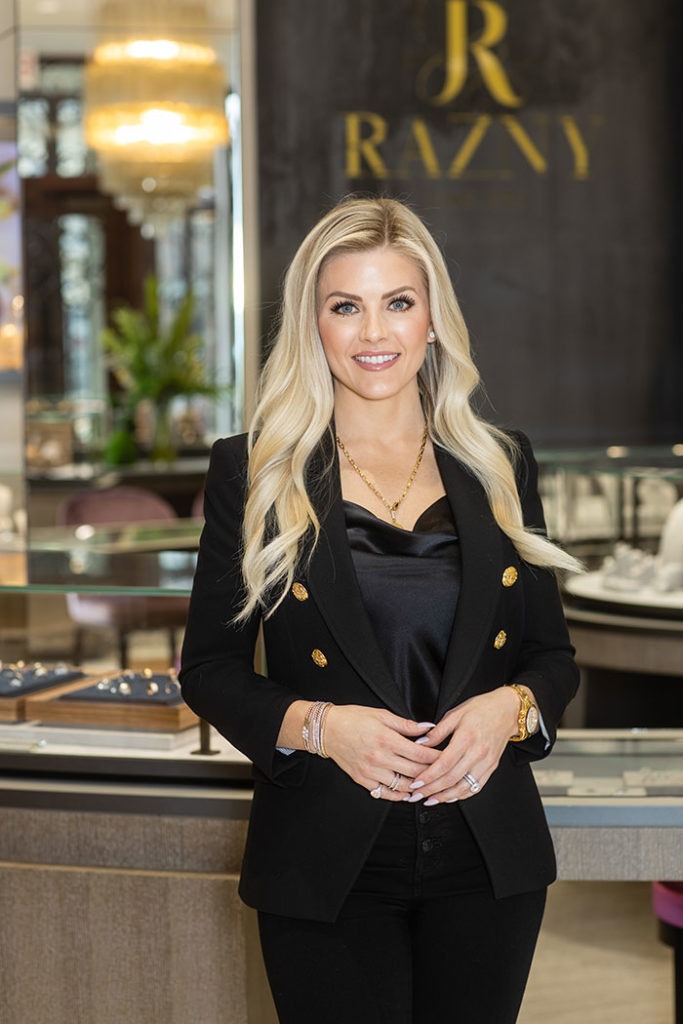
Christine Razny-Porter

Photography by Francis Son

As a third-generation owner of Razny Jewelers, Chicago’s leading family-owned and operated jeweler, Christine Razny-Porter has worked in the business of luxury since birth. Alongside her parents and siblings, she officially operates as the company’s collection curator, finding and nurturing up-and-coming designers, a role she’s thrived in for the last nine years.  The graduate gemologist brings a young eye and modern aesthetic to the organization, keeping Razny Jewelers ahead of the industry’s trends.  

Of course, with her family’s name on the door, Christine must wear many hats simultaneously. She nurtures new and longtime client relationships with a generous attitude coupled with unparalleled jewelry and diamond knowledge. Leading by example, she systematically assists with gauging and maintaining the success of the family’s four boutiques, located in downtown Chicago (Gold Coast), Addison, Highland Park, and Hinsdale. 

When she isn’t helping clients find the treasure of their dreams or training the company’s next diamond specialist, Christine enjoys cooking and spending time with her husband and beautiful baby girl.

Addison
1501 W. Lake St.
Addison, IL 60101

Chicago
109 E. Oak St.
Chicago, IL 60611

Highland Park
1700 Green Bay Rd.
Highland Park, IL 60035

Hinsdale
37 S. Washington St.
Hinsdale, IL 60521

Read More

Christine Razny-Porteron April 22, 2021 at 4:22 pm Read More »

Schiller-DuCanto & Fleckon April 22, 2021 at 4:35 pm

Schiller-DuCanto & Fleck

Schiller DuCanto & Fleck LLP proudly celebrates its 40th anniversary this year.

We celebrate our clients’ success, our team’s accomplishments and our exceptional, strong, and intelligent women attorneys who have helped shape our sophisticated family law practice.

All of these extraordinary women have significant experience with crisis management, and are committed to providing our clients a steady hand to help them navigate through difficult personal times in our uncertain world and help them make confident decisions about their future.

We listen, we care, and we are there when you need us.

Chicago, Lake Forest, Wheaton  |  312-641-5560  |  sdflaw.com

Read More

Schiller-DuCanto & Fleckon April 22, 2021 at 4:35 pm Read More »

Alison Guttermanon April 22, 2021 at 4:51 pm

Alison Gutterman

Photograph: Francis Son

Alison is president and CEO of Jelmar, the family-owned cleaning products manufacturer of CLR® (pronounced CLeaR) and Tarn-X® products. As the third-generation owner, Alison has brought the company unprecedented success with her modern approach and leadership techniques. Committed to brand growth via innovation and acquisition, Alison is focused on identifying companies that can expand the CLR product portfolio.

As a Chicago Tribune article covering Alison’s transition to president and CEO stated, “Through passion, perseverance, and planning, Gutterman has helped Jelmar defy the odds.”

Alison has led the charge in relaunching and modernizing the CLR brand and reformulating Jelmar’s products to be more environmentally friendly — and was one of the first CPG companies to do so — by partnering with the EPA’s Safer Choice Program. Jelmar was named Safer Choice Partner of the Year in 2015, 2016, 2017, 2018, 2019, and 2020.

As a result of her community leadership and contributions, Alison has been honored with awards such as the 2017 EY Entrepreneur of the Year® in the Midwest (family business category). Alison thrives in navigating the business world, building allies and partners, and combating stereotypes and challenges that plague women leaders. She is dedicated to elevating the role of women in business and empowering women entrepreneurs.

5550 W. Touhy Ave., Ste. 200
Skokie, IL 60077
clrbrands.com
[email protected]

Read More

Alison Guttermanon April 22, 2021 at 4:51 pm Read More »

List of deaths at police hands grows after Derek Chauvin verdicton April 22, 2021 at 3:11 pm

Just as the guilty verdict was about to be read in the trial of former Minneapolis police officer Derek Chauvin, police in Ohio shot and killed a Black teenager in broad daylight during a confrontation.

The shooting of Ma’Khia Bryant, 16, who was swinging a knife during a fight with another person in Columbus, is in some ways more representative of how Black and other people of color are killed during police encounters than the death of George Floyd, pinned to the ground by Chauvin and captured on video for all the world to see.

Unlike Chauvin’s case, many killings by police involve a decision to shoot in a heated moment and are notoriously difficult to prosecute even when they spark grief and outrage. Juries have tended to give officers the benefit of the doubt when they claim to have acted in a life-or-death situation.

While Tuesday’s conviction was hailed as a sign of progress in the fight for equal justice, it still leaves unanswered difficult questions about law enforcement’s use of force and systemic racism in policing. The verdict in the Chauvin case might not be quickly repeated, even as the list of those killed at the hands of police grows.

“This was something unique. The world saw what happened,” said Salt Lake County District Attorney Sim Gill, who has examined over 100 use-of-force cases there. To have video, witnesses, forensic evidence and multiple police officers testify against one of their own is unique and “demonstrates how high the bar has to be in order to actually have that kind of accountability,” he said.

Convictions like Chauvin’s are extraordinarily rare. Out of the thousands of deadly police shootings in the U.S. since 2005, about 140 officers have been charged with murder or manslaughter and just seven were convicted of murder, according to data maintained by Phil Stinson, a criminologist at Bowling Green State University.

“This is a success, but there are so many more unjust murders that still need reckoning, that we still need to address,” said Princess Blanding, a Virginia gubernatorial candidate whose brother was killed by a Richmond police officer. Marcus-David Peters, who was Black, was fatally shot by a Black officer during a mental health crisis after he ran naked onto an interstate highway and charged at the officer.

In Columbus, Bryant had been swinging a knife wildly at another girl or woman pinned against a car when the officer fired after shouting at the girl to get down, according to police and body camera video released within hours of the shooting. The mayor mourned the teen’s death but said the officer had acted to protect someone else.

Kimberly Shepherd, who lives in the neighborhood where Bryant was killed, had been celebrating the guilty verdict in Floyd’s killing when she heard the news about the teenager.

“We were happy about the verdict. But you couldn’t even enjoy that,” Shepherd said. “Because as you’re getting one phone call that he was guilty, I’m getting the next phone call that this is happening in my neighborhood.”

In Chauvin’s case, by contrast, cellphone video seen around the world showed the white officer pressing his knee to the Black man’s neck for more than nine minutes as Floyd gasped for air. It sparked protests across the U.S., and Chauvin’s fellow officers took the extraordinary step of testifying against him.

“As we look to future prosecution, the question is going to be: Is this perhaps the beginning of a new era, where those walls of silence are not impenetrable?” said Miriam Krinsky, a former federal prosecutor and executive director of the reform-minded group Fair and Just Prosecution. Chauvin’s case could also make future juries more skeptical of police, she said.

The day after Bryant was fatally shot, at least two other people were also killed by police in the United States.

On Wednesday morning, a deputy fatally shot and killed a Black man while serving a search warrant in eastern North Carolina. Authorities wouldn’t provide details of the shooting but an eyewitness said that Andrew Brown Jr. was shot while trying to drive away, and that deputies fired at him multiple times. And in the San Diego suburb of Escondido, police said an officer fatally shot a man who was apparently striking cars with a metal pole.

On Thursday, a funeral will be held for Daunte Wright, a 20-year-old Black motorist who was shot during a traffic stop this month in Brooklyn Center, Minnesota, just a few miles from the courthouse as the Chauvin trial unfolded. In Chicago last month, 13-year-old Adam Toledo was fatally shot less than a second after he tossed a gun and began raising his hands as an officer had commanded.

Kim Potter, a white police officer, has been charged with second-degree manslaughter in Wright’s shooting. The former police chief said Potter mistakenly fired her handgun when she meant to use her Taser; Potter resigned from the force afterward. Wright’s family has called for more serious charges, comparing her case to the murder charge brought against a Black officer who killed a white woman in nearby Minneapolis in 2017.

The Cook County state’s attorney’s office will decide whether to charge Eric Stillman, the white officer who shot Toledo on March 29 in Little Village, a predominantly Hispanic neighborhood of Chicago’s southwest side. The boy, who was Latino, appeared to drop a handgun moments before the officer shot him. The graphic video of the boy’s death sparked outrage, but some legal experts have said they don’t believe Stillman could or should be charged under criteria established by a landmark 1989 Supreme Court ruling on the use of force by police.

Instead of just prosecuting officers after shootings happen, more must be done to prevent such encounters from happening in the first place, said Eugene Collins, who was a local organizer for the NAACP’s Baton Rouge, Louisiana, branch when Alton Sterling, a Black man selling CDs in front of a convenience store, was shot and killed by a white police officer in July 2016. The two officers involved in the encounter weren’t charged in his death.

“We’re pulled over more, stopped and frisked more,” said Collins, now head of the NAACP branch. “It’s about putting responsibility on the policymakers.”

Activists say the fight for police reform and a more just legal system is far from over.

Rachael Rollins, the first woman of color to become district attorney in Massachusetts, said it must start in part by breaking down the misconception that questioning the police or suggesting ways they can improve means “you don’t back the blue.”

“The police have an incredibly hard job, and believe me, I know there are violent people that harm community and police but that’s not all of us. So we have to acknowledge that it’s not working and we have to sit together to come up with solutions, but it’s urgent,” said Rollins, the district attorney for Suffolk County, which includes Boston.

“I’m afraid, I’m exhausted and I’m the chief law enforcement officer so imagine what other people feel like,” she said.

____

Associated Press reporters Denise Lavoie in Richmond, Va., and Rebecca Santana in New Orleans contributed to this report, as did Farnoush Amiri in Columbus, Ohio, a corps member for the Associated Press/Report for America Statehouse News Initiative.

Read More

List of deaths at police hands grows after Derek Chauvin verdicton April 22, 2021 at 3:11 pm Read More »

Former Bears linebacker Geno Hayes under hospice careon April 22, 2021 at 3:15 pm

Geno Hayes, 33, who played three seasons at Florida State and seven in the NFL with the Tampa Bay Buccaneers, Bears and Jacksonville Jaguars, is under hospice care for liver complications.

“Geno’s in need of prayers. He’s fighting for his life,” said Hayes’ former high school coach Frankie Carroll, who visited Hayes at his mother’s home in Valdosta, Georgiam, last Sunday. “It’s tough. Geno’s a fun-loving guy.”

Hayes — known for his instincts, athleticism and quickness — always seemed to find the football.

“And he’d get people on the ground when he got there,” former Florida State defensive coordinator Mickey Andrew said. “He had a motor, a knack for locating the ball.”

Hayes signed with Florida State in 2005 out of Madison County, Florida.

Hayes finished his junior season at Florida State second on the team in total tackles with 94 and was first in tackles for loss with 17.5.

Bypassing his senior season and declaring for the NFL draft, Hayes was a sixth-round selection of the Bucs in 2008. He moved into the starter’s role at weakside linebacker in his second season with the Bucs, finishing with a career-best 98 tackles.

Hayes played in 101 career NFL games with 70 starts spread between the Bucs (2008-11), Bears (2012) and Jags (2013-14). He had 401 career tackles and 10 sacks.

He played in 15 games for the Bears in 2012, starting three. He had 16 total tackles, including one tackle for loss, that season.

Billy Ray Reddick, a former teammate at Madison County High School and one of Hayes’ closest friends, has remained in contact with Hayes and other high school teammates through a group text chat.

Hayes’ health, however, has deteriorated in recent weeks.

“It’s a hard pill to swallow,” said Reddick, who lives in Houston.

Read more at usatoday.com

Read More

Former Bears linebacker Geno Hayes under hospice careon April 22, 2021 at 3:15 pm Read More »

Chicago police say they fired shots during arrest of armed man on 606 Trail, no one hurton April 22, 2021 at 3:35 pm

Police fired gunshots while arresting an armed man Thursday morning on the western end of the 606 Trail in Logan Square, according to Chicago police.

No one was injured in the incident, which unfolded shortly after 7 a.m. as officers confronted a man in the 3700 block of West Bloomingdale, police said in a statement.

Police said the man, 28, was wanted in “several crimes involving a weapon.” After finding him on the trail, a “confrontation ensued and resulted in shots fired by police with no hits,” police said in the statement.

The man was arrested and a weapon was recovered, according to police, who shared a photo of a revolver on a patch of gravel.

Video from WGN9’s helicopter showed officers arresting a man who had jumped over a fence at the western end of the trail. An officer behind the fence kept his gun drawn while another officer hopped over and placed cuffs on the suspect, who fell the ground and raised his hands to surrender.

The video did not appear to show police firing gunshots.

The officer or officers who fired the shots will be placed on routine administrative duty for 30 days while the shooting is investigated by the Civilian Office of Police Accountability, police said.

A police spokeswoman declined to provide additional information.

The trail was closed west of Central Park Avenue as police investigated.

Police say this gun was recovered from a man who was arrested Thursday on the 606 Trail.
Chicago police

Read More

Chicago police say they fired shots during arrest of armed man on 606 Trail, no one hurton April 22, 2021 at 3:35 pm Read More »