St. Rita’s Kaleb Brown (3) runs the ball against Notre Dame’s Jordan Geroulis (8). | Kirsten Stickney/For the Sun-Times
Brown had touchdown runs of 56 and 20 yards in No. 3 St. Rita’s 24-17 win against Notre Dame on Friday in Niles.
Kaleb Brown has it, that special thing that makes you watch sports.
The junior is one of the state’s most talented athletes. He’s lightning quick but his most noticeable asset might be his football player instincts. A 20-yard run he ripped off late in the game was breathtaking. He should have been tackled at the line of scrimmage, but darted and dashed and wound up all the way over on the left sideline, faking out more defenders before finally going down.
Brown had touchdown runs of 56 and 20 yards in No. 3 St. Rita’s 24-17 win against Notre Dame on Friday in Niles. He had 15 carries for 146 yards and caught four passes for 44 yards.
Brown is a top 60 player in the national Class of 2022 and it is easy to see why Alabama, Michigan and Ohio State have all offered him scholarships.
“He’s unbelievable,” St. Rita linebacker Michael Gaughan said. “I’m really proud of him, how he stepped up this season. He was a little nervous last year as a sophomore but he was a leader this year. He’s going to be something special. It’s his team next year and I can’t wait to see what he does.”
Gaughan was all over the field himself, making 20 tackles in the game. Notre Dame (2-4) gave the Mustangs a solid challenge just a week after knocking off Nazareth 10-0.
“I was impressed with them,” Gaughan said. “We knew they were tough kids and well coached and whoever fought the hardest would win. That was just an old fashioned good game.”
St. Rita (5-1) led 17-14 at halftime. The Dons scored on a wild play at the end of the half. Quarterback Vincenzo Ricciardi’s pass was batted into the air two or three times before landing in the hands of receiver Jodan Geroulis, who was on his back in the end zone.
St. Rita held the Dons to just a field goal in the second half.
Ricciardi, a sophomore, was 19-for-37 for 192 yards with two touchdowns and two interceptions.
“We got off to a slow start this spring and couldn’t put the ball in the end zone,” Notre Dame coach Mike Hennessey said. “But defensively we’ve hit the mark in every game except maybe the Marist game. We’re a young team but we play hard.”
Ricciardi connected with eight different receivers. Geroulis finished with four catches for 58 yards.
St. Rita quarterback Tommy Ulatowski was 20-for-34 with one interception. Senior Isaiah Bragg had eight catches for 105 yards.
Kaleb Brown goes 20 yards for a score on fourth down. St Rita leads Notre Dame 24-14, 3Q. Brown had a 56-yard TD in the first half. pic.twitter.com/uzbKT9hTw0
“Isaiah is the unfound treasure no one knew about,” St. Rita coach Todd Kuska said. “He’s our leading receiver. He’s been making plays for us every week. I wish we had played in the fall because he’d have had a shot at college. He has a couple walk on things that could happen.
The Mustangs only loss this season was a 7-4 defeat to Loyola in Week 1. It was the only close game the top-ranked, undefeated Ramblers played all season.
“It sucks to just have the season end like this,” Gaughan said. “We’d be pretty tough in [Class 5A]. And I wish we had played Loyola later in the season so we had our pieces moving more. But at least we had these six games. It was great to play with my brothers again.”
7 p.m. Fears of third statewide spike lessens as positivity rate continues to decline
Ashlee Rezin Garcia/Sun-Times
Illinois’ average statewide COVID-19 testing positivity rate fell to its lowest point in three weeks Friday as public health officials reported 3,369 new cases of the disease.
They were diagnosed among 104,795 tests, sending the positivity rate down to 3.6% and continuing an 11-day streak without any increases in that key metric, which indicates how rapidly the virus is spreading.
The Illinois Department of Public Health also reported a third straight night of decreasing COVID-19 hospitalizations, easing concerns — for now — that a third statewide spike in infections that started last month could spiral further out of control. Hospitals across the state were treating 2,112 COVID-19 patients Thursday night.
Chicago’s regional positivity rate is down to 5.1% compared to 5.7% a week ago, while the city’s daily rate has fallen by 15%.
6 p.m. Loyola to require students to be vaccinated before returning to campus in the fall
Loyola University Chicago will require students to be fully vaccinated against COVID-19 before returning to campus this fall.
The decision came after the university announced plans last week to return to in-person classes at three of its Chicago campuses this fall for undergraduate and many graduate programs.
The vaccine requirement is “the most effective, efficient, and safest way to return to campus,” Jo Ann Rooney, president of Loyola, and Norberto Grzywacz, provost and chief academic officer, said in a joint statement sent to the university community Thursday.
5 p.m. Indian hospitals plead for oxygen, country sets virus record
NEW DELHI — India put oxygen tankers on special express trains as major hospitals in New Delhi begged on social media on Friday for more supplies to save COVID-19 patients who are struggling to breathe. More than a dozen people died when an oxygen-fed fire ripped through a coronavirus ward in a populous western state.
India’s underfunded health system is tattering as the world’s worst coronavirus surge wears out the nation, which set a global record in daily infections for a second straight day with 332,730.
India has confirmed 16 million cases so far, second only to the United States in a country of nearly 1.4 billion people. India has recorded 2,263 deaths in the past 24 hours for a total of 186,920.
The fire in a hospital intensive care unit killed 13 COVID-19 patients in the Virar area on the outskirts of Mumbai early Friday.
The situation is worsening by the day with hospitals taking to social media to plead with the government to replenish their oxygen supplies and threatening to stop admissions of new patients.
4:15 p.m. US health panel urges restarting J&J COVID-19 vaccinations
A U.S. health panel says it’s time to resume use of Johnson & Johnson’s COVID-19 vaccine, despite a very rare risk of blood clots.
Out of nearly 8 million people vaccinated before the U.S. suspended J&J’s shot, health officials uncovered 15 cases of a highly unusual kind of blood clot, three of them fatal. All were women, most younger than 50.
But advisers to the Centers for Disease Control and Prevention said Friday the vaccine’s benefits outweigh that serious but small risk — especially against a virus that’s still infecting tens of thousands of Americans every day. The government will rapidly weigh that recommendation in deciding next steps.
3 p.m. Wisconsin Sen. Ron Johnson questions need for COVID-19 vaccinations
MADISON, Wis. — Republican Sen. Ron Johnson, of Wisconsin, questioned the need for widespread COVID-19 vaccinations, saying in a radio interview “what do you care if your neighbor has one or not?”
Johnson, who has no medical expertise or background, made the comments Thursday during an interview with conservative talk radio host Vicki McKenna. Contrary to what medical experts advise, Johnson has said he doesn’t need to be vaccinated because he had COVID-19 in the fall. On Thursday, he went further, questioning why anyone would get vaccinated or worry about why others have not.
“For the very young, I see no reason to be pushing vaccines on people.” Johnson said. “I certainly am going to vigorously resist any kind of government use or imposing of vaccine passports. … That could be a very freedom-robbing step and people need to understand these things.”
Johnson’s comments come as health officials in the U.S. and around the world urge people to get vaccinated for COVID-19 as soon as possible, saying that reaching herd immunity is the best shot at stopping the uncontrolled spread of the virus.
2:10 p.m. Payroll Protection Plan paid off for Illinois banks; see which of them got the most money
Illinois banks issued 239,000 loans under the federal Paycheck Protection Program worth $29 billion to businesses affected by the coronavirus pandemic — and collected at least $1.5 billion in fees ultimately paid by taxpayers, a Chicago Sun-Times analysis finds.
Chicago-based BMO Harris Bank got the most money in fees: at least $232 million for handling 34,000 loans that totaled $6 billion that the banking company’s top executive has said contributed heavily to “a good” first quarter of 2021.
BMO Harris’s PPP loans ranged from just $133 to the maximum amount allowed under the program — $10 million.
The 360 banks with headquarters in Illinois made loans through the program to businesses in all 50 states and four U.S. territories.
Illinois ranked 10th among states for total fees and seventh for dollars provided in the loans, which did not need to be repaid as long as businesses spent all of the money to keep employees on the payroll and pay rent and utilities.
1 p.m. US drop in vaccine demand has some places turning down doses
JACKSON, Miss. — Louisiana has stopped asking the federal government for its full allotment of COVID-19 vaccine. About three-quarters of Kansas counties have turned down new shipments of the vaccine at least once over the past month. And in Mississippi, officials asked the federal government to ship vials in smaller packages so they don’t go to waste.
As the supply of coronavirus vaccine doses in the U.S. outpaces demand, some places around the country are finding there’s such little interest in the shots, they need to turn down shipments.
“It is kind of stalling. Some people just don’t want it,” said Stacey Hileman, a nurse with the health department in rural Kansas’ Decatur County, where less than a third of the county’s 2,900 residents have received at least one vaccine dose.
The dwindling demand for vaccines illustrates the challenge that the U.S. faces in trying to conquer the pandemic while at the same time dealing with the optics of tens of thousands of doses sitting on shelves when countries like India and Brazil are in the midst of full-blown medical emergencies.
12:15 p.m. N95 masks, now plentiful, should no longer be reused: FDA
The Biden administration has taken the first step toward ending an emergency exception that allowed hospitals to ration and reuse N95 medical masks, the first line of defense between frontline workers and the deadly coronavirus.
Thousands of medical providers have died in the COVID-19 pandemic, many exposed and infected while caring for patients without adequate protection.
Critical shortages of masks, gowns, swabs, and other medical supplies prompted the Trump administration to issue guidelines for providers to ration, clean, and reuse disposable equipment. Thus, throughout the pandemic, once a week many doctors and nurses were issued an N95 mask, which is normally designed to be tossed after each patient.
Now U.S. manufacturers say they have vast surpluses for sale, and hospitals say they have three to 12 month stockpiles.
11:30 a.m. Limited number of walk-in COVID-19 vaccine appointments start today at city-run clinics
The vaccine “Hunger Games” are over.
After four months of frustration for thousands of residents who scrambled to claim fleeting batches of COVID-19 vaccination appointments, Chicago finally has enough doses to provide a shot to anyone who wants one, the city’s top doctor said Thursday.
Thanks to a “softening” of vaccine demand in other parts of Illinois and growth in supply provided by the federal government, “you can get one today, no excuses,” according to Chicago Public Health Commissioner Dr. Allison Arwady.
10:45 a.m. Topless clubs in Las Vegas among Nevada businesses allowed to reopen under COVID protocols
LAS VEGAS — Topless dancers in Las Vegas can soon shed coronavirus restrictions along with some of their clothing and once again get face-to-face with patrons under rules accepted Thursday by a Nevada COVID-19 task force.
But masks still will be required for adult entertainment employees and will still be recommended for customers.
Strip clubs that went dark when Nevada Gov. Steve Sisolak ordered casinos, clubs and nonessential businesses closed in March 2020 will be able to open May 1 at 80% of fire code capacity under strict social distancing guidelines.
The rules will allow strip club entertainers to get closer than three feet to patrons if the entertainer has gotten at least a first coronavirus vaccination 14 days earlier, according to county rules or if the dancers test negative in a weekly COVID test.
Occupancy limits will be relaxed but not completely lifted at many other businesses — stores, spas and saunas, restaurants and bars, even karaoke clubs — under a new reopening plan adopted by Clark County officials.
9 a.m. National Spelling Bee revamps to ensure single champion in pandemic-altered competition.
WASHINGTON– The Scripps National Spelling Bee is undergoing a major overhaul to ensure it can identify a single champion, adding vocabulary questions and a lightning-round tiebreaker to this year’s pandemic-altered competition.
The 96-year-old bee has in the past included vocabulary on written tests but never in the high-stakes oral competition rounds, where one mistake eliminates a speller. The only previous tiebreaker to determine a single champion was a short-lived extra written test that never turned out to be needed.
The changes, announced this week, amount to a new direction for the bee under executive director J. Michael Durnil, who started in the job earlier this year.
Wednesday, the Illinois Department of Public Health reported 2,765 new cases of the coronavirus diagnosed among 81,133 tests to keep the average statewide positivity rate at 3.8%. After doubling over the course of a month, that key metric has now fallen or held steady for nine straight days.
As of this week, more than 40% of Americans have received at least one dose of the COVID vaccine and 26% are fully vaccinated. Though it wasn’t planned this way, more normal human life is returning just as the redbuds, azaleas, magnolias and tulips are performing their gorgeous annual affirmation of renewal. Fears of catastrophic depression, widespread shortages and massive civil unrest are receding.
Hundreds of thousands of American families and millions worldwide are bereaved, and nearly everyone has experienced some form of disruption, pain or trauma during the past year. But not everything changed for the worse.
A recent Pew poll found that among adults whose jobs can be conveniently performed online, 54% would like to continue working from home after the pandemic is over. Another 33% said they’d like to do so part time. If employers agree, then that could mark a dramatic change in many areas of American life — less road congestion, reduced demand for office space and reduced greenhouse gas emissions from cars and buses. That also means less income for real estate landlords, bus drivers, restaurants, dry cleaners, delivery services and other businesses that serve office workers. There will be many dislocations and adjustments.
Cinespace Chicago Film Studio will add 19 soundstages to its location in the 1500 block of South Rockwell Street. | Ashlee Rezin/Sun-Times
Cinespace Chicago Film Studios is the home of Showtime’s “The Chi,” Comedy Central’s “South Side,” and NBC’s “One Chicago” franchise.
Cinespace Chicago Film Studios, the home to several locally filmed hit TV series and movies, says it’s aiming to expand its imprint.
The announcement, made by Cinespace this week, says it plans to add 19 soundstages in their two Little Village locations at 2621 W. 15th Pl. and in the 3100 block of South Kedzie Avenue, and the space acquired in the 1900 block of South Rockwell Street will be ultilized for mill work and storage.
Cinespace is home to TV series and films including NBC’s “Chicago Fire,” “Chicago P.D.,” and “Chicago Med,” Showtime’s “The Chi” and Comedy Central’s “South Side.”
Adrian S. Burrows Sr./NBC“Chicago Fire,” NBC’s hit TV series, is filmed at Cinespace Chicago Film Studios.
The expansion, first reported by Crain’s Chicago Business, was prompted by the popularity of the studio site. Cinespace president Alexander S. Pissios told Crain’s he’s had to turn away projects, and aims to make the film studio one of the largest in the country east of Hollywood.
“Typically, productions need anywhere from four to six stages for each show, and each production brings about 300 new jobs with it. This means we could potentially add between 1,200–1,800 new jobs at our studios because of this expansion,” Pissios said in a written statement. “If we have more productions, we can have more interns from the area learning the business and working on shows.”
This month, Cinespace added Starz’s “Power Book IV: Force,” Amazon Prime’s “Paper Girls” and “Lightyears,” the latter featuring Sissy Spacek and Ed O’Neill (“Married With Children” and “Modern Family”), along with AMC’s “61st Street,” a series for which actor Michael B. Jordan (“Black Panther,” “Creed,” and “The Wire”) is an executive producer.
“During this pandemic, I think we all had a chance to experience how essential quality shows are to our culture and even to our mental health,” Pissios said. “Having Chicago as a critical link to providing not only quality entertainment, but also good-paying jobs in our community makes all the extra effort to help production companies keep filming worth it.”
In recent years, Cinespace was home to FX’s “Fargo,” Fox’s “The Big Leap,” HBO’s “Lovecraft Country” and the 2018 film “Widows.”
The man ran up to the car in rush-hour traffic on the Eisenhower and pointed a gun. His message was clear: Get out.
The family from out of state, two kids in the backseat, had suddenly become ensnared in a police pursuit of a gunman wanted in the shooting death of a 7-year-old girl, police sources said.
The gunman had just crashed his vehicle and then scurried across the highway Thursday evening, police close behind.
When the driver refused to open his door, the gunman shot through the driver’s side window, sources said. The adults jumped out of the car, then tried to get the kids out of the back seat as the gunman slid behind the wheel.
A Chicago police officer caught up to the gunman and stood next to the driver’s side window, ordering the man to raise his hands and surrender, sources said.
The officer could see a gun in the man’s lap as he sat in the driver’s seat. When he reached for the gun, the officer opened fire, police sources said.
The gunman was struck several times and arrested. He was taken to a hospital for treatment and was expected to survive, police said. The family was not injured,
Police recovered two guns from the scene, police sources said. Charges were pending Friday evening.
A man being chased by police crashed on the inbound Eisenhower Expressway near Mannheim Road on Thursday afternoon, then tried to carjack another vehicle with a family inside, police said.Tyler LaRiviere/Sun-Times
The shooting happened on the inbound lanes of the Eisenhower near Mannheim Road shortly after 4 p.m., creating a traffic nightmare for thousands of motorists as well as the terrifying ordeal for the family.
Chicago police officers had been performing surveillance on the man in a western suburb, authorities said. They attempted to stop his vehicle on the expressway before he crashed just off the shoulder and tried to carjack the family’s vehicle.
Jaslyn’s father, Jontae Adams, was treated for a gunshot wound to his torso and was released from the hospital.
Police said the shooting that killed Jaslyn was gang-related and was believed to be tied to another shooting less than three hours later that wounded two people at a Popeyes in Humboldt Park.
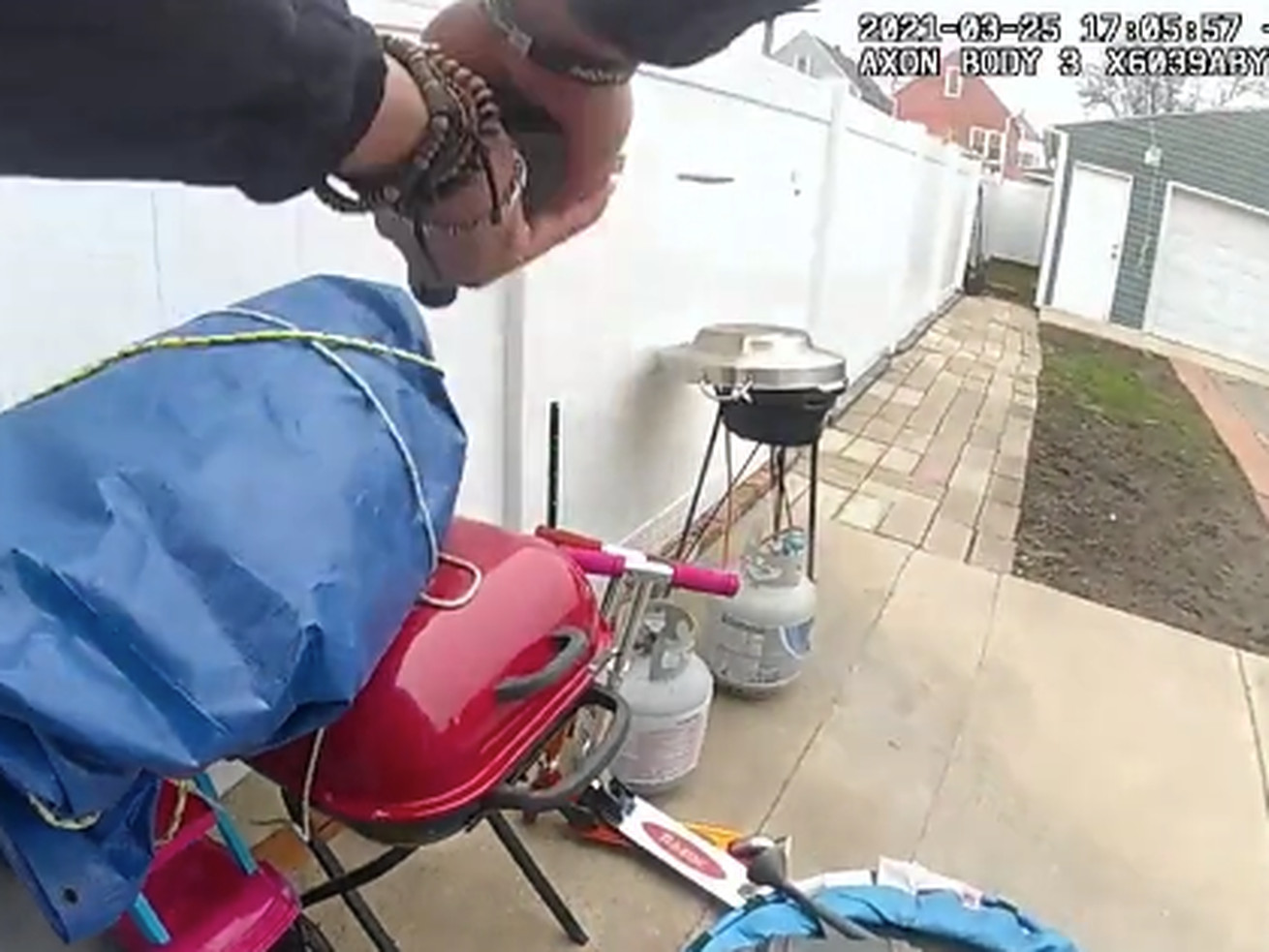
Screenshot of body camera footage released April 23, 2021, of a fatal police shooting in Little Village. | Civilian Office of Police Accountability
The officer chased the suspect into an alley and said, “What’s up, man?” A single gunshot can be heard as the officer starts to turn and duck into a gangway.
Police bodycam video released Friday shows an officer getting shot in the shoulder after confronting a man suspected of having just seriously wounded a security guard at a Little Village Home Depot last month.
Minutes later, another officer is seen lying in wait in a backyard as gunfire is heard. Climbing on top of a folding chair, the officer reaches over a white fence and shoots the suspect.
The suspect later died. The cop was released from the hospital later that night, but the guard, in his 50s, suffered a serious wound to the head. The officer was the fourth Chicago cop to be shot in two weeks.
The videos were released by the Civilian Office of Police Accountability, which reviews all police shootings. They capture the frantic moments after the suspect, 18-year-old Travon Chadwell, was confronted by a guard at a Home Depot store in the 2400 block of West 46th Street around 4 p.m. on March 25.
Warning: Graphic video
The guard had seen Chadwell allegedly shoplifting and started struggling with him and was shot, according to police.
One of the videos shows two officers arriving in their squad car near the store as police searched for Chadwell. “He’s running, he’s running, go get him,” one officer says.
One of them chases the suspect into an alley. As the officer turns the corner of a garage, he sees the suspect standing in the middle of the alley.
“What’s up, man?” the officer says.
In seconds, a single gunshot is heard as the officer starts to turn and duck back into the gangway. He falls to the ground and shouts, “I’m shot, I’m shot, I’m shot.”
Surveillance video from a nearby garage appears to show the suspect turn around and raise his gun toward the officer as the officer runs back toward the gangway.
His partner tells the officer to grab his gun and point it at the entrance to the alley as he drags the officer away.
More police cars pour into the scene and the suspect is cornered in the backyard of a home on 46th Street, between Western Avenue and Rockwell Street.
“Put the f- – -ing gun down, my man, it’s not f- – -ing worth it,” one officer yells as shots can be heard.
Video from a neighboring apartment shows a bystander stuck in the backyard, his hands raised while the standoff plays out. Officers eventually signal the man to run behind them into the alley while the suspect hides behind two SUVs, holding his gun.
Meanwhile, an officer is seen creeping into the backyard of a neighboring home, waiting, then setting up a folding chair near the fence. Three shots are heard, and the officer steps onto the chair and appears to fire three shots of his own.
“I got him, I got him!” he shouts.
Other officers surround the home and rush into the backyard, where the suspect is lying in a pool of blood, groaning. The officers immediately put Chadwell in handcuffs, then flip him onto his back to tend to his wounds.
An ambulance arrives at the scene about 5:15 p.m., 10 minutes after Chadwell was shot. The bodycam footage ends.
The standoff lasted about six minutes between the time Chadwell shot the officer and when he was shot by police. A police spokesperson could not give an update on the officer’s condition or if he has returned to duty.
COPA provided seven tactical response reports produced by the officers at the scene of the fatal shootout. The agency has not yet finished its investigation.
Though none of the footage shows Chadwell shooting the Home Depot security guard, COPA released an audio recording of the 9-1-1 calls to police.
“Someone got shot at the Home Depot at 47th and Western,” one caller says, distraught. “It was security, I heard the gunshot and saw a guy running.”
State Rep. Katie Stuart, D-Edwardsville. | From Facebook
The measure was backed by LGBTQ advocates, but state Rep. Katie Stuart, D-Edwardsville, said she was looking to the many businesses that want to have multi-stall gender neutral bathrooms “either because their patrons or their employees have asked for it. But our laws don’t allow it.”
SPRINGFIELD — The Illinois House passed a bill Friday that would allow businesses to offer multi-occupancy restrooms inclusive to all genders, a measure that the bill’s sponsor said was designed to allow caregivers to help those who need assistance.
But a Republican legislator cast the bill as the first step in requiring special bathrooms to benefit transgender patrons, which he argued would be unsafe for others.
The measure was backed by LGBTQ advocates, but state Rep. Katie Stuart, D-Edwardsville, said she was looking to the many businesses that want to have multi-stall gender neutral bathrooms “either because their patrons or their employees have asked for it. But our laws don’t allow it.”
“This bill is really about when you have a caregiver that’s an opposite gender, that they can now go in with their loved one such as a mother can go in with a son and help in the restroom,” she said. “And we’re talking about a normal bodily function, a human bodily function. That’s all we’re talking about.”
But state Rep. Tom Morrison said the bill would make women feel unsafe while sharing a restroom with transgender women.
“Once [a woman] exits a stall she could be in this very vulnerable position with somebody who may or may not pass as female,” said the Palatine Republican. “What’s happening is little by little these private spaces are being eliminated, and who’s ultimately hurt by this is women and girls.”
Rich Hein/Sun-Times fileState Rep. Tom Morrison, R-Palatine, in 2018.
He also argued that bill would lead to such bathrooms being mandatory, rather than optional.
“They start with ‘may,’ but expect this to be a ‘shall’ at some point,” he said.
Morrison listed several examples of male sexual predation in women’s bathrooms, saying Stuart’s bill “sets up that situation.”
In an interview with the Sun-Times on Friday, Stuart called Morrison’s comments “clearly transphobic.”
She argues that her bill doesn’t have anything to do with transgender Illinoisans. Residents of the state can already use the restroom for the gender with which they identify.
From Facebook.State Rep. Katie Stuart, D-Edwardsville.
A spokesperson for Equality Illinois, an LGBTQ advocacy group pushing the bill, called Morrison’s remarks a “distraction that shows he wants a license to discriminate in state law.”
“There’s been a lot of national legislation recently really targeting transgender individuals, and trans youth in particular. Tom Morrison has been the face of that effort in Illinois,” said Mike Ziri, the group’s spokesperson. “But what he doesn’t understand is that in Illinois our state values are justice, equality, inclusion, and the freedom to be who you are without discrimination.”
Earlier this month, Arkansas enacted a law banning physicians from providing gender- affirming hormone treatments to trans youth and another banning trans kids from participating in school sports. In 2019, Morrison introduced similar legislation in Illinois.
Stuart’s bathroom bill passed 63 to 43, along party lines and now goes to the state Senate.
The House also passed a bill Friday mandating that the Illinois Environmental Protection Agency ensure lead is removed from the state’s drinking water, despite Republican concerns the initiative could not be paid for.
“There is no safe level of lead in our state,” said state Rep. Lamont Robinson Jr., D-Chicago, the bill’s sponsor. “Everyone should be able to drink clean water without any issue and no matter what financial capabilities you have.”
Rich Hein/Sun-Times fileState Rep. Lamont J. Robinson, D-Chicago.
Republicans contended the measure would be funded by a fee on community water suppliers.
“I know my local utilities could not pay for this, and I’m 20 times smaller than the community you come from, so I am skeptical about the ability of us to be able to pay for this,” said state Rep. Steven Reick, R-Woodstock.
Robinson said that the consequences for “Black and Brown communities and particularly our youth” outweighed the Republicans’ fiscal concerns.
The bill passed the chamber in a 76 to 31 vote and moves to the Senate.
Other House bills passed Friday would raise from $9 to $18 a fee collected from homebuyers to support state-assisted housing, allow pregnant women in their third trimester to obtain temporary disability placards for their cars, and ban the use of some time outs and physical restraints in public schools.
On Thursday, a House Committee advanced a bill requiring potential gun owners to submit fingerprints to obtain a Firearm Owner Identification Card, after including provisions from a similar bill backed by the Illinois State Police, which oversees the FOID program.
The original bill would require background checks for private, in-person sales of firearms, fingerprints for a FOID card, and increase fees for that application.
The new provisions of the bill include the option of an electronic FOID and Concealed Carry License, a single application for those licenses, and the creation of a portal for state police to make sure persons with revoked FOID cards do not have access to firearms.
The bill’s sponsor, state Rep. Kathleen Willis of Addison, said that she had been “happy to incorporate the common sense ideas” of the other bill.
Illinois State Police Director Brendon Kelly spoke in favor of the legislation at the committee hearing, saying that the bill would alleviate “gaps in state record systems” and allow his agency to have “precise information to zero in on somebody who we all agree should not have a firearm.”
Kelly noted that the state police did not support provisions of the bill that would increase fees on FOID applicants or require those licenses to be renewed every five years instead of ten.
A representative from the Illinois State Rifle Association also took issue with those provisions, saying they would increase the cost of a FOID card by more than 300%.
Illinois’ average statewide COVID-19 testing positivity rate fell to its lowest point in three weeks Friday as public health officials reported 3,369 new cases of the disease.
They were diagnosed among 104,795 tests, sending the positivity rate down to 3.6% and continuing an 11-day streak without any increases in that key metric, which indicates how rapidly the virus is spreading.
The Illinois Department of Public Health also reported a third straight night of decreasing COVID-19 hospitalizations, easing concerns — for now — that a third statewide spike in infections that started last month could spiral further out of control. Hospitals across the state were treating 2,112 COVID-19 patients Thursday night.
Chicago’s regional positivity rate is down to 5.1% compared to 5.7% a week ago, while the city’s daily rate has fallen by 15%.
5 p.m. Indian hospitals plead for oxygen, country sets virus record
NEW DELHI — India put oxygen tankers on special express trains as major hospitals in New Delhi begged on social media on Friday for more supplies to save COVID-19 patients who are struggling to breathe. More than a dozen people died when an oxygen-fed fire ripped through a coronavirus ward in a populous western state.
India’s underfunded health system is tattering as the world’s worst coronavirus surge wears out the nation, which set a global record in daily infections for a second straight day with 332,730.
India has confirmed 16 million cases so far, second only to the United States in a country of nearly 1.4 billion people. India has recorded 2,263 deaths in the past 24 hours for a total of 186,920.
The fire in a hospital intensive care unit killed 13 COVID-19 patients in the Virar area on the outskirts of Mumbai early Friday.
The situation is worsening by the day with hospitals taking to social media to plead with the government to replenish their oxygen supplies and threatening to stop admissions of new patients.
4:15 p.m. US health panel urges restarting J&J COVID-19 vaccinations
A U.S. health panel says it’s time to resume use of Johnson & Johnson’s COVID-19 vaccine, despite a very rare risk of blood clots.
Out of nearly 8 million people vaccinated before the U.S. suspended J&J’s shot, health officials uncovered 15 cases of a highly unusual kind of blood clot, three of them fatal. All were women, most younger than 50.
But advisers to the Centers for Disease Control and Prevention said Friday the vaccine’s benefits outweigh that serious but small risk — especially against a virus that’s still infecting tens of thousands of Americans every day. The government will rapidly weigh that recommendation in deciding next steps.
3 p.m. Wisconsin Sen. Ron Johnson questions need for COVID-19 vaccinations
MADISON, Wis. — Republican Sen. Ron Johnson, of Wisconsin, questioned the need for widespread COVID-19 vaccinations, saying in a radio interview “what do you care if your neighbor has one or not?”
Johnson, who has no medical expertise or background, made the comments Thursday during an interview with conservative talk radio host Vicki McKenna. Contrary to what medical experts advise, Johnson has said he doesn’t need to be vaccinated because he had COVID-19 in the fall. On Thursday, he went further, questioning why anyone would get vaccinated or worry about why others have not.
“For the very young, I see no reason to be pushing vaccines on people.” Johnson said. “I certainly am going to vigorously resist any kind of government use or imposing of vaccine passports. … That could be a very freedom-robbing step and people need to understand these things.”
Johnson’s comments come as health officials in the U.S. and around the world urge people to get vaccinated for COVID-19 as soon as possible, saying that reaching herd immunity is the best shot at stopping the uncontrolled spread of the virus.
2:10 p.m. Payroll Protection Plan paid off for Illinois banks; see which of them got the most money
Illinois banks issued 239,000 loans under the federal Paycheck Protection Program worth $29 billion to businesses affected by the coronavirus pandemic — and collected at least $1.5 billion in fees ultimately paid by taxpayers, a Chicago Sun-Times analysis finds.
Chicago-based BMO Harris Bank got the most money in fees: at least $232 million for handling 34,000 loans that totaled $6 billion that the banking company’s top executive has said contributed heavily to “a good” first quarter of 2021.
BMO Harris’s PPP loans ranged from just $133 to the maximum amount allowed under the program — $10 million.
The 360 banks with headquarters in Illinois made loans through the program to businesses in all 50 states and four U.S. territories.
Illinois ranked 10th among states for total fees and seventh for dollars provided in the loans, which did not need to be repaid as long as businesses spent all of the money to keep employees on the payroll and pay rent and utilities.
1 p.m. US drop in vaccine demand has some places turning down doses
JACKSON, Miss. — Louisiana has stopped asking the federal government for its full allotment of COVID-19 vaccine. About three-quarters of Kansas counties have turned down new shipments of the vaccine at least once over the past month. And in Mississippi, officials asked the federal government to ship vials in smaller packages so they don’t go to waste.
As the supply of coronavirus vaccine doses in the U.S. outpaces demand, some places around the country are finding there’s such little interest in the shots, they need to turn down shipments.
“It is kind of stalling. Some people just don’t want it,” said Stacey Hileman, a nurse with the health department in rural Kansas’ Decatur County, where less than a third of the county’s 2,900 residents have received at least one vaccine dose.
The dwindling demand for vaccines illustrates the challenge that the U.S. faces in trying to conquer the pandemic while at the same time dealing with the optics of tens of thousands of doses sitting on shelves when countries like India and Brazil are in the midst of full-blown medical emergencies.
12:15 p.m. N95 masks, now plentiful, should no longer be reused: FDA
The Biden administration has taken the first step toward ending an emergency exception that allowed hospitals to ration and reuse N95 medical masks, the first line of defense between frontline workers and the deadly coronavirus.
Thousands of medical providers have died in the COVID-19 pandemic, many exposed and infected while caring for patients without adequate protection.
Critical shortages of masks, gowns, swabs, and other medical supplies prompted the Trump administration to issue guidelines for providers to ration, clean, and reuse disposable equipment. Thus, throughout the pandemic, once a week many doctors and nurses were issued an N95 mask, which is normally designed to be tossed after each patient.
Now U.S. manufacturers say they have vast surpluses for sale, and hospitals say they have three to 12 month stockpiles.
11:30 a.m. Limited number of walk-in COVID-19 vaccine appointments start today at city-run clinics
The vaccine “Hunger Games” are over.
After four months of frustration for thousands of residents who scrambled to claim fleeting batches of COVID-19 vaccination appointments, Chicago finally has enough doses to provide a shot to anyone who wants one, the city’s top doctor said Thursday.
Thanks to a “softening” of vaccine demand in other parts of Illinois and growth in supply provided by the federal government, “you can get one today, no excuses,” according to Chicago Public Health Commissioner Dr. Allison Arwady.
10:45 a.m. Topless clubs in Las Vegas among Nevada businesses allowed to reopen under COVID protocols
LAS VEGAS — Topless dancers in Las Vegas can soon shed coronavirus restrictions along with some of their clothing and once again get face-to-face with patrons under rules accepted Thursday by a Nevada COVID-19 task force.
But masks still will be required for adult entertainment employees and will still be recommended for customers.
Strip clubs that went dark when Nevada Gov. Steve Sisolak ordered casinos, clubs and nonessential businesses closed in March 2020 will be able to open May 1 at 80% of fire code capacity under strict social distancing guidelines.
The rules will allow strip club entertainers to get closer than three feet to patrons if the entertainer has gotten at least a first coronavirus vaccination 14 days earlier, according to county rules or if the dancers test negative in a weekly COVID test.
Occupancy limits will be relaxed but not completely lifted at many other businesses — stores, spas and saunas, restaurants and bars, even karaoke clubs — under a new reopening plan adopted by Clark County officials.
9 a.m. National Spelling Bee revamps to ensure single champion in pandemic-altered competition.
WASHINGTON– The Scripps National Spelling Bee is undergoing a major overhaul to ensure it can identify a single champion, adding vocabulary questions and a lightning-round tiebreaker to this year’s pandemic-altered competition.
The 96-year-old bee has in the past included vocabulary on written tests but never in the high-stakes oral competition rounds, where one mistake eliminates a speller. The only previous tiebreaker to determine a single champion was a short-lived extra written test that never turned out to be needed.
The changes, announced this week, amount to a new direction for the bee under executive director J. Michael Durnil, who started in the job earlier this year.
Wednesday, the Illinois Department of Public Health reported 2,765 new cases of the coronavirus diagnosed among 81,133 tests to keep the average statewide positivity rate at 3.8%. After doubling over the course of a month, that key metric has now fallen or held steady for nine straight days.
As of this week, more than 40% of Americans have received at least one dose of the COVID vaccine and 26% are fully vaccinated. Though it wasn’t planned this way, more normal human life is returning just as the redbuds, azaleas, magnolias and tulips are performing their gorgeous annual affirmation of renewal. Fears of catastrophic depression, widespread shortages and massive civil unrest are receding.
Hundreds of thousands of American families and millions worldwide are bereaved, and nearly everyone has experienced some form of disruption, pain or trauma during the past year. But not everything changed for the worse.
A recent Pew poll found that among adults whose jobs can be conveniently performed online, 54% would like to continue working from home after the pandemic is over. Another 33% said they’d like to do so part time. If employers agree, then that could mark a dramatic change in many areas of American life — less road congestion, reduced demand for office space and reduced greenhouse gas emissions from cars and buses. That also means less income for real estate landlords, bus drivers, restaurants, dry cleaners, delivery services and other businesses that serve office workers. There will be many dislocations and adjustments.
Ditka coached McMichael from 1982 to ’92 — nearly his entire Bears career — and thoroughly enjoyed it.
“I don’t want to say that you have favorites, but I would have to say that Steve McMichael was always one of my favorites,” Ditka told the Chicago Sun-Times on Friday. “There was no quit in the guy. He gave you what he had. Whether it was enough or not, it didn’t matter. You were going to get his best effort. And that’s what I love about him.”
The Bears signed McMichael in free agency in 1981 and hired Ditka the next year. In ’84, they kicked off an incredible run of 62-17 over five seasons and won Super Bowl XX.
While that ’85 team was loaded with stars and future Hall of Famers, McMichael stood out for his grit.
“The way Steve conducted himself and played for the Bears in those years is a great example to all the young players,” Ditka said. “He was a hard worker. He was a no-nonsense guy. He didn’t take any [garbage] from anybody, including his teammates. You had to love him. You had to love his spirit and the way he went about playing the game. He was special.
“He didn’t have all the talent that Richard [Dent] and Dan [Hampton] and some of the other guys had, but he gave it everything he had all the time, and you’ve gotta love that.”
Ditka added that McMichael, “wasn’t one of the big names, but he was one of the best football players we had.”
Ditka saw McMichael last year, and it was clear McMichael was having health problems. He was diagnosed with ALS in January and is paralyzed from the shoulders down. His wife, Misty, is his caretaker.


:no_upscale()/cdn.vox-cdn.com/uploads/chorus_asset/file/22465506/CV_UNION_033021_08.jpg) Ashlee Rezin Garcia/Sun-Times
Ashlee Rezin Garcia/Sun-Times

/cdn.vox-cdn.com/uploads/chorus_asset/file/22465167/Screen_Shot_2021_04_23_at_11.49.22_AM.png)
:no_upscale()/cdn.vox-cdn.com/uploads/chorus_asset/file/22466230/I290SHOOTING_042321_6.jpg)

/cdn.vox-cdn.com/uploads/chorus_asset/file/22466174/2018ELECTION_511.jpg)
/cdn.vox-cdn.com/uploads/chorus_asset/file/22466177/94583499_883970692027206_1605597176270946304_n.jpg)
/cdn.vox-cdn.com/uploads/chorus_asset/file/19105037/2018CANDIDATES_392.jpg)
/cdn.vox-cdn.com/uploads/chorus_asset/file/19239050/HEARING_101118_07.jpg)