Former Bulls trainer Jeff Tanaka is in his first season with the Fire. | Courtesy of the Fire
Tanaka became the Fire’s head athletic trainer last fall.
After spending 12 years with one Chicagosports team, Jeff Tanaka is adjusting to working with another.
Let go by the Bulls in May 2020 after the team hired executive vice president of basketball operations Arturas Karnisovas and general manager Marc Eversley to revamp the franchise, Tanaka became the Fire’s head athletic trainer last fall. When the Bulls moved on from him, the Sun-Times reported that Tanaka wasn’t being ‘‘scapegoated’’ for injuries but that the new brass wanted to bring in someone it chose.
‘‘It was disappointing, obviously,’’ Tanaka told the Sun-Times this week. ‘‘I had been there for 12 years, but you understand that that’s part of the business sometimes. New people come in and have the right to make decisions from a personnel standpoint.’’
The move to the Fire represents a shift for Tanaka, who was hired by the Bulls as an assistant trainer in 2008 after eight years with the 49ers. He was promoted to head trainer in 2014 and was a fixture in the Bulls’ organization during the Derrick Rose/Tom Thibodeau era, as well as during the team’s decline under John Paxson and Gar Forman that led to Karnisovas’ arrival.
Tanaka has experience he’s eager to apply to the Fire. At the same time, however, he’s leaning somewhat on the rest of their medical and performance staffs to learn some of the nuances about top-level soccer and soccer players.
One of the aspects Tanaka is adjusting to is the mindset of a soccer player compared to that of an NBA or NFL player.
‘‘I’m continuing to learn,’’ Tanaka said. ‘‘That’s one of the exciting things is to kind of branch out into another area that is newer and exciting for me.’’
While starting a new job can be tough at any time, Tanaka began a new one during an especially trying period.
Though vaccines are becoming more available and things are beginning to open up, the COVID-19 pandemic still is going and causes obstacles for Tanaka and his colleagues. That means managing COVID-19 protocols and handling issues that weren’t a part of the job description before last season.
Given all the challenges, Tanaka said he is ‘‘pretty happy’’ with how his new job is going as he spends more time with the Fire, builds relationships and gets into more of the soccer specifics. He said he has felt really supported since starting with the Fire and credited sporting director Georg Heitz, technical director Sebastian Pelzer, coach Raphael Wicky and the rest of the team for being ‘‘open-minded enough’’ to bring him on board.
‘‘They could have very easily stayed with a ‘soccer’ person,’’ Tanaka said. ‘‘That shows they’re kind of thinking out of the box, too. I’m appreciative of that. It’s still early on, but they’re on a good path with the staff, the coaches, as well as the players.’’
Cassie Miller was in goal for the Red Stars in the first two games of the 2021 Challenge Cup against the Houston Dash and Portland Thorns. | Rick Bowmer/AP
Pandemic threw a wrench in her plans last season, but she is finally getting an opportunity in ’21
Goalkeeper Cassie Miller’s National Women’s Soccer League debut came in 2020, but her experience with the Red Stars goes all the way back to her high school days.
In fact, Julie Ertz was a teammate when she was growing up in Arizona playing for the Sereno Soccer Club.
When the opportunity came to sign with the Red Stars and begin her NWSL career, it was a no-brainer.
“I committed to Florida State after my sophomore year of high school,” Miller said. “So I started training with the Red Stars every summer starting then.”
Miller said she realized she had a future in the game when she was 12 and began playing club soccer in Arizona, but her soccer goals have shifted several times.
When she graduated from Florida State, she decided not to pursue opportunities in the NWSL, opting to begin her professional career overseas.
It was important to experience the game internationally, so she signed her first professional contract with PSV in the Netherlands. After a year and a half, she signed with Apollon Ladies FC in Cyprus for a chance to compete in the prestigious Champions League.
Overseas, Miller says it’s a more technical game than in the NWSL which showcases speed and power.
In anticipation of the Tokyo Olympics, originally planned for 2020, Miller signed with the Red Stars, knowing there would be an opportunity in goal with Alyssa Naeher competing for gold in Japan.
When the pandemic forced a postponement of the Olympics, Miller went from competing to be Naeher’s replacement to spending an entire season learning from her.
It wasn’t a bad gig when your goals include becoming a No. 1 keeper in the league someday.
“I’ve always shown up and given 100% at training,” Miller said. “Watching her professionalism, how she takes care of her body, starts early and always kicks after training has taught me a lot. I really need to give that every single day if I want to get to that level.”
Miller’s plan to defend the goal in place of Naeher is being realized a year later than expected, and it hasn’t taken place without a healthy dose of competition.
Emily Boyd has been the Red Stars’ No. 2 goalkeeper for three years. When Miller arrived in 2020, Boyd was thrilled to have someone to compete with. When she tore ligaments in her knee playing for the Danish football club HB Køge after the 2020 Challenge Cup, that competition was halted.
Miller remembers hearing the news and immediately texting Boyd and offering her support. When Boyd came out of surgery, Miller was there to help her around her apartment.
When the 2021 Challenge Cup kicked off, Miller was in goal. She had a shutout in the Red Stars’ opening game against the Houston Dash and gave up a goal to the Portland Thorns’ Morgan Weaver in the second game.
Naeher returned to the Red Stars this week for the first time in 2021 but will leave in June for the Tournament of Nations and again in July for the Olympics.
By then, Boyd will have returned from injury and will be ready to compete to be Naeher’s understudy.
“She just keeps saying, ‘I’ll be back soon,’ ” Miller said. “It’s always been a healthy competition.”
Whoever plays, the Red Stars will be in good hands. Both keepers have learned from the best and continue to push each other.
If it’s Miller, she said there’s no pressure.
“It’s taking all the tools that I have from club level, college level, overseas experience, and when that whistle blows, knowing that I’m OK and I’ve gained that trust,” Miller said.
Oklahoma State forward Natasha Mack, right, and Stanford forward Cameron Brink (22) reach for the opening tip of an NCAA women’s tournament second-round game in San Antonio on March 23, 2021. | Stephen Spillman/AP
Sky coach Wade sees versatile forward playing significant role on defense
Natasha Mack was sitting with her family in Lufkin, Texas, on draft night. Her dream of making it to the WNBA that she had since she first picked up a basketball was about to come true.
Then, 12 picks went by, the first round ended and her name wasn’t called.
“My spirit went down,” Mack said. “At that point, I reminded myself what really mattered was getting drafted to a great team and making a difference once I got there.”
Mack has been reminding herself of the bigger picture her entire basketball career.
In high school, she was a four-star recruit on an average team that never made it to state. To her, that didn’t matter. Mack’s mentality was to let her work do all the talking. She knew that would take her to the next level.
Mack was heavily recruited and ended up choosing the University of Houston. She never played a game for the Cougars. Instead, she ended up returning to Lufkin before enrolling.
After falling out of love with the game, Mack said she took a job at a local chicken plant, Pilgrim’s Pride, on the west side of Lufkin.
“There are three things you can do in Lufkin,” Mack said. “You either have a rap career, play a sport or you’re up to no good.”
Mack spent almost a year at the plant before being recruited by Angelina College, a local community college. She parlayed a scholarship to Angelina into an eventual scholarship to Oklahoma State and the national spotlight.
In two seasons with Oklahoma State, Mack started in all 55 games she played, averaging 18.7 points, 12.4 rebounds and 3.7 blocks per game. In her senior year, she led the country with 112 blocks and broke her own single-season school record. She was named the 2021 WBCA Defensive Player of the Year, Big 12 Defensive Player of the Year and was a unanimous Big 12 All-Defensive Team selection.
When she heard her name called by the Sky with the No. 16 overall pick, she was relieved but surprised. Mack had no conversations with the Sky ahead of the draft. She spoke with the Seattle Storm, New York Liberty and Atlanta Dream.
When Wade called her after making the selection, Mack said he told her he didn’t know until about 30 minutes before that he would be taking her with the second-round pick. Wade’s expectations for Mack start with defense. He told her that’s where he needs her to make a significant impact.
Mack’s length, athleticism and ability to protect the rim are all qualities Wade loves about the versatile 6-4 forward. Still, she’s competing for a rookie contract, and Wade’s 20-player training-camp roster is the most competitive he has had since he was hired ahead of the 2019 season.
“There’s always a place for players like that in the league,” Wade said.
Mack arrived in Chicago for the first time a week before training camp and understood why it’s called the Windy City. Before her first week in the city was up, she already had tried deep dish pizza.
Training camp officially begins Sunday, and Mack is coming in with the same mentality that has carried her to this life-changing moment.
“I don’t talk much,” Mack said. “I show my game through my actions.”
Jay Bramblett’s solo takedown of Clemson top rusher Travis Etienne in a 47-40 Irish upset win in double overtime on Nov. 7 showed he’s more than just an ordinary punter. | Tony Ding/AP
His improbable tackle last fall has become a template for desire and determination.
SOUTH BEND, Ind. — The most memorable tackle of Notre Dame’s 2020 football season, non-Jeremiah Owusu-Koramoah division, belonged to Jay Bramblett.
Yes, the punter.
You may recall Bramblett, who doubles as the team’s holder on place kicks, standing his ground near midfield as Clemson’s Travis Etienne came roaring up the left sideline. This was last Nov. 7, on the final play of the first half of what became a 47-40 Irish upset win in double overtime.
Etienne, the leading rusher in Atlantic Coast Conference history, had just corralled a long field-goal attempt eight yards deep in the Tigers’ end zone. With Clemson trailing by 10, Etienne — halfway to a momentum-snatching kick six — was at full throttle as he took his 205 pounds and 4.4 speed into the clear.
“Look out!” play-by-play announcer Mike Tirico bellowed on NBC’s telecast. “Etienne might go!”
Incredibly, the 193-pound punter prevailed. Bramblett didn’t just trip up the hurdling Etienne — he practically form-tackled him.
A flurry of gold helmets swallowed up the rising junior from Tuscaloosa, Alabama, who had already shown his added value with a first-down run on a fake punt against Duke.
“I really pride myself on being somebody the team is going to lean on when a big play is needed,” Bramblett said this spring. “Obviously it’s not shiny and all great being a punter. You know you’re not the quarterback anymore, that’s for sure.”
Bramblett, who threw for 18 touchdowns and completed nearly 70 percent of his passes as a high school senior, may yet get the chance to use his arm from punt formation.
“With the importance of some of those plays, just being called upon is a pretty big deal to me,” Bramblett said. “I take that really seriously.”
In the stands that night at Notre Dame Stadium, Mike Bramblett couldn’t stop shaking his head. Defensive coordinator at Tuscaloosa Hillcrest during his youngest son’s standout career, the elder Bramblett laughed this week when asked how many tackles Jay made in high school.
“He’s made one in his lifetime, and you’re talking about it right now,” Mike Bramblett, now the head coach at Brookwood (Alabama) High School, said in a phone interview. “That gave me great information to bring back to our kids here. I told our kids, ‘He’s never worked tackling a day in his life, but it’s all about want-to and desire.’ If you want to make a tackle, you’ll make a tackle.”
The elder Bramblett, a high school punter in Pelham, Alabama, whose long snapper was future Clemson coach Dabo Swinney, still beams whenever someone brings up The Tackle.
“It certainly wasn’t the most graceful thing in the world, but he got it done in a big situation,” said Bramblett, who played baseball at Alabama-Birmingham. “I really feel like that’s his goal with everything that he does: ‘Just tell me what you want me to do, and I’ll do my best.’ ”
A baseball standout who could have been a two-sport athlete at a non-Power 5 school, Jay Bramblett chose Notre Dame after getting passed over by Clemson and hometown Alabama. The younger Bramblett, who counts NFL punters Ty Long (Chargers), AJ Cole III (Raiders) and Johnny Hekker (Rams) among his mentors, is among the nation’s best at killing punts deep in opponents’ territory. But it’s that takedown of Etienne, a potential first-rounder in next week’s NFL Draft, that has become the bullet point on his résumé.
Brian Polian, Notre Dame’s special teams coordinator, praises Bramblett for having the “mentality of a starting pitcher [or] a quarterback.” Bramblett’s job description may focus on relinquishing possession, but he wants the ball regardless.
“There’s a mental toughness there,” Polian said. “He’s not a sensitive guy. He takes coaching. It’s been a joy to work with Jay.”
As Mike Bramblett said of his son’s famous tackle: “He could have not gone full speed, could have taken the easy way out and fallen down and let him jump over you and keep running. But there was some determination to get it done. I’m so very, very proud of him for that.”
Billy Martin, Rick Telander, Roger Maris and Mickey Mantle | Provided
Columnist Rick Telander recalls a day 44 years ago when he shared company with three Yankees legends.
The bar in the lounge at the Hilton Hotel in Gainesville, Florida, was empty except for the four of us: Roger Maris, Mickey Mantle, Billy Martin and me.
It was Wednesday afternoon, March 23, 1977, and I was glad there was nobody else at the long, wooden bar because I didn’t want needless chaos and fan interference as I tried to get a handle on these famous baseball men for a Sports Illustrated story I was working on. The assigned piece was about Maris, but he was here in this unexpected reunion with his old Yankees pals, far from New York City, where they all had labored under the glare of the massed media. I couldn’t believe I was lucky enough to be along for the ride, a 20-something journalist, in awe.
Yet I also was concerned that Martin, in a bar, drinking (as we all were), might react badly if a rowdy crowd appeared. Martin had lots of combative precedents. He had punched a number of people and had gotten into bad fights in bars, lounges or wherever alcohol was served, even at the ballpark. It was hard to say which venue — bar or ballpark — was more loaded with tension for the high-strung former player, the slender, big-eared, big-nosed guy some called a genius and others called an idiot, now managing the Yankees.
Indeed, the year after our gathering, after getting fired halfway through the 1978 season, Martin would punch a young sportswriter named Ray Hagar, chipping several of Hagar’s teeth. There would be Martin’s barroom belting of a marshmallow salesman in 1979, with people lavishing ridicule on that incident. A marshmallow salesman? Oh, Billy, you kid!
Back in his playing days with the Yankees in 1957, Martin had been involved in a barroom brawl with five of his teammates, including Hank Bauer, Whitey Ford and Mantle, at the Copacabana nightclub in Manhattan. Yankees general manger George Weiss blamed Martin for the fight, even though Bauer allegedly threw the first punch at the foes, and Martin was traded at the end of the season to the Athletics.
The fights would go on incessantly, it seemed, including with opponents and later even players he was managing, such as the famous near-dustup with star Reggie Jackson in the Yankees’ dugout, which would occur a few months after our meeting in Gainesville, a nasty, vein-bulging snarl match caught by national TV for a stunned audience.
Yankees coaches Elston Howard and Yogi Berra held back Martin the way you might a rabid Tasmanian devil, and player Jimmy Wynn held back the profanity-spewing Jackson, who was 18 years younger than Martin and outweighed him by 35 pounds. But Martin was going to go, size be damned, no question about it. This wasn’t a hold-me-back act. This was pure Billy.
Former Yankees beat writer Bill Pennington epically would describe Martin as ‘‘one of the most magnetic, entertaining, sensitive, humane, brilliant, generous, insecure, paranoid, dangerous, irrational and unhinged people I had ever met.’’
I had determined from the start I would stay calm and not become Martin’s next KO.
Ray Stubblebine/APYankees manager Billy Martin sits in his office in this 1978 photo.
How had this hotel-bar reunion even occurred?
I had been with Maris for a day, much enjoying his decency and openness, and was pleasantly surprised that instead of flaring with repressed anger over his remarkably stressful 1961 season — when he hit 61 home runs, breaking Babe Ruth’s 34-year-old record of 60 — he was delighted to talk about the chase and his ultimate success.
The press had been demanding and, at times, vicious toward him in ’61. He told me about sitting for two, three, four hours at his locker after games simply to appease the requests. He tried to give them what they needed, but this was New York, with its maelstrom of media outlets, and the beast was insatiable.
The stress got to the All-Star right fielder, and his hair began to fall out in patches as the season progressed. His wife visited from Kansas City, where she and the kids lived during the season — Maris never would bring them to the crazed hellhole of New York — and she said he looked like a molting bird.
And how the writers described him! If Martin had elicited some wildly divergent adjectives from Pennington, Maris outdid him in spades. These are but some of the adjectives I dug up about Maris from 1961: ‘‘shy,’’ ‘‘quiet,’’ ‘‘decent,’’ ‘‘devout and home-loving,’’ ‘‘stubborn,’’ ‘‘hot-headed,’’ ‘‘low key,’’ ‘‘easily agitated,’’ ‘‘surly,’’ ‘‘direct,’’ ‘‘honest,’’ ‘‘silent,’’ ‘‘morose,’’ ‘‘unselfish,’’ ‘‘reticent,’’ ‘‘choleric,’’ ‘‘wonderful,’’ ‘‘petulant,’’ ‘‘self-pitying,’’ ‘‘constantly irritated,’’ ‘‘trite,’’ ‘‘sincere,’’ ‘‘self-possessed,’’ ‘‘sensible,’’ ‘‘straightforward,’’ ‘‘cooperative,’’ ‘‘talkative,’’ ‘‘likable’’ and ‘‘soft-spoken.’’
Until I met Maris, it was literally impossible to know what the man was like. The curse of incessant, in-depth media coverage and its unintended and ironic tendency to obscure, even obliterate, rather than emphasize facts had hit the modern world.
But the Yankees were leaving spring training in Fort Lauderdale, Florida, getting ready for the season to start, and owner George Steinbrenner had made a charitable gesture and decided his team would play an exhibition game against the University of Florida before heading back to the Bronx. Florida was his adopted university, for some reason — his alma maters were Williams College and Ohio State — and he just had purchased lights for McKethan Stadium, the Gators’ baseball field.
The whole Yankees caravan was coming to this college town, and it seemed as though almost nobody knew about it. But Maris sure knew. He had been almost quivering with anticipation as we waited for the buses to show up at the hotel.
We ate lunch as we waited at that Hilton bar, and Maris, who owned the Busch beer distributorship in Gainesville — which he bought but was also something of a friendly sendoff deal from Cardinals owner August Busch after Maris finished his career in St. Louis — was pulling at his tie and seemed uncomfortable in his dress shirt, blazer, slacks and shiny wingtips.
And his longer, more fashionable combed hair — so different from the Marine-style flat-top of his playing days — he wasn’t much of a fan of that, either.
‘‘I don’t know about this stuff,’’ he said.
He was an athlete, regardless of age. It was clear he was an outdoor man wearing an inside man’s costume. In high school. he had been an electric football player, once running back three kick returns and an interception for touchdowns in a game. Besides being a naturally strong man with big quads and blacksmith’s wrists — his best playing weight for his slightly shorter than 6-foot height was about 205 pounds, he said — he also could move. As a young player, he was fast and agile and a good fielder with an excellent arm. His two American League MVP awards didn’t come just because of his hitting power.
‘‘You know, I’m about this close to getting a crewcut again,’’ he said. ‘‘I really am. It’s hard these days when athletes and professors and everybody has long hair. It’s hard for me to tell my kids to get theirs cut.’’
One thing he emphasized was how much he loved his children — all six of them — even though, after the ugliness he had been through in New York, he said he never should have named his first-born son Roger Maris Jr. But the boy was born in 1959, two years before the craziness of the home-run chase.
‘‘How would you know?’’ Maris asked, almost to himself.
In truth, the 1961 baseball season was like no other. The AL had added two new teams and the season expanded from 154 to 162 games. Old-boy commissioner Ford Frick did incalculable damage to the game (and, yes, to Maris) when he abruptly decided midway through the season that Maris and Mantle, both of whom were hitting homers at a record pace, could not officially break the season record unless they did it in 154 games.
‘‘You can’t break the 100-meter record in the 100-yard dash,’’ Frick famously declared.
If Maris hit 61 in 162 games, he’d get a ‘‘distinctive mark’’ demeaning his record, said Frick, a former ghostwriter for — and pal of — Ruth. Frick never said the word ‘‘asterisk’’ specifically — that was offered to him as a solution by caustic New York Post sports columnist Dick Young — but the unofficial asterisk behind Maris’ record was in place until commissioner Fay Vincent declared it dead and gone in 1991, ending 30 years of virtual shame for what should have been baseball’s — and Maris’ — proudest moment.
APRoger Maris heads for home after hitting his record-breaking 61st home run in 1961.
Imagine, only 23,000 people were at vast Yankee Stadium to see Maris hit No. 61 in the fourth inning of the last game of the season. It wasn’t a cheap homer, either. It was the only run in the Yankees’ 1-0 victory against the Red Sox.
I have a news clip in my file that points out that a distant newspaper, the Green Bay (Wisconsin) Post-Gazette, didn’t even have Maris’ record blast on the front page of its sports section. Nope, just lots of analysis of the Packers’ fresh 24-0 shutout of the Bears. The overdue erasure by Vincent of the ‘‘asterisk’’ stain, sadly, did Maris no real good. He had died six years earlier of lymphatic cancer at 51.
For many years, I’ve thought of Frick’s name in asterisk terms of its own: ‘‘Ford F*ck.’’
Fans at away parks had booed Maris loudly. Fans even booed him at Yankee Stadium because he was chasing the immortal Babe and simply wasn’t worthy of such fame. There were so many things lacking in Maris, media-wise, that it was a no-brainer for opinion writers. He was in New York — ‘‘the Volcano,’’ for God’s sake — and yet he cared not a whit because he was a country fellow, born in Hibbing, Minnesota, and raised in Fargo, North Dakota.
It could be argued this decent small-town man (his high school didn’t even field a baseball team), who married his high school sweetheart, was the first sports star in history to be hounded by a multiheaded media monster that wanted gossip, opinion and scandal more than it wanted news.
Indeed, at that time, there was not another record in American sports more hallowed than Ruth’s 60 homers. And the way so many stories went, that record was not being beaten; it was being trashed by a low-level creature. In 1963, one writer would sum it up thusly: The trouble with Maris was not that he had problems with the press but that ‘‘he has proved to be such an unsatisfactory hero.’’
That’s kind of funny when you think about it now. Do you even know who owns the home-run record and what it is?
Well, it’s Barry Bonds, and the number is 73. A ridiculous number. Truly. Put up by a ridiculous man in 2001, a jealous man who had seen Sammy Sosa hit 66 in 1998 and Mark McGwire outdo him that same season with 70 and both get all kinds of attention. Bonds didn’t like this. Not at all. So he got huge and became a sledgehammer man. All three of those men are ridiculous. All three — the only ones to surpass Maris — forever are linked to steroids and other illicit performance-enhancing drugs. Maris drank beer at times and smoked Camels to help with stress. That’s all the doping he did.
But he was cool now, on this day, years before meatheads such as Jose Canseco and his ilk would make steroid culture baseball culture.
And here came the Yankees, slowly exiting a pair of luxury buses. Maris stood just inside the doors of the hotel lobby, like a greeter at a convention. He nodded at Dock Ellis, Chris Chambliss and Lou Piniella. He shook hands with Catfish Hunter and Roy White. He greeted Graig Nettles and Howard. And he had a huge handshake for Yogi Berra. He had an even bigger one for Martin, to go along with an immense smile and babbling small talk with his old pal. Then he saw Mantle.
‘‘Look who did make it!’’ he exclaimed.
And their embrace was warm, genuine, exuberant. The media tried to paint the two as intense rivals, even enemies. Mantle was the greater player — everybody knew that — so he should have been the home-run king. Such was the logic.
In fact, Mantle might have gotten to 61 homers first in 1961, but a late-season injury derailed him, and he missed a number of games. Even so, he finished with 54, and the combined 115 for the ‘‘M&M boys’’ set the record for homers by a pair of teammates in a season.
They truly liked each other and always had. Mantle, three years Maris’ senior, always had helped his teammate, soothed him during his torment. They even roomed together.
John Rooney/APMIckey Mantle and Roger Maris pose in the Yankees locker room after both homered in a 1961 doubleheader against the Washington Senators.
Sure, as the skeptics noted, you had to throw lots more strikes to Maris, couldn’t walk him, made it easy for him, because you didn’t want to get to the switch-hitting Mantle with a man on base. And there was that short right-field wall at Yankee Stadium helping Maris, a left-handed pull hitter.
And there were other things, too. All so wrong, so unfair, critics wailed. Forget facts. Such as the truth that Maris hit more homers on the road in ’61 than he did at the cozy-for-him ‘‘House That Ruth Built.’’
But here these three buddies were now, and the ‘‘M&M&M boys’’ quickly repaired to the bar, and the stories began. A lot of the stories were racy, off-color and juvenile because these were, after all, overgrown kids. Maris hadn’t been back to Yankee Stadium in more than a decade and didn’t want to go, even for the fun-filled old-timers’ game. (‘‘I might get shot,’’ he had said earlier, meaning it.) But baseball is the quintessential kid’s pastime, the sport any gaggle of young Americans will start playing in any sandlot anywhere if a bat, ball and gloves are handy. And you don’t grow up if you think about baseball endlessly.
Beers were ordered — Anheuser Busch products, of course — and the yarns began.
‘‘So we were in this bar the other night, and this stool was in the aisle,’’ said Mantle, who was serving as a sort of emeritus batting instructor for the Yankees. ‘‘And I didn’t see it and stumbled into it. And this guy who was there — ’’
‘‘Yeah, this guy,’’ Martin interjected, ‘‘he says, ‘Mantle’s drunk again.’ And I said, ‘‘ ‘A—hole, we didn’t come here to get sober!’ ’’
They all laughed. And slowly, through their posture and words, their personalities emerged.
Maris was the steady, non-profane, good-natured pal who had zero interest in controversy. Unlike the other two, both blooming alcoholics, he hadn’t much interest in drinking, either. At lunch, when the place didn’t have the Natural Lite beer he wanted, he shrugged and drank water instead.
Mantle, in his open-necked shirt, wide-checked jacket, deep tan, light-blue eyes and blond bangs — all of which still could be discerned in the dim bar light — seemed as easygoing as his Oklahoma drawl. He looked like a handsome and charming, if heavy-drinking, lady-slayer. And, truth be known, he was.
Then there was Martin. If the other two were broad-shouldered, thick-necked, big-armed lions, he was wiry and narrow and resembled a weasel more than a cat. His mustache and beige hipster leisure suit, accessorized with tooled cowboy boots and a $20-goldpiece string tie, identified him as a man on the move. He was sharper and more cunning than the other two but always impish, ready to take charge and make sure things happened the way he wanted. It was no accident Steinbrenner would hire and fire him five times through the years.
‘‘I’ll have a Schlitz,’’ Martin said to the bartender, just to get a rise out of Maris.
All three men had father issues. Maris’ dad, Rudy, was big, tough and mean, and he and his wife, Ann, had a turbulent marriage. They finally divorced when Maris was in his late 20s, but the sting never went away.
Mantle’s dad, Mutt, died at 39 of Hodgkin’s disease. Mutt’s father, Mantle’s grandfather, died in his 40s. Mutt’s two brothers, Mantle’s uncles, died in different years at 34 from separate forms of cancer. Because of this history, Mantle never thought he would live to see 50. When he finally went to alcohol rehab at the Betty Ford Clinic at 62, he told the counselor he drank from depression because he never lived up to his father’s dream for him to be the best ballplayer ever.
This was crazy, of course. Mantle played 18 years for the Yankees, hit 536 homers, was named AL Most Valuable Player three times, won the Triple Crown in 1956 and hit more homers in World Series play than anyone. And he was a near-unanimous selection for the Hall of Fame. But a father’s presence never exits a son’s mind.
All you had to do was consider Martin, who didn’t meet his father until he was 14. That assuredly helped build his explosive core, fueling some kind of frantic search for something he never had and fighting anything in the way. The problem with Martin, Frank Deford had written, ‘‘is that he is a terribly complicated personality — not necessarily sophisticated-complicated, more ironic-complicated.’’ Deford added that because of insecurities Martin ‘‘finds liars, back-stabbers, cowards, bullies and other blackguards lurking about, anxious to do him in.’’
At the game that night, Maris talked with Jackson in the dugout, the two homer-hitting Yankees right fielders from different generations sharing thoughts only they could know so well.
‘‘Looks like a Budweiser tie,’’ Jackson said with a laugh.
‘‘No, just to hide the boiler,’’ Maris said, patting his ample belly.
They joked around, then Maris said, ‘‘Boy, times have changed.’’ The topic now was money. Serious.
‘‘People talk about high salaries,’’ Jackson said. ‘‘Well, I tell them I remember when gas was 21 cents a gallon. Now it’s 65 cents. You know, after our third World Series championship [in 1974 with the A’s], I got a $2,500 raise. After hitting .289 with 29 home runs. Kenny Holtzman had 19 wins that year and didn’t get a raise.’’
‘‘The highest I got was in 1961,’’ Maris said. ‘‘Never got anymore. So I said: ‘‘I’m just biding my time. Just biding my time.’ ’’
Nobody knew it yet, but the Yankees would win the World Series that season, Martin and Jackson almost would come to blows and Martin would get fired by Steinbrenner in the middle of the next season. The Yankees would win the Series that season, too, but Bob Lemon would finish as their skipper, becoming the winning manager of record. The Yankees wouldn’t win a championship again for 18 years, by which time Maris, Mantle and Martin all would be dead.
Shockingly, Mantle would live the longest, though he was sure he would die the soonest. He died in 1995 at 63, shortly after his alcohol rehab stint. Martin died, drunk, as a passenger in a single-car accident, the car driven by another drunk, on Christmas Day 1989. He was 61.
By many measures, none of these men had wonderful lives. They were haunted by tragedy, despite their successes in an invented game. Their short lives only made their triumphs bittersweet.
Back at the hotel bar, Martin, Maris and I had ended up in the men’s room, at various urinals, at the same time.
‘‘Hey, Rog,’’ Martin said. ‘‘Did you ever see the ninth episode of ‘Roots’?’’
‘‘No,’’ Maris said.
‘‘Yeah, it’s the one where they teach them to play basketball.’’
There was light chuckling but nothing sincere. There would be insinuations, some coming from Jackson later, that Martin had a redneck streak, that he told racist jokes and maybe was a bit of a racist himself. Other players, some Black, would defend Martin, saying that wasn’t the case.
I heard the joke, found it startling in its inherent assumption that neither I nor Maris nor anyone else who might have been in the restroom at that moment would be offended by it and didn’t know what to think. I had watched as Martin got a little more toasted with each succeeding beer, saw him state a few things maybe a trifle too loudly, looking down toward where a couple of newcomers were drifting in, as though hoping for a wiseguy response from somebody, anybody. Something that could lead to a fight.
But I also didn’t think his ugly joke was coming from an essential racist. Rather, it felt as though it was coming from someone who was angry — at what, I couldn’t tell — and hoping to start controversy simply for its own sake. Martin seemed like a man who needed conflict, wanted to bask in it. Maybe I was wrong, but that’s how it seemed.
At the night game a few hours later, Maris sat smiling at the far end of the dugout with three of his young boys scattered about, a loving dad in his element, cheering on Mickey Rivers, Jackson, Willie Randolph. Next to him sat Mantle in his Yankees uniform, chowing down on peanuts. Sure, he was a batting coach, but basically he was Mickey Mantle. That was his job: Be Mickey.
In the seventh inning, Maris looked at his old pal and said, ‘‘Hey, Mick, after signing all those autographs today, you gonna take a shower?’’
‘‘You weren’t here earlier,’’ Mantle said. ‘‘I was shagging flies.’’
They both laughed. Over near the action, Martin was hollering toward the pitchers mound, ‘‘Have an idea out there!’’ He was managing away.
I am reminded of the time at Yankee Stadium when I unwittingly got on an elevator with Joe DiMaggio, just the two of us. He was in a dark-blue suit with a thin blue tie. I said hi. He said hello. And then somehow we were talking about Yankees baseball history, and he said that what was on his mind, like an unextractable thorn in his side, was a fly ball he should have caught in a game maybe 50 years before and didn’t. He didn’t know why. He could have, but he didn’t. It haunted him. And I felt bad for him. How crazy it was. How hard to define victory, success, joy.
And so what I wanted to remember about that time in the bar in Gainesville in 1977 was what it shortly would lead to — a baseball game with Maris, Mantle and Martin all at peace, secure in the ambience of what they knew best, if only until the last out. It is still, for me, a beautiful image.
Robert Redford as Roy Hobbs in ‘‘The Natural’’ | Provided
Just in time for the Oscars, our movie man reveals his best baseball film ever, and his picks in many other categories
Here’s the windup and the pitch.
With the 93rd annual Academy Awards taking place Sunday night, we thought this would be the perfect (game) time to hold the Baseball Movie Awards, with an academy of one (yours truly) selecting the all-time best actors, actresses, one-liners, et al.
Batter up!
Best Supporting Actress
Amy Adams, “Trouble With the Curve”
Kim Basinger, “The Natural”
Glenn Close, “The Natural”
Rosie O’Donnell, “A League of Their Own”
Kelly Preston, “For Love of the Game”
And the winner is…Kelly Preston, who gave a grounded, funny, authentic performance as single mother Jane Aubrey, who brings out the best in veteran Detroit Tigers pitcher Billy Chapel. Even when Billy is on the mound in his final start and going for a perfect game against the Yankees, it’s Aubrey who’s there with him every pitch of the way.
Best Supporting Actor
Wilford Brimley, “The Natural”
Harrison Ford, “42”
Tom Hanks, “A League of Their Own”
James Earl Jones, “Field of Dreams”
Philip Seymour Hoffman, “Moneyball”
And the winner is…It’s a tie between Tom Hanks (“THERE’S NO CRYING IN BASEBALL!”) and James Earl Jones (“People will come, Ray. People most definitely will come…”)
Hey. They’ve had six ties at the Oscars—most famously when Katharine Hepburn and Barbra Streisand had an equal number of votes for Best Actress of 1969—so we can have a tie as well. We’re the Academy!
Best Actress
Drew Barrymore, “Fever Pitch”
Nicole Beharie, “42”
Geena Davis, “A League of Their Own”
Amy Madigan, “Field of Dreams”
Susan Sarandon, “Bull Durham”
And the winner is…Geena Davis. All due respect to the other nominees, but they were on the sidelines rooting for their significant others. Geena took the field and played the game.
Best Actor
Chadwick Boseman, “42”
Gary Cooper, “The Pride of the Yankees”
Kevin Costner, “Bull Durham”
Brad Pitt, “Moneyball”
Robert Redford, “The Natural”
And the winner is…Robert Redford. Legend—and it’s more legend that documented history–says Redford played baseball with future Dodgers great Don Drysdale when they were kids, and Redford had enough “natural” talent to warrant a tryout with the baseball team at the University of Colorado. (Redford’s baseball back story is about as murky as Roy Hobbs’.) Regardless, the aging Golden Boy certainly looked the part at the plate and on the field wearing No. 9 for the New York Knights.
Best Picture
“The Bingo Long Traveling All-Stars & Motor Kings”
“Bull Durham”
“Eight Men Out”
“Field of Dreams”
“The Natural”
And the winner is…“The Natural.” Critics say it’s corny, sappy, sentimental and basically a fairy tale—and that’s exactly why it’s my favorite baseball movie of all time. BASEBALL is corny, sappy, sentimental and basically a fairy tale!
Also in our lineup: a number of categories they DON’T have at the Oscars:
Best Baseball Scene That Doesn’t Take Place on a Baseball Field
Young Roy Hobbs (Robert Redford) strikes out the Babe Ruth-like Whammer (Joe Don Baker) in a sun-dappled field near a locomotive train and a summer carnival in “The Natural.”
Most Ferocious Use of a Baseball Bat in a Non-Baseball Movie
Robert De Niro as Al Capone proves to be the ultimate contact hitter in “The Untouchables.”
Best Baseball Movie of This Century You Might Not Have Seen
“Sugar” (2008), with Algenis Perez Soto as Miguel “Sugar” Santos, a Dominican pitcher trying to make it to the big leagues.
Least Believable Portrayal of a Chicago Softball Player
Rob Lowe, “About Last Night…”
Best Non-Baseball Scene in a Ballpark
John Candy takes Ally Sheedy to a picnic on the field in Comiskey Park in “Only the Lonely.” (The scene was filmed in October 1991, not long after the last White Sox game at the old ball yard.)
Best Fictional Villain in a White Sox Uniform
David Keith’s Jack Parkman in “Major League II.”
Best Baseball Mom
Oak Park native and Steppenwolf great Amy Morton (aka Chicago Police Sgt. Trudy Platt in “Chicago Fire/Med/P.D.”) as Henry’s mother in “Rookie of the Year.”
Best Score (Musical, That Is)
Randy Newman, “The Natural.” By a country mile.
Best Movie About Being a Baseball Fan
“Fever Pitch”
Worst Movie About Being a Baseball Fan
“The Fan”
Best Sportswriter(s)
Studs Terkel and John Sayles as real-life, legendary sports reporters Hugh Fullerton and Ring Lardner, respectively, in the Sayles-directed “Eight Men Out.”
Most Hiss-Worthy Sportswriter
Robert Duvall’s cynical Max Mercy in “The Natural.”
Best Catch of a Foul Ball by Fan
Ferris Bueller grabs a foul ball off the bat of the Braves’ Claudell Washington at Wrigley Field on June 5, 1985.
Most Ridiculous Catch of a Home Run by a Fan
In “Mr. Destiny,” the Cubs’ Mark Grace hits a homer against the Angels in the World Series, and Jim Belushi literally swings from a foul pole that appears to be in in fair territory to make the catch.
Best Announcer
Harry Doyle, aka Bob Uecker in “Major League.”
Lifetime Achievement Award
Kevin Costner, for “Bull Durham,” “Field of Dreams” and “For Love of the Game.”
Honorable mention: Charlie Sheen, for his performances as Ricky “Wild Thing” Vaughn in the “Major League” movies, and as White Sox center fielder Happy Felsch in “Eight Men Out.”
Best One-Liner not from “Field of Dreams,” “A League of Their Own” or “Bull Durham.”
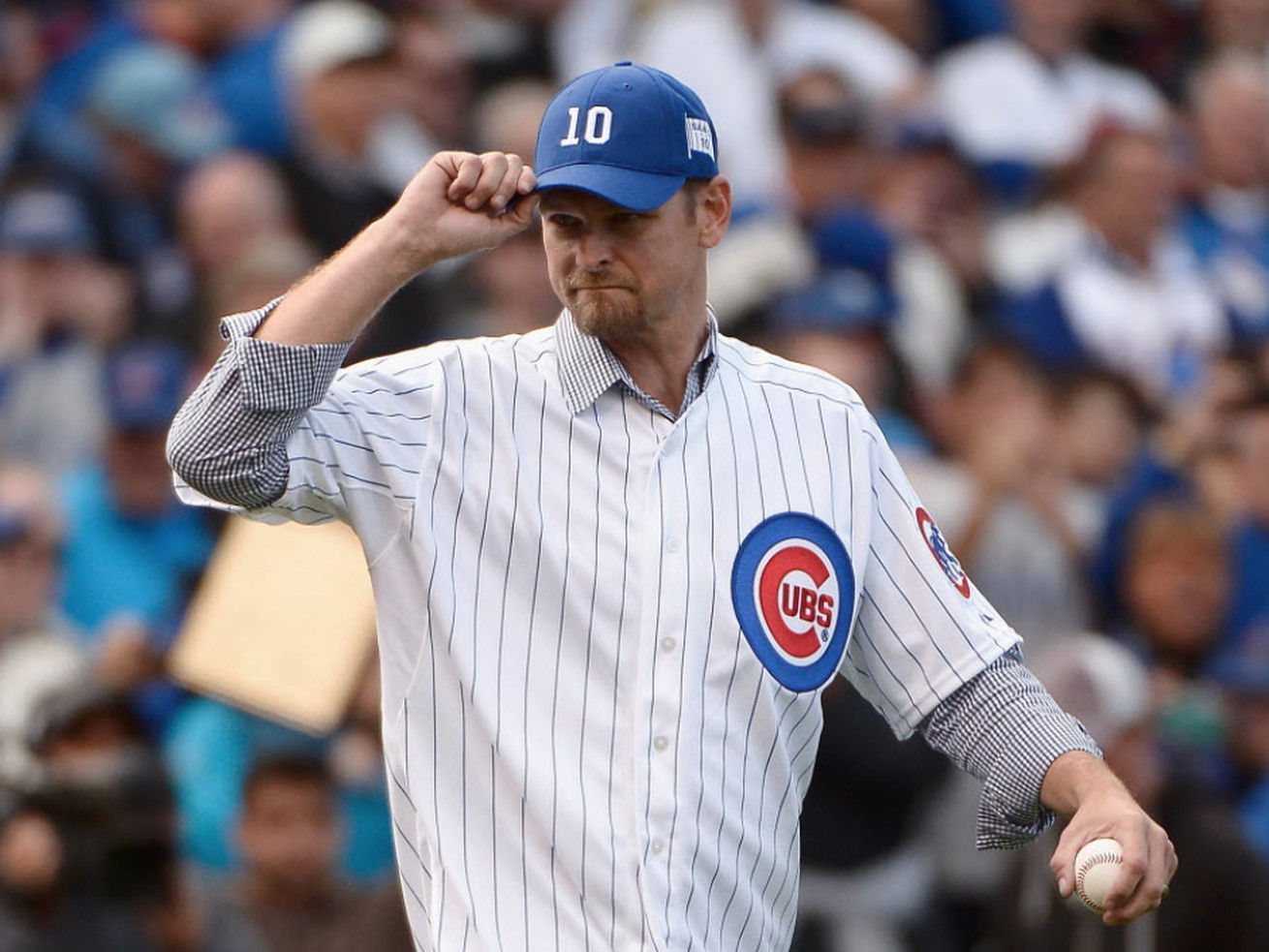
Former Chicago Cubs pitcher Kerry Wood is introduced prior to game four of the National League Division Series between the Chicago Cubs and the St. Louis Cardinals at Wrigley Field on October 13, 2015 in Chicago, Illinois. | David Banks/Getty Images
There will be a nice mix of Cubs and White Sox and a blend of history and current events
Welcome to the Sun-Times Chicago Baseball Quiz, I am your quizmaster, Bill Chuck. These quizzes are designed to be fun and can be played on your own or you can test your family, friends, neighbors, or colleagues. The questions are easy if you know the answers. But rest assured, they are multiple choice, so you can always guess. Other than stats, there will be no math. There will be a nice mix of Cubs and White Sox and a blend of history and current events. Baseball is filled with great facts and stories, so there is no need for the questions to be obscure (“Who was sitting next to Steve Bartman?”).
Are you ready for the Chicago Nine?
Play ball!
1. Three of these guys struck out in their first official at-bat in the majors, who didn’t?
a. Kris Bryant
b. Jose Abreu
c. Yoan Moncada
d. Javy Baez
2. Who is the only White Sox with multiple three-homer games?
a. Paul Konerko
b. Frank Thomas
c. Harold Baines
d. Jose Abreu
3. Which Cubs pitcher holds the record for most double-digit strikeout games in a season? Give yourself bonus points if you know how many and in what year.
a. Kerry Wood
b. Ferguson Jenkins
c. Yu Darvish
d. Carlos Zambrano
4. In regular interleague play, in the match-up between our two teams, only one pitcher has six wins (that’s the most). Who is he?
a. Jon Lester
b. Mark Buehrle
c. Jake Peavy
d. Carlos Zambrano
5. The great Hall of Famer Eddie Collins hit .335+ for the Sox in six different seasons. In three of those seasons, he had the same number of strikeouts. What were his strikeout totals for each of those seasons?
a. 19 c. 8
b. 16 d. 11
6. The most recent White Sox pitcher to homer was?
a. Mark Buehrle
b. Anthony Ranaudo
c. Jon Garland
d. Gary Peters
7. Lucas Giolito and Adam Eaton have a connection. What is it?
a. They are brothers-in-law
b. They were traded for each other
c. They went to college together
d. Eaton has hit two homers off Giolito
8. Who was the last Chicago Cy Young Award winner?
a. Chris Sale
b. Jack McDowell
c. Jake Arrieta
d. John Danks
9. Which happened first?
a. Jose Abreu hit for the cycle
b. Kris Bryant hit for three homers and two doubles in the same game
c. Jon Lester earned his 150th win
d. Ian Happ/Jason Heyward/Kyle Schwarber (all three outfielders) each hit two home runs in the same game
QUIZ ANSWERS
1. While Yoan Moncada walked in his first PA, he struck out in his first AB. Jose Abreu doubled in his first at-bat. 2. Harold Baines in 1982 against the Tigers and 1984 against the Twins. 3. Kerry Wood had 11 games of 10+ strikeouts in 2003. 4. Carlos Zambrano, with six wins against the Sox. 5. In 1926, Eddie Collins hit .344; in 1925, Collins hit .346; and in 1923, Collins hit .360, and each season he struck out just eight times. 6. Anthony Ranaudo on July 27, 2016, against Jason Hammel of the Cubs. Ranaudo took the 8-1 loss. 7. On December 7, 2016, the Sox traded Adam Eaton to the Nationals for Lucas Giolito and two other players. 8. Jake Arrieta won the NL Cy Young in 2015. 9. Kris Bryant hit for three homers and two doubles in the same game on June 27, 2016, against the Reds.
The ChicagoBears have been one of the most mediocre teams in all of football over the last few seasons. They went 12-4 in 2018 and everybody thought that a period of sustained success was on the horizon. They followed that with 2019 and 2020 seasons that both ended at 8-8. The 2020 season ended […]
The possibilities are, in fact, endless for the ChicagoBears as they enter the 2021 NFL Draft. Looking at the facts, no one truly knows what will happen. General manager Ryan Pace was given yet another year in Chicago, but we are not sure if this is his last chance or not. Knowing George McCaskey […]




/cdn.vox-cdn.com/uploads/chorus_asset/file/22465668/AP755997847938.jpg)
/cdn.vox-cdn.com/uploads/chorus_asset/file/22465724/AP45355284386.jpg)
/cdn.vox-cdn.com/uploads/chorus_asset/file/22465817/AP6108130243.jpg)