Videos

Teven Jenkins’ versatility could put Charles Leno on noticeon May 1, 2021 at 5:29 pm

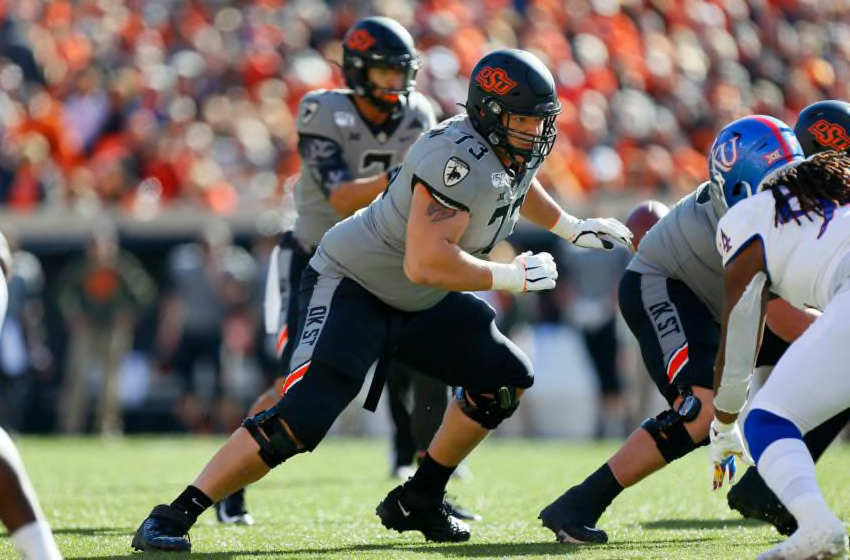
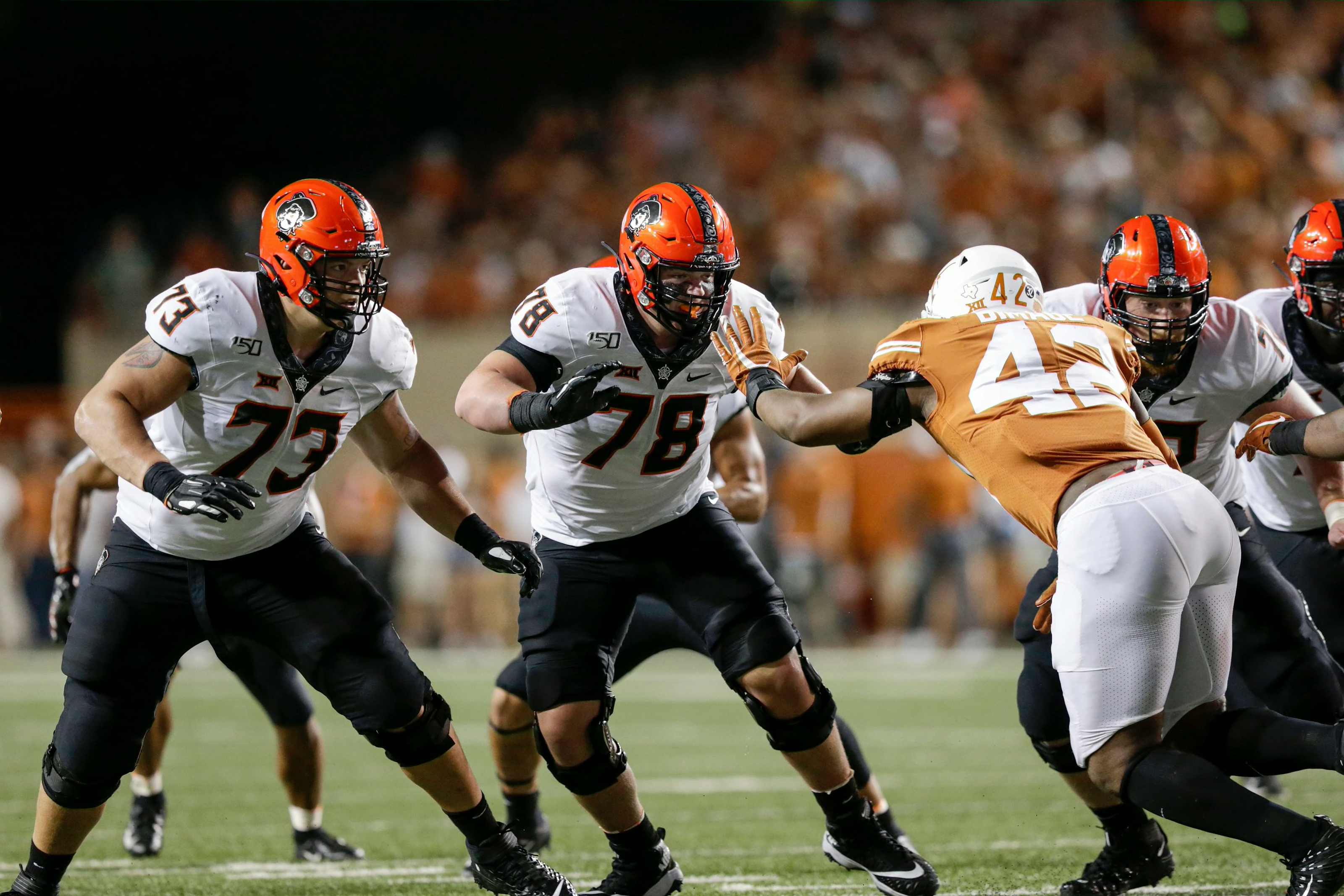
When the Bears traded up to draft Oklahoma State offensive lineman Teven Jenkins in the second round of the NFL Draft, it was presumed that Jenkins would be plugged into the opening at right tackle — a starter eventually as a rookie if not in Week 1.

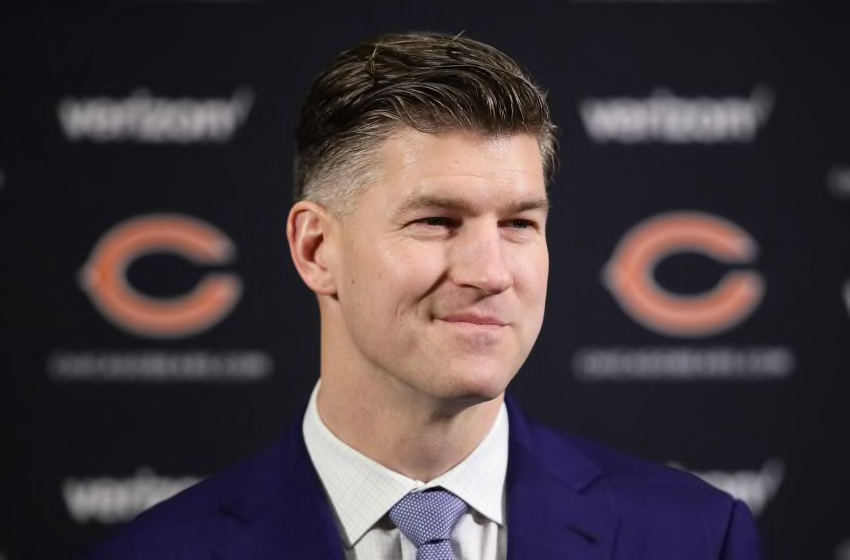
But maybe not at right tackle. Bears general manager Ryan Pace notably emphasized Jenkins’ versatility and ability to play the left side — a curious acknowledgement with veteran Charles Leno supposedly entrenched at left tackle.

“He played right tackle. He played left tackle. He’s played both guard spots while he was at Oklahoma State,” Pace said of Jenkins. “We feel that his best fit is at either tackle spot for us.”

Coaches and general managers are loathe to provoke speculation about any starters’ status, so Pace’s reference to Jenkins’ ability to play the left side is a bit unusual. What does that mean for Leno, who has started the Bears’ last 95 games at left tackle?

The Bears are still in a salary-cap crunch after cutting right tackle Bobby Massie and cornerback Kyle Fuller. They still need to make room to sign their draft picks. Leno has always been a potential, if unlikely, cap casualty — the Bears can save $6.2 million in cap space if they cut him, $9 million if they cut him after June 1.

The Bears could play Jenkins at left tackle and live with Germain Ifedi, free-agent Elijah Wilkinson or second-year pro Lachavious Simmons at right tackle. They’re probably better with Leno at left tackle and Jenkins at right. But the cap situation could force them to take a chance on an alternative lineup. And again, Pace’s eagerness to note Jenkins’ play at left tackle — where he made seven starts over the past three seasons — only stokes that speculation.

“That’s the great thing about [Jenkins] is he’s played both guard spots and both tackle spots [at Oklahoma State],” Pace said. “He’s played more right tackle, but there’s two games of starting tackle tape at left tackle in 2019. You go back and look at it — I think it’s Texas Tech and Baylor. He’s at left tackle in both those games. There’s plenty of left tackle tape, so we feel that he can play both tackle positions, and we’ve just got to sort through that.”

Wherever he plays, Jenkins figures to be a starter in 2021. The Bears have a hole to fill. Jenkins was rated a first-round talent, and not just by the Bears. And players drafted in his range often start as rookies. Of the 13 offensive tackles drafted from 20th to 50th overall in the past four seasons, eight of them were Week 1 starters as a rookie; 10 of them by Week 2.

Oklahoma State coach Mike Gundy wouldn’t be surprised. It’s a post-draft cliche for the college coach to think his guy will be great in the NFL. But Gundy’s enthusiastic endorsement of Jenkins was notable even by that standard.

Gundy said he rates Jenkins ahead of former Oklahoma State offensive lineman Russell Okung — the sixth overall pick of the 2010 draft by the Seahawks — as an NFL prospect. Okung is a two-time Pro Bowl player who started at left tackle on the Seahawks’ back-to-back Super Bowl teams in 2013 and 2014.

“Teven is more talented than him in my opinion. He’s just scratching the surface of his ability,” Gundy said of Jenkins in a videoconference with Bears beat reporters Saturday. “He came from Topeka, Kan. When he arrived, I don’t think he had any idea what college football was like. And just in the last year, he’s finally developed some toughness and grit that will benefit him playing in the NFL.

“I would not be surprised in two years if people are looking back and saying he is potentially the best offensive linemen taken in this draft. He has the phenomenal athleticism; strength; he’s highly intelligent; and he’s just started to really get into football over the last 18 months.”

The fresh-faced Jenkins is an interesting prospect, even Gundy admitted a little deceiving. “If you saw a mugshot of him, he looks like he’s going to engineering class,” Gundy said. But over his five years at Oklahoma State, the 6-5, 317-pound Jenkins has developed an awareness of just how good he can be, with a mean streak he now embraces.

And he responds to a challenge. “Our offensive staff, particularly our o-line coach, challenged him with the personnel he was facing against Texas,” Gundy said. “And we knew in order for us to be successful offensively, he had to hold his own on the edge and he did. Essentially, his guys didn’t make any plays at all.”

The NFL is a different world, of course. So it remains to be seen if Jenkins will respond the same way at this level. But at least the Bears knew he’s got it in him.

“Teven is an interesting young man,” Gundy said. “You look at him and you say, ‘It took that long for you to realize that you were a special talent,’ and it really did with him because he had a such a laid back personality and I don’t think he ever saw himself being that good of a football player.

“That’s why I’m saying within the next couple years, the NFL is going to be really shocked at what you have. Because when we asked him and challenged him to be as good as he can be and dominate a player, we had a lot of success with him on those days.”

Read More

Teven Jenkins’ versatility could put Charles Leno on noticeon May 1, 2021 at 5:29 pm Read More »
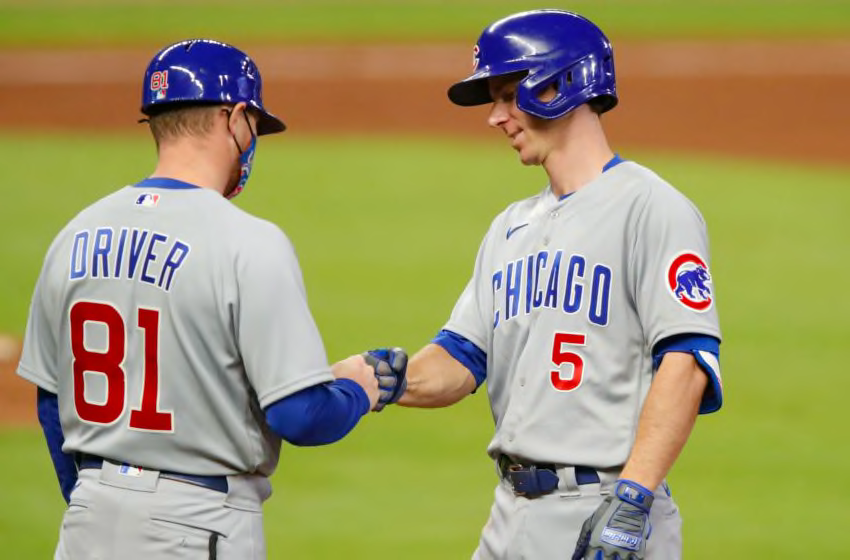
Chicago Cubs: Reviewing the tough month of April for the teamon May 1, 2021 at 3:31 pm

Read More

Chicago Cubs: Reviewing the tough month of April for the teamon May 1, 2021 at 3:31 pm Read More »

Chicago Bears: 3 things to know about Teven Jenkinson May 1, 2021 at 2:00 pm

Read More

Chicago Bears: 3 things to know about Teven Jenkinson May 1, 2021 at 2:00 pm Read More »

Lexie Brown is ready to capitalize on new opportunity with Sky after off season resetAnnie Costabileon May 1, 2021 at 12:30 pm

Lexie Brown (left, shown with the Lynx) spent the WNBA offseason focusing on her training rather than playing overseas. | Ethan Miller/Getty Images

Brown’s goal for the 2021 season was to return an entirely different player, so she took House of Athlete owner, Brandon Marshall — the former Bears receiver — up on an offer to train at his facility in the Miami area.

After the Lynx signed Aerial Powers in the WNBA’s free-agency period, Lexie Brown had a feeling her future with the team wasn’t certain.

Still, Brown’s intuition didn’t temper the frustration she felt when she found out she was being waived the day before reporting to training camp.

‘‘It’s been a frustrating but enlightening experience,’’ Brown said. ‘‘Some things are meant to teach you about yourself.’’

Selected ninth overall by the Sun in the 2018 draft, Brown said she thinks her second season was the only one that really proved what she’s capable of.

After leaving the WNBA bubble early last season because of a concussion, Brown didn’t pick up a basketball for four months. It was her first summer since turning pro that she opted not to play overseas, and she said it was exactly what she needed.

Instead of the yearlong grind most players in the WNBA commit to, Brown was able to focus on training. It’s something she wishes more women in the WNBA were able to do, but most can’t give up the supplemental income playing overseas provides.

Brown wanted to return a different player for the 2021 season, so she took House of Athlete owner Brandon Marshall — the former Bears receiver — up on an offer to train at his facility in the Miami area and put in work.


provided photo
Lexie Brown spent her offseason working out with basketball trainer Justin Zormelo and Vice President of pro sports at House of Athlete Mo Wells.

Brown put in work training twice a day, five days a week with Vice President of pro sports at House of Athlete Mo Wells and basketball trainer Justin Zormello. Wells helped Brown reach her physical fitness goals, focusing on her strength and speed. Zormello worked with Brown on the court, helping her extend her shooting range and add other elements to her game.

She said this is the best she has looked and felt in her career.

When she got a call from Sky coach and general manager James Wade to invite her to training camp, she was confident she could turn it into a roster spot because of how she spent her offseason.

‘‘Chicago has an amazing core already,’’ Brown said. ‘‘The thing I’m asking myself is, how can I enhance that core? I’m not trying to replace the core or change it. I want to make it better.’’

The Sky aren’t lacking at guard. Of the eight players signed to training-camp contracts, five are guards. That doesn’t include rookie Shyla Heal, who is waiting on her travel visa and hasn’t been with the team through the first week of camp.

Veterans Courtney Vandersloot and Allie Quigley also are expected to arrive during the second week of camp. Brown said she will look to Vandersloot to help her grow as a passer and to Quigley for lessons on becoming a knock-down shooter.


Chicago Sky

Wade’s expectations for Brown are simple: He wants her to play her game. More specifically, he said he wants her to have good shot production and a short memory.

He also wants Brown to be a high-level defender, an area of her game she doesn’t lack confidence in. The Sun finished third in team defense in Brown’s rookie season, and the Lynx finished fourth in 2020.

The Sky’s intensity level has been high through the first week of camp, Brown said. The team has been practicing three hours a day, but Brown said it feels like 30 minutes because of the high level they’re playing at.

That’s how Brown likes to work. After all, she’s a gym rat.

‘‘There are a lot of players who have bounced around the league until they found their home,’’ Brown said. ‘‘I don’t take this opportunity for granted.’’

Read More

Lexie Brown is ready to capitalize on new opportunity with Sky after off season resetAnnie Costabileon May 1, 2021 at 12:30 pm Read More »

On Shecky Greene and greener pasturesRob Miechon May 1, 2021 at 12:45 pm

Shecky Greene
Legendary entertainer Shecky Greene in 1968 | Sun-Times

Chicago native and famous comedian Greene still has a passion for horse racing at 95.

LAS VEGAS — A year into creating a comedy career that would become legendary, Shecky Greene sat at a blackjack table at the Riviera when a publicist darted up to him one day in 1954.

Mr. Greene, you’re due at the track! Nearly noon, he had forgotten. A big handicap race was being staged at Las Vegas Park, the ill-fated thoroughbred venture that hosted only a few weeks of racing in 1953 and 1954.

The 95-year-old Chicago native said he still might have been ill from a late night.

“They introduce the presenter of the second race. Me! And I roll from

the grandstand onto the track, to the infield, through horses—t and everything else.

“[Jockey] George Taniguchi wins the race. I go behind the judge and, in my drunken stupor, I kiss the horse’s ass. George jumps off and runs away. They didn’t see him for a week! One of the last times I drank.”

SHECKY, THE HORSE

Kentucky Derby day summons special memories for Greene, the inveterate horse-playing son of a degenerate — his word —shoe-salesman horseplayer.

Carl Greenfield took the youngest of his three boys to watch the ponies when he was 6, hooking Fred Sheldon Greenfield (he’d -legalize his stage name in 2004) for life. They would frequent six Chicago-area tracks, the most in any metropolitan region.

That Arlington Park for a few decades staged a Shecky Greene Handicap might have matched, in honorifics, his March 2020 induction into the National Comedy Hall of Fame in Florida.

Employing a walker and usually donning a beige flat cap, Greene is a sportsbook regular at Green Valley Ranch, a casino tucked into the Henderson foothills. He typically bets a buck or two on races all over the country.

People greet him, nod in respect, whisper tributes. He sits among friends. He bemoans the recent passing of pal Eddie. With a sly bill cupped behind fingers, he’ll tip those who provide him with a winner.

He delivers impromptu Italian arias, as if he’s at La Scala. But it’s a concocted, -nonsensical dialect. He caps French gibberish with ‘‘Dipinto Di Blu.’’ Crooning was part of a Vegas lounge act that brought him six-figure weekly checks in the 1970s.

For today’s Derby, Greene likes the price on O Besos, a Greg Foley-trained colt who was 35-to-1 at Circa Sports this week, 40-1 at William Hill.

For Derby drama, though, nothing touches 1973. Owner and friend Joe Kellman named a fast bay Shecky Greene, a sliver of which the comedian bought. But he objected to the sprinter being run in the demanding 1¼-mile Derby.

A son of famous Aussie chestnut stallion Noholme, Shecky Greene, a 6-1 choice, set a blistering pace out of the Louisville gate but, as predicted by the comedian, flamed out, finishing sixth. He’d win the Eclipse speed award that year.

“My horse didn’t belong there,” Greene said.

Secretariat relished the rabbit, covering each quarter of the race faster than the -previous one to set a Derby record of 1 minute, 59.4 seconds that stands today. He would clinch the Triple Crown in a record 31-length triumph at the Belmont.

Greene’s largest hit was a $12,000 win at Del Mar. Vince Edwards, star of the hit TV series “Ben Casey,” who had a crippling gambling addiction, begged for a loan at the -window.

A nearby racetrack during the day, the show at night — Greene’s road routine.

“It’s just the way my life went,” he said. “I think as long as the horses are running, I’ll still be living.”

SHECKY, THE MAN

Manic depression, a bipolar condition, agoraphobia and anxiety and panic attacks all have consumed Greene. It’s in the genes, he said, that also have provided him with such durability.

Clips of him from TV shows in 1959 and 1963, featuring Ed Sullivan and Groucho Marx, are magnificent. Audiences howl at his quick and clever wit, shifting gears, singing, rhyming on the fly. Confident, in total command.

“Anything but,” he said. A façade. “Doing what I did in show business, it’s really a shock to me.”

Six or seven therapists prescribed everything from Ativan to lithium to Zoloft. He has taken no medication for five years. He said he didn’t enjoy his career or stardom.

“People really didn’t know me. Matter of fact, I didn’t know me. My psychiatrists didn’t know me . . . when I look back, I don’t like 90% of the things I did and the way I was.”

Like the Las Vegas Park incident, or drunkenly steering his rig into the fountains at Caesars Palace.

“It’s been a curse living to 95.”

The blessing has been Marie Musso, Greene’s third wife, whose jazz-saxophonist father, Vito, roomed with Frank Sinatra in Tommy Dorsey’s band.

Musso told the Los Angeles Times that Greene would cry and shake in bed. The 1980s were a wash. Getting him to walk took effort. She’s his rock.

“But we never lost our sense of humor,” Musso said.

He might not prefer 90% of it, but Greene does believe that frank details of his past could help someone else’s future.

“Not giving up on yourself is the most important thing,” he said. “Surround yourself with people who like you, who understand you. Anybody who has an adverse effect on you, get rid of them. Look for people who are gentle and kind. There are a lot of those.”

Read More

On Shecky Greene and greener pasturesRob Miechon May 1, 2021 at 12:45 pm Read More »

White Sox’ Minoso was Minnie in name onlyDaryl Van Schouwenon May 1, 2021 at 1:00 pm

White Sox outfielder Orestes “Minnie” Minoso poses at Al Lopez Field on March 9, 1957, in Tampa, Fla. | Associated Press

Minoso isn’t credited enough for his play with the Sox, his impact on Chicago and being the first Black Latino major-leaguer.

For Minnie Minoso to be known as “Mr. White Sox,” he would have to be the face of the consistently good “Go-Go Sox” teams of the 1950s and ’60s.

Which he was.

Minoso also would have to be one of the franchise’s greatest and most exciting players, at the forefront of an abrupt turnaround into its greatest era.

And he was that, too. They called Saturnino Orestes Armas Miñoso the “Cuban Comet,” a trailblazer with speed and power and defensive skill who, without question, built a career worthy of the Hall of Fame.

And, oh, Minoso would have to be traded to the Sox first. The Indians took care of that on a huge day in Sox history 70 years ago Friday.

Sox general manager Frank “Trader” Lane, who would make 241 trades in seven years — including deals that brought Nellie Fox, Billy Pierce, Sherm Lollar and Jim Rivera to the South Side — had his eye on Minoso for a while. Lane landed the 25-year-old in a complicated three-team swap in which the Sox sent Gus Zernial and Dave Philley to the Athletics and got Minoso from the Indians.

“The Sox got a good man in Minoso,” Indians and St. Louis Browns legend Satchel Paige said when the trade was made. “I rate him No. 1. I’ve been around baseball some 23 years, and if there’s one thing I know, that’s a baseball player when I see one.

“He’s the fastest. That man’s fast as lightning.”

On the day after the trade, May 1, Minoso wasted no time reporting to Comiskey Park. He batted third in manager Paul Richards’ lineup against the Yankees, played third base and hit a home run in the first inning with his first swing against 21-game winner Vic Raschi. It traveled an estimated 425 feet into the center-field bullpen.

On a day when a 19-year-old kid named Mickey Mantle would hit his first major-league home run for the hated Yanks, Minoso’s Sox debut was more momentous. Minoso not only became the first Black White Sox player four years after Jackie Robinson broke baseball’s color barrier in 1947, but the first Black Latino to play in the major leagues.

It’s remarkable to many that the latter fact often gets overlooked.

“The one thing he really should get credit for and doesn’t is he’s a Black Latino pioneer,” baseball historian, statistician and author Don Zminda said. “He was the first Black Latin player in major-league baseball, and he doesn’t get credit for that.”

“He was our Jackie Robinson,” Hall of Famer Orlando Cepeda famously said.

And like Robinson, Minoso was a fabulous, exciting player.

“As a pioneer, he should be recognized,” Zminda said, “but he was a tremendous player.”

To wit: From 1951 to ’60, Minoso was second among American League players in Baseball Reference wins above replacement behind Mantle and ahead of Ted Williams, Nellie Fox and Yogi Berra. Only Mantle scored more runs, only Fox had more hits, only Mantle and Berra had more RBI and only Luis Aparicio had more stolen bases during that period.

“That’s a great player,” Zminda said.

Minoso already was showing that in the Pacific Coast League. He needed an open door.

“The trade liberated Minoso,” said Adrian Burgos, a professor of history at the University of Illinois. “He had the terrific misfortune of going to the most diverse organization in the American League when his contract was sold from the New York Cubans to the Cleveland Indians. The Indians were signing African American, Black Latino players and Mexican players, so he arrived to a team that was loaded with Black talent. Minnie was a major-league-ready player. That trade, and his debut, were about finally getting a chance to prove he was that superstar-caliber player.”

Minoso not only played well — he batted .326/.422/.500 with 10 homers, a major-league-high 14 triples, AL-best 32 stolen bases and 74 RBI that season — but he blazed a trail in Chicago two years before Gene Baker and Ernie Banks would become the first African Americans to play for the Cubs.

The outgoing Minoso opened grocery stores in the city, hawked milk and bread in Chicago newspaper ads and quickly became a popular star.

“He was the face of Chicago, sporting Chicago, for that year and years to come,” Burgos said. “I don’t think people understand what Minnie breaking through and being a superstar did for Chicago. This was a big city, with lots of neighborhoods, and not everyone was on board when integration started.”

And yet, sadly, for all he accomplished on the field and beyond, Minoso, who died in 2015, has not been elected to the Hall of Fame.

Minoso’s career didn’t start with the Indians until 1949 when he was 25 — and there are many who believe he was actually 28 — preventing case-building numbers from going on his résumé. And coming out of retirement to play briefly in 1976 at age 50 and in 1980 probably didn’t endear him to some Hall of Fame voters. At owner Bill Veeck’s urging, Minoso did so to become the first player to play in five decades.

“He’s kind of known for these stunts he was involved in with Bill Veeck and for being a character,” Zminda said. “What gets lost is what a tremendous player he was, particularly from 1951 to ’60.”

Credit Lane for that being shown first in Sox pinstripes. Stacked with outfielders in 1951, the Indians were open to a trade because they didn’t have a spot for Minoso, who would lead the Sox (81-73) to a third-place finish. That season kicked off a golden age of White Sox baseball, a stretch of 17 consecutive winning seasons through 1967.

“An immediate turnaround from a team that was an also-ran for decades,” Zminda said.

Minoso got snubbed by Rookie of the Year voters, finishing a close second to Yankees infielder Gil McDougal (Minoso settled for the Sporting News Rookie of the Year Award), a slight that always troubled him. Lane was upset, too, saying Minoso was deserving of MVP honors. He was fourth in MVP voting.

Minoso was traded back to the Indians after the 1957 season in a deal that brought right-hander Early Wynn and outfielder Al Smith to the Sox and helped them win the 1959 AL pennant. When the Sox reacquired Minoso after that season, Veeck gave him a championship ring, citing Minoso’s role in building a winning culture and for delivering Wynn, the AL Cy Young winner in 1959, in the trade.

Back on the South Side in 1960, Minoso would have his best season, batting .311/.374/.481 with 20 homers, 32 doubles and 105 RBI and winning his third Gold Glove (an award first given in 1957) as an outfielder. He was fourth in MVP voting for the fourth time in his career.

As Burgos said, how Minoso and others like him performed under unique, trying circumstances shouldn’t be overlooked. But it often is.

“The story of Minnie Minoso adds the element of a man who leaves his home country, is experiencing the reality of being a Black foreigner, to become beloved in a city like Chicago,” Burgos said. “And on top of all that, he was becoming a hero in Black Chicago.”

Robinson set the standard and made it clear Minoso could be a major-league star.

“But Minnie’s debut — and his performance — just reverberated because now as a Black Latino star, he was not only the toast of Chicago, but of the Caribbean and Cuba. ‘This is what we can do. We can follow in his footsteps.’

“His performance, persona and charisma attracted folks to what the promise of integration could be, and that starts with the 1951 season.”

Read More

White Sox’ Minoso was Minnie in name onlyDaryl Van Schouwenon May 1, 2021 at 1:00 pm Read More »

Time & life: Tommy Rees is devoted to the gameMike Berardinoon May 1, 2021 at 1:00 pm

Notre Dame offensive coordinator Tommy Rees (above) will have to manage without record-setting quarterback Ian Book this season. | Santiago Flores/AP

Notre Dame offensive coordinator vows to keep searching for ways to score points after key departures.

SOUTH BEND, Ind. — Notre Dame’s offense might not be as flashy or as productive in 2021, but Tommy Rees isn’t about to concede that now.

As he prepares for Saturday and his first Blue-Gold Game as offensive coordinator, spring ball having ended abruptly last year because of the pandemic, the Lake Forest High School grad vows to keep searching for new ways to keep the Irish prolific.

“Look, I don’t have a family,” Rees, three weeks from turning 29, said recently. “I don’t have many obligations besides this job. So I’m fortunate I’m able to pour a lot of time into studying football. I’ve been around the game my entire life. It’s something I’m extremely passionate about, something I love to do.”

Bill Rees, his father, remains on staff as director of scouting, and the familiarity and trust that come with having played quarterback for coach Brian Kelly a decade ago work in the younger Rees’ favor, as well.

But there’s no denying this will be his greatest challenge.

Record-setting Ian Book, 30-5 in his three years as Notre Dame’s quarterback, is gone. Wisconsin grad transfer Jack Coan is the leading candidate to replace him.

Four multiyear starters off one of the nation’s top offensive lines have departed.

Tight end Tommy Tremble, a beastly blocker, was a surprise early applicant to the NFL Draft, and the combined 71 catches and eight touchdowns of last year’s wide receiver tandem of Javon McKinley and Ben Skowronek must be replaced.

Even with a one-year crack at a full ACC schedule, Rees’ first outfit as coordinator dropped 17 spots in the national scoring rankings. Thirteenth nationally at 36.8 points per game in Chip Long’s final season, Notre Dame dipped to 30th and 33.4 points per game in Rees’ debut season.

No one must explain this to the fertile young mind at the controls.

“This year it’s a new team — completely new team,” Rees said. “We understand wholeheartedly we do not have the offensive line that we had last year. We’re going to have to create opportunities to be efficient but also create explosive [plays].”

Troubles in the red zone in 2020 are being addressed. Rees is reminding his new crop of quarterbacks, including five-star freshman Tyler Buchner, that there’s nothing wrong with completing a pass short of the goal line.

Losing Tremble hurts, but Rees already is scheming to get as many single-coverage looks as possible for rising sophomore tight end Michael Mayer, a matchup nightmare who quickly earned the nickname Baby Gronk.

Rees didn’t hesitate when asked if a tight end could be the focal point of his reconfigured offense.

“It was in 2012, I can tell you that,” he said, referencing Tyler Eifert and the 50-catch season that helped Notre Dame reach the BCS title game. “I don’t see why it should be any different in terms of being able to feature someone. Last year was only a brief glimpse of how good this kid can be.”

Kyren Williams is coming off an 1,125-yard rushing season, but his skills as a receiver (35 catches) will be highlighted even more. Look for Williams and/or Mayer to line up in the slot frequently as Rees seeks to stretch the field horizontally as much as vertically.

Coan isn’t nearly as mobile as Book, but he does stand in the pocket better, so look for more short drops and quick-release plays that should take some pressure off that youthful group up front.

And don’t be surprised if Buchner, an “elite athlete” in Rees’ estimation, forces his way onto the field as the season moves along.

“Everybody has their core beliefs and [says] this is what we’re going to do,” Rees said. “But as you study different people and what they’re doing, the creativity and the ideas start to flow. What can fit our personnel? How can we apply that to the system that’s in place?”

Rees, a football junkie with nothing but time, vows to keep searching.

“That,” he said, “is going to be never-ending for me.”

Read More

Time & life: Tommy Rees is devoted to the gameMike Berardinoon May 1, 2021 at 1:00 pm Read More »

Chicago Bears: The Bears are quietly winning the NFL Drafton May 1, 2021 at 1:00 pm

Read More

Chicago Bears: The Bears are quietly winning the NFL Drafton May 1, 2021 at 1:00 pm Read More »

Chicago Bears Draft: Second round trade a smart move by Paceon May 1, 2021 at 12:00 pm

Read More

Chicago Bears Draft: Second round trade a smart move by Paceon May 1, 2021 at 12:00 pm Read More »

Chicago Bears: What should main goal on day three be?on May 1, 2021 at 12:30 pm

Read More

Chicago Bears: What should main goal on day three be?on May 1, 2021 at 12:30 pm Read More »