A man was critically injured after being struck by a Metra train Saturday in Gresham on the South Side.
The man was struck by a train on the Rock Island line about 11 a.m. near the Gresham station, 820 W. 87th St., according to the Metra Rock Island Twitter account.
Paramedics transported the man to Christ Medical Center in Oak Lawn, where he was listed in critical condition, Chicagofire officials said.
Trains were stopped for over an hour as emergency crews responded to the scene, but were running with delays by Saturday afternoon.
INDIANAPOLIS — Indiana’s governor told members of the Sikh community and others who gathered at a downtown Indianapolis football stadium Saturday to remember the eight people killed in a mass shooting at a FedEx warehouse that he knows their anguish from the attack is far from over.
The three-hour event at Lucas Oil Stadium came two weeks after a former FedEx employee fatally shot the eight people, including four members of Indianapolis’ Sikh community, before killing himself. Authorities have not released a motive in the April 15 shooting.
Under the stadium’s open roof, Republican Gov. Eric Holcomb said in his opening remarks that the capital city “is still reeling from the impact of that dark night.”
“Never in my wildest imagination did I see this day or this cause of gathering as a reason for our unification,” Holcomb told the hundreds of people in attendance at the stadium where the Indianapolis Colts play. “Why must any day be that dark? Why must tragedy strike and tear a community, tear humanity apart? This pain will for sure persist as we continue to live with the loss in all of our days to come.”
In a letter read aloud during the ceremony, former Vice President Mike Pence emphasized particular grief for the Sikh community, whose members “add to the tapestry of this country.”
“Know that our hearts and our prayers are with you all,” Pence, a former Indiana governor, said in his letter. “We join fellow Hoosiers across the state of Indiana and Americans across the country in expressing our heartfelt condolences. … You have been in our hearts since that horrific night, and you remain in our prayers today.”
A monotheistic faith founded more than 500 years ago in India’s Punjab region, Sikhism is the world’s fifth-largest religion with about 25 million followers, including about 500,000 in the United States.
Indianapolis Mayor Joe Hogsett said his message to the Sikh community, to immigrants and “to anyone who feels threatened by this act simply because of who they are” is that they are “welcome in Indianapolis, and it is the responsibility of every one of our residents to make sure you know that to be true.”
Hogsett, a Democrat, also reiterated his previous calls for changes to gun policy, saying the shooting could have been prevented. He said the city, state and country are “far past due for transformative action.”
Authorities have said that Brandon Scott Hole, 19, had two rifles that he was able to purchase legally, even after his mother called police last year to say her son might undertake “suicide by cop.” Marion County Prosecutor Ryan Mears has faced sharp criticism for choosing not to pursue court hearings that could have prevented Hole from accessing the guns.
“When gun violence takes a life, it affects us all,” Hogsett said.
Private services for victims from the Sikh community are also expected to take place in the coming week. The proceedings will begin with cremation, followed by up to 20 days of reading of the 1,400-page Guru Granth Sahib scripture.
The victims’ families were granted roughly two-dozen fast-tracked visas so relatives overseas can travel for the funeral rites, said Amrith Kaur, legal director at the Sikh Coalition. They’re arriving just days before the U.S. restricts travel from India — a response spurred by a rise in COVID-19 cases in the country and the emergence of potentially dangerous variants of the coronavirus.
___
Casey Smith is a corps member for the Associated Press/Report for America Statehouse News Initiative. Report for America is a nonprofit national service program that places journalists in local newsrooms to report on undercovered issues.
Back on October 12, 2020, Nick Foles led the Chicago Bears to a win over the Carolina Panthers, 23-16, on the road for his third straight start of the season.
After the game, Foles told reporters Meek Mill’s song Dreams and Nightmares, “got his juices going” in the locker room before the game and helped him get the win.
Now, after Ryan Pace has been a dream general manager for the Bears — snagging Justin Fields, Teven Jenkins, and Larry Borom in the NFL draft — Nagy has to turn his nightmare 2020 campaign around.
To paraphrase Philadelphia legend Meek Mill, “It’s time to marry the game and Matt Nagy needs to say ‘Yeah, I do.'”
Nick Foles is now shouting out Meek Mill because they played “Dreams and Nightmares” in the locker room and it got him juiced up and reminded him of Philly.
Pace has developed an offensively-driven offseason for the Bears. With his job on the line, he is giving the offense a roster that Nagy can work with.
Let’s quickly sum up Pace’s offseason thus far.
In free agency, Pace went after Super Bowl-star running back Damien Williams, who stepped up for 104 rushing yards, 29 receiving yards, and two touchdowns with the Chiefs. His veteran presence will be good for David Montgomery, especially to take a physical workload off his back.
Recently, Pace captured Marquise Goodwin from free agency on a cheap deal. The veteran wideout is injury prone, having played only one full season. Yet, he will fill the gap for a bonafide third receiver.
Finally, Pace obviously acquired Andy Dalton on an expensive $10 million deal. Not a fan favorite, but has had his moments in his prime. A solid veteran presence is definite. Solid football player? Not so sure.
Now to the draft, Pace traded up to snag Justin Fields out of Ohio State University. For a long time, Fields was the unanimous second overall quarterback in the draft behind generational talent Trevor Lawrence. After having some rough starts against Big Ten opponents Northwestern and Indiana, his stock dropped. Nonetheless, he’s an NFL-ready quarterback.
To sum up, the Bears stole Teven Jenkins out of the second round and Larry Borom in the fifth round. The offensive line is improving, with these two rookies likely to start with James Daniels, Cody Whitehair, and possibly Alex Bars.
Percentage of passing yards that came before the catch (air yards) for Ohio State QBs + Power 5 Rank:
They have their franchise quarterback now and veterans to coach him up. The offensive line was awful last year, no debate there. Now, they added two high-profile rookies to spice up the line. The wide receiver core is solid — backed by Allen Robinson, Darnell Mooney, and Marquise Goodwin. David Montgomery has a true backup running back to share the field with Williams.
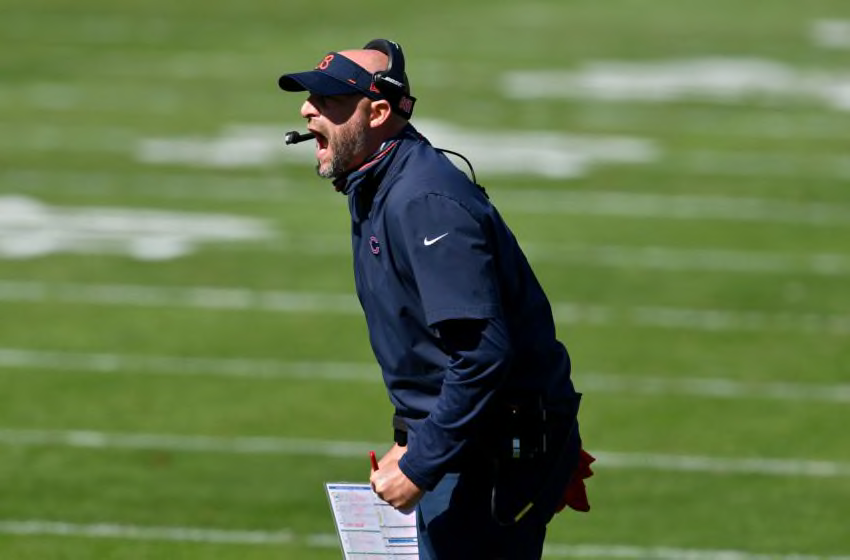
Now, the ball is in head coach Matt Nagy’s court.
Matt Nagy next season is finally exposed to having no more excuses for an unproductive offense. His offense was a nightmare last season, ranking 22nd in points per game and 28th in total yards per game.
Next season, at the helm of Justin Fields, Nagy should be able to get more creative with a versatile quarterback. Fields can run, air out the ball, etc. There are a lot of things Fields can do, but Nagy has to put it into action.
Let’s not forget, the run game needs credit too. David Montgomery threw the team on his back in the back half of last season to give himself his first 1,000 rushing yard season. They need to keep him and Williams more involved (37.73 rushing play percentage last season, 27th in the NFL).
Pace’s dream offseason is coming together and tasking Nagy’s nightmare offense to come alive for the 2021 season. Can they pull it together? If not, it could be the end for at least one of them.
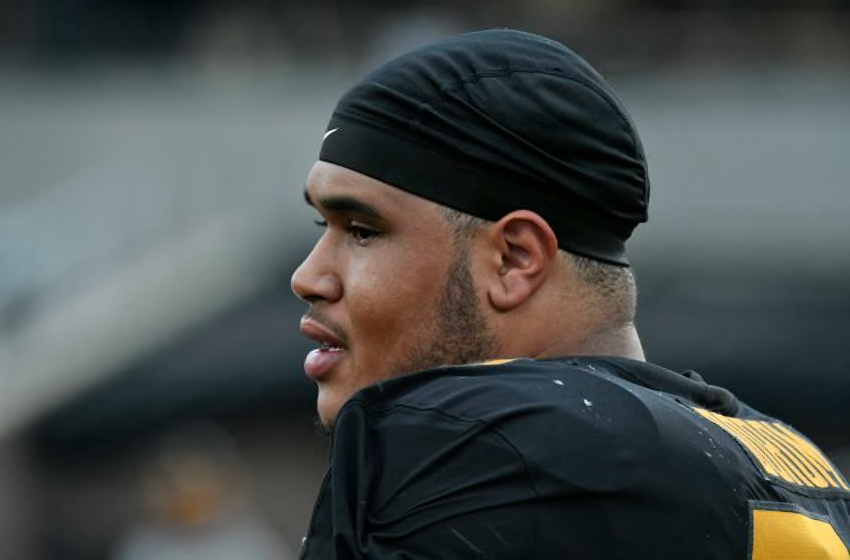
The Bears drafted Missouri tackle Larry Borom in Round 5 on Saturday. | Hunter Dyke/Mizzou Athletics
Borom spent part of the offseason training alongside quarterback Justin Fields at Proactive Sports Performance in Westlake Village, California, near Los Angeles.
The Bears’ fifth-round pick already knows one of his new teammates.
Missouri offensive tackle Larry Borom spent part of the offseason training alongside quarterback Justin Fields at Proactive Sports Performance in Westlake Village, California, near Los Angeles.
“He’s a hard worker,” said the 6-4, 327-pound Borom, who started 16 games at right tackle over hte past two years. “He’s going to do extra. He’s not the guy that is going to be trying to rush out of the room. He’s going to do a lot more than everyone else.”
He does it humbly.
“As a person, he’s a real friendly, goofy guy,” Borom said. “He’s an old[-school] person at the end of the day. He’s caring, he’s helpful, he’s looking to help people any chance he can.”
Borom can help Fields by blocking for him — eventually. He figures to be a developmental project at tackle, though he played two games at guard in college.
The Bears consider offensive line coach Juan Castillo one of the best teachers on young blockers in the league, and are eager to let him work with both Borom and second-round pick Teven Jenkins.
“The only direction he’s going to take me is up,” Borom said. “He’s one of the best in the game. He’s a guru. We had our Zoom meeting and he’s an up-tempo guy and he brings the juice and the energy.
“I honestly fell in love with it at the meeting. That’s what I like. That’s what I want to bring to the room as well. It was major.”
A Detroit native, Borom grew up playing basketball — his dad is 6-8 — but said he fell in love with football in high school. While he said he wants to start “as soon as possible,” Borom figures to serve as a backup this season. If the Bears determine that Jenkins can play left tackle at some point, that could open a spot for Borom.
The 22-year-old said he has a “ton of excitement” to play for the Bears — and with Fields.
“He was out training where I was training — I know him,” he said. “It’s a lot of good things going on for the organization and it’s a blessing to be part of.”
Eight people have been shot since 5 p.m. April 30, 2021 in Chicago. | Sun-Times file photo
A 17-year-old boy was critically hurt in a shooting Friday in Lawndale on the West Side.
Nine people have been wounded in shootings across Chicago so far this weekend, including a 17-year-old boy critically hurt in an attack in Lawndale.
The teen was standing in front of a home about 7:35 p.m. Friday in the 1900 block of South Drake Avenue when someone approached him and fired shots, Chicago police said.
He suffered gunshot wounds to both legs and was transported to Mount Sinai in critical condition, police said.
Just after noon Saturday, a man was shot in Uptown on the North Side.
The man, 28, was shot in the shoulder about 12:05 p.m. in the 5000 block of North Kenmore Avenue, Chicago police said. He was taken to Illinois Masonic Medical Center in good condition.
Early Saturday morning, a 25-year-old man was critically wounded in a shooting in Englewood.
About 12:45 a.m., he was standing outside on a sidewalk on the 6300 block of South Honore Street when he heard shots and felt pain, police said. He suffered a gunshot wound to the abdomen and was transported to the University of Chicago Medical Center in critical condition, police said.
Two people were hurt, one critically, in a shooting late Friday in Brighton Park on the Southwest Side.
A man and a woman, both 27, were sitting in a parked car about 11:50 p.m. in the 3900 block of South Kedzie Avenue when a male got out of a black sedan and fired shots at them, police said.
The man suffered gunshot wounds to the torso and transported to Mount Sinai Hospital in critical condition, police said. The woman was struck in the left arm and right shoulder, police said. She was taken to Stroger Hospital in fair condition, according to police.
A man was dropped off at a South Side hospital Friday night after being shot, but would not tell police anything about the attack.
The 46-year-old man was dropped off at Jackson Park Hospital about 11:45 p.m. with a gunshot wound to the left leg and right foot, police said. He was listed in critical condition and transferred to the University of Chicago Medical Center, police said.
Earlier Friday night, two people were shot in Washington Park on the South Side.
They were standing in an alley about 9:05 p.m. in the 5200 block of South Michigan Avenue when a male suspect approached them and fired shots, police said.
A 21-year-old man was struck in the leg and was taken to the University of Chicago Medical Center, where he was listed in fair condition, police said.
A woman, 51, was also struck by gunfire and was taken to the same hospital, where she was listed in fair condition, police said. She was shot in both legs and sustained a graze wound to the chest.
About 7:35 p.m., a 20-year-old man was wounded in a shooting in Gage Park on the Southwest Side.
The man was sitting in a parked vehicle in the 5200 block of South Maplewood Avenue when someone fired shots from the sidewalk, Chicago police said.
He was shot in the leg and was transported to Mount Sinai in fair condition, police said.
Public health officials have applauded Illinois residents for “bending the curve” of the state’s latest uptick in COVID-19 cases, but now another important pandemic curve is flattening out — and that’s not what experts want to see.
The Illinois Department of Public Health on Saturday reported the state’s seven-day average of coronavirus vaccine doses administered per day is down to 87,494, its lowest point since March 4.
The daily vaccination rate hit an all-time high of almost 133,000 on April 12, and that figure has been in free fall ever since — a 34% decrease in just 19 days.
A total of 88,753 shots went into arms Friday, a 29% decrease compared to the previous Friday and barely half the total reported April 16.
Officials have said they expected demand to decline after the initial rush on the life-saving vaccines, and it comes just as there are finally more than enough doses to go around.
“Now we have to change hearts and minds to encourage individuals who have not yet made the decision to get vaccinated,” Cook County Health CEO Israel Rocha said earlier this week. “The COVID vaccine offers an easy, safe way to protect yourself and your loved ones from serious illness and death.”
COVID-19 vaccine doses administered by day
Graphic by Jesse Howe and Caroline Hurley | Sun-Times
About 60% of Illinois adults have gotten at least one shot, and 32% of residents are fully vaccinated so far.
Meanwhile, infection numbers remain relatively low across the state, but the virus is still claiming dozens of lives every day.
Officials reported 32 more COVID-19 fatalities, including that of a woman in her 30s from Madison County in the downstate Metro East region. Illinois’ viral death toll since last March stands at 21,992.
The state also logged 2,813 new cases that were diagnosed among 83,070 tests, raising the average statewide positivity rate slightly to 3.5%. Illinois has been hovering around that number for about a week. It’s down from 4.4% in mid-April.
More than 1.3 million of the state’s 12.7 million residents have contracted the virus over the past year.
For help finding a vaccination appointment in Chicago, visit zocdoc.com or call (312) 746-4835.
In the fifth round of the 2021 NFL Draft, the Chicago Bears selected Missouri starting tackle Larry Borom with pick number 151.
This was a pick not everyone saw coming. If you were to ask most fans going into today, they would have told you the Bears should prioritize cornerback and wide receiver. Yet, general manager Ryan Pace continued to put emphasis on the offensive line.
Selecting Borom tells you a couple of things. First of all, Pace is all-in on Justin Fields. Whether he admits it or not, Fields will end up being the starter this season and the Bears are ready to do whatever they can to protect him. The Bears are going to keep him clean, period. That’s what this draft has become about.
Secondly, in attempting to keep Fields healthy and upright, the Bears are sending a very clear message to current starting tackle Charles Leno.
The Chicago Bears just let Charles Leno know that he is not safe.
Leno, originally a seventh rounder back in 2014, has seen his quality play diminish just a little bit since making a Pro Bowl back during the 2018 season. The team let go of Bobby Massie this offseason, declining his option, and now Leno may be in for some competition.
Already, the Bears moved up to take Oklahoma State tackle Teven Jenkins, who will come in and start immediately. The only question is, whether or not Leno will stay at left tackle or move over to the right side.
Pace seemed non-committal on Jenkins’ position on Friday night, essentially saying that they’ll have to figure out which side he’ll fit best. That statement alone should sound the alarm in Leno’s head — he’s far from safe.
Borom is a big, strong tackle with a ton of power. He can move bodies with ease. The issue with why he’s a later pick is due to his lack of mobility. He could use some improvement with his footwork and hand placement, but Borom is simply a tank. He’s a heck of a football player, regardless of what scouts say he needs to improve.
OTs allowing a QB pressure on less than 1% of pass-blocking snaps: ? Brady Christensen, BYU ? Alijah Vera-Tucker, USC ? Larry Borom, Missouri ? Max Mitchell, Louisiana pic.twitter.com/VakIVklkpa
Anytime you can make a list like the one above, you are going to be just fine in the NFL regardless of where you’re drafted. Borom rarely gives up a sack, as you can see. Borom’s attitude mirrors that of Jenkins, both of whom will do whatever they can to keep their quarterback clean.
Back to Leno, who should feel uncomfortable at the very least. The biggest reason why he could be in trouble of losing his starting job? The Bears’ selection of Borom was only their third pick of the draft — out of 151 selections. They have now invested two very valuable picks in offensive tackles, and now head to the later rounds for some dart throws.
Leno’s job is in jeopardy, which is a good thing. He’s been a liability for a while now, and the Bears are in the business of keeping a clean pocket for their shiny new franchise quarterback. Borom’s arrival only furthers that notion.
KABUL, Afghanistan — The final phase of ending America’s “forever war” in Afghanistan after 20 years formally began Saturday, with the withdrawal of the last U.S. and NATO troops by the end of summer.
President Joe Biden had set May 1 as the official start of the withdrawal of the remaining forces — about 2,500-3,500 U.S. troops and about 7,000 NATO soldiers.
Even before Saturday, the herculean task of packing up had begun.
The military has been taking inventory, deciding what is shipped back to the U.S., what is handed to the Afghan security forces and what is sold as junk in Afghanistan’s markets. In recent weeks, the military has been flying out equipment on massive C-17 cargo planes.
The U.S. is estimated to have spent more than $2 trillion in Afghanistan in the past two decades, according to the Costs of War project at Brown University, which documents the hidden costs of the U.S. military engagement.
Defense department officials and diplomats told The Associated Press the withdrawal has involved closing smaller bases over the last year. They said that since Biden announced the end-of-summer withdrawal date in mid-April, only roughly 60 military personnel had left the country.
The U.S. and its NATO allies went into Afghanistan together on Oct. 7, 2001 to hunt the al-Qaida perpetrators of the 9/11 terrorist attacks who lived under the protection of the country’s Taliban rulers. Two months later, the Taliban had been defeated and al-Qaida fighters and their leader, Osama bin Laden, were on the run.
In his withdrawal announcement last month, Biden said the initial mission was accomplished a decade ago when U.S. Navy SEALS killed bin Laden in his hideout in neighboring Pakistan. Since then, al-Qaida has been degraded, while the terrorist threat has “metastasized” into a global phenomenon that is not contained by keeping thousands of troops in one country, he said.
Until now the U.S. and NATO have received no promises from the Taliban that they won’t attack troops during the pullout. In a response to AP questions, Taliban spokesman Suhail Shaheen said the Taliban leadership was still mulling over its strategy.
U.S. military spokesman Col. Sonny Leggett tweeted late Saturday that there was some ineffective firing in the area of southern Kandahar air base, one of the U.S. military’s largest bases.
“Kandahar Airfield received ineffective indirect fire this afternoon; no injury to personnel or damage to equipment,” he tweeted, without attaching blame.
However, he also posted a video clip of Gen. Austin Miller, head of the U.S.-led coalition in Afghanistan, speaking to an Afghan journalist in which he said “a return to violence would be one senseless and tragic,” but that coalition troops “have the military means to respond forcefully to any type of attacks.”
The insurgent group continues to accuse Washington of breaching the deal it signed with Biden’s predecessor more than a year ago. In that agreement, the U.S. said it would have all troops out by May 1.
In a statement Saturday, Taliban military spokesman Zabihullah Mujahid said the passing of the May 1 deadline for a complete withdrawal “opened the way for (Islamic Emirate of Afghanistan) mujahidin to take every counteraction it deems appropriate against the occupying forces.”
However, he said fighters on the battlefield will wait for a decision from the leadership before launching any attacks and that decision will be based on “the sovereignty, values and higher interests of the country.”
U.S. Marines watch during the change of command ceremony at Task Force Southwest military field in Shorab military camp of Helmand province, Afghanistan on Jan. 15, 2018.Massoud Hossaini/AP
Violence has spiked in Afghanistan since the February 2020 deal was signed. Peace talks between the Taliban and Afghan government, which were part of the agreement, quickly bogged down. On Friday, a truck bomb in eastern Logar province killed 21 people, many of them police and students.
Afghans have paid the highest price since 2001, with 47,245 civilians killed, according to the Costs of War project. Millions more have been displaced inside Afghanistan or have fled to Pakistan, Iran and Europe.
Afghanistan’s security forces are expected to come under increasing pressure from the Taliban after the withdrawal if no peace agreement is reached in the interim, according to Afghan watchers.
Since the start of the war they have taken heavy losses, with estimates ranging from 66,000 to 69,000 Afghan troops killed. The Afghan military has been battered by corruption. The U.S. and NATO pay $4 billion a year to sustain the force.
Some 300,000 Afghan troops are on the books, although the actual number is believed to be lower. Commanders have been found to inflate the numbers to collect paychecks of so-called “ghost soldiers,” according to the U.S. watchdog monitoring Washington’s spending in Afghanistan.
Still, the Afghan defense ministry and presidential palace in separate statements have said that Afghanistan’s security forces are in good shape to defend against Taliban advances.
Last year was the only year U.S. and NATO troops did not suffer a loss. The Defense Department says 2,442 U.S. troops have been killed and 20,666 wounded since 2001. It is estimated that over 3,800 U.S. private security contractors have been killed. The Pentagon does not track their deaths.
The conflict also has killed 1,144 personnel from NATO countries.
The Taliban, meanwhile, are at their strongest since being ousted in 2001. While mapping their gains and territorial holds is difficult, they are believed to hold sway or outright control over nearly half of Afghanistan.
“We are telling the departing Americans … you fought a meaningless war and paid a cost for that and we also offered huge sacrifices for our liberation,” Shaheen told the AP on Friday.
Striking a more conciliatory tone, he added: “If you … open a new chapter of helping Afghans in reconstruction and rehabilitation of the country, the Afghans will appreciate that.”
In announcing the departure, Biden said waiting for ideal conditions to leave would consign America to an indefinite stay.
In the Afghan capital and throughout the country, there is a growing fear that chaos will follow the departure of the last foreign troops. After billions of dollars and decades of war, many Afghans wonder at whether it was worth it.



:no_upscale()/cdn.vox-cdn.com/uploads/chorus_asset/file/22484109/troops.jpg)