
How about a Cinco de Mayo this year with no damn guacamole?on May 5, 2021 at 10:18 pm
How about a Cinco de Mayo this year with no damn guacamole?on May 5, 2021 at 10:18 pm Read More »
One hundred years ago, a group of British explorers and their porters set out on the first reconnaissance mission to Everest. The world hasn’t been the same since.Read More

The Chicago History Museum is hosting “Vivian Maier: In Color,” an exhibit of 65 of the Chicagoan’s color images, the majority of which have not been shown before, and excerpts from some of her 8mm films.
Few artist profiles have skyrocketed more quickly than that of Vivian Maier, who went from an unknown at the time of her death in 2009 to one of this country’s most respected 20th-century street photographers.
The latest boost to her now-international reputation will come May 8 when the Chicago History Museum opens “Vivian Maier: In Color.” She is best known for her black-and-white photos, but this exhibition showcases 65 of the Chicagoan’s color images, the majority of which have not been shown before, and excerpts from some of her 8mm films.
“I think there is still a lot of character to this work,” said the museum’s guest curator Frances Dorenbaum, “but it has a slightly different tone, perhaps a little softer, a little subtler.”
The bulk of the show’s Chicago images are drawn from a group of nearly 1,800 color slides, negatives and transparencies from the 1950s-1970s that were donated to the museum in December 2020 by Chicago-based artist and art collector Jeffrey Goldstein.
“It’s a perfect for the History Museum in terms of something that might draw people into the building, get people thinking about Chicago and maybe even thinking about how they might capture the city if given the opportunity,” said John Russick, the museum’s senior vice president.
/cdn.vox-cdn.com/uploads/chorus_asset/file/22485556/i180799_pm.jpg)
The gift became possible following the January 2020 resolution of a 5½-year court case between Goldstein, one of the three principal collectors who have owned and promulgated her work, and Maier’s estate, overseen by the state public administrator’s office for Cook County.
“I have a long family history with Chicago,” Goldstein said. “I have an affinity for museums, and I like John Russick. I love the idea of art reaching young people, and if I had to pick one work for Vivian Maier’s legacy, it’s inspiration.”
Maier (1926-2009), an American of French and Austro-Hungarian descent, learned photography while living in France in 1949 and pursued it avidly into the late 1990s, producing more than 100,000 images, many of them with a German-made, medium-format Rolleiflex camera.
/cdn.vox-cdn.com/uploads/chorus_asset/file/22485557/i180500_pm.jpg)
In 1956, she moved to Highland Park to serve as a nanny for the Gensburg family, a job she held through the 1970s. During this time and her later work with other families, she devotedly took to the streets of Chicago, often capturing images of inauspicious, everyday people, and made other photos on trips in this country and abroad.
Some time around the turn of the century, she placed her camera equipment, photographs — many undeveloped — and other belongings in storage. These items were sold at auction in 2007 to cover past-due rent, and her hidden photographic legacy began to come light as several buyers began promulgating her work.
A selection of mostly black-and-white images were shown at the Chicago Cultural Center in early 2011, creating a sensation among both photography connoisseurs and the general public. “That was really the lightning-bolt moment,” Russick said.
She has gone on to be featured in more than 40 exhibitions worldwide, including “Vivian Maier’s Chicago” at the Chicago History Museum from 2012 through 2017, and showcased in a 2013 Academy Award-nominated documentary, “Finding Vivian Maier.”
/cdn.vox-cdn.com/uploads/chorus_asset/file/22485560/i181330_pm.jpg)
In early 2010, Goldstein acquired a portion of Maier’s photographic holdings from one of the original buyers, Randy Prow, and added more later. (He has since sold all his black-and-white negatives.) “Vivian Maier: In Color,” also includes loans from Ron Slattery and John Aloof.
The History Museum received a grant from the New York-based Gladys Krieble Delmas Foundation for the cataloguing, preservation and online dissemination of the Maier holdings acquired from Goldstein.
All the prints on view from the museum collection are new digital scans from the original slides or transparencies. “For most of them,” Dorenbaum said, “prints didn’t exist. And for the ones that did, the length of the show is such that it would likely damage any original color prints if we kept them out the whole time.”
A major challenge was dealing with the inevitable degradation of color in the vintage images. The museum staff had to make decisions about how far to go in correcting and adjusting for these changes in the digital prints.
“We tried our best,” Dorenbaum said, “to do the most minimal adjustments to the digitized files so you could at least recognize the items or objects in the photograph as they might be presented in natural light. It was really tricky, for sure.”
Rather than dwell on Maier’s life, which has been investigated elsewhere, Dorenbaum chose to focus on the aesthetics of the images themselves. The show is organized thematically according to the photographer’s points of view – her different compositional or framing strategies. Its seven sections carry such titles as “Looking Up,” “Looking from Afar” and “Looking from Behind.”
In some cases, it is possible see how Maier used a similar approach to quite different subjects, as in a group of three photographs alternately depicting firefighters, flowers and a downtown Chicago landscape.
As excited as History Museum officials are about presenting parts of their new Maier holding for the first time, they are also hoping it might spur future donations of works by the photographer. “Growing this collection,” Russick said, “would be an appealing opportunity for us, absolutely.”

At least seven states and nearly two dozen cities have limited government use of the technology amid fears over civil rights violations, racial bias and invasion of privacy.
COLUMBUS, Ohio — Law enforcement agencies across the U.S. have used facial recognition technology to solve homicides and bust human traffickers, but concern about its accuracy and the growing pervasiveness of video surveillance is leading some state lawmakers to hit the pause button.
At least seven states and nearly two dozen cities have limited government use of the technology amid fears over civil rights violations, racial bias and invasion of privacy. Debate over additional bans, limits and reporting requirements has been underway in about 20 state capitals this legislative session, according to data compiled by the Electronic Privacy Information Center.
Lawmakers say they want to give themselves time to evaluate how and why the technology is being used.
“I think people are just freaked out, and rightfully so, about this technology,” said Freddy Martinez, director of Lucy Parsons Labs, a Chicago nonprofit that specializes in citizens’ digital rights. “It’s one of those rare issues that’s seen bipartisan support, in that nobody wants to be tracked everywhere they go, especially when you don’t have a choice.”
The issue caught fire in statehouses after law enforcement applied facial recognition technology to images taken from street cameras during last year’s racial justice demonstrations — and in some cases used those to make arrests.
Complaints about false identifications prompted Amazon, Microsoft and IBM to pause sales of their software to police, though most departments hire lesser-known firms that specialize in police contracts. Wrongful arrests of Black men have gained attention in Detroit and New Jersey after the technology was blamed for mistaking their images for those of others.
The American Civil Liberties Union began raising questions about the technology years ago, citing studies that found higher error rates for facial recognition software used to identify people of color. Concerns also have grown because of increasing awareness of the Chinese government’s extensive video surveillance system, especially as it’s been employed in a region home to one of China’s largely Muslim ethnic minority populations.
In March, the ACLU sued Clearview AI, a company that provides facial recognition services to law enforcement and private companies, contending it illegally stockpiled images of 3 billion people scraped from internet sites without their knowledge or permission.
For many, news of that stockpile, first reported by The New York Times, raised concerns that the type of surveillance seen in China could happen in the U.S. and other countries. Cities that passed bans — including Boston; Minneapolis; San Francisco; Oakland, California; and Portland, Oregon — listed concerns about police using the technology secretly among their reasons.
Hoan Ton-That, CEO of Clearview AI, said his company collects only publicly available photos from the open internet that are accessible “from any computer anywhere in the world.” He said its database cannot be used for surveillance.
Ton-That said that, as a person of mixed race, it is important to him that the technology is not biased.
“Unlike other facial recognition technologies that have misidentified people of color, an independent study has indicated that Clearview AI has no racial bias,” he said in a statement. “We know of no instance where Clearview AI’s technology has resulted in a wrongful arrest.”
But the pushback against the technology has continued.
Last year, New York imposed a two-year moratorium on use of the technology in schools after an upstate district adopted facial recognition as part of its security plans and was sued. A state ACLU executive called it “flawed and racially-biased” technology that didn’t belong in schools.
That came on the heels of the nation’s first ban on government use of the technology, in San Francisco in 2019, and a statewide three-year moratorium on police departments using facial recognition from videos shot with body cameras that California imposed later that year.
No such restrictions exist at the federal level. Variants of facial recognition technology were used, including by ordinary people, to help identify those who took part in the deadly insurrection at the U.S. Capitol on Jan. 6. Police also used it at some protests last year staged against coronavirus-related mask mandates, and some activists have used it to identify police officers engaged in misconduct.
This February, Virginia lawmakers passed one of the most restrictive bans of them all. It prohibits local law enforcement agencies and campus police departments — though not state police — from purchasing or using facial recognition technology unless expressly authorized by the state legislature.
Police groups are pushing for the prohibitions to be revisited.
“It’s fear-mongering politics at its worst,” said Jonathan Thompson, CEO and executive director of the National Sheriffs’ Association.
He said facial recognition technology is just one tool used by police agencies — and not to the extent politicians suggest.
“I’ve never heard of anybody sitting around a computer monitor searching for people all day, every day. It doesn’t work that way,” he said. “Agencies have rules. They have governance of how and who has access to these databases. They have to have a legitimate, rational reason for doing it.”
Thompson’s association produced a report detailing example after example of the technology being used for good to snag drug dealers, to solve murders and missing persons cases, and to identify and rescue human trafficking victims. Most often, a face is compared against a database of known subjects. The vast majority of images are criminal mugshots, he said, not driver’s license photos or random pictures of individuals.
A new Massachusetts law tries to strike a balance between civilian and police concerns. It allows police to benefit from the technology while adding protections that could prevent false arrests.
In Ohio, Republican Attorney General Dave Yost headed off a restrictive law on facial recognition data — at least so far — by conducting his own investigation into the state’s images database in response to a Georgetown University Law Center report that found immigration officials were applying the technology to driver’s license photos in some states.
Yost’s review found local, state and federal authorities didn’t use driver’s license or other photos “to conduct mass surveillance, broad dragnets, political targeting or other illegitimate uses.”
Martinez, of the Lucy Parsons Lab, said he’s not reassured.
“I really do think this is one of these tools, let’s say, science shouldn’t be using. It’s uniquely bad in ways other technologies are not,” he said. “People nationally want police to do their jobs, but there are certain lines we don’t let them cross. This crosses that line.”
___
Associated Press writers Steve LeBlanc in Boston and Lindsay Whitehurst in Salt Lake City, AP Business Writer Mary Gordon in Washington and AP Technology Writer Matt O’Brien in Providence, R.I., contributed to this report.
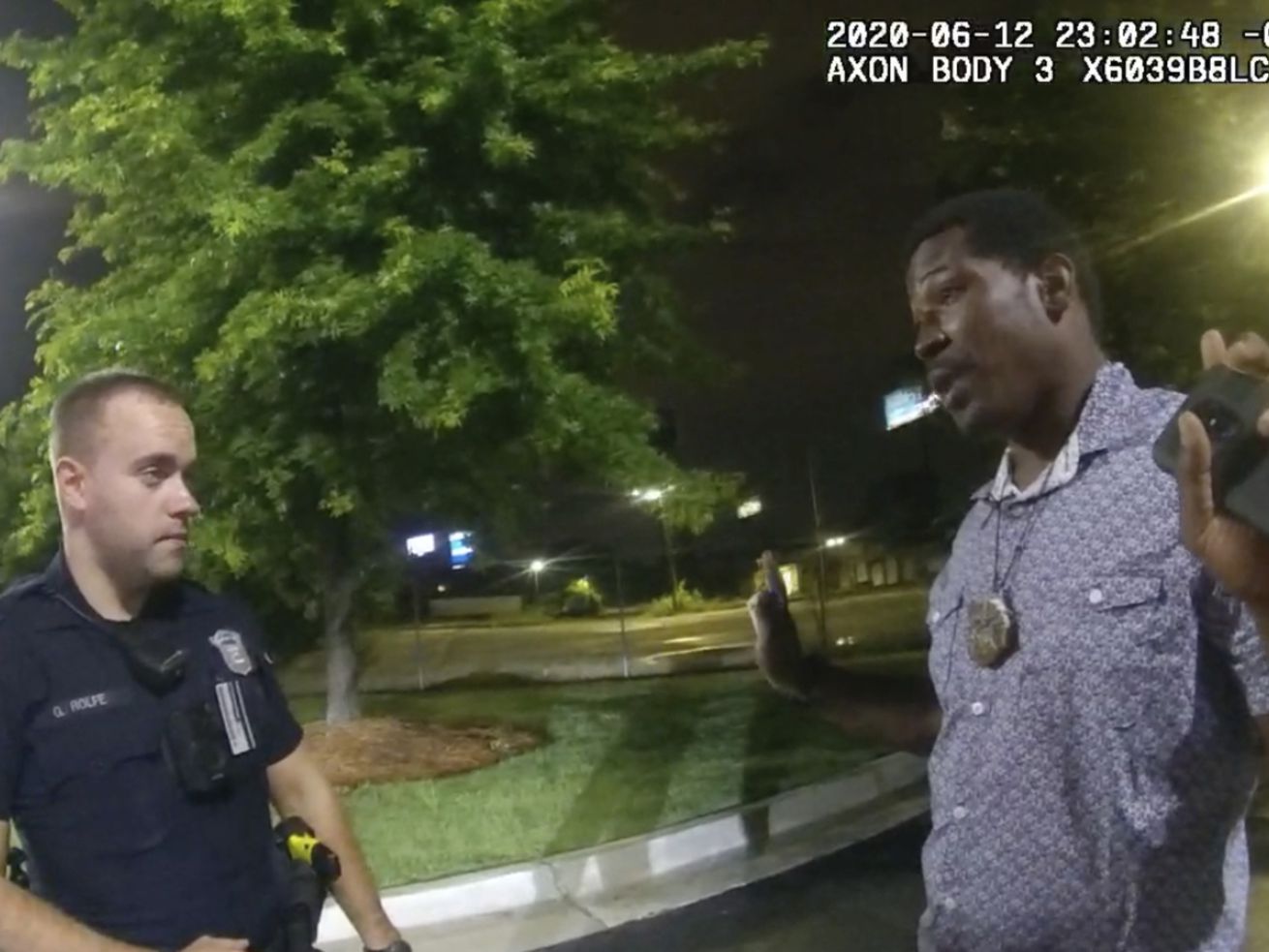
Garrett Rolfe was fired last June, a day after he shot the Black man in the parking lot of a fast food restaurant. The Atlanta Civil Service Board on Wednesday released its decision on Rolfe’s appeal of his firing.
ATLANTA — The firing of the former Atlanta police officer who’s charged with murder in the shooting death of Rayshard Brooks was reversed after a review panel found the city failed to follow its own procedures for disciplinary actions.
Garrett Rolfe was fired last June, a day after he shot the Black man in the parking lot of a fast food restaurant. The Atlanta Civil Service Board on Wednesday released its decision on Rolfe’s appeal of his firing.
“Due to the City’s failure to comply with several provisions of the Code and the information received during witnesses’ testimony, the Board concludes the Appellant was not afforded his right to due process,” the board said in its decision. “Therefore, the Board grants the Appeal of Garrett Rolfe and revokes his dismissal as an employee of the APD.”
Rolfe will remain on administrative leave until the criminal charges against him are resolved, Atlanta Mayor Keisha Lance Bottoms said.
Atlanta police spokeswoman Chata Spikes said she could not comment on whether he would receive back pay or would be paid while on administrative leave.
Brooks’ killing last June 12 happened amid weeks of sometimes violent protests across the U.S. after a Black man, George Floyd, was killed by a white Minneapolis officer on May 25. The night after Brooks died, the Wendy’s restaurant where he was shot was set on fire. Protesters have denounced racial inequality and called for the dismantling of police departments or the reallocation of their funding to social services.
Atlanta police Sgt. William Dean had testified that the firing seemed rushed, and Rolfe was not given sufficient time to respond, according to the decision.
Dean also said that during his tenure in the police department’s internal affairs unit, he was not aware of any such termination of an officer for an alleged firearms violation without the department first conducting an investigation, the decision states.
“He further stated that the hurried dismissal may have been due in part, to a press conference that was on the horizon,” it says.
Lance LoRusso, an attorney for Rolfe, applauded the board’s decision, saying his client now has the opportunity to explain what happened that night.
“We are very pleased at this action and consider it the first step in the total vindication of Officer Garrett Rolfe,” LoRusso said in an emailed statement.
Relatives of Brooks were disappointed and confused by the decision, said one of their lawyers, L. Chris Stewart.
“We find it mindboggling that our elected officials and the former chief weren’t aware of the proper procedures for firing an officer,” Stewart said during a Wednesday news conference.
“The city of Atlanta cannot be the alleged blueprint for civil rights for other cities and not actually fulfill that promise,” he added.
The Rev. James Woodall, president of the Georgia NAACP, said the decision to reinstate Rolfe “is not only a testament to a sustained commitment of enacting violence upon human lives but the lack of leadership and vision we currently have that will prevent further injustices from happening that leave our community grieving and begging for mercy.”
Police responded to complaints that Brooks had fallen asleep in his car in the drive-thru lane of a Wendy’s restaurant. Police body camera video shows the 27-year-old man struggling with two white officers after they told him he’d had too much to drink to be driving and tried to arrest him. Brooks grabbed a Taser from one of the officers and fled, firing it at Rolfe as he ran. An autopsy found that Brooks was shot twice in the back.
Brooks assaulted both officers, and Rolfe was entitled, as an officer and a citizen, to respond to that assault with deadly force, LoRusso said.
Bottoms said the day after the shooting that she did not believe it was a justified use of deadly force. She called for Rolfe’s immediate firing and announced that she had accepted the resignation of then-Police Chief Erika Shields.
“Given the volatile state of our city and nation last summer, the decision to terminate this officer, after he fatally shot Mr. Brooks in the back, was the right thing to do,” she said in a statement Wednesday. “Had immediate action not been taken, I firmly believe that the public safety crisis we experienced during that time would have been significantly worse.”
Bottoms said it’s important to note that the Civil Service Board did not determine whether Rolfe violated police department policies and that the department would determine whether additional investigation is needed.
Police Chief Rodney Bryant, who became interim chief after Shields’ departure and this week was named to the role permanently by Bottoms, said in an interview with The Associated Press that it’s not unusual for officers to appeal disciplinary action and that he respected the board’s decision.
Less than a week after the shooting, then-Fulton County District Attorney Paul Howard held a news conference to announce charges against the two officers. Rolfe faces charges including murder. The other officer, Devin Brosnan, was charged with aggravated assault and violating his oath. Lawyers for both officers have said their clients acted appropriately. Both are free on bond.
The officers haven’t been indicted yet.
Howard’s successor, Fani Willis, who became district attorney in January, has asked Georgia Attorney General Chris Carr to reassign the case, saying actions by Howard made it inappropriate for her office to continue handling the case. Carr has refused, saying the potential problems she cited were specific to Howard, so the responsibility for the case remained with her office.
Fulton County Superior Court Judge Christopher Brasher last month asked Willis to provide evidence showing why she should not be involved by this past Monday so that he can make a decision on the matter.

The Blackfeet tribe in northern Montana provided about 1,000 surplus vaccines last month to its First Nations relatives and others from across the border, in an illustration of the disparity in speed at which the United States and Canada are distributing doses.
BABB, Mont. — On a cloudy spring day, hundreds lined up in their cars on the Canadian side of the border crossing that separates Alberta and Montana. They had driven for hours and camped out in their vehicles in hopes of receiving the season’s hottest commodity — a COVID-19 vaccine — from a Native American tribe that was giving out its excess doses.
The Blackfeet tribe in northern Montana provided about 1,000 surplus vaccines last month to its First Nations relatives and others from across the border, in an illustration of the disparity in speed at which the United States and Canada are distributing doses. While more than 30% of adults in the U.S. are fully vaccinated, in Canada that figure is about 3%.
Among those who received the vaccine at the Piegan-Carway border crossing were Sherry Cross Child and Shane Little Bear, of Stand Off, about 30 miles (50 kilometers) north of the border.
They recited a prayer in the Blackfoot language before nurses began administering shots, with Chief Mountain — sacred to the Blackfoot people — rising in the distance. The prayer was dedicated to people seeking refuge from the virus, Cross Child said.
Cross Child and her husband have family and friends in Montana but have not been able to visit them since the border closed last spring to all but essential travel.
“It’s been stressful because we had some deaths in the family, and they couldn’t come,” she said. “Just for the support – they rely on us, and we rely on them. It’s been tough.”
More than 95% of the Blackfeet reservation’s roughly 10,000 residents who are eligible for the vaccine are fully immunized, after the state prioritized Native American communities — among the most vulnerable U.S. populations — in the early stages of its vaccination campaign.
The tribe received vaccine allotments both from the Montana health department and the federal Indian Health Service, leaving some doses unused. With an expiration date fast approaching, it turned to other nations in the Blackfoot Confederacy, which includes the Blackfeet and three tribes in southern Alberta that share a language and culture.
“The idea was to get to our brothers and sisters that live in Canada,” said Robert DesRosier, emergency services manager for the Blackfeet tribe. “And then the question came up – what if a nontribal member wants a vaccine? Well, this is about saving lives. We’re not going to turn anybody away.”
The tribe distributed the Pfizer and Moderna vaccines over four days in late April at the remote Piegan Port of Entry, amid a backdrop of rolling grasslands to the east and Glacier National Park’s snow-covered peaks to the west.
As news of the effort spread in Canada, first by word of mouth, then through social platforms and media reports, people traveled from farther away. Some drove five hours from the city of Edmonton.
The effort was particularly timely as Alberta sees a surge in new cases of the respiratory virus, with a caseload record reached this month.
Bonnie Healy, Blackfoot Confederacy health administrator, said she was glad the vaccination effort reached both First Nations and other communities in the province.
“We have family members that live in those areas,” she said. “If we can get these places safe, then it’s safe for our children to go to school there. It’s safe for our elders to go shopping in their stores.”
Canadians who got the vaccines were not allowed to linger in the U.S. They returned home with letters from health officials exempting them from the mandatory 14-day quarantine imposed on all those entering the country.
The tribe’s initiative is one of a few partnerships that have cropped up between communities in the U.S. and Canada, where residents might otherwise have to wait weeks or months for a shot.
Canada has lagged in vaccinating its population because it lacks the ability to manufacture the vaccine and like many countries has had to rely on the global supply chain for the lifesaving shots. Although Canada’s economy is tightly interconnected with the U.S., Washington hasn’t allowed the hundreds of millions of vaccine doses made in America to be exported until very recently, and Canada has had to turn to Europe and Asia.
But vaccinations have ramped up in recent months, and the Canadian government expects to receive at least 10 million vaccines this month and millions more in June. First Nations have been prioritized from the start.
In the meantime, Alaska Gov. Mike Dunleavy has offered COVID-19 vaccines to residents of Stewart, British Columbia, with hopes it could lead the Canadian government to ease restrictions between that town and the Alaska border community of Hyder, a couple of miles away. In North Dakota, Gov. Doug Burgum and Manitoba Premier Brian Pallister unveiled a plan last month to administer vaccinations to Manitoba-based truck drivers transporting goods to and from the U.S.
On the Montana side of the border, vaccine recipients were often emotional, shedding tears, shouting words of gratitude through car windows as they drove away, and handing the nurses gifts such as chocolate and clothing. Some shared stories about what the vaccine meant to them – the possibility of safely caring for vulnerable loved ones, reuniting with grandparents or traveling again.
Recipients included 17-year-olds who are low on the country’s priority list and parents who camped out with their young children in the backseat.
Maxwell Stein, 25, who plays the horn with the Calgary Philharmonic Orchestra, arrived at the border crossing at 6 p.m. Wednesday and spent the night in his car, finally reaching the front of the line around 10 a.m. Thursday.
“It wasn’t awesome, but you do what you need to to get a vaccine,” he said. He predicted that if he had waited in Canada, he’d likely get his first dose sometime in late June, and it would be months before he would be fully vaccinated.
The Canadian government has recommended extending the interval between the two doses of the Moderna and Pfizer vaccines from around three weeks to four months, with the goal of quickly inoculating more people amid the shortage. Some who attended the Blackfeet clinics had already gotten their first shot in Canada. More than 34% of Canada’s population has received at least one dose of the vaccine, but around 3% have received both doses recommended by the drug manufacturers to reach full immunity. Canadian officials say partial immunity is better than none.
“With vaccines, I think it’s really important to get the correct dosage in the right time period, so your body builds up the full resistance,” Stein said.
When Stein heard about the vaccine clinic on the border, he didn’t hesitate about the long drive, particularly as a professional musician who has a lot of free time with many concerts canceled.
“Really, I have no excuse. If I had to drive 10 hours to get the Pfizer or Moderna, I probably would have done it,” he said.
___
Samuels is a corps member for The Associated Press/Report for America Statehouse News Initiative. Report for America is a nonprofit national service program that places journalists in local newsrooms to report on undercovered issues.

Jennifer Coleman “traditionally” would have reviewed any high-profile proffer read in court but she didn’t go over the one prosecutor James Murphy read in court detailing the allegations against 21-year-old Ruben Roman, State’s Attorney Kim Foxx said. Foxx claims she was kept out of the loop on the matter.
One of Cook County State’s Attorney Kim Foxx’s top prosecutors was forced to resign this week after an internal investigation revealed she did not review an in-court statement a fellow prosecutor made about 13-year-old Adam Toledo holding a gun before he was shot and killed by Chicago police in Little Village.
Adam was holding a gun on March 29 but within less than a second, he threw it on the ground, turned around and put his hands up in the air when an officer fired, video footage released by the Civilian Office of Police Accountability shows.
First Assistant State’s Attorney Jennifer Coleman “traditionally” would have reviewed any high-profile proffer read in court by her underlings but she didn’t go over the one prosecutor James Murphy read in court on April 10 as he detailed the allegations against 21-year-old Ruben Roman, Foxx told the Chicago Sun-Times Wednesday.
Roman was arrested at the scene of Adam’s shooting, which Murphy described as part of Roman’s bond hearing. Roman faces charges of reckless discharge of a firearm, unlawful use of a weapon, child endangerment and violating probation.
“The officer tells [Adam] to drop it as [Adam] turns towards the officer. [Adam] has a gun in his right hand,” Murphy had told Judge Susana Ortiz last month.
“The officer fires one shot at [Adam], striking him in the chest. The gun that [Adam] was holding landed against the fence a few feet away.”
The proffer did not mention Adam throwing his weapon or him not having it in his hand when he was shot.
A source told the Sun-Times that the child endangerment charge wasn’t approved by Coleman until hours before Roman’s bond hearing, leaving Murphy little time to adjust his statement, which required detailing Adam’s shooting to make a case for that charge.
Five days after Roman’s bond hearing — and hours before COPA released footage of Adam’s shooting — Foxx approved a statement, saying Murphy “failed to fully inform himself before speaking in court,” and described the omission about the weapon as an error.
/cdn.vox-cdn.com/uploads/chorus_asset/file/22493215/Jennifer_Coleman.png)
On Wednesday, the state’s attorney’s office said Murphy “did not intend to give the impression that Adam Toledo was holding a gun when shot” and the “investigation revealed that the language the attorney used in court was inartful, leaving an unintended impression.”
Without mentioning Coleman’s forced resignation, the state’s attorney’s office in its statement also said its investigation “revealed a breakdown of communication in how information was shared, which ultimately did not get elevated to State’s Attorney Foxx before, nor in a timely manner following, the bond court hearing.”
Coleman, who was appointed first assistant in December, was asked to resign for failing to read the proffer and not showing the proper urgency required to correct the record after, the source said.
“She was essentially fired,” the source said.
Foxx, who told staff about Coleman’s firing in an internal email, said “had that proffer been vetted by superiors . . . I don’t think we would have been in this position.”
Foxx said she was informed by email about Roman’s proffer that Saturday, but she said that no one flagged it for her to read that weekend when she may not be as responsive on email compared to a weekday.
“I wasn’t given the opportunity to read [the proffer] beforehand because those who would have been in the position to give it to me hadn’t notified me, hadn’t called me, hadn’t said . . . you need to read this,” Foxx said. “The ability [for me] to weigh in didn’t happen on this day.”
Coleman could not be reached for comment.
Murphy, who had been placed on paid leave while the internal investigation took place, will be resuming his duties in the office.
Murphy had not been given all the materials the state’s attorney’s office obtained from COPA, the city oversight agency that investigates officer-involved shootings, Foxx said.
The office’s Law Enforcement Accountability Division had the information from COPA but it wasn’t shared with the Felony Review Unit, which only had information from police. LEAD is “walled off” from other other units and from Foxx until its investigation is complete.
Still Coleman, who reports directly to Foxx and oversees both units, should have reviewed Murphy’s proffer with her knowledge of the materials available to both units, Foxx said.
“I am not directly involved in the investigation of LEAD until they complete their initial work,” Foxx said. “It is by my own design. I think what has been evident in cases involving officer-involved shootings, is they’ve become very emotionally and politically charged.
“Politics should not impact how we review these cases. That was the intent of the design. … I have the final say on whether charges are filed or not.”
While Foxx said she was told “very early on” about the content in the videos capturing Adam’s shooting, she did not watch them until April 12. The top prosecutor did not say why it took three days after that for her office to comment on the discrepancy.
Foxx wouldn’t say if the officer who shot Adam would be charged and said the matter is still under review.
All assistant state’s attorneys will now have to undergo new training, and new policies and procedures will be put in place as a result of the investigation.

The Packers’ Aaron Rodgers reportedly wants to be traded, and the Bears and their fans are excited about Justin Fields.
Green Bay is troubled, Chicago is happy and absolutely nothing makes sense anymore. Left is right. Hot is cold. If there’s a bloodthirsty hen running loose in the fox house, I would not be surprised.
The Packers, the picture of quarterback stability for decades, are going through severe quarterback turmoil, and the Bears, the franchise that can’t spell QB if you spot it two letters, are at peace with the position.
Where are we? How did we get here? And what did you put in this brownie?
Aaron Rodgers’ unhappiness with the Packers burst into the open last week, and a trade of one of the best quarterbacks in NFL history is very much a possibility. According to one report, Rodgers wants out unless the team fires general manager Brian Gutekunst.
On the same day that news of Rodgers’ discontent broke, the Bears traded up in the draft to select Ohio State quarterback Justin Fields with the 11th overall pick. Chicago greeted the development with a joy last seen on the day Prohibition ended. General manager Ryan Pace, whose record of choosing quarterbacks has been abysmal, was lauded by local media as a swashbuckling genius. You try being that without pulling a muscle.
This is how strange and discombobulated things are: According to The Athletic, Rodgers mockingly referred to Gutekunst in group chats with teammates as “Jerry Krause,’’ equating him to the late Bulls general manager, whom Michael Jordan blamed for breaking up the team’s dynasty. Hey, Aaron, come up with your own symbols for dysfunction!
This is why my boat is adrift. Chicago has lived so long in the shadow of Green Bay’s quarterbacks that to see even a sliver of a chance of places being traded, of the shoe being put on the other foot, is mind-boggling. The Packers have had Bart Starr, Brett Favre and Rodgers, each of whom played 16 seasons with the franchise. The Bears? The great Sid Luckman played 12 seasons in Chicago, the most for a quarterback in team history, followed by the so-so Jay Cutler with eight. That’s all you really need to know.
But now comes Mr. Fields, a possible antidote to all the pain and suffering that Bears fans carry in their DNA.
And there, perhaps, goes Mr. Rodgers.
Neither of these possibilities computes with me. I understand why Bears fans have grafted themselves to the idea of Fields’ being great. They’re desperate for a quarterback, and the kid showed tons of promise at Ohio State. The franchise’s history would suggest that the buyer beware, that you don’t ever want to fall in love with the next quarterback, but, hey, it’s your heart, folks. What’s one more session with a carving knife?
The Rodgers situation makes no sense to the average scarred Bears fan, which is every Bears fan. When Green Bay decided to move on from Favre in 2008, it didn’t seem to make a whole lot of sense, either. The Packers were coming off a loss in the NFC Championship Game. But the organization knew how good Rodgers, his replacement, was. This time, there is no logical replacement. By most accounts, Jordan Love, heading into his second year in the league, is not ready to lead the offense.
Few people understood Green Bay’s decision to draft Love in the first round in 2020. Rodgers certainly didn’t. That the Packers failed to inform their future Hall of Famer they were going to use a first-round pick on a QB might have been the beginning of the end of the marriage.
As I said, the whole thing makes zero sense to those of us who have looked longingly north, to the land of quarterback plenty, and wondered what maleficent force out there had it in for Chicago. The Packers have perhaps the most talented quarterback in league history, and they can’t make it work? Really? Rodgers responded to the drafting of Love with one of his best seasons. His desire to have his contract redone in the offseason apparently fell on deaf ears.
He is not an innocent in all of this, of course. He can be prickly, and it’s why Packers fans aren’t rushing en masse to his defense. They like the victories he has brought them, but they liked Favre’s one-of-the-guys earthiness better. Will they side with management’s intransigence or Favre’s petulance? I have no idea.
What I do know is that Bears fans would embrace Vlad the Impaler if he were an accurate passer. Someone as intriguing as Fields comes along, and what happens? The city comes loose from its moorings.
Green Bay is Titletown. Now, somehow, Chicago is Tickled Town. Somebody help me. I don’t know how to navigate this landscape.
The Packers’ Aaron Rodgers reportedly wants to be traded, and the Bears and their fans are excited about Justin Fields.
Green Bay is troubled, Chicago is happy and absolutely nothing makes sense anymore. Left is right. Hot is cold. If there’s a bloodthirsty hen running loose in the fox house, I would not be surprised.
The Packers, the picture of quarterback stability for decades, are going through severe quarterback turmoil, and the Bears, the franchise that can’t spell QB if you spot it two letters, are at peace with the position.
Where are we? How did we get here? And what did you put in this brownie?
Aaron Rodgers’ unhappiness with the Packers burst into the open last week, and a trade of one of the best quarterbacks in NFL history is very much a possibility. According to one report, Rodgers wants out unless the team fires general manager Brian Gutekunst.
On the same day that news of Rodgers’ discontent broke, the Bears traded up in the draft to select Ohio State quarterback Justin Fields with the 11th overall pick. Chicago greeted the development with a joy last seen on the day Prohibition ended. General manager Ryan Pace, whose record of choosing quarterbacks has been abysmal, was lauded by local media as a swashbuckling genius. You try being that without pulling a muscle.
This is how strange and discombobulated things are: According to The Athletic, Rodgers mockingly referred to Gutekunst in group chats with teammates as “Jerry Krause,’’ equating him to the late Bulls general manager, whom Michael Jordan blamed for breaking up the team’s dynasty. Hey, Aaron, come up with your own symbols for dysfunction!
This is why my boat is adrift. Chicago has lived so long in the shadow of Green Bay’s quarterbacks that to see even a sliver of a chance of places being traded, of the shoe being put on the other foot, is mind-boggling. The Packers have had Bart Starr, Brett Favre and Rodgers, each of whom played 16 seasons with the franchise. The Bears? The great Sid Luckman played 12 seasons in Chicago, the most for a quarterback in team history, followed by the so-so Jay Cutler with eight. That’s all you really need to know.
But now comes Mr. Fields, a possible antidote to all the pain and suffering that Bears fans carry in their DNA.
And there, perhaps, goes Mr. Rodgers.
Neither of these possibilities computes with me. I understand why Bears fans have grafted themselves to the idea of Fields’ being great. They’re desperate for a quarterback, and the kid showed tons of promise at Ohio State. The franchise’s history would suggest that the buyer beware, that you don’t ever want to fall in love with the next quarterback, but, hey, it’s your heart, folks. What’s one more session with a carving knife?
The Rodgers situation makes no sense to the average scarred Bears fan, which is every Bears fan. When Green Bay decided to move on from Favre in 2008, it didn’t seem to make a whole lot of sense, either. The Packers were coming off a loss in the NFC Championship Game. But the organization knew how good Rodgers, his replacement, was. This time, there is no logical replacement. By most accounts, Jordan Love, heading into his second year in the league, is not ready to lead the offense.
Few people understood Green Bay’s decision to draft Love in the first round in 2020. Rodgers certainly didn’t. That the Packers failed to inform their future Hall of Famer they were going to use a first-round pick on a QB might have been the beginning of the end of the marriage.
As I said, the whole thing makes zero sense to those of us who have looked longingly north, to the land of quarterback plenty, and wondered what maleficent force out there had it in for Chicago. The Packers have perhaps the most talented quarterback in league history, and they can’t make it work? Really? Rodgers responded to the drafting of Love with one of his best seasons. His desire to have his contract redone in the offseason apparently fell on deaf ears.
He is not an innocent in all of this, of course. He can be prickly, and it’s why Packers fans aren’t rushing en masse to his defense. They like the victories he has brought them, but they liked Favre’s one-of-the-guys earthiness better. Will they side with management’s intransigence or Favre’s petulance? I have no idea.
What I do know is that Bears fans would embrace Vlad the Impaler if he were an accurate passer. Someone as intriguing as Fields comes along, and what happens? The city comes loose from its moorings.
Green Bay is Titletown. Now, somehow, Chicago is Tickled Town. Somebody help me. I don’t know how to navigate this landscape.

The Hurricanes’ fourth goal Tuesday exemplified how confused and out-of-position the Hawks have often been lately in their own zone.
The Blackhawks’ defensive coverage, a weakness all season and in seasons past, has reached new lows in recent weeks.
Defensemen and forwards alike are regularly getting beat to the net or slot by the player they’re supposed to cover, or — even worse — leaving players uncovered entirely. Individual missed assignments and collective confusion with sorting and switching have all contributed.
Turnovers have been problematic, and often coverage is at its worst immediately after an unexpected turnover. Coach Jeremy Colliton has also pointed to cleaner breakout passes and more offensive possession time as ways to reduce stress on the defense. But the coverage has been arguably the most inept facet of the Hawks’ recent play.
Through April 20, the Hawks allowed 56.0 shot attempts and 28.2 scoring chances per 60 minutes on five-on-five play — the sixth- and second-most in the NHL, respectively. They weren’t good.
But in the seven games since, they’ve been even worse. They’ve allowed 66.2 shot attempts and 33.7 scoring chances per 60 minutes of five-on-five play, and their goals-against rate has nearly doubled from 2.51 to an unsightly 4.91.
With the pressure of the playoff race gone (due to the team’s many losses), Colliton has rotated the lineup more and challenged many of the Hawks’ young players with more responsibilities. That explains some of the statistical regression.
The urgency for players to make final good impressions before the upcoming summer housecleaning, however, should still theoretically provide plenty of motivation.
“It’s the NHL, right?” defenseman Riley Stillman said after Tuesday’s 6-3 loss. “Guys are trying to keep jobs, guys are trying to take jobs… We’re attempting to come the right way [but] things aren’t happening right now.”
One play from Tuesday — the Hurricanes’ fourth goal, scored coincidentally by Teuvo Teravainen — exemplified the Hawks’ coverage woes.
Teuvo Teravainen and Sebastian Aho team up to push the Hurricanes lead to 2 in the third!#LetsGoCanes pic.twitter.com/bbfL0UCwlY
— Hockey Daily 365 (@HockeyDaily365) May 5, 2021
The Hawks had Nikita Zadorov and Wyatt Kalynuk as their defensive pair and Dylan Strome centering Alex DeBrincat and Patrick Kane as their forward line. The Hurricanes carried the puck up ice with Zadorov guarding Andrei Svechnikov, Kalynuk covering Dougie Hamilton — the defenseman joining the rush — and Strome following Sebastian Aho as the center-on-center matchup.
Once in the offensive zone, Svechnikov stopped with the puck along the half-wall and appeared to momentarily lose control. Strome ignored Aho to try to poke the puck away, but Svechnikov backhand-passed it a millisecond before to Aho down low. That created a scenario in which the Hawks’ coverage crumbled.
DeBrincat led Teravainen comfortably up the ice behind the rush. But he inexplicably left him at the moment of Strome’s failed poke-check, leaving DeBrincat too high in the zone to cover anyone. He actually never re-entered the camera frame.
Zadorov, as he too often has this spring, was caught flat-footed. He didn’t react quickly enough to switch onto Aho, and he failed to recognize a now-unmarked Teravainen over his left shoulder.
Kalynuk, meanwhile, briefly disengaged when Hamilton held up above the faceoff circle and drifted back next to goalie Collin Delia, leaving him too deep to cover anyone — and essentially useless — after the puck reached Aho.
Kane, arriving late into the defensive zone, hung back to block the passing lane for a potential Hamilton weak-side one-timer. But he never stepped toward Teravainen, even when it became clear the way the play developed that Teravainen was the more imminent threat.
/cdn.vox-cdn.com/uploads/chorus_asset/file/22494204/Screen_Shot_2021_05_05_at_1.33.17_PM.png)
Ultimately, both Aho and Teravainen were left completely unguarded and cleanly executed a simple pass, simple pass and simple goal.
“I felt we got hung up [along the wall] and got beat to the inside,” Colliton said succinctly when asked later about the sequence.
Tuesday’s loss was meaningless from a postseason perspective, just as the Hawks’ final three games will be. But breakdowns like that demonstrated just how much they’ll need to improve — in terms of personnel, performance and even overall system — to hold their own defensively in 2021-22.