A 15-year-old boy was shot May 10, 2021 in Englewood on the South Side. | Adobe Stock Photo
A 15-year-old boy was wounded in a shooting in the 7100 block of South Emerald Avenue.
A 15-year-old boy was wounded in a shooting Monday evening in Englewood on the South Side.
The boy was found about 6:15 p.m. on a sidewalk in the 7100 block of South Emerald Avenue and told officers he had heard shots and felt pain, Chicago police said.
He suffered a gunshot wound to the right leg and a grazed wound to the neck, police said.
He was transported to Comer Children’s Hospital in good condition, according to police.
Chicago fire officials initially reported the boy was in critical condition.
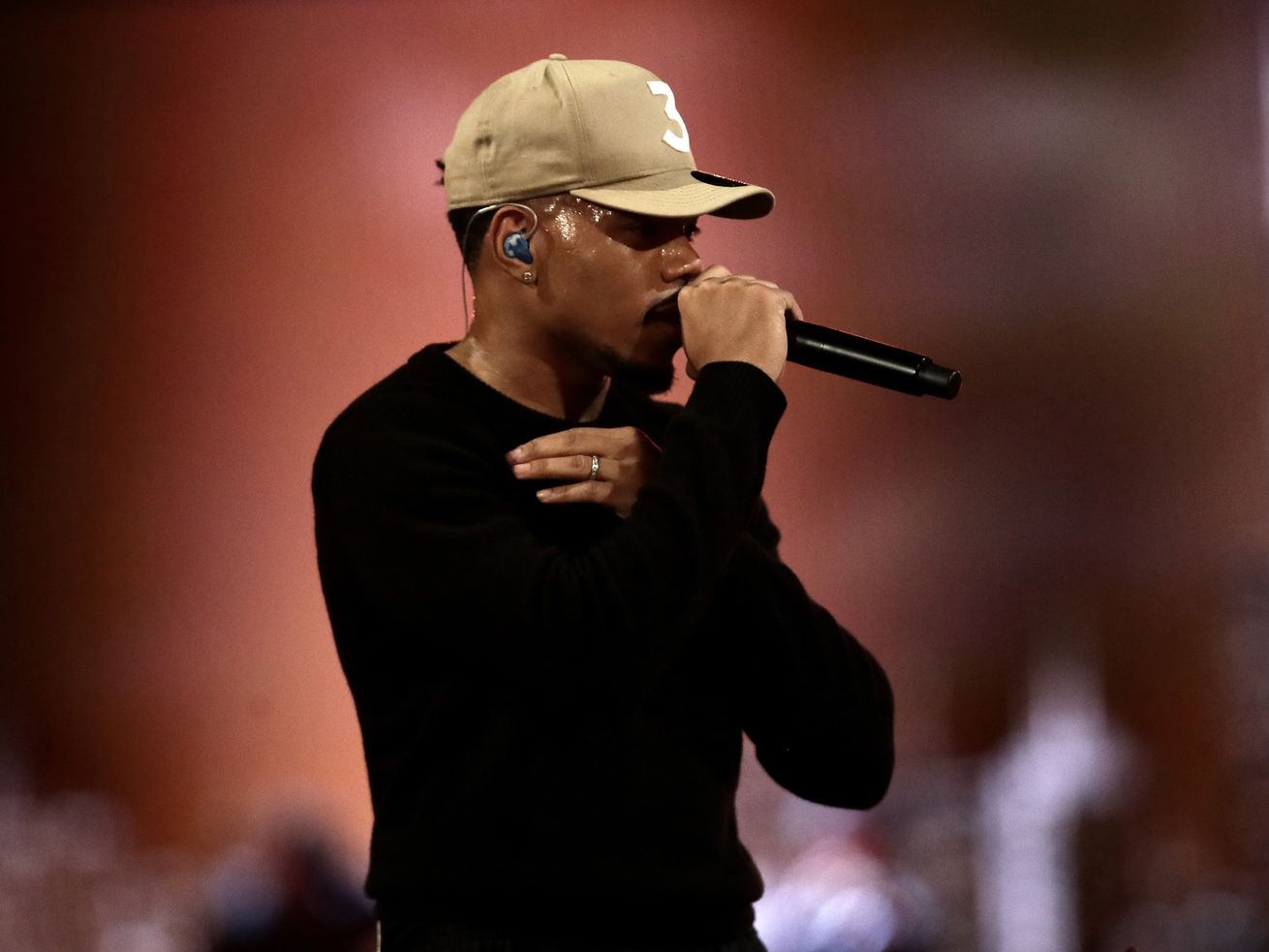
Chance the Rapper performs during halftime of the 69th NBA All-Star Game at the United Center on February 16, 2020. | Getty
The Chicago rapper and AMC Theatres announced screenings of “Magnificent Coloring World,” May 14-16 at AMC River East 21.
Chance the Rapper’s upcoming concert film “Magnificent Coloring World” will get three days of advance screenings in Chicago later this month.
On Monday, the Chicago rapper and AMC Theatres announced screenings May 14-16 at AMC River East 21.
Tickets will go on sale at 6 p.m. May 12 exclusively at the theater box office, 322 E. Illinois.
The movie was filmed in 2017, hot on the heels of Chance’s history-making win at the Grammys, where he was awarded best rap album for “Coloring Book,” the first time the accolade went to a streamed-only album. Nominated in seven categories, Chance picked up three statuettes for his work featured on the album, including best new artist and best rap performance for “No Problem” with 2 Chainz and Lil Wayne.
“Seeing movies together on the big screen is an essential part of summertime and something I deeply missed over the last year, so I am extremely excited and honored to partner with AMC to safely bring fans back to the theater,” Chance The Rapper said via statement, about the movie screenings.
“Magnificent Coloring World” is scheduled for a theatrical release this summer.
SACRAMENTO, Calif. — Gov. Gavin Newsom on Monday expanded a drought emergency declaration to a large swath of the nation’s most populated state amid “acute water supply shortages” in northern and central parts of California.
The declaration now covers 41 of 58 counties, covering 30% of California’s nearly 40 million people. The U.S. Drought Monitor shows most of the state and the American West is in extensive drought just a few years after California emerged from a punishing multiyear dry spell.
Officials fear an extraordinarily dry spring presages a wildfire season like last year, when flames burned a record 6,562 square miles.
The expansion comes as Newsom prepares to propose more spending on both short- and long-term responses to dry conditions. He was set to release details during a visit to Merced County, in the agricultural Central Valley south of Sacramento.
The Democratic governor last month had declared an emergency in just two counties north of San Francisco — Mendocino and Sonoma.
The expanded declaration includes the counties in the Klamath River, Sacramento-San Joaquin Delta and Tulare Lake watersheds across much of the northern and central parts of the state.
The Sierra Nevada snowpack, which provides about a third of the state’s water, was at just 59% of average on April 1, when it is normally at its peak.
This year is unique because of extraordinarily warm temperatures in April and early May, the Newsom administration said. That led to quick melting of the Sierra Nevada snowpack in the waterways that feed the Sacramento River, which in turn supplies much of the state’s summer water supply.
The problem was worse because much of the snow seeped into the ground instead of flowing into rivers and reservoirs, the administration said.
The warmer temperatures also caused water users to draw more water more quickly than even in other drought years, the administration said, leaving the reservoirs extremely low for farmers, fish and wildlife that depend on them.
That all reduced the state’s water supplies by as much as what would supply up to 1 million households for a year, officials said.
“It’s time for Californians to pull together once again to save water,” California Natural Resources Agency Secretary Wade Crowfoot said in a statement.
He urged residents to limit their use, whether by limiting outdoor watering, checking for leaks, or taking shorter showers and turning off the water when washing dishes or brushing teeth.
Newsom’s declaration directs the State Water Board to consider changing the rules for reservoir releases and water diversions to keep more water upstream later this year to maintain more water supply, improve water quality and protect cold water pools for salmon and steelhead.
The declaration also allows more flexibility in regulations and contracting to respond to the drought, while speeding voluntary transfers of water between owners.
Newsom said he also wants lawmakers to spend more in the next fiscal year to both respond to the drought and build the state’s long-term water supply.
The governor is spending the week previewing highlights of the revised budget he will present to state lawmakers Friday for the fiscal year that begins July 1.
Earlier Monday in the San Francisco Bay Area, Newsom proposed tax rebates of up to $1,100 for millions of lower- and middle-income Californians, one leg of a pandemic recovery plan made possible by an eye-popping $75 billion budget surplus.
The barnstorming comes as Newsom faces a fall recall election driven in large part by frustration over his handling of the pandemic, though he noted that he also previewed his budget proposals in the past when he wasn’t facing a recall.
The governor’s fellow Democrats, who control the Legislature, have until June 15 to pass a spending plan.
U.S. regulators on Monday expanded the use of Pfizer’s COVID-19 vaccine to children as young as 12, offering a way to protect the nation’s adolescents before they head back to school in the fall and paving the way for them to return to more normal activities.
Shots could begin as soon as a federal vaccine advisory committee issues recommendations for using the two-dose vaccine in 12- to 15-year-olds. An announcement is expected Wednesday.
Most COVID-19 vaccines worldwide have been authorized for adults. Pfizer’s vaccine is being used in multiple countries for teens as young as 16, and Canada recently became the first to expand use to 12 and up. Parents, school administrators and public health officials elsewhere have eagerly awaited approval for the shot to be made available to more kids.
“This is a watershed moment in our ability to fight back the COVID-19 pandemic,” Dr. Bill Gruber, a Pfizer senior vice president who’s also a pediatrician, told The Associated Press.
The Food and Drug Administration declared that the Pfizer vaccine is safe and offers strong protection for younger teens based on testing of more than 2,000 U.S. volunteers ages 12 to 15. The study found no cases of COVID-19 among fully vaccinated adolescents compared to 18 among kids given dummy shots. More intriguing, researchers found the kids developed higher levels of virus-fighting antibodies than earlier studies measured in young adults.
The younger teens received the same vaccine dosage as adults and had the same side effects, mostly sore arms and flu-like fever, chills or aches that signal a revved-up immune system, especially after the second dose.
Pfizer’s testing in adolescents “met our rigorous standards,” FDA vaccine chief Dr. Peter Marks said. “Having a vaccine authorized for a younger population is a critical step in continuing to lessen the immense public health burden caused by the COVID-19 pandemic.”
Pfizer and its German partner BioNTech recently requested similar authorization in the European Union, with other countries to follow.
The latest news is welcome for U.S. families struggling to decide what activities are safe to resume when the youngest family members remain unvaccinated.
“I can’t feel totally comfortable because my boys aren’t vaccinated,” said Carrie Vittitoe, a substitute teacher and freelance writer in Louisville, Kentucky, who is fully vaccinated, as are her husband and 17-year-old daughter.
The FDA decision means her 13-year-old son soon could be eligible, leaving only her 11-year-old son unvaccinated. The family has not yet resumed going to church, and summer vacation will be a road trip so they do not have to get on a plane.
“We can’t really go back to normal because two-fifths of our family don’t have protection,” Vittitoe said.
Pfizer is not the only company seeking to lower the age limit for its vaccine. Moderna recently said preliminary results from its study in 12- to 17-year-olds show strong protection and no serious side effects. Another U.S. company, Novavax, has a COVID-19 vaccine in late-stage development and just began a study in 12- to 17-year-olds.
Next up is testing whether the vaccine works for even younger children. Both Pfizer and Moderna have begun U.S. studies in children ages 6 months to 11 years. Those studies explore whether babies, preschoolers and elementary-age kids will need different doses than teens and adults. Gruber said Pfizer expects its first results in the fall.
Outside of the U.S., AstraZeneca is studying its vaccine among 6- to 17-year-olds in Britain. And in China, Sinovac recently announced that it has submitted preliminary data to Chinese regulators showing its vaccine is safe in children as young as 3.
Children are far less likely than adults to get seriously ill from COVID-19, yet they represent nearly 14% of the nation’s coronavirus cases. At least 296 have died from COVID-19 in the U.S. alone, and more than 15,000 have been hospitalized, according to a tally by the American Academy of Pediatrics.
That’s not counting the toll of family members becoming ill or dying — or the disruption to school, sports and other activities so crucial to children’s overall well-being.
The AAP welcomed the FDA’s decision.
“Our youngest generations have shouldered heavy burdens over the past year, and the vaccine is a hopeful sign that they will be able to begin to experience all the activities that are so important for their health and development,” said AAP President Dr. Lee Savio Beers in a statement.
Experts say children must get the shots if the country is to vaccinate the 70% to 85% of the population necessary to reach what’s called herd immunity.
In the meantime, the Centers for Disease Control and Prevention says unvaccinated people — including children — should continue taking precautions such as wearing masks indoors and keeping their distance from other unvaccinated people outside of their households.
___
The Associated Press Health and Science Department receives support from the Howard Hughes Medical Institute’s Department of Science Education. The AP is solely responsible for all content.
Chicago musical theater star E. Faye Butler helms an online sci-fi feminist drama.
Sometimes, we just don’t give ourselves the space. That’s something E. Faye Butler, in her new capacity as the board president of Artemisia Theatre, as well as the director of Goods, Artemisia’s first production of the year, has been thinking about a lot lately. …Read More
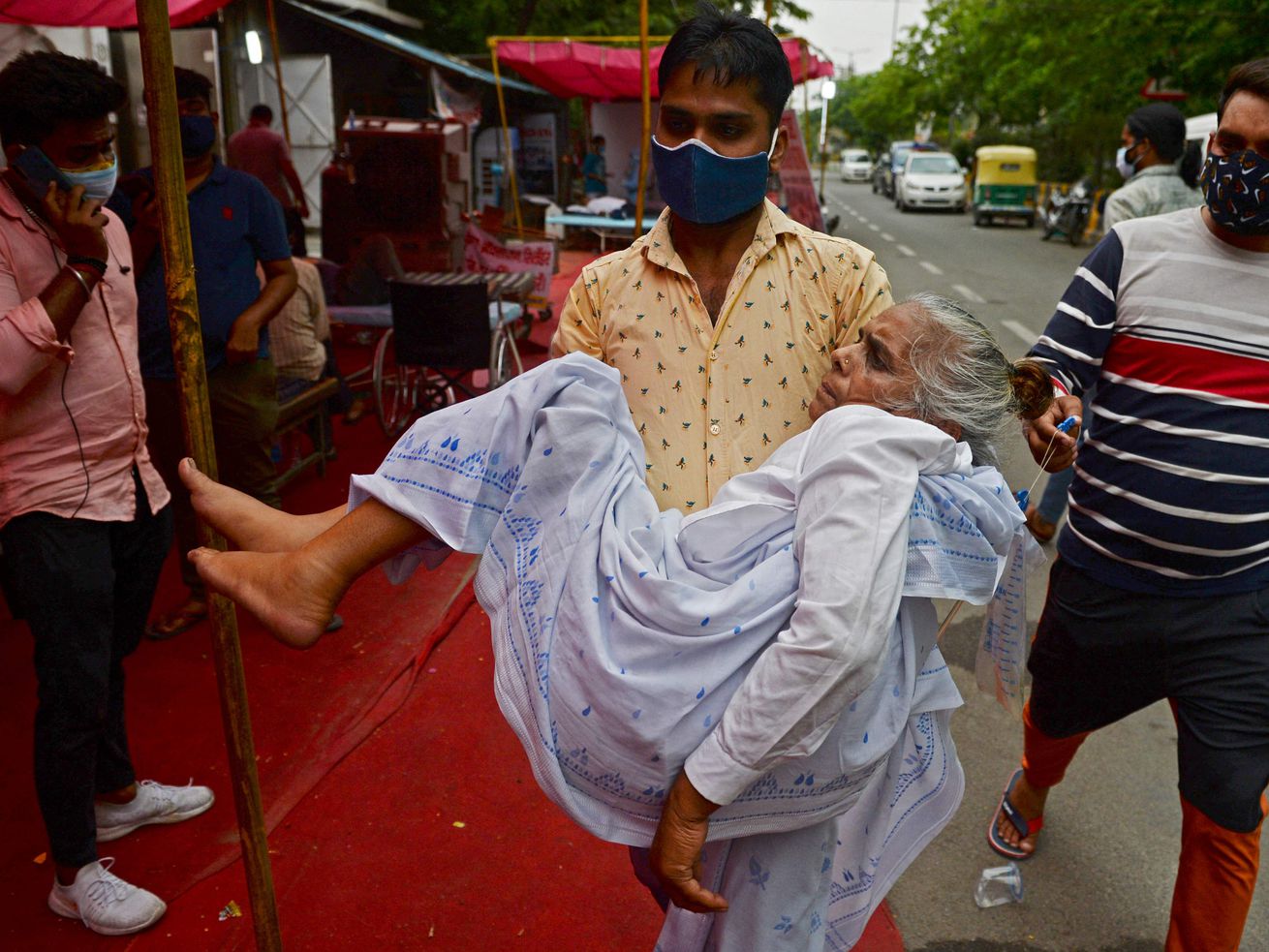
On the outskirts of New Delhi, a man carries a relative who is suffering from COVID-19 to an oxygen support center. | Getty
The pandemic is truly a global threat that requires a global mobilization.
India is now ground zero for COVID-19.
On Saturday, it suffered a record of more than 335,000 new infections and more than 4,000 deaths in one day. Hospitals are running out of oxygen and beds. Morgues and crematoria are overwhelmed.
In total, a staggering 22.6 million people in India have been infected, with 246,116 deaths.
With 1.3 billion people, India is the second most populous country in the world. From across the country and across the world, there are increasing demands that Prime Minister Narendra Modi order a lockdown of the country to help staunch the spread of the virus.
This may be imperative, but one can understand the reluctance to do it. When Modi enforced a 21-day lockdown last year, it helped squelch the spread of the disease but caused a 24% economic contraction in the first quarter of 2020 and widespread desperation among India’s large numbers of migrant workers.
More recently, at the same time Modi put off another lockdown, he displayed Trumpian irresponsibility by holding a mass political rally with thousands of largely maskless people crowded together and refusing to halt the huge Hindu pilgrimage of millions to bathe in the Ganges River. To some extent, as The Lancet, a medical journal, noted, this is a “self-inflicted catastrophe.”
With India in distress and much of the world desperate for access to vaccine supplies, supplier nations have been slow to respond. China is by far the largest supplier of vaccines, having shipped more than 240 million doses to countries across the world, more than the rest of the world combined. China promises to ship 500 million more.
China, fierce rival of India, immediately stepped in to promise to supply countries that India was forced to cut off to fight its own outbreak. China’s vaccine is not as effective as those developed by Pfizer and Moderna, but it surely is better than nothing.
Last week, the Biden administration finally challenged the U.S. drug industry, announcing that the White House would support an international waiver of intellectual property protections on COVID-19 vaccines during the pandemic. This is a long overdue measure, but if the industry continues to resist, the negotiations are likely to take months that the world can ill afford. Though the companies benefited greatly from government subsidies and guaranteed purchases — and have seen their profits and stocks soar — they have a large stake in controlling production to ensure continued profits over time.
The Biden administration decision — if aggressively enforced — will put public health over private profit.
As the pandemic rages in India and Brazil, it poses a continued threat to the world. If it isn’t brought under control everywhere, new variants will develop and most likely spread, even to countries that have succeeded in inoculating their populations. The pandemic is truly a global threat that requires a global mobilization.
At the national level, global cooperation has been slow to develop. Instead, the surge to supply countries in need is propelled less from a unified global effort and more from a competitive national “vaccine diplomacy,” with India, China, Russia and now the U.S. vying to win hearts and minds through vaccine supplies.
Fighting the pandemic isn’t just the responsibility of governments. This is a global, human tragedy. The pandemic spreads through the air, so no people are safe unless all are safe. We need at outpouring of citizen action — telethons by stars and musicians, increased donations from foundations, mobilization of volunteers, ramping up of production of supplies — to ensure that vaccines are available and citizens are mobilized to receive them. We need increased global efforts to get the vaccine into rural areas and into the poorest ghettos and barrios of the poorest nations.
Joe Biden announced that he would rely on science for advice, but we can’t rely on science or on government alone. Popular mobilization is essential.
If we are to address common global threats such as contagions or climate change or nuclear war, we must develop a global perspective. Now it becomes ever more apparent that, as Dr. Martin Luther King taught long ago, “all life is interrelated. We are caught in an inescapable network of mutuality; tied in a single garment of destiny. Whatever affects one directly, affects all indirectly. … As long as diseases are rampant … no man can be totally healthy, even if he just got a clean bill of health from the finest clinic in America.”
In the global struggle to meet the threat of Covid-19, this basic truth is more important than ever.
Palestinians inside the Al-Aqsa mosque clash with Israeli security forces at the Al Aqsa Mosque compound in Jerusalem’s Old City Monday, May 10, 2021. Israeli police clashed with Palestinian protesters at a flashpoint Jerusalem holy site on Monday, the latest in a series of confrontations that is pushing the contested city to the brink of eruption. Palestinian medics said at least 180 Palestinians were hurt in the violence at the Al-Aqsa Mosque compound, including 80 who were hospitalized. | AP
The early evening attack drastically escalated what already are heightened tensions throughout the region following weeks of confrontations between Israeli police and Palestinian protesters in Jerusalem that have threatened to become a wider conflict.
JERUSALEM — The Hamas militant group on Monday launched a rare rocket strike on Jerusalem after hundreds of Palestinians were hurt in clashes with Israeli police at an iconic mosque, as tensions in the holy city pushed the region closer to full-fledged war.
Israel responded with airstrikes across the Gaza Strip, where 20 people, including nine children, were killed in fighting.
It was a long day of anger and deadly violence that laid bare Jerusalem’s deep divisions, even as Israel tried to celebrate its capture of the city’s eastern sector and its sensitive holy sites more than half a century ago. With dozens of rockets flying into Israel throughout the night, Prime Minister Benjamin Netanyahu met with top security officials and warned that the fighting could drag on, despite calls for calm from the U.S., Europe and elsewhere.
“The terrorist organizations in Gaza have crossed a red line and attacked us with missiles in the outskirts of Jerusalem,” Netanyahu said. “Whoever attacks us will pay a heavy price,” he said, warning that the fighting could “continue for some time.”
By late Monday, the military had carried out dozens of airstrikes across Gaza, targeting what it said were Hamas military installations and operatives. It said a Hamas tunnel, rocket launchers and at least eight militants had been hit.
Gaza health officials gave no further breakdowns on the casualties. At least 13 of the 20 deaths in Gaza were attributed to the airstrikes. Seven of the deaths were members of a single family, including three children, who died in a mysterious explosion in the northern Gaza town of Beit Hanoun. It was not clear if the blast was caused by an Israeli airstrike or errant rocket.
Shortly before midnight, the Israeli army said at least 150 rockets had been fired into Israel. That included a barrage of six rockets that targeted Jerusalem, some 100 kilometers (60 miles) away. It set off air raid sirens throughout Jerusalem, and explosions could be heard in what was believed to be the first time the city had been targeted since a 2014 war.
Dozens of rockets were intercepted by Israel’s Iron Dome defense system. But one landed near a home on the outskirts of Jerusalem, causing light damage to the structure and sparking a brush fire nearby. In southern Israel, an Israeli man was lightly wounded after a missile struck a vehicle.
Abu Obeida, spokesman for Hamas’ military wing, said the attack on Jerusalem was a response to what he called Israeli “crimes and aggression” in the city. “This is a message the enemy has to understand well,” he said.
He threatened more attacks if Israeli forces re-entered the sacred Al-Aqsa Mosque compound or carried out planned evictions of Palestinian families from an east Jerusalem neighborhood.
The mosque is in a hilltop compound that is the third-holiest site in Israel and the holiest in Judaism. Tensions at the site, known to Muslims as the Noble Sanctuary and to Jews as the Temple Mount, have triggered repeated bouts of violence in the past.
In Monday’s unrest, Israeli police fired tear gas, stun grenades and rubber bullets in clashes with stone-throwing Palestinians at the compound.
More than a dozen tear gas canisters and stun grenades landed in the mosque as police and protesters faced off inside the walled compound that surrounds it, said an Associated Press photographer at the scene. Smoke rose in front of the mosque and the golden-domed shrine on the site, and rocks littered the nearby plaza. Inside one area of the compound, shoes and debris lay scattered over ornate carpets.
Over 500 Palestinians were hurt, including 333 people who required care at hospitals and clinics, according to the Palestinian Red Crescent.
Palestinians and police reported renewed clashes late Monday. Israeli police also reported unrest in northern Israel, where Arab protesters burned tires and threw stones and fireworks at security forces. Police said 46 people were arrested.
Monday’s confrontations came after weeks of almost nightly clashes between Palestinians and Israeli police in the Old City of Jerusalem, the emotional center of their conflict, during the Muslim holy month of Ramadan. The month tends to be a time of heightened religious sensitivities.
Most recently, the tensions have been fueled by the planned eviction of dozens of Palestinians from the Sheikh Jarrah neighborhood of east Jerusalem, where Israeli settlers have waged a lengthy legal battle to take over properties.
Israel’s Supreme Court postponed a key ruling Monday in the case, citing the “circumstances.”
In Washington, State Department spokesman Ned Price condemned “in the strongest terms” the rocket fire on Israel and called on all sides to calm the situation.
“More broadly, we’re deeply concerned about the situation in Israel, the West Bank and the Gaza Strip, including violent confrontations in Jerusalem,” he said. He said the U.S. would remain “fully engaged” and praised steps by Israel to cool things down, including the court delay in the eviction case.
In an apparent attempt to avoid further confrontation, Israeli authorities changed the planned route of a march by thousands of flag-waving nationalist Jews through the Muslim Quarter of the Old City to mark Jerusalem Day.
The annual festival is meant to celebrate Israel’s capture of east Jerusalem in the 1967 Mideast war. But it is widely seen as a provocation because the route goes through the heart of Palestinian areas.
Israel also captured the West Bank and Gaza in 1967. It later annexed east Jerusalem and considers the entire city its capital. The Palestinians seek all three areas for a future state, with east Jerusalem as their capital.
Meanwhile, the United Nations, Egypt and Qatar, which frequently mediate between Israel and Hamas, were all trying to halt the fighting, a diplomatic official confirmed. He spoke on condition of anonymity because he was not authorized to discuss the issue with the media.
The tensions in Jerusalem have threatened to reverberate throughout the region and come at a crucial point in Israel’s political crisis. Netanyahu failed to form a governing coalition last week, and his opponents are now working to build an alternate government.
Netanyahu pushed back against the criticism Monday, saying Israel is determined to ensure the rights of worship for all, which “occasionally requires taking a strong stand as the officers of the Israeli police, and our security forces, are doing at the moment. We back them in this just struggle.”
___
Akram reported from Gaza City, Gaza Strip. Associated Press Writer Matthew Lee in Washington also contributed to this report.
This illustration provided by NASA depicts the Osiris-Rex spacecraft at the asteroid Bennu. On Monday, May 10, 2021, the robotic explorer fired its engines, headed back to Earth with samples it collected from the asteroid, nearly 200 million miles away. | AP
The trip home for the robotic prospector, Osiris-Rex, will take two years. Osiris-Rex reached asteroid Bennu in 2018 and spent two years flying near and around it, before collecting rubble from the surface last fall.
CAPE CANAVERAL, Fla. — With rubble from an asteroid tucked inside, a NASA spacecraft fired its engines and began the long journey back to Earth on Monday, leaving the ancient space rock in its rearview mirror.
The trip home for the robotic prospector, Osiris-Rex, will take two years.
Osiris-Rex reached asteroid Bennu in 2018 and spent two years flying near and around it, before collecting rubble from the surface last fall.
The University of Arizona’s Dante Lauretta, the principal scientist, estimates the spacecraft holds between a half pound and 1 pound of mostly bite-size chunks. Either way, it easily exceeds the target of at least 2 ounces.
It will be the biggest cosmic haul for the U.S. since the Apollo moon rocks. While NASA has returned comet dust and solar wind samples, this is the first time it’s gone after pieces of an asteroid. Japan has accomplished it twice, but in tiny amounts.
Scientists described Monday’s departure from Bennu’s neighborhood as bittersweet.
“I’ve been working on getting a sample back from an asteroid since my daughter was in diapers and now she’s graduating from high school, so it’s been a long journey,” said NASA project scientist Jason Dworkin.
Added Lauretta: “We have gotten used to being at Bennu and seeing new and exciting images and data coming back to us here on Earth.”
Osiris-Rex was already nearly 200 miles from the solar-orbiting Bennu when it fired its main engines Monday afternoon for a fast, clean get-away.
Colorado-based flight controllers for spacecraft builder Lockheed Martin applauded when confirmation arrived of the spacecraft’s departure: “We’re bringing the samples home!”
Scientists hope to uncover some of the solar system’s secrets from the samples vacuumed last October from Bennu’s dark, rough, carbon-rich surface. The asteroid is an estimated 1,600 feet wide and 4.5 billion years old.
Bennu — considered a broken chunk from a bigger asteroid — is believed to hold the preserved building blocks of the solar system. The returning pieces could shed light on how the planets formed and how life arose on Earth. They also could improve Earth’s odds against any incoming rocks.
Although the asteroid is 178 million miles away, Osiris-Rex will put another 1.4 billion miles on its odometer to catch up with Earth.
The SUV-size spacecraft will circle the sun twice before delivering its small sample capsule to Utah’s desert floor on Sept. 24, 2023, to end the more than $800 million mission. It launched from Cape Canaveral in 2016.
The precious samples will be housed at a new lab under construction at NASA’s Johnson Space Center in Houston, already home to hundreds of pounds of lunar material collected by the 12 Apollo moonwalkers from 1969 to 1972.
Scientists initially thought the spacecraft stored 2 pounds of asteroid rubble, but more recently revised their estimate downward. They won’t know for certain how much is on board until the capsule is opened after touchdown.
“Every bit of sample is valuable,” Dworkin said. “We have to be patient.”
NASA has lots more asteroid projects planned.
Set to launch in October, a spacecraft named Lucy will fly past swarms of asteroids out near Jupiter, while a spacecraft known as Dart will blast off in November in an attempt to redirect an asteroid as part of a planetary protection test. Then in 2022, the Psyche spacecraft will take off for an odd, metallic asteroid bearing the same name. None of these missions, however, involve sample return.
___
The Associated Press Health and Science Department receives support from the Howard Hughes Medical Institute’s Department of Science Education. The AP is solely responsible for all content.
A south side couple carves out a digital safe space for POC interested in outdoor recreation.
When Chevon Linear looked up at the sky as darkness descended over Wyoming’s Grand Teton National Park in August of 2020, she unwillingly began to cry. As her partner Kameron Stanton chuckled at her response, Linear tried to rationalize her reaction.…Read More


/cdn.vox-cdn.com/uploads/chorus_asset/file/22505528/poster_2_d_credits.png)