Videos

Prosecutor plans to seek death penalty in Atlanta area spa shootingsAssociated Presson May 11, 2021 at 6:43 pm

Captain Jay Baker, of the Cherokee County Sheriff’s Office, speaks at a press conference on March 17, 2021 in Atlanta, Georgia.
Captain Jay Baker, of the Cherokee County Sheriff’s Office, speaks at a press conference on March 17, 2021 in Atlanta, Georgia. Suspect Robert Aaron Long, 21, was arrested after a series of shootings at three Atlanta-area spas left eight people dead on Tuesday night, including six Asian women. | Getty

The prosecutor also filed notice that she’ll also seek hate crime charges against 22-year-old Robert Aaron Long.

ATLANTA — A man accused of killing eight people, six of them women of Asian descent, in shootings at three Atlanta-area massage businesses was indicted Tuesday on murder charges, and a prosecutor filed notice that she’ll also seek hate crime charges and the death penalty.

A Fulton County grand jury indicted Robert Aaron Long, 22, in the March 16 slayings of Suncha Kim, 69; Soon Chung Park, 74; Hyun Jung Grant, 51; and Yong Ae Yue, 63. The indictment only covers those four killings that happened at two spas in Atlanta, and not the attack in Cherokee County in which Xiaojie “Emily” Tan, 49; Daoyou Feng, 44; Delaina Yaun, 33; and Paul Michels, 54, were killed.

Fulton County District Attorney Fani Willis also filed notice that she intends to seek hate crime charges and the death penalty against Long, who is white. The hate crime charges are based on actual or perceived race, national origin, sex and gender, according to online records. Georgia’s new hate crimes law does not provide for a stand-alone hate crime. After a person is convicted of an underlying crime, a jury must determine whether it’s a hate crime, which carries an additional penalty.

The indictment charges Long with four counts of murder, four counts of felony murder, five counts of assault with a deadly weapon, four counts of possession of a firearm during the commission of a felony and one count of domestic terrorism, according to online records.

It will be up to a separate grand jury in Cherokee County to decide on charges in the shooting at a spa near suburban Woodstock in which four were killed and one person was wounded.

Willis’ decision to seek the death penalty is a departure from her stance during her campaign to be district attorney last year.

During a candidate forum last year, Willis answered yes when asked: “Will you commit to refuse to seek the death penalty?”

Police have said Long shot and killed four people, three of them women and two of Asian descent, at Youngs Asian Massage near Woodstock just before 5 p.m. on March 16. He also shot and wounded a fifth person, investigators said.

He then drove about 30 miles south to Atlanta, where he shot and killed three women at Gold Spa before going across the the street to Aromatherapy Spa and fatally shooting another woman, police have said. All of the Atlanta victims were women of Asian descent.

After the shootings at the two Atlanta spas, Long got back into his car and headed south on the interstate, police said.

Long’s parents called authorities to help after recognizing their son in still images from security video that the Cherokee County Sheriff’s Office posted on social media. They provided cellphone information that allowed authorities to track their son to rural Crisp County, about 140 miles south of Atlanta.

State troopers and sheriff’s deputies spotted his SUV on Interstate 75, and one of them forced Long to spin to a stop by bumping his vehicle. Long then surrendered to authorities.

In an initial interview with investigators, Long claimed to have a “sex addiction,” and authorities said he apparently lashed out at businesses he viewed as a temptation. But those statements spurred outrage and widespread skepticism given the locations and that six of the eight victims were women of Asian descent.

Read More

Prosecutor plans to seek death penalty in Atlanta area spa shootingsAssociated Presson May 11, 2021 at 6:43 pm Read More »

Rockets kill 2 Israelis; 28 Palestinians die in Gaza as Israel hits Hamason May 11, 2021 at 5:09 pm

GAZA CITY, Gaza Strip — A confrontation between Israel and Hamas sparked by weeks of tensions in contested Jerusalem escalated Tuesday as Israel unleashed new airstrikes on Gaza while militants barraged southern Israel with hundreds of rockets. The exchange killed a number of militants and civilians in Gaza and at least two Israelis.

The barrage of rockets from the Gaza Strip and airstrikes into the territory continued almost nonstop throughout the day, in what appeared to be some of the most intense fighting between Israel and Hamas since their 2014 war. The fire was so relentless that Israel’s Iron Dome rocket-defense system seemed to be overwhelmed. Columns of smoke rose from many places in Gaza.

Since sundown Monday, 28 Palestinians — including 10 children and a woman– were killed in Gaza, most by airstrikes, health officials there said. The Israeli military said at least 16 of the dead were militants.

Two women were killed by rockets fired from Gaza that hit their homes in the southern city of Ashkelon — the first Israeli deaths in the current violence. At least 10 other Israelis have been wounded since Monday evening.

After those deaths, Israeli Prime Minister Benjamin Netanyahu said officials decided to “increase both the strength and rate of the strikes” against militant groups Hamas and Islamic Jihad in the Gaza Strip.

Egyptian officials said they were trying to broker a cease-fire, but the cycle of violence was gaining momentum. Even before the two Israeli deaths, the Israeli military said it was sending troop reinforcements to the Gaza border, and the defense minister ordered the mobilization of 5,000 reserve soldiers.

Lt. Col. Jonathan Conricus, a military spokesman, told reporters that Israel was beefing up defensive forces on the border to prevent possible infiltrations and increasing its offensive forces as well, primarily in the air.

He said the objective was to send a “clear message” to Hamas.

The barrage of rockets and airstrikes was preceded by hours of clashes Monday between Palestinians and Israeli security forces, including dramatic confrontations at Jerusalem’s Al-Aqsa Mosque compound, a sacred site to both Jews and Muslims. The current violence, like previous rounds, including the last intifada, or uprising, has been fueled by conflicting claims over Jerusalem, which is at the emotional core of the long conflict.

In a sign of widening unrest, hundreds of residents of Arab communities across Israel staged overnight demonstrations denouncing the recent actions of Israeli security forces against Palestinians. It was one of the largest protests by Palestinian citizens in Israel in recent years.

In the central Israeli town of Lod, police fired tear gas and stun grenades after mourners threw rocks at officers during the funeral of an Arab man allegedly shot to death by a Jewish resident the night before. Thousands took part in the funeral, and police said the crowd set fire to a patrol car, a bus and a motorcycle. Two police officers were injured.

Israel and Hamas have fought three wars and numerous skirmishes since the militant group seized control of Gaza in 2007. Recent rounds of fighting have usually ended after a few days, often helped by mediation by Qatar, Egypt and others.

Israel carried out dozens of airstrikes, including two that targeted high-rise apartment buildings where militants were believed to be hiding.

At midday, an airstrike hit a building in central Gaza City, sending terrified residents running into the street, including women and barefoot children. The Islamic Jihad militant group confirmed that the strike killed three of its commanders.

Another strike hit a high-rise as people were conducting dawn prayers, killing a woman, her 19-year-old disabled son and another man, residents said. Health officials confirmed the deaths.

The Gaza Health Ministry said 28 people, including 10 children and the woman, have been killed and 152 wounded. Ashraf al-Kidra, a spokesman for the ministry, said Israel’s “relentless assault” was overwhelming the health care system, which has been struggling with a COVID-19 outbreak.

The escalation comes at a time of political limbo in Israel.

Netanyahu has been caretaker prime minister since an inconclusive parliamentary election in March. He failed to form a coalition government with his hard-line and ultra-Orthodox allies, and the task was handed to his political rivals last week.

One of those rivals is Israel’s defense minister, who is overseeing the Gaza campaign. It was not clear whether the political atmosphere was spilling over into military decision-making, though the rival camps have unanimously expressed support for striking Hamas hard.

The support of an Arab-backed party with Islamist roots is key for the anti-Netanyahu bloc. But the current tensions might deter the party’s leader, Mansour Abbas, from joining a coalition for now. The sides have three more weeks to reach a deal.

The current violence in Jerusalem coincided with the start of the Muslim fasting month of Ramadan in mid-April.

Critics say heavy-handed police measures helped stoke nightly unrest, including a decision to temporarily seal off a popular gathering spot where Palestinian residents would meet after evening prayers. Another flashpoint was the east Jerusalem neighborhood of Sheikh Jarrah, where dozens of Palestinians are under threat of eviction by Jewish settlers.

Over the weekend, confrontations erupted at the Al-Aqsa Mosque compound, which is the third holiest site of Islam and the holiest site in Judaism.

Over several days, Israel police fired tear gas, stun grenades and rubber bullets at Palestinians in the compound who hurled stones and chairs. At times, police fired stun grenades into the carpeted mosque.

On Monday evening, Hamas began firing rockets from Gaza. From there on, the escalation was rapid.

Gaza militants fired more than 500 rockets at Israel, with about one-third falling short and landing in Gaza, Conricus said.

At midday, a barrage of some 10 rockets whizzed above the southern city of Ashdod, filling the skies with streaks of white smoke.

A rocket that hit an apartment building in Ashkelon injured six people, according to Israeli paramedic service Magen David Adom. A building in Ashdod was also hit, lightly wounding four, Israeli police said.

The military hit 130 targets in Gaza, including two tunnels militants were digging under the border with Israel, Conricus said. He did not address Gaza Health Ministry reports about the dead children.

In Gaza, most of the deaths were attributed to airstrikes. However, seven of the deaths were members of a single family, including three children, who died in an explosion in the northern Gaza town of Beit Hanoun. It was not clear if the blast was caused by an Israeli airstrike or errant rocket.

Dozens of mourners took part in the funeral of Hussein Hamad, an 11-year-old boy who was among the dead.

Israel struck scores of Gaza homes in its 2014 war with Hamas, arguing it was aiming at militants, but also killing many civilians. The practice drew broad international condemnation at the time. Israel’s latest tactics in Jerusalem have drawn angry reactions from leaders from the Arab and Muslim world.

___

Federman reported from Jerusalem. Associated Press writers Karin Laub in the West Bank, Ilan Ben Zion in Jerusalem and Samy Magdy in Cairo contributed.

Read More

Rockets kill 2 Israelis; 28 Palestinians die in Gaza as Israel hits Hamason May 11, 2021 at 5:09 pm Read More »

McConnell leads GOP in attack on Dems’ voting rights billon May 11, 2021 at 5:11 pm

WASHINGTON — Republicans launched an all-out assault Tuesday on sweeping voting rights legislation, forcing Democrats to take politically awkward votes spotlighting the increasingly charged national debate over access to ballots.

The measure would bring about the largest overhaul of U.S. elections in a generation, touching on almost every aspect of the electoral process. Democrats say the changes are even more important now as Republican-controlled states impose new voting restrictions after the divisive 2020 election.

Yet it’s a motivating issue for Republicans, too. GOP Senate leader Mitch McConnell is so determined to stop Democrats that he’s personally arguing against the measure in Tuesday’s Rules Committee session, a rare role for a party leader that shows the extent to which Republicans are prepared to fight.

Republicans will offer scores of amendments to highlight aspects of the bill they believe are unpopular, including the creation of a public financing system for political campaigns, an overhaul of the federal agency that polices elections and dozens of provisions that would dictate how states conduct their elections.

“We’ll hear a lot of flowery language today,” said McConnell. “But we all learned early in life if you can write the rules, you can win the game.”

The congressional effort comes as states including Georgia, Florida, Arizona and Texas are pushing new voting rules, spurred by former President Donald Trump’s false claims about election fraud after his 2020 loss.

Democrats are on defense, having been unable to halt the onslaught of new state rules that will take months or years to litigate in court. That leaves passage of legislation through Congress as one of the few remaining options to counteract the GOP efforts.

“These bills moving in state capitals across America are not empty threats, they are real efforts to stop people from voting,” said Sen. Amy Klobuchar, a Minnesota Democrat and chairwoman of the Senate Rules Committee.

Republicans argue the new state rules are needed to clamp down on mail ballots and other methods that became popular during the pandemic, but critics warn the states are seeking to reduce voter access, particularly for Black voters, ushering in a new Jim Crow era for the 21st century.

There was no widespread fraud in the 2020 election. Trump’s claims were rejected by Republican and Democratic election officials in state after state, by U.S. cybersecurity officials and by courts up to the U.S. Supreme Court. And his attorney general at the time said there was no evidence of fraud that could change the election outcome.

Senate Majority Leader Chuck Schumer, D-N.Y., also spoke during the Rules panel meeting to add his weight to the debate, excoriating Republicans for embracing Trump’s false claims about the election.

“President Trump told a big lie, one of the biggest ever told. We all know that. every single person in this room knows that,” Schumer said. “And it’s taking root, this big lie is taking root in our country, not just in the minds of his voters but in the laws of the land.”

President Joe Biden has said the federal bill would “restore the soul of America” by giving everyone equal access to the vote.

Known as the For the People Act, the legislation was given top billing on the Democratic agenda, but the path ahead is unclear. Moderate members of the Democratic caucus — not just Republicans — pose a sizable obstacle to the bill becoming law.

Sens. Joe Manchin of West Virginia and Kyrsten Sinema of Arizona have both said they oppose making changes to the Senate’s filibuster rules, which would be needed to maneuver the bill past Republican opposition and pass it with a simple majority in a 50-50 Senate, with Vice President Kamala Harris delivering the tiebreaking 51st vote.

Manchin has called for any elections overhaul to be done on a bipartisan basis. Other Democrats want to pare back the bill to core voting protections to try to put Republicans on the spot.

Both Manchin and Sinema were getting face time with President Joe Biden this week, as their votes are also vital to passing the president’s infrastructure plan. Manchin came to the White House on Monday, while Sinema was to do so on Tuesday, according to the White House.

House resolution H.R. 1, and its companion, S. 1, in the Senate have been in the works for several years. As passed by the House in March, the legislation would create automatic voter registration nationwide, require states to offer 15 days of early voting, require more disclosure from political donors and restrict partisan gerrymandering of congressional districts, among other changes. It would also compel states to offer no-excuse absentee voting.

It would force the disclosure of donors to “dark money” political groups, which are a magnet for wealthy interests looking to influence the political process while remaining anonymous.

Democrats have been making their own changes to the bill to draw support.

In the latest version of the legislation, states would have more time and flexibility to put new federal rules in place. Some election officials had complained of unrealistic timelines, increased costs and onerous requirements.

States would have more time to launch same-day voter registration at polling places and to comply with new voting system requirements. They would also be able to apply for an extension if they were unable to meet the deadline for automatic voter registration. Officials have said these are complex processes that require equipment changes or upgrades that will take time.

Democrats are also dropping a requirement that local election offices provide self-sealing envelopes with mail ballots and cover the costs of return postage. They plan to require the U.S. Postal Service to carry mail ballots and ballot request forms free of charge, with the federal government picking up the tab.

But Republicans fired back that the changes would do little to limit what they view as unwarranted federal intrusions into local elections.

“Giving states more time to implement bad policy doesn’t make the policy less bad,” said Sen Roy Blunt, R-Mo., the ranking minority member on the committee. “I think the federal government taking over elections is the wrong thing to do.”

___

Cassidy reported from Atlanta. Associated Press reporter Jonathan Lemire contributed reporting.

Read More

McConnell leads GOP in attack on Dems’ voting rights billon May 11, 2021 at 5:11 pm Read More »

100 days in power, Myanmar junta holds pretense of controlon May 11, 2021 at 5:28 pm

BANGKOK — After Myanmar’s military seized power by ousting the elected government of Aung San Suu Kyi, it couldn’t even make the trains run on time. State railway workers were among the earliest organized opponents of the February takeover, and they went on strike.

Health workers who founded the civil disobedience movement against military rule stopped staffing government medical facilities. Many civil servants were no-shows at work, along with employees of government and private banks. Universities became hotbeds of resistance, and in recent weeks, primary and secondary education has begun to collapse as teachers, students and parents boycott state schools.

One hundred days after their takeover, Myanmar’s ruling generals maintain just the pretense of control. The illusion is sustained mainly by its partially successful efforts to shut down independent media and to keep the streets clear of large demonstrations by employing lethal force. More than 750 protesters and bystanders have been killed by security forces, according to detailed independent tallies.

“The junta might like people to think that things are going back to normal because they are not killing as many people as they were before and there weren’t as many people on the streets as before, but … the feeling we are getting from talking to people on the ground is that definitely the resistance has not yet subsided,” said Thin Lei Win, a journalist now based in Rome who helped found the Myanmar Now online news service in 2015.

She says the main change is that dissent is no longer as visible as in the early days of the protests — before security forces began using live ammunition — when marches and rallies in major cities and towns could easily draw tens of thousands of people.

At the same time, said David Mathieson, an independent analyst who has been working on Myanmar issues for over 20 years, “Because of the very violent pacification of those protests, a lot of people are willing to become more violent.”

“We are already starting to see signs of that. And with the right training, the right leadership and the right resources, what Myanmar could experience is an incredibly nasty destructive, internal armed conflict in multiple locations in urban areas.”

The junta also faces a growing military challenge in the always restive border regions where ethnic minority groups exercise political power and maintain guerrilla armies. Two of the more battle-hardened groups, the Kachin in the north and the Karen in the east, have declared their support for the protest movement and stepped up their fighting, despite the government military, known as the Tatmadaw, hitting back with greater firepower, including airstrikes.

Even a month ago, U.N. High Commissioner for Human Rights Michelle Bachelet was describing the situation as grim, saying Myanmar’s “economy, education and health infrastructure have been brought to the brink of collapse, leaving millions of Myanmar people without livelihood, basic services and, increasingly, food security.”

It was not surprising that The Economist magazine, in an April cover story, labeled Myanmar “Asia’s next failed state” and opined it was heading in the direction of Afghanistan.

The U.N.’s Bachelet made a different comparison.

“There are clear echoes of Syria in 2011,” she said. “There too, we saw peaceful protests met with unnecessary and clearly disproportionate force. The State’s brutal, persistent repression of its own people led to some individuals taking up arms, followed by a downward and rapidly expanding spiral of violence all across the country.”

Bill Richardson, a former U.S. ambassador to the United Nations with long experience working with Myanmar, said, “The most immediate step is for the government and the opposition to start a dialogue to end the violence and bloodshed. There has to be a negotiation on humanitarian access to keep the economy and … health care system from collapsing.”

Junta chief Senior Gen. Min Aung Hlaing has so far shunned all suggestions of talks from the United Nations as well as the Association of Southeast Asian Nations, of which Myanmar is a member. He attended a specially called ASEAN summit meeting in Indonesia in April.

The 10-member group issued a statement calling for an immediate cessation of violence and a dialogue mediated by an ASEAN special envoy.

Within days of Min Aung Hlaing’s return, his junta brushed aside the initiative, saying Myanmar would “give careful consideration to constructive suggestions made by ASEAN Leaders when the situation returns to stability in the country since priorities at the moment were to maintain law and order and to restore community peace and tranquility.”

Myanmar’s resistance movement, meanwhile, has organized widely and swiftly underground.

Within days of the junta takeover, elected parliamentarians who were denied their seats convened their own self-styled Parliament. Its members have formed a shadow National Unity Government with guidelines for an interim constitution, and last week, a People’s Defense Force as a precursor to a Federal Union Army. Many cities, towns and even neighborhoods had already formed local defense groups which in theory will now become part of the People’s Defense Force.

Aside from being morale boosters, these actions serve a strategic purpose by endorsing a federal style of government, which has been sought for decades by the country’s ethnic minorities to give them autonomous powers in the border areas where they predominate.

Promoting federalism, in which the center shares power with the regions, aligns the interests of the anti-military pro-democracy movement with the goals of the ethnic minorities. In theory, this could add a real military component to a movement whose armaments are generally no deadlier than Molotov cocktails and air rifles — though homemade bombs have been added to its arsenals in recent weeks.

In practice, at least for the time being, the guerrilla armies of the Kachin in the north and the Karen in the east will fight as they always have, to protect their own territory. They can give military training to the thousands of activists that are claimed to have fled the cities to their zones, but are still overmatched by the government’s forces. But on their home ground they hold an advantage against what their populations consider an occupying army. That may be enough.

“The only thing that the military is really threatened by is when all of these disparate voices and communities around the country actually start working against it, not as a unified monolith, but all working against the military’s interests,” said the analyst, Mathieson. “And I think that’s the best that we can hope for moving forward, that the people recognize that all efforts have to go against the military. And if that means fighting up in the hills and doing peaceful protests and other forms of striking back against the military in the towns and the cities, then so be it.”

It’s hard to gauge if the army has a breaking point.

Mathieson said he’s seen no signs the junta was willing to negotiate or concede anything. The Tatmadaw is “remarkably resilient. And they recognize that this is an almost existential threat to their survival.”

___

Associated Press journalist Jerry Harmer contributed to this report.

Read More

100 days in power, Myanmar junta holds pretense of controlon May 11, 2021 at 5:28 pm Read More »

Fatal shooting of 12-year-old girl in Hazel Crest was accidental, no charges to be filed, police chief sayson May 11, 2021 at 5:34 pm

The fatal shooting of a 12-year-old girl in Hazel Crest over the weekend was a “tragic accident” and no charges will be filed, the south suburban police department said Tuesday.

The department said Erica Gibson was shot by another juvenile, but it released few other new details.

Hazel Crest police officers responded to a call of a reported gunshot victim in the 17600 block of Arlington Lane in Hazel Crest around 10 p.m. Saturday, Police Chief Mitchell Davis said in a statement.

Erica, who was from the Gresham neighborhood in Chicago, had been shot in the head and was taken to South Suburban Hospital, where she was pronounced dead at 10:53 p.m., police said.

An autopsy ruled her death a homicide, the medical examiner’s office said. But the police department’s investigation and a legal review by the Cook County state’s attorney’s office determined no criminal charges will be filed against the juvenile involved, Davis said.

“At this time, the investigation shows this to be another case of young people having access to an unsecured weapon in a home that had a tragic ending,” Davis said.

This is at least the second accidental shooting by a minor in the last week.

A 12-year-old boy was critically wounded Thursday night on the South Side when he was accidentally shot by another child.

The boy was hit in the chest inside a home in the 3500 block of South Rhodes shortly before 7 p.m., Chicago police said. He was taken to Comer Children’s Hospital in critical condition, according to police and fire officials.

Read More

Fatal shooting of 12-year-old girl in Hazel Crest was accidental, no charges to be filed, police chief sayson May 11, 2021 at 5:34 pm Read More »

Cubs Daily Minor Recap: First week impressionson May 11, 2021 at 3:35 pm

Cubs Den

Cubs Daily Minor Recap: First week impressions

Read More

Cubs Daily Minor Recap: First week impressionson May 11, 2021 at 3:35 pm Read More »

Rockets kill 2 Israelis; 28 Palestinians die in Gaza as Israel hits HamasAssociated Presson May 11, 2021 at 4:03 pm

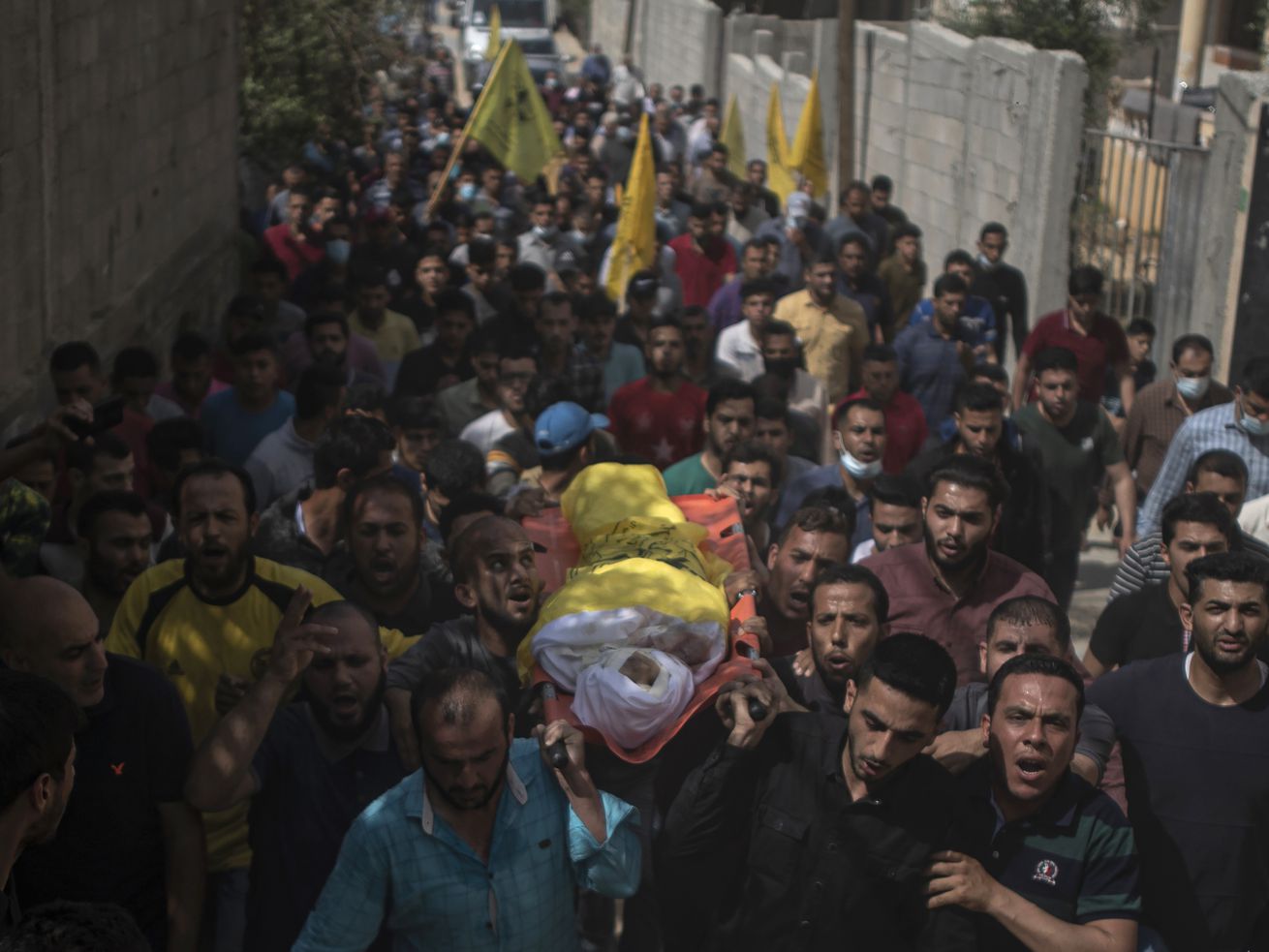
Palestinian mourners carry the body of 11-year-old Hussain Hamad, who was killed by an explosion during the ongoing conflict between Israel and Hamas, during his funeral in Beit Hanoun, northern Gaza Strip, Tuesday, May 11, 2021.
Palestinian mourners carry the body of 11-year-old Hussain Hamad, who was killed by an explosion during the ongoing conflict between Israel and Hamas, during his funeral in Beit Hanoun, northern Gaza Strip, Tuesday, May 11, 2021. | AP

The Gaza Health Ministry said a total of 28 people, including 10 children and the woman, were killed and 152 people were wounded. Ashraf al-Kidra, a spokesman for the ministry, said Israel’s “relentless assault” was overwhelming the health care system, which has been struggling with a COVID-19 outbreak.

GAZA CITY, Gaza Strip — A confrontation between Israel and Hamas sparked by weeks of tensions in contested Jerusalem escalated Tuesday. Israel unleashed new airstrikes on Gaza, killing a number of militants and civilians, while militants barraged southern Israel with hundreds of rockets, killing two Israelis.

The barrage of rockets leaving Gaza and airstrikes coming into the territory continued almost non-stop throughout the day, in what appeared to be some of the most intense fighting between Israel and Hamas since their 2014 war. The fire was so relentless that Israel’s Iron Dome rocket-defense system seemed to be overwhelmed. Meanwhile, columns of smoke rose from many places in Gaza.

Since sundown Monday, 28 Palestinians — including 10 children and a woman— were killed in Gaza, most by airstrikes, health officials there said. The Israeli military said at least 16 of the dead were militants.

Two women were killed by rockets fired from Gaza that hit their homes in the southern city of Ashkelon — the first Israeli deaths in the current violence. At least 10 other Israelis have been wounded since Monday evening.

After those deaths, Israeli Prime Minister Benjamin Netanyahu said officials decided to “increase both the strength and rate of the strikes” against militant groups Hamas and Islamic Jihad in the Gaza Strip.

Egypt was trying to broker a cease-fire, but the cycle of violence was gaining momentum. Even before the two Israeli deaths, the Israeli military said it was sending troop reinforcements to the Gaza border and the defense minister ordered the mobilization of 5,000 reserve soldiers.

Lt. Col. Jonathan Conricus, a military spokesman, told reporters that Israel was beefing up defensive forces on the border to prevent possible infiltrations and increasing its offensive forces as well, primarily in the air.

He said the objective was to send a “clear message” to Hamas.

The barrage of rockets and airstrikes was preceded by hours of clashes Monday between Palestinians and Israeli security forces, including dramatic confrontations at Jerusalem’s Al-Aqsa Mosque compound, a sacred site to both Jews and Muslims. The current violence, like previous rounds, including the last intifada, or uprising, has been fueled by conflicting claims over Jerusalem, which is at the emotional core of the long conflict.

In a sign of widening unrest, hundreds of residents of Arab communities across Israel staged overnight demonstrations denouncing the recent actions of Israeli security forces against Palestinians. It was one of the largest protests by Palestinian citizens in Israel in recent years.

Israel and Hamas have fought three wars and numerous skirmishes since the militant group seized control of Gaza in 2007. Recent rounds of fighting have usually ended after a few days, often helped by behind-the-scenes mediation by Qatar, Egypt and others.

An Egyptian official confirmed that the country was trying to broker a truce. But the official, speaking on condition of anonymity because he was discussing sensitive diplomacy, said Israeli actions in Jerusalem had complicated those efforts. A Palestinian security official, also speaking on condition of anonymity, confirmed the cease-fire efforts.

Israel carried out dozens of airstrikes, including two that targeted high-rise apartment buildings where militants were believed to be hiding.

At midday, an airstrike hit a building in central Gaza City, sending terrified residents running into the street, including women and barefoot children. The Islamic Jihad militant group confirmed that the strike killed three of its commanders.

An earlier airstrike struck another high-rise in the city as people were conducting dawn prayers, killing a woman, her 19-year-old disabled son and another man, residents said. Health officials confirmed the deaths.

The Gaza Health Ministry said a total of 28 people, including 10 children and the woman, were killed and 152 people were wounded. Ashraf al-Kidra, a spokesman for the ministry, said Israel’s “relentless assault” was overwhelming the health care system, which has been struggling with a COVID-19 outbreak.

The escalation comes at a time of political limbo in Israel.

Netanyahu has been caretaker prime minister since an inconclusive parliamentary election in March. He tried and failed to form a coalition government with his hard-line and ultra-Orthodox allies, and the task was handed to his political rivals last week.

One of those rivals is Israel’s defense minister, who is overseeing the Gaza campaign. It was not clear whether the toxic political atmosphere is spilling over into military decision-making, though the rival camps have unanimously expressed support for striking Hamas hard.

The support of an Arab-backed party with Islamist roots is key for the anti-Netanyahu bloc’s efforts. But the current tensions might deter the party’s leader, Mansour Abbas, from joining a coalition for now. The sides have three more weeks to reach a deal.

The current round of violence in Jerusalem coincided with the start of the Muslim fasting month of Ramadan in mid-April.

Critics say heavy-handed police measures helped stoke nightly unrest, including a decision to temporarily seal off a popular gathering spot where Palestinian residents would meet after evening prayers. Another flashpoint was the east Jerusalem neighborhood of Sheikh Jarrah, where dozens of Palestinians are under threat of eviction by Jewish settlers.

Over the weekend, confrontations erupted at the Al-Aqsa Mosque compound, which is the third holiest site of Islam and the holiest site in Judaism.

Over several days, Israel police fired tear gas, stun grenades and rubber bullets at Palestinians in the compound who hurled stones and chairs. At times, police fired stun grenades into the carpeted mosque.

On Monday evening, Hamas began firing rockets from Gaza, setting off air raid sirens as far as Jerusalem. From there on, the escalation was rapid.

Conricus, the Israeli military spokesman, said Gaza militants fired more than 500 rockets at Israel, with about one-third falling short and landing in Gaza.

At midday, a barrage of some 10 rockets whizzed above the southern city of Ashdod, filling the skies with streaks of white smoke.

A rocket that hit an apartment building in the coastal Israeli city of Ashkelon injured six people, according to Israeli paramedic service Magen David Adom. A building in Ashdod was also hit, lightly wounding four, Israeli police said.

Conricus said the military hit 130 targets in Gaza, including two tunnels militants were digging under the border with Israel.

He did not address Gaza Health Ministry reports about the dead children.

In Gaza, most of the deaths were attributed to airstrikes. However, seven of the deaths were members of a single family, including three children, who died in an explosion in the northern Gaza town of Beit Hanoun. It was not clear if the blast was caused by an Israeli airstrike or errant rocket.

Dozens of mourners took part in the funeral of Hussein Hamad, an 11-year-old boy who was among the dead.

Israel struck scores of Gaza homes in its 2014 war with Hamas, arguing it was aiming at militants, but also killing many civilians. The practice drew broad international condemnation at the time. Israel’s latest tactics in Jerusalem have drawn angry reactions from leaders from the Arab and Muslim world.

___

Federman reported from Jerusalem. Associated Press writers Karin Laub in the West Bank, Ilan Ben Zion in Jerusalem and Samy Magdy in Cairo contributed.

Read More

Rockets kill 2 Israelis; 28 Palestinians die in Gaza as Israel hits HamasAssociated Presson May 11, 2021 at 4:03 pm Read More »

Most in US who remain unvaccinated need convincing, poll showsAssociated Presson May 11, 2021 at 4:10 pm

In this April 10, 2021, file photo, registered nurse Ashleigh Velasco, left, administers the Johnson & Johnson COVID-19 vaccine to Rosemene Lordeus, right, at a clinic held by Healthcare Network in Immokalee, Fla. Fewer Americans are reluctant to get a COVID-19 vaccine than just a few months ago, but questions about side effects and how the shots were tested still hold some back, according to a new poll that highlights the challenges at a pivotal moment in the U.S. vaccination campaign.
In this April 10, 2021, file photo, registered nurse Ashleigh Velasco, left, administers the Johnson & Johnson COVID-19 vaccine to Rosemene Lordeus, right, at a clinic held by Healthcare Network in Immokalee, Fla. Fewer Americans are reluctant to get a COVID-19 vaccine than just a few months ago, but questions about side effects and how the shots were tested still hold some back, according to a new poll that highlights the challenges at a pivotal moment in the U.S. vaccination campaign. | AP

Just 11% of people who remain unvaccinated say they definitely will get the shot, while 34% say they definitely won’t, according to the poll by The Associated Press-NORC Center for Public Affairs Research.

Fewer Americans are reluctant to get a COVID-19 vaccine than just a few months ago, but questions about side effects and how the shots were tested still hold some back, according to a new poll that highlights the challenges at a pivotal moment in the U.S. vaccination campaign.

Just 11% of people who remain unvaccinated say they definitely will get the shot, while 34% say they definitely won’t, according to the poll by The Associated Press-NORC Center for Public Affairs Research.

That leaves a large swath of Americans in the middle who might still roll up their sleeves — including 27% who say they probably will and 27% who say they probably won’t — if someone credible addressed their concerns. That’s where National Institutes of Health immunologist Kizzmekia Corbett comes in.

Corbett helped lead development of the Moderna shot, and she spends hours giving plain-spoken answers to questions from Americans — especially Black Americans like her — to counter misinformation about the three vaccines used in the U.S.

No, COVID-19 vaccines won’t cause infertility: “Whoever started that rumor, shame on you.”

No, the shots’ speedy development doesn’t mean corners were cut: “We worked our butts off for the last six years” hunting vaccines for earlier cousins of COVID-19 — a head start that made the difference, Corbett recently told the AP.

Getting as many people vaccinated as fast as possible is critical to returning the country to normal. More than 150 million people — about 58% of all adults — have received at least one dose, according to the Centers for Disease Control and Prevention.

As that number grows, reluctance is inching down. Overall, the AP-NORC poll found about 1 in 5 American adults say they probably or definitely won’t get vaccinated, compared to about a third in January, when the shots were just rolling out.

Black Americans likewise are becoming more open to the shots, with 26% now saying they definitely or probably won’t get vaccinated compared with 41% in January. That’s similar to the 22% of Hispanic Americans and white Americans the poll found unlikely to get vaccinated. Among Asian Americans, just 9% say they definitely or probably won’t get the shots.

Holdouts are from all over American society — fueling experts’ advice that there is no one-size-fits-all vaccine message and that people need to hear from trusted sources, whether that’s scientists like Corbett or their own doctors. Adults under 45, rural Americans and Republicans are especially likely to say they will avoid vaccination, the poll found. But again, attitudes are changing: 32% of Republicans now say they probably or definitely won’t get vaccinated, down from 44% in January.

About three-fourths of those who say they are unlikely to get vaccinated have little to no confidence that the vaccines were properly tested, and 55% are very concerned about side effects, the poll found. Even among those who say they will probably get vaccinated but have not done so yet, concerns about proper testing are elevated compared with people who have received their shots already.

In forums hosted by colleges, Black pastors, doctors and even basketball great Kareem Abdul-Jabbar, Corbett says the best way to overcome distrust is to put the science in understandable terms for strangers just like she does for family. Later this spring, she’s moving from the NIH to Harvard’s School of Public Health to continue both her vaccine research and that outreach to communities, the school plans to announce on Tuesday.

The vaccines’ speedy development “is historic and it is brag-worthy,” said Corbett, whose NIH team was able to customize a shot that matched the new virus after spending six years developing vaccines against other dangerous coronaviruses such as MERS.

But “really, we should have started the conversations very early about what went into it,” she said, so the public understood that no steps were skipped.

A combination of huge studies and real-world data show the main side effects of the U.S. vaccines are temporary fevers or aches as the immune system revs up. The shots are undergoing unprecedented safety monitoring, which last month led to a temporary pause in Johnson & Johnson vaccinations to determine how to handle an incredibly rare risk of blood clots.

Even after that pause, overall confidence in the vaccines is up slightly compared with a few months ago, with 45% of all adults now very or extremely confident that the shots were properly tested for safety and effectiveness, compared with 39% in an AP-NORC poll in February.

But side effect myths persist. Corbett calls the fertility concern “completely absurd,” and in forum after forum explains why it’s biologically impossible for the vaccines to alter anyone’s DNA.

The repetition is OK: “People need to hear things multiple times,” she said.

Plus, many Americans have some of the same questions scientists are still trying to answer, such as whether or when people might need a booster dose.

“Those are things that even I can’t even answer. But what I can say is that we’re doing everything we can to make sure we can answer it as soon as possible,” Corbett said.

___

The AP-NORC poll of 1,842 adults was conducted April 29-May 3 using a sample drawn from NORC’s probability-based AmeriSpeak Panel, which is designed to be representative of the U.S. population. The margin of sampling error for all respondents is plus or minus 3.2 percentage points.

Read More

Most in US who remain unvaccinated need convincing, poll showsAssociated Presson May 11, 2021 at 4:10 pm Read More »

Signs of optimism as NYC sees rise in tourismAssociated Presson May 11, 2021 at 4:21 pm

Visitors peek into the museum at the 9/11 Museum & Memorial, Thursday, April 29, 2021, in New York.
Visitors peek into the museum at the 9/11 Museum & Memorial, Thursday, April 29, 2021, in New York. In recent weeks, tourism indicators for New York City like hotel occupancy and museum attendance that had fallen off a pandemic cliff have ticked up slightly. It’s a welcome sight for a city where the industry has been decimated by the impact of the coronavirus. | AP

Tourists who vanished from New York City’s museums, hotels and cultural attractions when the coronavirus pandemic hit a year ago are trickling back in as restrictions loosen.

NEW YORK — The once-deserted steps outside the Metropolitan Museum of Art are filling up with visitors again. Hotel lobbies are losing their desolate feel. Downtown, people are back to taking selfies with the Charging Bull statue near Wall Street.

Tourists who vanished from New York City’s museums, hotels and cultural attractions when the coronavirus pandemic hit a year ago are trickling back in as restrictions loosen.

There’s still a long way to go before the still-closed theater district is mobbed with international travelers again.

But lately, indicators like hotel occupancy and museum attendance have ticked up, thanks to domestic travelers and day trippers who don’t mind seeing the city operating at less than its usual hectic pace.

“I’ve always wanted to come to New York, just because I’ve watched the movies,” said Chazmin Fuhrer, 26, a first-time visitor from Concord, California, who came into the city for a handful of days recently to celebrate a friend’s birthday.

Lounging at a table in Times Square as three street performers started their dance moves nearby, Fuhrer said she knew it wasn’t anywhere near as busy as usual. But she was OK with that.

“It’s kind of nice without a lot of people out,” she said, noting that the pre-pandemic crush of people would probably now make her nervous, with the virus still circulating.

City officials are optimistic, even in the wake of an incident in Times Square on Saturday, when three people — including a child — were injured by stray bullets when a dispute led to gunfire.

“In the end, people want to come to this city,” Mayor Bill de Blasio said Monday. “It is an overwhelmingly safe city, when you look at New York City compared to cities around the country, around the world.”

In 2019, an estimated 67 million people visited the city. In 2020, that plummeted to slightly more than 22 million, mostly those who came before the pandemic began rampaging in New York in March.

Restaurants and stores were forced to close, as were some hotels, bringing the city’s available rooms from 124,000 to 88,000, according to city tourism officials.

On top of that, unrest over racial injustice in late spring led to two days of property destruction and stealing. While the damage was limited and cleanup quick, the city suffered through months of bad press as then-President Donald Trump, eager to bash his Democrat-run hometown, publicly smeared it as having succumbed to anarchy.

The daytime Times Square shooting brought a fresh round of handwringing.

But after a moribund year, things are looking up. The Metropolitan Museum of Art, for example, has reached 9,000 visitors on some recent days. That’s still far less than the swarms of 25,000 who once packed in on the busiest days pre-pandemic, but far more than the museum was seeing when it reopened in late August.

Ridership is up on the ferries that take visitors from the southern tip of Manhattan to the Statue of Liberty, where the grounds and a museum are open even as the statue’s interior remains off limits.

Rafael Abreu, vice president for marketing at Statue Cruises, said it had been “fairly slow” through February, but ridership had risen in March and April to about 25-30% of pre-pandemic times.

Hotel occupancy, which had been running in the 30% range, has been in the 50% range over the last few weeks, said Fred Dixon, president and CEO of NYC & Company, the city’s tourism agency.

New hotels are opening, and the number of rooms is expected to reach 118,000 by year’s end.

“It’s just really wonderful,” Dixon said of the city’s cautious reawakening. “And so, it’s given us a lot of hope.”

The agency is predicting just over 31 million visitors in 2021.

City and state officials in recent weeks have been making moves to open the city up as much as possible.

New York Gov. Andrew Cuomo announced the city’s subway system would return to 24-hour service in mid-May. Capacity restrictions on businesses are being lifted, although 6 feet of space between patrons will still be required.

The Yankees and Mets have been allowed to boost crowd capacity at games, with no restrictions at all on people who can show they have been vaccinated.

De Blasio last month announced a $30 million tourism marketing campaign that NYC & Company will launch in June.

The city and state are also setting up vaccination stations offering free shots to tourists.

“We think this is a positive message to tourists. Come here. It’s safe. It’s a great place to be and we’re going to take care of you,” said de Blasio, a Democrat.

In a city where multitudes are dependent on tourism for their livelihoods, things can’t get better quickly enough.

Michael Keane, an owner of O’Hara’s Restaurant and Pub near the World Trade Center site, said things have been looking up.

“It’s been a slow crawl but we’re seeing more and more tourists every week come in the area,” he said, noting that he’s keeping a nervous eye on how the virus has continued to ravage some other countries. “I can’t imagine going through that again.”

Limitations remain. Broadway shows won’t start running again until September. Some attractions require timed reservations to keep crowds down. Others are still closed.

But even with things moving slower, Fuhrer said she was “definitely not disappointed” with her trip.

Back home, “I feel like people are still a little bit cautious out there with COVID,” she said. Meanwhile, in New York, “I feel like everybody out here is trying to get their life going.”

She and girlfriend Gabbi Allen, 23, both vaccinated, felt like they got to experience some of that New York vibe.

“All the sirens, all the honking,” Allen said.

“People yelling at each other in the middle of the street,” Fuhrer added.

The lower-key New York City has actually been wonderful, said Stephanie Piefke, 24, of Atlanta, a frequent visitor out recently for some touristy activities with her friend, first-time visitor Danielle Jenkins.

The women, both vaccinated, said at the Empire State Building there were maybe a few dozen people cruising through a waiting area set up to handle what Piefke said would have been a “miserable” snaking line.

She didn’t think the quieter New York City would last, though, once the city fully reopens.

“Y’all are gonna be like, ‘Oh God, they’re here,’” she said, “and it’ll be like a tsunami of tourists that have been wanting to come.”

Read More

Signs of optimism as NYC sees rise in tourismAssociated Presson May 11, 2021 at 4:21 pm Read More »

Candace Parker’s Sky teammate made a project about her in middle schoolGrace Asiegbuon May 11, 2021 at 4:34 pm

Two Black women standing next to each other, smiling, while the woman on the right holds her phone up to the camera so a doll is visible on the screen.
Chicago Sky players Candice Parker (L) and Azuré Stevens stand next to each other while Stevens holds her phone up, showing a photo of the doll she created in Parker’s likeness. | Screenshot from embedded tweet by @chicagosky

It’s fair to say that some of Parker’s Sky teammates look up to her.

In what could be described a full-circle moment, Chicago Sky forward Azurá Stevens is now teammates with one of her childhood basketball heroes, Candace Parker.

In a tweet posted Monday night, the team showed the two women standing next to each other all smiles after Stevens, 25, showed her new teammate a middle school project she did about her more than a decade ago. We also got a close-up of Stevens’ creation: a Parker doll that she made for the project.

Stevens created the doll in middle school, when Parker was a star player for the University of Tennessee. It’s a funny reminder of not only Parker’s incredible longevity at basketball’s highest levels but the age gap between her and some of her teammates.

A decorated player, Parker began making history in basketball as a student at Naperville Central High School. She won the Gatorade National Girls Basketball Player of the Year awards back-to-back in 2003 and 2004, making her the second junior and the only woman to receive the award twice.

In college, Parker led the Tennessee Lady Volunteers to two consecutive national championships (2007 and 2008) and became the first woman to dunk twice in a college game.

Parker continued to star professionally and internationally after being drafted by the Sparks, winning MVP awards and two Olympic gold medals. She’ll make her debut for the Sky this season after being acquired in an offseason trade.

Read More

Candace Parker’s Sky teammate made a project about her in middle schoolGrace Asiegbuon May 11, 2021 at 4:34 pm Read More »