It still doesn’t feel real. Justin Fields is a member of the ChicagoBears. Before they traded up to get him in the 2021 NFL Draft, it didn’t feel possible that there would be anything exciting about the Bears going into the season. Well, they got him and he is the new hope of the […]
It might be best for the Bears if rookie quarterback Justin Fields is able to remain on the sideline and learn the ins and outs of the NFL before taking the starting job. | Mike Ehrmann/Getty Images
Only good would come from that. You can say that there’s no better teacher than being thrown into the fire. You can also say that fire sometimes burns beyond recognition.
For selfish reasons, many of us would like to see Justin Fields as the Bears’ starting quarterback sooner rather than later. Sooner, meaning tomorrow.
We want to know if the kid can play. We want to be entertained by a player who can run and throw and chew gum at the same time without the player experiencing multiple organ failure. We want a quarterback, simply because most of us have never seen one in a Bears uniform. Either they weren’t any good (don’t make me name names) or they couldn’t stay healthy (Jim McMahon).
But for the good of everyone involved, it might be better for Fields, the 11th overall selection in this year’s draft, to stand on the sidelines for the 2021 season. Believe me, I know: not a popular opinion. Watching Fields be idle would be like getting a bicycle for Christmas in Siberia. You can stare at it. You can’t ride it.
For my scenario to work, and for everyone to benefit from it, Andy Dalton has to play well as the starting quarterback. That’s a given the way an unexpected inheritance is. He’s had one great season in his 10-year career, when he went 10-3 as a starter for the 2015 Bengals, completing 66.1% of his passes, throwing 25 touchdowns passes to seven interceptions and putting up a career-high 106.2 passer rating. Other than that, he has been anywhere from average to good, with a lot of pretty decent thrown in.
But if Dalton plays well this season, it takes the pressure off everyone, especially Fields. He’d be able to learn the position from a veteran. Only good would come from that. You can say that there’s no better teacher than being thrown into the fire. You can also say that fire sometimes burns beyond recognition. If the NFL is as mental a game as coaches tell us it is, then sitting in a room with Dalton, head coach Matt Nagy, offensive coordinator Bill Lazor and quarterbacks coach John DeFilippo can only be a positive.
It’s fair to say that I’m operating here from a position of all that could go wrong with a rookie QB starting, probably because I’ve seen everything go wrong for the Bears when it comes to quarterbacks. But what’s the downside of Fields spending a season learning? Getting deprived of the kind of season the Bengals’ Joe Burrow or the Chargers’ Justin Herbert put up in their rookie years? Fair enough. They were very good. But it’s also true that Patrick Mahomes turned out pretty well for the Chiefs after spending his first season watching Alex Smith play. There are many more examples of that happening in NFL history than of rookie quarterbacks succeeding right away.
It’s a different world now because of quarterback salaries, of course, but still. What’s the harm of Fields sitting, other than to our need to see The Next Big Thing?
The expectations on him will be huge if he’s named the starter at any point this season. We’ve all seen what Chicago does to its QBs. It loves them to death when they arrive, and then, if they’re not playing well, it offs them.
A good season by Dalton and a spot next to Nagy on the sideline for Fields would likely mean that Nagy and general manager Ryan Pace keep their jobs. I’m not a big proponent of this outcome, but it would mean that Pace didn’t make the same mistake he made with Mike Glennon in 2017. And it would mean that the allure and promise of Fields would still be at concentrated levels in Chicago for 2022.
A good season by Dalton would get him a nice contract from another team.
And Fields not starting in 2021 would be valuable for you, dear Bears fan. It would mean that your team is winning, that Dalton is doing more than his part and that what was considered a declining Bears defense isn’t declining so much. It would mean that Fields is learning different NFL coverages from the comfort of a darkened film room. And no defenders with murder in their hearts would be chasing him.
I’d love to see him use his athleticism to make those defenders look like fools. But I wouldn’t understand the rush to get him on the field if Dalton is playing well. When I look at the Bears’ roster, I don’t see the greatest offensive line or the greatest weapons at wide receiver. One year of getting to know the NFL for Fields and another draft and free-agent period to get him some help … what am I missing here in terms of a downside?
Look, I know that it’s unlikely Dalton will have a standout season and that the temptation to push Fields out there will be fierce. If Fields has a great training camp, it might be too much for Nagy and Pace, even if they want to be patient with him (and I’m not sure they do). But if you watched him play at Ohio State, it’s not a sure thing that he’s ready. Talented, yes. Ready, maybe not.
If we’re looking out for what’s best for the kid, given all that the Bears went through with Mitch Trubisky, having Fields watch and learn for a year would be the way to go. It wouldn’t be the sexy move. It’d be more like long underwear. But you’d stay warm and emotionally safe for a year.
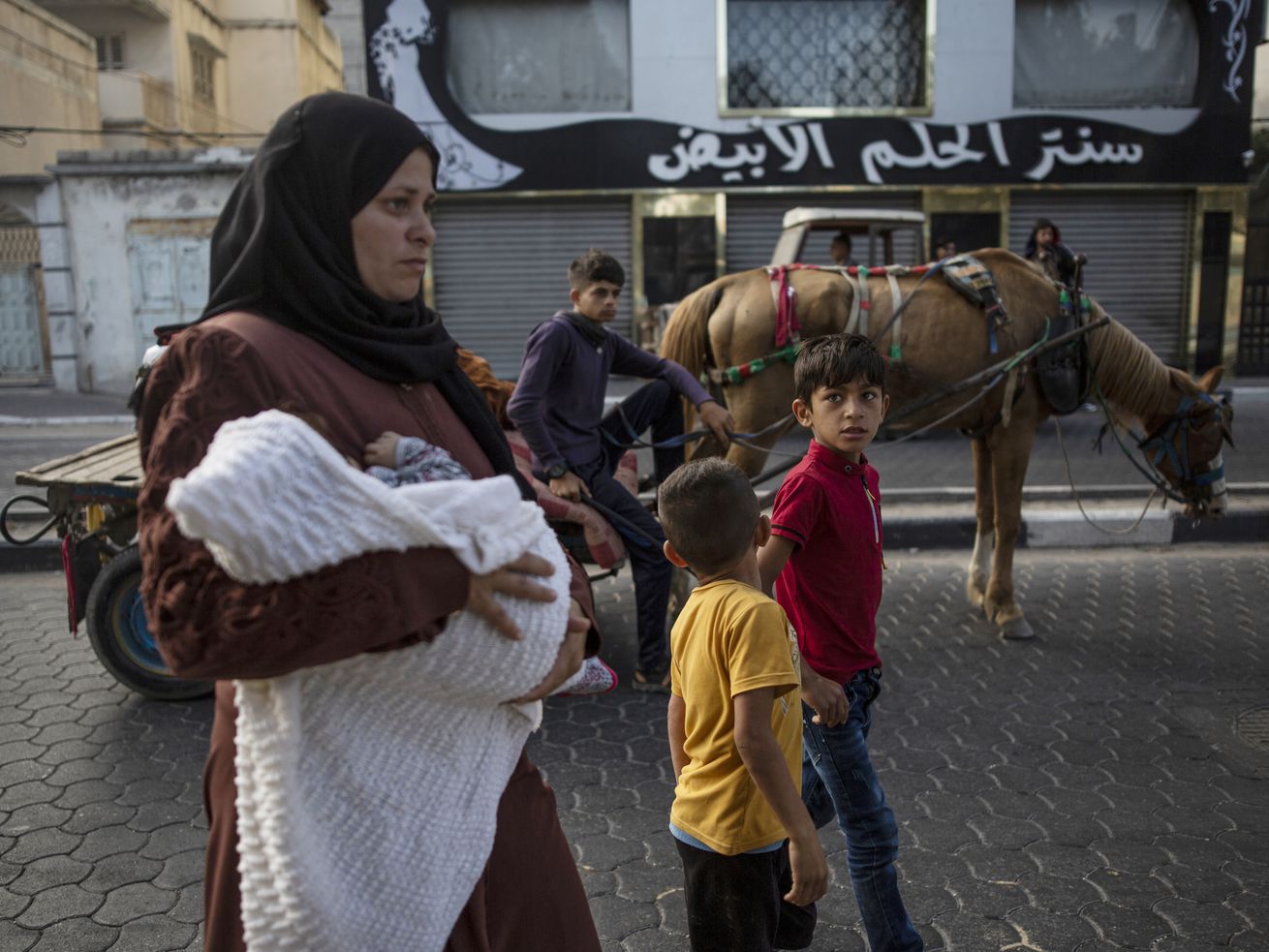
Palestinians flee their homes after overnight Israeli heavy missile strikes on their neighborhoods in the outskirts of Gaza City, Friday, May 14, 2021. | AP
The Gaza Health Ministry says the toll from the fighting has risen to 119 killed, including 31 children and 19 women, with 830 wounded.
GAZA CITY, Gaza Strip — Thousands of Palestinians grabbed children and belongings and fled their homes Friday as Israel barraged the northern Gaza Strip with tank fire and airstrikes, killing a family of six in their house and heavily damaging other neighborhoods in what it said was an operation to clear militant tunnels.
As international efforts at a cease-fire stepped up, Israel appeared to be looking to inflict intensified damage on the Islamic militant group Hamas, which controls the Gaza Strip and has fired hundreds of rockets into Israel.
The Gaza violence increasingly spilled over into turmoil elsewhere.
Across the West Bank, Palestinians held their most widespread protests since 2017, with hundreds in at least nine towns burning tires and throwing stones at Israeli troops. Soldiers opening fire killed six, according to Palestinian health officials, while a seventh Palestinian was killed as he tried to stab an Israeli soldier.
Within Israel, communal violence erupted for a fourth night. Jewish and Arab mobs clashed in the flashpoint town of Lod, even after additional security forces were deployed.
In Gaza, the toll from the fighting rose to 122 killed, including 31 children and 20 women, with 900 wounded, according to the Health Ministry. The Hamas and Islamic Jihad militant groups have confirmed 20 deaths in their ranks, though Israel says that number is much higher. Seven people have been killed in Israel, including a 6-year-old boy and a soldier.
Israel called up 9,000 reservists Thursday to join its troops massed at the Gaza border, and an army spokesman spoke of a possible ground assault into the densely populated territory, though he gave no timetable. A day later, there was no sign of an incursion.
But before dawn Friday, tanks deployed on the border and warplanes carried out an intense barrage on the northern end of the Gaza Strip.
Houda Ouda said she and her extended family ran frantically into their home in the town of Beit Hanoun, seeking safety as the earth shook for two and half hours in the darkness.
“We even did not dare to look from the window to know what is being hit,” she said. When daylight came, she saw the swath of destruction: streets cratered, buildings crushed or with facades blown off, an olive tree burned bare, dust covering everything.
Rafat Tanani, his pregnant wife and four children, aged 7 and under, were killed after an Israeli warplane reduced their four-story apartment building to rubble in the neighboring town of Beit Lahia, residents said. Four strikes hit the building at 11 p.m., just before the family went to sleep, Rafat’s brother Fadi said. The building’s owner and his wife also were killed.
“It was a massacre,” said Sadallah Tanani, another relative. “My feelings are indescribable.”
Lt. Col. Jonathan Conricus, an Israeli military spokesman, said the operation involved tank fire and airstrikes, aimed at destroying a tunnel network beneath Gaza City that the military refers to as “the Metro,” used by militants to evade surveillance and airstrikes.
“As always, the aim is to strike military targets and to minimize collateral damage and civilian casualties,” he said. “Unlike our very elaborate efforts to clear civilian areas before we strike high-rise or large buildings inside Gaza, that wasn’t feasible this time.”
When the sun rose, residents streamed out of the area in pickup trucks, on donkeys and on foot, taking pillows, blankets, pots and pans and bread. “We were terrified for our children, who were screaming and shaking,” said Hedaia Maarouf, who fled with her extended family of 19 people, including 13 children.
Adnan Abu Hasna, a spokesman for UNRWA, said thousands broke into 16 schools run by the relief agency, which he said was scrambling to find a way to shelter them, given movement restrictions on its staff amid the fighting and COVID-19 worries.
Mohammed Ghabayen, who took refuge in a school with his family, said his children had eaten nothing since the day before, and they had no mattresses to sleep on. “And this is in the shadow of the coronavirus crisis,” he said. “We don’t know whether to take precautions for the coronavirus or the rockets or what to do exactly.
Hamas showed no signs of backing down. So far, it has fired some 1,800 rockets toward Israel, some targeting the seaside metropolis of Tel Aviv, although more than a quarter of them have fallen short inside Gaza and most of the rest have been intercepted by missile defense systems.
Still, the rockets have brought life in parts of southern Israel to a standstill and caused disruptions at airports.
A spokesman for Hamas’ military wing said the group was not afraid of a ground invasion, which would be a chance “to increase our catch” of Israeli soldiers.
The strikes came after Egyptian mediators rushed to Israel for cease-fire talks that showed no signs of progress. Egypt, Qatar and the U.N. were leading truce efforts.
An Egyptian intelligence official with knowledge of the talks said Israel rejected an Egyptian proposal for a yearlong truce with Hamas and other Gaza militants, which would have started at midnight Thursday had Israel agreed. He said Hamas had accepted the proposal.
The official said Israel wants to delay a cease-fire to give time to destroy more of Hamas’ and Islamic Jihad’s military capabilities. He spoke on condition of anonymity because he was not authorized to talk to reporters.
Prime Minister Benjamin Netanyahu vowed Hamas would “pay a very heavy price” for its rocket attacks.
U.S. President Joe Biden said he spoke with Netanyahu about calming the fighting but also backed the Israeli leader by saying “there has not been a significant overreaction.”
He said the goal now is to “get to a point where there is a significant reduction in attacks, particularly rocket attacks.” He called the effort “a work in progress.”
The fighting has, for the moment, disrupted efforts by Netanyahu’s political opponents to form a new government coalition, prolonging his effort to stay in office after inconclusive elections. His rivals have three weeks to agree on a coalition but need the support of an Arab party, whose leader has said he cannot negotiate while Israel is fighting in Gaza.
Israel has come under heavy international criticism for civilian casualties during three previous wars in Gaza, home to more than 2 million Palestinians. It says Hamas is responsible for endangering civilians by placing military infrastructure in civilian areas and launching rockets from them.
The fighting broke out late Monday when Hamas fired a long-range rocket at Jerusalem in support of Palestinian protests there against the policing of a flashpoint holy site and efforts by Jewish settlers to evict dozens of Palestinian families from their homes.
The violent clashes between Arabs and Jews in Jerusalem and other mixed cities across Israel has added a layer of volatility to the conflict not seen in more than two decades.
The violence continued overnight. A Jewish man was shot and seriously wounded in Lod, the epicenter of the troubles, and Israeli media said a second Jewish man was shot. In the Tel Aviv neighborhood of Jaffa, an Israeli soldier was attacked by a group of Arabs and hospitalized in serious condition.
Police spokesman Micky Rosenfeld said some 750 suspects have been arrested since the communal violence began this week.
___
Krauss reported from Jerusalem. Associated Press writer Isabel DeBre in Dubai, United Arab Emirates, and Samy Magdy in Cairo contributed.
Police say this Glock handgun was used by Jason Nightengale in a Jan. 9 shooting rampage that left five people dead. | Evanston Police Department
Newly obtained police reports link the Glock handgun Jason Nightengale used in his Jan. 9 rampage to five other shootings on the South Side between 2009 and 2016.
The .45-caliber Glock pistol Jason Nightengale used in a January killing spree that began on the South Side and ended in Evanston was likely used in five prior shootings in Chicago dating to 2009, according to police reports obtained by the Chicago Sun-Times.
Nightengale, 32, killed five people, including a University of Chicago student in an East Hyde Park parking garage, a doorwoman of a nearby condo building, a convenience-store worker on the South Side, a woman he took hostage at an IHOP restaurant in Evanston and a 15-year-old girl, Damia Smith, who fought for her life for more than three weeks at Comer Children’s Hospital before she died.
About four hours after the Jan. 9 rampage began, Evanston officers killed Nightengale — who also wounded two other people — in a shootout outside a Dollar General store there.
Chicago police reports provide new details about the gun authorities say Nightengale used as well as about his bizarre interactions with his victims.
Nightengale, a father of twin girls, listed jobs over the years as a janitor, security guard, taxi driver and forklift operator, according to his LinkedIn page.
He “was fighting some demons,” his family has said. During the week before the shootings, he posted videos online, ranting about Satan, waving a gun and talking about wanting to kill people.
Chicago police arrest photoJason Nightengale in a security guard shirt.
Police haven’t said anything about a motive for the killings, which appeared to be random.
Officers collected bullet casings from the crime scenes along with the Glock 21 pistol he was carrying when he was killed. The Chicago Police Department crime lab test-fired the gun, compared the markings on those casings to those found at the crime scenes and found they matched.
The lab also found that the gun appeared to be linked to bullet casings found at five other shootings on the South Side between 2009 and 2016.
According to the police reports and news accounts, those five shootings included:
A 16-year-old boy who “heard shots and felt pain” and realized he was shot at 7:55 p.m. June 2, 2009, in the 7400 block of South Colfax Avenue . The case was closed without an arrest after the teenage victim refused to cooperate.
A person wounded on a sidewalk at 11 p.m. Dec. 23, 2009, in the 7800 block of South Ridgeland Avenue. The investigation was suspended without an arrest.
A 31-year-old man wounded in the ankle and mouth at 10:52 p.m. Aug. 8, 2011, on the street in the 7800 block of South Cregier Avenue. This investigation also was suspended without an arrest.
A 24-year-old man wounded in the head by someone shooting from an alley at 3:45 p.m. July 24, 2014, in a yard in the 8000 block of South Manistee Avenue. The investigation remains open.
A person wounded on a sidewalk at 3:25 a.m. Oct. 30, 2016 in the 12300 block of South Emerald Avenue. The case was closed without an arrest because the victim wouldn’t cooperate.
Police also found a shell casing in the 0-100 block of East 120th Place that was linked to the Glock, but there wasn’t a report of a crime there.
The federal Bureau of Alcohol, Tobacco, Firearms and Explosives investigated the history of the gun and learned it was bought in 2006 at Chuck’s Gun Shop in Riverdale. A police source said the owner of the gun had reported it stolen.
It’s unclear from the detectives’ reports when or how Nightengale obtained the gun, and they haven’t said whether they think he was involved in any of the earlier shootings.
The detectives’ reports also detail some of Nightengale’s erratic behavior that day.
After he killed 30-year-old University of Chicago graduate student Yiran Fan, who was sitting in a car in a parking garage in the 5000 block of South East End Avenue, Nightengale entered an apartment building a block away.
Aisha Nevell, who was staffing the door, let Nightengale in after he said he needed to use a phone because he’d been in an accident. Nightengale took off his right glove, pulled out the gun and killed the 46-year-old woman. He also wounded a 77-year-old woman, shooting her in the mouth.
Then, he went to the 5500 block of South East End, where it’s believed some of his relatives once lived, and got on an elevator with a 74-year-old man he knew, police said. When they exited on the floor where the man lived, Nightengale announced, “This is a holdup. Keep walking,” and followed him to his apartment.
In the kitchen, Nightengale set down the bottle of Arizona Iced Tea he was holding, a pack of Newport cigarettes and a pair of black The North Face gloves. He asked for and got a glass of water, then took $37 and the key fob to the man’s red Toyota hatchback, which he drove during the rest of his spree.
“He’s a maniac, very playful and very loving,” Letitia Brown said. Her cat Hennessy jumped from the fifth-floor window of Brown’s South Side apartment Thursday to escape a fire, a dive captured in a now-viral video.
Letitia Brown says her cat Hennessy — named after the drink — was always finicky, jumping from couches and chairs in her apartment.
But his latest leap left her amazed.
Hennessy jumped from the fifth-floor window of Brown’s Englewood apartment Thursday to escape a fire, a dive captured in a now-viral video.
“I didn’t think he would clear the whole wall, but they say cats land on all fours. I was just amazed,” Brown said in an interview.
Brown’s furry companion survived the fall but still hasn’t returned home. She and her neighbors have been searching for him since Thursday and hope he returns home soon.
“That’s my baby,” Brown said. “He’s a maniac, very playful and very loving. He loves to play and snuggle. The best cat ever.”
The blaze started in the kitchen of her apartment in the 6500 block of South Lowe Avenue, according to Chicago Fire Department spokesman Larry Langford. Smoke billowed from windows of the fifth floor of the building, according to video posted to Twitter by Langford.
Chicago Fire DepartmentScreenshot of a video showing a cat leap from a building to escape a fire May 13, 2021, in Englewood.
Hennessy stretches out his paws as he approaches a ledge, jumps from the window and narrowly misses a wall on the way down, the video shows. He appears to bounce off a patch of grass and saunter away.
“That’s just normal, how he is,” Brown said of Hennessy’s jump.
Brown said Hennessy is mostly a house cat who doesn’t spend much time outside. She has had him for nearly three years and is unsure how old he is because she took him in when someone else couldn’t care for him.
“I ended up with a blessing,” Brown said, adding that Hennessy was her main concern when the fire broke out. “But he made it,” she said.
Brown, who is currently staying at a neighbor’s apartment, thinks Hennessy may be hiding near her building. Witnesses said they saw him trying to reenter the building after the fire.
“We’re hoping that he’ll just hear my voice and just run up to me,” she said. “It’s just very stressful. I’m just trying to keep my head up and look for my baby.”
Gas shortages at the pumps have spread from the South, all but emptying stations in Washington, D.C., following a ransomware cyberattack that forced a shutdown of the nation’s largest gasoline pipeline. Though the pipeline operator paid a ransom, restoring service was taking time.
As Georgia-based Colonial Pipeline reported making “substantial progress” in restoring full service, two people briefed on the matter confirmed that the company had paid the criminals a ransom of about $5 million in cryptocurrency for the software decryption key required to unscramble their data network. The people spoke on condition they not be further identified because they were not authorized to divulge the information. Bloomberg first reported the payment.
President Joe Biden, when asked by a reporter on Thursday if he had been briefed about the ransom payment, said “I have no comment on that.”
Biden also said that his administration will try to disrupt the hackers’ ability to operate.
The tracking service GasBuddy.com on Friday showed that 88% of gas stations were out of fuel in the nation’s capital, 45% were out in Virginia and 39% of Maryland stations were dry. About 65% of stations were without gas in North Carolina, and nearly half were tapped out in Georgia and South Carolina.
Colonial said Thursday that operations had restarted and gasoline deliveries were being made in all of its markets, but it would take “several days” to return to normal, and some areas may experience “intermittent service interruptions during this start-up period.”
“Our current expectation based on the conversations between the company and experts at the Department of Energy is that the vast majority of markets and affected regions are receiving fuel at gas stations for consumers, and will continue to receive more fuel throughout the weekend and into early next week,” White House press secretary Jen Psaki said at a Friday briefing. “Hence, getting us closer to return us back to normal.”
A gas station owner in Virginia said panic buying is the problem.
“It’s like a frenzy,” Barry Rieger, who owns a gas station in Burke, Virginia, told WJLA-TV.
In North Carolina, at least five school systems canceled in-person learning on Friday as the gasoline supply crisis continued. Wake County, with the largest school system in North Carolina, emailed parents citing “the impact of the gas shortage on staffing availability and student transportation.”
Businesses were also feeling the sting.
At Dixie Speedway in Woodstock, Georgia, maintenance and safety vehicles have to be filled up, but “all the gas stations close to use — within a mile of us — are out of gas,” said Mia Green, the track’s general manager. She’s heard of racetracks that canceled this weekend’s races because crews might not be able to get there due to gas shortages.
Many authorities are warning of the dangers of hoarding gas.
In South Carolina, a woman was severely burned after flipping a car that a deputy tried to pull over for a suspected stolen license plate Thursday night. The fire touched off multiple explosions due to fuel “that she was hoarding in the trunk of the vehicle,” a Pickens County sheriff’s statement said.
In Florida, a 2004 Hummer was destroyed by fire Wednesday shortly after the driver had filled up four 5-gallon gas containers in Homosassa, according to Citrus County Fire Rescue spokeswoman Cortney Marsh. Firefighters doused the blaze and found the melted gas containers. One man was injured, but refused medical treatment, she said.
A cyberattack by hackers who lock up computer systems and demand a ransom to release them hit the pipeline on May 7. The hackers didn’t take control of the pipeline’s operations, but Colonial shut it down to prevent the malware from impacting its industrial control systems.
Biden said U.S. officials do not believe the Russian government was involved, but said “we do have strong reason to believe that the criminals who did the attack are living in Russia. That’s where it came from.”
Biden has promised aggressive action against DarkSide, the Russian-speaking ransomware syndicate responsible for the attack. The syndicate’s public-facing darknet site went offline on Thursday and its administrator said in a cybercriminal forum post that the group had lost access to it.
This does not necessarily mean U.S. or allied cyberjockeys knocked it offline. Cybersecurity experts said that DarkSide, which rents out its ransomware to partners to carry out the actual attacks, could have taken it down to prevent Western law enforcement from tracking down the rest of its infrastructure.
And just because DarkSide’s public-facing structure is offline doesn’t mean its backend operations have been impacted, said Alex Holden, the founder of Hold Security, who closely monitors the cybercriminal underground.
“DarkSide’s main servers are alive,” said analyst Yelisey Boguslavskiy of the cybersecurity firm Advanced Intelligence. While the servers are hidden, encrypted traffic to and from them is being monitored by threat hunters, he said.
DarkSide stole information from Colonial’s network prior to locking up the data on Friday. It’s not known how long the cybercriminals were inside the network. DarkSide is among the ransomware gangs that employ double extortion, threatening to dump online sensitive data they steal before activating the ransomware. In Colonial’s case, that could potentially include data on contracts with suppliers that would be of keen interest to stock and commodities traders.
DarkSide, in fact, recently offered to share data stolen from victims with inside traders.
It would not be surprising if DarkSide were to disappear, experts noted. Ransomware gangs have dissolved and ‘rebranded’ under different names in the past when the heat was on.
The Colonial Pipeline system stretches from Texas to New Jersey and delivers about 45% of the gasoline consumed on the East Coast.
“We are not out of the woods yet, but the trees are thinning out,” Richard Joswick, global head of oil analytics at S&P Global Platts, said.
Gas stations should be back to normal next week if the pipeline restart goes as planned and consumers are convinced they no longer need to panic-buy fuel, Joswick said. Full recovery would take several more weeks, he estimated.
—
Bajak reported from Boston, Martin from Marietta, Ga., and Merchant in Washington. Freida Frisaro in Miami also contributed.
BIRMINGHAM, Ala. — Charles Avery had barely started marching when police arrested him, forced him into a police vehicle and took him to jail for participating in landmark civil rights protests that helped change the nation in 1963. He spent days in custody and then lived decades haunted by a conviction for the most innocuous of offenses — parading without a permit — that he saw as noble yet others questioned with suspicion.
“I had to explain what it was, that it was from Birmingham,” said Avery, 76. “It always came up.”
Yet Avery said he’d do it again all these years later, and he has a message for the thousands of demonstrators who have been arrested nationwide during the months-long uprising over police violence and racism: Keep going. A lifelong mark in the name of justice is worth the trouble.
Veterans of the campaign that the Rev. Martin Luther King Jr. helped lead to eradicate racial segregation in Birmingham nearly 60 years ago remain firmly in the corner of racial justice now that they’re old and gray, with some joining in protests that followed George Floyd’s murder by Minneapolis police last year and others watching at home on TV.
Nonviolence was King’s way, and some are put off by scenes of burning buildings and rioting that accompanied some protests, including one in Birmingham. But foot soldiers who first advocated for the idea that Black lives matter decades ago now support the movement of the same name; The Associated Press interviewed some of them ahead of an online commemoration of the ’63 Children’s Crusade protests held Friday that focused on challenges facing young people today.
The Rev. Jonathan McPherson was walking just a few feet behind King when both were arrested in downtown Birmingham. He spent a night in jail and sees his conviction for illegal parading as a badge of honor.
“It was worth it, every bit of it. I’ve even told my wife I can’t move like I used to but I’ll be glad to join those young people today in these protests that we have,” said McPherson, 87. He once served as a bodyguard for King and other movement leaders in Birmingham, which came to be known as “Bombingham” for the frequency of attacks on Black churches, homes and leaders.
Arrested the same day as McPherson, Myrna Jackson recently had a stroke and spends most of her time at home. But she stays up to date on the Black Lives Matter movement and mourns every time someone else dies at the hands of law enforcement.
“People are fed up. A lot of times these things are happening so close together it doesn’t give you breathing room,” she said.
More than 10,000 people were arrested nationwide last year during protests for offenses including curfew violations and failure to disperse; hundreds also were were arrested on burglary and looting charges. Protesters often were restrained in plastic zip-ties and taken away in buses, and many times charges were dropped.
Demonstrations continued recently in places including Brooklyn Center, Minnesota, where Daunte Wright was fatally shot by police, and Elizabeth City, North Carolina, where deputies fatally shot Andrew Brown Jr. Both Wright and Brown were Black men, and both died last month.
In Birmingham, local activists including the Rev. Fred Shuttlesworth had been confronting racism and legalized segregation of schools, businesses and public accommodations for years by the time King’s Southern Christian Leadership Campaign launched the “Birmingham Campaign” in the spring of ’63 with weeks of marches, selective buying campaigns and pickets.
More than 1,600 demonstrators, many of them Black students from area schools, were arrested from March through May, city records show, and authorities used police dogs and firehoses to break up marches. Scenes of the mayhem, broadcast on black-and-white TVs worldwide, and a racist church bombing that killed four Black girls in Birmingham months later helped build support for the Civil Rights Act of 1964.
The youngest protesters that year included Paulette Roby, who was arrested as a 13-year-old girl. She didn’t face charges and now chairs the Civil Rights Activist Committee, which documents the stories of participants and tells their stories in tours, workshops and seminars that help tie the past together with demonstrations today.
“I didn’t realize that things I did at 13 would still be important now,” said Roby, 71.
Older teens and adults often were charged with parading without a permit. While some went to city court, others say they never did and wound up with misdemeanor convictions on their record despite never having a chance to defend themselves.
Then-Mayor Larry Langford issued a blanket pardon for the convicted protesters in 2009, and many including Avery accepted. While serving both in the Army in Vietnam and later in the civilian workforce, Avery said he’d been singled out for scrutiny because of the conviction and forced to explain his record for years.
Avery, who served as senior class president at Hooper City High School and led fellow students to the demonstration that day in 1963, was allowed to graduate but never received his diploma, which he said the principal refused out of fear of appearing to endorse the protests. Just 18 at the time, Avery soon relocated to Chicago because his mother feared for his safety in Birmingham.
Attending a rally last year in a park near where he was arrested in 1963, Avery was happy to see nearly as many white people and Hispanic people as Black people demonstrating on behalf of racial justice. “I thought, ‘This is what it’s about, bringing people together,”‘ he said.
McPherson was among dozens of demonstrators who refused a pardon to wipe away a 1963 conviction. A minister for more than 50 years, he said the case never presented a problem, and it’s something he remains proud of decades later.
“The only time I have been in jail was when I went to jail with Martin Luther King on Good Friday, 1963,” he said. “So I don’t mind anybody seeing that if they want to see it anywhere.”
Years from now, he said, perhaps today’s demonstrators facing arrest and convictions will look back on their experiences similarly.
“As long as you know what you are doing is right and is for a good cause, keep on keeping on. Keep on protesting because you’ll never get anything without some sacrifice being made,” said McPherson.
___
Reeves is a member of AP’s Race and Ethnicity team. Follow him on Twitter: https://www.twitter.com/Jay_Reeves.
Spring Awakening, the largest all-electronic music festival in the Midwest that usually takes place in early June, is shifting to the fall.
Rechristening itself “Autumn Equinox,” the 2021 version is scheduled for Oct. 2-3. The event will shift back from the suburbs to Addams/Medill Park, 1301 W. 14th St., where the event was held from 2016-18.
On Friday, organizers announced the festival lineup. Martin Garrix, Excision, Diplo, Galantis, RL Grime b2b Baauer will headline and 70 artists are slated to perform on four stages at the festival.
“We are thrilled to bring an eclectic mix of artists together this October in Chicago and celebrate the return of live music while showcasing new stage designs, art installations, and so much more,” said Brian Griffin, Director of React Presents.
Also booked to appear: Additional talent slated to perform include AC Slater, Adventure Club, Atliens, Baynk, Bear Grillz, Chris Lorenzo, Dillon Francis, Dion Timmer, Doctor Pb2b Funtcase, Don Diablo, HulkGang: 4B b2b Valentino Khan, Kaivon, Kayzo, Kill Feed, LP Giobbi, Madeon, Marauda, Masteria, Matoma, Midnight Kids, MitiS, MK, Petey Clicks b2b Tombz, Qlank b2b Nostalgix, Said The Sky, Sam Feldt, Showtek, SNBRN, SidePiece, Taiki Nulight b2b Shift K3y, Two Friends, Tygapaw, Vicetone, Wenzday, Westend, Wreckno and Zomboy. Organizers say more names will be announced.
COLUMBUS, Ohio — Ohio’s capital city will pay a $10 million settlement for the family of Andre Hill, a Black man who was fatally shot by a white Columbus police officer in December as he emerged from a garage holding a cellphone, the Columbus city attorney announced Friday.
It’s the largest such settlement in city history.
Hill, 47, was fatally shot by officer Adam Coy on Dec. 22 as Hill emerged from a garage holding up a cellphone. Coy was fired and has pleaded not guilty to murder and reckless homicide charges.
“No amount of money will ever bring Andre Hill back to his family, but we believe this is an important and necessary step in the right direction,” Columbus City Attorney Zach Klein said in a statement.
As part of the settlement, a gym frequented by Hill will be renamed the Andre Hill Gymnasium.
Lawyers representing Hill’s family praised the settlement and the gym renaming, saying in a statement: “Now all those involved can begin to heal.”
Hill was visiting a family friend when he was shot. Coy and another officer had responded to a neighbor’s nonemergency complaint about someone stopping and starting a car outside.
“He was bringing me Christmas money. He didn’t do anything,” a woman inside the house shouted at police afterward.
The shooting was recorded by Coy’s body camera, but without sound because Coy hadn’t activated the camera on what started as a nonemergency call. A 60-second look-back function on the camera captured the shooting.
Coy, who had a long history of complaints from citizens, was fired Dec. 28 for failing to activate his body camera and for not providing medical aid to Hill. He was initially charged for dereliction of duty for not activating the camera, but those charges were dropped.
Coy’s attorneys successfully argued the officer didn’t violate any duty because he was on a nonemergency run that didn’t require the cameras to be activated.
Beyond an internal police investigation, the Ohio attorney general, the U.S. attorney for central Ohio and the FBI have begun their own probes into the shooting.
Following Hill’s death, Mayor Andrew Ginther forced out Police Chief Thomas Quinlan in January, saying he’d lost confidence in the chief’s ability to make needed changes to the department.
The city is narrowing a list of finalists for the new chief, with an announcement expected by month’s end. All candidates are external, with Ginther saying an outsider was needed to enact broad cultural changes in the department.
The department is under scrutiny for recent fatal shootings of Black people by white officers, including the death of 16-year-old Ma’Khia Bryant on April 20. And earlier this month, a federal judge ordered the city to alter the way it responds to mass protests, saying officers ran “amok” during protests over racial injustice and police brutality last summer.
Ginther and other officials invited the Justice Department last month to review the agency for deficiencies and racial disparities in several areas.
The settlement announcement follows other large payouts in recent months by cities over the killing of Black people by white officers.
In March, the city of Minneapolis reached a $27 million settlement with the family of George Floyd ahead of the trial of Derek Chauvin, the white former officer charged in Floyd’s death. Chauvin was convicted in April of second-degree unintentional murder, third-degree murder and second-degree manslaughter for pressing his knee against Floyd’s neck for about 9 1/2 minutes as Floyd said he couldn’t breathe and went motionless.
In September, the city of Louisville, Kentucky, agreed to pay Breonna Taylor’s family $12 million and reform police practices. Taylor was shot to death by officers acting on a no-knock warrant.
Festivals are beginning to announce their future plans for 2021. | Ashlee Rezin Garcia/Sun-Times
Improving coronavirus numbers have made more summer events possible. Here’s the latest updates on this year’s changing entertainment landscape.
With coronavirus case numbers and positivity rates on the decline, the summer festival season in Chicago is in much better shape than last year.
The city has given the green light for festivals and “general admission outdoor spectator events” to welcome 15 people for every 1,000 square feet.
The city has debated various ways bolster vaccination rates among young people most likely to attend outdoor music events like Lollapalooza and Riot Fest. Mayor Lori Lightfoot said a proposal to create a coronavirus vaccine passport for Chicago events is “very much a work in progress” but that preferred seating at those events could be one way to urge vaccination.
Some festivals have already announced their return and concerts are starting to be rescheduled.
We’re tracking the status of the city’s festival and major events throughout the area as new cancellations and postponements are announced. Check back for more updates.
May
Navy Pier Fireworks: The Pier is hosting a 10-minute fireworks show every Saturday in May at 9:00 p.m.
Manifest Urban Arts Festival: Columbia College Chicago’s student driven event that showcases graduating student work. May 10-14.
For the Love of Chocolate: Long Grove, demonstrations, classes, presentations, experiences, vendors, chocolatiers, entertainment and so much more. Advanced online registration is required, May 14-16.
Hot Stove Cool Music virtual music festival, benefits the Foundation To Be Named Later, which was co-founded by former Cubs president Theo Epstein. Eddie Vedder headlines. May 18.
Mayfest: Armitage Ave. at Sheffield Ave. in Lincoln Park, May 21 – 23.
Pivot Arts Festival: Reimagining Utopia – A Performance Tour: Live, a multi-arts experience featuring world premieres in theatre, dance, video, music and puppetry. May 21 – June 5.
Chicago Symphony Orchestra concerts at Symphony Center, beginning May 27. Tickets will go on sale 10 a.m. May 11, at cso.org. Performances will take place over three consecutive weekends at 7:30 p.m. Thursdays, 1:30 p.m. Fridays, 7:30 p.m. Saturdays and 3 p.m. Sundays.
June
“Tuesdays on the Terrace,” Museum of Contemporary Art Chicago, starting June 1 and every Tuesday at 5:30 p.m. through Aug. 31.
Pride in the Park, Grant Park, Headlining will be Chaka Khan, the legendary Queen of Funk; Gryffin, the self-taught prodigal producer; and Tiësto, who has been dubbed “the world’s greatest DJ.” June 26- 27.
July
The Ravinia Festival announced it will reopen in July 1 for 64 concerts through Sept. 26 with a slate of outdoor concerts including a six-week residency by the Chicago Symphony Orchestra. Also slated to appear are: Cynthia Erivo, Kurt Elling, Brian McKnight, Ides of March, Madeleine Peyroux, Midori, Joshua Bell, Pinchas Zukerman, the Chicago Sinfonietta and the Joffrey Ballet.
Grant Park Music Festival, Millennium Park. All concerts are free with reserved seats for all concertgoers and will take place Wednesday, Fridays and Saturdays at 6:30 p.m. Run time will be 90 minutes, without intermission. July 2-Aug. 21.
Summerfest: Milwaukee. The festival will take place over three weekends, Sept. 2-4, 9-11 and 16-18. More than 100 artists are slated to perform including Chance the Rapper, Miley Cyrus, Luke Bryan, Pixies, Rise Against, Wilco, Diplo, and Fitz and the Tantrums.



/cdn.vox-cdn.com/uploads/chorus_asset/file/22513186/Screen_Shot_2021_05_13_at_6.24.33_PM.png)

/cdn.vox-cdn.com/uploads/chorus_asset/file/22513035/Screenshot_2021_05_13_162130.jpg)
