COVID-19 vaccines are seen inside a pop-up vaccine site beside West Town Bakery and Diner in the East Ukrainian Village neighborhood on Tuesday. About 38% of Illinoisans are fully vaccinated. | Pat Nabong/Sun-Times
The Illinois Department of Public Health reported just 25,936 vaccinations were performed Monday, the state’s lowest one-day total in two weeks.
Illinois’ average statewide COVID-19 testing positivity rate fell to its lowest point in two months Tuesday as officials reported 1,495 new cases of the disease.
They were diagnosed among 58,222 tests to decrease the infection rate to 2.3%, suggesting the virus is spreading at its slowest rate since St. Patrick’s Day.
Significantly improving metrics in most other states mean Chicagoans now have more flexibility to travel without quarantining or showing proof of a negative COVID-19 test, as advised by the city Department of Public Health.
The agency updated its emergency travel quarantine order to include just seven states considered hot spots, from which travelers must self-isolate or have a clean test upon arrival in Chicago: Michigan, Minnesota, Colorado, Florida, Maine, West Virginia, and Washington.
The quarantine order — which hasn’t resulted in any fines in almost a year since it was implemented — doesn’t apply to people who are two weeks removed from their final vaccine dose.
“Chicago’s daily case rate has dropped considerably over the past two weeks but Chicagoans must realize that until you are fully vaccinated, you are still at risk of contracting COVID-19,” the city public health department said in a statement.
But fewer people are signing up for shots each day. The Illinois Department of Public Health reported just 25,936 vaccinations were performed Monday, the state’s lowest one-day total in two weeks.
That’s partly because a data reporting issue left out some doses administered at pharmacies, but vaccine demand has shrunk by more than half in Illinois since mid-April.
COVID-19 vaccine doses administered by day
Graphic by Jesse Howe and Caroline Hurley | Sun-Times
The state hit an all-time high seven-day average of nearly 133,000 shots given per day April 12. That rate is now just 56,593 — as low as it’s been since the end of February, back when scarce supply was the biggest issue facing the state.
About 58% of Illinois residents 16 or older have gotten at least one shot. Almost 38% are fully vaccinated.
Meanwhile, the virus is still claiming dozens of lives per day. The state reported 21 additional COVID-19 deaths, including those of men in their 40s from Cook and Will counties.
About 1.4 million Illinoisans have tested positive since March 2020 and 22,466 have died.
Israeli Kassadra Bodari, left, and Lilian Feciouru take shelter in Ashdod, Israel during sirens warning of incoming rockets fired from Gaza Strip, Tuesday, May 18, 2021. | AP
At least 213 Palestinians have been killed in airstrikes since, including 61 children and 36 women, with more than 1,440 people wounded, according to the Gaza Health Ministry.
GAZA CITY, Gaza Strip — A rocket launched from Gaza killed two Thai workers in southern Israel on Tuesday, police said, hours after Israeli airstrikes toppled a six-story building in the Palestinian territory that housed bookstores and educational centers. With the war showing no sign of abating, Palestinians in the region staged a general strike in a rare collective action against Israel’s policies.
Violence erupted at protests in the occupied West Bank, including in the city of Ramallah. Hundreds of Palestinians burned tires and hurled stones at an Israeli military checkpoint. Troops fired tear gas canisters at the crowd, and protesters picked up some of them and threw them back.
One protester was killed and more than 70 wounded — including 16 by live fire — in clashes with Israeli troops in Ramallah, Bethlehem, Hebron and other cities, according to the Palestinian Health Ministry. The Israeli army said two soldiers were wounded by gunshots to the leg.
The general strike was an uncommon show of unity among Palestinian citizens of Israel, who make up 20% of its population, and those in the territories Israel seized in 1967 that the Palestinians have long sought for a future state. It threatened to further widen the conflict after a spasm of communal violence in Israel and protests across the West Bank last week.
Strike organizer Muhammad Barakeh said Palestinians are taking a position against Israeli “aggression” in Gaza and Jerusalem, as well as the “brutal repression” by police. Israel blames the war on Hamas and accuses it of inciting the violence.
Since the fighting began last week between Israel and Gaza’s Hamas rulers, the Israeli military has launched hundreds of airstrikes it says are targeting Hamas’ militant infrastructure, while Palestinian militants have fired more than 3,400 rockets from civilian areas in Gaza at civilian targets in Israel.
The latest attack from Gaza hit a packaging plant in a region bordering the territory. In addition to the two people killed, Israel’s Magen David Adom rescue service said it took another seven to the hospital. Thai Foreign Ministry spokesman Tanee Sangrat said the wounded were also Thai.
The Israeli military said rockets also were fired at the Erez pedestrian crossing and at the Kerem Shalom crossing, where humanitarian aid was being brought into Gaza, forcing both to close. It said a soldier was slightly wounded in Erez attack.
Israel continued its airstrikes into Gaza, leaving behind a large pile of rubble in its attack on the six-story building with centers used by the Islamic University and other colleges. Desks, office chairs, books and wires could be seen in the debris.
Israel warned the building’s residents ahead of time, sending them fleeing into the predawn darkness. There were no reports of casualties.
“The whole street started running, then destruction, an earthquake,” said resident Jamal Herzallah. “This whole area was shaking.”
Since 2012, Hamed al-Ijla had run a training center in the building, teaching first aid, hospital management and other skills.
When the war is over, “I will set up a tent across the street and resume work,” he said.
The fighting began May 10 when Hamas fired long-range rockets toward Jerusalem in support of Palestinian protests against Israel’s heavy-handed policing of the Al-Aqsa Mosque compound, a flashpoint site sacred to Jews and Muslims, and the threatened eviction of dozens of Palestinian families by Jewish settlers.
At least 213 Palestinians have been killed in airstrikes since, including 61 children, with more than 1,440 people wounded, according to the Gaza Health Ministry, which does not break the numbers down into fighters and civilians. Hamas and Islamic Jihad say at least 20 of their fighters have been killed, while Israel says the number is at least 160.
Twelve people in Israel, including a 5-year-old boy, have been killed in the ongoing rocket attacks.
The fighting is the most intense since a 2014 war between Israel and Hamas, but efforts to halt it have stalled so far. Egyptian mediators are trying to negotiate a cease-fire, but the U.S. has stopped short of demanding an immediate stop to the hostilities and Israel has vowed to press on.
The war has also seen an unusual outbreak of violence in Israel, with groups of Jewish and Palestinian citizens fighting in the streets and torching vehicles and buildings.
As the fighting drags on, medical supplies, fuel and water are running low in Gaza, which is home to more than 2 million Palestinians and under an Israeli-Egyptian blockade since Hamas seized power from rival Palestinian forces in 2007. Nearly 47,000 Palestinians have fled their homes.
Israeli attacks have damaged at least 18 hospitals and clinics and destroyed one health facility, the World Health Organization said. Nearly half of all essential drugs in the territory have run out.
Essential supplies and aid have only trickled in during the fighting, some from Egypt through the Rafah crossing it controls and some from Israel when it briefly opened the territory’s main commercial crossing Tuesday before the attack forced it shut.
The WHO said the bombing of key roads, including those leading to the main Shifa Hospital, has hindered ambulances and supply vehicles in Gaza, which was already struggling to cope with a coronavirus outbreak.
The United States signaled it would not pressure the two sides for a cease-fire even as President Joe Biden said he supported one.
Israeli Prime Minister Benjamin Netanyahu said the bombardments had set the Palestinian militants back many years.
“I am sure that all our enemies around us see the price we have levied for the aggression against us,” he said, speaking in front of an F-16 fighter jet at an air force base in a video released by his office Tuesday.
The Biden administration has declined so far to publicly criticize Israel’s part in the fighting or send a top-level envoy to the region, and it has blocked a proposed U.N. Security Council statement calling for an end to the crisis.
Among the buildings that Israeli airstrikes have leveled was the one housing The Associated Press Gaza office and those of other media outlets.
Netanyahu alleged that Hamas military intelligence was operating inside the building. U.S. Secretary of State Antony Blinken said Tuesday in Iceland that Israel had given the U.S. information about the bombing. Blinken declined to characterize the material, and Israel has not publicly provided any evidence of its claim.
AP President Gary Pruitt reiterated the organization’s call for an independent investigation of the attack.
“As we have said, we have no indication of a Hamas presence in the building, nor were we warned of any such possible presence before the airstrike,” he said in a statement. “We do not know what the Israeli evidence shows, and we want to know.”
___
Krauss reported from Jerusalem. Associated Press writers Isabel DeBre in Dubai, United Arab Emirates, Grant Peck in Bangkok and Ilan Ben Zion in Jerusalem contributed.
Eric Crawford was gravely wounded in a shooting Sunday in McKinley Park. | Facebook
Patricia Deates’ son Eric has been on life support at Stroger Hospital since he was wounded while riding his bike Sunday morning.
Patricia Deates went to the hospital Tuesday preparing to say a “final goodbye” to her 13-year-old son, one of the youngest victims of a violent weekend in Chicago.
Eric Crawford, about to enter eighth grade, has been on life-support at Stroger Hospital since he was wounded while riding a bike four blocks from his home in McKinley Park Sunday morning.
“Eric is a wonderful, bright child,” Deates said in a brief phone interview from her son’s hospital bed. He loved to ride his bike and play video games, she said. He has two siblings.
Eric was shot shortly before 8 a.m. by someone in the back seat of a white SUV in the 3700 block of South Wood Street, a police spokesperson said Tuesday. He was hit in his head and neck and taken to Stroger, where his condition was described as “grave.”
Chief of Detectives Brendan Deenihan said the shooting may have been a gang retaliation.
“The subject was riding his bike when it looks like a rival gang was following him and targeting him, and shot him and fled the area,” Deenihan said Monday at a news conference on the weekend, the most violent of the year so far.
He did not give details, and the family disputed that Eric was in a gang.
Deates told WGN-TV that Eric was not in a gang, though gang members had been trying to recruit him. “Yes, they have. And I blame them. Every single one of them,” she told the station.
Eric is one of several children caught in gun violence in Chicago in the last week. A 2-year-old girl was shot Friday evening as she sat in the backseat of a car near the Cook County criminal courthouse. Earlier that day, a 14-year-old girl was shot as she stood outside in Englewood. A day earlier, gunfire wounded an 8-year-old boy in Lawndale. Police said he was not the intended target.
An online fundraiser for Eric’s care had received over $1,500 by Tuesday afternoon.
Buckingham Fountain will start back up this Saturday. | Sun-Times file
The fountain and beaches were closed last summer due to COVID-19 restrictions.
Chicago is taking more steps toward summer reopening plans — just in time for Memorial Day weekend.
On Saturday, the city will revive its summer tradition of turning on the Buckingham Fountain. The fountain had remained off last summer due to pandemic-related restrictions.
The virtual celebration will be livestreamed, with a contest winner chosen to flip a switch to turn the fountain back on, according to the Chicago Park District website.
The city also plans to reopen its Lake Michigan beaches on Friday, May 28, Mike Kelly, Chicago Park District superintendent, said earlier this week.
The beaches also were closed last summer due to COVID-19 restrictions.
The fountain is located at Columbus Drive and the lakefront. An official Chicago landmark, the fountain was donated to the city by Chicagoan Kate S. Buckingham in 1927 in honor of her late brother Clarence, a renowned art enthusiast. It was designed by architect Edward H. Bennett, with the sculptural elements designed by French artist Marcel Loyau based on fountains at the Palace of Versailles in France. It was officially dedicated on Aug. 26, 1927.
Other credits included “Midnight Run,” “The Woman in Red” and “Heaven Can Wait,” TV’s “Louie” and Broadway’s “Same Time, Next Year.”
Charles Grodin, the droll, offbeat actor and writer who scored as a caddish newlywed in “The Heartbreak Kid” and later had roles ranging from Robert De Niro’s prisoner in the comic thriller “Midnight Run” to the bedeviled father in the “Beethoven” comedies, has died. He was 86.
Grodin died Tuesday at his home in Wilton, Connecticut, from bone marrow cancer, his son, Nicholas Grodin, said.
Known for his deadpan style and everyday looks, Grodin also appeared in “Dave,” “The Woman in Red,” “Rosemary’s Baby” and “Heaven Can Wait.” On Broadway, he starred with Ellen Burstyn in the long-running 1970s comedy “Same Time, Next Year,” and he found many other outlets for his talents.
In the 1990s, he made his mark as a liberal commentator on radio and TV. He also wrote plays and television scripts, winning an Emmy for his work on a 1997 Paul Simon special, and wrote several books humorously ruminating on his ups and downs in show business.
Actors, he wrote, should “think not so much about getting ahead as becoming as good as you can be, so you’re ready when you do get an opportunity. I did that, so I didn’t suffer from the frustration of all the rejections. They just gave me more time.” He spelled out that advice in his first book, “It Would Be So Nice If You Weren’t Here,” published in 1989.
Grodin became a star in the 1970s, but might have broken through years earlier: He auditioned for the title role in Mike Nichols’ “The Graduate,” which came out in 1967. But the part for what became a classic went instead to Dustin Hoffman.
Grodin did have a small role in “Rosemary’s Baby” and was part of the large cast of Nichols’ adaptation of “Catch-22″ before he gained wide notice in the 1972 Elaine May comedy “The Heartbreak Kid.”
He starred as a Jewish newlywed who abandons his comically neurotic bride to pursue a beautiful, wealthy blonde played by Cybill Shepherd. The movie was a hit and Grodin received high praise. He commented: “After seeing the movie, a lot of people would approach me with the idea of punching me in the nose.”
In the next few years, Grodin starred in a lavish 1976 film remake of “King Kong” as the greedy showman who brings the big ape to New York. (The World Trade Center replaced the Empire State Building in the climax.) He was Warren Beatty’s devious lawyer in “Heaven Can Wait,” and Gene Wilder’s friend in “The Woman in Red” (Less successfully, he appeared in May’s 1987 adventure comedy “Ishtar,” a notorious flop).
In 1988′s “Midnight Run,” Grodin was a bail-jumping accountant who took millions from a mobster and De Niro was the bounty hunter trying to bring him cross-country to Los Angeles. They’re being chased by police, another bounty hunter and the Mob, and because Grodin is afraid of flying, they are forced to go by car, bus, even boxcar.
“Beethoven” brought him success in the family-animal comedy genre in 1992. Asked why he took up such a role, he told The Associated Press he was happy to get the work.
“I’m not that much in demand,” Grodin replied. “It’s not like I have this stack of wonderful offers. I’m just delighted they wanted me.”
Amid his film gigs, Grodin became a familiar face on late-night TV, perfecting a character who would confront Johnny Carson or others with a fake aggressiveness that made audiences cringe and laugh at the same time.
“It’s all a joke,” he told The Los Angeles Times in 1995. “It’s just a thing. It was a choice to do that.”
His biggest stage success, by far, was “Same Time, Next Year,” which opened on Broadway in 1975 and ran nearly 3½ years. He and Burstyn were two people who — though each happily married — meet in the same hotel once a year for an extramarital fling. Beyond the humor, the play won praise for deftly tracing the changes in their lives, and in society, from the 1950s to the ’70s. Critic Clive Barnes called Grodin’s character “a monument to male insecurity, gorgeously inept.”
After 1994’s “My Summer Story,” Grodin largely abandoned acting. From 1995 to 1998, he hosted a talk show on CNBC cable network. He moved to MSNBC and then to CBS’ “60 Minutes II.”
In his 2002 book, “I Like It Better When You’re Funny,” he said too many TV programmers’ believe that viewers are best served “if we hear only from lifelong journalists.” He argued that “people outside of Washington and in professions other than journalism” also deserved a soapbox.
He returned to the big screen in 2006 as Zach Braff’s know-it-all father-in-law in “The Ex.” More recent credits include the films “An Imperfect Murder” and “The Comedian” and the TV series “Louie.”
Grodin was born Charles Grodinsky in Pittsburgh in 1935, son of a wholesale dry goods seller who died when Charles was 18. He played basketball and later described himself as “a rough kid, always getting kicked out of class.”
He studied at the University of Miami and the Pittsburgh Playhouse, worked in summer theater and then struggled in New York, working nights as a cab driver, postal clerk and watchman while studying acting during the day.
In 1962 Grodin made his Broadway debut and received good notices in “Tchin Tchin,” a three-character play starring Anthony Quinn. He followed with “Absence of a Cello” in 1964.
He co-wrote and directed a short-lived 1966 off-Broadway show called “Hooray! It’s a Glorious Day … and all that.” That same year, he made his movie debut in a low-budget flop called “Sex and the College Girl.”
In 1969, Grodin demonstrated his early interest in politics by helping write and direct “Songs of America,” a TV special starring Simon and Garfunkel that incorporated civil rights and antiwar messages. But the original sponsor pulled out and Simon later called the little-noticed effort “a tragedy.”
Simon returned with a special in 1977 that spoofed show business and featured Grodin as the show’s bumbling producer. Grodin and his co-writers won Emmys.
Grodin and his first wife, Julia Ferguson, had a daughter, comedian Marion Grodin. The marriage ended in divorce. He and his second wife, Elissa Durwood, had a son, Nicholas.
President Joe Biden tours the Ford Rouge EV Center, Tuesday, May 18, 2021, in Dearborn, Mich. From left, Corey Williams, plant manager, Biden, William “Bill” Ford, Jr., Executive Chairman, Ford Motor Company and Jim Farley, CEO, Ford Motor Company. | AP
Any presidential script is subject to real-world rewrites, and Joe Biden faces rising pressure to weigh in more forcefully to stop the Middle East violence — as, by a scheduling quirk, he visited Dearborn, Mich. that is almost half Arab American.
DEARBORN, Mich. — President Joe Biden’s efforts to spotlight his big infrastructure plans are suddenly being overshadowed by the escalating violence between Israel and the Palestinians, the conflict sparking protests during his visit to a Ford electric vehicle center in Michigan as the White House faced growing pressure to intervene.
Biden, who planned to use the two week-stretch before Memorial Day to build Republican support for his $2.3 trillion package, visited a Ford plant in Dearborn on Tuesday to make his case that his plans could help steer the country toward a promising electric-car future.
But any presidential script is subject to real-world rewrites, and Biden faces rising pressure to weigh in more forcefully to stop the Middle East violence — as, by a scheduling quirk, he visited a city that is almost half Arab American.
The Ford Rouge plant is in a section of Dearborn that’s estimated to be more than 90% Arab American Muslim, many of the locals strong supporters of Palestinians. A series of significant protests were planned to coincide with his visit.
The president’s appearance came as Secretary of State Antony Blinken and his envoy reached out to Palestinian and regional Arab leaders in the Middle East amid ongoing attacks between Israel and Gaza’s Hamas rulers.
The Biden administration is conducting what it calls quiet diplomacy while declining to press for an immediate cease-fire by close ally Israel and Hamas. The administration is emphasizing working with allies while refraining from publicly criticizing Israel.
All the while, Hamas rockets and Israeli airstrikes continued for a ninth day. At least 213 Palestinians and 12 people in Israel have died.
To this point in Biden’s young term, foreign policy has also taken a backseat. The president has stressed the need to first focus on domestic matters — taming the COVID-19 pandemic and reshaping the economy — to prove that democracies can still compete with global autocracies, namely China.
But the intractable conflict in Gaza has derailed that narrative.
Aboard Air Force One for the flight to Michigan, White House press secretary Jen Psaki was peppered with questions about the administration’s response to the violence before she was asked about electric cars. She defended Biden’s cautious approach to this point.
“Sometimes diplomacy needs to happen behind the scenes, it needs to be quiet,” Psaki said. “He’s been doing this long enough to know that the best way to end an international conflict is typically not to debate it in public.”
During his tour of the Dearborn facility, Biden kept the focus on jobs, the car enthusiast marveling at new technology while stressing the importance of his infrastructure plan.
“We’re at an inflection point in America,” Biden said.
There were protests outside in Dearborn, which is 47% Arab American, most of them Muslim, the highest percentage among cities in the U.S.
The Biden White House has prided itself on message control and carefully scripting its approach to legislation. The first two months of his term were focused on passing the $1.9 trillion COVID relief bill and dramatically increasing the nation’s vaccination program.
The pivot was then to Biden’s two-part infrastructure and family plan, which totals roughly $4 trillion. The president has set a soft deadline of Memorial Day to gauge whether there is Republican support. Not one GOP lawmaker backed the COVID bill, though it had strong public support. There have been a few, if fleeting, signs of possible Republican support for the infrastructure plan.
Last week, a group of Republican senators met with Biden and they are to return this week with a counteroffer. There are some hopes for bipartisan agreement on hard infrastructure — like highways and broadband — before Democrats push forward their family plan on a party-line vote. At minimum, aides have said, they want to make a show of reaching across the aisle to reassure moderate Democrats leery of pushing through massive spending bills using a legislative strategy that bypasses Republicans entirely.
Biden’s plan would help transform the automotive sector by making vehicles more mainstream that don’t burn gasoline. He also sees a shift toward electric vehicles as a major part of his plan to fight climate change, and his visit came the day before Ford was expected to release details of an all-electric version of its F-150 pickup truck called the Lightning.
The president also has to overcome a major hurdle before his electric vehicle, zero emission future becomes reality: the lack of stations where people can plug in and juice up their engines. To that end, Biden has proposed $174 billion for electric vehicles. That money includes rebates and incentives for consumer purchases, along with money to build 500,000 charging stations by 2030.
The White House says the U.S. has just a fraction, about one-third, of the electric vehicle market share that China has, and far fewer public charging points — and needs to catch up before it can take the lead.
At Ford, its F-Series pickups — including heavy-duty versions — have been the top-selling vehicles in the U.S. for 39 straight years. Last year, the company sold more than 787,000 of the trucks, even though it had to close factories for eight weeks at the start of the coronavirus pandemic.
The F-150 Lightning electric truck, due in showrooms in the middle of next year, will come at a time when only a few Americans have been willing to switch away from gasoline-powered vehicles. Through April of this year, automakers have sold only 107,624 fully electric vehicles in the U.S. That’s almost double the number for the same time last year. Still, EVs account for only 2% of U.S. vehicle sales, according to Edmunds.com.
Biden also has pushed the transition to electric vehicles as a way to create good-paying American union jobs for the next generation of transportation. Critics of his plan say that his taxes and the move away from fossil fuels would increase expenses for businesses and possibly cost jobs.
Studies have shown that each electric vehicle sold reduces emissions, although it takes a couple of years to reach that point if coal is used to generate the power used to charge the vehicles.
___
Associated Press writer Tom Krisher contributed reporting from Detroit. Boak reported from Washington. Lemire reported from New York.
Nate Mullins, a former bartender from Oak, Harbor, Wash. quit his job last November after clashing with managers over enforcing mask rules. There’s a wild card in the push to return to post-pandemic life: many workers don’t want to return to the jobs they once had. Mullins’ unemployment checks don’t match what he was making at the bar, but they’re enough to get by while he looks for jobs that would provide health care and retirement benefits. | AP
Layoffs and lockdowns, combined with enhanced unemployment benefits and stimulus checks, gave many Americans the time and the financial cushion to rethink their careers.
There’s a wild card in the push to return to post-pandemic life: Many workers don’t want to go back to the jobs they once had.
Layoffs and lockdowns, combined with enhanced unemployment benefits and stimulus checks, gave many Americans the time and the financial cushion to rethink their careers. Their former employers are hiring again — and some, like Uber and McDonald’s, are offering higher pay — but workers remain hesitant.
In March, U.S. job openings rose 8% to a record 8.1 million, but overall hiring rose less than 4%, according to government data.
Nate Mullins quit his job as a bartender last November after clashing with managers over mask rules and worrying that he would spread the coronavirus to his immune-compromised sister.
Mullins’ unemployment checks don’t match what he was making at his Oak Harbor, Washington bar, but they’re enough to get by while he looks for jobs that would provide health care and retirement benefits.
“This opportunity to take a step back and really think about what you’re doing really changed my mind,” said Mullins, 36. “(It) made me think long-term for the first time.”
Workers like Mullins are one reason U.S. hiring slowed in April. Employers and business groups argue that the $300-per-week federal unemployment supplement gives recipients less incentive to look for work. Several states have begun requiring those receiving the benefits to show they are actively searching for work, and a few will stop providing the supplement.
But Heidi Shierholz, a senior economist who researches low- and middle-income workers with the Economic Policy Institute, said health concerns and child care responsibilities seem to be the main reasons holding workers back.
In April, she said, at least 25% of U.S. schools weren’t offering in-person learning, forcing many parents to stay home. And health concerns could gain new urgency for some workers now that the U.S. Centers for Disease Control and Prevention has said fully vaccinated people can stop wearing masks in most settings.
Shierholz added that unemployment benefits are designed to give workers the time to find jobs that are better suited to their abilities.
“We want people well-matched to their skills and experience,” she said. “That’s what helps the economy run better.”
Higher pay for workers can push up inflation, which jumped in April as the economy struggled with widespread shortages of raw materials and parts amid a faster-than-expected reopening. If companies are forced to raise prices to cover the cost of higher wages, that could slow the recovery and reduce Americans’ purchasing power.
For now, most economists see labor shortages as likely to be temporary. As more Americans are vaccinated, fewer will worry about getting sick at work. Schools should reopen in September, freeing more parents to return to work, and the extra $300 in unemployment aid is also set to expire in early September. Those steps should bring more people into the job market.
Sarah Weitzel gave birth to her second child in February 2020. She was on leave from her job at a Victoria’s Secret store in St. Louis when the pandemic threw her life into chaos.
She got a text telling her she was furloughed. Then her husband lost his restaurant job. In financial straits, they sold their home, moved in with friends, survived on unemployment insurance and fell deeper into debt.
In the fall, Victoria’s Secret offered Weitzel part-time work that would pay $12 an hour, but she declined. She and her husband, who now works long hours at a new restaurant job, can’t afford child care.
“Something just kind of broke, where I thought about how hard I was working for this job that paid about $32,000 a year,” Weitzel said.
Weitzel, 31, got accepted to Rung for Women, a St. Louis program that offers career coaching and training for jobs in high demand, including banking, health care, customer service and technology. In the fall, when her oldest daughter starts preschool, Weitzel hopes to get part-time work in a new career.
Mark Smithivas drove for Uber and Lyft for four years before he abruptly quit last spring out of concern for his health. He has spent the last year taking technology classes in a federal worker training program.
Smithivas, 52, just got his second vaccination, but he doesn’t want to go back to ride-hailing. He worries about carjackings and other crimes targeting drivers in Chicago, where he lives.
“I always viewed this job as temporary, and I really do want to find something that fits my career and background better,” he said.
Some workers say the pandemic helped them prioritize their mental and physical health.
After a lifelong career as a bartender, 57-year-old Ellen Booth was in constant pain from lifting ice buckets and beer kegs. But without a college degree, she felt she had limited options.
When the restaurant she worked for closed last year, she said it gave her “the kick I needed.” Booth, of Coventry, Rhode Island, started a year-long class to learn to be a medical coder. When her unemployment benefits ran out two months ago, she started drawing on her retirement funds.
Shelly Ortiz, 25, used to love her career as a restaurant server. But things changed last June, when her Phoenix restaurant reopened its dining room. She wore two masks and glasses to protect herself, but still felt anxiety in a restaurant full of unmasked diners.
Sexual harassment also got worse, she said. Patrons would ask her to pull down her mask so they could see how cute she was before tipping her.
Ortiz quit in July after she learned that the restaurant didn’t deep-clean the bar after a bartender was potentially exposed. She and her partner, a teacher, curtailed their spending, and Ortiz returned to school full time. This month, she is graduating from Glendale Community College with a degree in film and a certificate in documentary directing.
Ortiz stopped getting unemployment benefits in November, when she did some part-time film work. Money is tight, she said, but she’s never been happier. And she doesn’t think she’ll ever be a restaurant server again.
“I don’t know if I could do it with a smile anymore,” she said. “I don’t think it should be an option for anyone to treat any worker the way that service industry workers are treated in America.”
In a tight labor market, some workers are also finding that if they hold out, they might get a better job than the one they left.
Taryn Henderson spent six years working at Best Buy before she was unexpectedly let go in February.
“They didn’t value the work I put in, the time I put in, because I got laid off,” said Henderson, 24, a college student who lives in Austin, Texas. “It was just really discouraging.”
At first she focused on her schoolwork, living on her unemployment checks and a severance payment that gave her 10 weeks’ worth of pay. But soon she was anxious to work again, and thought a new job that valued her more would make her feel better.
After a few months of searching, she found another job with a music streaming service. She’ll start later this month and will make $10 more per hour than the $17 she made at Best Buy.
“As long as I’m making enough money that I can support myself, the people that I love and I can get to travel every once in a while, I’m good,” said Henderson. “I think this job will afford me the opportunities to do that.”
___
AP Economics Writer Christopher Rugaber contributed to this report.
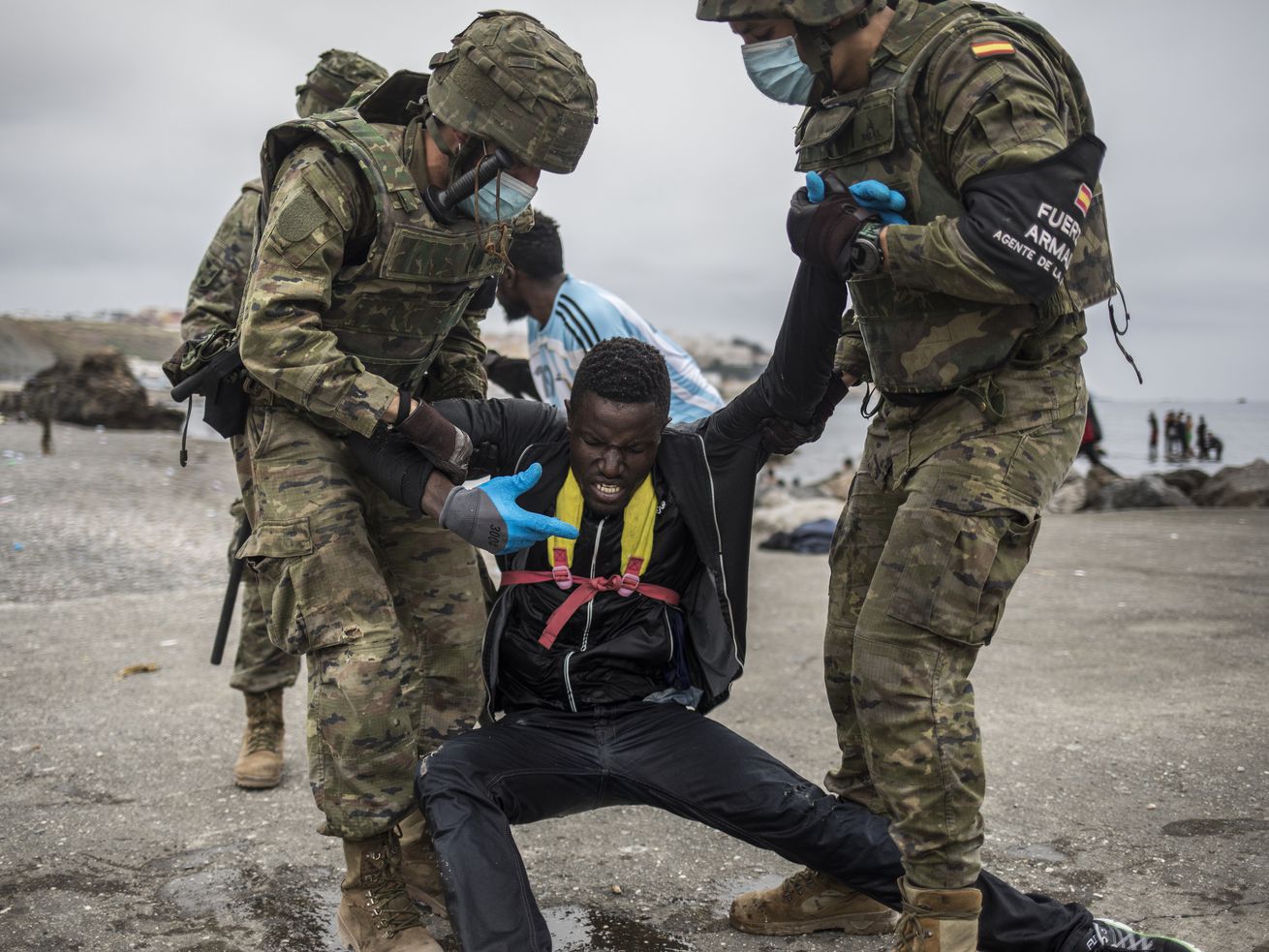
A man is held by soldiers of the Spanish Army at the border of Morocco and Spain, at the Spanish enclave of Ceuta, on Tuesday, May 18, 2021. Ceuta, a Spanish city of 85,000 in northern Africa, faces a humanitarian crisis after thousands of Moroccans took advantage of relaxed border control in their country to swim or paddle in inflatable boats into European soil. Around 6,000 people had crossed by Tuesday morning since the first arrivals began in the early hours of Monday, including 1,500 who are presumed to be teenagers. | AP
The sudden influx of migrants fueled the diplomatic spat between Rabat and Madrid over the disputed Western Sahara region and created a humanitarian crisis for Ceuta, the Spanish city of 85,000 in North Africa on the Mediterranean Sea, separated from Morocco by a double-wide, 32-feet fence.
CEUTA, Spain — Spain deployed its military to the Moroccan border Tuesday as thousands of migrants jumped fences or swam onto European soil for the second day in a row after Rabat loosened border controls amid a deepening diplomatic spat.
Overwhelmed soldiers separated the adults from the young and carried children in their arms while Red Cross workers helped an endless trickle of migrants who were emerging from the water shivering and exhausted. One unconscious woman laid on the sand before she was carried away on a stretcher.
The sudden influx of migrants has fueled the diplomatic spat between Rabat and Madrid over the disputed Western Sahara region and created a humanitarian crisis for Ceuta, the Spanish city of 85,000 in North Africa on the Mediterranean Sea, separated from Morocco by a double-wide, 32-feet fence.
Amina Farkani, a 31-year-old Moroccan woman who commuted to jobs in Ceuta for 18 years until foreign workers were banned from entering last year when coronavirus outbreaks began to surge, said she saw an opportunity to go back to work when she heard that police were not controlling the border.,
“They let people pass and stood there without speaking,” Farkani told The Associated Press. “People just pass and pass and pass.”
Video cameras captured how some people rushed up the hills surrounding the city and jumped over the fences.
Spanish Prime Minister Pedro Sánchez canceled a trip to Paris, where he was to attend a summit on international aid to Africa, and flew by helicopter to Ceuta. While calling Morocco a “friend of Spain,” Sánchez also urged authorities to “respect the shared border.”
By Tuesday morning, more than 7,000 sea-soaked people had crossed the border into the city since early Monday, the Spanish government said, including 1,500 thought to be teenagers. The number getting in slowed but didn’t stop Tuesday even as Spain deployed additional police and soldiers.
At least 3,800 adults already have been returned to Morocco, according to Spain’s Interior Ministry. Morocco and Spain signed an agreement three decades ago to expel all those who swim across the border.
Yet many arriving Tuesday were sub-Saharan Africans who often migrate to flee poverty or violence at home. Spain has agreements to return some of those migrants to their native countries, but not all of them.
One young man drowned and dozens were treated for hypothermia or small injuries, the Red Cross in Ceuta said, adding that it was performing coronavirus tests on the new arrivals. The adults were being transferred to Ceuta’s main soccer stadium, while those thought to be minors were sent to warehouses run by charity groups.
By Tuesday afternoon, Moroccan authorities closed the road leading to the border post with Ceuta and anti-riot police dispersed crowds of would-be migrants. Neither the government in Rabat nor local officials have commented about the mass influx or responded to queries by The Associated Press.
“It’s such a strong invasion that we are not able to calculate the number of people that have entered,” said Juan Jesús Vivas, the president of Ceuta, an autonomous city of about 7.7 square miles.
“The army is at the border in a deterrent role, but there are great quantities of people on the Moroccan side waiting to enter,” he told Cadena SER radio.
Four Spanish armored vehicles parked Tuesday at Tarajal beach in Ceuta, where the border fence leads to a short breakwater.
In a video shared by a Spanish police union urging authorities to send in reinforcements, anti-riot officers behind the border fence were using shields to protect themselves from stones being thrown by people in Morocco.
Interior Minister Fernando Grande-Marlaska denied local media reports saying that unaccompanied Moroccan migrants under 18, who are allowed to remain legally under the tutelage of Spanish authorities, were being deported.
The European Union’s top migration official – Home Affairs Commissioner Ylva Johansson – described the incidents as “worrying” and called on Morocco to prevent people from setting out in the first place.
“The most important thing now is that Morocco continues to commit to prevent irregular departures, and that those who do not have the right to stay are orderly and effectively returned,” Johansson told the European Parliament.
“Spanish borders are European borders. The European Union wants to build a relationship with Morocco based on trust and shared commitments. Migration is a key element,” she said.
Morocco’s loosened border watch came after Spain decided to grant entry for medical treatment to the chief of a militant group that fights Morocco for the independence of Western Sahara. Morocco annexed the sprawling region on the west coast of Africa in 1975.
Morocco’s Foreign Ministry has said Madrid’s move to assist Brahim Ghali, head of the Polisario Front, was “inconsistent with the spirit of partnership and good neighborliness” and vowed there would be “consequences.”
Vivas, Ceuta’s conservative regional president, said residents were in a state of “anguish, concern and fear” and 60% of the city’s children had not shown up for school on Tuesday. He also linked the sudden mass arrival to Spain’s compassionate assistance to Ghali.
The Spanish government itself, however, officially rejects the notion that Morocco is punishing Spain for a humanitarian move.
The prime minister appeared on live television to announce he would visit Ceuta and that his top priority was to ensure safety in the city “in the face of any challenge, any eventuality and under any circumstance.”
Over the decades, Spain has built a close relationship with Morocco to crack down on illegal border crossings but also to increase economic exchanges and fight extremism. Sánchez on Tuesday avoided any direct criticism to Rabat in his speech.
“To be effective,” he said, “that cooperation must always be based on respect — respect for the shared border.’’
Sánchez was also facing a political storm at home, with the far-right Vox party blaming the migration crisis on the government’s “inaction” and sending its leader on a quick visit to Ceuta.
Many African migrants regard Ceuta and nearby Melilla, another Spanish territory, as a gateway into Europe. In 2020, 2,228 chose to cross into the two enclaves by sea or land, often risking injuries or death.
On Tuesday, another 80 African migrants reached Melilla, 218 miles east of Ceuta, by jumping over the enclave’s double fence.
Morocco scored a diplomatic victory last year when the previous U.S. administration under Donald Trump recognized Rabat’s sovereignty over Western Sahara, paving the way for normalizing relations between Israel and Morocco.
___
AP journalists Tarik El Barakah in Rabat, Lorne Cook in Brussels, and Elaine Ganley in Paris contributed to this report.
Israeli Kassadra Bodari, left, and Lilian Feciouru take shelter in Ashdod, Israel during sirens warning of incoming rockets fired from Gaza Strip, Tuesday, May 18, 2021. | AP
At least 213 Palestinians have been killed in airstrikes since, including 61 children and 36 women, with more than 1,440 people wounded, according to the Gaza Health Ministry.
GAZA CITY, Gaza Strip — A rocket launched from Gaza killed two Thai workers in southern Israel on Tuesday, police said, hours after Israeli airstrikes toppled a six-story building in the Palestinian territory that housed bookstores and educational centers. With the war showing no sign of abating, Palestinians across the region went on a general strike in a rare collective action against Israel’s policies.
Violence erupted at protests in the occupied West Bank, including in the city of Ramallah. Hundreds of Palestinians burned tires and hurled stones toward an Israeli military checkpoint. Troops fired tear gas canisters at the crowd and protesters picked up some of them and threw them back.
One protester was killed and more than 70 others wounded — including 16 by live fire — in clashes with Israeli troops in Ramallah, Bethlehem, Hebron and other cities, according to the Palestinian Health Ministry. The Israeli army said two soldiers were wounded by gunshots to the leg.
The general strike was an uncommon show of unity among Palestinian citizens of Israel, who make up 20% of its population, and those in the territories Israel seized in 1967 that the Palestinians have long sought for a future state. It threatened to further widen the conflict after a spasm of communal violence in Israel and protests across the West Bank last week.
Muhammad Barakeh, one of the organizers of the strike, said Palestinians are expressing a “collective position” against Israel’s “aggression” in Gaza and Jerusalem, as well as the “brutal repression” by police across Israel. Israel blames the war on Hamas and accuses it of inciting violence across the region.
Since the fighting began last week between Israel and Gaza’s Hamas rulers, the Israeli military has launched hundreds of airstrikes it says are targeting Hamas’ militant infrastructure, while Palestinian militants have fired more than 3,400 rockets from civilian areas in Gaza at civilian targets in Israel.
The latest attack from Gaza hit a packaging plant in a region bordering the territory. In addition to the two people killed, who were in their 30s, Israel’s Magen David Adom rescue service said it transported another seven wounded to the hospital. Thai Foreign Ministry spokesman Tanee Sangrat said the wounded were also Thai.
The Israeli military said militants also fired rockets at the Erez pedestrian crossing and at the Kerem Shalom crossing, where humanitarian aid was being brought into Gaza, forcing both to close. It said a soldier was lightly wounded in the attack on Erez.
Israel continued its airstrikes into Gaza, leaving behind a massive mound of rebar and concrete slabs in its attack on the six-story building with centers used by the Islamic University and other colleges. Desks, office chairs, books and computer wires could be seen in the debris. Residents sifted through the rubble, searching for their belongings.
Israel warned the building’s residents ahead of time, sending them fleeing into the predawn darkness, and there were no reports of casualties.
“The whole street started running, then destruction, an earthquake,” said Jamal Herzallah, a resident of the area. “This whole area was shaking.”
Since 2012, Hamed al-Ijla had run a training center in the building, teaching first aid, hospital management and other skills to thousands of students.
When the war is over, “I will set up a tent across the street and resume work,” he said.
Heavy fighting broke out May 10 when Gaza’s militant Hamas rulers fired long-range rockets toward Jerusalem in support of Palestinian protests against Israel’s heavy-handed policing of the Al-Aqsa Mosque compound, a flashpoint site sacred to Jews and Muslims, and the threatened eviction of dozens of Palestinian families by Jewish settlers.
At least 213 Palestinians have been killed in airstrikes since, including 61 children and 36 women, with more than 1,440 people wounded, according to the Gaza Health Ministry, which does not break the numbers down into fighters and civilians. Hamas and Islamic Jihad say at least 20 of their fighters have been killed in the fighting, while Israel says the number is at least 160.
Twelve people in Israel, including a 5-year-old boy and a soldier, have been killed in the ongoing rocket attacks.
The fighting is the most intense since a 2014 war between Israel and Hamas, but efforts to halt it have so far stalled. Egyptian mediators are trying to negotiate a cease-fire, but the U.S. has stopped short of demanding an immediate stop to the hostilities and Israel has so far vowed to press on.
The war has also seen an unusual outbreak of violence in Israel, with groups of Jewish and Palestinian citizens fighting in the streets and torching vehicles and buildings.
As the fighting drags on, medical supplies, fuel and water are running low in Gaza, which is home to more than 2 million Palestinians and has been under an Israeli-Egyptian blockade since Hamas seized power from rival Palestinian forces in 2007. Nearly 47,000 Palestinians have fled their homes.
Israeli attacks have damaged at least 18 hospitals and clinics and entirely destroyed one health facility, the World Health Organization said in a new report. Nearly half of all essential drugs in the territory have run out.
Essential supplies and aid have only trickled in during the fighting, some from Egypt through the Rafah crossing point it controls and some from Israel when it briefly opened the territory’s main commercial crossing Tuesday before the attack forced it shut.
The WHO said the bombing of key roads, including those leading to the main Shifa Hospital, has hindered the movement of ambulances and supply vehicles in Gaza, which was already struggling to cope with a coronavirus outbreak.
Israel has vowed to press on with its operations, and the United States signaled it would not pressure the two sides for a cease-fire even as President Joe Biden said he supported one.
Israeli Prime Minister Benjamin Netanyahu said the bombardments had set the Palestinian militants back many years.
“I am sure that all our enemies around us see the price we have levied for the aggression against us,” he said, speaking in front of an F-16 fighter jet at an air force base in a video released by his office Tuesday.
The Biden administration has declined so far to publicly criticize Israel’s part in the fighting or send a top-level envoy to the region and has blocked a proposed U.N. Security Council statement calling for an end to the crisis.
Among the buildings that Israeli airstrikes have leveled was the one housing The Associated Press Gaza office and those of other media outlets.
Netanyahu alleged that Hamas military intelligence was operating inside the building. U.S. Secretary of State Antony Blinken said Tuesday that Israel had given the U.S. information about the bombing.
Blinken, speaking from Iceland, declined to characterize the material received. Israel has not publicly provided any evidence of its claim.
AP President Gary Pruitt reiterated the organization’s call for an independent investigation into the attack.
“As we have said, we have no indication of a Hamas presence in the building, nor were we warned of any such possible presence before the airstrike,” he said in a statement. “We do not know what the Israeli evidence shows, and we want to know.”
___
Krauss reported from Jerusalem. Associated Press writers Isabel DeBre in Dubai, United Arab Emirates, Grant Peck in Bangkok and Ilan Ben Zion in Jerusalem contributed o this report.