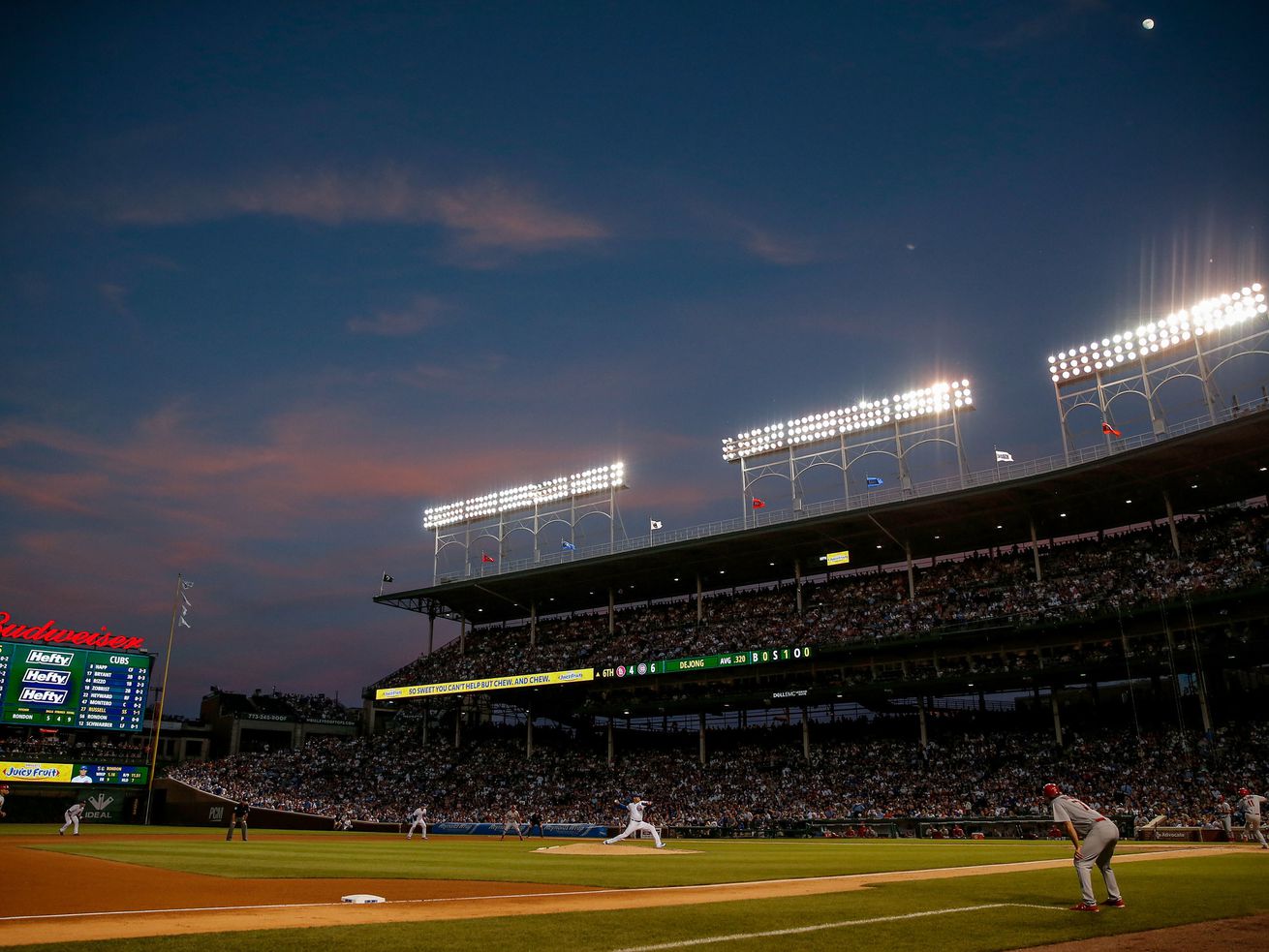
The Cubs want city approval for an extra night game at Wrigley — and they want it on a Friday, which is usually off-limits. | Getty
Normally, Friday or Saturday night games are a no-no; that’s when Wrigleyville restaurants and nightclubs expect their biggest crowds. The exception was OK’d by a City Council committee because of the Cubs’ travel schedule.
The Cubs got the go-ahead Wednesday to play a rare Friday night game on June 18 against the Miami Marlins because the team returns to Chicago late the night before after playing the Mets in New York.
Normally, Friday and Saturday night games are a no-no because they exacerbate parking and congestion problems in Wrigleyville on a night restaurants and nightclubs count on to draw their biggest crowds.
But at the behest of local Ald. Tom Tunney (44th), the City Council’s Committee on License and Consumer Protection agreed to make the one-time exception due to the Cubs’ travel schedule, hoping a better-rested home team would be more likely to defeat the Miami Marlins.
“It’s a pretty simple ask. This is to move a day game that was scheduled for Friday, June 18 to a night game … . We’ve done it in the past on a very limited basis to help accommodate tight travel schedules in the hopes that a well-rested team might get us in the playoffs,” Tunney said.
“The Cubs, traditionally by the night game ordinance, were not allowed Friday or Saturday night games without this kind of exception. … This was done historically because generally, in Lake View and other communities, Friday and Saturday night are the busiest nights for restaurants, theater and other uses that really are necessary to keep these businesses alive. When there’s a game around Wrigley Field, there’s too much congestion and parking issues for other businesses to really survive.”
Prior to the final vote, Ald. Michael Scott Jr. (24th) asked Tunney how often the ban on Friday night games is lifted.
“Once in a blue moon. Whenever the Cubs make the playoffs,” Tunney joked.
During the Zoom hearing, License Committee Chairman Emma Mitts (37th) held up her hand.
She appeared to be wearing a replica of the World Series ring distributed to Cubs players and personnel after the team won the 2016 World Series, ending a 108-year championship drought that was the longest in Major League Baseball.
“Can you bring one of these back home? With you getting this extra night [game], we’re looking for a win. This is your victory right here. We need a World Series coming from the Cubs,” Mitts said.
Cubs Vice-President and General Counsel Mike Lufrano replied: “That would be terrific. Thank you, Madame Chair.”
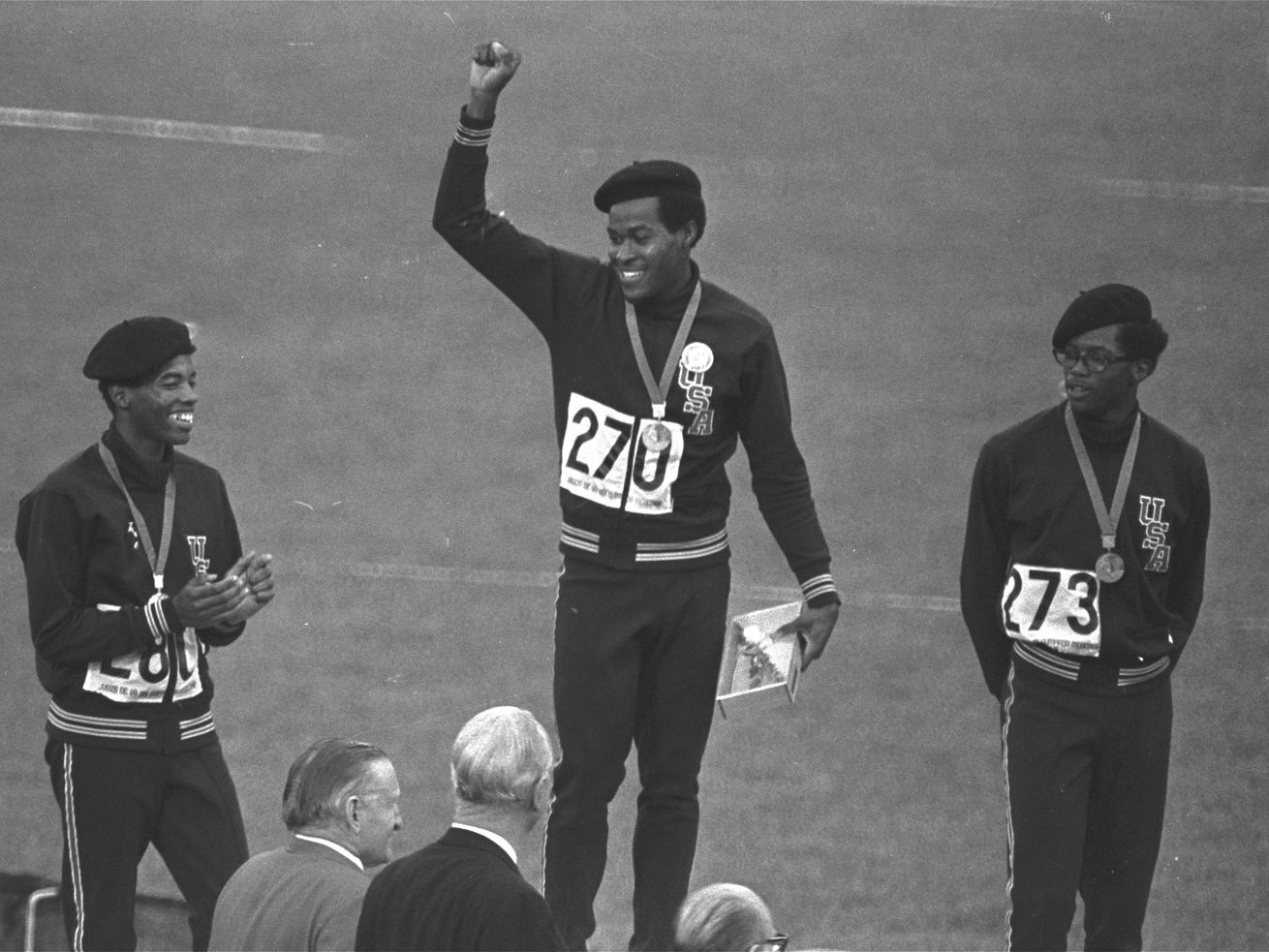
Lee Evans, center, the record-setting sprinter who wore a black beret in a sign of protest at the 1968 Olympics, died Wednesday. He was 74. | AP
Evans became the first man to crack 44 seconds in the 400 meters, winning the gold medal at the Mexico City Games in 43.86.
LAGOS, Nigeria — Lee Evans, the record-setting sprinter who wore a black beret in a sign of protest at the 1968 Olympics, died Wednesday. He was 74.
USA Track and Field confirmed Evans’ death. The San Jose Mercury News reported that Evans’ family had started a fundraiser in hopes of bringing him back to the U.S. from Nigeria, where he coached track, to receive medical care after he suffered a stroke last week.
Evans became the first man to crack 44 seconds in the 400 meters, winning the gold medal at the Mexico City Games in 43.86. His victory came shortly after his teammates, Tommie Smith and John Carlos, were sent home from the Olympics for raising their fists on the medals stand.
In later interviews, Evans said an official warned him not do anything similar. He took a different approach, wearing a black beret to show support for the Black Panther Party and other civil rights organizations.
Like Smith and Carlos, Evans was a college star on the San Jose State “Speed City” teams. He was also a high-profile member of the Olympic Project for Human Rights, which called attention to racial inequality and oppression and spearheaded the protests at the 1968 games.
“His legacy of contributions to sports and the struggle for social justice is indelible and enduring,” tweeted Harry Edwards, the architect of the movement.
After running the 43.86, Evans anchored the U.S. 4×400 team to a world record of 2 minutes, 56.16 seconds. The 400 record stood for almost 20 years. The relay record stood for 24.
Evans won five U.S. titles at 400 meters and is a member of both the USATF and U.S. Olympic halls of fame.
After he stopped running competitively, Evans spent ample time in Africa, working for the United Nations, and also coaching national teams in Nigeria and Saudi Arabia. The Mercury News said he was currently coaching high school track in Lagos.
Tanker trucks are parked near the entrance of Colonial Pipeline Company Wednesday, May 12, 2021, in Charlotte, N.C. The operator of the nation’s largest fuel pipeline has confirmed it paid $4.4 million to a gang of hackers who broke into its computer systems. That’s according to a report from the Wall Street Journal. Colonial Pipeline’s CEO Joseph Blount told the Journal that he authorized the payment after the ransomware attack because the company didn’t know the extent of the damage. | AP
“This decision was not made lightly,” but it was one that had to be made, a company spokesman said.
NEW YORK — The operator of the nation’s largest fuel pipeline confirmed it paid $4.4 million to a gang of hackers who broke into its computer systems.
Colonial Pipeline said Wednesday that after it learned of the May 7 ransomware attack, the company took its pipeline system offline and needed to do everything in its power to restart it quickly and safely, and made the decision then to pay the ransom.
“This decision was not made lightly,” but it was one that had to be made, a company spokesman said. “Tens of millions of Americans rely on Colonial – hospitals, emergency medical services, law enforcement agencies, fire departments, airports, truck drivers and the traveling public.”
Colonial Pipeline’s CEO, Joseph Blount, told The Wall Street Journal he authorized the payment because the company didn’t know the extent of the damage and wasn’t sure how long it would take to bring the pipeline’s systems back.
The FBI discourages making ransom payments to ransomware attackers, because paying encourages criminal networks around the globe who have hit thousands of businesses and health care systems in the U.S. in the past year alone. But many victims of ransomware attacks, where hackers demand large sums of money to decrypt stolen data or to prevent it from being leaked online, opt to pay.
“I know that’s a highly controversial decision,” Blount told the Journal. “I didn’t make it lightly. I will admit that I wasn’t comfortable seeing money go out the door to people like this.”
“But it was the right thing to do for the country,” he said.
Blount said Colonial paid the ransom in consultation with experts who previously dealt with the group behind the attacks, DarkSide, which rents out its ransomware to partners to carry out the actual attacks.
Multiple sources had confirmed to The Associated Press that Colonial Pipeline had paid the criminals who committed the cyberattack a ransom of nearly $5 million in cryptocurrency for the software decryption key required to unscramble their data network.
A ransom payment of 75 Bitcoin was paid the day after the criminals locked up Colonial’s corporate network, according to Tom Robinson, co-founder of the cryptocurrency-tracking firm Elliptic. Prior to Robinson’s blog post, two people briefed on the case had confirmed the payment amount to AP.
Blount told the Journal the attack was discovered around 5:30 a.m. on May 7. It took Colonial about an hour to shut down the pipeline, which has 260 delivery points across 13 states and Washington, D.C., Blount said. That helped prevent the infection from potentially migrating to the pipeline’s operational controls.
The pipeline system delivers about 45% of the gasoline consumed on the East Coast, and Colonial, which is based in Alpharetta, Georgia, halted fuel supplies for nearly a week. That led to panic-buying and shortages at gas stations from Washington, D.C. to Florida.
Colonial restarted its pipeline a week ago, but it took time to resume a full delivery schedule, and the panic-buying led to gasoline shortages. More than 9,500 gas stations were out of fuel on Wednesday, including half of the gas stations in D.C. and 40% of stations in North Carolina, according to Gasbuddy.com, which tracks fuel prices and station outages.
___
Associated Press Writer Frank Bajak contributed to this report from Boston.
A man died in a drive-by shooting late Wednesday morning in Park Manor on the South Side, Chicago police said.
The 32-year-old was outside in the 7400 block of South King Drive when a gunman opened fire from a passing silver SUV, possibly a Dodge Journey, about 11:20 a.m., police said.
The man was hit multiple times and taken to the University of Chicago Medical Center, where he was pronounced dead, police said. His name hasn’t been released.
No arrest was made.
The city’s 3rd police district — which covers Park Manor, Woodlawn and South Shore — has seen a 70% increase in shootings this year compared to the same period in 2020. Police have responded to 63 shootings this year through May 21, compared with 37 shootings in the same timeframe last year, according to police statistics.
Prosecutors have dropped their bid for $168,000 in damages from two snowboarders who triggered a slide that buried a service road and destroyed an expensive avalanche-mitigation system in Colorado’s backcountry.
Outdoor enthusiasts and avalanche-prevention specialists were closely watching the case, which stoked concerns that other skiers and snowboarders would be deterred from coming forward to report avalanches out of fear they’d be saddled with the cost of the damage.
Tyler DeWitt, 39, of Silverthorne; and Evan Hannibal, 26, of Vail, agreed instead to plead guilty June 7 to a misdemeanor charge of reckless endangerment, according to Jason Flores-Williams, their lawyer.
The snowboarders also will have to complete 20 to 60 hours of community service as part of the plea deal.
Evan Hannibal outside his home in Vail, Colo. Prosecutors have dropped their bid for $168,000 in damages from Hannibal and a second snowboarder who triggered a costly avalanche.Thomas Peipert / AP
Hannibal’s helmet cam captured the March 25, 2020, avalanche — and also the tense, profanity-laced exchange that followed as a wall of snow wider than a football field barreled downhill in the vicinity of the Continental Divide near Vail.
The experienced backcountry snowboarders weren’t injured. But the avalanche buried a service road in about 20 feet of snow and came dangerously close to Interstate 70, a major route for ski traffic.
As soon as they were safe, the two men called 911 to report the slide and spent two about hours at the scene describing what happened. They also shared the video and photos with the Colorado Avalanche Information Center.
Hannibal described the interaction as cordial. But the snowboarders were shocked a few weeks later when they got word they were being criminally charged after the footage was handed over to law enforcement.
Investigators cited Hannibal’s video in an affidavit explaining the charge. Summit County sheriff’s Deputy Brian Metzger wrote that the footage shows the snowboarders making “several comments” expressing concern about the risks.
“The pair were clearly worried about avalanche conditions but proceeded down the path anyway,” Metzger wrote. “There was also a comment made about being in trouble if the cops show up.”
A report by the avalanche center also suggested the snowboarders might have misgauged the hazard on the slope.
The slide, which was about 400 feet wide and ran about 1,200 vertical feet, destroyed one of six O’Bellx avalanche-mitigation units in the area. The remotely operated devices are part of a statewide system controlled by the Colorado Department of Transportation. They ignite a mixture of oxygen and hydrogen that causes an explosion aimed at safely triggering avalanches.
As Hannibal’s and DeWitt’s case moved forward, the Colorado attorney general’s office joined those raising concerns about the message that was being sent by prosecuting them. The office filed a motion to quash testimony from the director of the Colorado Avalanche Information Center — a state agency — and one of its avalanche forecasters.
The motion, which was denied, argued that the testimony could have an “unintended adverse ‘chilling’ impact” on the avalanche center’s ability to collect photographs and videos from people involved in backcountry accidents because they might fear the information would be used against them.
“When people are willing to become reasonable, then you can actually have fair outcomes that don’t damage people or have national implications,” said Flores-Williams, who called prosecutors’ initial restitution request obscene and unjust.
Summit County District Attorney Heidi McCollum didn’t respond to a request for comment.
Flores-Williams said he hopes the case will lead to protocols under which people can freely interact with the avalanche center, which uses the information to compile daily backcountry forecasts during the winter and to warn of possibly dangerous conditions.
“It was always our hope that, at the end of all of this, that the Colorado Avalanche Information Center remains that neutral, positive state agency that it is meant to be,” he said. “It was really unfortunate that they were brought in the way they were. But, at the same time, they need to be given real credit for bringing in the attorney general. And the attorney general needs to be given real credit for coming in and trying to keep them from becoming a partial state agency.”
Hannibal said that even though he won’t be on the hook to pay restitution, the fact that criminal charges were filed to begin with is likely to keep some people from reporting avalanches.
“That’s kind of inevitable,” he said. “But I do think that [the Colorado Avalanche Information Center] is put in a better position by coming to a plea deal here instead of being forced to testify against members of the backcountry and kind of putting them in between the state and the community.”
Chicago aldermen moved Wednesday to corral the “Wild West” of rogue tow truck drivers who rush to accident scenes, snare damaged vehicles and hold them hostage until rattled motorists pay exorbitant fees.
One month after putting on the brakes, the City Council’s Committee on License and Consumer Protection approved a revised ordinance that calls for the city to establish a first-ever license for tow truck operators, require a $250 license for every truck they use and license the locations where vehicles they tow are stored.
Last month, License Committee Chairman Emma Mitts (37th) demanded more time to consider AAA’s request for a waiver that could excuse the motor club from record-keeping requirements that would slow down AAA towing operations.
Ald. David Moore (17th) raised concerns about the impact on city contractors.
That prompted Ald. Gilbert Villegas (36th) to amend the ordinance he championed to satisfy their concerns.
“AAA didn’t want to be responsible for individual towing contractors. So, [I] struck that. If you’re a city vendor, you won’t have to pay the license. However, if you have other vehicles that are not working on the city contract, those vehicles would have to pay the license,” Villegas said.
“We had language regarding what would be prohibited for someone getting a license. We struck misdemeanor and just kept it at felony to keep it consistent with how [Business Affairs and Consumer Protection] licenses people in the booting industry.”
With those changes, the License Committee approved the ordinance tailor-made to prevent “rampant” abuses by “rogue” towing companies that “take advantage of rattled vehicle owners” by appearing unsolicited at accident scenes.
“We need this industry policed because it’s just been the Wild West for the past few decades. We’re the second-worst in the country as it relates to rogue towers. I’m trying to address this before we get to No. 1,” Villegas said.
“We have an industry here that … is filled with organized crime. They’re running around the city, speeding to crash sites, intimidating people in accidents. In some cases, even shooting at one another. There’s no accountability.”
Last month, Sgt. Keith Blair of the Chicago Police Department’s Major Auto Theft Unit called towing abuses a “very serious problem” that has “overloaded” CPD and hampered its ability to investigate the number of vehicles towed illegally from crash scenes.
Many rogue tow-truck drivers monitor police and fire department radio frequencies, Blair said, often beating first responders to the scene.
“They’re using any method necessary to try and obtain control of an unsuspecting victim’s vehicle. Promising them free rental and [making] other promises that they never fulfill. And they end up holding these cars hostage,” Blair said on that day.
“They’re closely aligned in some areas with gangs. … Much like we see gang conflicts, we see gang conflicts among tow drivers as well.”
The ordinance also would prohibit certain acts, such as:
o Stopping “at or near” an accident scene or near a damaged or disabled vehicle to solicit the vehicle owner unless summoned to the scene by law enforcement, other city or state agencies or the vehicle owner or his or her representative.
o Making any false, misleading or threatening statements to the vehicle owner for the purpose of coercing the owner to engage the operator’s towing services, such as claiming to be affiliated with a government agency or insurance company that would cover the towing cost.
o Holding a towed vehicle against the owner’s will until the motorist agrees to pay a “ransom” fee amounting to thousands of dollars.
“Even if you wanted to pay to get your vehicle released, you can’t even pay with a credit card. You have to pay with cash,” Villegas said.
“Rental car companies have had vehicles stolen and held hostage by these rogue towers demanding thousands of dollars. Even if a rental car company wanted to pay for the ransom, they couldn’t pay with a check. They had to pay in cash. They had to hire a third party, since they don’t deal with cash. It’s the Wild West.”
Five years ago, the tilted playing field between towing companies that snatch cars off Chicago streets and parking lots and motorists who own those vehicles got a bit more level.
The City Council approved a “towing bill of rights” in response to an avalanche of complaints about Lincoln Towing, the company made famous in the Steve Goodman song, “Lincoln Park Pirates.”
MINNEAPOLIS — Tony La Russa called this “a big game for us.”
Lucas Giolito came up really big.
The White Sox All-Star and Opening Day right-hander, showing more of the fleeting form that earned him the title of staff “ace,” Giolito struck out a season high 11 over eight excellent innings of one-run ball, and the Sox held on to defeat the Twins 2-1 to take an important, eventful series against the defending AL Central champions.
Defeating the Twins (14-27) for the fifth time in six games, the first-place Sox (26-16) got a hustling RBI single with two outs in the fifth inning from Adam Eaton that scored Leury Garcia and an RBI single off the left field wall by Garcia in the sixth to erase a 1-0 Twins lead. Garcia’s single scored Jake Lamb, who had doubled leading off the inning against Twins starter Matt Shoemaker.
The Twins only run against Giolito (3-4, 4.35 ERA) came on Nelson Cruz’s home run in the third. After that, Giolito did not allow a hit, facing the minimum thanks to a double play after Jorge Polanco leading off the sixth. First baseman Andrew Vaughn dove to his right on that one, flipped to shortstop Tim Anderson while on his knees and went back to first to complete the DP.
Giolito walked three and allowed two hits. He was 1-4 with a 6.75 ERA over his previous five starts.
Closer Liam Hendriks, on the mound when the Twins walked off their 5-4 victory Tuesday night, got the final three outs. Hendriks struck out Polanco, got Cruz on a pop fly to short left and struck out Max Kepler to record his ninth save.
The Sox won the first game of the series 16-4, the last run coming on a home run by Yermin Mercedes against position player Willians Astudillo on a 3-0 count. Mercedes had been given a take sign but swung anyway, prompting La Russa to apologize to the Twins for breaking old-school sportsmanship protocol, a “we’re sorry” that wasn’t enough for Mercedes to get thrown at Tuesday.
The Sox are off Thursday before completing their road trip with three games in New York against the Yankees.
Two nights ago, Chicago White Sox designated hitter Yermin Mercedes hit a home run off Willians Astudillo to cap off a 16-4 blowout over the Minnesota Twins, much to the chagrin of Tony La Russa, the Chicago White Sox manager.
La Russa said that a “take” sign was on. Not surprising, since the Chicago White Sox led by 11 at the time, there were two outs and no one on, and Astudillo is typically a catcher.
Mercedes missed the sign, swung away at a 47-mph pitch, and deposited it over the fence. Setting off a firestorm of debate about baseball’s unwritten rules.
Chicago White Sox manager Tony La Russa has been critical of his own player while also defending the Twins.
Sox players and fans, along with many of the media pundits, have castigated La Russa for his old-school attitude.
Now, let’s be clear here. There are really two issues at hand. Issue one is regarding the signs and Mercedes either intentionally ignoring or inadvertently missing one. Issue two is whether it’s OK to swing at a 3-0 pitch tossed by a position player – or anyone, really – in the middle of a blowout.
I understand the argument for Mercedes needing to be aware of the signs and to follow them. It’s no big deal to miss one in a blowout in May, but a missed sign could cost the team a game in September or October – and this is a team with playoff aspirations.
That said, there’s also nothing wrong with swinging at a 3-0 pitch during a blowout. It’s not disrespectful. Don’t want to be taken deep? Pitch better. Or maybe use an actual bullpen pitcher.
Clearly, the Twins didn’t want to use a bullpen pitcher in a game that was all but over. So if you’re going to do that, you have to understand that a position player might allow a homer.
It’s also important to note that Mercedes, like any player, has an incentive to have the best stats he can over time. He’s not going to stop competing just because the guy on the mound throws slower than most beer-besotted fans would.
Not to mention that a swing might’ve actually been better for the Twins, at least if the ball hadn’t left the ballpark. A walk to Mercedes, even with the bases empty and two outs, means at least one more batter to face. A ball in play could’ve been an out. Too bad for Minnesota that instead of being an out, it went out of the park.
La Russa made it all worse with his public comments. Instead of calling Mercedes – who’s been a great story for the Sox thus far – “clueless“, La Russa would’ve been better off simply saying they’d talk about following the signs and moving on. He also should’ve defended the team against the Twins’ retaliation.
If the only problem was that Mercedes missed a sign, that’s easily taken care of via an internal conversation. Instead, La Russa doubled down on old-school baseball convention that is being rapidly left in the dust as a younger generation of players and fans embraces fun while also showing how dumb most of these unwritten rules are. He did so at the risk of alienating his own players – all of whom play for a team that advertises via the hashtag “change the game.”
I doubt this incident will sink a Sox team that appears ready to rule the AL Central even with two of its best players out for a good chunk of the year with injuries. But compared with actual on-field decisions La Russa has made this season that have arguably cost the team games, it’s one more arrow in the quiver of his critics.
I’m not yet ready to fire the manager. But he needs to come to grips with the fact that the game really has changed in the decade he was away from the dugout. His old-school attitude may or may not cost the Sox in the standings, but it does bring unnecessary drama.
People inspect the rubble of destroyed the Abu Hussein building that was hit by an Israeli airstrike early morning, in Gaza City, Wednesday, May 19, 2021. | AP
Benjamin Netanyahu’s tough comments marked the first public rift with the United States since the fighting began last week and could complicate international efforts to reach a cease-fire.
GAZA CITY, Gaza Strip — Israeli Prime Minister Benjamin Netanyahu vowed Wednesday to press ahead with a fierce military offensive in the Gaza Strip, pushing back against calls from the United States to wind down the operation that has left hundreds dead.
Netanyahu’s tough comments marked the first public rift between the two close allies since the fighting began last week and could complicate international efforts to reach a cease-fire.
Israel continued to pound targets in Gaza with airstrikes, while Palestinian militants bombarded Israel with rocket fire throughout the day. In another sign of potential escalation, militants in Lebanon fired a rocket barrage into northern Israel.
After a visit to military headquarters, Netanyahu said he appreciated “the support of the American president,” but he said Israel would push ahead to return “calm and security” to Israeli citizens.
He said he was “determined to continue this operation until its aim is met.”
He spoke shortly after U.S. President Joe Biden told Netanyahu that he expected “a significant de-escalation today on the path to a cease-fire,” the White House said.
Biden had previously avoided pressing Israel more directly and publicly for a cease-fire with Gaza’s Hamas militant rulers. But pressure has been building for Biden to intervene more forcefully as other diplomatic efforts gather strength.
Egyptian negotiators have also been working to halt the fighting, and an Egyptian diplomat said top officials were waiting for Israel’s response to a cease-fire offer. The diplomat spoke on condition of anonymity in line with regulations. Meanwhile, German Foreign Minister Heiko Maas said he would fly to the region Thursday for talks with Israelis and Palestinians.
Israel’s Foreign Ministry said the foreign ministers of Slovakia and the Czech Republic would also arrive in Israel Thursday, and that the diplomats were invited by Foreign Minister Gabi Ashkenazi “to express their solidarity and support” for Israel.
Earlier in the day, the Israeli military said it was widening its strikes on militant targets in southern Gaza to blunt continuing rocket fire from Hamas. At least nine people were killed Wednesday in the Gaza Strip.
The current round of fighting between Israel and Hamas began May 10, when the militant group fired long-range rockets toward Jerusalem after days of clashes between Palestinian protesters and Israeli police at the Al-Aqsa Mosque compound, a flashpoint site sacred to Jews and Muslims. Heavy-handed police tactics at the compound and the threatened eviction of dozens of Palestinian families by Jewish settlers had inflamed tensions.
Since then, Israel has launched hundreds of airstrikes that it says have targeted Hamas’ infrastructure, and Hamas and other militant groups embedded in residential areas have fired more than 3,700 rockets at Israeli cities, with hundreds falling short and most of the rest intercepted or landing in open areas.
At least 227 Palestinians have been killed, including 64 children and 38 women, with 1,620 people wounded, according to the Gaza Health Ministry, which does not break the numbers down into fighters and civilians. Hamas and Islamic Jihad say at least 20 of their fighters have been killed, while Israel says the number is at least 130. Some 58,000 Palestinians have fled their homes.
Twelve people in Israel, including a 5-year-old boy, a 16-year-old girl and a soldier, have been killed.
The rockets fired by militants in Lebanon into northern Israel threatened to open up a new front in the fighting. The rocket attack, which drew Israeli artillery fire in response but did not cause any injuries, raised the possibility of dragging Israel into renewed conflict with the powerful Lebanese militant group Hezbollah to its north.
No one immediately claimed responsibility for the attack, and Hezbollah, which fought a monthlong war against Israel in 2006, has stayed out of the fighting for now. The rockets were widely believed to be fired by Palestinian factions based in south Lebanon.
But they cannot operate without Hezbollah’s tacit consent, and the barrage appears to be carefully calibrated to send a political message that the group, which has tens of thousands of missiles, could join the battle at any time. Israel considers Hezbollah to be its most formidable threat and has threatened widespread destruction in Lebanon if war were to erupt.
In Gaza, one of the Israeli airstrikes destroyed the home of an extended family.
Residents surveyed the piles of bricks, concrete and other debris that had once been the home of 40 members of al-Astal family in the southern Gaza town of Khan Younis. They said a warning missile struck the building five minutes before the airstrike, allowing everyone to escape.
Ahmed al-Astal, a university professor, described a scene of panic, with men, women and children racing out of the building.
“We had just gotten down to the street, breathless, when the devastating bombardment came,” he said. “They left nothing but destruction, the children’s cries filling the street. … This is happening, and there is no one to help us.”
Another strike in nearby Deir al-Balah killed a man, his wife and their 2-year-old daughter, witnesses said. Iyad Salha, a brother of the man who was killed, said the family had just sat down for lunch when the missile hit.
Among those killed Wednesday were a reporter for Hamas-run Al-Aqsa radio and two people who died when warning missiles crashed into their apartment.
The Israeli military said it was striking a militant tunnel network in southern Gaza, with 52 aircraft hitting 40 underground targets.
Military officials, meanwhile, said a mysterious explosion that killed eight members of a Palestinian family on the first day of the fighting was caused by a misfired rocket from Gaza. “This wasn’t an Israeli attack,” said Lt. Col. Jonathan Conricus, a military spokesman.
Since the fighting began, Gaza’s infrastructure, already weakened by a 14-year blockade, has rapidly deteriorated. Medical supplies, water and fuel for electricity are running low in the territory, on which Israel and Egypt imposed the blockade after Hamas seized power in 2007.
Israeli attacks have damaged at least 18 hospitals and clinics and destroyed one health facility, the World Health Organization said. Nearly half of all essential drugs have run out.
Among the buildings leveled by Israeli airstrikes was one housing The Associated Press’ Gaza office and those of other media outlets.
Netanyahu has alleged that Hamas military intelligence was operating in the building. Secretary of State Antony Blinken said Tuesday that Israel had given the U.S. information about the bombing, without elaborating.
The AP has called for an independent investigation. The news organization’s president, Gary Pruitt, has said the AP had no indication Hamas was present in the building.
The fighting, the worst since a 2014 war between Israel and Hamas, has ignited protests around the world and inspired Palestinians in Israel and the occupied territories to call a general strike Tuesday. It was a rare collective action that spanned boundaries central to decades of failed peace efforts. Israel captured the West Bank, east Jerusalem and Gaza in the 1967 Mideast war, territories the Palestinians want for their future state.
___
Krauss reported from Jerusalem. Associated Press writers Bassem Mroue and Zeina Karam in Beirut, Isabel DeBre in Dubai, United Arab Emirates, Samy Magdy in Cairo, and Frank Jordans in Berlin contributed to this report.
As part of a joint announcement Wednesday, Lyric Opera of Chicago revealed plans for a seven-production season beginning Sept 17; Joffrey Ballet will present a four-program season beginning Oct. 13.
Lyric Opera of Chicago and the Joffrey Ballet will take turns performing on the Lyric Opera House stage for the first time in 2021-22, as the two major companies return to live, in-person productions after a more than 1½-year hiatus.
As part of a joint announcement Wednesday, Lyric Opera of Chicago revealed plans for a seven-production season (one in an alternative venue) that includes its first mainstage opera sung in Spanish – Daniel Catán’s “Florencia en el Amazonas (Florencia in the Amazon)” (1996). Among other highlights are Verdi’s “Macbeth,” led by new music director Enrique Mazzola, and the Chicago premiere of “Proving Up,” a 2018 chamber opera by Missy Mazzoli, composer-in-residence at the Chicago Symphony Orchestra.
Pat Nabong/Sun-TimesGreg Cameron, Joffrey Ballet’s president and CEO, speaks during a press conference Wednesday at the Lyric Opera House about the return of live performances as many COVID-19 restrictions are lifted by the city.
Joffrey Ballet will present a four-program season highlighted by the April 27-May 8, 2022, world premiere of choreographer Cathy Marston’s adaptation of John Steinbeck’s “Of Mice and Men.” It will be paired with the company’s debut of “Serenade,” a 1934 classic by legendary 20th-century choreographer, George Balanchine.
“We are confident that the really exciting season that we’ve planned will be a magnet that will draw people back into the Opera House with great enthusiasm and in very large numbers,” said Anthony Freud, Lyric’s general director, president and CEO.
Lyric Opera’s season is arranged in a such way that it leaves the Opera House stage open for the Joffrey Ballet’s annual monthlong presentation of “The Nutcracker.” Returning Dec. 4-26 will be Christopher Wheeldon’s five-year-old take on the Tchaikovsky classic set during preparations for the 1893 World’s Columbian Exposition.
The plan for the Joffrey Ballet to shift its performances from the Auditorium Theatre, where it had appeared since 1998, to the Lyric Opera House was announced in 2017. The move was supposed to have happened in 2020-21 but had to be postponed because of the coronavirus shutdown.
Audiences attending the Lyric Opera and Joffrey performances will experience an opera house with slightly larger new seats throughout and a staggered configuration and widened aisles on the main floor. The changes, which were carried out in 2020, reduce the theater’s overall capacity from 3,563 to 3,276.
Lyric Opera’s line-up features one less production than what had been announced for the cancelled 2020-21 season, because the company has omitted the presentation of a classic musical as it has done in recent seasons.
“We have not yet announced one for this upcoming season just because of current safety and budget restraints, but there may be a chance that we announce a musical later this year once we have a better idea of how the season is going,” said Lyric Opera spokeswoman Marianna Moroz.
Here are the two companies’ line-ups:
Lyric Opera of Chicago
“Macbeth,” Verdi, Sept. 17, 23 and 30, Oct. 3, 6 and 9
“The Elixir of Love,” Donizetti, Sept. 26 and 29 and Oct. 2, 5 and 8
“The Magic Flute,” Mozart, Nov. 3, 7, 11, 14, 17, 19 and 27
“Florencia in the Amazon,” Catán, Nov. 13, 18, 21, 26 and 28.


:no_upscale()/cdn.vox-cdn.com/uploads/chorus_asset/file/22526217/merlin_97718908.jpg)




/cdn.vox-cdn.com/uploads/chorus_asset/file/22526016/LYRIC_052021_9.jpeg)