At least 1,244 people have been shot in Chicago this year, and there have been 244 homicides.
Three people were killed and 14 others were wounded by gun violence in Chicago over five hours Thursday night into Friday morning, with shootings now up 36% over last year.
The violent night comes as the Chicago Police Department prepares for the traditional summer surge in violence. Last weekend had the most shooting victims so far this year.
While shootings are up 36% from the same period last year, homicides are up 19%, according to data kept by the Chicago Sun-Times. At least 1,244 people have been shot this year and there have been at least 244 homicides.
Overnight, a 56-year-old man was killed in a double shooting in Grand Crossing on the South Side. He and another man, 54, were shot as they stood outside in the 7300 block of South Blackstone about 3:20 a.m. The 56-year-old died at a hospital, while the other man was in fair condition.
At 2:15 a.m., a man was shot dead as he stood outside with friends in Englewood. The man, 27, was shot in his back and chest in the 6000 block of South Racine Avenue. Another man, 33, was wounded by the gunfire as he was changing a tire, police said.
Around 6:30 a.m., police found a man who was shot dead in Austin on the West Side. The man was found in a vacant lot in the 4700 block of West Jackson Boulevard with a gunshot wound to his head, police said. He appeared to have been shot “a while ago,” police said.
Other shootings:
A woman was shot about 10:40 p.m. Thursday in Humboldt Park. The woman, 18, was a passenger in a car when someone on the sidewalk shouted gang slogans and fired in the 1300 block of North Monticello Avenue, police said. He was listed in good condition.
Two men were shot in Austin at 11 p.m. Thursday in the 700 block of North Lorel Avenue, police said. One man, 33, was shot in his abdomen and listed in serious condition. The other man, 21, was struck in the calf and was stabilized.
At 11:15 p.m., a teenage boy was shot in Austin. The boy, 17, was shot in the leg outside in the 900 block of North Lockwood Avenue, police said. His condition stabilized
At 11:20 p.m., another man was shot in the same neighborhood. The 30-year-old was shot in the calf as he walked on the sidewalk in the 1100 block of South Mason Avenue, police said. He went to a hospital in fair condition.
At 11:45 p.m., a woman was shot in Woodlawn on the South Side. The woman, 36, was shot by someone on sidewalk as she rode as a passenger in a vehicle in the 400 block of East Marquette Road, police said. She was in good condition with a shoulder wound.
A man was shot at 12:15 a.m. Friday following a traffic accident in Austin. The man, 24, was shot in his shoulder in the 4800 block of West Washington Boulevard, police said. He was in good condition.
At 1:05 a.m., a 63-year-old man was critically hurt in South Chicago. Someone shot him n the neck in the 7900 block of South Oglesby Avenue, police said.
At 1:10 a.m., two teenagers were wounded, one critically, when someone fired into a Gresham home on the South Side. The pair were shot as they sat in the living room in the 7900 block of South Laflin Street, police said. An 18-year-old was critical with gunshots to his abdomen and neck. A 19-year-old was grazed in his arm and in good condition.
About 2:10 a.m., one person was shot and two others were injured following a shooting and crash on the Dan Ryan Expressway near Garfield Boulevard.
About 2:55 a.m., a woman was shot in Park Manor on the South Side. The woman, 28, was shot in her shoulder in the 7400 block of South Champlain Avenue, police said. She was listed in good condition.
Palestinians inspect the destroyed building housing the offices of The Associated Press and other media, after it was hit last week by Israeli airstrike, in Gaza City, Friday, May 21, 2021. A cease-fire took effect early Friday after 11 days of heavy fighting between Israel and Gaza’s militant Hamas rulers that was ignited by protests and clashes in Jerusalem. | AP
The 11-day war left more than 250 dead — the vast majority Palestinians — and brought widespread devastation to the already impoverished Hamas-ruled Gaza Strip.
GAZA CITY, Gaza Strip — Palestinians rallied by the thousands Friday after a cease-fire took effect in the latest Gaza war, with many viewing it as a costly but clear victory for the Islamic militant group Hamas. Israel vowed to respond with a “new level of force” to further hostilities.
The 11-day war left more than 250 dead — the vast majority Palestinians — and brought widespread devastation to the already impoverished Hamas-ruled Gaza Strip. But the rocket barrages that brought life to a standstill in much of Israel were seen by many Palestinians as a bold response to perceived Israeli abuses in Jerusalem, the emotional heart of the conflict.
Israeli Prime Minister Benjamin Netanyahu warned against further attacks, saying, “If Hamas thinks we will tolerate a drizzle of rockets, it is wrong.” He vowed to respond with “a new level of force” against aggression anywhere in Israel.
The Israeli leader, who is facing criticism from his hawkish base for ending the offensive prematurely, said Israel had done “daring and new things, and this without being dragged into unnecessary adventures.” He added that Israeli forces had caused “maximum damage to Hamas with a minimum of casualties in Israel.”
He said Israeli strikes killed more than 200 militants, including 25 senior commanders, and hit more than 60 miles of militant tunnels. Hamas and the Islamic Jihad militant group have only acknowledged 20 fighters killed.
The Gaza Health Ministry says at least 243 Palestinians were killed, including 66 children, with 1,910 people wounded. It does not differentiate between fighters and civilians. Twelve people were killed in Israel, all but one of them civilians, including a 5-year-old boy and 16-year-old girl.
The truce faced an early test when clashes broke out between Palestinian protesters and Israeli police following Friday prayers at the Al-Aqsa Mosque compound, a flashpoint holy site in Jerusalem sacred to Jews and Muslims. Clashes there earlier this month were one of the main triggers for the war.
It was unclear what sparked Friday’s violence. Police fired stun grenades and tear gas, and Palestinians hurled rocks after hundreds took part in a celebratory demonstration in which they waved Palestinian and Hamas flags and cheered the militant group. Israeli police said they arrested 16 people.
Protesters also clashed with Israeli troops in parts of the occupied West Bank, which has seen violent demonstrations in recent days linked to Jerusalem and Gaza.
Thousands took to the streets of Gaza as the cease-fire took hold at 2 a.m. Young men waved Palestinian and Hamas flags, passed out sweets, honked horns and set off fireworks. Celebrations also broke out overnight in east Jerusalem and across the occupied West Bank. Israel captured all three territories in the 1967 war and the Palestinians want them for their future state.
An open-air market in Gaza City that was closed throughout the war reopened, and shoppers stocked up on fresh tomatoes, cabbage and watermelons. Workers in orange traffic vests swept up rubble from surrounding roads.
“Life will return, because this is not the first war, and it will not be the last war,” said shop owner Ashraf Abu Mohammad. “The heart is in pain, there have been disasters, families wiped from the civil registry, and this saddens us. But this is our fate in this land, to remain patient.”
There was little to celebrate in the hard-hit northern town of Beit Hanoun. Residents, many of whom had lost loved ones, surveyed wrecked homes.
“We see such huge destruction here, it’s the first time in history we’ve seen this,” said Azhar Nsair. “The cease-fire is for people who didn’t suffer, who didn’t lose their loved ones, whose homes were not bombed.”
Rescue workers were still recovering bodies from areas that had been too dangerous to enter. Five were collected Friday in the southern Gaza town of Khan Younis, including that of a 3-year-old, the Red Crescent emergency service said.
Like the three previous wars, the latest round of fighting ended inconclusively. Israel claimed it inflicted heavy damage on Hamas but once again was unable to halt the rockets.
Hamas also claimed victory but faces the daunting challenge of rebuilding in a territory already suffering from high unemployment and a coronavirus outbreak, and from years of blockade by Egypt and Israel.
The fighting began May 10, when Hamas militants in Gaza fired long-range rockets toward Jerusalem. The barrage came after days of clashes between Palestinian protesters and Israeli police at Al-Aqsa. Heavy-handed police tactics at the compound, and the threatened eviction of dozens of Palestinian families by Jewish settlers had inflamed tensions.
Competing claims to Jerusalem, one of the most volatile issues in the decades-old conflict, have repeatedly triggered bouts of violence.
The cease-fire was brokered by neighboring Egypt after the U.S. pressed Israel to wind down the offensive. U.S. Secretary of State Antony Blinken plans to visit the region “to discuss recovery efforts and working together to build better futures for Israelis and Palestinians.” the State Department said.
Hamas and other militant groups fired over 4,000 rockets at Israeli cities. Dozens landed as far north as the bustling commercial capital of Tel Aviv.
Israel, meanwhile, carried out hundreds of airstrikes. A senior Israeli army official said Israel hit 1,600 “military targets” during the 11-day conflict.
The United States, Israel’s closest and most important ally, initially backed what it said was Israel’s right to self-defense against indiscriminate rocket fire. But as fighting dragged on and deaths mounted, the Americans increasingly pressured Israel to stop the offensive.
President Joe Biden welcomed the cease-fire. He said the U.S. was committed to helping Israel replenish its supply of interceptor missiles and to working with the internationally recognized Palestinian Authority — not Hamas — to provide humanitarian aid to Gaza.
Netanyahu faced heavy criticism from members of his hawkish, nationalist base. Gideon Saar, a former ally who leads a small party opposed to the prime minister, called the cease-fire “embarrassing.” Itamar Ben Gvir, head of the far-right Jewish Power party, tweeted that the cease-fire was “a grave surrender to terrorism and the dictates of Hamas.”
In a potentially damaging development for the Israeli leader, the Palestinian militants claimed Netanyahu had agreed to halt further Israeli actions at the Al Aqsa Mosque and to call off the planned evictions of Palestinians in the nearby Sheikh Jarrah neighborhood. An Egyptian official said only that tensions in Jerusalem “will be addressed.”
Some 58,000 Palestinians sought shelter in crowded U.N. schools amid a coronavirus outbreak. Thousands returned to their homes as the truce took hold.
The fighting dealt another blow to Gaza’s already decrepit infrastructure. The small coastal territory, home to more than 2 million Palestinians, has been under an Israeli-Egyptian blockade since Hamas seized power from forces loyal to Palestinian President Mahmoud Abbas in 2007, confining his authority to parts of the West Bank.
The World Health Organization says 30 health facilities in Gaza were damaged, with one clinic destroyed and another with significant damage. An airstrike damaged the only facility in Gaza processing coronavirus tests, forcing a halt to testing in the territory.
Fabrizio Carboni, regional director for the Near and Middle East at the International Committee of the Red Cross, estimated there were “several hundred” pieces of unexploded ordnance strewn in Gaza, adding that medical supplies were a pressing need.
___
Krauss reported from Jerusalem. Associated Press writers Isabel DeBre in Dubai, United Arab Emirates, Laurie Kellman in Tel Aviv, Jamey Keaten in Geneva and Karin Laub in the West Bank contributed.
Don’t look now, but Ian Happ is suddenly one of the hottest hitters in the Chicago Cubs lineup. And it’s no coincidence the team has won five of their last seven games. In his last five games, the Cubs centerfielder is batting a robust .393 with five home runs and 10 RBI’s. In Thursday’s series […]
Everyone kind of wants to live in a penthouse—otherwise “deluxe apartment in the sky” or the infamous magazine wouldn’t resonate quite like they do.
As a result, they tend to be pretty expensive. But they don’t have to be. Just one of these five goes for over a million dollars, despite being unique spaces in great locations. You might not get something out of Architectural Digest, but you can pick from a range of styles, with great views, in different parts of town (or the suburbs).
What’s more: you can get a penthouse. Like a house where a penthouse should be. I’ll explain.
This handsome Roaring ’20s building was built as wealth moved north along the lake, and it’s situated right on one of Lake View’s most handsome corners, right across LSD from Belmont Harbor. It’s as nice inside as you would expect, but what really makes it special is how the interior has been updated—simultaneously extremely contemporary and a throwback to its era, without being corny about it. The use of wallpaper is just delightful, like the green floral pattern on the ceiling of the sitting room, set off with Lily Pulitzer-hued paint. It’s a pretty bold choice given the view. Or there’s the laundry room, a converted galley kitchen, which could be a throwaway, but has a rich rose pattern on… the ceiling? The library and bar, alternately, eschews wallpaper for a rich dark blue. It’s a lush and vivid look throughout, perfect for its spot.
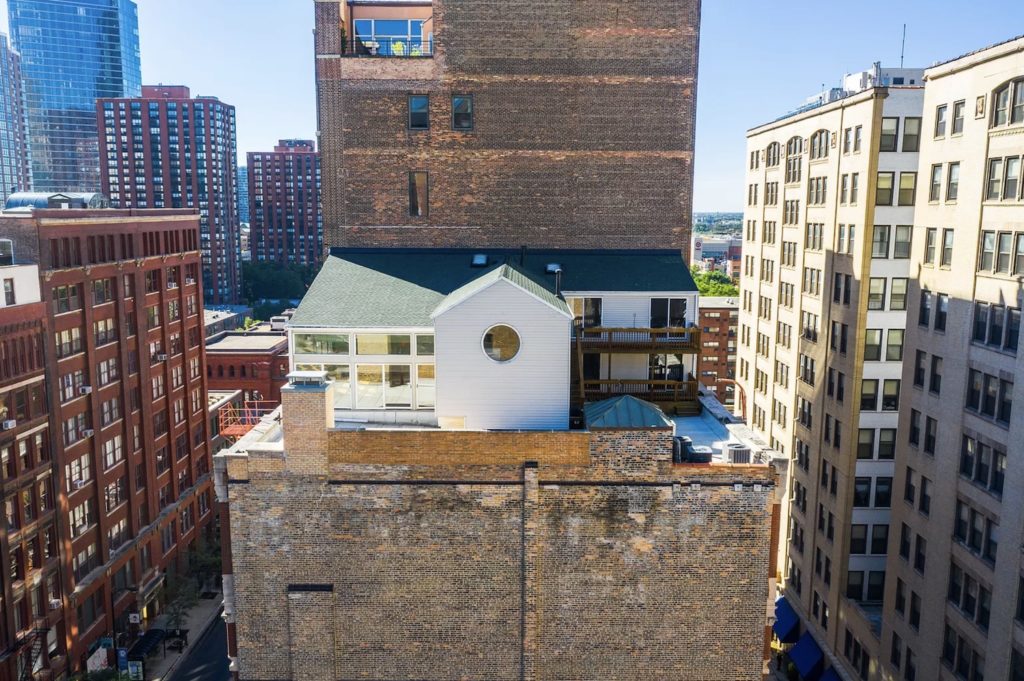
Can’t decide between an apartment or a house? Have I got the place for you: a three-bed, three-bath house on top of an old apartment building in the South Loop. It’s actually a house, on top of the building. A nice one, kind of postmodern, a bit Stanley Tigerman-ish, with lots of windows, two big porches, and a big glass-block centerpiece bath in the middle of its open-plan first floor. It’s not exactly a luxury house, though it is nice; it doesn’t match the building at all; it’s just a house, dropped on top of an apartment building. Downside: you have to pay HOA dues on a house. Upside: you live in a house, on top of a building.
For the same feel but a bit less weird, this three-bed, two-bath river condo offers similar size at a similar price in an ideal location (and a boat dock). It has lofted bedrooms, accessible by a glass-and-metal spiral staircase, leading to a haute-industrial mesh floor, which overlooks the living space, which is cooled by a fan with transparent blades. It’s pretty cool. It also comes with roof rights, with which very little has been done, but the view of the bend in the river is gorgeous.
This corner unit has two beds and one bath and spectacular skyline views for under $400k, with reasonable HOA dues of $576 a month. What’s the catch? It’s not quite a proper penthouse, just penthouse-floor, and the finishing is pretty basic. But you can let the skyline do all the work for you, and for more color there’s a rooftop lounge, off which there is a rooftop pool, which—being on the 29th floor—you’re right next to. It’s also a great location, on the other side of LSD from Burnham Harbor and Northerly Island, and due east of Chinatown and Ping Tom Park.
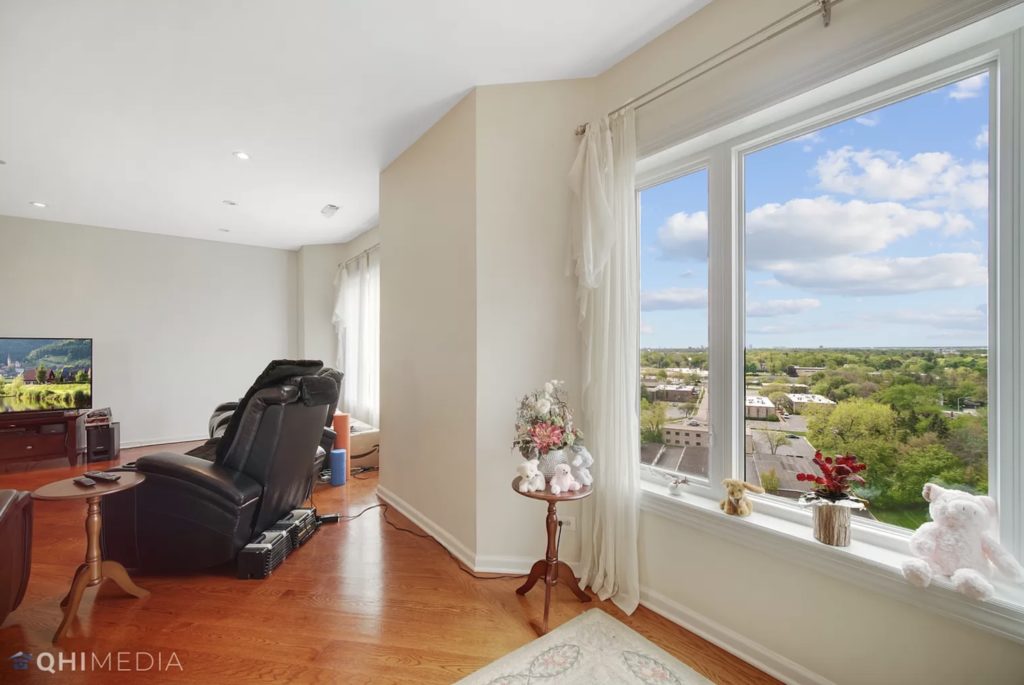
Finally, here’s an inexpensive suburban option. It’s pretty simple, as you’d expect from the price, and it’s a bit dated—but kind of nicely so, as with the gold accents in the large bathroom, or the wall of mirrors that adds some light and a nice reflection to the large open-plan kitchen. Why have a penthouse out in the suburbs? For the pleasant views of the green space surrounding the building. It’s right off a big park with a pond, with Deer Grove a bit farther in the distance, which is connected by a bike trail. It’s got an outdoor pool, is practically next door to a library, and there’s a Mariano’s and a gym about a quarter-mile away, so you can spend a lot of time outdoors instead of in a car.
Got a craving for Italian pasta with a funky name? Then you’ve come to the right place! We have created a list of the best restaurants near you in Chicago to get killer gnocchi. And for the record, here’s how you pronounce it. So sound like a pro next time you order Nee-Oh-Key. *chefs kiss*
This laidback Italian restaurant serves up ALL the goodness including pizza, wines by the quartino, and of course, gnocchi. Their Gnocchi Pesto features a potato based pasta, pesto genovese, garlic confit, and overnight tomato. And Gnocchi alla Romana offers semolina dumplings, amatriciana, and pecorino.
Are you looking for a cozy Italian eatery that offers gnocchi near you in Chicago? You’ll absolutely want to try the Jalapeno Gnocchi which consists of jalapeno stuffed dumplings with roasted red pepper puree. Stop by this cute location for lots of pastas, sandwiches, salads, and daily specials.
Head to this small neighborhood joint and plan on stuffing your face. Sapori’s Gnocchi al Brivido features tender potato gnocchi sautéed in a basil pine nut pesto, tossed with tender chicken breast, sun-dried tomatoes, parmesan, and pine nuts. Just. Wow.
This Roscoe Village staple offers ~ambience~ with candlelit brick and wood rooms, a cocktail lounge, and sidewalk seats. If you’re looking for the top restaurants that offer fresh gnocchi near you in the city, the folks at Piazza Bella serve up a traditional Potato Gnocchi with fresh, handmade pasta served with a rich four cheese sauce.
Three words describe Pasta Al Gusto: fresh, fresh, and FRESH. Get down on their no-frills potato-based Gnocchi, served with your choice of sauce and topped with (dangerously addicting) parmesan cheese.
Grab a friend and get to this bustling space for dope cocktails and generous carafes of vino. Quartino’s Gnocchi is served in an organic tomato sauce with fresh basil and ricotta. Yum.
Since their reopening, A Tavola offers a 4 course menu featuring their best sellers for $64, created by Chef Dan. Of course, you’ll want to indulge in their mouth watering Gnocchi with browned sage butter & parmesan.
The folks at Antico focus on authentic Italian cuisine with an emphasis on using the freshest ingredients possible. Their execution? Simple. Just straight up Gnocchi, made fresh daily. Choose how you want it prepared. Easy, right?
To say that the Chicago Bears need a bounce back season in 2021 would be an understatement.
There is not a single fan, in their right mind, who thinks that last year was a success simply because of a playoff berth in 2020. This past season was just as much of a failure as it would have been had the Bears missed the playoffs completely.
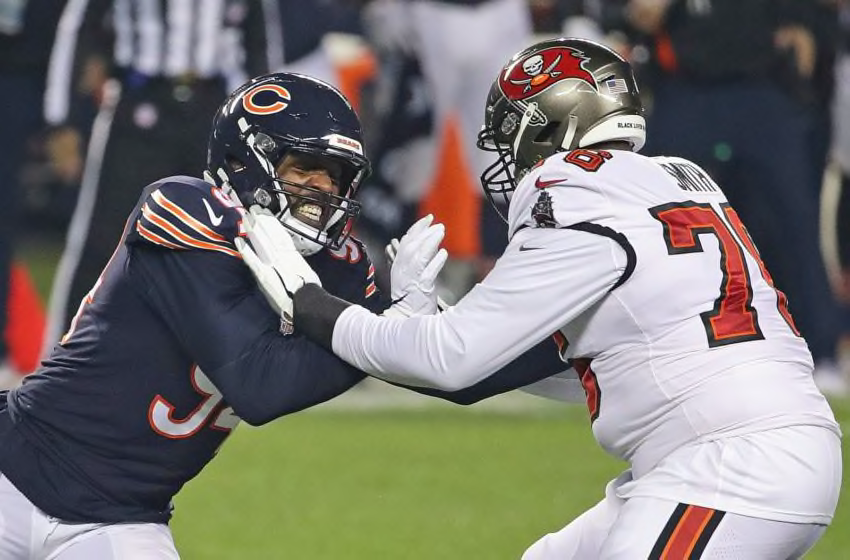
The quarterback play was as erratic as ever behind Mitchell Trubisky and Nick Foles. Hopefully, we don’t have to worry about that in 2021 with the emergence of Justin Fields. The offensive line play was subpar for most of the season, thus the Bears addressing it in a big way during this year’s draft.
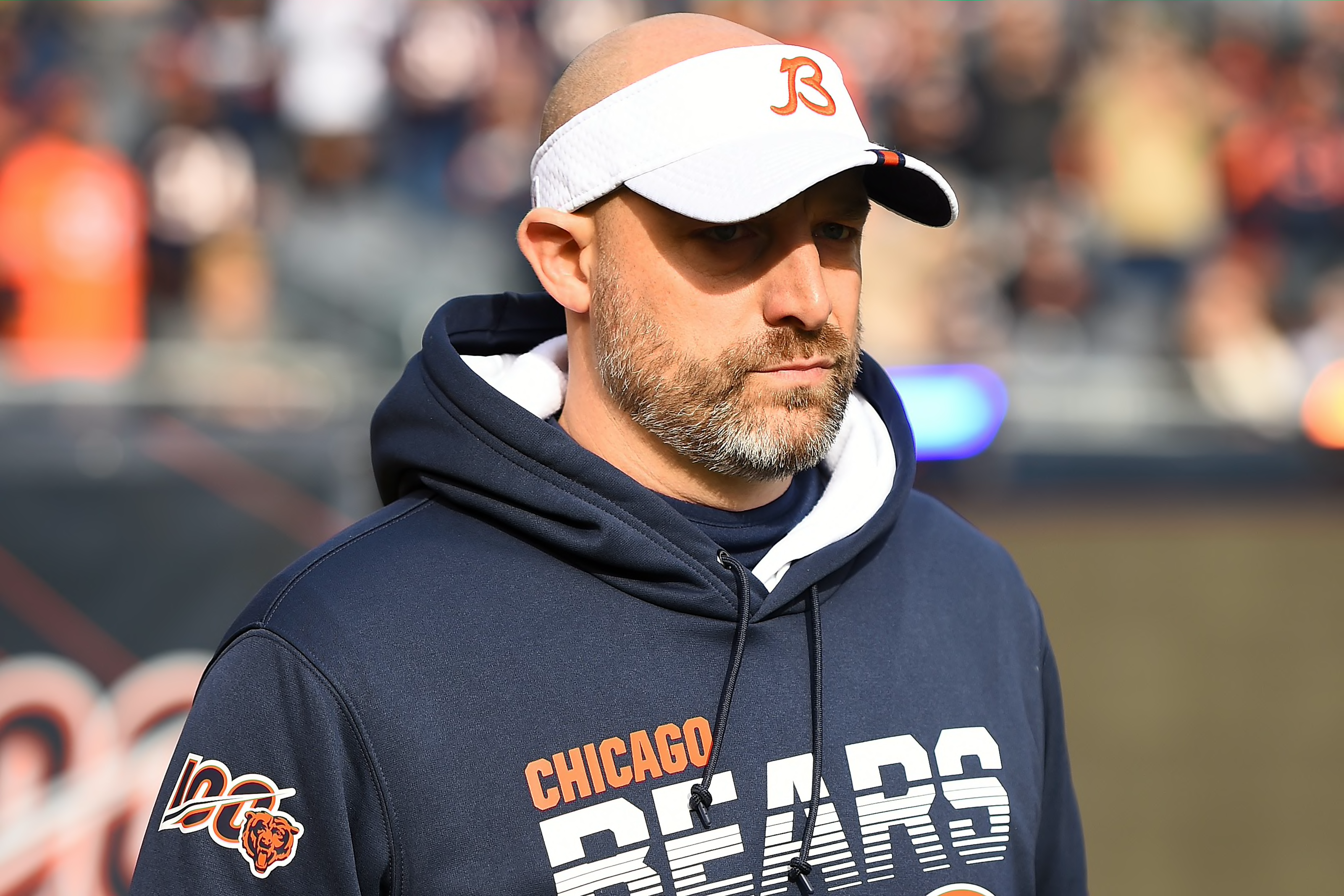
Last year is in the rear view, and there is much reason to be excited about the coming season. Of course, Fields is at the forefront of all the excitement. However, head coach Matt Nagy might have his best offensive group as a whole since coming to Chicago.
The Chicago Bears will bounce back on the heels of a few particular players in 2021.
We know the Bears are going to get great seasons from players like Allen Robinson and Roquan Smith. Both of these guys are in the thick of their prime and mean the world to their respective side of the ball.
There’s also not going to be a single person surprised if David Montgomery continues where he left off in 2020, when he finished as the league’s fourth-leading rusher. He’s one of those players most fans count on to be great again in 2021.
The Bears have some certainties going into the upcoming season, but there are some players who need to have big years ahead and for different reasons. If the Bears are to be a legitimate threat a few months down the road, the following five players have to bounce back from a disappointing season last year.
I didn’t get a chance to check this game out, but I wish I had. Not only did the offense explode but Kohl Stewart turned in another fine pitching line. I’ve missed all of the former 4th overall pick’s starts this season. A sinker baller who has struggled to miss bats and walked a few too many guys at times throughout his career, has seemingly been dialed in through three starts. He’s walked just four in 16 innings while keeping the ball on the ground for the strong Iowa infield defense.
As for the offense, Patrick Wisdom hadn’t recorded a hit in his first four games since joining the Iowa active roster this week, but the veteran power hitter made up for it last night. He blasted two home runs, walked twice and was hit by a pitch, reaching safely in all five plate appearances.
He was joined in the homer barrage by Taylor Gushue, Jose Lobaton and Rafael Ortega, but this was really a top-to-bottom effort by the I-Cubs lineup. Sergio Alcantara and Abiatal Avelino continued their hot starts (I still really like both of these offseason acquisitions, they look good at the plate and in the field). Even Andrew Romine chipped in with three hits.
The Tennessee offense got off to a strong start in their first handful of games, but has cooled off over the past ten. With Jared Young injured and Brennen Davis still in Mesa, the team is struggling to hit for power, and thus is reliant on stringing hits together. On top of that the pitching staff hasn’t been quite as sharp as expected early on. It’s an experienced staff, with plenty of AA/AAA veterans, but they haven’t found their groove.
The recent return from injury by Nelson Velazquez has been a welcomed one. South Bend has been struggling mightily on offense, mostly due to their inability to hit home runs (the team has just 2 in total). Velazquez already recorded one of the team’s two homers in his first 5 games, while recording four consecutive multi-hit games. There just isn’t much power in the South Bend lineup outside Velazquez and Chase Strumpf, who has also missed time. Everyone else in the lineup tops out as gap power hitters.
Delvin Zinn is now 11-for-11 on stolen base attempts so far this season (14 games). The athletic utility man was 30-for-38 in 2019.
A very young (6 regulars are 20-years-old-or-younger) Myrtle Beach (7-8) lineup continued it’s struggles. Two days ago their lineup did not feature a single batter above the Mendoza Line. After yesterday’s game they now have two (Jonathan Sierra and Yohendrick Pinango) but their inexperience shows, especially when they face older pitchers. As a group they are overly aggressive and often get themselves out on pitcher’s pitches.
It will get better. There is talent with this group, but it is clearly going to take some time, as they wait for the young hitters to make some adjustments. In the meantime, the club will need some of the older players to carry some of the burden: Edmond Americaan (24), Matt Mervis (23), Sierra (22). Unfortunately, Sierra is the only guy with significant full-season experience (101 G with South Bend in 2019). Americaan spent most of 2019 in Eugene, and Mervis is just 9 games into his professional career.
Top Performers
D.J. Herz: 4 IP, 2 H, R, 0 BB, 8 K (1.08)
Injuries, Updates, and Trends
As bad as the Pelicans offense (.168/.243/.257, 52 runs in 15 G) has been, its actually only the third worst offense among the twelve team Low-A East league. There are four teams with batting averages below .200 and OPS below .600. Kannaplois (36 R) and Fredericksburg (39 R) have had even greater struggles pushing runs across than the Pelicans. A sign of the Pelicans inexperienced approach is they trail all teams in walks (38) by a huge margin (second worst is 55), while also striking out at the third highest amount (176).
The Pelicans pitching is middle of the pack overall, but they have the third lowest batting average against (.204). Defense and a few too many walks and hit batters are keeping them from moving higher.
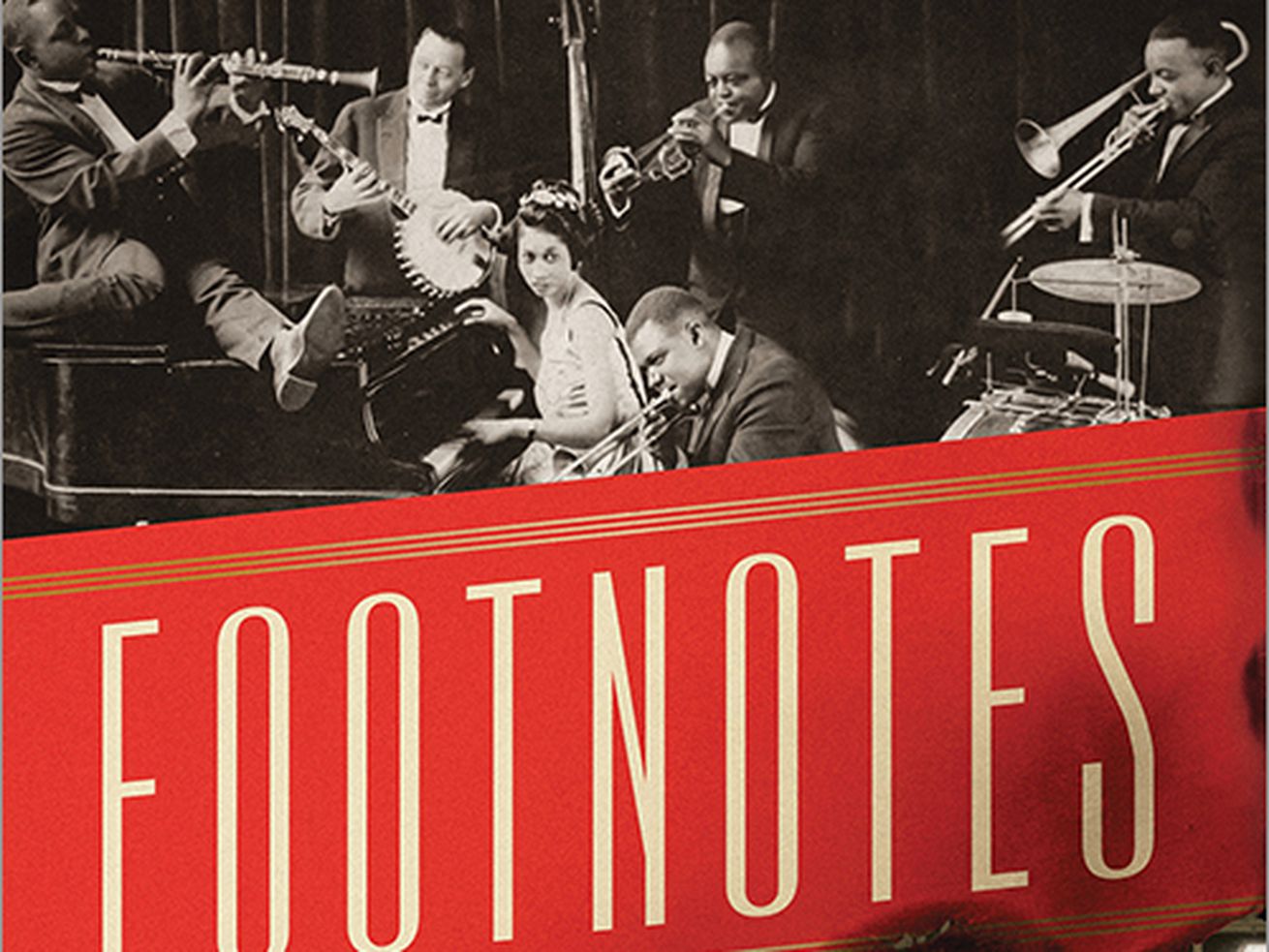
“Footnotes: The Black Artists Who Rewrote the Rules of the Great White Way,” is a deep dive into the 1921 musical “Shuffle Along” and its creators. | Sourcebooks
‘Shuffle Along’ defied the racism of the day, becoming Broadway’s first all-jazz musical. It changed musical theater and showed white audiences would pay Broadway prices to see Black performers.
Caseen Gaines didn’t know anything about the forgotten 1921 production of “Shuffle Along,” the groundbreaking hit musical that brought Black entertainers to Broadway, until he saw George C. Wolfe’s 2016 reimagining of the show.
“Shuffle Along, or The Making of the Musical Sensation of 1921 and All That Followed” celebrated and dissected that earlier show. But it abruptly closed when one of its key performers, Audra McDonald, became pregnant and left the show.
Sourcebooks“Footnotes: The Black Artists Who Rewrote the Rules of the Great White Way,” is a deep dive into the 1921 musical “Shuffle Along” and its creators.
Gaines attended the penultimate performance. Seeing a show that celebrated this landmark musical meet a premature end felt “like justice being denied once again.”
“I went home and started Googling around like most people do when they find something interesting and want to know more about it,” Gaines says. “Then, I fell down the rabbit hole.”
More than four years later, Gaines is the author of “Footnotes: The Black Artists Who Rewrote the Rules of the Great White Way” (Sourcebooks, $26.99), a deep dive into the musical and its multitalented and determined creators — playwright-comedians Flournoy Miller and Aubrey Lyles, singer and lyricist Noble Sissle and composer and ragtime pianist Eubie Blake.
Maryland Center for History and CultureFlournoy Miller (from the top), Noble Sissle, Eubie Blake and Aubrey Lyles in a publicity photo from the 1921 production of “Shuffle Along,” the groundbreaking hit musical that brought Black entertainers to Broadway.
“It was a perfect storm, and at the center of it were two comedians who were incredibly smart, witty and clever and two equally smart musicians,” Gaines says.
“Shuffle Along” defied the systemic racism of the day. Broadway’s first all-jazz musical, it changed the sound of musical theater and showed that white audiences would pay Broadway prices to see Black performers.
It helped popularize the Harlem Renaissance, ran for 484 performances before touring the country and launched or boosted the careers of Josephine Baker, Paul Robeson, Florence Mills, Lottie Gee, Fredi Washington and Adelaide Hall.
“There was a great story to tell not only about this moment in 1921 but also about how something that was so prevalent and significant became something that 100 years later is a footnote,” Gaines says. “The creators are just a few of the many Black Americans who forever changed this country and have been denied their due.”
Gaines sets his book against the backdrop of a recession, the aftermath of the global flu pandemic and the worst period of anti-Black violence since the Civil War. The play opened a week before the Tulsa Race Massacre, in which mobs attacked Black residents and businesses of the Oklahoma city’s Greenwood District, and two years after “a prolonged period of radicalized antagonism and violence known as the Red Summer.”
Maryland Center for History and CultureNoble Sissle with the show’s chorines in a publicity photo for the 1921 production of “Shuffle Along.”
The musical’s plot was based on Mills and Lyles’ play “The Mayor of Dixie,” about two conniving men, Sam Peck and Steve Jenkins, who run for mayor of Jimtown. Whoever wins agrees to appoint the other as police chief. Differences arise, and their opponent in the race, Harry Walton, vows to end their corrupt reign. Amidst this, a love story unfolds.
It was the first Broadway musical to feature syncopated jazz and a chorus of professional female dancers. Its popular songs included “I’m Just Wild About Harry” (later a campaign song for 1948 presidential candidate Harry S Truman), “Love Will Find a Way” (Broadway’s first African American romantic musical duet) and “In Honeysuckle Time.”
Gaines’ research led to libraries including the New York Public Library’s Schomburg Center for Research in Black Culture, the Maryland Center for History and Culture and the Emory University archives. The show’s creators were celebrities, and their lives were well documented in the Black press.
Gaines says he relished discovering Sissle and Blake’s unpublished memoirs. He uses excerpts throughout the book.
“These were really helpful because there was such a richness in their voices,” he says.
Johanna CalleAuthor Caseen Gaines.
“Shuffle Along” was a chaotic mix of vaudeville, operetta and burlesque. It heralded a new form of musical. The jazz score was revolutionary and exciting, yet the show also relied on “the Southern comfort of antebellum humor and blackface,” holdovers from vaudeville minstrel shows.
“You can see how tenuous the construction of the show had to be for it to resonate with white audiences,” says Gaines, 35. “It’s a really interesting look at the delicate dance that people of color have to do in order to find mainstream success.”
After Broadway, “Shuffle Along” toured through 1924, in Chicago and other cities.
Gaines, who teaches English and journalism at Hackensack High School in New Jersey, says the story of Miller, Lyles, Sissle and Blake and their determination to succeed is as important today as it was in 1921.
“Sometimes, when you look at the footnotes of history, you find a more interesting story to tell about America,” Gaines says.
He says the story he unearthed is one of “racial representation, a story about living in ones authentic self as a means of gaining representation.
“It feels so relevant to me right now because I think there’s something very important in being reminded that this took place 100 years ago. If we are to ever break the cycle of systemic racism, we need to remember how long this fight has been and use that to act with increased urgency.”
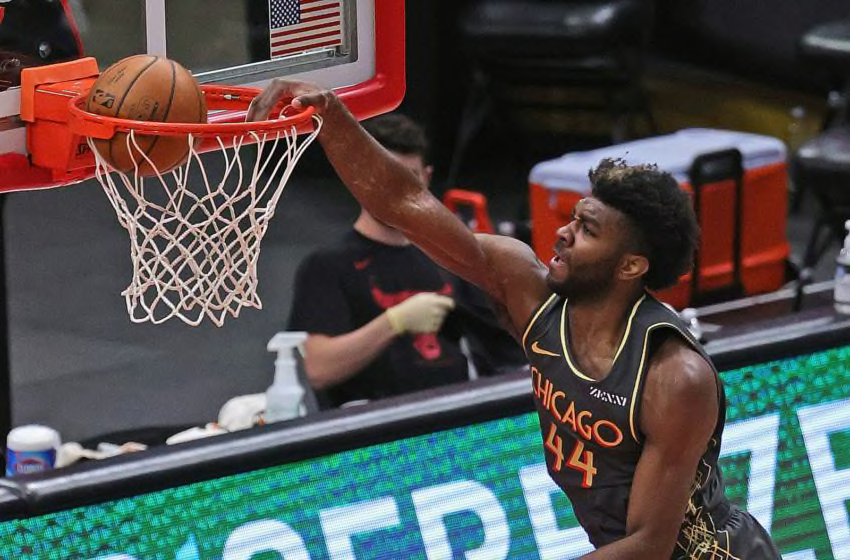
Now that the Chicago Bulls season is done, it’s important to look back on the development over the first year of their new starting small forward, Patrick Williams.
Williams, also known as PWill or PDubs, was drafted out of Florida State in the 2020 NBA draft by the Bulls. He was not a highly-touted prospect for the NBA after never starting a game for the Seminoles.
Williams played in 29 games in college and averaged 9.2 points, four rebounds, and one assist per game. He shot just under 46 percent from the field, 35 percent from distance, and 83 percent from the free-throw line. Pretty reputable numbers for a freshman in the ACC.
Williams was clearly athletic and a great defender in college, racking up a steal and a block per game.
[embedded content]
Scouts thought he might have gone too early in the draft, knowing that Deni Avidja could be a better option for the #3 position because he has been playing professionally since he was 16-years old.
However, Williams had a standout year as a rookie.
“For me, it’s more mental than anything,” said Williams. “I have to learn how to control my mentality and to really dial in 100 percent mentally. I think that will make me the player that I want to be and that I need to be. I want to be known as one of the greats in this league.”
Let’s check out his improvement from both sides of the court.
If you watched Williams play in the preseason games against the Houston Rockets, you saw a frightened 19-year old kid out there.
Williams had no confidence in his ability to shoot the ball and his conservative play became utterly useless for the Bulls early on.
Clearly, his effort and hustle on defense were always there, trying to help the team in any way he could. But, he failed to participate in the game when the team needed him.
That fear did not last long.
Williams scored 16 points in his first game against the Atlanta Hawks, shooting 5/11 from the field and 5/6 from the charity stripe.
By the end of the season, he had more confidence in his shot and his ability to drive the basket. He averaged 9.2 points, 4.6 rebounds, and 1.4 assists in his first season, nearly identical to his college stats.
Williams was also extremely efficient, something head coach Billy Donovan tipped his cap to Williams for.
He shot 48.3 percent from the floor, 39.1 percent from downtown, and 72.8 percent from the free-throw line. The 50/40/90 club is definitely in Williams’s future.
His efficiency while on the floor is not great, recording a 105 average offensive rating and a -2.7 offensive box plus/minus, but that will improve.
Either way, Williams was a great pick for the Bulls and has superstar potential in the league.
Defense
There isn’t much negative to say about Williams’s defense. He stepped into the role of taking on the toughest matchups for the Bulls this season and is one of the best defenders.
His huge build, 6-foot-8 and 225 pounds, really helped him facing tougher opponents. His on-ball defense and shot contests are excellent, a real treat to Bulls’ fans this season.
He recorded a zero in the defensive box plus/minus category this season, an outstanding mark for a rookie with the matchups he gets every game.
He also led the team in defensive win shares this season with 2.2, tied with Thaddeus Young.
Williams’s defense does not need much explanation. The Bulls seriously needed a true defensive player to take on teams’ better players, and now he’s the one to do it.








/cdn.vox-cdn.com/uploads/chorus_asset/file/22528483/9781492688815.jpeg)
/cdn.vox-cdn.com/uploads/chorus_asset/file/22523513/Sissle_Blake_Miller_Lyles.jpeg)
/cdn.vox-cdn.com/uploads/chorus_asset/file/22523521/Sissle_Chorines.jpeg)
/cdn.vox-cdn.com/uploads/chorus_asset/file/22523526/Caseen_Gaines.jpeg)
Leave a comment