Both longtime White Sox announcer Ken “Hawk” Harrelson and manager Tony La Russa praised Joe West before he was set to break the all-time record for games worked Tuesday night.
Behind home plate, West was scheduled to work his 5,376th game to break the mark set by Bill Klem. A well-known figure and frequent target of fans on social media, West has a divisive reputation.
As for Harrelson, he and West “had problems there for about 30 years” but have been friends for around a decade. Harrelson planned to attend Tuesday night’s game but didn’t because of flu-like side effects from a recent COVID-19 vaccination.
West, Harrelson said, is one of two umpires he’s respected the most, with Hall of Famer Nestor Chylak being the other. And if Harrelson could pick one umpire to be behind the plate for Game 7 of the World Series, he said it would be West.
According to Harrelson, there are two keys to winning a West game. One of them is to catch the ball and not give away extra outs, and the other is specific to the record-setting umpire.
“The second rule is: don’t mess with Joe West,” Harrelson said.
La Russa, meanwhile, said West is very consistent. He understands emotion is part of the game and lets people have outbursts, though he doesn’t allow them to go too far.
“But you couldn’t disrespect the game,” La Russa said. “Joe was going to make sure the game was played correctly. And he had a flair and he’s the perfect guy to set the record because he represents a lot of what an umpire should be.”
Watching Kopech Pitcher Michael Kopech continued his strong start to the season Monday, striking out three over two scoreless innings to finish off the 5-1 Sox victory and lower his ERA to 1.78. And whether he’s started or pitched in relief, Kopech has come through and shown why the Sox acquired him from Boston along with Yoan Moncada for Chris Sale.
On Monday, the fire-balling Kopech even got two strikeouts on changeups, a pitch he’s been working on improving.
“There’s a lot of things that keep evolving with him. It’s a huge arm, it’s one of the best fastballs in the game,” pitching coach Ethan Katz said. “But anything that’s thrown his way, he’s done a great job and handled every single pressure situation. He’s done everything we’ve asked him to do.”
Katz said the Sox will continue to be careful with Kopech after he missed the 2019 season following Tommy John surgery and opted out of 2020. The team is monitoring Kopech and making sure he has a workload he can handle, but it doesn’t sound like he has a set innings limit.
“There’s no magic number that we’re saying, ‘Once he gets to this, he’s done,'” Katz said. “It’s just a matter of kind of respecting what his body is saying to be able to get through this.”
Engel begins Outfielder Adam Engel (right hamstring) began his rehab assignment Tuesday with Triple-A Charlotte against Norfolk. Engel, who hasn’t appeared in a big-league game this season, led off and was the Knights’ designated hitter.
Summer arrived over the weekend and there was a lot of fishing going on around Chicago and that is basically the lead to this sprawling raw-file Midwest Fishing Report.
Tom Riordan emailed the photo at the top and this:
Hi Dale,
I got this 18LB 10oz King a few miles out from Montrose in 90 FOW on a Moonshine Mag RV spoon down about 55′ on the downrigger.
I got into Lake Michigan trolling last summer and have learned all I know from the local forums like Chitown-Angler and reading Dan Keating books. This is the first big king we’ve boated so we are pretty stoked and hoping we’ll see more around Chicago this season.
Tight lines,
Tom
May there be lots of big Chinook or at least enough to keep things interesting.
PERCH CLOSURE
Perch fishing in the Illinois waters of Lake Michigan is closed through June 15.
WISCONSIN MUSKIE
Muskie fishing in Wisconsin Northern Zone opens Saturday, May 29.
LAKEFRONT PARKING
Chicago Park District’s parking passes for the fisherman’s parking lots at DuSable and Burnham harbors are on sale at Henry’s Sports and Bait in Bridgeport and Park Bait at Montrose Harbor.
Readers suggest SpotHero app downtown. Otherwise, here are some basics: Foster (free street parking or pay lot); Montrose (now a mix of metered and free street parking); Belmont (pay lots on north and south sides); Diversey (pay lot or street parking); DuSable Harbor (pay lot or fisherman’s lot); Northerly Island/Burnham Harbor (meters, pay lot or fisherman’s lot); 31st/Burnham (meter parking between McCormick Place and 31st Street Harbor); Oakwood/39th (meters); 63rd Street/Casino Pier (pay lot); Steelworkers Park (free street parking at east end of 87th); Cal Park (free parking).
AREA LAKES
Bryan Missey fishing for night bass.Provided
Bryan Missey emailed the photo above and this:
Hi Dale,
The warm weather is turning on the night bass bite. I caught 22 bass Saturday night from 9-11 at my favorite Chicago area lake. They ate a spinnerbait early then a chatterbait later. Keep up the good work.
Thanks,
Bryan Missey
Ken “Husker” O’Malley emailed:
Hey Dale,
Here is a recap of this past weeks fishing.
Area lakes- With the warmup bass are getting active again after the post spawn. Bluegill are starting to stage. Bass are not far behind.
Bass- best bite has been during evening hours as summer patters are starting to setup. Find the bluegill and you find the bass. Best bait has been a baby 1-minus worked slowly along the inside weedlines.
. . .
TTYL
—
Ken “Husker” O’Malley
Husker Outdoors Waterwerks fishing team
Pete Lamar emailed:
Hi Dale,
All still-water this past week-no stream fishing for smallmouths recently. The local ponds have warmed up quickly, right through the 70s to pushing 80 degrees. Spawning bluegills are obvious in some of the shallow water. Fishing was a mixed bag of big bluegills and largemouth bass. Not a single fish was taken subsurface: all fish came on poppers. Based on the frog activity of the past week, it’s about time to fish after dark with some large green foam or deer hair poppers.
Cottonwood seeds were everywhere over the weekend. More than once, they accumulated in the knots on my leader. The bluegills were almost as interested in them as in the flies I was throwing. Maybe it’s time to lash a few cottonwood seeds or some synthetic imitation to a small hook and fish it as an imitation of the seeds the bluegills seem to like so much.
Glad somebody else fought the good cottonwood fight, too.
Rico Cantu enjoys a good largemouth bass.Provided
Rico Cantu emailed the photo above and this:
Hey Dale got a bass on a wacky worm, the weeds are terrible already lucky I had 20 lb braid on , be safe out there and enjoy your weekend.Rico Cantu
Mike Gruca messaged the photo below and this:
Pulled this out of Independence Grove off a swim jig. Haven’t been able to get out lately been working a lot.
Mike Gruca with a free-time largemouth bass.Provided
BRAIDWOOD LAKE
Open daily 6 a.m. to sunset. Click here for the preview.
CHAIN O’LAKES AREA
Art Frisell at Triangle Sports and Marine in Antioch said catfish are unbelievable, try stinkbait or crawlers; bluegill are excellent on ice jigs tipped with waxies or spikes, use light line and small bobbers, shallow; walleye are great on leeches and fatheads on a split and hook; muskie are fair on topwaters or big bucktails, especially on Fox; look for white bass in 8-15 feet, try Cubby jigs tipped with small fatheads or spikes, no bobber, just cast out and let it sink.
NOTE: Check updates on water conditions at foxwaterway.com or (847) 587-8540.
NOTE 2: The Stratton Lock and Dam is open 8 a.m. to midnight through Sept. 30.
CHICAGO RIVER
Lucas Wise Jr. with a PB smallmouth bass from DuSable Harbor. Provided
Sgt. Lucas Wise emailed the photo above and this:
Dale,
This is Sgt Lucas Wise from the Police Marine Unit. Hope youre enjoying the fishing season ramping up here in Chicago. My 12yo son Lucas Jr came by my office today and his PB smallmouth (6.5) on a 4 inch keitech with a 1/4 oz VMC mooneye jig. That bait has been deadly down there lately with these big fish moving in to spawn. Take care and be safe brother. Tight lines!
Sincerely,
Lucas Wise
Jeffrey Williams with a largemouth bass from the Chicago River.Provided
Jeffrey Williams messaged the photo above and this:
so slow carp day at the river, but i caught 24 bluegills(sum were 10 in) and a nice beautiful LMB, 1 pound 7 oz on a Cicada blade bait
DELAVAN LAKE, WISCONSIN
Dave Duwe emailed:
Delavan Lake 5/24/21 through 5/31/21
Largemouth bass are still spawning or trying to spawn in 2-5 ft of water. The hard sand areas are producing most of the action. Look for the fish by Lake Lawn Lodge or by the outlet bridge. I’ve been catching most of my fish either with a nightcrawler on a single hook or a Texas Rigged Senko. The wind of last week made it really hard to fish weightless Senkos very effectively. When the winds calm, fishing will improve greatly.
Smallmouth bass are being caught on the outside of the weed lines. Some rather large fish are being caught by the Oriental boathouse or by Delavan Lake Marine. The best presentation is leeches fished on a small split shot or a small sucker. Most of the smallmouth that were caught last week were over 16 inches.
Crappie fishing has been inconsistent. The fish are either spawning or preparing to spawn. Some success is coming in the 8 ft depth range or on the weed break in 12-14 ft. of water. The only problem is that you really have to sort to get any kind of limit. I’ve been fishing for them on small plastics however, the larger fish have come off of slip bobbers fished with a small crappie minnow.
Last week, was the first time I tried for northerns this year. I found quite a few positioned outside the schools of crappie. I was catching most of my fish on lindy rigged suckers. Good electronics was the key to finding feeding Northern Pike. Most of my fish have come by Willow Point or by Browns Channel.
Walleyes are still very scarce. I’ve trolled 3-4 hours in the last few weeks without any success. That bite is either hit or miss. Troll perch colored Bandit Lures or 300 series Bandit bass crankbaits when trying for them for the best chance of success.
Good Luck and I hope to see you on the water. For guide parties, please call Dave Duwe at 608-883-2050
DOWNSTATE
POWERTON: Hours are 6 a.m. to 8 p.m. through Sept. 30.
EMIQUON: Access permits and liability waivers are again required. They are available Tuesday to Saturday at Dickson Mounts Museum, 10 a.m. to 4 p.m.
CARLYLE: Boaters are doing well below the dam for sauger, some are limiting in short time trolling crankbaits. Shore anglers are catching a mixed bag, including some decent crappie, especially on plastics.
GENEVA LAKE, WISCONSIN
Dave Duwe emailed:
Lake Geneva 5/24/21 through 5/31/21
The smallmouth bass are a few days from really spawning hard on their flats. Look for the fish by the Military Academy, Elgin Club, Knollwood and Belvidere Park. The best presentation has either been drop shotting small green pumpkin finesse worms or dragging football head jigs with Chompers grubs. Most of my guide parties, I have been dragging either nightcrawlers or fathead minnows. The best depth has been 12-14 ft of water.
Largemouth bass have been in Geneva Bay, Trinkes and Abbey Harbor. The best depth is 3-5 ft. Most of the fish have been caught either with Rapala Husky Jerks or with split-shotting small green pumpkin lizards. Once the bass spawn they will be moving out to the weeds which will be the best time of the year to catch big numbers. Once that happens I like Williams Bay and Trinkes.
Rock bass, bluegill and perch are in the shallows with the spawning smallmouth bass. The best depth is 12-14 ft. I’ve caught most of my fish split shotting nightcrawlers. The best place I’ve seen is by Knollwood.
Northern Pike remain in the shallows chasing the other small fish. They can be caught on black and silver Husky Jerks or Smithwick Rattling Rogues. The best location is by the Fontana Beach or in Williams Bay. Some of the recent catches are between 25 and 30 inches.
Good Luck and I hope to see you on the water. For guide parties, please call Dave Duwe at 608-883-2050
GREEN LAKE AREA, WISCONSIN
Guide Mike Norris emailed:
Fishing Report 5/24/2021
Mike Norris
Little Green Lake – A few walleyes on the deeper weedline. Try drifting with leeches or trolling crawler harnesses. Muskies are active. 45 and 47-inchers caught in the last week.
Fox Lake – Largemouth bass are shallow and the fishing for them with chatterbaits and senkos is excellent right now. Northern pike are also active on chatterbaits and swim baits. Try both the “The Jug” and “Government” areas for both bass and pike. Bluegills are moving into the pier areas.
Big Green Lake – Water is finally warming up and the smallmouth bass are moving shallow to spawn. Try the area known as “Sliding Rock” for smallies. Largemouth bass can be found under piers. I am still getting reports of anglers catching lake trout in shallow water.
To book a guide trip reach out to me via my Facebook page at mike.norris.7773 or email me through my website at www.comecatchsmallmouth.com
Art Costa messaged Tuesday:
Fishing Big Green Lake yesterday and today, yesterday a lot of rock bass a few small large mouths, then the winds came and haven’t laid down yet , very rough , caught about 5 rock bass and one small large mouth, home tomorrow
A crappie double on Heidecke Lake.Provided by Bob Johnson
Bob Johnson emailed the photo above and this:
Hi Dale –
Got out for a few hours in the evening this week and we boated a mixed bag of quality fish. Joel Wilson caught the biggest Bass at 3lb. Most fish were caught on hard baits and Walleye ( 26.5″ 6.25 lb) caught on soft bait fishing for Bass. We also boated several Crappie while casting. Water temp is in range of 70 to 72 so lake in very good shape.
Some pics are dark so use what you can. We will be getting out again soon. Thanks Bob
Ken “Husker” O’Malley with a Heidecke bass.Provided
Ken “Husker” O’Malley emailed the photo above and this:
Hey Dale,
Here is a recap of this past weeks fishing.
. . .
Heidecke-water temps are 68-70. Water clarity is clear and the shad hatch has not occurred yet. Smallmouth have been very good. During morning hours works sub-surface baits along the riprap. Best bait has been the x-rap. As the morning progresses, move out to the mud lines and mid-lake humps using a drop shot technique.
. . .
TTYL
—
Ken “Husker” O’Malley
Husker Outdoors Waterwerks fishing team
Open 6 a.m. (6:30 bank fishing) to sunset. Click here for the promising preview.
KANKAKEE RIVER
George Peters with a nice Kankakee River smallmouth bass.Provided
On Monday, George Peters emailed the photo above and this:
Hey Dale, just got this 18 1/4″ kkk water warm and clearing. G. Peters
Hi Dale, not much info lately w perch closed. Smallmouth must be done spawning. Less fish, moving deeper. I’m told guys are Seeing big puke swimming around w no luck hooking one. Sounds like salmon and trout are 70-100 feet mostly on Dodgers and flies. We need rain!!!! Rivers are drying up and so is my garden. Take care and have a nice holiday weekend
Stacey Greene at Park Bait at Montrose Harbor texted:
Good morningNot much on fishing we’re kind of at that transition going from Spring to Summer. There are still a few trout here and there nice brown trout was caught in the harbor over the weekend. Sheephead been pretty good on the Horseshoe on soft shells. Lots of carp starting to roll around. Haven’t heard how the Smallmouth are hitting.
For right now I think the meters are going to stay from the shop around the turn around and back.
Capt. Bob Poteshman of Confusion Charters said coho are showing up in Chicago again, lakers are really good in the mornings in 60-120 feet straight off Chicago. Out of North Point, coho are good again from the hill to 120 with lots of alewives around; fishing is good.
About the same as last week, fish on boats still scattered from 70 to 130 feet and deeper.Nice spring cohos.All ponds doing well for cats and panfish
Capt. Scott Wolfe emailed:
Hi Dale
Waukegan and Northpoint fishing was fair at best this week. The fish were scattered and so was the bait. Alewives were all over the harbor and the beach and we also found them out to over 230 feet of water. The water temperature was also nearly even everywhere. ThIs has the coho scattered. To the extent there was any pattern, 60 to 110 feet early and late in the day was best. In the mid-day 120 to 150 was best. For coho, planner board presentations using 00 red and stubby dodgers with standard coho candy size flies in Blue Liz and Green Liz Jimmy Fly have been best. At times Black and June Bug patterns were better.
As the week moved on the laker trout seemed to almost disappear, with boaters moving from getting laker limits to only getting a few. Coho dominated the catch over the past weekend with an occasional chinook and steelhead. Good presentations for multi-specials were spoons on leadcore and short copper lines. Our best was the Magnum size Warrior Lures with Green Menace being a standout.
I did not see many people fishing the harbor, but I saw bass and pike moving around, with lots of activity at sunset. A dedicated carp fisherman in the harbor landed several huge carp over the weekend. There are some great opportunities right in the harbor for shore guys.
The very good news was that as the week progressed there were more and more salmon in the area, a very good thing because the lake trout sort of disappeared. I expect that salmon fishing will improve this week.
Justin Lederer checking in from McQuoids Inn Iake Mille Lacs. Walleye have moved in to deeper water 20-33 foot range bobber and a leach are producing the best. Smallmouth are starting to bed in some areas seeing them in four to six feet. Better bite has been the ones that haven’t started yet. 10 to 15 feet has been producing well live bait bite has been good also slow presentations with artificials.
A warm and rainy week helped those anglers not afraid of getting a little wet while angling for their favorite fish. Lots of good reports across the board. A bit of a cool down on Sunday seemed to affect fishing by late morning, but things picked back up by Sunday evening.
Walleye: Very Good-Good – Back in the spotlight as the cloud cover and warming water brought Eyes into the shallower water on many lakes to feed. Leeches were hot for most bites with dace, fats and smaller chubs not far behind. Wind blown weedy shallows where small Perch, Bluegills and Crappies congregated were tops! Reports from Bass and Pike anglers catching Walleyes over shallow weedy flats were not uncommon over the weekend.
Crappies: Very Good-Good – Reports vary as some anglers finding Crappies still on beds while others moved out to nearby weeds to feed. Don’t expect to find bedding fish for much longer, but Crappie populations seem to be strong and still very good catches being reported. Small jigs (Gapen Freshwater Shrimp and Mini Mites) under small floats as well as the good ol’ bobber & minnow rig working best.
Smallmouth Bass: Very Good – Big Smallies in the 3-5# range being reported every day as fish are up shallow and on beds! Top-water action on Chug Bugs, Pop-R’s, Zara Puppy’s have been a blast! Ned Worms, Wacky Worms and tubes not being turned away. Remember, season is catch & release only, get ’em back in the water quickly to ensure great Smallie fishing to come.
Largemouth Bass: Very Good – Not in spawn mode like the Smallies, but cruising and hungry. Spinner baits and chatter baits scoring well as Bass active. Swim baits and shallow cranks also producing over weed tops. Lots of #’s with some nice LMB in the 18-20″ range reported.
Northern Pike: Very Good – Take your pick! Actively pursue with a spinner bait, chatter bait or Mepps, or kick back with a bobber and chub or sucker, Pike have been willing participants.
Bluegills: Good – Anglers targeting other species for the most part, but doing well with shallow water action. Like Largemouth, Gills are not bedding, but enjoying a smorgasbord of bugs and small invertebrates. Tiny jigs or just a plain Aberdeen hook with some worms, small leeches or thunder bugs all producing well.
Yellow Perch: Good – Like Gills, not heavily targeted, but decent catches in and around drowned wood and cabbage flats of 4-8′.
Looks to be a good, yet cool weekend weather wise. Cold mornings may lead to better late morning bites and better evening fishing.
Musky opens on Saturday, May 29th. A lot of sightings of paired (and tripled) Musky in shallows as they are spawning, many fish showing signs of “rough” Love! Could be finished on small to mid-sized lakes by week’s end.
Kurt Justice
Kurt’s Island Sport Shop
Like us on FaceBook
NORTHWEST INDIANA
Catch on Tuesday morning aboard the Triplecatch Charters out of Indiana.Provided by Capt. Rich Sleziak
Capt. Rich Sleziak at Slez’s Bait in Lake Station texted the photo above and this:
Steelhead coho and lakers this morning Dale nice mix bag
Fishing out of burns ditch in 65 to 75 ft of water has been good dodgers and Flys spoons and dodgers and spin n glows best
Gills and red ears going good at most lakes and ponds jumbo reds and beemoth and crickets best
Catfish at portage river walk in the evening using cut bait and triple s stink bait
Open 5 am to 7 pm daily now as yes same hours on Memorial Day
Whew! How are you liking this heat, Dale? Long overdue & great for fishing, but it caught me off guard, must say; enjoy, & stay well…
The warm weather has really done great for the fishing. Thermoclines have started to set up on Lake Michigan, so now the fish are not as scattered. They’re far more concentrated into certain areas or “hotspots”. A nice number of both Kings & Coho are still being caught. Charter Captains out of Hammond Marina & the Port of St. Joseph are catching fish on spoons, paddles, & flies while fishing in depths from 80-140 FOW, with the Northwest & Southeast being their best trolling directions. Inland lakes are warming up fast, pushing the fish into the shallower waters. Lots of limit catches of Bluegills are being reported. The local rivers are producing some nice Walleye & plenty of Catfish.
ROOT RIVER, WISCONSIN
Click here for the Wisconsin DNR’s report, usually on Tuesday or Wednesday.
SOUTHWEST MICHIGAN
Staff at Tackle Haven in Benton Harbor said walleye are good in the river; coho steelhead and a few kings 180-230 and lake trout are everywhere.
Northern Pike caught by Edward Evans at Wolf Lake on 5/23/21
WOLF RIVER, WISCONSIN
Guide Bill Stoeger in Fremont texted:
Haven’t seen a female white bass in 7 days. Today we’re near Partridge Lake and two out of 3 are females. Water temp is 69 degrees. Numbers are down, averaging 50-60
Rep. Marjorie Taylor Greene, the outrageous Georgia Republican, is comparing pandemic mandates for masks and vaccinations to the Nazi genocide of the Jewish people. | Drew Angerer/Getty Images
Rep. Brad Schneider, D-Ill., is drafting legislation to censure Greene. “It is shameful that the Republican Conference continues to let her define their party, and dangerous that they refuse to expel her.”
WASHINGTON — Never, ever compare anything to the Nazi Holocaust, a singular horrific event in human history.
It’s time for the House Republican leaders — who dumped Rep. Liz Cheney from leadership because she would not embrace ex-President Trump’s lies — to do something about Greene.
Last week, Greene, in an interview on the podcast “The Water Cooler with David Brody,” slammed House Speaker Nancy Pelosi after the California Democrat decided to continue masking mandates on the House floor because she was not convinced all members were vaccinated.
“This woman is mentally ill,” Greene said, referring to Pelosi. “You know, we can look back in a time in history where people were told to wear a gold star and they were definitely treated like second-class citizens — so much so that they were put in trains and taken to gas chambers in Nazi Germany, and this is exactly the type of abuse that Nancy Pelosi is talking about.”
On Saturday, Greene, in Arizona, was asked if she stood by her comment by Bianca Buono, a reporter for Arizona’s 12 News.
“I stand by all of my statements. I’ve said nothing wrong. And I think any rational Jewish person didn’t like what happened in Nazi Germany and any rational Jewish person doesn’t like what’s happening with overbearing mask mandates and overbearing vaccine policy,” Greene said.
Buono asked Greene if she understood why some people would be “upset and offended” by her comment.
Greene, never one to disappoint, of course did not.
She told Buono in reply, “Well, do you understand how people feel about being forced to wear masks or being forced to have to take a vaccine or even have to say whether they have taken it or not. These are just things that shouldn’t be happening in America.”
The U.S. Holocaust Museum in D.C. reopened last week after a COVID-19-imposed closure. I wish I had the power to send Greene there for Holocaust education — perhaps meet with survivors and listen to their stories — because her ignorance is more that appalling. It is dangerous.
The Holocaust museum on Tuesday sent out a tweet about the danger of Holocaust analogies. “Simplistic comparisons to the Holocaust don’t help us understand the past or the present. These kinds of analogies demean the memory of the victims.”
We are in a bad place now, with anti-Semitic incidents hitting a “historic high” in 2020, according to the Anti-Defamation League.
I’m torn about giving any attention to Greene. But to ignore her totally is to risk normalizing her noxious behavior and her promotion of anti-Semitism and lies, especially the big one about Trump winning the election.
The Big Lie is taking hold.
A new national Reuters/Ipsos opinion poll taken May 17-19 shows 53% of Republicans — compared to 3% of Democrats — believe Trump won the 2020 election and President Joe Biden only won, they believe, because of illegal voting.
On Tuesday, House Minority Leader Kevin McCarthy condemned Greene, saying in a statement, “Marjorie is wrong, and her intentional decision to compare the horrors of the Holocaust with wearing masks is appalling. The Holocaust is the greatest atrocity committed in history. The fact that this needs to be stated today is deeply troubling.”
The words of McCarthy, a California Republican, were not matched by any disciplinary action against Greene.
McCarthy led the charge to get rid of Cheney, the Wyoming Republican.
Greene’s sanction so far is a rhetorical slap on the wrist.
Rep. Brad Schneider, an Illinois Democrat, on Tuesday was drafting legislation to censure Greene. He said in a statement, “It is shameful that the Republican Conference continues to let her define their party, and dangerous that they refuse to expel her. There should be no room for such unapologetic hate and anti-Semitism in our politics or our government.”
Rep. Adam Kinzinger, the Illinois Republican who is one of the few in the GOP party fighting against Trump-inspired denialism and McCarthy’s fealty to Trump on Tuesday, at a POLITICO event, said House Republicans should kick Greene out of their organization.
Said Kinzinger “What we can do as a party is take a stand and say you don’t belong in our conference.”
East Chicago-born DJ Drip balances business studies at Columbia College with a rapidly growing music career.
Julian Leal is a 21-year-old college student majoring in business at Columbia College in the South Loop, but he’s better known by his stage name: DJ Drip.…Read More
The Pritzker Museum highlights Bill Mauldin’s 50-year fight with injustice.
Editorial cartoonist Bill Mauldin, whose bedraggled “Willie and Joe” characters famously represented the lowly “dogface” foot soldiers of World War II, won two Pulitzer Prizes, the first when he was only 23. He didn’t win for his best-known cartoon, however.…Read More
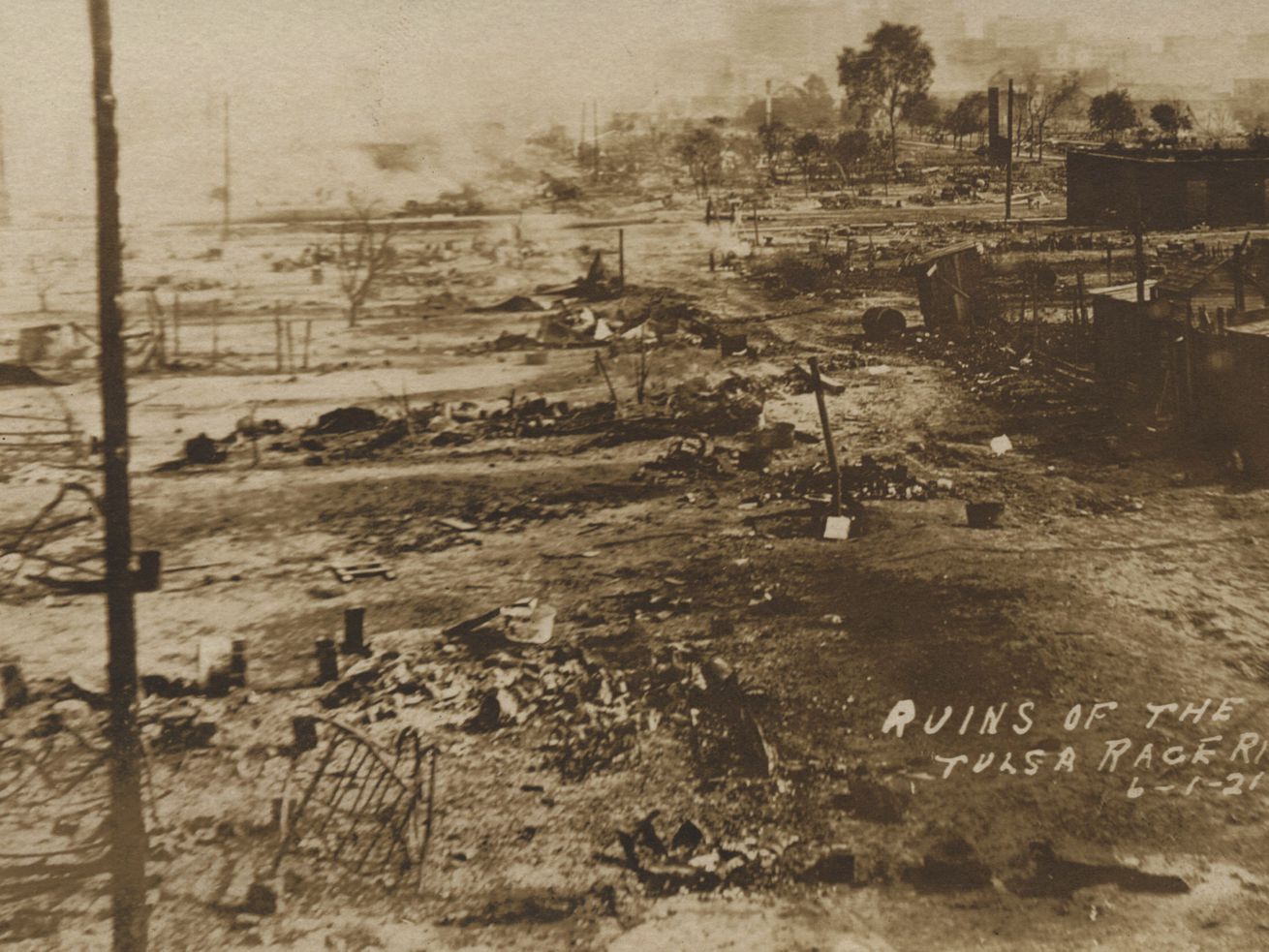
This photo provided by the Department of Special Collections, McFarlin Library, The University of Tulsa shows the ruins of Dunbar Elementary School and the Masonic Hall in the aftermath of the June 1, 1921, Tulsa Race Massacre in Tulsa, Okla. | AP
The Tulsa Race Massacre is just one of the starkest examples of how Black wealth has been sapped, again and again, by racism and racist violence — forcing generation after generation to start from scratch while shouldering the burdens of being Black in America.
TULSA, Okla. — On a recent Sunday, Ernestine Alpha Gibbs returned to Vernon African Methodist Episcopal Church.
Not her body. She had left this Earth 18 years ago, at age 100. But on this day, three generations of her family brought Ernestine’s keepsakes back to this place which meant so much to her. A place that was, like their matriarch, a survivor of a long-ago atrocity.
Albums containing black-and-white photos of the grocery business that has employed generations of Gibbses. VHS cassette tapes of Ernestine reflecting on her life. Ernestine’s high school and college diplomas, displayed in not-so-well-aged leather covers.
The diplomas were a point of pride. After her community was leveled by white rioters in 1921 — after the gunfire, the arson, the pillaging — the high school sophomore temporarily fled Tulsa with her family. “I thought I would never, ever, ever come back,” she said in a 1994 home video.
But she did, and somehow found a happy ending.
“Even though the riot took away a lot, we still graduated,” she said, a smile spreading across her face. “So, we must have stayed here and we must have done all right after that.”
Not that the Gibbs family had it easy. And not that Black Tulsa ever really recovered from the devastation that took place 100 years ago, when nearly every structure in Greenwood, the fabled Black Wall Street, was flattened — aside from Vernon AME.
The Tulsa Race Massacre is just one of the starkest examples of how Black wealth has been sapped, again and again, by racism and racist violence — forcing generation after generation to start from scratch while shouldering the burdens of being Black in America.
All in the shadow of a Black paradise lost.
“Greenwood proved that if you had assets, you could accumulate wealth,” said Jim Goodwin, publisher of the Oklahoma Eagle, the local Black newspaper established in Tulsa a year after the massacre.
“It was not a matter of intelligence, that the Black man was inferior to white men. It disproved the whole idea that racial superiority was a fact of life.”
___
Prior to the massacre, only a couple of generations removed from slavery, unfettered Black prosperity in America was urban legend. But Tulsa’s Greenwood district was far from a myth.
Many Black residents took jobs working for families on the white side of Tulsa, and some lived in detached servant quarters on weekdays. Others were shoeshine boys, chauffeurs, doormen, bellhops or maids at high-rise hotels, banks and office towers in downtown Tulsa, where white men who amassed wealth in the oil industry were kings.
But down on Black Wall Street — derided by whites as “Little Africa” or “N——-town” — Black workers spent their earnings in a bustling, booming city within a city. Black-owned grocery stores, soda fountains, cafés, barbershops, a movie theater, music venues, cigar and billiard parlors, tailors and dry cleaners, rooming houses and rental properties: Greenwood had it.
According to a 2001 report of the Oklahoma Commission to Study the Tulsa Race Riot of 1921, the Greenwood district also had 15 doctors, a chiropractor, two dentists, three lawyers, a library, two schools, a hospital, and two Black publishers printing newspapers for north Tulsans.
Tensions between Tulsa’s Black and white populations inflamed when, on May 31, 1921, the white-owned Tulsa Tribune published a sensationalized report describing an alleged assault on Sarah Page, a 17-year-old white girl working as an elevator operator, by Dick Rowland, a 19-year-old Black shoeshine.
“Nab Negro for Attacking Girl in Elevator,” read the Tribune’s headline. The paper’s editor, Richard Lloyd Jones, had previously run a story extolling the Ku Klux Klan for hewing to the principle of “supremacy of the white race in social, political and governmental affairs of the nation.”
Rowland was arrested. A white mob gathered outside of the jail. Word that some in the mob intended to kidnap and lynch Rowland made it to Greenwood, where two dozen Black men had armed themselves and arrived at the jail to aid the sheriff in protecting the prisoner.
Their offer was rebuffed and they were sent away. But following a separate deadly clash between the lynch mob and the Greenwood men, white Tulsans took the sight of angry, armed Black men as evidence of an imminent Black uprising.
There were those who said that what followed was not as spontaneous as it seemed — that the mob intended to drive Black people out of the city entirely, or at least to drive them further away from the city’s white enclaves.
Over 18 hours, between May 31 and June 1, whites vastly outnumbering the Black militia carried out a scorched-earth campaign against Greenwood. Some witnesses claimed they saw and heard airplanes overhead firebombing and shooting at businesses, homes and people in the Black district.
More than 35 city blocks were leveled, an estimated 191 businesses were destroyed, and roughly 10,000 Black residents were displaced from the neighborhood where they’d lived, learned, played, worked and prospered.
Although the state declared the massacre death toll to be only 36 people, most historians and experts who have studied the event estimate the death toll to be between 75 and 300. Victims were buried in unmarked graves that, to this day, are being sought for proper burial.
The toll on the Black middle class and Black merchants is clear. According to massacre survivor Mary Jones Parrish’s 1922 book, R. T. Bridgewater, a Black doctor, returned to his home to find his high-end furniture piled in the street.
“My safe had been broken open, all of the money stolen,” Bridgewater said. “I lost 17 houses that paid me an average of over $425 per month.”
Tulsa Star publisher Andrew J. Smitherman lost everything, except for the metal printing presses that didn’t melt in the fires at his newspaper’s offices. Today, some of his descendants wonder what could have been, if the mob had never destroyed the Smitherman family business.
“We’d be like the Murdochs or the Johnson family, you know, Bob Johnson who had BET,” said Raven Majia Williams, a descendant of Smitherman’s, who is writing a book about his influence on Black Democratic politics of his time.
“My great-grandfather was in a perfect position to become a media mogul,” Williams said. “Black businesses were able to exist because they could advertise in his newspaper.”
Smitherman moved on to Buffalo, New York, where he opened another newspaper. It was a struggle; eventually, after his death in 1961, the Empire Star went under.
“It wasn’t a very large office, so I’d often see the bills,” said his grandson, William Dozier, who worked there as a boy. “Many of them were marked past due. We didn’t make a lot of money. He wasn’t able to pass any money down to his daughters, although he loved them dearly.”
___
After the fires in Greenwood were extinguished, the bodies buried in unmarked mass graves, and the survivors scattered, insurance companies denied most Black victims’ loss claims totaling an estimated $1.8 million. That’s $27.3 million in today’s currency.
Over the years, the effects of the massacre took different shapes. Rebuilding in Greenwood began as soon as 1922 and continued through 1925, briefly bringing back some of Black Wall Street.
Then, urban renewal in the 1950s forced many Black businesses to relocate further into north Tulsa. Next came racial desegregation that allowed Black customers to shop for goods and services beyond the Black community, financially harming the existing Black-owned business base. That was followed by economic downturns, and the construction of a noisy highway that cuts right through the middle of historic Greenwood.
Chief Egunwale Amusan, president of the African Ancestral Society in Tulsa, regularly gives tours around what’s left. Greenwood was much more than what people hear in casual stories about it, he recently told a small tour group as they turned onto Greenwood Avenue in the direction of Archer Avenue.
Interstate 244 dissects the neighborhood like a Berlin wall. But it is easy for visitors to miss the engraved metal markers at their feet, indicating the location of a business destroyed in the massacre and whether it had ever reopened.
“H. Johnson Rooms, 314 North Greenwood, Destroyed 1921, Reopened,” reads one marker.
“I’ve read every book, every document, every court record that you can possibly think of that tells the story of what happened in 1921,” Amusan told the tour group in mid-April. “But none of them did real justice. This is sacred land, but it’s also a crime scene.”
No white person has ever been imprisoned for taking part in the massacre, and no Black survivor or descendant has been justly compensated for who and what they lost.
“What happened in Tulsa wasn’t just unique to Tulsa,” said the Rev. Robert Turner, the pastor of Vernon AME Church. “This happened all over the country. It was just that Tulsa was the largest. It damaged our community. And we haven’t rebounded since. I think it’s past time that justice be done to atone for that.”
Some Black-owned businesses operate today at Greenwood and Archer avenues. But it’s indeed a shadow of what has been described in books and seen in century-old photographs of Greenwood in its heyday.
A $30 million history center and museum, Greenwood Rising, will honor the legacy of Black Wall Street with exhibits depicting the district before and after the massacre, according to the 1921 Tulsa Race Massacre Centennial Commission. But critics have said the museum falls far short of delivering justice or paying reparations to living survivors and their descendants.
Tulsa’s 1921 Black population of 10,000 grew to roughly 70,500 in 2019, according to a U.S. Census Bureau estimate; the median household income for Tulsa’s Black households was an estimated $30,955 in 2019, compared to $55,278 for white households. In a city of an estimated 401,760 people, close to a third of Tulsans living below the poverty line in 2019 were Black, while 12% were white.
The disparities are no coincidence, local elected leaders often acknowledge. The inequalities also show up in business ownership demographics and educational attainment.
Attempts to force Tulsa and the state of Oklahoma to take some accountability for their role in the massacre suffered a major blow in 2005, when the U.S. Supreme Court declined to hear survivors’ and victim descendants’ appeal of a lower federal court ruling. The courts had tossed out a civil lawsuit because, justices held, the plaintiffs had waited too long after the massacre to file it.
Now, a few living massacre survivors —106-year-old Lessie Benningfield Randle, 107-year-old Viola Fletcher, and 100-year-old Hughes Van Ellis — along with other victims’ descendants are suing for reparations. The defendants include the local chamber of commerce, the city development authority and the county sheriff’s department.
“Every time I think about the men and women that we’ve worked with, and knowing that they died without justice, it just crushes me,” said Damario Solomon-Simmons, a native Tulsan who is a lead attorney on the lawsuit and founder of the Justice for Greenwood Foundation.
“They all believed that once the conspiracy of silence was pierced, and the world found out about the destruction, the death, the looting, the raping, the maiming, (and) the wealth that was stolen … that they would get justice, that they would have gotten reparations.” Solomon-Simmons said.
The lawsuit, which is brought under Oklahoma’s public nuisance statute, seeks to establish a victims’ compensation fund paid for by the defendants. It also demands payment of outstanding insurance policy claims that date back to the massacre.
Republican Mayor G.T. Bynum, who is white (Tulsa has never had a Black mayor), does not support paying reparations to massacre survivors and victims’ descendants. Bynum said such a use of taxpayers’ money would be unfair to Tulsans today.
“You’d be financially punishing this generation of Tulsans for something that criminals did a hundred years ago,” Bynum said. “There are a lot of other areas of focus, when you talk about reparations. People talk about acknowledging the disparity that exists, and recognizing that there is work to do in addressing those disparities and making this city one of greater equality.”
State Sen. Kevin Matthews, who is Black and chairs the massacre centennial commission, said no discussion of reparations can happen without reconciliation and healing. He believes the Greenwood Rising history center, planned for his legislative district, is a start.
“We talked to people in the community,” Matthews said. “We wanted the story told first. So this is my first step, and I do agree that reparations should happen. Part of reparations is to repair the damage of even how the story was told.”
___
Among the treasured keepsakes that came home to Vernon AME was a certificate of recent vintage that recognized Ernestine Gibbs as a survivor of the 1921 Tulsa Race Massacre.
But for Ernestine and her family, the real pride is not in survival. It is in surmounting disaster, and in carrying on a legacy of Black entrepreneurial spirit that their ancestors exemplified before and after the massacre.
After graduating from Langston University, Ernestine married LeRoy Gibbs. Even as she taught in the Tulsa school system for 40 years, Ernestine and her husband opened a poultry and fish market in the rebuilt Greenwood in the 1940s. They sold turkeys to order during the holidays.
Carolyn Roberts, Ernestine’s daughter, said although her parents lived with the trauma of the massacre, it never hindered their work ethic: “They survived the whole thing and bounced back.”
Urban renewal in the late 1950s forced LeRoy and Ernestine to move Gibbs Fish & Poultry Market further into north Tulsa. The family purchased a shopping center, expanded the grocery market and operated other businesses there until they could no longer sustain it.
The shopping center briefly left family hands, but it fell into disrepair under a new owner, who later lost it to foreclosure. Grandson LeRoy Gibbs II and his wife, Tracy, repurchased the center in 2015 and revived it as the Gibbs Next Generation Center. The hope is that the following generation — including LeRoy “Tripp” Gibbs III, now 12 — will carry it on.
LeRoy II credits his grandmother, who not only built wealth and passed it on, but also showed succeeding generations how it was done. It was a lesson that few descendants of the victims of the race massacre had an opportunity to learn.
“The perseverance of it is what she tried to pass on to me,” said LeRoy Gibbs II. “We were fortunate that we had Ernestine and LeRoy. … They built their business.”
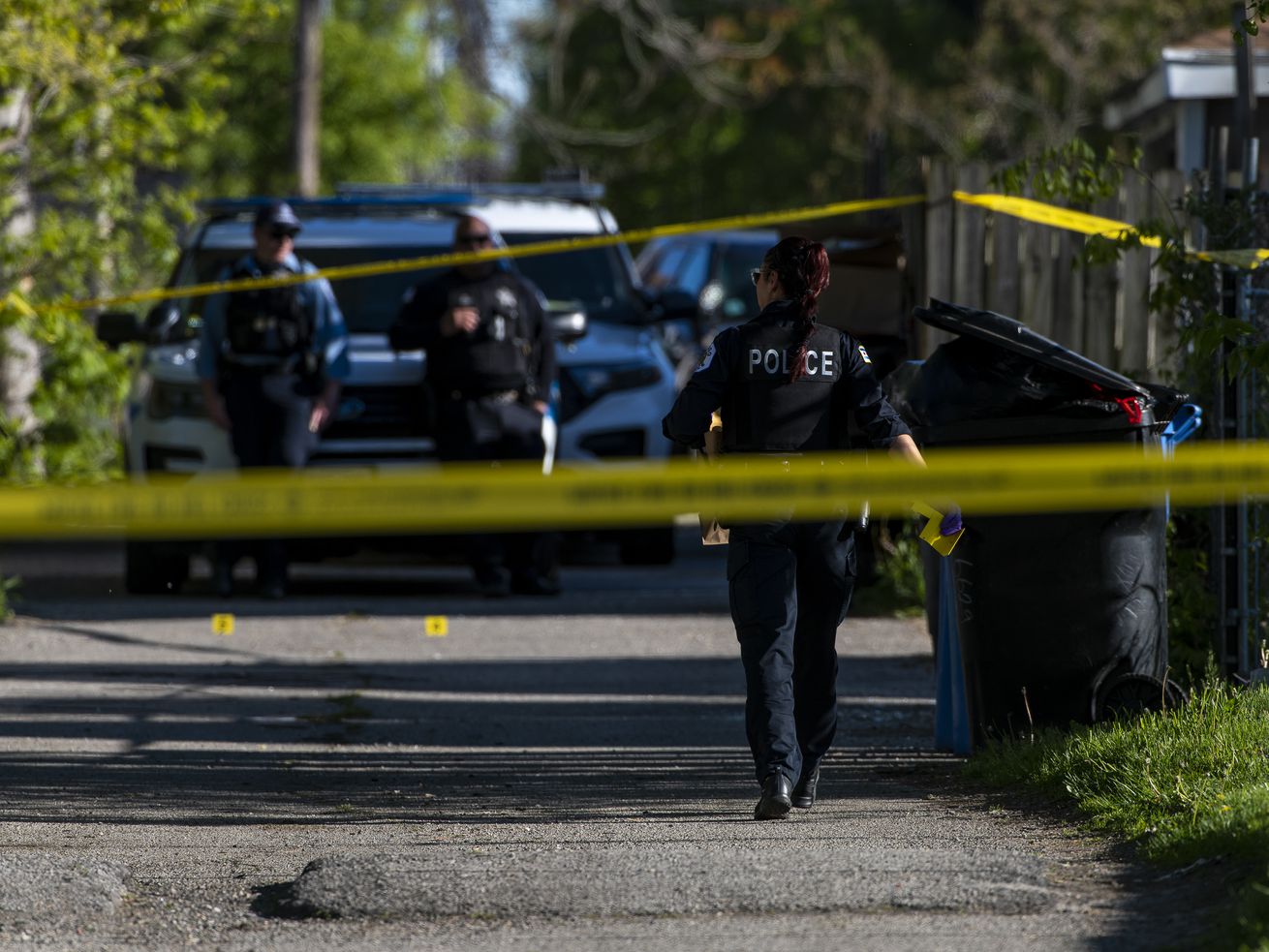
Chicago police work the scene where a 15-year-old boy was critically wounded in a shooting in an alleyway near the 6600 block of South May Avenue in the Englewood neighborhood on May 12. | Tyler LaRiviere/Sun-Times file
Illinois can’t stop all the crime guns that flow into the state, but it can keep some firearms out of the hands of criminals.
After a weekend in which gunfire killed 12 people and injured 42 in Chicago alone, the Legislature really ought to do something. Shootings in the city are up by 36% over a year ago.
Illinois can’t stop all the crime guns that flow into the state, but it can keep some firearms out of the hands of the criminals who take so many lives and hurt so many. Legislation known as the Block Illegal Ownership bill would close some of the loopholes. In 2020, it passed in the Illinois House, but the Senate failed to act on it during the pandemic.
Gun safety advocates are planning a press conference and a digital day of action on Thursday with gun violence survivors to try to get the BIO bill across the finish line. If they fail, it could be another two years before the Legislature takes another serious look at the legislation. There’s always an election coming up or some other excuse not to act.
Chicago and Illinois can’t afford that kind of delay. As the Legislature has dragged its feet, horror story has followed horror story. A man shot during a carjacking after changing a tire for a mother and her little children. A 15-year-old rapper gunned down. An 86-year-old woman shot in the foot while watering her lawn. A 16-year-old girl shot while sitting in a car. A couple shot at a stop sign. People shot on the expressways. Drive-by shootings.
All in the past few days.
All just a small part of the mayhem of gunfire terrorizing entire communities.
The BIO bill has several components, but the two most critical are requiring mandatory fingerprints for people getting Firearms Owners Identification cards and universal background checks by a federally licensed gun dealer for person-to-person sales. Those measures can help stop criminals from getting easy access to guns.
Other loopholes need to be closed as well, but the BIO bill is something the Legislature can do right now. Chicago just had its worst weekend of shootings this year, and everyone is worried about the upcoming Memorial Day weekend, often a time of heightened gun violence.
We don’t know how many lives might have been saved in the two years the Legislature has failed to act. We do know there’s no justification for adding to the toll of the dead and wounded by continuing to delay.
Under Mayor Lightfoot’s plan, the Chicago Police Department would be placed under stronger, though not ultimate, civilian oversight.
It’s appropriate that Mayor Lori Lightfoot has unveiled her plan to increase civilian oversight of the Chicago police in the same week that our nation marks the one-year anniversary of the killing of George Floyd.
The outrage that followed Floyd’s death, under the knee of a Minneapolis police officer, has spurred police reform efforts across the country, including Lightfoot’s police oversight plan. Her long-awaited proposal includes many of the changes demanded by police reform advocates.
Much of the public discussion about the mayor’s plan, released on Monday, is sure to focus on where the mayor and reform activists fundamentally disagree. The mayor insists that she and future mayors must retain their authority to hire and fire the police superintendent and make major policy decisions. But two local police reform groups, who have joined together to support an alternative plan now pending in the City Council, say an elected board of civilians, not the mayor, should make those calls.
We stand firmly with the mayor on this. The people of Chicago will always demand action from the mayor, not some semi-anonymous elected board, when crime rates soar or the police screw up. Strip any mayor of that most basic power — the authority to hire and fire the superintendent — and watch accountability fly out the window.
But what’s more significant, to our thinking, is the degree to which the mayor’s plan incorporates other elements of proposals by reform advocates. The police department still would be placed under stronger, though not ultimate, civilian oversight.
Under the mayor’s plan, Chicagoans would elect three-person panels in each of the city’s 22 police districts. Those panels then would nominate people to a seven-person commission, with the mayor making the final appointments.
When it becomes necessary to hire a new police superintendent, this commission would choose three candidates. Then the mayor would choose a finalist to be approved by the City Council.
Assuming those three-person panels were elected in well publicized and fair elections — assuming the fix is not in — this process for choosing a superintendent would ensure an unprecedented level of civilian participation.
The mayor also would select the heads of the Police Board and the Civilian Office of Police Accountability — and for the same good reason. As Lightfoot said Monday, “the buck” will always stop at the mayor’s office.
The seven-member commission proposed by Lightfoot would not have final say on police policy. But, as Fran Spielman of the Sun-Times reported, it would “review and approve by majority vote” any changes in in policy. The weight of that advisory function, given the likely media attention, should not be underestimated.
The commission also would have the right to “direct” COPA’s chief administrator to “investigate complaints of police misconduct.”
Negotiations will now begin to find common ground for a final police civilian oversight ordinance. Both sides will have to compromise.
But know this: One year after the murder of George Floyd, significant, real reform is coming to Chicago.
Raised in Little Village, the painter creates quiet art to process grief.
Elsa Muñoz’s paintings carry a sense of intimacy. They’re full of dark colors, but they glow—it’s as if light can’t help but seep through the lines.…Read More
People pays their respects to George Floyd in the intersection of 38th Street and Chicago Avenue on May 25, 2021 in Minneapolis, Minnesota. | Getty
Floyd’s sister Bridgett and other family members held a moment of silence at a “Celebration of Life” event at a downtown Minneapolis park that included music, food trucks, an inflatable bouncy house and a pop-up vaccination stand.
MINNEAPOLIS — A family-friendly street festival, musical performances and moments of silence were held Tuesday to honor George Floyd and mark the year since he died at the hands of Minneapolis police, a death captured on wrenching bystander video that galvanized the racial justice movement and continues to bring calls for change a year later.
Floyd’s sister Bridgett and other family members held a moment of silence at a “Celebration of Life” event at a downtown Minneapolis park that included music, food trucks, an inflatable bouncy house and a pop-up vaccination stand. A few miles away, at the site of the intersection where Floyd died, dozens of people gathered around a steel fist sculpture and kneeled for several minutes — symbolic of the 9 minutes, 29 seconds during which Floyd was pinned to the ground.
“It’s been a troubling year, a long year,” Bridgett Floyd told the crowd in downtown Minneapolis. “But we made it. … The love is very outpouring today. The love is here. George is here.”
Other members of Floyd’s family met with President Joe Biden and Vice President Kamala Harris in Washington, who urged Congress to quickly pass a law in Floyd’s name that would bring changes to policing. A moment of silence to honor Floyd was also held in New York and a rally was held in Los Angeles. Globally, a rally took place in Germany and Floyd’s death was marked by U.S. embassies in Greece and Spain.
Hours before the festivities began in Minneapolis, the intersection where Floyd died was disrupted by the sound of gunfire.
Associated Press video from 38th Street and Chicago Avenue — informally known as George Floyd Square — showed people running for cover as shots rang out. Police said a man, who they believe was injured in the shooting, went to a nearby hospital with a gunshot wound. Police spokesman John Elder said he was in critical condition but was expected to survive. No one was in custody by midday.
Philip Crowther, a reporter working for AP Global Media Services, which provides live video coverage, reported hearing as many as 30 gunshots about a block from the intersection. Crowther said a storefront window appeared to have been broken by gunshots.
“Very quickly things got back to normal,” Crowther said. “People here who spend a significant amount of time, the organizers, were running around asking, ‘Does anyone need a medic?’”
Like other major cities, Minneapolis has been struggling with rising gun violence, a problem made worse, in part, by many officers leaving the embattled force since Floyd’s death. A 6-year-old girl was fatally shot and two other children wounded in recent weeks. Minneapolis Mayor Jacob Frey last week unveiled sweeping public safety proposals aimed at fixing the problem. Other groups are pursuing a more radical remaking of the police department.
The intersection of 38th and Chicago has been barricaded since soon after Floyd’s death. It quickly turned into a memorial — and also a challenging spot for the city, with police officers not always welcome.
The square was transformed Tuesday into an outdoor festival, with food, children’s activities and a long list of musical performers. The “Rise and Remember George Floyd” celebration includes a candlelight vigil and caps several days of marches, rallies and panel discussions about his death and confronting racial discrimination.
Xavier Simmons, a 24-year-old organizer from Racine, Wisconsin, chanted “Say his name!” as the crowd kneeled before the fist sculpture. Simmons said he hopes people taking part in the festivities will both honor Floyd’s life and legacy and continue to “uplift and empower this movement.”
“We got the verdict that we needed, but it’s never going to change until we make a change,” he said.
Floyd, 46, who was Black, died May 25, 2020, after then-Officer Derek Chauvin knelt on his neck, pinning him to the ground for about 9 1/2 minutes. Chauvin, who is white, was convicted last month of murder and faces sentencing June 25. Three other fired officers still face trial.
Earl Vaughn, 20, of Minneapolis, went to the event in downtown Minneapolis to show support for Floyd’s family. Despite the event’s celebratory atmosphere, Vaughn said: “For all this a Black man had to die, so that’s really unfortunate.”
In New York City, elected officials, including Mayor Bill de Blasio and U.S. Rep. Hakeem Jeffries, joined the Rev. Al Sharpton in kneeling for 9 minutes, 29 seconds. “As we took a knee, imagine how long that was on a human being’s neck,” Sharpton said. “Never switched knees, just dug in. It’s time we correct policing in this country.”
Several Floyd family members, including his young daughter Gianna, met with Biden and Harris on Tuesday. Biden had called family members after the Chauvin verdict and pledged to continue fighting for racial justice.
On Tuesday, he recalled how Gianna told him on the eve of Floyd’s funeral that “Daddy changed the world.” He said in a statement that Floyd did bring change, but that real change must include accountability and trust in the justice system. He said he hopes the George Floyd Justice in Policing Act can pass the Senate and get to his desk quickly.
“We have to act,” he said of the legislation that would ban chokeholds and no-knock police raids and create a national registry for officers disciplined for serious misconduct.
Harris also called on Congress to move “with a sense of urgency. Passing legislation will not bring back those lives lost, but it will represent much needed progress. We must address racial injustice wherever it exists. That is the work ahead.”
Bridgett Floyd told the crowd in Minneapolis: “We don’t want a watered down bill … My message to the president: Get your people in order … We’re going to continue to fight this good old fight.”
Floyd’s brother Philonise, who appeared on CNN, said he thinks about George “all the time.”
“My sister called me at 12 o’clock last night and said ’This is the day our brother left us,’” he said, adding: “I think things have changed. I think it is moving slowly but we are making progress.”
Also Tuesday, the U.S. Senate voted to confirm Kristen Clarke as assistant attorney general for civil rights, the first Black woman to hold the position. In the last few weeks, the Justice Department under Biden has announced sweeping investigations into the police in Minneapolis and Louisville and brought federal civil rights charges against the officers involved in Floyd’s death, including Chauvin.
Separately, the Floyd family announced the launch of a fund that will make grants to businesses and community organizations in the neighborhood, as well as broader grants “encouraging the success and growth of Black citizens and community harmony.” The money comes from $500,000 earmarked as part of the city’s $27 million civil settlement for the Floyd family earlier this year.
___
Associated Press writer Amy Forliti contributed to this report.

:no_upscale()/cdn.vox-cdn.com/uploads/chorus_asset/file/22539639/fotw05_26_21largemouthMissey.jpeg)
:no_upscale()/cdn.vox-cdn.com/uploads/chorus_asset/file/22539732/fotw05_26_21largemouthCantu.jpg)
:no_upscale()/cdn.vox-cdn.com/uploads/chorus_asset/file/22539682/fotw05_26_21Grucalargemouth.jpg)
:no_upscale()/cdn.vox-cdn.com/uploads/chorus_asset/file/22539668/fotw05_26_21smallmouthDuSable.jpg)
:no_upscale()/cdn.vox-cdn.com/uploads/chorus_asset/file/22539665/fotw05_26_21chicagoriverlargemouth.jpg)
:no_upscale()/cdn.vox-cdn.com/uploads/chorus_asset/file/22539658/fotw05_26_21heideckedoublecrappie.jpg)
:no_upscale()/cdn.vox-cdn.com/uploads/chorus_asset/file/22539647/fotw05_26_21omalley.jpg)
:no_upscale()/cdn.vox-cdn.com/uploads/chorus_asset/file/22539739/fotw05_26_21smallmouthKankakee.jpg)
:no_upscale()/cdn.vox-cdn.com/uploads/chorus_asset/file/22539745/fotw05_26_21millelacs.jpg)
:no_upscale()/cdn.vox-cdn.com/uploads/chorus_asset/file/22538649/fotw05_26_21triplecatch.jpg)
:no_upscale()/cdn.vox-cdn.com/uploads/chorus_asset/file/22538584/fotw05_26_21wolfpike.jpg)