The Chicago Cubs were looking for a ticket to another playoff appearance in 2019. After a few seasons of frustrating offensive outputs putting a damper on their previous early playoff exits, the Cubs’ front office felt if they could solidify their bullpen, they could give their core pieces another shot. It would be a decision […]
There are plenty of options in free agency this summer, especially from playoff teams, for the ChicagoBlackhawks to consider. The Pittsburgh Penguins are not really one of those teams as they only have one big free agent coming off the books and that is Cody Ceci. He is a player that the Chicago Blackhawks […]
Experimental drone and postmetal outfit Nadja got their start in 2003 as the solo studio project of ambient musician Aidan Baker, but by 2005 he’d enlisted the help of bassist and vocalist Leah Buckareff to bring his music to the stage. They’re a married couple as well as bandmates, and they’ve since relocated from their native Canada to Berlin.…Read More
Three people were shot, one fatally, May 27, 2021 in Chicago. | Sun-Times file photo
A 22-year-old man was killed in a drive-by after getting in the backseat of a ride-share car in the 2000 block of East 75th Street.
A person was killed and two others wounded in shootings Thursday across Chicago.
A man was fatally shot Thursday morning as he got into a ride-share car in South Shore.
The man, 22, had gotten into the backseat of the car in the 2000 block of East 75th Street when a gray Volkswagen sedan pulled up and two people fired shots, Chicago police said.
The ride-share driver drove to a gas station in the 2300 block of East 75th Street and flagged down officers who were responding to a Shotspotter alert, police said. The 22-year-old was pronounced dead at the scene.
The shooters crashed their car into a parked car in the 7500 block of South Clyde Avenue and fled on foot, police said. No one was in custody.
In nonfatal attacks, a woman was wounded in a drive-by early Thursday in Englewood on the South Side.
About 3:50 a.m., she was getting out of her car in the 7200 block of South Winchester Avenue, when someone inside a passing vehicle fired shots, police said.
She was grazed by a bullet on her head, struck in her arm, and brought to Christ Medical Center in Oak Lawn in serious condition, police said.
Minutes later, a 35-year-old man was found shot in Park Manor on the South Side.
About 4:05 a.m., officers found him unresponsive on the sidewalk in the 6800 block of South Calumet Avenue, with gunshot wounds to his back, police said.
The man’s car was struck by bullets multiple times, and witnesses told officers they saw four to six males in dark-colored hoodies come out of a gangway at the time of the shooting, police said.
He was taken to the University of Chicago Medical Center in fair condition, police said.
From 1912 to 1991, the Lincoln Park Gun Club occupied the Chicago lakefront just north of Diversey Harbor. Here, Robert Jacobazzi waits for his target and the right moment. | Sun-Times file
Hard to believe now, but, from 1912 until its demise 30 years ago, the Lincoln Park Gun Club occupied a choice lakefront locale just north of the mouth of Diversey Harbor.
Walking the beach, I spotted plastic wadding from a shotgun shell and realized I hadn’t seen one of those in a long time.
Some of you will remember when most of Chicago’s beaches were littered with shotgun wadding, their distinctive splayed shape like toy squid burrowed into the sand everywhere you went.
Then again, some of you probably never have seen one at all. Which made me realize there must be a whole generation of Chicagoans at this point who know nothing about the Lincoln Park Gun Club.
Let’s remedy that.
From 1912 until its demise 30 years ago this month, the gun club — formally known as Lincoln Park Traps — occupied a choice piece of lakefront real estate just north of the mouth of Diversey Harbor.
The club’s name came from the trap and skeet shooting conducted there. Members had their own clubhouse, and every day the pop-pops rang out in Lincoln Park as shooting enthusiasts fired at clay targets flung over Lake Michigan.
In the early years after the club was formed by such luminaries as Oscar Mayer and P.K. Wrigley, they shot at actual live pigeons before that became unfashionable.
The debris landed in the water, where most of it remains today, except for the plastic wadding that would wash up on the beaches.
And here’s the thing to understand: it was just an accepted part of life in the big city, beloved by some, despised by others, ignored or tolerated by most.
By today’s standards, the whole notion sounds bizarre and anachronistic. If a lakefront gun club were proposed today, it wouldn’t even receive serious consideration.
But at the time, which to my mind is not so very long ago, booting the club was a very controversial matter that took years to accomplish. And many people remained bitter about the closing even years later.
In the end, it was closed by the Chicago Park District on the basis of environmental concerns over the lead shot, plastic litter and pollutants from the clay targets — more to the point, the potential legal liability they posed, said Nancy Kaszak, who at the time was the park district’s general counsel and later was elected to the Illinois Legislature.
APShotgun shells and plastic wadding littered the grounds of the old Lincoln Park Gun Club, but a bigger problem was the wadding that washed up on Chicago’s beaches.
Some of the club’s supporters always maintained the dispute was really about guns and people who don’t like guns.
In retrospect, it probably was about a lot of things.
“It didn’t fit with what a majority of Chicagoans wanted with their lakefront,” said Cam Davis, a Metropolitan Water Reclamation District of Chicago commissioner who, as a young environmentalist, opposed the gun club.
Erma Tranter, former president of Friends of the Parks, which led the fight to close the club, said “it’s so obvious now” that the gun club was an inappropriate use of lakefront parkland.
“It was just wrong for a Chicago public park,” Tranter said, citing the pollution, private use of parkland and “cacophony” of the gunfire.
Christopher Cohen, a former 46th ward alderman who was the club’s lawyer during its early days of fending off the park district in 1988, concedes the club could not be in the same location today.
“Lifestyles have certainly changed, and the public’s point of view has changed,” he said.
Cohen said he fought the perception that the gun club was exclusive by pointing to its diverse group of users, including its African American president, and having a woman on its board.
Chicago Daily NewsJohn Gray, former board chairman of Hart Schaffner & Marx, was the type of skeet shooter who gave the Lincoln Park Gun Club an exclusive image. But supporters said the club had a diverse membership.
The aggressive pushback, which included a Chicago City Council resolution unanimously supporting the club, succeeded in delaying the closing for a few more years.
But, in 1991, then-Illinois Attorney General Roland Burris sued the club for polluting the lake, prompting the park district to finally halt its operations.
Burris, who would go on to be appointed to the U.S. Senate by then-Gov. Rod Blagojevich, said it was a tough decision.
“The club had a lot of clout,” Burris said. “They had a big following. It was not an easy situation to go after.”
The clubhouse was torn down in 1997.
It’s true that lifestyles change. And the public’s point of view changes. Often, as in this case, it changes for the better.
A man is facing murder charges in connection to a January shooting in Chatham on the South Side.
Andrew McCullum was arrested after he was identified as the person who shot and killed 25-year-old Printiss Jones, Chicago police said.
On Jan. 4, officers responded to a call of shots fired in the 7800 block of South Indiana Avenue and found Jones in an apartment with a gunshot wound to the head, police said. He was pronounced dead at the scene.
McCullum, 26, is facing one felony count of first-degree murder, police said.
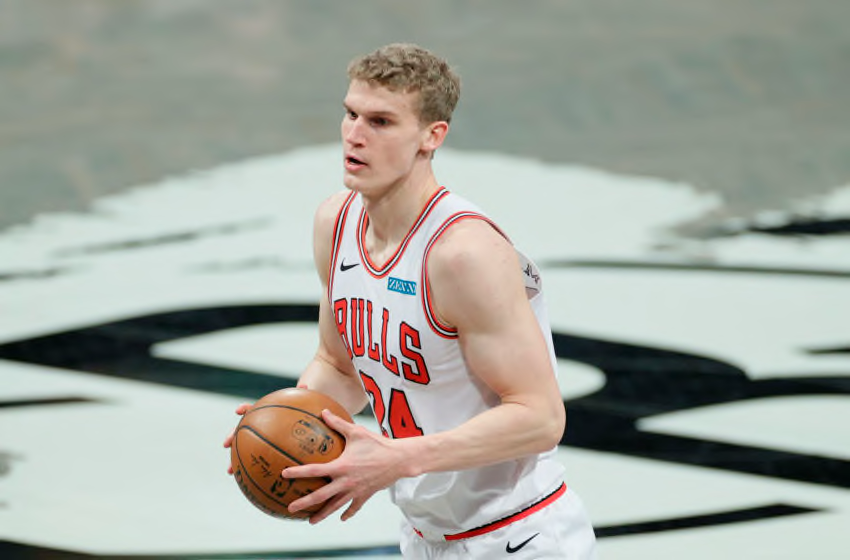
ChicagoBulls (Photo by Jonathan Daniel/Getty Images)
When the Chicago Bulls brought in head coach Billy Donovan, fans were shocked, thrilled and full of hope. Finally, Chicago hired a coach with previous head coaching experience — and a great one, at that.
The hope coming with Donovan had mostly to do with the fact that he notoriously gets the absolute most out of every single one of his players. He’s done far more with less talent than many coaches around the league, and it’s because of the buy-in factor.
Players listen to and respect Donovan. He’s been there and done that, and this young team bought in right away last year. Unfortunately, there were injuries and health issues that kept some key players out which ultimately led to the Bulls missing the playoffs.
But, that doesn’t mean last season was a failure. Fans saw some excitement out of this team they hadn’t seen in a while. Donovan had his guys playing hard, competitive basketball — and it was a sight which was rarely seen prior to last season.
This summer, the Chicago Bulls have decisions to make within their roster moving forward.
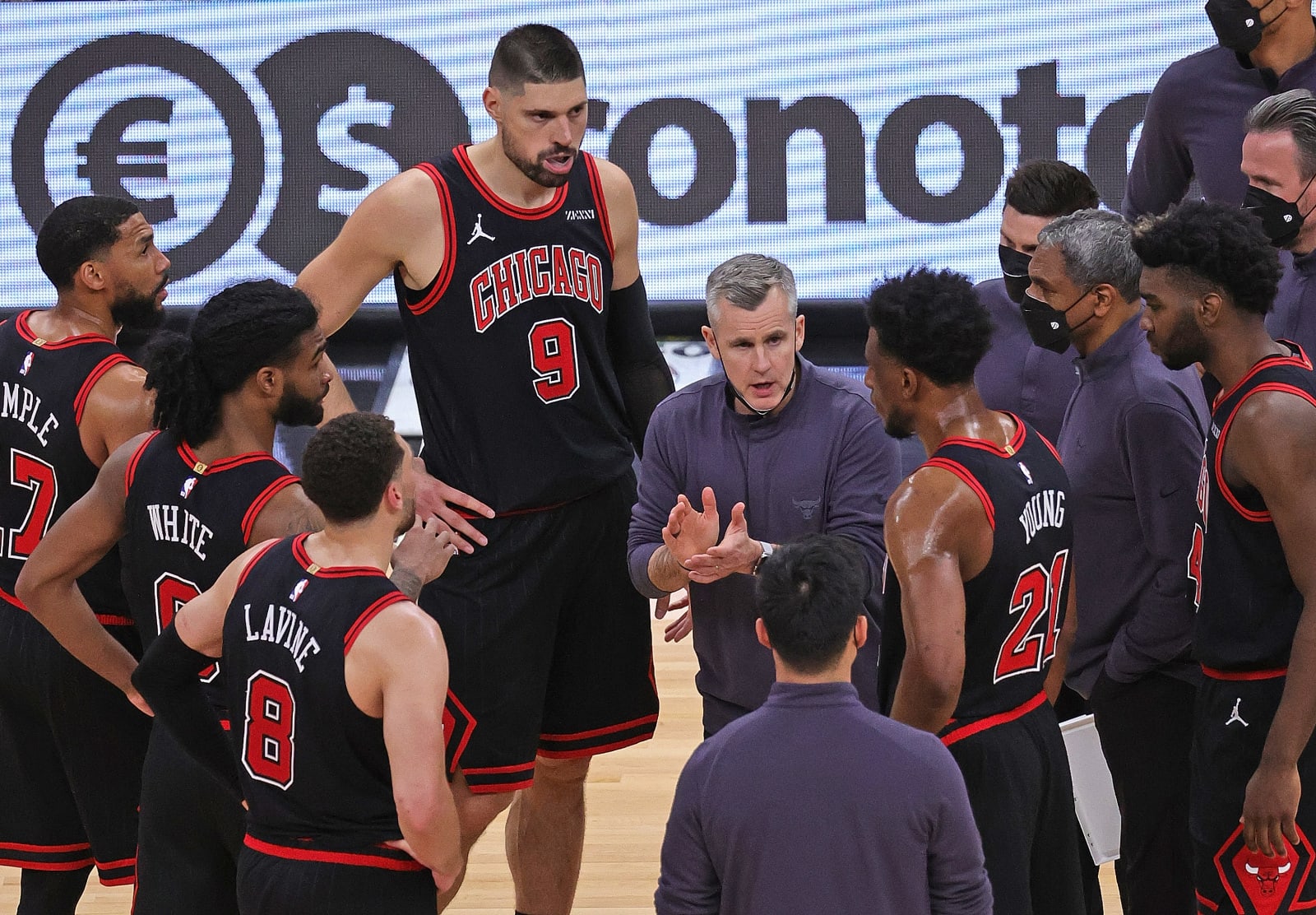
Donovan, along with Bulls brass (Arturas Karnisovas and Marc Eversley), will work together now over the summer to further shape this roster. The Bulls will actually have some cap space to work with this year, making things a little interesting for once.
Chicago might not be the top-tier free agent destination, but with Donovan in place and guys like Zach LaVine and Nikola Vucevic, you never know who the Bulls could lure in.
Before looking at the crop of free agent talent elsewhere, though, the Bulls will have to make decisions on their own guys. Chicago has quite a few players that could come off the books this summer, and not all of them will be brought back.
Some of these players are well-worth paying to return, but a few others aren’t quite as valuable to the Bulls. Which of their own players should be brought back, and which should be allowed to leave? The following five players all require that exact decision over the summer.



/cdn.vox-cdn.com/uploads/chorus_asset/file/22544638/shells_and_wadding.jpg)
/cdn.vox-cdn.com/uploads/chorus_asset/file/22544648/john_gray.jpg)
:no_upscale()/cdn.vox-cdn.com/uploads/chorus_asset/file/22545511/Andrew_McCullum__26.jpg)