The Cubs’ Javy Baez gets Pirates first baseman Will Craig to chase him back toward home plate on the first-base line during Thursday’s game. | Photo by Joe Sargent/Getty Images
Public discussions about whether to break up the core that won the 2016 World Series have gladly given way to the thrill of an unexpectedly competitive team.
This was supposed to be a slightly sad, mostly wistful season for the Cubs. Instead, two months in, it has turned into a surprise party.
Public discussions about whether to break up the core that won the 2016 World Series have gladly given way to the thrill of a fun, unexpectedly competitive team.
Grim debates about which popular player should be traded have taken a back seat to the entertainment value of Javy Baez’ ability to lure opponents into looking really, really stupid.
I’d like to compare all of it to funeral plans being ditched for a miracle-cure celebration, but that would be a bit much. How about a prison sentence being commuted? Still too much? You’re no fun.
As of Friday afternoon, the Cubs were 27-22, a half-game behind the first-place Cardinals in the National League Central. They had won nine of their previous 11 games, jumping from fourth place to second in that stretch.
It can’t be stressed enough that we’re only 30 percent through the schedule, but who saw this 30 percent coming? Not your faithful scribe.
With the franchise’s never-ending money grabs and its eternal mewling about a lack of resources to pay big salaries as the backdrop, 2021 looked to be a season of dark, unmoving clouds over Wrigley Field. That’s why what’s happening now is so cool. The one thing that we’re all here for – baseball – is going well. It might not be the exact plot to “Major League,’’ but the people who play and coach the game sure are sticking it to the highers-up who seem to be hell-bent on turning the page.
I don’t want to get into a debate over which direction the Cubs should go, over who is right and who is wrong. The World Series title was a long time ago. Players are getting older. All of it is true. But it’s also true that, to repeat, the Cubs are a half-game out of first place. Maybe put a hold on the What Can We Get For Kris Bryant talk.
When Baez made Pirates first baseman Will Craig look silly Thursday, it was a glorious reminder that, man, these are fun times for these Cubs. Baez’ two-out grounder to third looked like a sure end to the third inning. But when Craig took the slightly off-target throw, Baez stopped on the base path before reaching first. Rather than STEP ON THE BAG FOR THE THIRD OUT, Craig chased Baez back toward home plate, like a cat pursuing a piece of cheese on a string. Seeing Willson Contreras racing for home from second, Craig threw the ball to the catcher. Contreras beat the tag. More hilarity ensued when a throwing error to first allowed Baez to get to second. The Cubs’ dugout looked like an overserved comedy-club audience.
Inanity and insanity. The good kind.
The Cubs’ bats have warmed up after a slow start. The team’s earned-run average in May is 2.73, second-best in the big leagues. The bullpen has been outstanding.
Who knew?
So far, the storyline of a franchise in serious decline looks very, very fragile. Maybe that storyline will rise up again next week or the week after. Enjoy this for however long it lasts, for however far the Cubs go.
Who knows?
I received an email from a reader complaining that the baseball coverage in Friday’s Sun-Times weighed heavily in favor of the Cubs over the White Sox. I found it amusing. The Sox have received the lion’s share of attention for most of this season. They’re a good, young team dealing with an old-school manager, and vice-versa. It’s a sports section’s dream. Now the Cubs are budging their way into the picture, and some Sox fans have resorted to their age-old grievance about the North Siders receiving most-favored-nation status.
Can we be happy with two good teams in town? Everybody together: Of course not!
Off the field, the Cubs are doing their ritual filching of wallets. The franchise is telling fans that it might spend more money on the roster if they start showing up in large numbers at Wrigley. The people with the big dough telling the peasants they need to spend whatever is jangling around in their pockets – now that’s rich.
On the field, the team’s Big Three – Baez, Bryant and Anthony Rizzo — is still here, but the guessing game continues. Who will be here next year? Who will be here after this year’s trade deadline?
I don’t care right now. Hope I don’t have to care about it at the end of July, either.
Donuts are an easy yet delicious snack or meal in the mornings…..okay let’s be honest, we can eat donuts all day every day. I am always on the lookout for the best donuts in Chicago. The craving is REAL! Each of these places has the BEST selection of donuts. Seriously though, you won’t regret it. These 5 best donut spots in Chicago are my favorites and have the most selections perfect for a snack or a full-on donut meal.
In The Alley, 810 W Armitage Ave, Chicago, IL 60614
Beacon Doughnuts is a small-batch bakery full of vegan options. After becoming a big hit at Wicker Park Farmer’s Market, the bakery opened a hidden walk-up window in order to help serve their customers safely. While their menu changes day-to-day, their previous offerings include bday cake, Boston cream, blueberry pancake, campfire s’more, orange pistachio, cookies n cream donuts, and more!
In addition to their mouthwatering artisanal Hall of Fame donuts which include flavors like Butterscotch Praline, Peppermint Hot Chocolate, Maple Glazed Pineapple & Bacon, Caramel Apple Cider, Rum Cake, and Peanut Butter and Jelly. Just check out their website because all of the flavors are amazing! Firecakes whip up ice cream donut concoctions that your sweet tooth could never even dream of. Go there, seriously, you won’t be disappointed.
You can find fried dough here 24 hours a day, and when you try these pillowy pastries, you’ll find a good reason to come back at all hours of the day and night. If it’s your first time, go for a box of the original glazed yeast donuts, which basically melt in your mouth. The best part? Unlike costly downtown shops, Dat keeps its prices low; one donut will run you a buck and change.
Even with two brick-and-mortar locations, this spot is notorious for selling out fast. Once inside, you’ll find classics like the buttermilk old-fashioned alongside wacky specials including honey bun cake, birthday cake, and whiskey caramel old-fashioned with pecans. These pastries aren’t cheap, but trust me when I say they’re worth every single penny.
If you’re a donut lover, then you absolutely NEED to come to Bombobar. After opening up as a humble walk-up window, Bombobar has expanded to two locations including one 30-seat restaurant in Old Town. If you like over-the-top donuts and shakes, Bombobar is your spot.
Best Donuts Chicago Featured Image Credit: Choose Chicago
A Joyce Foundation grant paves the way for a community playmaking project at Congo Square focused on Black women and girls.
“I love Black women and girls. I love them and I think that we need to center a lot of their stories and amplify and uplift them as much as possible,” says Sydney Chatman.…Read More
Festivals are beginning to announce their future plans for 2021. | Ashlee Rezin Garcia/Sun-Times
Improving coronavirus numbers have made more summer events possible. Here’s the latest updates on this year’s changing entertainment landscape.
With coronavirus case numbers and positivity rates on the decline, the summer festival season in Chicago is in much better shape than last year.
The city has given the green light for festivals and “general admission outdoor spectator events” to welcome 15 people for every 1,000 square feet.
The city has debated various ways bolster vaccination rates among young people most likely to attend outdoor music events like Lollapalooza and Riot Fest. Mayor Lori Lightfoot said a proposal to create a coronavirus vaccine passport for Chicago events is “very much a work in progress” but that preferred seating at those events could be one way to urge vaccination.
Some festivals have already announced their return and concerts are starting to be rescheduled.
We’re tracking the status of the city’s festival and major events throughout the area as new cancellations and postponements are announced. Check back for more updates.
May
Navy Pier Fireworks: The Pier is hosting a 10-minute fireworks show every Saturday in May at 9:00 p.m.
Manifest Urban Arts Festival: Columbia College Chicago’s student driven event that showcases graduating student work. May 10-14.
For the Love of Chocolate: Long Grove, demonstrations, classes, presentations, experiences, vendors, chocolatiers, entertainment and so much more. Advanced online registration is required, May 14-16.
Hot Stove Cool Music virtual music festival, benefits the Foundation To Be Named Later, which was co-founded by former Cubs president Theo Epstein. Eddie Vedder headlines. May 18.
Mayfest: Armitage Ave. at Sheffield Ave. in Lincoln Park, May 21 – 23.
Pivot Arts Festival: Reimagining Utopia – A Performance Tour: Live, a multi-arts experience featuring world premieres in theatre, dance, video, music and puppetry. May 21 – June 5.
Chicago Symphony Orchestra concerts at Symphony Center, beginning May 27. Tickets will go on sale 10 a.m. May 11, at cso.org. Performances will take place over three consecutive weekends at 7:30 p.m. Thursdays, 1:30 p.m. Fridays, 7:30 p.m. Saturdays and 3 p.m. Sundays.
Pride in the Park, Grant Park, Headlining will be Chaka Khan, the legendary Queen of Funk; Gryffin, the self-taught prodigal producer; and Tiësto, who has been dubbed “the world’s greatest DJ.” June 26- 27.
July
The Ravinia Festival announced it will reopen in July 1 for 64 concerts through Sept. 26 with a slate of outdoor concerts including a six-week residency by the Chicago Symphony Orchestra. Also slated to appear are: Cynthia Erivo, Kurt Elling, Brian McKnight, Ides of March, Madeleine Peyroux, Midori, Joshua Bell, Pinchas Zukerman, the Chicago Sinfonietta and the Joffrey Ballet.
Grant Park Music Festival, Millennium Park. All concerts are free with reserved seats for all concertgoers and will take place Wednesday, Fridays and Saturdays at 6:30 p.m. Run time will be 90 minutes, without intermission. July 2-Aug. 21.
Summerfest: Milwaukee. The festival will take place over three weekends, Sept. 2-4, 9-11 and 16-18. More than 100 artists are slated to perform including Chance the Rapper, Miley Cyrus, Luke Bryan, Pixies, Rise Against, Wilco, Diplo, and Fitz and the Tantrums.
This combination of photos shows a general view of Times Square near 42nd Street in New York in the 1920s, left, and a general view of Times Square in New York on March 10, 2021. As hopes rise that the pandemic is ebbing in the United States and Europe, visions of a second “Roaring Twenties” to match last century’s post-pandemic decade have proliferated. | AP
As hopes rise that the pandemic is ebbing in the United States and Europe, visions of a second “Roaring Twenties” to match last century’s post-pandemic decade have proliferated.
NEW YORK — History repeats itself. But do decades duplicate?
As hopes rise that the pandemic is ebbing in the United States and Europe, visions of a second “Roaring Twenties” to match last century’s post-pandemic decade have proliferated. Months of lockdown and restrictions on social life have given way to dreams of a new era of frivolity and decadence. For some, it feels like party time.
In many parts of the world, such thoughts are unthinkable. India is engulfed in crisis. The virus is raging in South America. Japan is grappling with a punishing new wave of cases. And even in places where cases are falling and vaccinations are expanding, deep wounds remain from more than a year of death, illness and isolation. COVID-19 won’t disappear. More infectious variants are circulating. Herd immunity may be elusive. Long-term health effects will linger. There will be no Hollywood ending.
But a coming summer and a soaring stock market have lifted optimism and fueled predictions of a new Roaring Twenties. This time, Bill Maher has suggested, we do it without “the Depression at the end of it.” The New Yorker joked that prohibition in “the New Roaring Twenties” should be on “company-mandated virtual happy hours.” Madison Avenue has turned up the heat. Suitsupply, a men’s fashion brand, is running a suggestive ad campaign with writhing models and the tagline: “The New Normal Is Coming.” Summer travel is booming. A summer of love “sexplosion “ is predicted. Even the bob is back in style.
Is it fair to connect these twin ’20s, both decades that follow closely on the heels on of worldwide pandemic? Could two ‘20s really roar? Do we all need to start buying flapper dresses and brushing up on our F. Scott Fitzgerald?
Some of the parallels are legitimate, says Nicholas Christakis, professor of sociology and medicine at Yale University and author of “Apollo’s Arrow: The Profound and Enduring Impact of Coronavirus on the Way We Live.” After an interim period of “coping with the clinical, psychological and economic shock of the virus,” he says, we’ll see an uplift this summer, with a post-pandemic period taking root by 2023. It will, he says, be “a bit of a party.”
“Understandably, people will be very relieved when this is all finally over. People have been cooped one way or another for a very long time,” Christakis says. “We’re going to see people relentlessly seeking out social opportunities in nightclubs and restaurants and bars and sporting events and musical concerts and political rallies. We might see some sexual licentiousness, some loosening of sexual mores.”
Such prognostications have tantalized many eager for the fabled liberation of a century ago — what Fitzgerald described as “the most expensive orgy in history.” Outside of the 1960s, perhaps, no decade looms larger in the collective imagination than the 1920s, thanks in part to the emerging mass culture that captured the time — the swinging speakeasies, the Harlem Renaissance, the first “talkie” in 1927’s “The Jazz Singer.” Over time, the mythology has only grown glitzier (see Baz Luhrmann, “Gatsby,” 2013).
There’s truth in that portrait of the ’20s, but mainly to wealthier white Americans.
The decade was punishing to farmers; for the first time, more people lived in cities. Membership surged for the Ku Klux Klan, which targeted African Americans, immigrants, Jews and Catholics — anyone who didn’t meet its definition of a “real American.” In 1921, one of the worst incidents of racial violence occurred — the Tulsa Race Massacre. Three years later, the Immigration Act of 1924 restricted immigrants from Asia and Eastern Europe.
The 1920s, in short, were not all they were cracked up to be. “We have today in the United States, cheek by jowl, Prosperity and Depression,” the author and civil rights activist W.E.B. Du Bois wrote in 1926.
It’s not hard to see many of the same threads today: racial injustice, economic inequity, convulsive technological change. The 1921 campaign slogan of Warren G. Harding — “a return to normalcy” — sounds very familiar and even appealing to those who have had it with the “new normal.”
Forecasts on Wall Street, of course, vary. The United Nations last month raised its global economic forecast to 5.4% growth in 2021. While many analysts are predicting the pace to quicken in the months and years ahead, Tina Fordham, partner and head of global political strategy for Avonhurst, foresees a post-lockdown period that will feel like “The Great Gatsby” only to a few.
“For many, it could be more like ‘The Grapes of Wrath,’ unless steps are taken to address inequities — which accelerated during the pandemic — and the gaps in the social safety net,” Fordham concluded.
Are we even right to connect the 1920s with the 1918 influenza? To John M. Barry, author of the defining history “The Great Influenza,” it’s a false association. The so-called Spanish Flu was far more virulent and deadly. It killed more than 50 million worldwide and some 675,000 Americans — more than ten times the toll of WWI to the U.S.
“People seem to think we just leapt into the Roaring Twenties,” says Barry. “But first we went through 1919, which is one of the most chaotic and violent years in American history. Then you had a serious recession in 1920, 1921. The aftermath this time, one would hope, is quite different.”
People also experienced the 1918 influenza differently. Lockdowns then never lasted more than a few weeks. The societal surge that followed in the ’20s? Most historians ascribe that to the postwar period.
“The Roaring Twenties, that was the Lost Generation,” says Barry, who is writing a book on the COVID-19 pandemic. “There was a sense of fatalism, ennui, disillusionment with the world that I think was much more closely related to the war.”
Lucy Moore, author of “Anything Goes: A Biography of the Roaring Twenties,” connects World War I with the 1918 influenza in that they both were punishing for young Americans. The 1920s, says Moore, were propelled by a disillusioned, emancipated youth.
“The young have sacrificed a lot during this pandemic on behalf of the older generation,” Moore says. “There was a sense of that after the war and after the Spanish Flu. The war was very much young people being sent off to die by an older generation they’d been taught to trust but then felt very let down by.”
Whether the same response will happen in the aftermath of this pandemic is something to watch for. The crisis is far from over, Christakis cautions. “We don’t want to spike the ball at the 5-yard line,” he says. But throughout history, Christakis sees a pattern common to prolonged calamity. Plagues are followed by boom times. After the Black Death came the erosion of feudalism.
“The Roaring Twenties is just a metaphor,” Christakis says. “Grief walks the streets during times of plague, so people will rightly be relieved when this period of loss is behind us.”
The Chicago Symphony Orchestra returned to performing before a live audience with the program “Fanfare” featuring musicians from the CSO brass and percussion sections (seated across the stage to adhere to social distancing protocols) conducted by Michael Mulcahy on Thursday night. | Anne Ryan
The CSO presented its first live, in-person concert Thursday evening in Orchestra Hall following nearly 15 months of pandemic shutdown.
It didn’t matter that the concert only lasted a little more than an hour or that the seating capacity, normally 2,522, was reduced to 398.
It didn’t matter that the musicians had to be spread across the stage in an unusual semi-circle to accommodate safe distancing.
And it didn’t matter that the event had a slightly ad hoc feel, considering that this kick-off to three sets of programs was only announced on May 4 and had none of the usual amenities like a pre-concert talk or intermission.
What did count is that the Chicago Symphony Orchestra presented its first live, in-person concert Thursday evening in Orchestra Hall after nearly 15 months of at first, inaction, and later, virtual, small-ensemble presentations.
The message was clear: One of the city’s and the world’s cultural treasures survived a pandemic that has severely strained arts organizations across the country and no doubt felled some.
My feelings Thursday evening were many and somewhat contradictory — both disorientation and relief. But most of all, joy.
Live music has been at the center of my entire career as a critic and I have never taken it for granted, but its absence for so long has made me painfully realize how much it means to me and my well-being. And I’m sure I’m not alone in these feelings.
As suggested already, Coronavirus protocols made it impossible for the Chicago Symphony to stage a normal concert. Just 24 total orchestra members and guest musicians took part (the configuration varied by piece), but that was enough.
Symphony trombonist Michael Mulcahy, who has considerable experience on the podium, led the all-American brass and percussion program. It comprised five familiar and not-so-familiar works, beginning with Aaron Copland’s “Fanfare for the Common Man,” a fitting tribute to the many often unheralded heroes during this time of medical devastation.
Anne RyanOnly 328 patrons (out of a normally 2,522 capacity seating) were allowed to attend Thursday night’s Chicago Symphony Orchestra concert at Orchestra Hall due to pandemic restrictions.
A highlight was “Street Song” for Symphonic Brass by Michael Tilson Thomas, who is best known as the music director of the San Francisco Symphony from 1995 through 2020. This 1996 symphonic arrangement of his 1988 brass quintet of the same title makes it clear he knows his way around this family of instruments. The satisfying 18-minute work was a kind of fantasy, with showy frills, off-balance swells, clipped bursts, dissonant tinges, full-bodied chords and jazzy riffs — all smartly realized by these eager musicians.
Rounding out the line-up was Gunther Schuller’s Symphony for Brass and Percussion, Op. 16 (1950); Samuel Barber’s “Mutations from Bach” (1968), and a rhythmic romp excerpted from Leonard Bernstein’s score for the movie, “On the Waterfront” (1954).
The evening ended with a surprise encore — Timothy Higgins’ spirited arrangement of “Happy Birthday” which Mulcahy said was dedicated to a “certain unnamed person” with a birthday this summer. That, of course, would be music director Riccardo Muti who turns 80 on July 28. Maestro Muti returns to the podium at Symphony Center this fall.
Yes, it was possible to quibble with some aspects of the performance, such as a few tempos that could have used a bit more dynamism. But Thursday evening was not the moment for nitpicking.
It was a time to celebrate. Live music and the Chicago Symphony are back!
People wearing masks to help protect against the spread of the coronavirus walk near a banner promoting the Tokyo Olympics. | Eugene Hoshiko/AP
The prospect of empty venues at the postponed Olympics became more likely when the Japanese government decided Friday to extend a state of emergency until June 20 as COVID-19 cases continue to put the medical system under strain.
TOKYO — The president of the Tokyo Olympic organizing committee hinted Friday that even local fans may be barred from venues when the games open in just under two months.
Fans from abroad were ruled out months ago as being too risky during a pandemic.
The prospect of empty venues at the postponed Olympics became more likely when the Japanese government decided Friday to extend a state of emergency until June 20 as COVID-19 cases continue to put the medical system under strain.
The state of emergency was to have been lifted on Monday. The extension in Tokyo, Osaka and other prefectures raises even more questions if the Olympics can be held at all.
Organizers and the IOC are insistent they will go ahead despite polls in Japan showing 60%-80% want them called off.
“We would like to make a decision as soon as possible (on fans), but after the state of emergency is lifted we will assess,” organizing committee president Seiko Hashimoto said at her weekly briefing.
Hashimoto promised to decide on local fans by April, then put it off until early June. Now the deadline is within a month of the July 23 opening date.
“There are many people who are saying that for the Olympic Games we have to run without spectators, although other sports are accepting spectators,” Hashimoto said. “So we need to keep that in mind. We need to avoid that the local medical services are affected. We need to take those things into consideration before agreeing on the spectator count.”
Cancellation pressure grows daily on Tokyo and the IOC as more questions arise about the risks of bringing 15,000 Olympic and Paralympic athletes from more than 200 countries and territories into Japan, a country that has been largely closed off during the pandemic.
The IOC says more than 80% of athletes and staff staying in the Olympic Village on Tokyo Bay will be vaccinated. They are expected to remain largely in a bubble at the village and at venues.
In addition to athletes, tens of thousands of judges, officials, VIPs, media and broadcasters will also have to enter Japan.
Earlier this week, the New England Journal of Medicine said in a commentary: “We believe the IOC’s determination to proceed with the Olympic Games is not informed by the best scientific evidence.”
It questioned the IOC’s so-called Playbooks, which spell out rules at the games for athletes, staff, media and others. The final edition will be published next month. Also this week, the Asahi Shimbun — the country’s second-largest newspaper — said the Olympics should be canceled.
The British Medical Journal last month in an editorial also asked organizers to “reconsider” holding the Olympics in the middle of a pandemic.
On Thursday, the head of a small doctors’ union in Japan warned that holding the Olympics could lead to the spread of variants of the coronavirus. He mentioned strains in India, Britain, South Africa and Brazil.
Japan has attributed about 12,500 deaths to COVID-19, a relatively small number that has gone up steadily in the last few months. The vaccination rollout began slowly in Japan, but has moved more quickly in the last few days. Vaccinated people are estimated at about 5% of the population.
The IOC, which often cites the World Health Organization as the source of much of its coronavirus information, has been steadfast in saying the games will happen. It receives about 75% of its income from selling broadcast rights, which is estimated to be $2 billion-$3 billion from Tokyo. That cashflow has been slowed by the postponement.
Japan itself has officially spent $15.4 billion or organize the Olympics, and government audits suggest the figure is even higher.
Senior IOC member Richard Pound told a British newspaper this week that “barring Armageddon” the games will take place. Last week, IOC vice president John Coates was asked if the Olympics would open, even if there were a state of emergency.
“Absolutely, yes,” he replied.
IOC President Thomas Bach has also said “everyone in the Olympic community” needs to make sacrifices to hold the Olympics.
The message got pushback from Japanese social and local media, some of which noted that the IOC and the so-called Olympic Family are booked into many of Tokyo’s top five-star hotels during the games.
Hashimoto defended the IOC’s leadership.
“The IOC has a strong determination to hold the games,” she said. “So such a strong will is translated into strong words. That’s how I feel.”
Family members of shooting victim Timothy Romo embrace during a vigil at City Hall in San Jose, Calif., Thursday, May 27, 2021, in honor of the multiple people killed when a gunman opened fire at a rail yard the day before. | AP
Investigators were still trying to determine Friday what might have set off Samuel Cassidy, who for years apparently held a grudge against the workplace he detested.
SAN JOSE, Calif. — Taptejdeep Singh died trying to save others from a gunman. Kirk Bertolet saw some of his coworkers take their last breaths.
And friends, family and survivors were left to mourn after nine men died this week when a disgruntled coworker hauling a duffle bag full of guns and ammunition opened fire at a Northern California rail yard complex, apparently choosing his targets and sparing others.
Samuel Cassidy, 57, turned the gun on himself Wednesday morning as sheriff’s deputies rushed in at the Santa Clara Valley Transportation Authority in San Jose.
Investigators were still trying to determine Friday what might have set off Cassidy, who for years apparently held a grudge against the workplace he detested.
The victims were Alex Ward Fritch, 49; Paul Delacruz Megia, 42; Taptejdeep Singh, 36; Adrian Balleza, 29; Jose Dejesus Hernandez, 35; Timothy Michael Romo, 49; Michael Joseph Rudometkin, 40; Abdolvahab Alaghmandan, 63; and Lars Kepler Lane, 63.
The minutes-long attack was marked by both horror and heroism.
Singh, the father of a 3-year-old son and a 1-year-old daughter, was on an early shift as a light rail operator when the shooting began.
He called another transit employee to warn him, saying he needed to get out or hide.
“From what I’ve heard, he spent the last moments of his life making sure that others — in the building and elsewhere — would be able to stay safe,” co-worker Sukhvir Singh, who is not related to Taptejdeep Singh, said in a statement.
Singh’s brother, Bagga Singh, said he was told that his brother “put a lady in a control room to hide,” the San Jose Mercury News reported. “He saved her and rushed down the stairway.”
Singh’s brother-in-law, P.J. Bath, said he was told Singh was killed after encountering the gunman in a stairwell.
“He just happened to be in the way, I guess,” Bath told the paper.
Kirk Bertolet, 64, was just starting his shift when shots rang out, along with screams. As he and his coworkers threw a table in front of their door, Bertolet called the control center.
Then there was silence.
Cautiously, Bertolet left the barricaded office, hoping he could offer first aid. He couldn’t.
Bertolet, a signal maintenance worker who worked in a separate unit from Cassidy, said he is convinced Cassidy targeted his victims because he didn’t hurt some people he encountered.
“He was pissed off at certain people. He was angry, and he took his vengeance out on very specific people. He shot people. He let others live,” he said. “It was very personal.”
Glenn Hendricks, chair of the VTA’s board of directors, said he had no information about any tensions between Cassidy and the coworkers he shot.
Cassidy fired a total of 39 bullets. Camera footage showed him calmly walking from one building to another with his duffle bag to complete the slaughter, authorities said.
“It appears to us at this point that he said to one of the people there: ‘I’m not going to shoot you,’” Santa Clara County Sheriff Laurie Smith said. “And then he shot other people. So I imagine there was some kind of thought on who he wanted to shoot.”
Cassidy’s ex-wife said he had talked about killing people at work more than a decade ago. Cecilia Nelms told The Associated Press that he used to come home from work resentful and angry over what he perceived as unfair assignments.
The shooter spoke of hating his workplace when customs officers detained him after a 2016 trip to the Philippines, a Biden administration official told The Associated Press.
A Department of Homeland Security memo said Cassidy also had notes on how he hated the Valley Transportation Authority, according to the official. The official saw the memo and detailed its contents to the AP but was not authorized to speak publicly about the ongoing investigation.
The Wall Street Journal first reported the memo.
It doesn’t say why he was stopped by customs officers. It said he had books about “terrorism and fear and manifestos” but when he was asked whether he had issues with people at work, he said no. The memo notes that Cassidy had a “minor criminal history,” citing a 1983 arrest in San Jose and charges of “misdemeanor obstruction/resisting a peace officer.”
Neighbors, acquaintances and an ex-girlfriend described him as a loner, unfriendly, and prone at times to fits of anger.
Documents show he had worked at the transit authority since at least 2012. Bertolet said Cassidy worked regularly with the victims but he always seemed to be an outsider and perhaps couldn’t take the rough humor of colleagues.
“He was never in the group. He was never accepted by anybody there. He was always that guy that was never partaking in anything that the people were doing,” Bertolet said.
“I know some of those guys, they’ll keep joking with you and they’ll keep hammering you about stuff. And if you’re thin-skinned and you can’t take it … I see that is the main cause of what’s going on,” Bertolet said.
Sheriff’s officials said the three 9 mm handguns Cassidy brought to the rail yard appear to be legal. Authorities do not yet know how he obtained them.
He also had 32 high-capacity magazines, some with 12 rounds. In California, it is illegal to buy magazines that hold more than 10 rounds. However, if Cassidy obtained them before Jan. 1, 2000, he would have been allowed to have them unless he was otherwise prohibited from possessing firearms.
The sheriff said authorities found explosives at the gunman’s home, where investigators believe he had set a timer or slow-burn device so that a fire would occur at the same time as the shooting. Flames were reported minutes after the first 911 calls came in from the rail facility.
___
Har reported from San Francisco. Associated Press writers Stefanie Dazio in Los Angeles, Colleen Long in Washington, Jocelyn Gecker and Daisy Nguyen in San Francisco and Martha Mendoza in Santa Cruz contributed to this report.
A 40-year-old woman who was says she was held captive and repeatedly raped by 15 Eritrean soldiers over a period of a week in a remote village near the Eritrea border, speaks during an interview at a hospital in Mekele, in the Tigray region of northern Ethiopia, on Friday, May 14, 2021. “They talked to each other. Some of them: ‘We kill her.’ Some of them: ‘No, no. Rape is enough for her,’” she recalls. She said one of the soldiers told her: “This season is our season, not your season. This is the time for us.” | AP
Despite claims by both Ethiopia and Eritrea that they were leaving, Eritrean soldiers are in fact more firmly entrenched than ever in Tigray, where they are brutally gang-raping women, killing civilians, looting hospitals and blocking food and medical aid, The AP has found.
MEKELE, Ethiopia — Women who make it to the clinic for sex abuse survivors in the northern Ethiopian region of Tigray usually struggle to describe their injuries. But when they can’t take a seat and quietly touch their bottoms, the nurses know it’s an unspeakable kind of suffering.
So it was one afternoon with a dazed, barely conscious 40-year-old woman wrapped in bloodied towels, who had been repeatedly gang-raped anally and vaginally over a week by 15 Eritrean soldiers. Bleeding profusely from her rectum, she collapsed in the street in her village of Azerber, and a group of priests put her on a bus to Mekele.
The woman recently broke down in tears as she recounted her ordeal in January at the hands of Eritrean troops, who have taken over parts of the war-torn region in neighboring Ethiopia. The Eritreans often sodomize their victims, according to the nursing staff, a practice that is deeply taboo in the Orthodox Christian religion of Tigray.
“They talked to each other. Some of them: ‘We kill her.’ Some of them: ‘No, no. Rape is enough for her,’” the woman recalled in Mekele, Tigray’s capital. She said one of the soldiers told her: “This season is our season, not your season. This is the time for us.”
Despite claims by both Ethiopia and Eritrea that they were leaving, Eritrean soldiers are in fact more firmly entrenched than ever in Tigray, where they are brutally gang-raping women, killing civilians, looting hospitals and blocking food and medical aid, The Associated Press has found. A reporter was stopped at five checkpoints manned by sometimes hostile Eritrean soldiers dressed in their beige camouflage uniforms, most armed, as gun shots rang out nearby. And the AP saw dozens of Eritrean troops lining the roads and milling around in at least two villages.
Multiple witnesses, survivors of rape, officials and aid workers said Eritrean soldiers have been spotted far from the border, deep in eastern and even southern Tigray, sometimes clad in faded Ethiopian army fatigues. Rather than leaving, witnesses say, the Eritrean soldiers now control key roads and access to some communities and have even turned away Ethiopian authorities at times. Their terrified victims identify the Eritreans by the tribal incisions on their cheeks or their accents when speaking Tigrinya, the language of the Tigrayan people.
___
This story was funded by a grant from the Pulitzer Center on Crisis Reporting.
___
Almost all Tigrayans interviewed by the AP insisted there can be no peace unless the Eritreans leave. They see the Eritreans’ menace everywhere: the sacked homes, the murdered sons, the violated daughters, even the dried turds deposited in everything from cooking utensils to the floor of an X-ray room in one vandalized hospital.
Yet the Eritreans show no signs of withdrawing, residents said. And after first tacitly allowing them in to fight a mutual enemy in the former leaders of Tigray, the Ethiopian government now appears incapable of enforcing discipline. Two sources with ties to the government told the AP that Eritrea is in charge in parts of Tigray, and there is fear that it is dealing directly with ethnic Amhara militias and bypassing federal authorities altogether.
“They are still here,” said Abebe Gebrehiwot, a Tigrayan who serves as the federally appointed deputy CEO of Tigray, sounding frustrated in his office.
The continuing presence of Eritrean soldiers “has brought more crisis to the region,” he warned. “The government is negotiating…. I am not happy.”
The violence has already sent families fleeing to places like the camp for the internally displaced in Mekele that Smret Kalayu shares with thousands of others, mostly women and children. The 25-year-old, who once owned a coffee stall in the town of Dengelat, reflected on her escape in April while Eritrean forces searched houses and “watched each other” raping women of all ages. They also peed in cooking materials, she said.
“If there are still Eritreans there, I don’t have a plan to go back home,” she said, her voice catching with rage. “What can I say? They are worse than beasts. I can’t say they are human beings.”
Ethiopia and Eritrea were deadly enemies for decades, with Tigray’s then-powerful rulers, the Tigray People’s Liberation Front, taking leading roles in a divisive border conflict. That started to change in 2018, after Ethiopian Prime Minister Abiy Ahmed took office and made peace with Eritrea, for which he won the Nobel Peace Prize.
Abiy also marginalized the Tigrayan leaders, who fought back by questioning his authority. In early November the Ethiopian government accused Tigrayan troops of attacking federal ones. Tigrayan leaders later fired rockets into the Eritrean capital of Asmara, including some that appeared to target the airport there.
Abiy sent federal troops to Tigray to arrest its defiant leaders, and a war broke out that has dragged on for six months and displaced more than 2 million of the region’s 6 million people. United States Secretary of State Antony Blinken has referred to “ethnic cleansing” in western Tigray, a term for forcing a population from a region through violence, often including killings and rapes.
All sides have been accused of human rights abuses. But most of the atrocities are blamed on Ethiopian government forces, the Amhara militias allied with them and, notably, the shadowy fighters from Eritrea.
An Eritrean artillery bombardment lasting about 13 hours killed 150 people in Tirhas Fishaye’s village in the Zalambessa area in mid-November, she said. After that, she added, the Eritrean army moved in and started killing people in the streets.
“We hid in a cave for two months with 200 other people,” she said. “Then the Eritrean army found us and murdered 18 people.”
Tirhas, who is now displaced in Mekele, said the soldiers searched for young people, whom they shot as they ran away.
Another Tigrayan, Haileselassie Gebremariam, 75, was shot in front of a church in early January in his village in the Gulomakeda district. He said he counted the bodies of 38 people massacred by Eritrean troops inside the Medhane-Alem church during a religious festival. Several of his relatives were killed.
“When the Eritreans arrived, they shot everyone they found,” said Haileselassie, still nursing his ugly wound at Mekele’s Ayder Hospital. “They burnt our crops and took everything else.”
The Eritreans are acting out of a deep-rooted animosity against Tigrayan leaders after the border war, even though the people share a similar culture, according to Berhane Kidanemariam, an Ethiopian diplomat and Tigrayan who resigned his post earlier this year in protest. Eritrea’s longtime president, Isaias Afwerki, seeks a buffer zone along the border to foil any attempts by Tigray’s now-fugitive leaders to make a comeback, especially by resupplying their arsenal through Sudan, Berhane said.
“The mastermind of the situation in Ethiopia is Isaias,” Berhane said by phone from Washington, where until March he served as the deputy chief of Ethiopia’s mission. “Basically, Abiy is the poorer one in this. The head is Isaias…. The war, at the moment, is life or death for Isaias.”
For months, both Ethiopia and Eritrea denied the presence of Eritrean soldiers in Tigray. But evidence of Eritrea’s involvement grew, with the AP reporting the first detailed witness accounts in January, sparking a U.S. call for their withdrawal.
Abiy acknowledged in March that Eritrean troops were “causing damages to our people.” In early April Ethiopia’s foreign ministry reported that Eritrean troops had “started to evacuate.”
But the U.S. has said it still sees no sign of that happening, and has demanded a verifiable exit of Eritrean soldiers from Tigray. The U.S. this week announced sanctions, including visa restrictions, against Eritrean or Ethiopian officials blocking a resolution in Tigray, which the Ethiopian government called “misguided” and “regrettable.” The government has repeatedly warned of outside attempts to meddle in the country’s internal affairs.
Much of Tigray is still cut off from access, with no communications, leaving the displaced to describe what is happening. Tedros Abadi, a 38-year-old shopkeeper from Samre now in Mekele, said Eritrean troops arrived in his village as recently as April. After being ambushed by Tigrayan guerrillas, they gunned down priests walking home after service on a Sunday afternoon and burned about 20 houses, he said.
“Nothing is left there,” said Tedros, who does not know where his family is. “I left home because they were targeting all civilians, not only priests.”
He said dead bodies lay in the village for days afterward, eaten by vultures, because those who remained were too afraid to bury them. He added that Eritrean soldiers told Tigrayan elders that this was revenge for the border war.
Yonas Hailu, a 37-year-old tour guide in Mekele, is glad his father, a retired army lieutenant, died of natural causes before the Eritreans invaded. He sees no signs of the war ending.
“They will never give up fighting,” he said. “The Ethiopian troops – they would never stay here for three days without the Eritreans.”
Representatives of the Ethiopian and Eritrean governments did not respond to requests for comment.
The Eritreans seem bent on doing as much damage as they can, inserting sand into water pumps to disable them and even ferreting away such apparently useless items as old mattresses, witnesses said.
“You can literally see nothing left in the houses,” said one humanitarian worker with access to some remote areas of Tigray. She recalled seeing Eritrean soldiers smiling for selfies by a lorry with looted items near the town of Samre.
She requested anonymity to protect her organization from retaliation.
The Eritrean soldiers also have destroyed hospitals and sometimes set up camp in them. At the Hawzen Primary Hospital, walls were smeared with the blood of the chickens the Eritreans had slaughtered in the corridors. Soiled patient files were strewn on the ground, and the intensive care nursery for babies was trashed, with missing incubators and toppled little beds.
They have also looted and burned sacks of grain and killed livestock, witnesses told the AP.
Gebremeskel Hagos, a mournful-looking man in a Mekele camp for the displaced, recalled how Eritrean and Ethiopian troops sang as they entered the ancestral home of a former Tigrayan leader in a village near Adigrat in January. The soldiers fired rounds into the air and sent young and old scampering for safety. They killed people and livestock, and one referred to revenge for the border war.
“I don’t have hope,” said Gebremeskel, a 52-year-old farmer who is separated from five of his seven children. “They want to destroy us. I don’t think they will leave us.”
For all the damage the Eritreans have done, the gang rapes are among the worst.
The Mekele clinic for rape survivors is full to overflowing with women, sometimes raped by Ethiopian soldiers but often by Eritreans, according to Mulu Mesfin, the head nurse. Some women were held in camps by the Eritreans and gang-raped by dozens of soldiers for weeks, she said.
Her clinic has looked after about 400 survivors since November. Between 100 and 150 were sodomized, she said. She described survivors of anal rape who can’t sit down for the pain and are so ashamed that they simply lack words.
“They say, something, something,” recounted Mulu, a slender, wiry woman whose voice fell when she talked of the sodomy. “The victims are psychologically disturbed.”
In further humiliation, Mulu said, some survivors reported being sodomized because their attackers wanted to avoid any contact “with their TPLF husbands.”
She cried when she heard what had happened to the woman from Azerber, who was barely able to walk when she arrived. At first, Mulu recalled, she muttered to herself as if she was still in the presence of the Eritrean soldiers.
“She was saying, ‘Eritreans, go back. Close the door. You are a soldier. Don’t touch me,’” Mulu said.
The AP doesn’t name people who have been sexually abused, but an AP team looked at the notes in the woman’s medical file.
The woman said she was detained for a week at the Eritreans’ camp, where she saw about 10 more girls and women, including a 70-year-old. The soldiers mocked her when she asked them to let her go.
The attackers sometimes raised their guns and hit the back of her head. As they raped her, she said, one told her, “You are crying for a long period of time. This is not enough for you?” They also said they wanted to infect her with HIV.
The woman won her freedom one day when the Eritreans had to relocate. She now lives in a safe house for rape survivors at Mekele’s Ayder Hospital, along with about 40 others. She isn’t certain if her two children, ages 6 and 11, are still alive somewhere in northern Tigray because the phone network there is disabled.
Another woman from the town of Wukro was raped anally, and an Eritrean soldier inserted his arm in her vagina, according to Yeheyis Berhane, a researcher with the Tigray Institute of Policy Studies. He was furious that his team had been stopped from going into the remote areas north of Mekele to investigate sex and other crimes.
“They killed women, men, children,” he said. “But they don’t want us to go there because we are going to expose to them to the public.”
Other AP journalists in Mekele also contributed to this report.
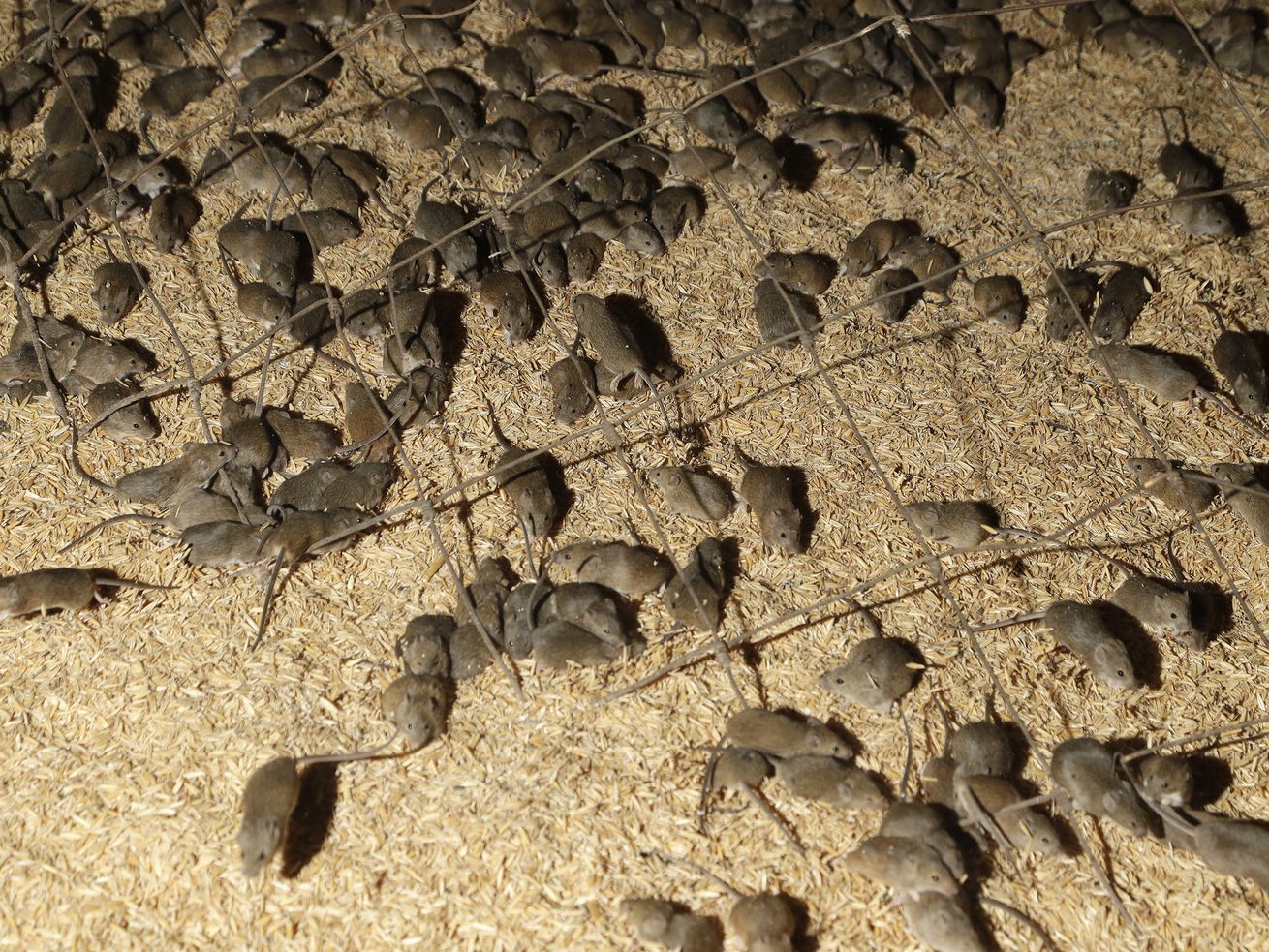
Mice scurry around stored grain on a farm near Tottenham, Australia on May 19, 2021. Vast tracts of land in Australia’s New South Wales state are being threatened by a mouse plague that the state government describes as “absolutely unprecedented.” Just how many millions of rodents have infested the agricultural plains across the state is guesswork. | AP
Vast tracts of land in Australia’s New South Wales state are being threatened by a mouse plague that the state government describes as “absolutely unprecedented.” Just how many millions of rodents have infested the agricultural plains across the state is guesswork.
BOGAN GATE, Australia — At night, the floors of sheds vanish beneath carpets of scampering mice. Ceilings come alive with the sounds of scratching. One family blamed mice chewing electrical wires for their house burning down.
Vast tracts of land in Australia’s New South Wales state are being threatened by a mouse plague that the state government describes as “absolutely unprecedented.” Just how many millions of rodents have infested the agricultural plains across the state is guesswork.
“We’re at a critical point now where if we don’t significantly reduce the number of mice that are in plague proportions by spring, we are facing an absolute economic and social crisis in rural and regional New South Wales,” Agriculture Minister Adam Marshall said this month.
Bruce Barnes said he is taking a gamble by planting crops on his family farm near the central New South Wales town of Bogan Gate.
“We just sow and hope,” he said.
The risk is that the mice will maintain their numbers through the Southern Hemisphere winter and devour the wheat, barley and canola before it can be harvested.
NSW Farmers, the state’s top agricultural association, predicts the plague will wipe more than $775 million from the value of the winter crop.
The state government has ordered 1,320 gallons of the banned poison Bromadiolone from India. The federal government regulator has yet to approve emergency applications to use the poison on the perimeters of crops. Critics fear the poison will kill not only mice but also animals that feed on them. including wedge-tail eagles and family pets.
“We’re having to go down this path because we need something that is super strength, the equivalent of napalm to just blast these mice into oblivion,” Marshall said.
The plague is a cruel blow to farmers in Australia’s most populous state who have been battered by fires, floods and pandemic disruptions in recent years, only to face the new scourge of the introduced house mouse, or Mus musculus.
The same government-commissioned advisers who have helped farmers cope with the drought, fire and floods are returning to help people deal with the stresses of mice.
The worst comes after dark, when millions of mice that had been hiding and dormant during the day become active.
By day, the crisis is less apparent. Patches of road are dotted with squashed mice from the previous night, but birds soon take the carcasses away. Haystacks are disintegrating due to ravenous rodents that have burrowed deep inside. Upending a sheet of scrap metal lying in a paddock will send a dozen mice scurrying. The sidewalks are strewn with dead mice that have eaten poisonous bait.
But a constant, both day and night, is the stench of mice urine and decaying flesh. The smell is people’s greatest gripe.
“You deal with it all day. You’re out baiting, trying your best to manage the situation, then come home and just the stench of dead mice,” said Jason Conn, a fifth generation farmer near Wellington in central New South Wales.
“They’re in the roof cavity of your house. If your house is not well sealed, they’re in bed with you. People are getting bitten in bed,” Conn said. “It doesn’t relent, that’s for sure.”
Colin Tink estimated he drowned 7,500 mice in a single night last week in a trap he set with a cattle feeding bowl full of water at his farm outside Dubbo.
“I thought I might get a couple of hundred. I didn’t think I’d get 7,500,” Tink said.
Barnes said mouse carcasses and excrement in roofs were polluting farmers’ water tanks.
“People are getting sick from the water,” he said.
The mice are already in Barnes’ hay bales. He’s battling them with zinc phosphide baits, the only legal chemical control for mice used in broad-scale agriculture in Australia. He’s hoping that winter frosts will help contain the numbers.
Farmers like Barnes endured four lean years of drought before 2020 brought a good season as well as the worst flooding that some parts of New South Wales have seen in at least 50 years. But the pandemic brought a labor drought. Fruit was left to rot on trees because foreign backpackers who provide the seasonal workforce were absent.
Plagues seemingly appear from nowhere and often vanish just as fast.
Disease and a shortage of food are thought to trigger a dramatic population crash as mice feed on themselves, devouring the sick, weak and their own offspring.
Government researcher Steve Henry, whose agency is developing strategies to reduce the impact of mice on agriculture, said it is too early to predict what damage will occur by spring.
He travels across the state holding community meetings, sometimes twice a day, to discuss the mice problem.
“People are fatigued from dealing with the mice,” Henry said.



/cdn.vox-cdn.com/uploads/chorus_asset/file/22546323/CSO_Return_032.jpeg)