
Democrats don’t give a damn about babies after they’re bornon June 2, 2021 at 10:20 pm
Democrats don’t give a damn about babies after they’re bornon June 2, 2021 at 10:20 pm Read More »

Bears rookie receiver Dazz Newsome broke his left collarbone during Tuesday’s organized team activity practice and will have surgery Thursday to repair it, a source confirmed to the Sun-Times.
Bears rookie receiver Dazz Newsome broke his left collarbone during Tuesday’s organized team activity practice and will have surgery Thursday to repair it, a source confirmed to the Sun-Times.
The sixth-round is expected to miss about eight weeks — which would put him on target to return near the beginning of training camp July 27.
The North Carolina alum — who caught 188 balls for 2,435 yards over four college seasons — attended practice Wednesday with a sling on his left arm.
“It’s unfortunate,” Bears coach Matt Nagy said. “But the kid is tough as heck and bounced back up until we went in and looked at it and saw that it wasn’t too good. But he’s been in good spirits. He was here [Wednesday] morning and we’ll put together a game plan moving forward.”
Newsome was one of five Bears rookies — all but first-round pick Justin Fields and second-round pick Teven Jenkins — to sign his NFL contract on Wednesday. The Bears inked Missouri offensive tackle Larry Borom (fifth round, No. 151 overall), Virginia Tech running back Khalil Herbert (sixth round, No. 217), Oregon cornerback Thomas Graham Jr. (sixth round, No. 228) and defensive tackle Khyiris Tonga (seventh round, No. 250) to four-year contracts.
The Bears almost certainly will need to make additional salary-cap maneuvers to fit contracts for Fields and Jenkins. Spotrac projects a four-year, $18.9 million contract for Fields with a $3.4 million cap hit this season and has Jenkins at four years, $8.4 million.

The woman and her son were at home in the 5200 block of West Congress Parkway when a man fired at them.
Police are speaking to a person of interest after a gunman shot a woman and her 1-year-old son through the window of their apartment in Austin on the West Side.
The shooting happened around 11:45 p.m. Tuesday in the 5200 block of West Congress Parkway, Chicago police said.
The woman was grazed by a bullet and was taken to Stroger Hospital in good condition, police said. The boy was struck twice in the legs, and was taken to the same hospital where he was stabilized.
A police spokeswoman confirmed that police were speaking to a person of interest. No charges have been filed.
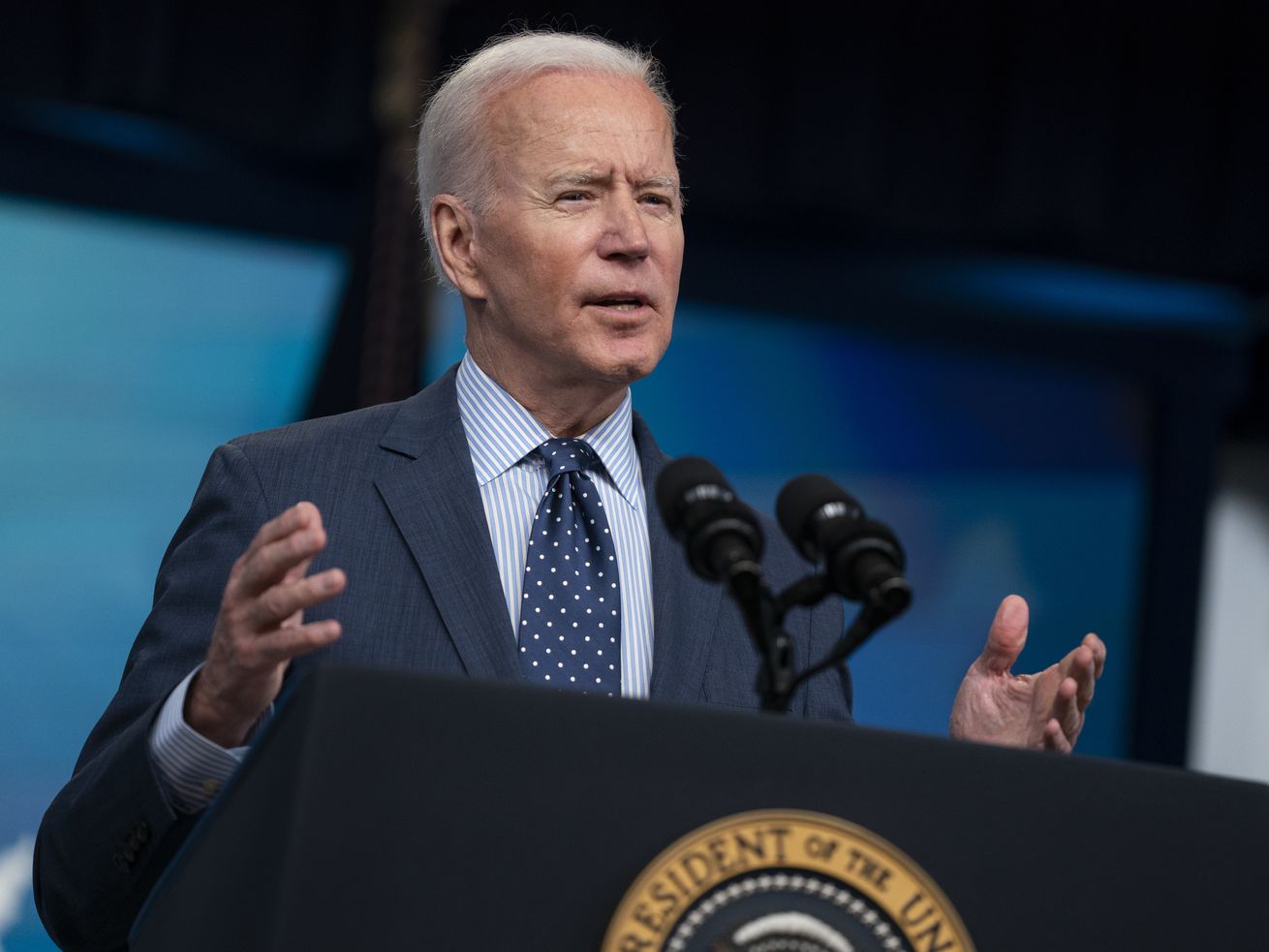
President Joe Biden on Wednesday announced a “month of action” to urge more Americans to get vaccinated before the July 4 holiday, including an early summer sprint of incentives and a slew of new steps to ease barriers and make getting shots more appealing to those who haven’t received them.
WASHINGTON — Dangling everything from sports tickets to a free beer, President Joe Biden is looking for that extra something — anything — that will get people to roll up their sleeves for COVID-19 shots when the promise of a life-saving vaccine by itself hasn’t been enough.
Biden on Wednesday announced a “month of action” to urge more Americans to get vaccinated before the July 4 holiday, including an early summer sprint of incentives and a slew of new steps to ease barriers and make getting shots more appealing to those who haven’t received them. He is closing in on his goal of getting 70% of adults at least partially vaccinated by Independence Day — essential to his aim of returning the nation to something approaching a pre-pandemic sense of normalcy this summer.
“The more people we get vaccinated, the more success we’re going to have in the fight against this virus,” Biden said from the White House. He predicted that with more vaccinations, America will soon experience “a summer of freedom, a summer of joy, a summer of get togethers and celebrations. An All-American summer.”
The Biden administration views June as “a critical month in our path to normal,” Courtney Rowe, the director of strategic communications and engagement for the White House COVID-19 response team, told the AP.
Biden’s plan will continue to use public and private-sector partnerships, mirroring the “whole of government” effort he deployed to make vaccines more widely available after he took office. The president said he was “pulling out all the stops” to drive up the vaccination rate.
Among those efforts is a promotional giveaway announced Wednesday by Anheuser-Busch, saying it will “buy Americans 21+ a round of beer” once Biden’s 70% goal is met.
“Get a shot and have a beer,” Biden said, advertising the promotion even though he himself refrains from drinking alcohol.
Additionally, the White House is partnering with early childhood centers such as KinderCare, Learning Care Group, Bright Horizons and more than 500 YMCAs to provide free childcare coverage for Americans looking for shots or needing assistance while recovering from side effects.
The administration is also launching a new partnership to bring vaccine education and even doses to more than a thousand Black-owned barbershops and beauty salons, building on a successful pilot program in Maryland.
They’re the latest vaccine sweeteners, building on other incentives like cash giveaways, sports tickets and paid leave, to keep up the pace of vaccinations.
“The fact remains that despite all the progress, those who are unvaccinated still remain at risk of getting seriously ill or dying or spreading the disease to others,” said Rowe.
Aiming to make injections even more convenient, Biden is announcing that many pharmacies are extending their hours this month — and thousands will remain open overnight on Fridays. The White House is also stepping up its efforts to help employers run on-site vaccination clinics.
Biden will also announce that he is assigning Vice President Kamala Harris to lead a “We Can Do This” vaccination tour to encourage shots. It will include first lady Jill Biden, second gentleman Doug Emhoff and Cabinet officials. Harris’ travel will be focused on the South, where vaccination rates are among the lowest in the country, while other officials will travel to areas of the Midwest with below average rates.
To date 62.9% of the adult U.S. population have received at least one dose of a COVID-19 vaccine and 133.9 million are fully vaccinated. The rate of new vaccinations has slowed to an average below 555,000 per day, down from more than 800,000 when incentives like lotteries were announced, and down from a peak of nearly 2 million per day in early April when demand for shots was much higher.
The lengths to which the U.S. is resorting to convince Americans to take a shot stands in contrast to much of the world, where vaccines are far less plentiful. Facing a mounting U.S. surplus, the Biden administration is planning to begin sharing 80 million doses with the world this month.
“All over the world people are desperate to get a shot that every American can get at their neighborhood drugstore,” Biden said.
Thanks to the vaccinations, the rate of cases and deaths in the U.S. are at their lowest since the beginning of the pandemic last March, averaging under 16,000 new cases and under 400 deaths per day.
As part of the effort to drive Americans to get shots, the White House is borrowing some tools from political campaigns, including phone banks, door-knocking and texting. The administration says more than 1,000 such events will be held this weekend alone. Additionally, it is organizing competitions between cities and colleges to drive up vaccination rates.
Other new incentives include a $2 million commitment from DoorDash to provide gift cards to community health centers to be used to drive people to get vaccinated. CVS launched a sweepstakes with prizes including free cruises and Super Bowl tickets. Major League Baseball will host on-site vaccine clinics and ticket giveaways at games. And Kroger will give $1 million to a vaccinated person each week this month and dozens of people free groceries for the year.
The fine print on the Anheuser-Busch promotion reveals the benefits to the sponsoring company, which will collect consumer data and photos through its website to register for the $5 giveaway. The company says it will hand out credits to however many people qualify.

The dramatic announcement by opposition leader Yair Lapid and his main coalition partner, Naftali Bennett, came moments before a midnight deadline and prevented the country from plunging into what would have been its fifth consecutive election in just over two years.
JERUSALEM — Prime Minister Benjamin Netanyahu’s opponents on Wednesday announced they have reached a deal to form a new governing coalition, paving the way for the ouster of the longtime Israeli leader.
The dramatic announcement by opposition leader Yair Lapid and his main coalition partner, Naftali Bennett, came shortly before a midnight deadline and prevented the country from plunging into what would have been its fifth consecutive election in just over two years.
“This government will work for all the citizens of Israel, those that voted for it and those that didn’t. It will do everything to unite Israeli society,” Lapid said.
Under the agreement, Lapid and Bennett will split the job of prime minister in a rotation. Bennett will serve the first two years, while Lapid is to serve the final two years. The historic deal also includes a small Islamist party, the United Arab List, which would make it the first Arab party ever to be part of a governing coalition.
The agreement still needs to be approved by the Knesset, or parliament, in a vote that is expected to take place early next week. If it goes through, Lapid and a diverse array of partners that span the Israeli political spectrum will end the record-setting 12-year rule of Netanyahu.
Netanyahu, desperate to remain in office while he fights corruption charges, is expected to do everything possible in the coming days to prevent the new coalition from taking power. If he fails, he will be pushed into the opposition.
Netanyahu has attempted to put pressure on hard-liners in the emerging coalition to defect and join his religious and nationalist allies. Knesset Speaker Yariv Levin, a member of Netanyahu’s Likud party, may also use his influence to delay the required parliamentary vote.
Lapid called on Levin to convene the Knesset for the vote as soon as possible.
Netanyahu has been the most dominant player in Israeli politics over the past three decades — serving as prime minister since 2009 in addition to an earlier term in the late 1990s.
Despite a long list of achievements, including last year’s groundbreaking diplomatic agreements with four Arab countries, he has become a polarizing figure since he was indicted on charges of fraud, breach of trust and accepting bribes in 2019.
Each of the past four elections was seen as a referendum on Netanyahu’s fitness to rule. And each ended in deadlock, with both Netanyahu’s supporters as well as his secular, Arab and dovish opponents falling short of a majority. A unity government formed with his main rival last year collapsed after just six months.
The new deal required a reshuffling of the Israeli political constellation. Three of the parties are led by hard-line former Netanyahu allies who had personal feuds with him, while the United Arab List made history as a kingmaker, using its leverage to seek benefits for the country’s Arab minority.
“This is the first time an Arab party is a partner in the formation of a government,” the party’s leader, Mansour Abbas, told reporters. “This agreement has a lot of things for the benefit of Arab society, and Israeli society in general.”
Lapid, 57, entered parliament in 2013 after a successful career as a newspaper columnist, TV anchor and author. His new Yesh Atid party ran a successful rookie campaign, landing Lapid the powerful post of finance minister.
But he and Netanyahu did not get along, and the coalition quickly crumbled. Yesh Atid has been in the opposition since 2015 elections. The party is popular with secular, middle-class voters and has been critical of Netanyahu’s close ties with ultra-Orthodox parties and said the prime minister should step down while on trial for corruption charges.
Bennett, meanwhile, is a former top aide to Netanyahu whose small Yamina party caters to religious and nationalist hard-liners. Bennett was a successful high-tech entrepreneur and leader of the West Bank settler movement before entering politics.
It is far from certain that their coalition will last that long. In order to secure the required parliamentary majority, Lapid had to bring together eight parties that have little in common.
Their partners range from a pair of dovish, left-wing parties that support broad concessions to the Palestinians to three hard-line parties that oppose Palestinian independence and support West Bank settlements. Lapid’s Yesh Atid and Blue and White, a centrist party headed by Defense Minister Benny Gantz, and the United Arab List are the remaining members.
The coalition members are hoping their shared animosity to Netanyahu, coupled with the agreement that another election must be avoided, will provide enough incentive to find some common ground.
“Today, we succeeded. We made history,” said Merav Michaeli, leader of the dovish Labor Party.
The negotiations went down to the wire, with Labor and Yamina feuding over the makeup of a parliamentary committee.
Earlier this week, when Bennett said he would join the coalition talks, he said that everyone would have to compromise and give up parts of their dreams. During the recent election campaign, Bennett had publicly vowed never to share power with Lapid or an Arab party. But facing the prospect of another unwanted election, Bennett, like the others, found flexibility.
In order to form a government, a party leader must secure the support of a 61-seat majority in the 120-seat Knesset, or parliament. Because no single party controls a majority on its own, coalitions are usually built with smaller partners. Thirteen parties of various sizes are in the current parliament.
As leader of the largest party, Netanyahu was given the first opportunity by the country’s figurehead president to form a coalition. But he was unable to secure a majority with his traditional religious and nationalist allies.
Netanyahu, who in the past has incited against Israel’s Arab minority, even attempted to court the United Arab List but was thwarted by a small ultranationalist party.
After Wednesday’s coalition deal was announced, that party, the Religious Zionists, angrily accused Bennett of betraying Israel’s right wing.
“We won’t forget and we won’t forgive,” said Bezalel Smotrich, leader of the Religious Zionists.
After Netanyahu’s failure to form a government, Lapid was then given four weeks to cobble together a coalition. That window was set to expire at midnight.
Lapid already faced a difficult challenge bringing together such a disparate group of partners. But then war broke out with Hamas militants in the Gaza Strip on May 10. The fighting, along with the eruption of Arab-Jewish mob violence in Israeli cities during the war, put the coalition talks on hold.
But after a cease-fire was reached on May 21, the negotiations resumed, and Lapid raced to sew up a deal. He reached a breakthrough on Sunday when Bennett, a former ally of Netanyahu, agreed to join the opposition coalition.
___
AP correspondent Ilan Ben Zion contributed reporting.

The power struggle between the premier-designate, Saad Hariri, on one side and President Michel Aoun and his son-in-law Gebran Bassil on the other, has worsened despite warnings from world leaders and economic experts of the dire economic conditions tiny Lebanon is facing.
BEIRUT — Lebanon’s president and prime minister-designate traded barbs Wednesday, accusing one another of obstruction, negligence and insolence in a war or words that has for months obstructed the formation of a new government as the country sinks deeper into economic and financial crisis.
The power struggle between the premier-designate, Saad Hariri, on one side and President Michel Aoun and his son-in-law Gebran Bassil on the other, has worsened despite warnings from world leaders and economic experts of the dire economic conditions tiny Lebanon is facing. The World Bank on Tuesday said Lebanon’s crisis is one of the worst the world has seen in the past 150 years.
In a reflection of the growing turmoil, scores of Lebanese lined up in front of ATM machines late on Wednesday, after a top court suspended a Central Bank decree that allowed them to withdraw from dollar deposits at a rate two and a half times better than the fixed exchange rate.
In a late night burst of anger, protesters blocked main roads in Beirut and north of the capital. A young activist told a local TV station the protest was against the constant humiliation of Lebanese who line up to fill their cars with fuel, increasing power cuts, search for medicine and deal with confused banking decisions that are robbing thousands of their savings.
The Lebanese pound, pegged to the dollar for 30 years at 1,507, has been in a free fall since late 2019. It is now trading at nearly 13,000 to the dollar at the black market.
Lebanon is governed by a sectarian power sharing agreement but as the crisis deepens, members of the ruling elite bicker over how to form a government that will have to make tough decisions.
Hariri, who was tasked by Aoun to form a Cabinet seven months ago, blames the president for the months-long delay, accusing him of insisting on having veto power in the upcoming government.
Aoun, an ally of the powerful militant Hezbollah group, has said that Hariri did not shoulder his responsibilities in forming a government they both can agree on. There is no legal avenue for the president to fire the prime minister-designate, who is chosen to the post by a majority of lawmakers.
The rift has paralyzed the cash-strapped country, delaying urgently needed reforms. The economic crisis, which erupted in 2019, has been compounded by the impact of the coronavirus pandemic on Lebanon and a massive blast at Beirut’s port last year that killed over 200 people and defaced a big section of the capital.
The crisis has driven more than half of the population into poverty, caused the local currency to lose more than 85% of its value, and prompted banks to lock deposits through informal capital controls, eroding trust in a once-thriving banking sector.
The country’s highest administrative court on Tuesday ordered the temporary suspension of a Central Bank circular that gave depositors a chance to withdraw at a rate better than the pegged rate.
The Central Bank announced late Wednesday it was accepting the decision, prompting the queues outside ATMS. One man said he went from one ATM to another to withdraw as much as he could. Another complained that people’s savings are at the mercy of corrupt politicians.
“This is not resilience. We got used to being humiliated and controlled this much by the politicians,” said Mustafa Taoush, a 23-year-old who failed to withdraw more than a weekly limit imposed on withdrawals.
A statement from Aoun’s office on Wednesday accused Hariri of trying to usurp presidential powers, and coming up with “delusional propositions and insolent expressions.”
“The prime minister-designate ’s continuous evading of responsibilities … constitutes a persistent violation of the constitution and national accord,” it added.
Hariri and his political group, the Future party, responded by saying the presidency is “hostage to the personal ambitions” of Bassil, Aoun’s son-in-law, alluding to his alleged presidential aspirations.
High-level mediation efforts from France and local powerful players, including the parliament speaker and the head of the Maronite Church, have faded without a breakthrough in the face of intransigence from the rival parties in Lebanon.
Amid the Aoun-Hariri barbs, caretaker Prime Minister Hassan Diab warned that a collapse of Lebanon could have consequences beyond its borders, hinting at a possible massive exodus of refugees.
Diab, whose Cabinet resigned days after the port explosion, appealed on politicians to make concessions so that a new Cabinet could be formed — one that could resume talks with the International Monetary Fund on how to get out of the crisis.
“The collapse, if it happens, God forbid, will have very grave consequences not only for the Lebanese or those living here but also on friendly countries from the land and sea,” Diab said. “No one will be able to control what waves the sea bring.”
___
Associated Press writer Bassem Mroue contributed to this report.

Eric Lander painted a rosy near future where a renewed American emphasis on science not only better prepares the world for the next pandemic with plug-and-play vaccines, but also changes how medicine fights disease and treats patients, curbs climate change and further explores space.
The new White House science adviser wants to have a vaccine ready to fight the next pandemic in just about 100 days after recognizing a potential viral outbreak.
In his first interview after being sworn in Wednesday, Eric Lander painted a rosy near future where a renewed American emphasis on science not only better prepares the world for the next pandemic with plug-and-play vaccines, but also changes how medicine fights disease and treats patients, curbs climate change and further explores space. He even threw in a Star Trek reference.
“This is a moment in so many ways, not just health, that we can rethink fundamental assumptions about what’s possible and that’s true of climate and energy and many areas,” Lander told The Associated Press.
Lander took his oath of office on a 500-year-old fragment of the Mishnah, an ancient Jewish text documenting oral traditions and laws. He is the first director of the Office of Science and Technology Policy to be promoted to Cabinet level.
Lander said President Joe Biden’s elevation of the science post is a symbolic show “that science should have a seat at the table” but also allows him to have higher-level talks with different agency chiefs about research issues.
Lander is a mathematician and geneticist by training who was part of the human genome mapping project and directed the Broad Institute at MIT and Harvard. He said he is particularly focused not so much on this pandemic, but the lessons learned from this one to prepare for the next one.
“It was amazing at one level that we were able to produce highly effective vaccines in less than a year, but from another point of view you’d say, ‘Boy, a year’s a long time,’” even though in the past it would take three years or four years, Lander said. “To really make a difference we want to get this done in 100 days. And so a lot of us have been talking about a 100-day target from the recognition from a virus with pandemic potential.”
“It would mean that we would have had a vaccine in early April if that had happened this time, early April of 2020,” Lander said. “It makes you gulp for a second, but it’s totally feasible to do that.”
Scientists were working on so-called all-purpose ready-to-go platform technologies for vaccines long before the pandemic. They’re considered “plug-and-play.” Instead of using the germ itself to make a vaccine, they use messenger RNA and add the genetic code for the germ. That’s what happened with the Pfizer and Moderna COVID-19 shots.
Beyond being optimistic about confronting future pandemics, Lander wonders about the implications for preventing cancer.
“Maybe the same sort of experience about moving so much faster than we thought is applicable to cancer,” said Lander, who during the Obama administration was co-chair of the Presidential Council of Advisors on Science and Technology. A company already has been working on that.
For that matter, the pandemic and telehealth brought the doctor to patients in some ways. Lander said he is reimagining “a world where we rearrange a lot of things” to get more patient-centered health care, including community health workers checking up every few weeks on people about their blood pressure, blood sugar and other chronic problems.
Two of Lander’s predecessor praised him. Neal Lane, President Bill Clinton’s science adviser, said Lander is “perfect” for the pandemic because of the need for a strategy and international agreements. Obama’s science chief, John Holden, called him “a Renaissance man.”
Lander’s confirmation was delayed for months as senators sought more information about his meetings with disgraced financer Jeffrey Epstein, who was accused of sex trafficking, as well as Lander’s comments that were thought to play down the contribution of two Nobel Prize-winning female scientists.
Having visited Greenland on a balmy 72-degree day, Lander called climate change “an incredibly serious threat to this planet in many, many ways.”
Still, Lander said he was more optimistic now than he and others were a decade ago because “I see a path to doing something about it.”
Lander pointed to a drop of about in 90% in solar and energy wind costs, making them now as cheap as fossil fuels that cause climate change. But he said what’s also needed is “an explosion of ideas” to improve battery life and provide carbon-free energy that is not weather-dependent. Those innovations need federal incentives that are part of Biden’s jobs package, he said.
Reducing methane is key to fighting climate change, Lander added, but first improvements are needed in technology to determine where methane is leaking from.
As for space, Lander said he was too new to comment on whether heading to the moon or Mars should be the goal. The Obama administration redirected NASA away from the Bush-era plan to send astronauts back to the moon and was more aimed for Mars or an asteroid. The Trump administration not only focused back on the moon but set a 2024 goal for a new moon landing.
“Are we going to go to the moon and are we going to go to Mars and are we going to moons of Jupiter? Sure. The exact order I think is great to think about or great to talk about,” Lander said.
He quoted “Star Trek IV: The Voyage Home,” when Captain James T. Kirk’s love interest asked if he was from outer space. He responded: “I’m from Iowa, I only work in outer space.”
Adds Lander: “That was a fun line in ‘Star Trek IV,’ but folks in Iowa are really going to say that.”
__
AP Medical Writer Lauran Neergaard contributed to this report.
__
Follow Seth Borenstein on Twitter at @borenbears.
___
The Associated Press Health and Science Department receives support from the Howard Hughes Medical Institute’s Department of Science Education. The AP is solely responsible for all content.

U.S. Reps. Marjorie Taylor Greene and Matt Gaetz cheered the audit at a rally just outside Phoenix last month.
PHOENIX — Three Pennsylvania lawmakers were in Arizona on Wednesday to check out the state Senate GOP’s partisan audit of the 2020 election.
They’re the latest Republicans to make a pilgrimage to Phoenix, ground zero in the “stop the steal” movement’s push to find support for conspiracy theories suggesting the election was stolen from former President Donald Trump.
U.S. Reps. Marjorie Taylor Greene and Matt Gaetz cheered the audit at a rally just outside Phoenix last month. The next day, several prominent Trump supporters and conspiracy promoters were advertised as speakers at a Phoenix megachurch. Enrique Tarrio, leader of the Proud Boys extremist group, recently posted a short video of himself at the Arizona Capitol.
Political pilgrimages are nothing new to Arizona, where Republican politicians have long enjoyed photo ops in front of the Mexico border wall. But now, the draw is the Arizona State Fairgrounds, site of a former basketball arena where a Trump supporter who has promoted election conspiracies is overseeing a hand recount of 2.1 million ballots from Maricopa County.
The latest visitors are Pennsylvania Sens. Doug Mastriano and Cris Dush, and Rep. Rob Kauffman. They met with Arizona legislators at the Capitol before traveling to the audit site to get a briefing from the auditors.
“Transparency is a must (in) our republic,” Mastriano wrote in a news release posted on Twitter. “Every citizen should be confident that their vote counts.”
As Trump and his allies claimed without evidence last year that his Arizona loss was marred by fraud, the Arizona Senate GOP used its subpoena power to get access to all ballots, counting machines and hard drives full of election data in Maricopa County, home to Phoenix and 60% of Arizona’s voters.
They handed all of it over to a team led by Cyber Ninjas, a small consulting firm with no prior election experience for a hand recount and analysis of vote-counting machines and data.
The effort will not change President Joe Biden’s victory, and election experts have pointed to major flaws in the process. But it’s become a model for Republicans in other states hoping to turn up evidence supporting conspiracy theories.
“It’s my belief that Arizona will be the launch pad for elections audits and election integrity efforts all over this great country,” Gaetz said. He listed the swing states where Trump lost in 2020.
Greene said the audit was the reason she and Gaetz chose Mesa, a Phoenix suburb, for the second stop on their tour of America First rallies.
“Matt said, ‘You been following that Arizona audit?’” Greene said. “I said, ‘Yeah I’ve been following it.’ He said, ‘Lets go to Arizona.’ I said, ‘Count me in.’”
Mastriano has become a one-man force in conservative politics in Pennsylvania, leading anti-mask protests last year, pushing to overturn Trump’s reelection loss and showing up outside the U.S. Capitol during the Jan. 6 riot.
In November, Mastriano organized a hearing in Gettysburg that featured Rudy Giuliani and a phone call appearance by Trump in which the president claimed the election was rigged and urged state lawmakers to overturn the result.
All three visiting Pennsylvania lawmakers were among the 64 Republican legislators who signed a letter asking the state’s congressional delegation to object to Pennsylvania’s electoral college votes being cast for Biden.
___
Associated Press writer Marc Levy in Harrisburg, Pennsylvania, contributed.
“…it feel like NY, SUMMERTIME CHI, AH! NOW THROW YOUR HANDS UP IN THE SKYYYYY!!”
Kanye West couldn’t have written that lyric better. Summertime Chicago 2021 is about to be a Project X party mixed with Ferris Bueller’s day mixed with a fever dream of what we all expected Fyre Festival to be. This excitement comes after Gov. Pritzker has said that Illinois will be ready and advancing with Phase 5 beginning on June 11. That means buckle up, throw on your party pants and get ready because Chicago is back.
Every corner of the city is going to be buzzing. The momentum has been mounting for months now. The temps are hitting 70s and 80s, people are getting vaccinated at an incredible rate, the city’s positivity rate is below 2 percent, and the streets are starting to sing. Cubs and Sox games are over 60 percent capacity and the energy in the stadium is palpable. Both teams are in first place and there is basically a Crosstown Classic World Series on the horizon.
Rooftop and patio bars around the city are entertaining patrons like we haven’t seen in two years. Lollapalooza, Pitchfork, and Windy City Smokeout are slated to return. The beaches are one strong week of 90 degree weather away from being filled with great taste less filling Miller Lite’s and suburban high school kids. The Play Pen, Wells Street, the Riverwalk, every single neighborhood in every single inch of this city…is ready. I could cry I’m so excited right now.
This is an exciting time in Chicago, and rightfully so. The city—along with the rest of the world—has undergone a 14-15 month period where our lives were completely flipped on its head. The past few months every Chicagoan has helped by doing their part in order to get to this point so go on with yourself Chicago. Celebrate this accordingly. Spend that extra $100 in the Bleachers, go to a museum you’ve never seen before, go to Lolla even if you hate it. It doesn’t matter, this summer is yours kings and queens.
Toss that mask to the side and pour yourself a drink. It’s Summertime, Chicago. And it’s one that you’re certainly never going to forget.
Summertime Chicago 2021 Featured Image Credit: Mike Fox on Unsplash
The post Summertime Chicago 2021 is All the Way Back Beginning June 11th appeared first on UrbanMatter.

Chancellor Rebecca Blank announced Wednesday that McIntosh will take over when Alvarez finalizes his retirement. The 74-year-old Alvarez announced April 6 that he was stepping down, and his retirement is expected to take effect at the beginning of July.
MADISON, Wis. — Chris McIntosh played for Barry Alvarez on two of Wisconsin’s Rose Bowl championship teams and spent the last few years working as his right-hand man.
Now he is about to succeed his former coach and boss as the Badgers’ athletic director.
Chancellor Rebecca Blank announced Wednesday that McIntosh will take over when Alvarez finalizes his retirement. The 74-year-old Alvarez announced April 6 that he was stepping down, and his retirement is expected to take effect at the beginning of July.
“I owe so much to the University of Wisconsin, and I’m deeply honored to be able to succeed Barry Alvarez,” McIntosh said in a statement released by the university before an afternoon news conference. “We will build upon our legacy of success on the field of competition and support our student-athletes in the classroom, on campus and after college.”
McIntosh is expected to make $940,000 annually, with $500,000 coming from university funds. The remaining portion will come from private gift funds designated for athletics.
McIntosh, a native of Pewaukee, Wisconsin, has worked in the Badgers’ athletic department since 2014 and became deputy athletic director in 2017. His roles included day-to-day operations, student-athlete recruitment, business development, human resources and strategic planning.
“Mac has been an essential part of my staff for several years,” Alvarez said in a statement. “In particular, his leadership and intelligence were critical in helping our department navigate the various challenges of the past 15 months. Those same qualities will serve him well on into the future.”
McIntosh, 44, was an offensive tackle and team captain when the Badgers won consecutive Rose Bowls in the 1998 and 1999 seasons. He was an All-American and Outland Trophy finalist in 1999 before the Seattle Seahawks selected him with the 22nd overall pick of the 2000 NFL draft.
A neck injury limited his NFL career to 24 games.
“He is uniquely positioned to continue our proud traditions of success on and off the field and doing things ‘the right way,’” Blank said. “Chris will build upon those traditions and has a strong vision for leading the program during a time of change in college athletics.”
McIntosh now faces the challenge of replacing Alvarez, one of the most prominent figures in the history of Wisconsin athletics.
Alvarez arrived at Wisconsin in 1990 as football coach and became athletic director in 2004. He briefly served in a dual role before stepping down as football coach after the 2005 season.
Wisconsin’s football team went 9-36 in the four seasons before Alvarez’s arrival but emerged as regular Big Ten contenders during his coaching tenure.
“I have known Mac since he was a teenager when he joined our football program,” Alvarez said. “I am extremely proud of what he has accomplished in his life.”