Jeff Reinebold, special teams coordinator of the CFL’s Hamilton Tiger-Cats and his nearly 40 years of coaching experience joins the 100 Crew to talk ChicagoBears football
A person was critically wounded in a shooting Wednesday night on the Dan Ryan Expressway.
The shooting happened about 7:40 p.m. on I-94 northbound express lanes near 33rd Street, according to Illinois State Police.
The driver of a vehicle suffered a gunshot wound and was transported to the University of Chicago Medical Center in critical condition, Chicago fire officials said.
The passenger of the vehicle was also taken to an area hospital with injuries from a crash during the incident, state police said.
All local lanes are shut down with traffic diverted at 35th Street, state police said. Express lanes are closed at 47th and traffic diverted to local lanes.
The ramp at 35th street also remains close for investigation.
A 14-year-old girl was critically wounded in a shooting Wednesday in Back of the Yards on the South Side.
About 6 p.m., the girl was standing on the sidewalk in the 1700 block of West 48th Street when three people approached her and one fired shots, Chicago police said.
She was struck in the head and taken to Comer Children’s Hospital in critical condition, police said.
Police investigate the scene were a 14-year-old girl was shot and critically wounded June 2, 2021 in the 1700 block of West 48th Street.Anthony Vazquez / Sun-Times
No one is in custody as area detectives investigate.
Community activist Andrew Holmes said the girl was in surgery around 8 p.m. Her family was at the hospital.
Holmes urged neighbors who may have cameras on their house to give footage to the Chicago Police Department to aid its investigation.
With shootings up 36% this year compared to 2020, Holmes put partial blame on pretrial judges who set bonds, saying the lack of consequences for gun offenders is resulting in more violence — a belief previously expressed by Chicago Police Supt. David Brown.
“These streets belongs to the children, the parks belong to the children,” Holmes said Wednesday outside Comer Hospital. “Give our city back to our youth.”
Between 5 and 8 p.m. Wednesday, at least four other people were also shot in Chicago, two of them fatally.
The divorce proceedings between former ChicagoBears quarterback Jay Cutler and his soon-to-be ex-wife Kristin Cavallari are starting to get a little messy.
NASCAR driver Bubba Wallace plays a game on a race simulator Wednesday at the Union League Boys & Girls Club at 2157 W. 19th St. in Pilsen. | Anthony Vazquez/Sun-Times
One of NASCAR racing’s biggest stars, Bubba Wallace donates two racing simulators and money to the club during a visit Wednesday in an effort to expand the sport’s audience among Latinos and Blacks.
Youngsters in Pilsen got an introduction to NASCAR racing when one of its biggest stars, Bubba Wallace, visited the Union League Boys & Girls Club on Wednesday afternoon and donated two racing simulators and money.
Wallace, whose real name is William Darrell Wallace Jr., came to the club as part of a partnership between the Boys and Girls Clubs of America and NASCAR with the goal of expanding the sport’s audience, according to Mary Ann Mahon Huels, president and CEO of the Union League Boys & Girls Cubs, which has several locations in Chicago.
Wallace, in town for a Fox television event Thursday, wanted to do something for young kids while in Chicago, according to spokesperson Beth Silverman.
Wallace, decked out in his McDonald’s Racing suit and ball cap, races under number 23 — and races on 23XI Racing team, owned by Chicago’s most famous number 23 — Michael Jordan.
Walking into the gymnasium of the club at 2157 W. 19th St., Wallace was greeted by about 30 children who regularly attend the club both during and after school hours. And although many of them said they didn’t know until recently who Wallace was, when asked who the most famous athlete to ever wear number 23 was, most shouted that it was Michael Jordan, a fact Wallace said he was well aware of.
“I got a great appreciation by watching The Last Dance of what Michael Jordan means to Chicago and what Chicago means to Michael Jordan. It’s kind of surreal; I feel like we came full circle being here today,” Wallace said.
Also Wednesday, NASCAR gave the club a $5,000 check and two racing simulators were provided to the club by Logitech, one of several Wallace sponsors. A third simulator was given to the Club’s branch at 1214 W. Washtenaw.
After taking a few questions from the kids, Wallace jumped on a simulator and was cheered on by the kids in the clubs. Then, he let them have a turn behind the wheel and rooted them on.
Wallace, who is mixed race and the only full-time African American driver in NASCAR’s three national series (Cup, Xfinity and Truck), also said it was important that the kids in the club, who are mostly Latino and Black, see that they have options.
“I went to Boys & Girls Clubs a few times when I was young and know how special it is for people to come in. To see what we’re doing now and having NASCAR be a part of it is very humbling.”
“It’s important to get them out to race and introduce them to it so they can be lifelong fans.
Since the murder of George Floyd in Minneapolis last year, Wallace has been vocal about the need for change in stock car racing and led NASCAR’s involvement in the Black Lives Matter Movement. He also successfully got NASCAR to ban displays of the Confederate Flag at events starting last June, a practice that went on for several years.
Now the challenge is to integrate the sports fan base, which is still overwhelmingly white. But events like the one Wednesday are a start, Wallace said.
After telling the kids that he’d love to see a NASCAR event in Chicago eventually, he conceded that winning a NASCAR race may be easier than navigating Chicago traffic in rush hour.
“Traffic is tougher. Traffic’s always the worst,” Wallace said, laughing.
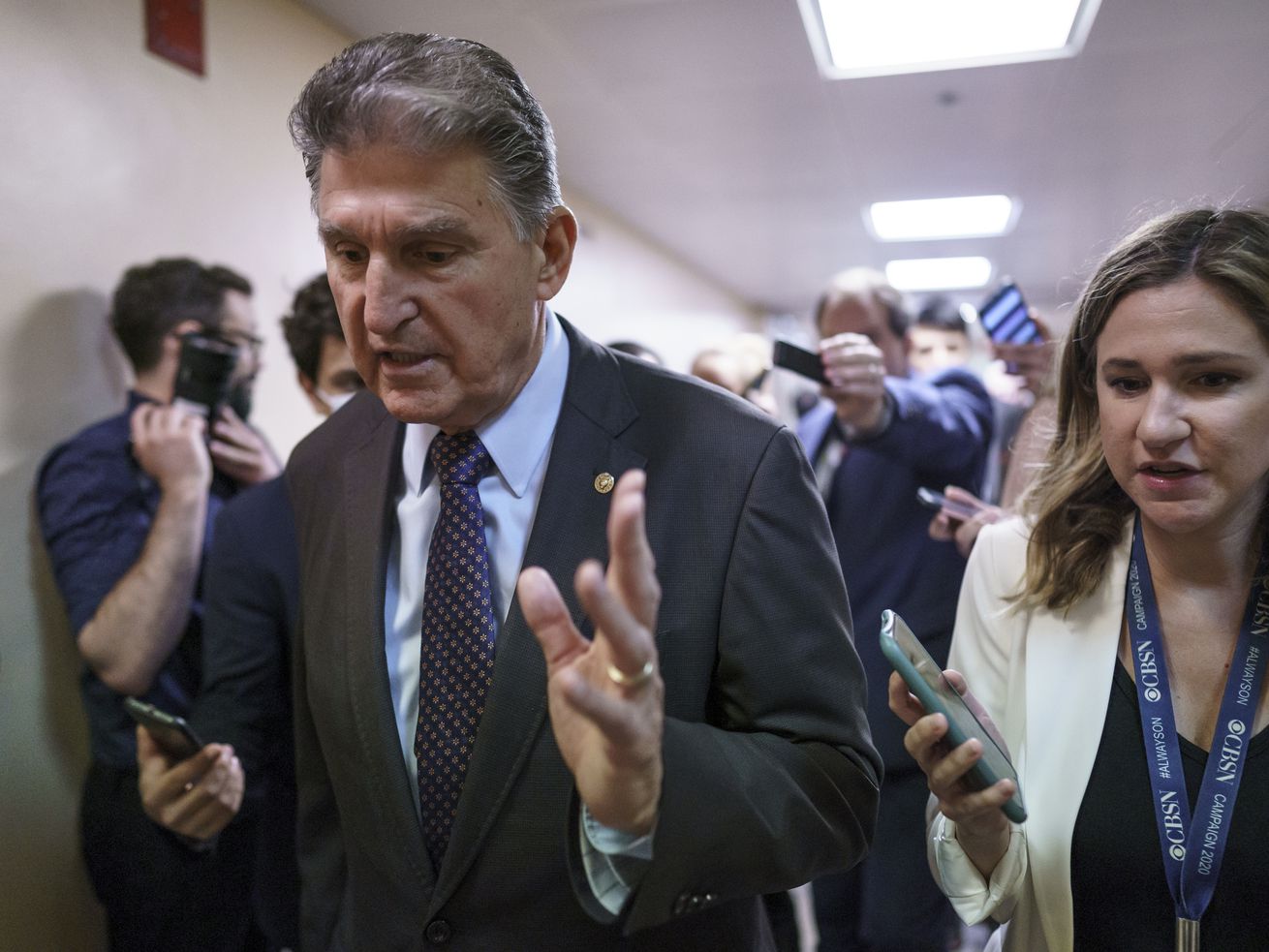
Preserving the filibuster seems more important to certain “moderate” Democrats, such as Sen. Joe Manchin of West Virginia, than taking action on big issues like climate change and voting rights, writes Gene Lyons. | AP Photos
Senate Democrats should ditch the filibuster and get stuff done. Does anybody think the GOP wouldn’t do away with the rule whenever it’s convenient?
Have Americans still got the guts for democracy? In light of recent events in Washington, you’d have to say it’s doubtful.
Last week, the Senate voted 54-35 to establish an independent commission to investigate the seditious Jan. 6 storming of the U.S. Capitol — the most violent attack there since the War of 1812. The House had previously approved the measure 252-175.
If the Senate vote were a football score, you’d call a 19-point win decisive. And yet, the measure failed to survive a Republican filibuster, a quaint Senate rule requiring a supermajority of 60 votes to become law.
Created during racial segregation and used for decades to block civil rights reforms, the filibuster is found nowhere in the U.S. Constitution. It’s neither a law nor a Supreme Court ruling. It’s merely a Senate custom — and an openly undemocratic one — which could be eliminated tomorrow by a simple majority vote.
The Senate is a conservative institution by definition. It gives far more power and influence to small rural states than to large, metropolitan ones where most people live. Citizens of Wyoming, population 579,000, for example, have about 70 times the influence in the U.S. Senate as citizens of California, population 39.5 million.
Only major constitutional surgery can change that, so it’s never going to happen. No point even talking about it.
Add the filibuster, however, and it’s a recipe for legislative paralysis: to wit, a government that refuses to defend itself against violent insurrection because it might hurt Citizen Trump’s feelings.
Or might put Sen. Mitch McConnell, R-Ky., in a tight spot. Not to mention Rep. Kevin McCarthy, R-Calif. These two heroes spoke out decisively in the immediate aftermath of the January coup attempt, but now the wind has changed and they’re busily hunting cover.
“If you can’t get a Republican to support a nonpartisan analysis of why the Capitol was attacked the first time since the War of 1812, then what are you holding out hope for?” asks Sen. Tim Kaine, D-Va.
What, indeed?
Former Obama White House aide David Plouffe put it even more bluntly on Twitter: “Democracy dying so the filibuster can live would seem a terrible way for this experiment to end.”
Polls have shown that Americans support the establishment of a Jan. 6 commission by 56% to 30% — a clear majority. Even 28% of Republicans would be interested in finding out, for example, how many of those “tours” given by right-wing members of Congress on Jan. 5 comprised pre-riot reconnaissance. Or who gave the “stand down” order preventing the National Guard from arriving on time, and why.
Just how organized was the conspiracy that resulted in uniformed Proud Boys running through the halls of Congress chanting “Hang Mike Pence!” while the vice president’s security team hustled him into hiding?
Did the Proud Boys keep it a secret from their pal Roger Stone? Did he neglect to tell his pal Donald J. Trump?
Inquiring minds want to know.
Senate Republicans, not so much.
Look, under current circumstances, 54-35 equates to a thunderous majority. The filibuster, however, equates with doing nothing, and with political cowardice.
Indeed, the filibuster is arguably more responsible than anything else for the disdain with which most Americans view Congress’ congenital inability to act. That’s certainly how Sen. Edward Markey, D-Mass., sees it.
“If they block the Jan. 6 commission, we will have to abolish the filibuster,” Markey told The Washington Post. “If the Republicans block climate action, we will have to abolish the filibuster. If Republicans block voting rights, we’ll have to abolish the filibuster. If Republicans block gun control legislation, we will have to abolish the filibuster. So I think that it’s just continuing to move towards the inevitability of the unavoidable necessity of repealing the filibuster.”
And yet, preserving the filibuster is seemingly more important to certain “moderate” Democrats — specifically Sens. Joe Manchin, D-W.Va., and Kyrsten Sinema, D-Ariz. — than all of those things. See, something else the filibuster does is enhance the power and visibility of individual senators — one reason President Joe Biden, a 30-year Senate veteran, is himself iffy about abolition.
The argument is that the 60-vote Senate requirement somehow fosters bipartisanship, although nobody ever says how. Mostly it now fosters Manchin’s televised imitations of Maine’s GOP Sen. Susan Collins — routinely regretting this and deploring that, before falling quietly in line. (In fairness, Manchin and Collins both voted for the Jan. 6 commission.)
On the day after voting to drop the filibuster, Manchin would return to being just another of 50 Democratic senators. So there’s that.
Others argue that should Republicans retake the Senate come 2022, Democrats could come to regret it. Could be, although does anybody think the GOP won’t ditch the rule whenever it’s convenient?
In the foreseeable future, there’s no chance of either party securing a 60-vote majority. The choice is between majority rule and paralysis.
The ChicagoBlackhawks are going to make the 11th overall pick in the 2021 NHL Draft. They had the 11th best odds and stayed right there. A lot of things went right for the Blackhawks in 2020-21 but the season did not finish strong for them. Picking 11th is pretty much exactly where you don’t […]
Mayor Lori Lightfoot doubled down on her decision to terminate a 15-year-old redevelopment agreement the city had with Mercy Hospital in order to prevent it from shuttering despite Ald. Sophia King (4th) saying the city abused its authority by not seeking City Council approval first.
Lightfoot called King an “interesting person” who was willing to let the Bronzeville hospital close to keep the redevelopment agreement in place.
The mayor said she was not about to let that happen.
“Mercy Hospital is in dire circumstances, and one thing that we know coming out of the pandemic is it is crucial that our safety net hospitals are supported, that they remain open, that they provide services to people in communities most in need,” Lightfoot said Wednesday. “Keeping that hospital open was a key priority for me. [I] make no apologies about it.”
Meanwhile, as the mayor reasserted her decision, the Illinois Legislative Reference Bureau, which is responsible for drafting state legislation, sent King a letter stating that, yes, City Council approval would usually be needed to terminate the redevelopment agreement.
However, the Bureau letter also stated the city could unilaterally terminate the agreement without Council approval under certain conditions. It outlined five, and at least one would seem to apply.
If Mercy “breaches any other of the covenants in the RDA, including by being party to a merger, liquidation, or consolidation, or selling, transferring, conveying, leasing, or otherwise disposing of all or substantially all of its assets or any portion of the property,” the city could terminate the deal.
Normally, the Department of Planning and Development monitors redevelopment agreements and can terminate an agreement if obligations aren’t being met — without City Council approval. Those obligations include being required to offer specific programs, and when Mercy hospital ended its medical education program, it put the hospital in violation of the agreement. That’s why, on May 27, the department terminated the contract.
Both Lightfoot and Insight have also said the change in ownership immediately put Mercy Hospital in violation of the agreement. But had the city tried to block the sale to Insight, the hospital would have closed.
“Letting Mercy Hospital close, which is what the alderman wanted to do, to me was just a fundamental mistake. We disagree on that. … If you let a hospital close, it doesn’t reopen,” Lightfoot said.
King fired back.
“Shame on her for insinuating that I wanted the hospital closed because I have records of me emailing her and it was her deputy recommending that we just let this hospital go so they can use the land,” King said. “My community knows I have been working hand-in-hand to keep it open.”
King said Lightfoot was simply exercising “mayoral prerogative” and bending to the will of Insight and Trinity Health — the former owner of Mercy Hospital.
“They asked her to terminate the redevelopment agreement and she did but she did so illegally,” King said.
Insight — which assumed control of Mercy Hospital on Tuesday — will operate the facility as a full-service community hospital through 2029 and the nonprofit organization will invest $50 million in the first two years of operation. That money will help increase services, fund operations. It also will provide the same level of charity care as Mercy for that same duration, with plans beyond 2029.
Anel Ruiz, a spokeswoman for Insight, said the hospital will have three independent community board members and will create a comprehensive plan for increasing services and addressing community needs. It also will reestablish the hospital as a teaching facility for emerging doctors and restore a comprehensive emergency department.
The progress will be monitored through annual updates that Insight will publish and provide “quarterly communication highlighting the operations” of the hospital.
“Insight Chicago agreed to operating covenants for the future operation of the hospital to be included in its final purchase agreement with Trinity Health,” Ruiz said in a statement. “The operating covenants reflect Insight’s commitment to building a long-lasting relationship with the City of Chicago and its residents.”
According to the new agreement obtained by the Sun-Times, Insight must also maintain a not-for-profit corporate status and serve Medicare and Medicaid patients until 2029 — a condition King on Tuesday had said wasn’t part of the new agreement.
Lightfoot pointed to these stipulations, which she called “extra benefits” the city. The new owner’s commitment to having community members sit on its board and providing quarterly reports to the public is a “level of transparency we don’t typically see from hospitals,” the. mayor added. “We did the right thing under difficult circumstances.”

:no_upscale()/cdn.vox-cdn.com/uploads/chorus_asset/file/22556112/Image_from_iOS__2_.jpg)