When the Fire moved to Soldier Field, there was hope they could emulate the Seattle Sounders or Atlanta United. Those leading MLS clubs, playing in NFL facilities, were supposed to be the model for the Fire both on and off the field.
But there’s another team the Fire should follow that’s much closer to the lakefront:
The White Sox.
Despite long-term injuries to star outfielders Luis Robert and Eloy Jimenez and the end of second baseman Nick Madrigal’s season, the Sox were 18 games above .500 after Wednesday’s 8-7 win over the Rays. While the Sox would probably be even better with one-third of their lineup, they’ve kept plugging along despite the adversity and look to be headed to the playoffs for the second straight year, with legitimate hopes for a World Series championship.
And you won’t hear them use the injuries as a crutch.
“Never give in, never give up,” Sox manager Tony La Russa told reporters the day after Madrigal’s injury.
That’s an attitude the Fire should copy.
Entering Saturday’s game at the Crew, the Fire are 1-5-1 and staring at another lost season if they don’t change course. After an 11th-place 2020 when they frequently mentioned the upheaval of the pandemic (which also affected the rest of the league), a common refrain from the 2021 Fire has been injuries.
Yes, they did suffer a rash of absences to their midfield. But other teams have been without key players, and none entered the June break behind the Fire’s .57 points per game.
So why can’t the Fire put aside adversity and get results? The Fire are still trying to figure out the answer, and coach Raphael Wicky said there isn’t a single explanation.
“The injuries we had, the six very important players for us who were hurt, they hurt us hard, but I don’t want to take these as excuses. That’s just a fact,” Wicky said. “We missed a lot of those players. Some of them are now back and some are on international duty. Other teams had that as well. There’s multiple factors.
“In certain games, we didn’t convert our chances and in certain games we made too many mistakes or we gave a goal up and then we couldn’t come back.”
No, the Fire-Sox comparisons aren’t apples-to-apples. Even with their injuries, the Sox’ baseball roster is better than the Fire’s soccer playing staff. Obviously, the teams play different sports, and the Sox have been carried by their starting pitching, a factor that isn’t present in soccer.
Yet at the same time, the Sox have gotten contributions from unheralded players and keep persevering partly because of a winning mentality that seems to get stronger by the series. The Fire, meanwhile, keep insisting things will change even though they haven’t had anybody step up and grab points.
“We are trying to reflect [on] what we can change, what we can do better,” Wicky said. “And the one thing is we are working hard on bringing this team back into winning games.”
Happy Juneteenth, America’s twelfth and newest federal holiday.
Celebrating the date on which Black slaves in Galveston, Texas were set free two and half years AFTER the effective date of the Emancipation Proclamation has its own special irony, not the least of which is that it comes 156 years after the fact, but that is where we are in 21st Century America.
The face of corporate America, including the TV shows they sponsor is changing. Shows are more Blackish and commercials feature a good representation of Black and mixed race couples and families.
People of color comprise much greater segments of the workforces of many of America’s retail chains and tech giants.
All of that is good, but it mostly exists for the benefit of the corporations themselves, reaching out to an increasingly diverse population of consumers.
Just as the stock market does not reflect our economy as a whole, those changes do not reflect the state of being Black in America.
In a recent editorial at the end of his New Rules segment, Bill Maher declared that racism did not exist in his house. He didn’t specify if he was referring to his condo in a secluded community on Catalina Island or his multi-parcel estate in Beverly Hills, but let’s assume there is no racism in either of those places.
Maher’s focal point seemed to be that it’s better to be Black now than it was before the Civil War, when slave owners could rape young girls and sell them to their neighbors and beat, maim or kill Black men for any reason or no reason at all.
Not an overwhelming example of progress.
Maher trotted out a study that said Black people are more optimistic about the future than White people. Meanwhile, rampant and flourishing gun violence in America’s inner cities chronicles the crush of hopelessness and lack of opportunity.
Not for nothing here, but a certain Party needs to stop insisting that the ready availability and easy transportation of guns across state lines has nothing to do with gun violence.
Today is affirmation that we are making racial progress, just as we’re making progress in the fight against cancer. Cancer however, still exists.
It seems that for every step forward, we make one huge step backward. The 1965 voting rights act granted suffrage to Black Americans, but in 2013 the Supreme Court gutted that law on the absurd premise that it is no longer relevant.
Black people are incarcerated for the same crimes that are probationable for White people and receive longer sentences for the same crimes. Black people are also less likely to receive parole for the same crimes.
The Supreme Court just ruled that currently incarcerated prisoners can not benefit from criminal reform and reduced sentencing guidelines. Not surprisingly, those overwhelmingly affected will be Black inmates.
When someone like Kevin Hart says that White power and privilege are at an all time high, he says that as a Black man living in black skin. Even celebrities like Chris Rock admit to the fear that grips them when they spot a police cruiser in the rear view mirror.
Maher presents the murder of George Floyd as proof of our changing attitudes and values. I would argue that it does the opposite.
While Derek Chauvin kneeled on George Floyd’s neck, his fellow cops did nothing to stop him. In follow-up reports, they lied and tried to cover for Chauvin.
The look in Chauvin’s eyes as he suffocated the life out of George Floyd, staring into a cell phone camera, challenging America to stop him said, This is MY America.
A belief commonly held in many White communities, some who consider America’s Indigenous People – Native Americans – as invaders.
Even though Chauvin was tried and convicted of his crime, it is still the exception to the rules by which Chauvin lived. How many times before and after has a George Floyd lost his life to sanctioned street justice without the benefit of a video record of his death?
You can read more about Derek Chauvin by clicking HERE and HERE.
Sadly, Chauvin was right. This is his America and just speaking out against injustice has brought swift and violent pushback from America’s hate groups, which are now center stage and taking over our governing bodies, all the way up to the federal level.
Neither Bill Maher nor I can truly imagine the visceral fear of parents watching their children walk out the door, knowing that their lives could be extinguished for otherwise inconsequential missteps.
It’s true that most Black people are killed by other Black people, just as most White people are killed by other White people. The difference is that there is no institutional policy that White deaths at the hands of police should generally be considered justified.
Barack Obama’s presidency brought the idea of a post-racial society to the fore, but that singular event couldn’t possibly wipe out centuries of slavery, Jim Crow laws and the resurrection of Confederate icons.
Think of the cosmetic changes we see on TV as picking boogers out of a shit sandwich. In the end, you’re still eating a shit sandwich.
Subscribe to the Chicago Board of Tirade * You will never get SPAM
* Your email address will never be sold or given away
* You will only receive emails on days I post
* You can unsubscribe at any time * Just type your email address in the box below and click the “Create Subscription” button
Bob “RJ” Abrams is a political junkie, all-around malcontent and supporter of America’s warriors. After a career path that took him from merchandising at rock concerts to managing rock bands to a 27-year stint in the pits of the Chicago Mercantile Exchange, he’s seen our nation from up and down.
As Regional Coordinator of the Warriors’ Watch Riders (a motorcycle support group for the military and their families) Bob plays an active role in our nation’s support of America’s warriors and their families.
Send comments and/or suggestions to [email protected]
The No. 4 overall pick out of the 2020 NBA Draft had a nice season, resulting in being selected to the NBA’s All-Rookie Second Team. But the skillset demands more from Williams, as he has a chance to be the dominant two-way forward the league covets.
Most of the NBA world is not privy to the feats of “Practice Pat.”
But Bulls teammates, coaches, executives and a handful of others at the Advocate Center have seen the full potential of 19-year-old forward Patrick Williams.
The outside world saw snippets of it this past season: Williams’ power at the rim, the float game in his offense, his willingness to defend whomever, whenever as a rookie. (Just Google the block he had on the Suns’ Deandre Ayton on March 31.)
But if you want a complete highlight reel, Practice Pat put together a great one.
That’s why there’s so much excitement surrounding Williams’ offseason — starting with the fact he’ll actually have one.
Because of the coronavirus, the No. 4 overall pick out of Florida State was basically thrown right into fall camp last year. No minicamp, no working out with the veterans, no Summer League in Las Vegas. And still, Williams had unbelievable moments — unfortunately, too often in practice and not enough in games, when he often looked passive.
That has to change heading into next season if Williams wants to be a truly special two-way player, and the Bulls know it.
“The things we think Pat does [are], like, incredible, and he doesn’t know he’s doing incredible stuff out there,’’ veteran forward Thad Young said last month. “We thought [the Ayton block] was one of the most amazing blocks ever, and he was like, ‘Was it?’ And I was like, ‘Yeah, if you don’t think it was incredible, go look at Twitter and go look at Instagram and you’re gonna see all the comments on it.’
“He’s just one of those guys that he has so many physical tools that it’s just all natural to him. That’s the fun part about having somebody like Pat. And that’s, I think, what’s gonna make him into a monster, because he’s doing stuff now that he’s already physically gifted to do. And when he gets that killer mindset in him, it’s gonna be trouble for a lot of people.”
That’s the hope. If what Williams shows in practice can translate more to games, it completely changes what the Bulls can be in the Eastern Conference. He’s that important.
The NBA is a wing-driven league. There’s a reason LeBron James, Kevin Durant and Kawhi Leonard are constant fixtures in the NBA Finals. Considering Williams’ size, physicality and skills, there’s no reason he can’t become the face of the franchise within the next few seasons.
He just has to be a willing participant.
“Usually when you get a young player, you build his arsenal,” said Arturas Karnisovas, the Bulls’ executive vice president of basketball operations. “You add certain things to his skill set. Pat has a lot of those skills. It’s just, when he is going to choose to use them?
“I think the sky is the limit for him. He’s going to have a summer for the first time. He knows again what he needs to work on. I’m looking forward to seeing his growth.”
FOCUSING ON FORWARDS
WHOM THE BULLS HAVE
Patrick Williams, Troy Brown Jr., Daniel Theis, Lauri Markkanen, Al-Farouq Aminu, Thad Young.
WHO COULD BE ON THE MOVE
Markkanen is a restricted free agent, and there will be money thrown his way from the outside. Theis is a free agent. Aminu had a player option for $10.1 million and picked it up for next season.
THE DRAFT
If the Bulls get lucky and retain a top-four pick in the draft lottery, they’re unlikely to use it to address their needs at forward. One player to remember is 2020 second-round pick Marko Simonovic, a draft-and-stash who could be on the roster by the fall.
FREE AGENCY
Expect the Bulls to make a tough decision on Markkanen but also put in an offer to keep Theis and his physicality in the frontcourt. Simonovic could take Markkanen’s role if he leaves, but the focus will be on keeping the frontcourt roster turnover to a minimum.
WILD CARD
After Kawhi Leonard and John Collins, it’s a weak free-agent class at forward. Simonovic is the wild card. Is his game NBA-ready? Arturas Karnisovas thinks it is.
In my perfect Chicago world, there would be no lights at Wrigley Field, the bullpens would still be in foul territory and the outfield basket never would have existed.
The Bulls and Black Hawks would still be playing at old Chicago Stadium. The White Sox would still be playing at old Comiskey Park. The “S” curve would be gone — with some regret — but Riverview would still be standing at Belmont and Western. Maxwell Street would be thriving. And the city would still own the parking meters.
I love tradition almost as much as I love Chicago. That’s why I was fully in favor of the 2002 renovation at Soldier Field that kept the historical colonnades and existing outside structure. And kept the Bears playing in it. I overlooked the tackiness of a 21st-century stadium wedged inside early 20th-century architecture because it kept the tradition of old Soldier Field alive.
But that time has passed.
The renovated Soldier Field will do. It’s not obsolete — even the turf is no longer horrible. But the Bears need better. And Chicagoans deserve better. The Bears need a new stadium. A modern stadium. A state-of-the-art stadium. Tradition still matters, but it has become a bigger obstruction to progress — on and off the field — than ever. It’s time.
The Bears organization’s acknowledgment Thursday of a bid for the Arlington International Racecourse site in Arlington Heights — with the obvious intent to build a stadium there — served one purpose, perhaps the main purpose: It put the Bears’ stadium issue on the front burner. Mayor Lori Lightfoot has plenty of serious issues on her plate, but she responded to the Bears’ announcement within hours with a statement of her own — with a snarky bite that rivals Mayor Richard J. Daley’s warning that the Bears “could not use the name Chicago” when a move to Arlington Heights was proposed in 1975.
Lightfoot not only noted that the Bears are “locked into” their Soldier Field lease until 2033, but also chided the Bears to worry more about the product on the field. “Like most Bears fans, we want the organization to focus on putting a winning team on the field, beating the Packers finally and being relevant past October. Everything else is noise.”
The noise might be an annoyance to Lightfoot, but it matters. It keeps people talking and gets people’s attention. And hopefully it puts the onus on the city to make a Bears stadium a front-burner issue. Chicago is the city that works, but usually step-by-step. This is the first step.
The team’s offer for the Arlington Park site moves the idea of a new Bears stadium a notch up from the pipe-dream stage. It might be more possible today than it was Wednesday or a year ago. But it’s still unlikely.
But should it happen? Should the Bears move to Arlington Heights if a new stadium can be built there? If the option is current Soldier Field, then the answer is yes. Presuming a new stadium would be a state-of-the-art facility that would draw big events such as the Super Bowl and Final Four, the benefit to the Bears and the Chicago area would be too good to pass up.
I don’t believe the Bears are bluffing. If you could wave a magic wand and make an Arlington Heights stadium happen, the Bears would go. But the better option would be a SOTA facility in Chicago, preferably near the lakefront. Unfortunately, Chicago doesn’t seem equipped to make something that big happen. Just finding the property and financing make it a bigger long shot than anything that ever hit at Arlington Park. So good luck with that.
But, for me anyway, the Bears playing in an outdoor stadium isn’t the necessity it once was. Indoor stadiums used to be dreadful. The Astrodome — the granddaddy of them all — was a wonder when it was built but had the feel of an actual barn. The -generation that followed were convention halls for football.
But the 21st century stadiums were huge steps toward acceptability. NRG Stadium in Houston and Ford Field in Detroit were big improvements. Lucas Oil Stadium in Indianapolis in 2008 took it another step to more of an outdoor stadium feel.
But U.S. Bank Stadium in Minneapolis in 2016 was a game-changer. It’s a beautifully designed building outside and inside that sets a new standard for natural light that replicates an outdoor stadium feel as much as can be expected.
The Bears will see the two newest NFL stadiums this season — SoFi Stadium in Inglewood, California, when they play the Rams on Sept. 12 and Allegiant Stadium in Las Vegas when they play the Raiders on Oct. 10.
Bears chairman George McCaskey and president Ted Phillips figure to be there. And my advice would be to invite the mayor so they can ask her the all-important question. “If they can build one of these here, why can’t they build one in Chicago?”
Cory Stillman, by winning the 2004 and 2006 Stanley Cups with the Lightning and Hurricanes, became the sixth player in NHL history to win consecutive Cups with different teams.
Riley Stillman, all of 6 and 8 years old at the time, thus became one of the first dozen or so kids to watch their fathers win consecutive Cups.
Now 23 and well into his own NHL career, the Blackhawks defenseman can appreciate the memories even more.
”That’s something you took for granted as a little kid,” he said. ”As my career has progressed on and moved forward, from a young kid to the position I’m in now, [I’m] realizing how hard it is to win one, let alone two. It was a massive influence to be around the rink and watch Dad grow as he got older.”
Riley hasn’t enjoyed a Cup run of his own yet, but he’s relishing his first months of career stability. As personable and easy-going off the ice as he is aggressive and intimidating on it, he appeared in 13 of the Hawks’ last 14 games after being acquired in a trade April 8 with the Panthers and signed a three-year contract extension before the end of the season.
With younger brother Chase projected as a second- or third-round pick in the NHL Draft next month, 2021 quickly is becoming a momentous year in the Stillman family. Cory, who retired in 2011 after more than 1,000 career games, soon will be able to celebrate having two sons affiliated with NHL franchises.
Yet it doesn’t feel long ago that Cory was in his mid-20s, starting to establish himself as a significant contributor with the Flames — his first of six NHL teams — and taking Riley out to skate for the first time.
Shortly after Riley’s birth in March 1998, the Stillman family moved into former Flames forward James Patrick’s house, which conveniently bordered a lake that froze in the winter.
”He skated around age 2,” Cory said. ”Up in Canada, it’s cold. The best place for kids to be is outside on ponds and backyard rinks. We have a picture of him and I out there — him with his helmet on, skating. . . . It’s a memory I’ll never forget.”
Riley’s acclimation to hockey soon transitioned from Canadian lakes to NHL rinks. Cory moved on to St. Louis, then Tampa, then Carolina, and Riley spent more and more time tagging along to practices and games.
Riley remembers only ”bits and pieces” of the Lightning’s title run, but he was old enough to fully admire the Hurricanes’ championship after the lockout. He made it to every playoff home game (and Game 6 in Edmonton), watching his dad score two postseason overtime game-winners and hoist the Cup after Game 7. He was hooked.
”There’s a big difference between age 6 and 8, going to the rink,” Cory said. ”At that time was probably when he started to really think he wanted to be a hockey player because he could see the excitement, the fun that we had winning.”
Cory Stillman won his first Stanley Cup with the Lightning in 2004.Getty Images
Cory Stillman won his second Stanley Cup with the Hurricanes in 2006.AP
”If I didn’t have sports or school, I was at the rink for [Dad’s] practice, whether it was folding towels with the trainers or hanging out with the guys,” Riley said. ”The guys my dad played with all took really good care of me and had a lot of fun with me.”
Riley often would be allowed to join the post-practice antics, shoot on one of the goalies or replicate some of the drills he saw taking place minutes before. And he developed friendships with a star-studded list of Cory’s teammates: Martin St. Louis with the Lightning, Eric Staal with the Hurricanes and Nathan Horton with the Panthers later in Cory’s career.
”That was a really cool experience for me,” Riley said. ”You don’t realize how big of superstars they are. Guys like Eric Staal or Martin St. Louis, as a kid, it’s just ‘Eric’ or ‘Martin.’ ”
The Stillmans moved home to Peterborough, Ontario, after Cory’s retirement. Missing the Calgary pond experience, Cory built a backyard rink for his sons that became a nightly hub of activity.
And as Riley’s own career began taking off, Cory passed on the lessons learned during his 16 years in the league.
”Work hard [and] be seen, not heard,” he told his son. ”But you’re being watched all the time. How do you carry yourself? How do you present yourself? Do you work in the gym? Do you work hard in practice? [Those habits are] carried on.”
Riley had shifted from forward to defenseman at age 12, when his spring tournament team suffered the common problem of a surplus of the former and a lack of the latter.
”I was like, ‘Yeah, sure. More ice? No problem!’ ” Riley recalled.
The temporary position change became permanent and allowed him to follow his dad’s advice while carving his own path toward the NHL.
Riley Stillman scored his first NHL goal in May with the Blackhawks against the Hurricanes, his father’s former team.AP Photos
Flashbacks to Cory’s career proved inescapable, though. Riley’s draft day and first 43 NHL games came with the Panthers, where Cory spent most of his final three seasons. Riley’s first NHL goal, on May 6 with the Hawks, came against the Hurricanes in Raleigh — on the ice where Riley stood when Cory won his second Cup.
And Riley chose to wear No. 61 — Cory’s number — with the Panthers, then keep it with the Hawks.
”Not only am I wearing the Blackhawks logo on the front of my jersey, but to be able to wear my dad’s number on a daily basis is something I take a lot of pride in,” he said. ”It’s a family number.”
Chase wears No. 61, too. There is some concern about what would happen if the brothers ever have to compete for it.
”We always said, ‘You can wear whatever number you want,’ ” Cory said. ”Both of them have now gone to 61. There would be a fight, I guess, if Chase was drafted by Chicago about who was going to wear it. I don’t know how they would work that one out, but it’d be pretty interesting.”
The Stillmans missed Riley’s NHL debut in February 2019 because of late notice and Cory’s coaching duties. (He spent three years as the head coach of the Sudbury Wolves, a Canadian junior team, until joining the Coyotes’ staff this past season.) But they’re committed to find a way to attend Riley and Chase’s first game together.
”It’ll be even more special when they play against each other — or with each other,” Cory said. ”That first game that they both skate on the ice together will be a special moment that we will definitely be there for.”
After all, the family might not have gotten even one son to the NHL if not for Cory’s influence.
”As a kid playing hockey, you want to be in the NHL; that’s every kid’s dream,” Riley said. ”But to see your dad doing it right in front of your eyes is something incredible.”
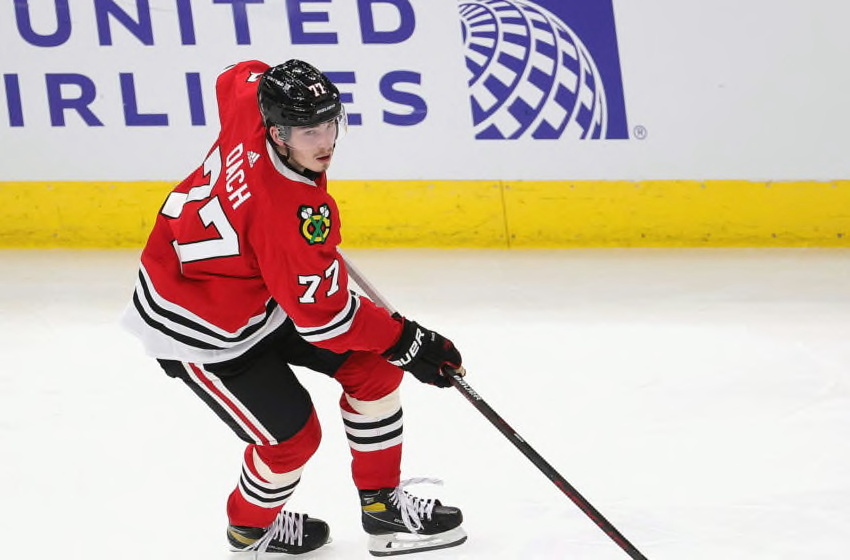
CHICAGO, ILLINOIS – APRIL 06: Kirby Dach #77 of the Chicago Blackhawks controls the puck against the Dallas Stars at the United Center on April 06, 2021 in Chicago, Illinois. The Blackhawks defeated the Stars 4-2. (Photo by Jonathan Daniel/Getty Images)
The Chicago Blackhawks are a strange team lately. Some of the moves they have made over the past five years have really made you scratch your head. They do some things that make themselves look like a team that is trying to win and others that sell a rebuild. Throughout the entire duration of Jonathan Toews and Patrick Kane’s contract, they have not won a single playoff series. Time is running out.
The ChicagoBlackhawks and Columbus Blue Jackets might be able to get something done.
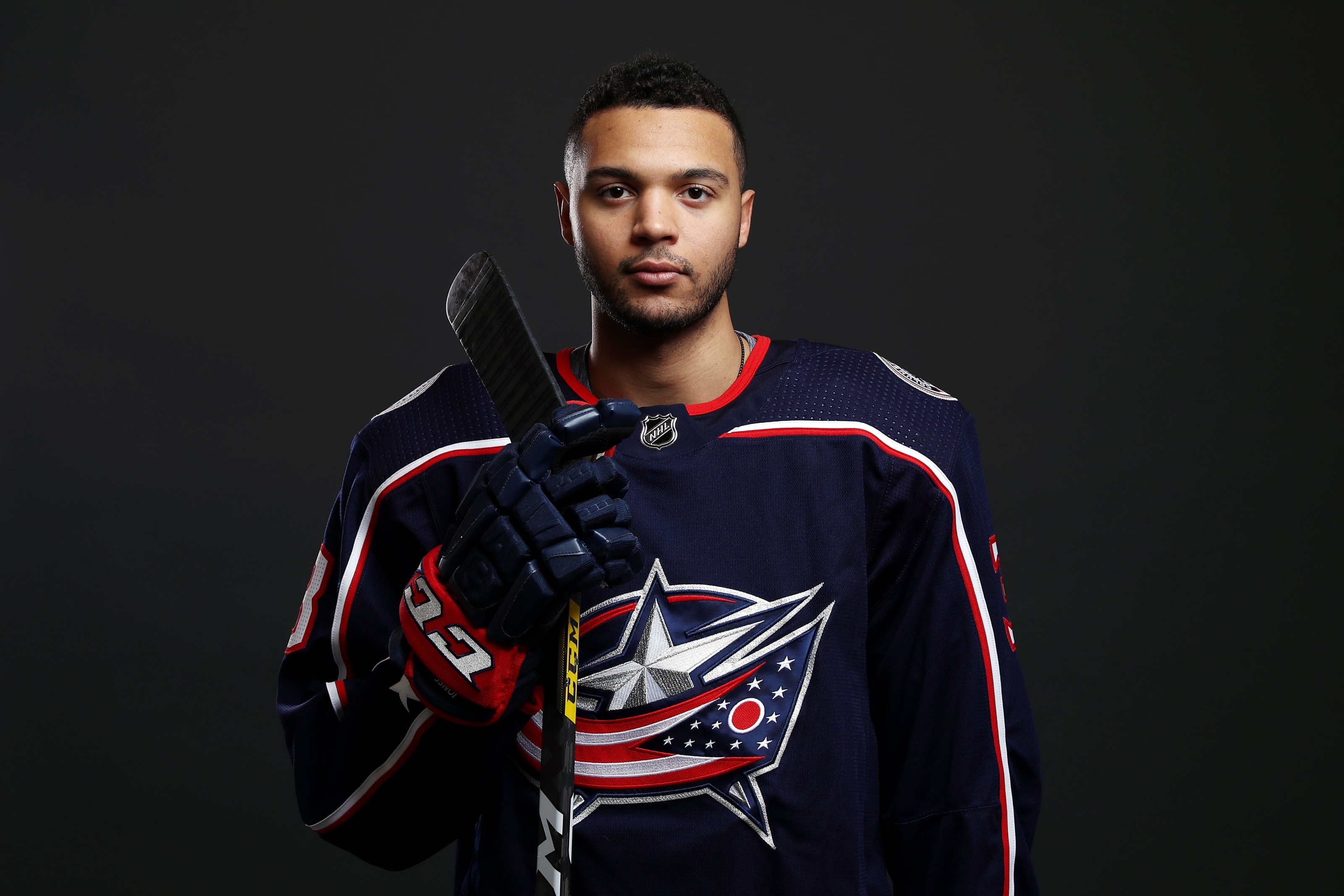
They are heavily involved in trade rumors for Seth Jones. He is a defenseman for the Columbus Blue Jackets and most would say he is a top-flight player. If he came to the Hawks, he would automatically be their number one. Not only would he be their number one, but he would also be a number one on most teams. This is a move that would tell the fanbase that they are trying to win.
Whether it is a good idea or not remains to be seen but as of now, it feels like a bad idea. However, if they did do it, they would need to give up a lot. One player that is now in rumors to go the other way is Kirby Dach. He was the Hawks’ third overall pick in the 2019 NHL Draft. There are a lot of people that would be into this trade and a lot of people that would hate it.
Dach is a good player with a high floor but it would be more than just a one-for-one trade. There are a lot of different trades that could come in a transaction like this. If a Kirby Dach for Seth Jones trade were to happen, it might look something like this:
The Epiphany Center for the Arts is a place for music performances, art exhibitions and other cultural and community events. | Provided photo.
Chicago, deeply segregated and divided, needs places with music, art, culture and just plain fun to bind us and connect the disconnected.
In deeply segregated Chicago, the races don’t always play well together. White folk socialize North, Black people hang South and West, Latino and Asian celebrate in other territory. We don’t go to the same parties. Sometimes, we don’t even party the same way.
Today’s turbulent Chicago needs places with music, art, culture and just plain fun to bind us. Places that connect the disconnected, stir the melting pot, where race doesn’t matter.
We need an epiphany, to help demolish our racial and ethnic divides.
I recently toured the Epiphany Center for the Arts, formerly the Church of the Epiphany.
The historic church was built in 1885 at 201 S. Ashland Avenue, in ornate, Richardson Romanesque style, fashioned from stone blocks imported from Lake Superior. Over the years, its congregation dwindled. It closed in 2011.
Kimberly Rachal and David Chase, a multi-racial wife/husband team, have resurrected and transformed the church and its adjoining campus located on what they call “the artsy end of the West Loop.”
Epiphany. “It’s almost an explosive kind of a word, right? I mean, it can be life-changing,” Chase said.
The 42,000 square foot, multi-level complex includes three music venues, art galleries, studios, a café, outdoor courtyard and patio, and a commercial and catering kitchen.
On the outside, the converted church is flanked with massive, decorative stone arches and columns; inside, its rooms are adorned with antique, stained-glass windows, mosaics and terra cotta, revived with love and ambition.
Its mission is “to bring Chicago together,” Chase said. “Not just in terms of programming, but racial, ethnic, age … and we’re centrally located, and our programing is such that in the arts, we are driven to support women, people of color, the LGBT community and the disability culture.”
Chase, who is white, is a real estate developer and transplant from Kohler, Wisconsin. Rachal, a designer, is a Chicago-born African American. They were married at the church in 1996 and live across the street.
Built by wealthy social register types of the Episcopal faith, the church is listed on the National Register of Historic Places. The wake for Chicago Mayor Carter Harrison Sr., who was assassinated in 1893, was held there.
During the civil rights movement, it was “The People’s Church,” hosting regular meetings of the Black Panthers. In 1969, slain Black Panther Party leaders Fred Hampton and Mark Clark were memorialized there.
The $15 million acquisition and redevelopment project took five years. The center officially opened in September 2020, at the height of the pandemic. It was soon forced to shut down.
It reopened in March, at just the right time.
“Thetimeliness of what we’re doing is something that we could not have imagined,” Rachal said. “With everything that’s happened, with the pandemic, which happened with George Floyd and Black Lives Matter, a protest and uprising, and just theclimate overall in our country and around the world.”
The singular arts center is “an outlet,” she added. “We’ve had people say, ‘We have been locked in for an entire year,’ and they’re walking through the door saying, ‘Oh my God, thank you, thank you, thank you.’”
The center presents a sprawling series of music performances, exhibits, educational programs, and offers space for weddings and galas.
It collaborates with nonprofits, museums, artists and activists to produce an eclectic panoply of offerings that explore everything from house music to LGBTQ rights, to gun violence, to mental health therapy.
The pandemic has widened and deepened Chicago’s inequities. Epiphanies can bring joyous, safe spaces to heal, play, and see each other, in peace.
Carlos Rodon of the White Sox pitches in the first inning against the Houston Astros at Minute Maid Park on June 18, 2021 in Houston, Texas. (Photo by Bob Levey/Getty Images) | Getty
Yordan Alvarez’s RBI double against Garrett Crochet in the ninth gives the Astros their second win in as many nights against the Sox.
HOUSTON — White Sox left-hander Carlos Rodon pitched a no-hitter against the Indians in April and flirted with another one Sunday against the Tigers.
Facing the Astros, the best-hitting team in baseball, he didn’t allow a hit until the fifth inning Friday.
It’s safe to say what Rodon has done this season — pitch like a no-doubt All-Star — is authentic.
‘‘Incredible,’’ assistant pitching coach Curt Hasler said before Rodon allowed one run in seven innings in his 12th start of the season, lowering his ERA to 1.83. ‘‘He’s had a miraculous turnaround.’’
The Sox (43-27) eventually lost 2-1 on an RBI double by Yordan Alvarez against reliever Garrett Crochet with one out in the ninth, their second defeat in as many nights against the Astros (41-28).
‘‘That’s as close as you can get to playoff atmosphere,’’ Rodon said. ‘‘It was fun to be out there, but it was a tough loss.’’
The Sox had five hits in the first two innings but only one run — on an RBI single by Jose Abreu in the first — to show for it. They had one hit after the third.
Rodon struck out eight and allowed three hits and three walks.
‘‘It’s been fun to watch,’’ Hasler said. ‘‘You’ve seen flashes of it in the past, but he’s put it together. We’ve always said if Carlos is healthy, he’s a good pitcher.’’
Rodon has been on the injured list at least once in each of the last five seasons. He looks healthy this season, however, and showed it with his pitch count at 103 with two on and one out in the seventh. After pitching coach Ethan Katz made a visit to the mound, Rodon gathered himself before getting Myles Straw to hit into an inning-ending double play.
‘‘I was pretty tired in the seventh, and they said, ‘Can you get me one more?’ ” Rodon said. ‘‘And I said, ‘Yeah, let’s do it.’ ”
Rodon’s other tight spot came during a 30-pitch fifth. A one-out cue shot by Alvarez broke up a perfect game. With the bases loaded, Rodon struck out Straw looking for the second out before walking No. 9 hitter Martin Maldonado to tie the score 1-1.
Rodon then struck out red-hot Jose Altuve on a 3-2 slider, let out a loud yell as he skipped off the mound and returned to retire Chas McCormick, Michael Brantley (three-pitch strikeout) and Yuli Gurriel in order in the sixth.
‘‘You see him start out at 94 and 95 [mph] and then 96, 97,’’ Hasler said. ‘‘And there’s a 100 popping in there in the sixth or seventh inning. That shows health and durability.’’
On Sunday, Rodon took a no-hitter into the seventh at Detroit. On Friday, he dominated against the team with the lowest strikeout rate and the highest numbers in runs, hits, batting average, on-base percentage, slugging percentage and OPS in the majors.
‘‘He’s just been dialed in,’’ catcher Zack Collins said. ‘‘Everything is working for him.’’
Codi Heuer pitched a perfect eighth before manager Tony La Russa went to Crochet in the ninth. He was saving closer Liam Hendriks for a save situation, he said.
Left fielder Andrew Vaughn was hit in the face with a throw from the outfield while sliding into second base in the sixth and left the game in the eighth. La Russa said Vaughn’s eyes were watering ‘‘and he was having trouble seeing.’’ He’s listed as day-to-day.
The Sox were probably more worried about Vaughn than they were about a one-run loss to a good team.
‘‘I don’t think we are worried at all,’’ Collins said. ‘‘It happens, and I don’t think anybody is pressing. I don’t think anybody is worrying we aren’t going to come back and score runs. Just look to tomorrow and leave this one behind.’’



:no_upscale()/cdn.vox-cdn.com/uploads/chorus_asset/file/22665851/Cory_Stillman_2.jpg)
:no_upscale()/cdn.vox-cdn.com/uploads/chorus_asset/file/22665854/Cory_Stillman_1.jpg)
:no_upscale()/cdn.vox-cdn.com/uploads/chorus_asset/file/22665870/Stillman_2.jpg)