Videos

Chicago man says he burned CPD SUV during May 2020 riot after seeing police abuse; feds want prisonon July 1, 2021 at 2:32 pm

A Chicago man who set a police SUV on fire amid the May 2020 rioting downtown became “filled with rage, with passion, and didn’t have time to think twice” after he saw police show “blatant disregard for the law and human life” that day, according to his attorney.

The defense lawyer for 23-year-old Jacob Fagundo alleged in a court filing Thursday that the School of the Art Institute student saw a police officer “split open the head of [a] young girl with whom he was — at that time — peacefully protesting” in Chicago on May 30, 2020.

That’s when attorney Robert Kerr said Fagundo’s “personal shortcomings caught up with him,” prompting him to throw a lit firework into a Chicago police vehicle. Kerr also wrote in a memo that Fagundo hadn’t been “on top of [his] mental health like [he] should’ve been.”

Jacob Fagundo
Chicago police

Kerr called it an “aberration” in Fagundo’s behavior. He noted that Fagundo promptly surrendered to authorities when he learned they were looking for him, and he pleaded guilty. Kerr asked U.S. District Judge Robert Gettleman to sentence Fagundo to probation.

Federal prosecutors say Fagundo should spend between eight and 14 months in prison for committing a crime “against the fabric of our democratic society while it was being pulled apart.”

Fagundo’s sentencing hearing July 14 may be the first in Chicago’s federal court to directly address the downtown violence after the murder of George Floyd by then-Minneapolis police officer Derek Chauvin.

Though Fagundo originally faced charges in state court, the feds wound up filing charges against him in late March. He pleaded guilty in early April to obstructing law enforcement amid a civil disorder. Meanwhile, Kerr said Fagundo participated in May graduation ceremonies at the School of the Art Institute, and he is awaiting confirmation that he has earned his final credits.

At the school, Kerr wrote that Fagundo “not only came to be regarded as an employee, student, mentor, role model, and friend of the highest character, he came to be known as [an] incredibly talented artist.”

Still, Assistant U.S. Attorney John D. Cooke wrote that Fagundo “came to a tinderbox on May 30, 2020 — Chicago beset by civil disorder amid protests aimed at police conduct — and threw a lit match into it.”

When Fagundo pleaded guilty in April, the prosecutor told Gettleman that Fagundo had purchased fireworks, lighter fluid and other products at a department store on May 29, 2020, ahead of the George Floyd protests. The next day, Cooke said, Fagundo joined with others and spray-painted a Chicago police vehicle.

The evening of May 30, 2020, Cooke said Fagundo discovered a CPD SUV in a garage at 30 E. Kinzie St. The prosecutor said Fagundo and others shattered some of the vehicle’s windows, including its rear windshield. Then, about 6:45 p.m., Cooke said Fagundo lit a firework and tossed it through the SUV’s rear window frame.

Fagundo fled when police arrived, Cooke said. The prosecutor said the vehicle was a total loss, and it cost CPD $58,125 to replace it. The judge is expected to order Fagundo to pay that amount in restitution at sentencing.

Another man, Timothy O’Donnell, is also charged in federal court with setting fire to a CPD vehicle while wearing a “Joker” mask. He is set to go to trial Feb. 7.

Read More

Chicago man says he burned CPD SUV during May 2020 riot after seeing police abuse; feds want prisonon July 1, 2021 at 2:32 pm Read More »

7 Places to Find the Best Oysters in Chicagoon July 1, 2021 at 2:06 pm

Jimmy Buffet once sang, “Give me oysters and beer, for dinner every day of the year, and I’ll feel fine.” We couldn’t agree more. Which is why we rounded up some of the top spots for the best oysters in Chicago. These 7 places offer the absolute best in plump, springy, sometimes briny, sometimes salty pearls of the sea. Let’s dive in!

400 N Clark Street Chicago, IL 

For incredible oysters at a great price, don’t miss this gem. For $3.25 each, get little shells of happiness from Cotuit Bay in Cape Cod, Island Creek in Duxbury, or the surprise oyster of the day. We’ll take 50, please.

Advertisement

21 E Hubbard St Chicago, IL 60611

Advertisement

This classic American seafood restaurant features oysters from all along the coast–from Maine to Washington and Rhode Island to Nova Scotia. Freshly shucked to order in the heart of Chicago! Enjoy a half dozen at $21 or a full dozen for $42.  

676 W Diversey Pkwy Chicago, IL 60614

Good brew. Good oysters. Good times. Check out this neighborhood pub serving up a solid seafood menu with oysters, clams, sashimi, shrimp, and crab legs. Try their six Blue Point oysters which come with house cocktail, lemon, and saltine for $11.90. And bring cash (no cards accepted!).

1933 S Indiana Ave Chicago, IL 60616

Looking for some serious eats? For $112, the Atlantic Platter features 2 east and 2 west coast oysters, ceviche with 2 lobster claws, 2 shrimps, and 1/2lb Alaskan Red King Crab Legs. Not that hungry? Try their oyster shooters which is a fresh oyster served with quail egg yolk, scallion, radish, Tabasco and citrus soy for $6.

1962 N Halsted St Chicago, IL 60614

Yep, it’s “Bah” not “Bar.” This New England inspired location offers a rustic nautical ambiance with the freshest seafood to boot. Slurp down oysters on the half shell with mignonette, cocktail sauce, and horseradish for $3.50 each. 

531 N Wells St Chicago, IL 60654

Delightful, fresh seafood? Uh huh. Stop into this modern location for beautifully plated oysters (hello Instagram). Their selection rotates daily but there’s a good chance you’ll have the choice between east or west coast. Or choose both coasts. At $3.25 to $3.50, you can go wild. 

2956 N Sheffield Ave Chicago, IL 60657

This intimate, casual restaurant dishes up sustainably sourced seafood that’ll make you do a happy dance. You know the drill: at $3.50 each, you can choose between east or west coast oysters served with mignonette, lemon, and cocktail sauce. Hungry yet?

Featured Image Credit: Louis Hansel on Unsplash

Read More

7 Places to Find the Best Oysters in Chicagoon July 1, 2021 at 2:06 pm Read More »

Woman dies in Roseland shooting that also wounds 8-year-old girl and another womanon July 1, 2021 at 1:04 pm

A woman was killed and an 8-year-old girl and another woman were wounded early Thursday in Roseland on the Far South Side — one of 14 neighborhoods in Chicago that have seen an increase in murders this year.

The two women were sitting on the porch of a home in the 11300 block of South Wentworth Avenue when someone stepped from a white Nissan and fired at them, Chicago police said.

A 40-year-old woman was taken to Christ Medical Center in Oak Lawn, where she was pronounced dead, police said. She has not yet been identified.

A 30-year-old woman was grazed by a bullet and taken to Roseland Hospital in good condition, police said.

One of the shots went through the house and struck an 8-year-old girl in the arm, police said. She was taken to Roseland Hospital and was also in good condition.

No one was in custody.

There have been at least 12 homicides in Roseland this year, up from nine for the same time last year, according to Sun-Times data. It ranks 11th among neighborhoods for homicides this year, a list topped by Austin with 28, North Lawndale with 21 and Englewood with 18.

Roseland is in the Calumet Police District, which has seen a 73% increase in homicides this year and a 49% percent increase in shootings, according to statistics kept by the Chicago Police Department.

Read More

Woman dies in Roseland shooting that also wounds 8-year-old girl and another womanon July 1, 2021 at 1:04 pm Read More »

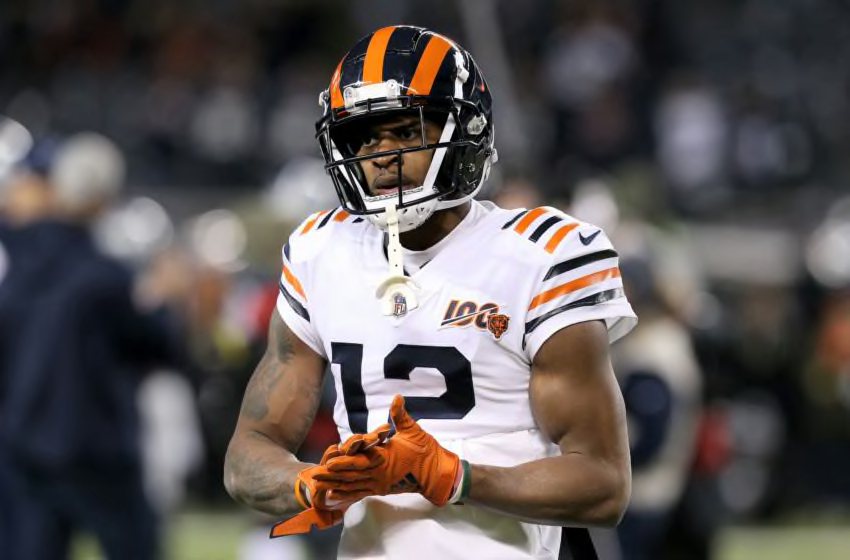
Chicago Bears Rumors: Allen Robinson doesn’t sound confident about extensionon July 1, 2021 at 1:36 pm

Read More

Chicago Bears Rumors: Allen Robinson doesn’t sound confident about extensionon July 1, 2021 at 1:36 pm Read More »

City mouse moves to suburbs, survives freshly mowed lawns and morning songs of wrens and sparrowson July 1, 2021 at 1:00 pm

Cheating Death

City mouse moves to suburbs, survives freshly mowed lawns and morning songs of wrens and sparrows

Read More

City mouse moves to suburbs, survives freshly mowed lawns and morning songs of wrens and sparrowson July 1, 2021 at 1:00 pm Read More »

The Index Cards of Covidon July 1, 2021 at 1:00 pm

The Rooted Wanderer

The Index Cards of Covid

Read More

The Index Cards of Covidon July 1, 2021 at 1:00 pm Read More »

Vlasta Krsek, ‘Ferris Bueller’ accordionist, remembered as ‘International Queen of Polka’on July 1, 2021 at 12:15 pm

Vlasta Krsek was the head-tossing, foot-stomping dynamo in the middle of one of the most exuberant movie scenes ever filmed.

As thousands of extras rock out to “Twist and Shout” in “Ferris Bueller’s Day Off,” she bounced on a pedestal and pounded out the song on her accordion, smiling at her parade float mate Matthew Broderick as he lip-synced the number for the crowd. She backed him on “Danke Schoen,” too.

“She was having a blast,” said her daughter Helen Krsek.

Mrs. Krsek was known as the International Queen of Polka, but there was little news coverage when the Berwyn resident died of cancer last August at 83 at the Spooner, Wisconsin, home of her daughter.

Helen Krsek said that not long before her mother died, she made a request: “She said, ‘Helen, don’t make a big thing of it. Just bury me beside my family.’ “

Last weekend, several of Mrs. Krsek’s accordions were sold at an estate sale at her Berwyn bungalow, according to Kim Chmura of All-Clear Estate Sales in Riverside.

And the most famous of her accordions — the one Mrs. Krsek played in the movie — will be offered for sale by an auction house that specializes in high-end entertainment memorabilia, Chmura said.

The accordion Vlasta Krsek played in the parade scene in “Ferris Bueller’s Day Off” is to be sold at an auction house that specializes in entertainment memorabilia.
Provided

Mrs. Krsek, who was born in Prague, was a World War II refugee who became a star, proudly garbed in the traditional Czech folk costumes known as kroje.

“The polka belongs to the world,” she once told an interviewer with the Cicero Life.

But she said it never hurt to try new kinds of music, like what she played in “Ferris Bueller’s Day Off.”

“She played it with her heart,” her daughter said. “She just wanted to make people happy, and she didn’t want to make people sad.”

Mrs. Krsek charmed Johnny Carson on “The Tonight Show.” She did “Late Night with David Letterman” and “Larry King Live.”

Vlasta Krsek charmed Johnny Carson and “The Tonight Show” band.
Provided

She performed with the Famous Potatoes at FitzGerald’s and with the legendary Frankie Yankovic at the International Polka Festival in Pine City, Minnesota. She worked stages at Taste of Chicago, Park West and Navy Pier. For appearances in Nashville, Mrs. Krsek spent two months learning to play the fiddle classic “Orange Blossom Special” on the accordion.

She once told the Chicago Sun-Times she liked the accordion “because it’s an instrument like a Stradivarius violin. You can feel your lifetime experience with it. It makes people happy. That’s the most important thing. It’s like a band within itself — such a great sound.”

Vlasta Krsek recorded with back-up musicians known as the Altar Boys.
Provided

On liner notes for her record “Vlasta and her Altar Boys,” Mrs. Krsek spelled out her goal: “You know, Bruce Springsteen is known as ‘The Boss of Rock,’ well, I want to be known as ‘The Boss of Polka!’ ”

Vlasta Krsek dancing the polka with Mayor Harold Washington.
Provided

She played for President Ronald Reagan, danced the polka with Mayor Harold Washington and performed for Mayor Jane Byrne and Mayor Richard M. Daley.

“All the mayors just loved her,” her daughter said.

And she was a star of the Houby Parade, which celebrates mushrooms and the Czech and Slovak heritage of Berwyn and Cicero.

Her career grew out of loss. In 1978, she was laid off by General Electric. That same year, Mrs. Krsek’s mother died.

“My mother was devastated,” her daughter said. “Then, Pope John Paul came to town, and she watched him, and she thought, ‘I’m going to write a song for him.’ ”

“I picked up my accordion, used my severance pay and taped the ‘John Paul II Polka,’ ” Mrs. Krsek told the Sun-Times.

She said her husband Jan encouraged her, saying, “Vlasta, go do your dream.”

Mrs. Krsek composed polkas for Reagan, Carson, the Chicago Sting soccer team, the Chicago Bears and even her cockatiel Freddie.

“She was her own promoter,” her daughter said, typing out hundreds of letters that opened doors for her to different shows and venues.

Her daughter said “Ferris Bueller” director John Hughes called Mrs. Krsek to ask her to appear in her famous scene, filmed in downtown Chicago at the Von Steuben parade.

Vlasta Krsek and her accordion with director John Hughes and Matthew Broderick during filming in downtown Chicago of “Ferris Bueller’s Day Off.”
Provided

“John Hughes created a part for me — queen of the German parade,” Mrs. Krsek said in a Sun-Times interview in 1986, the year the movie came out.

The director asked if she could play “Twist and Shout,” a hit for the Isley Brothers before the Beatles, and “Danke Schoen,” popularized by Wayne Newton.

No problem, she told him.

In an audio commentary for the film, Hughes said Mrs. Krsek “really didn’t realize that we were doing a comedy. I think she thought it was a tribute to Germany or something.”

To keep from falling off the float, she was strapped to it with safety belts. She made $230 for the movie, but said, “I feel like the promotion is priceless.”

Growing up, she was Vlasta Wanke, the “Shirley Temple of Czechoslovakia,” according to a biography on the back of her album. She tapdanced and played the accordion in more than a dozen European movies.

She said she was 6 when she learned to play the “Beer Barrel Polka” from Jaromir Vejvoda, its Czech composer.

During WWII, her family experienced deprivation and danger.

“There was hardly any food,” her daughter said. “She never even liked to watch the fireworks on Fourth of July. It sounded like bombs.”

Mrs. Krsek and her relatives spent four years in a refugee camp in Germany, where she performed for other displaced persons and American GIs.

“There were about 40 different nationalities,” Mrs. Krsek said. “In my music, I try to express all those nationalities together.”

In the 1950s, her family immigrated to the United States, eventually settling near St. Agnes of Bohemia in Little Village. She met Jan Krsek, who was from Plzen, Czechoslovakia, at the sausage factory where her mother worked, she told the Sun-Times.

Vlasta Krsek and her husband Jan.
Provided

“They started playing accordion together and hit it off, and that was it,” their daughter said.

They got married, and she worked for General Electric and he for International Harvester.

Mrs. Krsek also is survived by a granddaughter.

“She was an angel on that accordion, and I just miss her,” Helen Krsek said. “I was very proud of her anytime I would see her play.”

Mrs. Krsek liked being outside, where she’d laugh and talk with neighbors, her daughter said.

“She’d sit on the steps and call them over and start singing in Spanish for them or in Polish. She said, ‘Be happy. This world is too sad. We need to do more singing and dancing to make people happy.’ “

Read More

Vlasta Krsek, ‘Ferris Bueller’ accordionist, remembered as ‘International Queen of Polka’on July 1, 2021 at 12:15 pm Read More »

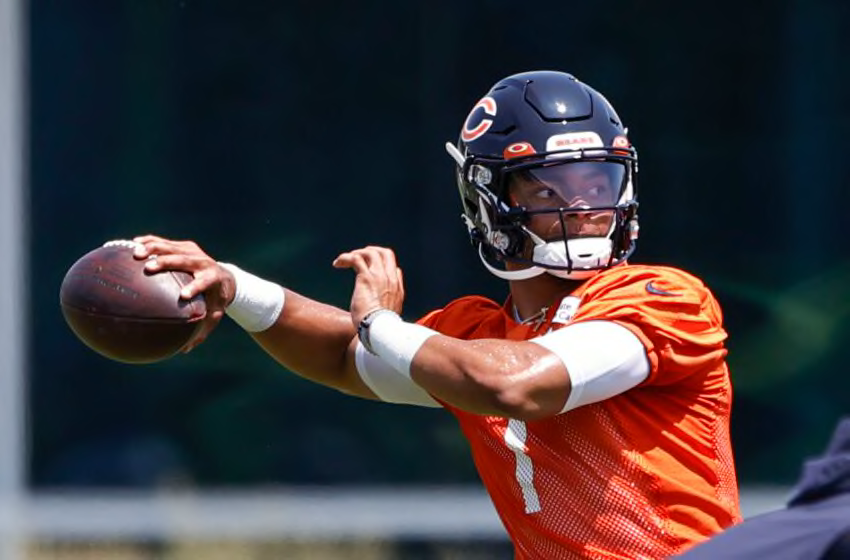
Chicago Bears legend thinks Justin Fields should start Week 1on July 1, 2021 at 12:15 pm

Read More

Chicago Bears legend thinks Justin Fields should start Week 1on July 1, 2021 at 12:15 pm Read More »

Dennis J. Leise grows his ownon July 1, 2021 at 11:00 am

Dennis J. Leise has a tiny farm in Gary, Indiana, and he sells eggs--and plays music--all over Chicagoland. - ELIZABETH SISSON

Dennis J. Leise whistles a high note and a crowd of turkeys, roosters, chickens, and ducks explodes in shrieks, quacks, and clucks. A 250-pound boar named Hamilton grunts as Leise massages his snout. Rabbits snooze on the side porch. Goats box for position to lap up the dry corn he pours from his hand.

This might look like a Doctor Dolittle scene to musicians who have to google the difference between a pig and a hog, but Leise is right at home. The life he leads on the three and a half acres he owns in unincorporated Gary, Indiana, is an extension of his childhood in rural Pennsylvania, where he didn’t eat a store-bought chicken until he was a teenager and spent free hours working the farms of his extended family.

“It’s really the fortress of solitude,” he says of his homestead. “But how could anyone be bored by all this going on?”

For the past few years, Leise’s farm life has run in parallel with another life as a singer-songwriter. Now 46, he’s played guitar in country and bluegrass groups since he moved to Chicago 16 years ago, but he only started to record his own songs under his own name in 2016. That year he released an EP of originals called Once in a Black Moon, and three years later he put out a full-length called State of Fairs. The latter included his breakout song, “Nobody’s Comin’,” whose country-gospel ebullience and clever video have helped it rack up more than 65,000 YouTube views since its debut in December 2019. In the video, Leise plays a country preacher setting up a revival tent and waiting for the faithful, who never show up. Not since Robbie Fulks’s “God Isn’t Real” has atheism been expounded with such a loving touch.

Leise scheduled a release show for State of Fairs last spring at FitzGerald’s, but the pandemic shut it down. On Wednesday, July 14, he has a gig at the Montrose Saloon where he’ll play State of Fairs plus material from The World That You Grew Up in Is No More, an album he’s releasing in installments throughout 2021. The first three songs came out in May, and three more will follow on July 1; he’ll follow that up with two more batches before the end of the year.


Dennis J. Leise
Solo set. Wed 7/14, 6 PM, Montrose Saloon, 2933 W. Montrose, free, 21+

Dennis J. Leise
Solo set. Fri 7/16, 7 PM, Blue Island Beer Company, 13357 Olde Western, Blue Island, free, 21+

Dennis J. Leise & Tiny Horse Trio
Sat 7/24, 1 PM, Martyrs’, 3855 N. Lincoln, free, all ages

Dennis J. Leise & Tiny Horse featuring Gerald Dowd
Sun 7/25, 4 PM, FitzGerald’s, 6615 Roosevelt, Berwyn, reservations suggested, free, all ages

Dennis J. Leise
Solo set. Sat 7/31, 2 PM, Val’s Halla Records, 239 Harrison, Oak Park, free, all ages


For years Leise’s go-to backing musicians have been an ace crew that includes Brian Wilkie of the Hoyle Brothers and three members of the Flat Five: Casey McDonough, Scott Ligon, and Alex Hall (McDonough and Ligon also play together in NRBQ). He’s schooled in honky-tonk country, gospel, and blues, and he uses his songwriting to inject them with his own ideas about mortality, madness, and food. Leise’s baritone voice and heavily reverbed guitar could’ve made “Hurry Up and Die” sound like a Johnny Cash homage, but instead it wraps up its self-loathing in a sweet-sounding proposal. “Multiflora Rose” and “I Think About You Naked” are prime rockabilly and western swing. Other songs subvert genres to comment on them: “So Tired of Stormy Monday” lambasts tourist blues, and “Americana Music” does the same with Nashville pop country. On the intimate “I Only Do It ‘Cause I Have To,” Leise addresses the serious topic of depression without sounding morose or self-pitying.

“His humor is always present in the songs, but sometimes that’s not necessarily the point,” says McDonough. “His lyrics are always dead serious, even when they’re trying to get a laugh.”

A goat takes an interest in Leise's washboard guitar. - ELIZABETH SISSON

Leise moved to the Chicago area in 2005 to take a job selling steel parts used in drywall construction for a company in Franklin Park. Music was mostly a weekend affair. While living in the western suburbs, he spent hours each week hanging out at Val’s Halla, the Oak Park record-retail institution where owner Val Camilletti created a clubhouse atmosphere for musicians and music lovers alike. Leise credits his time as a store regular with exposing him to the likes of Merle Travis, Chet Atkins, Blind Willie McTell, and Mississippi John Hurt and inspiring him to try writing songs. His main discovery was Chicago folk singer Steve Goodman, who was known for his storytelling, wizardly guitar picking, and energetic shows. “He played music from all sides of the tracks–blues, jazz, country,” Leise says. “He was an incredible songwriter who went for it every time.”

Leise met McDonough at a Joel Paterson show at FitzGerald’s, and in 2006 they formed the Possum Hollow Boys, a retro outfit that plays rockabilly, country, and blues. Their lone album, 2008’s Introducing, includes one Leise original; they continue to play as a band, and outside it the members are all regulars on the local Americana circuit. Around the same time Leise started that group, he was honing his chops at a Wednesday-night House of Blues residency, playing acoustic blues covers to diners. He also took a side job working the door at FitzGerald’s that doubled as helpful training in how to structure a show. But Leise insisted he was still only moonlighting. “I never really aspired to be a musician that played out anywhere–this was just therapy, born of loneliness and boredom,” he says.

McDonough says Leise exceeded his expectations. “I was impressed right away,” he recalls. “For a guy who didn’t claim to be really doing this seriously, he had no problem scuffing his way through songs he may not know. He was not hung up on genre or format, which has always been a big thing for me as well.”

Five years ago Leise realized he missed the wide-open fields of his childhood in Portersville, a town in the Appalachian region known as Pennsyltucky. So he sold his house in Brookfield and found land on a nondescript road outside Gary, surrounded by dense woods and swampland. The setup makes him feel closer to his parents, both of whom were children of the Great Depression and taught Leise and his nine siblings about sustainable living. He remembers his mother spending summers canning vegetables for the winter; his father, a mechanic for the Kerry Coal Company, would work with him on the nearby farms of uncles and aunts.

One of Leise's hogs is named "Hamilton." - MARK GUARINO

Today, Leise tends to about 100 animals, a sprawling garden, and an apple orchard. He ends his nights by locking the free-range birds into their pens to protect them from predators, and he starts his mornings by feeding the goats. He makes a living working remotely in quality assurance for a technology company, but he has a brisk side hustle selling eggs in Chicago. (His backing musicians get them free at gigs and sessions.) Word’s gotten around about those savory eggs, and Chef Xiong from Taste of Szechuan in Chinatown has made a trip to check out Leise’s farm.

Leise followed restructuring his life with restructuring his priorities as a musician. He wrote most of State of Fairs and The World That You Grew Up in Is No More two years ago, during a month he spent in Australia to play festival dates. The experience of being in a foreign environment doing nothing but playing music forced a personal reckoning: “I had to contemplate why I do what I do, and by extension, what I should do with my idle time, which is to write,” he says. He no longer considers music something he does on the side.

The farm also figures into Leise’s new life. He set up a stage in a shack on his property, and he plans to invite musicians for livestreamed events. He’s also considering throwing a music festival on his land. A shrewd digital marketer, Leise has reached audiences far outside the midwest via Spotify–he can drive listeners to his music by making sure it’s in the recommendations that the service generates based on user playlists.

Leise in a shack on his property - ELIZABETH SISSON

Besides eggs and apples, the farm is also producing songs. The breezy “Multiflora Rose” cheekily documents the charms of going rural: “Well, I thought I knew my oats / So I got myself some goats / Hoping that they’ll chop the vines down to the earth,” Leise sings. “Well they nibbled while they roam / And ate me out of house and home / Yes, I spent more on those goats than they are worth.”

On a recent Saturday morning, Leise eases back into a lawn chair while dozens of strutting fowl add to the conversation. A few feet away, a baby goat gazes at him like a child at a father. Last September, Leise’s own father died, and because his mother had passed five years before, the family homestead is now being prepared for sale. “I have no interest in going back,” he says.

On Leise’s farm, sustainability means more than repurposing hay for garden fertilizer or taking leftovers home to give them to the goats. The land is sustaining Leise’s soul too, and he says he’s finally getting what he needs. He just wants to connect with people somehow–if not through his music, then maybe with some eggs.

“My credo is to be true to myself,” he says. “I’m where I want to be.” v

Read More

Dennis J. Leise grows his ownon July 1, 2021 at 11:00 am Read More »

James Holvay helped create Chicago’s famous horn-rock sound in the 1960son July 1, 2021 at 11:00 am

sh_james_holvay_magnum.jpg

Since 2004 Plastic Crimewave (aka Steve Krakow) has used the Secret History of Chicago Music to shine a light on worthy artists with Chicago ties who’ve been forgotten, underrated, or never noticed in the first place.


Some artists seem to fall into the entertainment industry, but others might as well be destined for “the biz.” Such is the case with Jim Holvay, who must’ve strummed a guitar before he shook a baby’s rattle. Even if you don’t recognize this musical polymath’s name, you’ve definitely heard his songs. He’s best known for writing the Buckinghams’ smash “Kind of a Drag” and for cofounding the Mob, the group that arguably invented Chicago’s famous “horn rock” sound. But his story goes a lot deeper than that, and the Secret History of Chicago Music was lucky enough to get all the details from the living legend himself.

James Steven Holvay now lives in Los Angeles, but he was born in Chicago on May 16, 1945. “My parents were from the north side, Foster and Western,” he says. “My dad grew up across the street from Wrigley Field. My uncle Jim, who I was named after, lived in an apartment building on Waveland Avenue, just behind the left-field fence. Whenever the Cubs had a home game, we would visit my uncle. My brother Denny and I would run up the stairs to the rooftop to watch the game. When one of the players hit a home run, we would run like hell down four flights of stairs and out into the street in hopes of catching the ball.”

Holvay grew up in Brookfield, and his parents liked to joke that they’d found him in the monkey cage at the zoo. He attended St. Barbara School, and before he even reached his teens, his older brother got him hooked on rock ‘n’ roll by bringing home Bill Haley’s “Rock Around the Clock.” Holvay bought his first guitar and chord book at age 12, and his parents responded to his interests and upgraded him to a better ax and amplifier.

In seventh grade Holvay formed his first band, the Rockin’ Rebels. Their first gig was at a go-kart shop in Lyons, with Ray Nichols on guitar, Billy Krien on bass, Dale Soltwich on drums, and Holvay on guitar. “The only thing we knew to play was a blues progression in the key of E and C,” he admits. “My brother Dennis came up with the name, which was triggered by Duane Eddy & the Rebels and Gene Vincent & His Blue Caps. Denny spotted a few rebel hats at a five-and-dime store in Brookfield, bought them, and showed up at one of our rehearsals and said proudly, ‘You guys are the Rockin’ Rebels.'”

One of the Rebels’ more memorable gigs was at a gas station on Ogden Avenue in Brookfield. “The owner there ran an extension cord out to the front of the station so I could plug in my tiny Supro amp, and off we went,” Holvay says. “Ray Nichols and I played the same blues progression over and over until our fingers bled. A handful of kids stood around with their bikes and watched us. After about two hours (with one break), the owner gave us each a dollar.” The short-lived band managed to arrange a recording session, but it didn’t go well and yielded no releases.

Holvay took the lead in his next group, Jimmy & the Jesters, which he launched in the spring of his eighth-grade year. “I met the twins, Guy and George Miska, at Ehlert Park in Brookfield, through another schoolmate I also played little league with, Griff Durrett,” Holvay recalls. “They knew and sang every Everly Brothers song that was ever recorded and sounded just like them! Their father came up with the name Jimmy & the Jesters. I played lead guitar, Guy played rhythm, George on bass, and Griff on drums. Bob Sladek later replaced Griff, who went on to play with E.J. Mason & the Cool Ones out of Berwyn.”

The band kept playing into high school. “The Jesters played a few local church and school dances,” Holvay says. “We all attended Lyons Township High School. We played at school events and the Corral, which was the school’s local youth center. Guitar instrumentals were popular at that time, and we played all of them (Duane Eddy, Link Wray, the Ventures, the Fireballs, the Marketts). We alternated the instrumentals with Guy and George singing Everly Brothers hits and me singing a few Gene Vincent songs.”

Holvay’s father further encouraged his son’s fledgling music career by taking him to Chicago’s famed Record Row (the stretch of Michigan Avenue south of Roosevelt) to visit the offices of the premier labels of the day. “I was the kid that read all of the text on the record labels and found it fascinating,” Holvay explains. “It may have been during ’61 or ’62 when I noticed the address of Chess Records at the bottom of a Chuck Berry LP–2120 S. Michigan Avenue, Chicago IL. I also noticed that Vee-Jay Records was located on the same street.”

Holvay had started writing songs a year after getting his first guitar, and he’d learned to record them using his dad’s Webcor tape recorder. “The popular beat at the time was a cha-cha,” Holvay says. “I’d graduated from playing a blues progression to a more melodic C, Am, F, G progression. I would write a cha-cha type song, make a tape, and convince either my brother or my dad to drive me down to what was called Record Row. Mercury was at 35 E. Wacker Drive, and it was very difficult to get past the receptionist. But I could walk into Chess or Vee-Jay all day long.”

These visits became almost routine for Holvay. “The first time I went to Chess, I met Willie Dixon,” he recalls. “Little did I know at the time, but he was the A&R man for the label and had written and played on many of their hits. He listened to my song and offered a few suggestions. At Vee-Jay, I met Calvin Carter, who was the A&R man for the label. Both Dixon and Carter were very encouraging. The most memorable time was at Vee-Jay when I met Curtis Mayfield, who happened to be in the building. Curtis was a very shy and humble guy.”

Holvay joined his third band, the MayBees, as a high school sophomore. “There was a jazz-piano prodigy kid by the name of Ken Rhodes, who I had befriended,” he says. “We had a gym class together. He saw me play with the Jesters at numerous school events. He knew the MayBees guitar player, Chico Ledesma, who lived in Westmont. Ken told me the MayBees (who were based out of Aurora) were looking for a hot lead guitar player. I auditioned and got the job, quitting my group Jimmy & the Jesters. That did not go over well with the Miska twins. You could cut the tension with a knife each day we all had to stand on the corner, at the same bus stop, waiting for the school bus.”

At that point the MayBees were Holvay on lead guitar, George Torrens on lead vocals, Chico Ledesma on rhythm guitar, Gary Beisbier on tenor sax, Max Gregg on bass, and Don Dalton on drums. The band released three 45s on small Naperville label Terry in the late 50s and early 60s, including “Mary Lou” b/w “You’re Just an Angel” and “TR-3” b/w “Angel of My Dreams.” The third, an instrumental version of the 1947 hit “Buttons and Bows” backed with a cover of “The Third Man Theme” (from the 1949 movie), was reissued almost 50 years later on a Sundazed CD compilation called Dancehall Stringbusters! 2.

The MayBees played local dances at a Harvey Club called Teen Land and traveled to Wisconsin to gig at a different bar each weekend. “These places were depicted perfectly in The Blues Brothers, minus the chicken wire surrounding the stage,” Holvay recalls. The band lost members for the typical reasons: Torrens and Gregg both got married, and both were replaced. Holvay switched to bass, playing alongside Wayne Erwin (vocals), Phil Kagel (lead guitar), Dave Franch (drums), and Larry McCabe (trombone).

“It was 1962 or ’63 when we became a great band with two horns!” Holvay says. “We worked almost every weekend. During the summer of ’63, Phil and Wayne dropped out to do other things. Luckily, I got a call from a guy by the name of Sal Ferrera, who had a group called Sal & the Sidemen. He said there was a guy by the name of Jimmy Peterson who was looking for a bass player. They were going to go ‘on the road,’ which is where I wanted to be. I auditioned in drummer Bobby Ruffino’s basement and met with Peterson, Bobby, and Chuck Russell, a wonderful jazz guitar player. I told Peterson about the MayBees and the two horn players we had, Gary and Larry. The next rehearsal, they were in the band.”

This new group became known as the Chicagoans. “In the summer of ’63, the Chicagoans became the house band for a WGN-TV show called Danceville U.S.A. Every Saturday afternoon, we played at a different high school, where they filmed the show live. Every current hit artist coming through the city and promoting their record would make an appearance. We backed up Barbara Lewis, Lesley Gore, Johnny Tillotson, whole bunch of folks.”

The band also hit the road, as Holvay had hoped. “In September 1963, the Chicagoans worked our way to New York, where we played all of the popular clubs at that time. The Wagon Wheel, the Metropole, Arthur’s, the Round Table, et cetera. We were there when the Beatles came to New York to do The Ed Sullivan Show–it was a very exciting time. GAC, the booking agency we were with, got us a Chubby Checker tour, Terry Stafford, and Nino Tempo & April Stevens gigs–all wonderful people to work with.”

While in New York, the Chicagoans cut two sides at Beltone, a studio whose record label had scored a huge hit in 1961 with Bobby Lewis’s “Tossin’ & Turnin’.” But the song that ended up charting in Chicago in 1964 was thrown together during the session. “We cut the two songs quickly and had 20 minutes left on the studio clock,” Holvay says. “The engineer asked if we had anything else we wanted to record. Since the Beatles had just arrived, Gary and I wrote an instrumental (with no title) on kind of a lark. We recorded that track, which was later titled ‘Beatle Time’ by I believe Clark Weber or one of the jocks at WLS. They also changed the name of the band to the Livers.”

That Livers single can be considered a milestone in Windy City music history–some historians and critics identify it as the first song to display the soon-to-be-famous Chicago horn-rock sound, two years before the Mob formed.

Later that year, the Chicagoans parted ways with Jimmy Peterson and moved west. “The first place we played was a club called the Blackhawk in Salt Lake City, Utah,” Holvay says. “We were there a week and the place burned down with all of our instruments. The owner gave us gas money to get back to Chicago.”

The band regrouped with a new drummer named Barry Van Volkenberg and gave it another go. “We headed to San Diego and played a lounge in a huge bowling alley called Parkside,” Holvay says. “They had a second entertainment room that was like a showroom in Las Vegas. We were there a week when cops rolled in, pulled us offstage, and wanted to see our IDs. Having just purchased them in Tijuana a few days earlier, we thought we were good. Wrong! We fought the law and the law won. They told us to pack up and vacate the premises ASAP.”

A week later, the Chicagoans arrived in San Francisco. “We checked into a fleabag hotel called the Governor and immediately headed to the musicians’ union,” Holvay says. “North Beach was considered the entertainment district, and we played at every club that had live entertainment. Topless dancing was popular, as was a dance called the Swim. We played the Peppermint Tree, the Galaxy, the Off Broadway, the Purple Onion, the Embers, the Americana, the Robin Hood. The music scene was exploding. There were so many great bands playing in North Beach. While picking up my clothes at a dry cleaners, I met Lenny Bruce. He was a cool guy. I felt like I was talking to a jazz musician.”

Holvay returned home to attend junior college, but more musical opportunities arose. “While I was playing with the Chicagoans at the Gi-Gi a’ Go-Go in Lyons, Jimmy Ford came in to see us perform. He had a band called Jimmy Ford & the Kasuals,” Holvay says. Ford knew the head of the William Morris office in Chicago, and his group had landed lots of road gigs with Dick Clark’s Caravan of Stars, which played mostly ballrooms in the midwest.

Luckily for Holvay, the Caravan of Stars tours needed a second traveling band. Soon named the Executives, that new group consisted of Holvay, bassist Jim Guercio (future producer of the band Chicago), Hammond organist Kevin Murphy, and drummer Bobby Ruffino (formerly of the Chicagoans). Later that year, Holvay brought in trumpeter Rick Panzer and another former bandmate, saxophonist Gary Beisbier.

“It was grueling riding on that Greyhound bus and making those long jumps from city to city, but it was a phenomenal experience,” Holvay recalls. “The camaraderie that developed was priceless.” The Executives backed a staggering roster of performers on several mid-60s tours, among them Del Shannon, the Shangri-Las, Tommy Roe, the Ikettes, Tom Jones, Peter & Gordon, and Jimmy Soul.

Amusingly, Holvay himself was nicknamed “Jimmy Soul” in his next band, to differentiate between the two Jims in the lineup. That band was the Mob, which he and Beisbier put together in 1966, drawing on members from the two Caravan of Stars tour groups and Milwaukee R&B band Little Artie & the Pharaohs. Secret History covered the Mob in 2015, so I’ll skip the whole story here and interrupt Holvay’s tale only to reiterate that the Mob pioneered the Chicago horn-rock sound we all know and love today–and that they had the hits and the longevity to back it up.

Holvay has also had a significant career as a songwriter for other groups, most notably the Buckinghams. Holvay knew Buckinghams manager Carl Bonafede from his high-school record-hop days in 1960, back when Bonafede was singing with the Gem-Tones. He recalls the genesis of his most famous song in Bonafede’s 2016 memoir The Screaming Wildman: “I was dinking around on a spinet piano in a music practice room at Lyons Township Junior College and wrote ‘Kind of a Drag,'” Holvay says. “I wasn’t sure Carl remembered I was a songwriter until he asked if I had any tunes. Yeah, I did have something, and Carl asked when he could hear it. I remember cutting a demo of the song on acoustic guitar between shows.”

Bonafede worked with arranger Frank Tesinsky and with his coproducer on “Kind of a Drag,” big-band leader Dan Belloc, to add horns to the track–and he did it largely because he’d heard the Mob perform at local clubs. Thus was Chicago horn rock propagated into the 1970s. The Mob continued to release new music until dissolving in 1980, then reunited in 2011.

In a 2021 interview with Goldmine magazine, Holvay sheds light on the genesis of “Hey Baby,” another hit he cowrote for the Buckinghams, this one produced by Guercio. “We owned a converted Brunswick bowling truck to hold us and our instruments, and we were riding in it throughout the midwest doing mini-Dick Clark tours,” he recalls. “I heard the DJ on the radio say, ‘Hey baby, they’re playing our song,’ so I wrote that down in my spiral notebook of potential titles.”

Holvay wrote “Hey Baby” with Beisbier, who added lyrics. Beisbier also contributed to “Susan” and “Don’t You Care,” and all three tunes were top-ten hits for the Buckinghams in 1967. “Kind of a Drag,” released in ’66, had reached number one early that year.

In 2016 Holvay contributed songs to Eastside Heartbeats, a musical inspired by Cannibal & the Headhunters’ 1965 tour with the Beatles. The Headhunters, a Mexican American band from Los Angeles, got the gig thanks to their version of “Land of a Thousand Dances,” which became one of the most widely covered songs in garage rock.

This spring, Holvay released the solo EP Sweet Soul Song, which deftly captures the classic sound of Chicago soul. Inspired by the likes of Major Lance, Tyrone Davis, and Curtis Mayfield, its classy tunes swing between smooth and bouncy–and of course they use that horn sound that Holvay helped pioneer. “I’m planning a second album to be released in November,” he adds. “All of your readers can go to jamesholvay.com for details. Thank you for your support!” v


The radio version of the Secret History of Chicago Music airs on Outside the Loop on WGN Radio 720 AM, Saturdays at 5 AM with host Mike Stephen. Past shows are archived here.


?Read More

James Holvay helped create Chicago’s famous horn-rock sound in the 1960son July 1, 2021 at 11:00 am Read More »