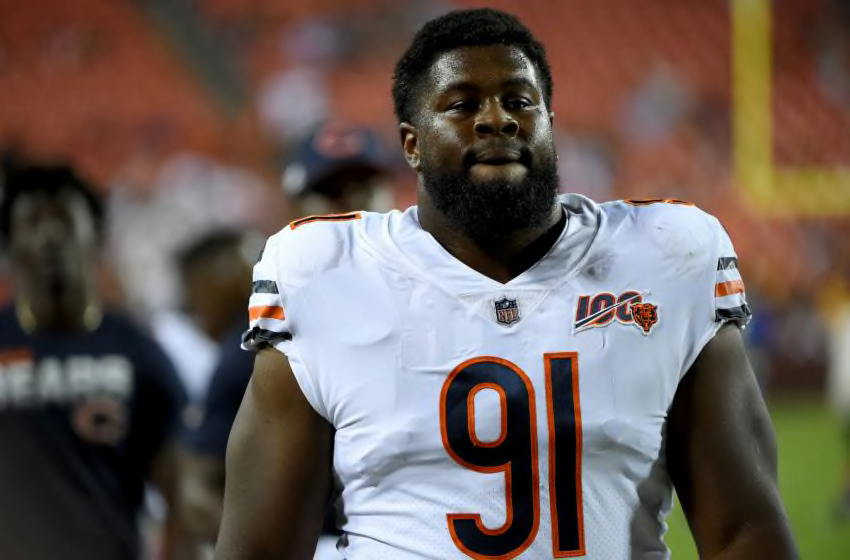
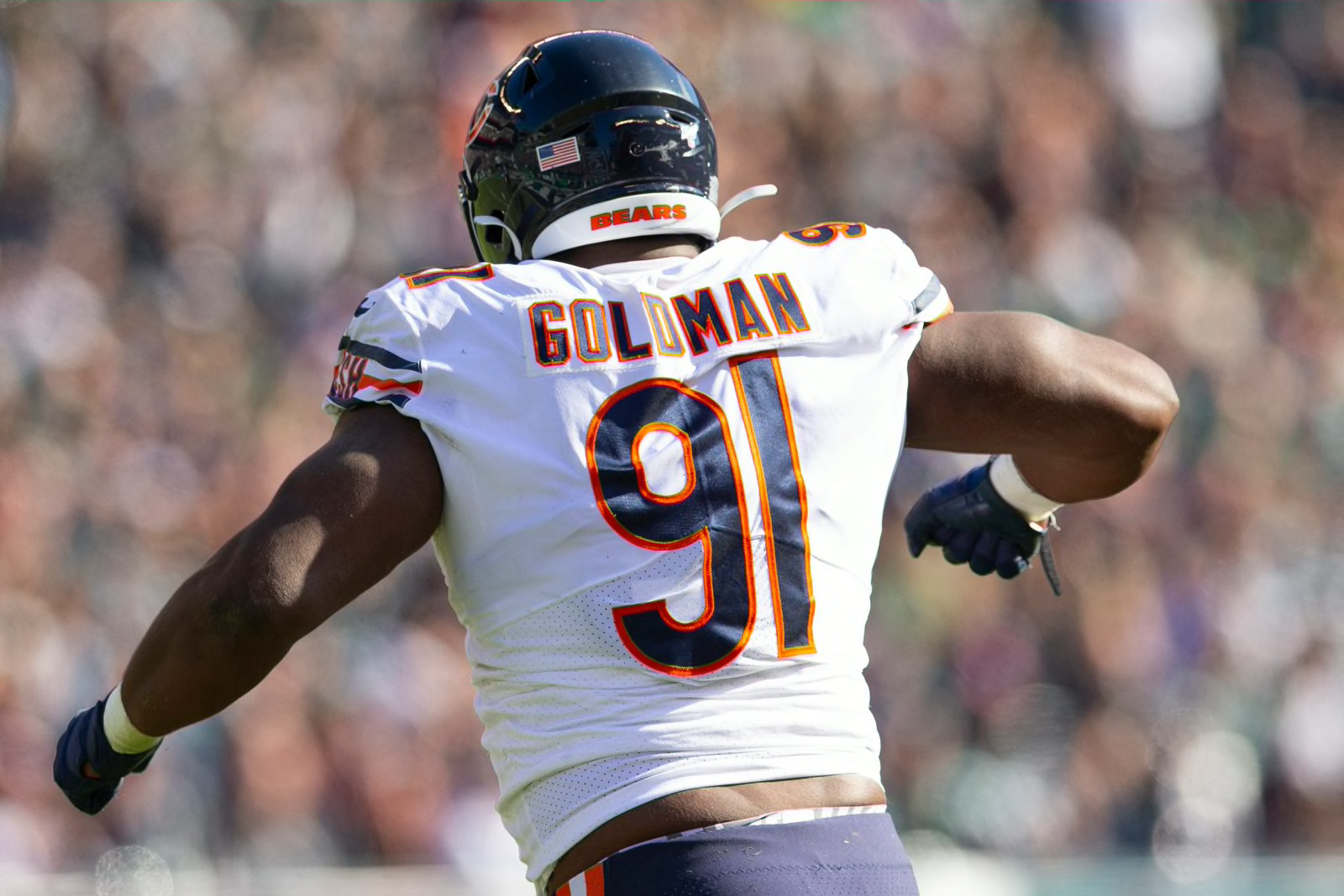
Chicago Bears: 5 players to potentially replace Eddie GoldmanRyan Heckmanon July 8, 2021 at 9:00 pm


Good afternoon. Here’s the latest news you need to know in Chicago. It’s about a 5-minute read that will brief you on today’s biggest stories.
Today will be mostly cloudy with a high near 72 degrees. Tonight will be mostly cloudy with a low around 59. Tomorrow will be partly sunny with a high near 76.
Longtime Ald. Carrie M. Austin (34th) pleaded not guilty through her lawyer during her arraignment today, one week after she became the third sitting member of Chicago’s City Council to face a federal indictment.
Austin’s chief of staff, Chester Wilson Jr., also pleaded not guilty through his lawyer. Their arraignment took place by telephone before U.S. District Judge John Kness. Austin spoke only briefly as the hearing began, answering most questions from the judge with “yes sir.”
A federal grand jury last week accused Austin of bribery and lying to the FBI in a 19-page indictment that also charged Wilson with bribery and theft of government funds.
Prosecutors say a developer involved in a $50 million, 91-unit development in Austin’s ward sought to influence Austin and Wilson with home improvements, furniture or appliances. The developer had a deal with the city of Chicago that made his company eligible for $10.5 million in tax increment financing and other funding, and Austin and Wilson allegedly took official actions to benefit the developer, a relative and an associate of his, and their companies.
Austin’s indictment not only made her the third sitting member of the Chicago City Council under federal indictment, it also meant the council’s two most senior members face federal criminal charges.
Jon Seidel has more on the legal challenges facing Austin here.
Summer in Chicago is salvageable for local “House Heads” after all.
Instead of the Chicago House Music Festival — and the Chosen Few Picnic & House Music Festival, which has gone virtual for consecutive years — the city’s Department of Cultural Affairs and Special Events is highlighting the locally created genre’s contributions to modern music with “House City,” a free, 10-part pop-up series that began last Sunday.
:no_upscale()/cdn.vox-cdn.com/uploads/chorus_asset/file/22706642/2019_05_24_001_house_music_festival_PP21616.jpeg)
The pop-up events will take place in Chicago neighborhoods such as South Shore, Englewood, North Lawndale, Humboldt Park and Lake View, among others.
The Aug. 28 date is sponsored by the Protect Chicago Music Series, and Chicago SummerDance in the Parks is a part of the Sept. 12 South Shore event.
Selah Say, one of the DJs headlining the North Lawndale slate of “House City,” says she’s excited about spinning beats outdoors, where “you can’t control where the music goes.”
Evan F. Moore has more on “House City” and the full schedule of events here.
If you could have had a brief one-on-one with President Biden yesterday, what would you have talked to him about?
Reply to this email (please include your first name and where you live) and we might feature your answer in the next Afternoon Edition.
Yesterday, we asked you: How would you define the “Midwest Nice” label? Do you think it’s accurate? Here’s some of what you said…
“Not accurate. It’s politically correct and that’s dishonest. The food is the best but too bad the people aren’t — and that’s honest.” — Roy Hillard Locke
“Spending an extra 10 seconds at a 4 way stop waving for each other to ‘go ahead’ and then accidentally all finally going at once, so you all stop again, say ‘ope’ to yourself, and start the process over.” — J. Allen
“By not sharing my edibles.” — Guy Battista
“I offer to help people with directions even if they just look lost.” — Mary Jane Tala
“Midwest Nice is just that. Respect, courtesy, holding doors, letting a car go ahead of yours, saying “Hello,” “Please,” “Thank You.” I have been all over the U.S.A. and can always identify a Midwest resident or former resident. They really do rise above the behavior of many others.” — Irena Nowak
Thanks for reading the Chicago Afternoon Edition. Got a story you think we missed? Email us here.
Sign up here to get the Afternoon Edition in your inbox every day.
Afternoon Edition: July 8, 2021Matt Mooreon July 8, 2021 at 8:00 pm Read More »
PORT-AU-PRINCE, Haiti — Two men believed to be Haitian Americans — one of them purportedly a former bodyguard at the Canadian Embassy in Port au Prince — have been arrested in connection with the assassination of Haiti’s president, a senior Haitian official said Thursday.
Mathias Pierre, Haiti’s minister of elections, told The Associated Press that James Solages was among six people arrested in the 36 hours since the brazen killing of President Jovenel Moise by gunmen at his home in the pre-dawn hours Wednesday.
Four other suspected assailants were killed in a gunfight with police and two are still missing, Pierre said. Earlier authorities had said seven suspects were killed.
Pierre would not provide additional details about Solages’ background, nor would he provide the name of the second Haitian-American he said was arrested.
Solages describes himself as a “certified diplomatic agent,” an advocate for children and budding politician on a website for a charity he established in 2019 in south Florida to assist residents.
On his bio page for the charity, Solages said he previously worked as a bodyguard at the Canadian Embassy in Haiti. Calls to the foundation and Solages’ associates at the charity either did not go through or were not answered.
“The pursuit of the mercenaries continues,” said Leon Charles, director of Haiti’s National Police, in announcing the arrest of suspects. “Their fate is fixed: They will fall in the fighting or will be arrested.”
Witnesses said two suspects were discovered hiding in bushes in Port-au-Prince on Thursday by a crowd, some of whom grabbed the men by their shirts and pants, pushing them and occasionally slapping them.
Police arrived shortly afterward to arrest the men, who were sweating heavily and wearing clothes that seemed to be smeared with mud, an Associated Press journalist at the scene said. Officers placed them in the back of a pickup truck and drove away as the crowd ran after them to the nearby police station.
Once there, some in the crowd chanted: “They killed the president! Give them to us. We’re going to burn them!”
One man was overheard saying that it was unacceptable for foreigners to come to Haiti to kill the country’s leader, referring to reports from officials that the perpetrators spoke Spanish or English.
The crowd later set fire to several abandoned cars riddled with bullet holes that they believed belonged to the suspects, who were white men. The cars didn’t have license plates, and inside one of them was an empty box of bullets and some water.
At a news conference Thursday, Charles, the police chief, asked people to stay calm, go home and let police do their work as he warned that authorities needed evidence they were destroying, including the burned cars.
Officials did not address a motive for the slaying, saying only that the attack, condemned by Haiti’s main opposition parties and the international community, was carried out by “a highly trained and heavily armed group.”
Prime Minister Claude Joseph assumed leadership of Haiti with the backing of police and the military and on Thursday asked people to reopen businesses and go back to work as he ordered the reopening of the international airport.
On Wednesday, Joseph decreed a two-week state of siege following Moise’s killing, which stunned a nation grappling with some of the Western Hemisphere’s highest poverty, violence and political instability.
Inflation and gang violence have spiraled upward as food and fuel grew scarcer in a country where 60% of Haitians earn less than $2 a day. The increasingly dire situation comes as Haiti is still trying to recover from the devastating 2010 earthquake and Hurricane Matthew in 2016 following a history of dictatorship and political upheaval.
“There is this void now, and they are scared about what will happen to their loved ones,” said Marlene Bastien, executive director of Family Action Network Movement, a group that helps people in Miami’s Little Haiti community.
She said it was important for the administration of U.S. President Joe Biden to take a much more active role in supporting attempts at national dialogue in Haiti with the aim of holding free, fair and credible elections.
Bastien said she also wants to see participation of the extensive Haitian diaspora: “No more band-aids. The Haitian people have been crying and suffering for too long.”
Haiti had grown increasingly unstable under Moise, who had been ruling by decree for more than a year and faced violent protests as critics accused him of trying to amass more power while the opposition demanded he step down.
According to Haiti’s constitution, Moise should be replaced by the president of Haiti’s Supreme Court, but the chief justice died in recent days from COVID-19, leaving open the question of who might rightfully succeed to the office.
Joseph, meanwhile, was supposed to be replaced by Ariel Henry, a neurosurgeon who had been named prime minister by Moise a day before the assassination.
Henry told the AP in a brief interview that he is the prime minister, calling it an exceptional and confusing situation. In another interview with Radio Zenith, he said he had no dispute with Joseph. “I only disagree with the fact that people have taken hasty decisions … when the moment demands a little more serenity and maturity,” he said.
Moise had faced large protests in recent months that turned violent as opposition leaders and their supporters rejected his plans to hold a constitutional referendum with proposals that would strengthen the presidency.
On Thursday, public transportation and street vendors remained scarce, an unusual sight for the normally bustling streets of Port-au-Prince.
Marco Destin, 39, was walking to see his family since no buses, known as tap-taps, were available. He was carrying a loaf of bread for them because they had not left their house since the president’s killing out of fear for their lives.
“Every one at home is sleeping with one eye open and one eye closed,” he said. “If the head of state is not protected, I don’t have any protection whatsoever.”
Destin said Haiti has always been a complicated country and that he wasn’t sure what the upcoming days would bring. “Haiti doesn’t know what direction it’s heading in right now,” he said. “To be honest, I don’t know what the solution is. There’s always been a fight for power.”
Gunfire rang out intermittently across the city hours after the killing, a grim reminder of the growing power of gangs that displaced more than 14,700 people last month alone as they torched and ransacked homes in a fight over territory.
Robert Fatton, a Haitian politics expert at the University of Virginia, said gangs were a force to contend with and it isn’t certain Haiti’s security forces can enforce a state of siege.
“It’s a really explosive situation,” he said, adding that foreign intervention with a U.N.-type military presence is a possibility. “Whether Claude Joseph manages to stay in power is a huge question. It will be very difficult to do so if he doesn’t create a government of national unity.”
Joseph told the AP that he supports an international investigation into the assassination and believes elections scheduled for later this year should be held, as he promised to work with Moise’s allies and opponents alike.
“Everything is under control,” he said.
___
Coto reported from San Juan, Puerto Rico. AP videographer Pierre-Richard Luxama in Port-au-Prince and AP writer Joshua Goodman in Miami contributed to this report.
Two men were shot, one fatally, Thursday in Wentworth Gardens on the South Side.
They were in front of a residence about 2:15 p.m. in the 3900 block of South Princeton Avenue when a vehicle pulled up and someone inside unleashed gunfire, Chicago police said.
A 26-year-old was struck in the face and taken to the University of Chicago Medical Center, where he was pronounced dead, police said.
The other man, 35, was shot in the leg and taken to the same hospital in good condition, police said.
No one was in custody. Area One detectives are investigating.
A Chicago man allegedly told authorities he opened fire on an unmarked car carrying a police officer and two ATF agents early Wednesday because he thought they were “opps” — or rival street gang members — surveilling a neighborhood on the Southwest Side.
Now Eugene “Gen Gen” McLaurin, 28, faces federal charges in connection with the shooting that wounded the officer and two agents Wednesday morning just ahead of a visit by President Joe Biden to the Chicago area.
McLaurin is charged with one count of using a dangerous and deadly weapon to assault an ATF special agent. He faces a maximum sentence of 20 years in prison. During a brief court appearance before U.S. Magistrate Judge Heather McShain, a prosecutor said the feds want McLaurin held in custody as a danger to the community.
:no_upscale()/cdn.vox-cdn.com/uploads/chorus_asset/file/22706705/McLaurin2.jpg)
A defense attorney for McLaurin waived a detention hearing for the time being, meaning McLaurin will stay in federal custody. Assistant U.S. Attorney Elizabeth Pozolo said McLaurin was initially arrested by Chicago police at 8:35 a.m. Wednesday, and he was transferred to federal custody at 11:03 a.m. Thursday.
The shooting happened just before 6 a.m. Wednesday as the officer and two agents were getting onto the northbound lanes of Interstate 57 near 119th Street, about a mile from the Morgan Park police station, authorities said.
The police officer was grazed in the back of the head, one ATF agent was shot in the hand, and another ATF agent suffered a wound to his side, police said. All were taken to Advocate Christ Medical Center.
Ald. Matt O’Shea (19th) made an appeal to Biden after the shooting, saying, “We’re at a critical point in the city of Chicago. We need help. Police can’t do it alone.” White House Press Secretary Jen Psaki said Biden had expressed his personal support for the officer and agents during a meeting with Mayor Lori Lightfoot on the tarmac at O’Hare Airport.
McLaurin is a convicted felon who was previously sentenced to five years in prison in 2015 for illegal gun possession and delivery of methamphetamine, and one year in prison in 2013 for illegal gun possession, court records show.
A seven-page criminal complaint filed Thursday against McLaurin says the officer and agents were working on an undercover investigation near the 400 block of West 118th around 5:45 a.m. Then, a white Chevrolet Malibu began to follow an unmarked Chrysler 300 in which the officer and two agents were riding.
The complaint identifies the Chicago police officer as an ATF task force officer.
The Malibu followed the Chrysler as it traveled west on 119th, according to the complaint. At one point, it said the Malibu pulled ahead of the Chrysler, parked, then began to follow the Chrysler again after it drove by.
The Chrysler turned north on Ashland to get onto I-57, and the officers inside the Chrysler took down the license plate number for the Malibu. Then, when the Chrysler reached the I-57 on-ramp, the officers inside saw the Malibu on Ashland Avenue.
That’s when the driver’s side window of the Malibu rolled down, and a Black male with a “twist hair style” pointed a black handgun at the officers and opened fire, according to the complaint.
Authorities later tracked the Malibu to a house in the 200 block of East 89th Street, according to the complaint. There, officers found two Hornady 9mm shell casings on the driver’s side of car. Three such casings were also found at the scene of the shooting, according to the complaint.
A Chicago police officer also saw someone with a hairstyle matching the shooter’s in the backyard of a house next door to where the Malibu was parked, authorities said. Officers knocked on the door at 7:15 a.m., and McLaurin eventually stepped out.
McLaurin was sweaty and “visibly nervous,” according to the complaint. He allegedly told authorities he had been with his girlfriend that morning and had just been dropped off. An ATF agent took his picture and texted it to one of the victims of the shooting, authorities said. The victim allegedly said McLaurin’s hair matched the shooter’s but couldn’t say definitively it was him.
However, authorities arrested McLaurin and questioned him at a police station, according to the complaint. There, McLaurin allegedly admitted he was driving the Malibu near 118th and Normal early Wednesday, and that he began following the Chrysler.
McLaurin allegedly explained that a friend told him Tuesday that a white Chrysler 300 had been seen surveilling the area, and he thought the car he found was being driven by “opps” — or members of a rival street gang.
The feds say McLaurin admitted opening fire on the Chrysler with a Glock 9mm that he had purchased for personal protection a few months earlier, and he said he later dropped the gun into a drain.
Authorities said they found a key to the Malibu in a dryer vent tube during a search of the home where McLaurin was found.
Contributing: Lynn Sweet
NEW YORK — Lawyers for R&B singer R. Kelly were granted a little more time Thursday to prepare his defense for his upcoming sex-trafficking trial in New York City.
At a hearing in federal court in Brooklyn, U.S. District Judge Ann Donnelly said jury selection would go forward on Aug. 9 as originally planned but agreed to delay opening statements until Aug. 18 rather than start the openings right after the panel is picked.
The jailed Kelly switched legal teams less than a month ago. His new attorneys had asked a judge Monday to postpone the New York trial for a longer period, saying they couldn’t adequately prepare.
The lawyers said they had been unable to meet with him in person while he was quarantined for 14 days in a Brooklyn federal jail after being brought there from a Chicago lockup on June 22. Federal jails have been quarantining transferred and newly incarcerated inmates since early in the COVID-19 pandemic.
The legal team also asked Thursday that Kelly be released on bail so he could better assist in his defense — a request the judge quickly denied. She assured them that they could now see Kelly in person at the jail seven days a week if they wanted.
“You’re going to have full access to Mr. Kelly,” she said.
Kelly, 54, was making his first in-person appearance in a New York court since his transfer. He didn’t speak, except to exchange greetings with the judge.
The Grammy-winning, multiplatinum-selling R&B singer is charged with leading an enterprise of managers, bodyguards and other employees who helped him recruit women and girls for sex. Federal prosecutors say the group selected victims at concerts and other venues and arranged for them to travel to see Kelly.
The case is only part of the legal peril facing the singer, born Robert Sylvester Kelly. He also has pleaded not guilty to sex-related charges in Illinois and Minnesota.
He denies ever abusing anyone.
Kelly won multiple Grammys for “I Believe I Can Fly,” a 1996 song that became an inspirational anthem played at school graduations, weddings, advertisements and elsewhere.
Nearly a decade later, he began releasing what eventually became 22 musical chapters of “Trapped in the Closet,” a drama that spins a tale of sexual deceit and became a cult classic.
But Kelly has been trailed for decades by complaints and allegations about his sexual behavior, including a 2002 child pornography case in Chicago. He was acquitted in that case in 2008.
Scrutiny intensified again amid the #MeToo movement in recent years, with multiple women going public with accusations against the singer. The pressure intensified with the release of the Lifetime documentary “Surviving R. Kelly” in 2019.
Criminal charges soon followed.
ESPN president Jimmy Pitaro was on a roll. He repaired a fractured relationship with the NFL, securing a deal that will bring two Super Bowls to ABC. He brought the NHL back to ESPN and nabbed the rights to the SEC game of the week from CBS. From a business standpoint, his tenure largely has been a success.
But behind it all, according to reports, is a workplace environment that’s failing its employees.
This week, the New York Times revealed comments made last year by Rachel Nichols, who is white, when she learned that Maria Taylor, who is Black, would host ESPN’s studio show for the 2020 NBA Finals at Walt Disney World. Video of Nichols’ conversation, held in her hotel room, was recorded accidentally. It became available to employees through an ESPN sever and was obtained by the Times.
Said Nichols: “I wish Maria Taylor all the success in the world — she covers football, she covers basketball. If you need to give her more things to do because you are feeling pressure about your crappy longtime record on diversity — which, by the way, I know personally from the female side of it — like, go for it. Just find it somewhere else. You are not going to find it from me or taking my thing away.”
Nichols said that July 13, according to the Times, and ESPN still allowed her to work the Finals the next month as the sideline reporter. She was supposed to handle the same job at the Finals this season, but after her comments became public, ESPN replaced her with Malika Andrews, who is Black. Nichols still is hosting her daily NBA show, “The Jump,” though it was pulled Tuesday without explanation.
Nichols, a former Sun-Times intern, apologized to Taylor on the air Monday, and she told the New York Times that she has tried to apologize through calls and texts. Taylor hasn’t responded. And because ESPN couldn’t bring them together in 12 months, the network’s missteps overshadowed the Finals before they began. Even NBA commissioner Adam Silver seemed amazed by the network’s failure.
“When people can’t get in a room and talk through these issues, this seemingly has fostered now for a full year,” said Silver, who’ll be negotiating a new broadcast deal with ESPN before the current one expires in 2025. “I would have thought that in the past year, maybe through some incredibly difficult conversations, that ESPN would have found a way to be able to work through it. Obviously not.”
ESPN’s mishandling has gone beyond letting feelings fester. According to the Times, it broke contractual and verbal agreements. Nichols, 47, said last year that hosting the Finals show is part of her deal. Taylor, 34, said she’d host then only if Nichols didn’t appear, but ESPN reneged. The only known person ESPN punished is the producer who sent the video to Taylor. She was suspended two weeks without pay.
Taylor must be wondering why she finds herself in these situations. In September, former 670 The Score host Dan McNeil targeted Taylor for her fashion sense while working a “Monday Night Football” game. Tweeted McNeil: “NFL sideline reporter or a host for the AVN [Adult Video News] annual awards presentation?” The Score fired him the next day.
That isn’t to say Nichols should be fired. But while she believed her conversation was private, she said what she said. It provided the public a window into a company where egos are big, tensions are high and race is an issue. The Times’ story noted an email Taylor sent to ESPN brass, including Pitaro, that said, “Simply being a front facing black woman at this company has taken its toll physically and mentally.”
Nichols has been a staple of ESPN’s coverage of the NBA since returning to the network in 2016, when she began hosting “The Jump,” which she created. It’s a quality show, and Nichols has established relationships within the league that have led to noteworthy interviews. But this episode will haunt her.
Taylor is a rising star, as evidenced by her expanding portfolio of events. But her contract expires July 20, and the sides are far apart on salary, according to reports. Though ESPN has no problem spending on broadcast rights, it has tightened its spending on broadcasters, and some big names have left.
With the clock ticking on Taylor’s tenure, she might be next. Nichols might not be far behind. And ESPN only has itself to blame.
NEW YORK — Michael Avenatti, the brash California lawyer who once represented Stormy Daniels in lawsuits against President Donald Trump, was sentenced Thursday to 2 1/2 years in prison for trying to extort up to $25 million from Nike by threatening the company with bad publicity.
Avenatti, 50, was convicted last year of charges including attempted extortion and honest services fraud in connection with his representation of a Los Angeles youth basketball league organizer who was upset that Nike had ended its league sponsorship.
U.S. District Judge Paul G. Gardephe called Avenatti’s conduct “outrageous,” saying he “hijacked his client’s claims, and he used those claims to further his own agenda, which was to extort millions of dollars from Nike for himself.”
Avenatti, the judge added, “had become drunk on the power of his platform, or what he perceived the power of his platform to be. He had become someone who operated as if the laws and the rules that applied to everyone else didn’t apply to him.”
Criminal fraud charges on two coasts disrupted Avenatti’s rapid ascent to fame. He also faces the start of a fraud trial next week in the Los Angeles area, a second California criminal trial later this year and a separate trial next year in Manhattan, where he is charged with cheating Daniels out of hundreds of thousands of dollars.
Avenatti represented Daniels in 2018 in lawsuits against Trump, appearing often on cable news programs to disparage the Republican president. Avenatti explored running against Trump in 2020, boasting that he would “have no problem raising money.” Daniels said a tryst with Trump a decade earlier resulted in her being paid $130,000 by Trump’s personal lawyer in 2016 to stay silent. Trump denied the affair.
Those political aspirations evaporated when prosecutors in California and New York charged Avenatti with fraud in March 2019. California prosecutors said he was enjoying a $200,000-a-month lifestyle while cheating clients out of millions of dollars and failing to pay hundreds of thousands to the Internal Revenue Service.
Charges alleging he cheated Daniels out of proceeds from a book deal followed weeks later. Avenatti pleaded not guilty to all charges.
Prosecutors requested a “very substantial” sentence, citing the U.S. Probation Department’s recommendation of an eight-year prison term. Avenatti’s lawyers said six months in prison and a year of home detention was enough punishment.
On Tuesday, the judge rejected a request by Avenatti’s lawyers to toss out his conviction in the Nike case on attempted extortion and honest services wire fraud charges. The judge wrote that evidence showed that Avenatti “devised an approach to Nike that was designed to enrich himself” rather than address his client’s objectives.
In written sentencing arguments, prosecutors said Avenatti tried to enrich himself by “weaponizing his public profile” to try to force Nike to submit to his demands.
In a victim-impact statement, Nike’s lawyers said Avenatti did considerable harm to the company by falsely trying to link it to a scandal in which bribes were paid to the families of NBA-bound college basketball players to steer them to powerhouse programs. An employee of Adidas, a Nike competitor, was convicted in that prosecution.
The lawyers said Avenatti threatened to do billions of dollars of damage to Nike and then falsely tweeted that criminal conduct at Nike reached the “highest levels.”
Avenatti’s former client, Gary Franklin Jr., said in a statement submitted by prosecutors that Avenatti’s action had “devastated me financially, professionally, and emotionally.” Franklin was expected in court Thursday.
In their presentence submission, Avenatti’s lawyers said their client had suffered enough, citing enormous public shame and a difficult stint in jail last year that ended after lawyers said he was particularly vulnerable to the coronavirus.
“Avenatti’s epic fall and public shaming has played out in front of the entire world. The Court may take judicial notice of this fact, as Avenatti’s cataclysmic fall has been well-documented,” the lawyers wrote.
Although prosecutors asked Gardephe to impose a $1 million restitution order to help cover Nike’s legal expenses, Avenatti’s attorneys cited the lack of financial losses as a reason for leniency.
“There was no financial loss to any victims so there is no restitution in this case,” they wrote. “The fact that a white collar federal criminal case was brought despite this fact is itself an important mitigating factor.”
A Chicago man has been charged in federal court in connection with Wednesday’s shooting of a Chicago police officer and two federal agents.
Eugene McLaurin, 28, of Chicago, is charged with one count of using a dangerous and deadly weapon to assault an ATF agent. He faces up to 20 years in prison.
McLaurin appeared before U.S. Magistrate Judge Heather McShain on Thursday afternoon, where a prosecutor said he had been taken into federal custody at 11:03 a.m. following his arrest Wednesday by Chicago police.
:no_upscale()/cdn.vox-cdn.com/uploads/chorus_asset/file/22706705/McLaurin2.jpg)
Prosecutors told the judge they would seek to keep McLaurin detained in federal custody. McLaurin’s defense attorney waived a detention hearing for now, meaning McLaurin will stay in custody for the time being.
The shooting happened shortly before 6 a.m. as the officer and agents were getting onto the northbound lanes of Interstate 57 near 119th Street, about a mile form the Morgan Park police station.
The police officer was grazed in the back of the head, one ATF agent was shot in the hand, and another ATF agent suffered a wound to his side, police said. All were taken to Advocate Christ Medical Center.
McLaurin admitted that he began following a vehicle in which the officer and agents were riding Wednesday because he thought it was driven by “opps,” or rival street gang members, according to a seven-page criminal complaint.
He said he opened fire with a Glock 9mm pistol and later dropped the weapon in a drain, according to the complaint.
This is a developing story.
A grizzly bear pulled a woman from her tent in a small Montana town in the middle of the night and killed her before fellow campers could use bear spray to force the bruin out of the area.
Leah Davis Lokan, 65, a registered nurse from Chico, California, was on a long-distance bicycling trip and had stopped in the western Montana town of Ovando when she was killed early Tuesday, according to Montana Fish, Wildlife and Parks officials.
It was the bear’s second visit to the site where Lokan and two fellow bicyclists were camping near the post office, officials said.
The approximately 400-pound grizzly first awakened the campers around 3 a.m. They took food out of their tents, secured it and went back to sleep.
Surveillance video from a business in town showed the bear about a block from the post office about 15 minutes later, wildlife officials said.
Around 4:15 a.m., the sheriff’s office got a 911 call after two people in a tent near the victim’s tent were awakened by sounds of the attack, Powell County Sheriff Gavin Roselles said. They discharged their bear spray, and the bear ran away.
The bear is also believed to have entered a chicken coop in town that night, killing and eating several chickens.
Officials searched by helicopter for the grizzly but couldn’t find it.
“At this point, our best chance for catching this bear will be culvert traps set in the area near the chicken coop where the bear killed and ate several chickens,” said Randy Arnold, the Montana Fish, Wildlife and Parks regional supervisor in Missoula.
If found, the bear will be killed, said Greg Lemon, a spokesman for the state agency.
Investigators said they have obtained the bear’s DNA from the scene of the attack and will be able to compare it with any bear they are able to trap.
Lokan, who had worked at a hospital in Chico, had looked forward to the Montana bike trip for months, said Mary Flowers, a friend from Chico. Lokan had taken previous long-distance bike trips andwas accompanied by her sister and a friend, Flowers said.
“She loved these kind of adventures,” Flowers said. “A woman in her 60s, and she’s doing this kind of stuff. She had a passion for life that was out of the ordinary.”
Grizzly bears have run into increasing conflict with humans in the Northern Rockies over the past decade as the federally protected animals expanded into new areas and the number of people living and looking for recreation in the region grew. That has spurred calls from elected officials in Montana and neighboring Wyoming and Idaho to lift protections so the animals could be hunted.
Ovando, about 60 miles northwest of Helena, is a community of fewer than 100 people at the edge of the sprawling Bob Marshall wilderness. North of Ovando lies an expanse of forests and mountains, including Glacier National Park that stretches to Canada and is home to an estimated 1,000 grizzlies. It’s the largest concentration of the bruins in the contiguous United States.
Fatal attacks in the region are rare. There have been three in 20 years, including this latest one, according to the U.S. Fish and Wildlife Service.
In 2001, a hunter was killed by a grizzly with two cubs while the hunter was gutting an elk at a wildlife management area west of Ovando. The three animals were shot and killed by wildlife officials days later.
Over the past 20 years, there have been eight fatal maulings of people by grizzlies from a separate population of about 700 bears in and around Yellowstone National Park. In April, a backcountry guide was killed by a grizzly bear while fishing along the park’s border in southwestern Montana.
Bears that attack people aren’t always killed if the mauling resulted from a surprise encounter or the bear was defending its young. But the bear involved in Lokan’s death is considered a public safety threat because of the circumstances of the attack, Lemon said.