The title of Hyun Jung Jun’s exhibition reads like an incantation, as if upon entering the gallery, viewers will be instantly transformed. Fittingly, “by flame by fog,” Jun’s solo show at Goldfinch in East Garfield Park, conjures a glade, where reality is suspended and unearthly charms work a strange magic. Visitors enter through the back gallery and immediately encounter the building’s vine-adorned windows, kissed by several wax figurines shaped like winged insects. A burst of color hits if you turn around. Jun has painted two walls in broad strokes of reds and blues, creating the illusion of a windswept and misty landscape that dizzies the eye. On small wooden shelves perch more wax critters, their wings extended as if ready to flutter skyward.
Jun, an Evanston-based artist, makes artworks that are meant to be transient as much as they play with our stock measure of time. She has received national press for her elaborate, edible cakes, made under the name Dream Cake Test Kitchen, whose aesthetic one could describe as Seussian cottagecore. Look closely at her wax sculptures, and you’ll see that they are candles; the wicks of the Goldfinch batch seem to double as graceful antennae. Carefully dipped in Jun’s kitchen, each candle is intended to eventually meet their fate by fire. “I actually want people to burn these, I want them to perish,” Jun said when we spoke in mid-June. “Really to just disappear.”
She first began working with candles as an undergraduate at the School of the Art Institute of Chicago when she would light them on fire in performative pieces. In Jun’s Candles & Water Gun (a 2012 work including a series of images and a performance) she squirted a water gun at a lit candle and photographed her attempts until she hit her mark. The resulting images of this markedly fatuous race between water and fire revel in the subtle shifts of a metamorphosis interrupted.
Ideas of shape-shifting and suspending time have continued to guide Jun, though her candles have since become less stick-like, more fantastical. Those at Goldfinch are inspired by moths, which break from their long sleep in cocoons spun by their former caterpillar selves. Jun’s moths are fetching but undeniably grotesque, presenting nubby protrusions on their wings and abdomens and a color palette that blends earth tones with high-key hues that bring to mind a confectioner’s counter. “The candles before this were butterflies, and I wanted to go into a direction that’s a little bit darker,” Jun said, noting that she is also afraid of moths: “They’re really beautiful, but I’m not over their eeriness.”
There is something quietly unsettling about Jun’s wax creatures, displayed to recall pinned species in a nascent lepidoptera collection and destined to burn. Fully formed for now, but not quite in flight, they suggest in this moment our own positions as humans emerging from more than a year of limbo: profoundly changed, dizzied, and surviving precariously.
click to enlarge
When life now seems surreally supercharged and repressurized as Chicago reopens, “by flame by fog” proffers a timely invitation for deep introspection. In addition to candles, Jun has assembled on one windowsill cracked eggshells that cradle strawberry seedlings; on one wall hangs small, photographic stills of the moon and clouds, taken from footage Jun recorded in Chicago and her native South Korea. Like the cleansing licks of fire or the nebulous drift of a rising brume, these simple scenes denote meditative ways of experiencing time, as a slow but persistent unfolding. Indulge in minutiae and dream against routine, Jun seems to urge, while asking: Who can we become when we stall the consuming march of time? v
There’s nothing better than partying on the weekend with your favorite cocktail, beer, or drink. But at the end of the weekend, most of us are left feeling…gross. The solution? A healthy cleanse! Here’s a quick roundup of top-notch juice bars in Chicago to help you look and feel your best.
Check out this “juice apothecary” serving up smoothies, cold-pressed juices, acai bowls, and more grab ’n go items. Everything on the menu at this juice bar in Chicago is 100% plant based so you know you’re getting a major dose of goodness. Use code 15LESS at checkout for 15% off in July!
Reach optimal nutrition with 100% organic cold-pressed juices. HI-VIBE delivers good vibes with their Keto coffees, superfood smoothies, grass-fed bone broth, and more. Unlock 10% off your order by entering your email and phone number on their website.
With so many options on their menu, it might be hard to choose. But we got you. Try the Green Detox for a boost with spinach, parsley, ginger, pineapple, cucumber, apple, and lemon. Or go with an Immune Booster for a vitamin C kick featuring orange, carrot, lemon, and ginger.
Say hello to an all organic health and juice bar in Chicago specializing in cold pressed juices, superfood blends, elixirs, and cleanse packages. This husband-and-wife owned juicery will get you feeling good again in no time.
From fresh fruit smoothies and raw vegan juices to CBD infused coffee and protein shakes, the folks at Bru Chicago have a little bit of something for everyone. Also, if you need to get some work done, stop by Bru for plenty of cozy seating.
Not feeling your greatest? Travel to this juice bar and order juices like Crimson Love which combines red cabbage, apple, ginger, and lemon juice. Or try the Grateful Greens which features celery, parsley, collard greens, apple, lemon, and ginger juice. We’ll take both.
Fuel your mind, body, and soul with high-quality superfoods found in every Pure Green juice. Ingredients range from pitaya and raw cocoa to spirulina to grass-fed whey protein. Not only are their juices healthy AF, they’re also tasty too.
What makes Rise Up different? Well, for starters, they use the #1 Meal Replacement Protein Powder to make the most delicious (and healthy) smoothies. Plus they offer personal coaching, fitness and meal plans, as well as online support if you need it.
Every baseball fan’s favorite part of the year is here! It’s time for the 2021 MLB All-Star Game! This season, players will take the field for the MLB All-Star Game on Tuesday, July 12 at Coors Field in Denver. Something they haven’t had the chance to participate in since 2019.
Due to the COVID-19 pandemic that led to a reduced schedule for last year’s MLB season, the All-Star Game celebration was put on hold. But now, thanks to more and more vaccinations and somewhat of a shift back to normal, it’s back on!
Baseball, baseball, and more baseball! That’s exactly what you can expect for this year’s All-Star festivities, among other things. But seriously, there will be so much baseball related activities going on over the course of the three-day long event.
Advertisement
Kicking off the event will be the Futures Game on Sunday, July 11 at 2 p.m. CST. Top prospects all across Major League Baseball will play in a seven-inning long game to see who’s the best of the young guys. Next up on the schedule is a fan-favorite, the Home Run Derby, which will go down Monday night at 7 p.m. CST. Pete Alonso of the New York Mets is the reigning derby champion from 2019. However, he’s not even considered the top seed this year. Even if you’ve been living under a rock, you’ve still probably heard the name Shohei Ohtani once or twice. We won’t go into too much detail about the guy, but as a starting pitcher for the Angels, he leads the league with 32 dingers and is the number 1 seed in this year’s Home Run Derby.
And finally, the 2021 MLB All-Star Game will wrap up the show on Tuesday night. You can watch the star-studded game on FOX, while the Home Run Derby will broadcast on ESPN’s network. You won’t want to miss seeing all the players from both the Chicago White Sox and Cubs rosters play.
Were there some snubs for Chicago players? Maybe. But, it’s not like one team missed out on sending guys to the All-Star Game. We just wanted to see more! For the Chicago Cubs, you’ll see third-baseman Kris Bryant and pitcher Craig Kimbrel represent the northside for the National League team. Both earned reserve or reliever designation for their team. For the Chicago White Sox, we actually sent a pair of starting pitchers to the American League All-Star team in Lance Lynn and Carlos Rodón. Liam Hendricks made it too as a reliever. We sure can’t wait to see our guys try and tear up the mound against some of the league’s best.
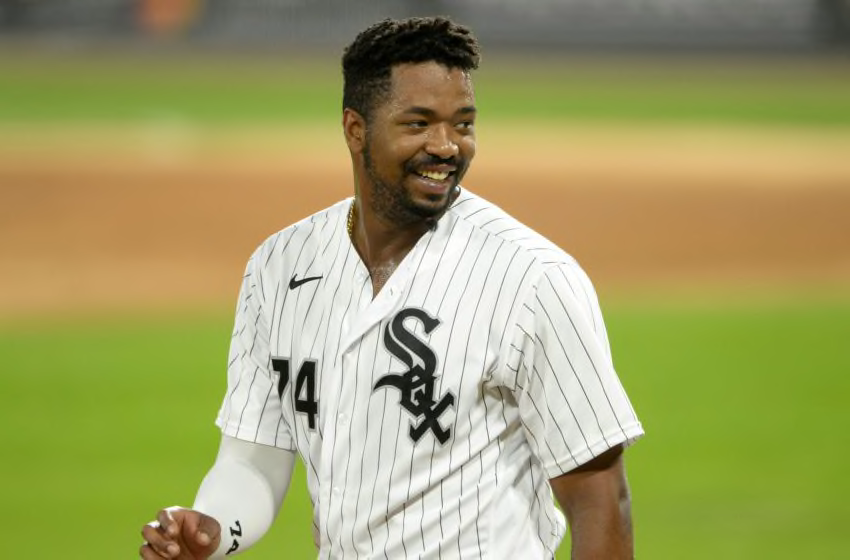
CHICAGO – SEPTEMBER 16: Eloy Jimenez #74 of the Chicago White Sox looks on against the Minnesota Twins on September 16, 2020 at Guaranteed Rate Field in Chicago, Illinois. (Photo by Ron Vesely/Getty Images)
The Chicago White Sox have defied the odds so far this season, staving off a ridiculous number of injuries to currently sit at 51-35 with an eight-game lead in the American League Central over the Cleveland Indians.
The White Sox are about to get a big boost when Eloy Jimenez returns to their offense.
While they have dealt with the various 10-day IL stints that most teams navigate over the course of a long season, they have been disproportionately impacted by significant injuries to many of their key players, including losing Eloy Jimenez, Luis Robert, Nick Madrigal, and most recently Yasmani Grandal for extended periods of time.
Unlike their counterparts on the North Side, the White Sox have handled adversity well and kept the ship afloat despite all of these injuries. With the trade deadline looming, fans will be looking to general manager Rick Hahn to see whether he will make a big splash move for a bat to mitigate the impact of these injuries.
However, a recent development may impact his decision-making process, as the White Sox got some good news regarding Jimenez.
On March 31, Jimenez had surgery to repair a torn pectoral muscle sustained while trying to make a play in the outfield during a spring training game. At the time, there was little hope he would be able to return at all this season.
Remarkably, just three months later, the White Sox announced that Eloy will begin his rehab assignment with the Winston-Salem Dash, the team’s Class A-Advanced Carolina League affiliate, on Friday.
BREAKING NEWS! Eloy Jimenez will begin his rehab assignment on Friday with Winston-Salem. pic.twitter.com/Unb9BxSVNf
This is an incredible turn of events for the White Sox who will certainly benefit from getting Eloy’s bat back in the lineup but will also get a lift to the team’s morale simply by getting him back in the clubhouse.
With the All-Star Break coming up, and a substantial lead in the Central, the Sox have the luxury of bringing him along slowly. When he does finally return to the big league club, expect him to get significant time as the team’s designated hitter, especially since they are not going to want to risk another injury in the outfield, where Eloy looks shaky at best.
Fans will have to wait and see how, if at all, this affects Hahn’s decisions ahead of the trade deadline, but with the team poised for a playoff run, he shouldn’t take his foot off the gas at this point. Therefore, expect Hahn to make some moves to solidify this team as the favorites in the American League.
The Beatles in the early days. Photo courtesy Chicago Tribune.
Ask me what I think about the Beatles and I will give the standard answer of my generation. They are the greatest band that ever lived, they revolutionized music, they mean the world to me. OK boomer, now ask me which of their songs I would put on my all-time, continuos loop, soundtrack of my life music stream.
And that’s where the dilemma lies. From the harmonies of I Want to Hold Your Hand, through the opening chord of A Hard Days Night to the final yeah-yeah-yeah-yeah of The Long and Winding Road, I like a lot of Beatle songs, but I don’t love any of them. Sort of like my relationship to Superdawg french fries. I like them but I don’t love them.
It’s not the same with the other artists that are constantly playing on my radio in the lab or the Pandora station in my headphones at the fitness center. If I’ve got favorite bands, I’ve got favorite songs to go with them.
U2? The bang-bang-bang opening of the Joshua Tree album–Where the Streets Have No Name, I Still Haven’t Found What I’m Looking For, and With or Without You introduced me to the band more than 30 years ago and have been my favorites ever since.
With Steely Dan, my favorite songs come from the end of their career, or at least the end of their career’s first chapter (I ignored the second chapter.) Aja, the title track of their 6th album, is sublimely mellow and mind-expanding and the same album’s Deacon Blue makes a wistful cry out to mid-life crises.
When Fleetwood Mac changed their personnel and music style in the mid-70’s they probably lost a few thousand fans but gained a few million more. It was that flip that led to Go Your Own Way, the best power-pop song of all time. And I love the more pensive Over My Head just as much. Easy to add to my jukebox of greats.
What Eagles songs are on that Love Those Songs jukebox? Give me the original Hotel California and then follow it up with the Hell Freezes Over version of…Hotel California. Sometimes you feel like acoustic, sometimes you don’t.
The longings of youth. Has anyone made them seem more desperate than Bruce Springsteen in Thunder Road or made them sound more fun than in the Boss’s Rosalita?
While Pink Floyd’s Dark Side of the Moon is my top-ranked album, I prefer not to think about individual songs from it — everything blends so seamlessly together. On the other hand, Wish You Were Here, the title cut and final track from the Floyd’s 1975 album stands alone as the perfect paean to loss of love, loss of a bandmate, loss of sanity. And the guitar solos in Comfortably Numb make me feel…comfortable.
But back to the Beatles. I am ok with the silly love songs, I enjoy the goofiness of Yellow Submarine and Octopuses Garden, and I can play air guitar to The End. But where is the song I could listen to over and over and over again? Where is their Hotel California? If Rocky Racoon put a gun to my head and made me choose one song, today it would be While My Guitar Gently Weeps. Tomorrow it would probably be something else. Like but never love.
And that is my dilemma with the Beatles.
Like (or love) what you read here? Add your name to our subscription list below. No spam, I promise!
___
Hi! I am Les, a practicing pathologist living in the North Suburbs and commuting every day to the Western ones. I have lived my entire life in the Chicago area, and have a pretty good feel for the place, its attractions, culture, restaurants and teams. My wife and I are empty-nesters with two adult children and a grandchild. We recently decided to downsize, but just a bit! I will be telling the story of the construction of our new home, but also writing about whatever gets me going on a particular day. Be sure to check out the “About” page to learn more about where we plan to go with this blog!
BOSTON, MASSACHUSETTS – JUNE 12: Vladimir Tarasenko #91 of the St. Louis Blues hoists the cup after defeating the Boston Bruins 4-1 to win Game Seven of the 2019 NHL Stanley Cup Final at TD Garden on June 12, 2019 in Boston, Massachusetts. (Photo by Patrick Smith/Getty Images)
The Chicago Blackhawks and St. Louis Blues have a long storied rivalry. They are also both teams looking to do whatever means necessary to get better. The Blues won the Stanley Cup in 2019 so you know that they are a lot closer to getting back than the Blackhawks who aren’t very good at all anymore. However, there is some news coming from St. Louis that might interest some fans of both teams. The report out there is that Vladimir Tarasenko has requested a trade.
The Chicago Blackhawks and St. Louis Blues could make a trade if both sides were willing.
There are a lot of things that could cause Tarasenko to want out of St. Louis. He has had a lot of success there, including the Stanley Cup title in 2019. He also has 218 goals and 224 assists for 442 points in 531 games played. He has dealt with injuries over the last few seasons which has made people wonder what the future is going to bring for him. It is easy to forget that he was once a top-five goal scorer in the NHL.
BREAKING: Blues winger Vladimir Tarasenko requests a trade, per sources: Why he wants out, possible destinations and more https://t.co/OLnEuCtgsI#stlblues
Obviously, the Blackhawks are not a likely destination for Tarasenko for a few reasons. First, it is hard to see the Blues trading him to a division rival that has so much history with them. Second, it doesn’t seem like he is the best fit for the Hawks at this point either. However, it is always fun to speculate what a trade might look like. If it did happen, it might look something like this:
If you went to a lot of shows at defunct Bridgeport punk house Rancho Huevos, you likely caught the July 2019 debut performance of south-side underground supergroup Canal Irreal. The band, whose name means “unreal channel” in Spanish, features members of razacore outfit Sin Orden (who emerged in a second wave of local Latinx punk bands in the late 1990s), guitarist Scott Plant of oddball postpunk unit Droids Blood, and longtime DIY punk linchpin Martin Sorrondeguy, best known as the fearless front man of radical Spanish-language hardcore champions Los Crudos and queercore evangelists Limp Wrist.
Almost two years after their first show, Canal Irreal have dropped their self-titled debut through Beach Impediment Records from Richmond, Virginia. This sinewy sprint of an album plants its flag in the contested territory between grim, cold postpunk and white-hot hardcore fury. On “Glaze,” an austere bass line seems to summon icy guitars that act as foils to Sorrondeguy’s sawtooth screams; Canal Irreal can create tension that makes you want to jump out of your skin, so it’s a relief when when they crank up the chorus into a warm wall of sound. The quicksilver hardcore stomp of “Si Somos” and the brisk goth melody of “Knockdown” summon complex emotions with aggressive sounds, and make Canal Irreal ideal for repeat listening. v
A few days after the Fourth of July in 2018, Zay Manning was shot outside his neighborhood corner store in Bronzeville — the one he grew up going to for a bottle of lemonade and a bag of hot fries.
He was 19 and loved helping his younger brother produce music — picking out beats, tweaking the sound one bar at a time.
The one bullet that hit him nearly killed him.
During his hospital stay, police officers and doctors told him about the Illinois’ Crime Victim Compensation Program, which uses state and federal dollars to reimburse victims of violent crime and their families for injury-related expenses. Manning applied, hoping to recoup some of the costs of his medical bills and replace clothing destroyed and bloodied in the shooting. But he found the program difficult and confusing as he also was navigating back-to-back hospital visits.
“It was a lot of documentation I didn’t really understand,” Manning says. “I got discouraged.”
More than a year after submitting his claim, Manning faces a similar situation as most of the program’s applicants.
He hasn’t gotten a single penny of compensation.
The nearly 50-year-old government program that’s supposed to help ease the blow of being a crime victim largely isn’t doing that, an investigation by The Trace has found.
Few people apply to the program. Even fewer end up getting financial relief. Those who do face long waits.
Using records obtained through the Freedom of Information Act, The Trace analyzed nearly 15,000 claims processed by the state’s victim’s compensation program between 2015 and 2020. Fewer than four in 10 applicants got any reimbursement.
And that’s out of those who even applied. Many people aren’t even aware the program exists, The Trace found.
In Chicago, just one application was filed for every 50 violent crimes during the period reviewed.
The majority of claims were denied or categorized as “award no pay” — a designation that means someone is eligible to get the money but, in most cases, that an analyst hasn’t been able to verify all of the necessary details of the application.
To examine how the program is working, The Trace interviewed nearly 50 survivors, family members, researchers, advocates and government officials and found that the problems stem in large measure from three factors:
The strict eligibility criteria.
Burdensome application requirements.
And not nearly enough outreach from government agencies.
The program has a small staff, and advocates and researchers worry that the application process can re-traumatize victims by making them prove that they have suffered.
John Maki of the Alliance for Safety and Justice, “If the best thing we have is crime victim compensation, then we don’t have very much.”Kevin Tanaka / Sun-Times file
Beyond that, it can take years for the state to decide whether to pay a claim, which in some cases leaves crime victims in debt for things such as medical care for their injuries.
Victims’ needs spiked during the COVID-19 pandemic, as violence in Illinois and across the country soared to historic levels alongside a rise in unemployment and housing insecurity.
“If the best thing we have is crime victim compensation, then we don’t have very much,” says John Maki, a director with the Alliance for Safety and Justice who’s a longtime advocate of reforming the reimbursement program. “It’s a service with a lot of potential, but the potential is far, far, from realized.”
Lakeidra Chavis reports for The Trace, a nonprofit news organization covering gun violence in America.This story is being published in partnership with the Sun-Times, Block Club Chicago and La Raza.
Earlier this year, the Illinois Legislature passed a bill that ultimately will make more people eligible for compensation and also raise the cap for reimbursement.
Advocates say the changes can’t come soon enough but still could leave big gaps in the people the program reaches.
Sharrise Kimbro, a division chief for Attorney General Kwame Raoul’s — whose office runs the program with the Illinois Court of Claims — said the agency can’t answer for problems with victim’s compensation before Raoul took office in 2019 and points to changes that the office has instituted that might not be reflected yet in the data on the program’s success.
Flawed from the start
Every state has a program to compensate crime victims, and each operates differently. Under the federal Victims of Crime Act, or VOCA, Congress disperses millions each year to help fund such efforts.
A decades-old federal report on victim services shows the philosophy that influenced this approach, saying: “The innocent victims of crime have been overlooked, their pleas for justice have gone unheeded, and their wounds — personal, emotional, and financial — have gone unattended.”
When Illinois lawmakers passed the Crime Victim Compensation Act with bipartisan support in 1973, they made the state among the first to do so.
A few years later, a report in the Loyola University Chicago Law Journal blasted the “inadequate draftsmanship” of the law, noting that few claims had been filed in the program’s first two years.
A 2019 report by 11 advocacy and anti-violence groups echoed this and pointed out that Illinois had one of the lowest application rates in the country.
Illinois’ victim compensation program has a roughly $6 million yearly budget, funded mostly by the state. To receive compensation from the state program, people have to be a victim of a crime that happened in Illinois and must apply within two years of the incident. They also must have reported the crime to police and cooperated with law enforcement and the victim compensation program.
Family members, including spouses and children, can apply to cover related expenses they covered as well.
People have to spend their own money before seeking reimbursement. And the program won’t reimburse what insurance covered.
Applicants can be found ineligible if the program’s staff determines they were hurt or killed while committing a crime or otherwise contributed in any way to their becoming a crime victim. And those who are on probation or in prison can’t be compensated until they’re released.
As of late June, the attorney general’s office — which vets the claims — had just over a dozen analysts who focus on processing the thousands of claims filed each year. They interview the victims, confirm expenses related to the injury and gather reports from law enforcement to determine whether they qualify.
Once the analyst makes a recommendation, the application is sent to the Illinois Court of Claims, which rules on monetary claims against the state. If the application is approved, the state comptroller’s office issues a payment — usually by check.
There are multiple points at which applicants might be asked to provide more documentation. The analysts usually send these requests by mail, and applicants have 30 days to respond.
For survivors of violent crimes like Manning, waiting for the analysts to make a decision can feel like peering into a black hole.They can’t go online to look up where their claim stands, as is done in Indiana and Tennessee. The process is largely done through the mail, unlike in some states that communicate with applicants by phone and email.
Though the attorney general’s office is the key agency, four state agencies are involved in the application process in Illinois, rather than one as in other states.
A lag in payments
Reports to the federal government show that, of Illinois applications for compensation that included information on the victim’s race, half were Black, and a smaller percentage were white or Latinx.
Raoul has said he first noticed problems with the victim compensation program about a decade ago, when he was a state senator.
Attorney General Kwame Raoul.AP file
“There was an inability to answer the question of, to what extent, were resources going to the most victimized communities,” Raoul said earlier this year. “There was a sense that there was a small likelihood that someone who was a Black or Brown male would qualify for resources. There were rules — written and unwritten — with regards to what would disqualify you from compensation.”
According to his office, the agency under Raoul has relaxed some of the state’s strict rules for who qualifies. He also has required analysts to undergo trauma-informed training and hosted listening sessions on where to make improvements.
The changes his office touts are reflected in a sweeping criminal justice reform law passed earlier this year. The reforms broaden the rules on who can apply for victim compensation, increase the total possible reimbursement per person to $45,000 and extend the application deadline to five years after the date of the crime. The reforms also shift more responsibilities to the attorney general’s office.
But expanding the cap doesn’t necessarily mean survivors will get more money. The average reimbursement under the program has been about $4,400 — far below the current financial cap of $27,000.
FEW RECEIVE THE MAX
The average reimbursement from 2015 to 2020 has been about $4,400. Just 2% got the maximum possible $27,000. Daniel Nass / The Trace
And it has taken increasingly longer for the state analysts to begin reviewing claims, even as the number of applications has fallen. Since 2015, the wait time has grown from a few days, on average, to nearly 50 during the pandemic, as the analysts worked from home. It’s then taken eight months longer, on average, to decide whether to approve any reimbursement.
“I’ve rarely seen a case that gets their funding in three to six months,” says Edwin Martinez, a mental health coordinator on the city’s Southwest Side.
Martinez likens the process to having to argue a case in court.
“You have to explain how this injury affected you,” he says. “You have to submit supporting documentation. That really depends on the stability [of an applicant’s living situation] and how informed that client is. Do you have your police report? Do you have your incident report?”
A lack of public awareness
In North Lawndale this summer, an elderly man, shot in 1981, spoke about how the bullet that hit him four decades ago remains lodged in his spine. He estimated his medical bills have come to about $80,000. He didn’t know that he might have been eligible to get reimbursement from the state to help cover that.
Down the street from him, another man, who’d been shot about a decade ago, also was surprised to learn the state might have helped pay the resulting bills.
For each, the deadline to apply for victim compensation has long passed.
Hospitals and police are required to inform victims about the possible compensation. But The Trace surveyed victim advocates and sampled people living on the South Side and the West Side and found few know the program exists.
Only about 3,300 people apply each year. The largest numbers of applications had come from Chicago neighborhoods that experience the most violence — majority-Black and Latinx communities including North Lawndale, Little Village, Austin, West Lawn, Roseland and Chatham.
But the percentage of crime victims seeking compensation is low. Since 2015, about one application has been filed for every 50 violent crimes in the city.
Beyond awareness, applying can be difficult.
Teyonna Lofton is still trying to grasp the process. She started looking into how to apply soon after she was shot last year, just days before her high school graduation, as the city erupted in riots after George Floyd’s killing by a Minneapolis police officer.
“I don’t understand how the application works,” Lofton says. “I don’t know if I submitted it or not.”
She says she recently called the attorney general’s office’s helpline to confirm whether her application was submitted but was told the information wasn’t available due to a ransomware attack that affected the agency.
Once someone does apply, the likelihood of being approved depends heavily on the type of crime. Reimbursements related to sexual offenses are the least likely to be approved compared to battery and murders, The Trace found.
AWARDS BY TYPE OF CRIME 2015-2020
The Illinois attorney general’s office “awards” nearly two of three crime victim compensation claims in murder cases. For victims of sex offenses, it’s fewer than one in five. “Award-no pay” means a claim was deemed eligible for compensation but, in most cases, that an analyst hasn’t been able to verify all of the necessary details of the application. Daniel Nass / The Trace
The low rate of approvals isn’t surprising for Maria Balata, a director with Resilience, a support organization for sexual assault survivors. Balata says her team tries to set realistic expectations with survivors about the program’s limitations.
“It’s just become such a convoluted system for us to navigate with victims,” she says. “Typically, it’s the bureaucracy of it that makes it feel like it’s inaccessible.”
The reason people end up not getting any compensation often is because an analyst couldn’t “substantiate” a crime victim’s claim.
Susan Catania, who was one of the sponsors of the crime victim compensation law: “I am really appalled that not enough people know about it and use it. Plowing through the bureaucracy has to be excruciating.”Sun-Times file
Claims are more likely to end up being designated “award no pay” than being denied outright. This means that thousands of applicants are still eligible to receive financial support — but might not realize that.
Susan Catania is one of the last living sponsors of Illinois’ law. Today, nearly 50 years later, the former Republican state representative from Chicago says, “I am really appalled that not enough people know about it and use it. Plowing through the bureaucracy has to be excruciating. A victim of any crime does not need that added as a burden — especially if ultimately they’re going to be told there’s some bureaucratic reason they’re not going to get any money.”
Covering funeral payments
On a recent morning in Austin, Nhemya Ward sat in a conference room at the Johnson Funeral Home as she went through a copy of the crime victim compensation application — a five-page document that has more than 100 information fields. The attorney general’s office made the application available online last year, but Ward uses the paper version.
Part of her job is helping the funeral home’s clients fill out the forms. She says most of them can’t afford the unexpected costs of burials resulting from violent crimes.
Since 2015, about a quarter of all claims to the state program have been to cover funeral costs. The state’s long lags in processing applications makes Ward’s job harder.
Nhemya Ward is a funeral director at Johnson Funeral Home, 5838 W. Division St. She helps clients with the paperwork for claims to the cime victim compensation fund. But her funeral home has had to start capping the number of clients it will take who rely on the state program to help cover funeral costs.Ashlee Rezin Garcia / Sun-Times
She says her funeral home requires families to pay upfront for half of funeral and burial expenses. The funeral home defers the rest of the bill in hopes the family’s reimbursement request is approved.
If it isn’t, the survivors must find another way to come up with the money.
“The reason why we do the 50/50 split is because crime victim compensation does not pay for up to two years,” Ward says. “Right now, our 2018 crime victims files are just being reviewed.”
To combat the uncertainty, Johnson and other funeral homes vet potential applications customers might file.
“I had one family who wanted to apply,” Ward says. “I asked them the details of what happened.”
A mother told Ward her son “went to defend [a relative], and, in the midst of that, he was shot and killed. That unfortunately is a risky case to take because he went to the person’s house.”
Austin funeral director Nhemya Ward holds a paper copy of the Crime Victims Compensation Application. It’s five pages long, with more than 100 information fieldsAshlee Rezin Garcia / Sun-Times
Ward says that, based on her experience, the attorney general’s office probably would view the man’s actions as “contributory misconduct” — meaning his own actions played a role in his death. Since 2015, more than 600 claims have been denied for this reason.
Ward’s funeral home began capping the number of clients this year that it will take who rely on crime victim compensation.
“It’s just not financially sound,” she says.
‘Blessing in disguise’
Zay Manning, now 23, got a lot further than most applicants — though, until recently, he wasn’t aware of just how far.
Last year, weeks before the pandemic hit, he got a letter from the attorney general’s office asking for more information about his medical bills.
“They wanted everything, like literally everything,” he says. “I’m going in and out of hospitals as I’m still healing, taking out staples and stitches. They wanted me to keep the paperwork from the time I was having surgery and basically my whole situation up until when they released me.”
Manning was juggling dozens of hospital visits and learning how to walk again after his injuries and says he struggled to reach people to get the information he needed.
“I didn’t get back to [the attorney general’s office] in enough time,” he says.
The process left him frustrated and disillusioned.
“It’s basically a hit or miss,” he says.
As a result, for nearly half a year, Manning and his mother Natalie believed his application had been denied. It wasn’t until a reporter searched for his claim and found that the attorney general’s office had marked his case as an “award no pay” that they realized his application still has a chance. He just needs to turn in more paperwork.
“It’s just confusing,” Natalie Manning says. “They need to have better communication.”
Isaiah “Zay” Manning and executive director Debra Gitter during a Zoom meeting at Contetos, the nonprofit she runs, where he works, Contextos. | Brian Rich / Sun-TimesBrian Rich / Sun-Times
Much of Zay Manning’s life since the shooting has focused on moving beyond the trauma. He still lives in Bronzeville, where he grew up. As part of his recovery, he started working for ConTextos, a nonprofit organization that helps young people in Chicago process trauma through storytelling.
Now the father of an almost 1-year old baby with chubby cheeks and enough hair for bantu knots, the opportunity to finally receive reimbursement offers a sliver of hope.
“I’m kind of shocked,” he says. “I was just looking past it and to forget. The fact that I might be able to obtain it — I feel like that’s a blessing in disguise.”
This story was produced as a project for the USC Annenberg Center for Health Journalism’s 2020 Data Fellowship.
APPLYING FOR VICTIM COMPENSATION
The Illinois Crime Victim Compensation Program reimburses victims of violent crimes for injury-related expenses. How it works:
WHO CAN APPLY: Victims of a violent crime in Illinois or their family members. You have two years from the date of the crime to file a claim, must have reported the crime to police within 72 hours — one week in the case of a sex crime — and must cooperate with the police and with analysts from the program. You’ll need records to verify expenses not covered by insurance.
WHAT’S COVERED: Expenses including funeral costs, relocation, mental health counseling and income loss. This is a reimbursement program that can cover costs you already have paid for.
HOW MUCH CAN YOU GET: Up to $27,000, though there are caps on certain types of services. Funeral cost reimbursements, for example, are limited to $7,500.
HOW LONG WILL IT TAKE: The process can take several months. If approved, the reimbursement will go to you or directly to a funeral home or other vendor you owe money to.
MORE INFORMATION: Call the state’s toll-free Crime Victims Assistance Line at (800) 228-3368. A text talk line is available at (877) 398-1130.
Two people were killed and 11 others were wounded in shootings in Chicago Thursday.
One of the fatal shootings occurred in Austin on the West Side. Miles A. Thompson, 18, from Northbrook, was found with a gunshot wound to the chest about 7:10 a.m. in the first block of North Mayfield Avenue, Chicago police said.
Thompson was pronounced dead on the scene. Police said it was not clear when the shooting occurred.
Two men were shot, one fatally, in Wentworth Gardens on the South Side. They were in front of a home in the 3900 block of South Princeton Avenue when a car pulled up and someone inside fired about 2:15 p.m., police said.
Deandre Abrams, 26, was struck in the face and taken to the University of Chicago Medical Center, where he was pronounced dead, police said. The other man, 35, was shot in the leg and taken to the hospital in good condition, police said.
Other shootings:
A 40-year-old man was shot during an attempted robbery in East Chatham. About 1:40 a.m., he was walking in the 7900 block of South Ingleside Avenue when someone walked up and demanded the man’s bag, police said. The 40-year-old refused and was shot in the leg, police said. The robber took the bag before fleeing. The man was taken to Jackson Park Hospital and stabilized.
Minutes later, a 30-year-old man was shot in Little Village on the Southwest Side. About 1:55 a.m., he was outside in the 3100 block of West 26th Street when someone in a passing red car fired at him, police said. He was struck in the abdomen and the left side, and was taken to Mount Sinai Hospital in critical condition.
Two people were shot, one critically, near Benito Juarez Community Academy in Pilsen about an hour before students were released for the day Thursday afternoon. A 16-year-old boy and a 34-year-old woman were in the 2100 block of South Ashland Avenue when someone approached and opened fire about 12:10 p.m, Chicago police said. The woman was hit in the neck and taken to Stroger Hospital in critical condition. The teen was shot in the leg and was in good condition at the hospital.
At least six others were wounded in citywide gunviolence.
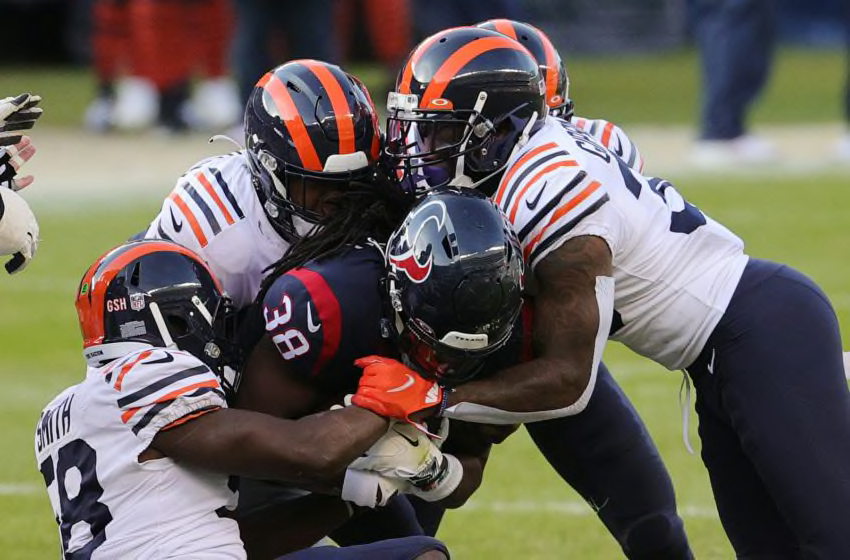
CHICAGO, ILLINOIS – DECEMBER 13: Houston Texans running back Buddy Howell #38 is gang tackled by the Chicago Bears defense during the second half at Soldier Field on December 13, 2020 in Chicago, Illinois. (Photo by Jonathan Daniel/Getty Images)
Most of the excitement surrounding the Chicago Bears this offseason has centered around the offense and first-round pick Justin Fields — and rightfully so. It has been a long time since there has been this level of optimism around the Bears’ quarterback situation, so you can’t blame fans for focusing their attention on that side of the ball.
However, if the Bears stick to their expressed intentions to start Andy Dalton (which could certainly change in training camp) they will once again be leaning heavily on their defense to carry them into the playoffs.
You can argue whether Dalton is an upgrade over Nick Foles or Mitch Trubisky, but even if he is, the improvement is nominal. Dalton is not the type of quarterback who is going to carry a team on his shoulders.
At this point, the best the Bears can hope for is that Dalton plays like the ultimate “game manager” and the defense can play at a high enough level to keep them in the playoff hunt. So what can we expect out of the defensive unit for the 2021 season?
What are the expectations for the Chicago Bears defense in 2021?
For this exercise we are going to break down all three levels of the defense, starting with the defensive line.
Right off the bat, we have to address the elephant in the room, which is Eddie Goldman. After opting out of last season due to COVID-19 concerns, there is a sense of worry that Goldman may choose to retire. If that were to happen, it would leave a massive hole in the defensive front — particularly in the run game. The team will turn to Bilal Nichols and recently signed Mike Pennel to fill that monstrous void. While neither is Goldman, the pair should be able to fill in admirably if he chooses to retire.
The rest of the line, to include the team’s edge rushers, should look the same from the 2020 season, at least in terms of composition. However, the Bears will absolutely need more production out of Robert Quinn if the defense is going to be a top five unit. While Khalil Mack may have been graded as the top edge rusher according to Pro Football Focus, his amount of impact plays were down, largely because underperformance on the rest of the line allowed defenses to key on Mack. If Quinn can take some of that focus off of Mack, he will feast in 2021.
Next, we move to the inside linebackers where we expect Roquan Smith’s ascension to continue. Smith has steadily improved every season and is close to the most dependable player on the defense. You can pencil him in for 120+ tackles and exceptional coverage of the field. Opposite Smith will be Danny Trevathan who will need to continue to be a complementary piece to Smith. Add in the addition of Cristian Jones for some nice depth, and the inside linebacker corps probably has the least number of question marks on the defense.
Finally, we take a look at the defensive backfield, where we have arguably the most question marks. With the departure of Kyle Fuller, the team will lean heavily on second-year player Jaylon Johnson (who appears up to the task) and either Kindle Vildor or Desmond Trufant opposite Johnson. Trufant has been a very solid corner throughout his career, but is past his prime, and Vildor, who has played well in limited time, has not been asked to be “the guy.” So both come with some question marks. This will be the most intriguing camp battle to watch in my opinion.
Looking at the nickel cornerback position, the Bears have another hole to fill with the aperture of Buster Skrine. They have some intriguing options here including the extremely versatile Marqui Christian who will hit camp incredibly hungry and eager to show how he can contrite to this unit. Other options include Artie Burns, who missed last season due to injury, Duke Shelley, who is still looking to make a name for himself, and rookie Thomas Graham, Jr.
Next, we move to the safety positions, where Eddie Jackson will be patrolling the field as the team’s unquestionable free safety. While Tashaun Gipson may seem to have the inside track to start as the strong safety, he will face stiff competition from the likes of the aforementioned Marqui Christian, and long-time Bear Deon Bush. In fact, the strong safety position could be another sneaky good camp battle to watch with Christian being one to keep your eye on.
While the unit may have some question marks, to include new defensive coordinator Sean Desai, they are still good enough to be a top-five unit, especially if they get back to their more aggressive ways when they were led by Vic Fangio. And if they want to be a playoff team with a Dalton-led offense, they are going to need to be just that.






:no_upscale()/cdn.vox-cdn.com/uploads/chorus_asset/file/16280055/trace_logo_black.jpg)
:no_upscale()/cdn.vox-cdn.com/uploads/chorus_asset/file/22410910/merlin_81750179.jpg)
:no_upscale()/cdn.vox-cdn.com/uploads/chorus_asset/file/22704803/Screen_Shot_2021_07_07_at_7.11.20_PM.png)
:no_upscale()/cdn.vox-cdn.com/uploads/chorus_asset/file/22704759/Screen_Shot_2021_07_07_at_6.54.12_PM.png)
:no_upscale()/cdn.vox-cdn.com/uploads/chorus_asset/file/22704838/merlin_38223076.jpg)
:no_upscale()/cdn.vox-cdn.com/uploads/chorus_asset/file/22704818/merlin_98379020.jpg)
:no_upscale()/cdn.vox-cdn.com/uploads/chorus_asset/file/22704820/merlin_98379024.jpg)
:no_upscale()/cdn.vox-cdn.com/uploads/chorus_asset/file/22704825/merlin_98842064.jpg)
lesraff
January 17, 2020 at 12:00 am