Videos

Taste of Chicago To-Go: Who, what & whenon July 9, 2021 at 6:19 pm

Show Me Chicago

Taste of Chicago To-Go: Who, what & when

Read More

Taste of Chicago To-Go: Who, what & whenon July 9, 2021 at 6:19 pm Read More »

What You Need to Know About the Special Edition Chicago Auto Show 2021Olessa Hanzlikon July 9, 2021 at 5:13 pm

Chicago Auto Show 2021 officials announced they received approval from state and city officials to host a special edition of the show July 15-19 at McCormick Place. It will be one of the McCormick Place’s first live, in-person events since the COVID-19 pandemic shutdown. The special edition show will move to the West Building of the McCormick Place complex and expand outdoors to take advantage of July weather. With the show’s move, attendees will now experience more outdoor test-drive opportunities, test tracks, and technology demonstrations, which will take place along Indiana Avenue and surrounding city streets. Some of these outdoor opportunities include the Camp Jeep and Ram Truck indoor test tracks, Subaru’s popular pet adoption event, and Ford experiences, featuring the new Bronco, Bronco Sport, and all-electric Mustang Mach-E SUV.

McCormick Place, West Building | 2301 S. King Drive, Chicago

The 2021 show will begin with electronic ticket processing and they will be exclusively sold online. Attendees will be able to select their preferred date and time. The event will be carefully controlled for crowd capacity and the floor will be regulated to control the number of people at any given time. Attendees will also have the opportunity to pre-register for onsite activities including an indoor and outdoor test track and ride-and-drive events.

Advertisement

And in an effort to make this show as special as possible, the Chicago Show organizers have gotten approval to shut down Indiana Ave for a Street fest! The Street Fest will feature the latest vehicles on display, food trucks, local brews, and musical entertainment. A variety of food options will be available including BBQ, street tacos, Asian fusion, burgers, and more. Goose Island will be on-site with their Chicago rail car bar and the Shandy Man will make special appearances. Desserts will include frozen custard, cupcakes, refreshing ices, and more.

Advertisement

The show will run from July 15 through July 18, 9 am-10 pm and July 19, 9 am-8 pm. More information regarding the show can be found here. Tickets prices start at $13 for adults and $10 for children and seniors. Tickets can be purchased here.

Advertisement

Read More

What You Need to Know About the Special Edition Chicago Auto Show 2021Olessa Hanzlikon July 9, 2021 at 5:13 pm Read More »

Where would you take a newcomer to Chicago? Readers gave us hundreds of ideas.Matt Mooreon July 9, 2021 at 4:00 pm

With people getting out more now that more are vaccinated and COVID-19 restrictions largely are lifted, we asked Sun-Times readers to tell us where they’d take someone visiting Chicago for the first time.

Hundreds of people responded, offering their collective take on a local’s guide to the city.

Everybody had at least a few must-sees to suggest. There were the expected downtown landmarks, of course, but also beloved spots across the city.

The “Amor y Comunidad” mural near 18th Street and South Loomis Street in Pilsen.
Anthony Vazquez / Sun-Times

“1.) An old-school neighborhood tavern — I like Stanley’s at 43rd and Ashland. 2.) Take the Brown Line to the end of the line so they get a bird’s-eye view of, like, 10 different neighborhoods. And 3.) Take the Pink Line to Ashland, and walk around Pilsen to see the murals and pop in to one of the many great Mexican restaurants around there.” — Paul Mulchrone

“A day at the Shedd Aquarium, then water-taxi to Navy Pier. Water-taxi from downtown to Chinatown. Go to the Signature Lounge for a drink and a stop at the women’s restroom with an amazing view of the city. Go to the Lincoln Park Zoo, the Chicago History Museum and then the J. Parker [rooftop restaurant].” — Kate Gronstal

A water-taxi ride on the Chicago River downtown is a must for many.
Colin Boyle / Sun-Times

“For the perfect day, head over to Hyde Park and the University of Chicago — where you can walk the campus and appreciate the amazing architecture and vibe. Then, just a stone’s throw away, is the wonderful Medici on 57th restaurant for a fabulous breakfast, lunch or dinner. Finally, end your afternoon with an awesome browsing experience at 57th Street Books. You will not be disappointed!” — Patti Joyce

Hull Gate, the stone entrance that leads into the heart of the University of Chicago campus in Hyde Park.
Victor Hilitski / Sun-Times

“For the full experience, it would have to be the top of one of the buildings, so they can see it all at once. Only then would I start taking them around to the obvious: Navy Pier, the Bean, the Magnificent Mile, Wrigley Field, etc.” — Sandy Gulliver

People once again can visit Navy Pier, which was shut down for much of the pandemic.
Pat Nabong / Sun-Times

“Get a topnotch beef burger in Beverly, a jibarito on Division Street, a tavern-style pizza from a neighborhood pizzeria and dim sum to go and eat at in Ping Tom Park in Chinatown. Go on an architecture tour along the river, get birria from Birrieria Ocotlan on 106th, then a walk around Steelworkers Park and picnic at Promontory Point in Hyde Park. Eat at Original Soul Vegetarian on 75th, and get BBQ in Washington Park. Spend a day at Montrose Beach, and walk around Devon and get some food, of course. Plus, go to whatever neighborhood festivals are going on while they’re here. See some music at Jazz Showcase or in the parks, get some Ethiopian food at Ethiopian Diamond or Demera, then see a show at the Green Mill. Walk down 26th, and get some tacos or churros or paletas — or all of it. Grab lunch at Manny’s Deli, and maybe, if we have leftover time, Millennium Park and downtown.” — Matt Ginsberg-Jaeckle

The Green Mill Cocktail Lounge at 4802 N. Broadway in Uptown.
Richard A. Chapman/Sun-Times

“After they do the standard tourist stuff downtown, we go to Logan Arcade because Chicago is the pinball capital of the world.” — Will Reynolds

“Navy Pier, Water Tower Place, Grand Lux Cafe, Sox park, Hyde Park and the University of Chicago, Grant Park, Willis Tower, the Field Museum and Museum of Science and Industry, Odyssey cruise, Riverwalk and more.” — Mary L. Fleming

6-24-09 Original Rainbow Cone. 9233 S. Western Avenue. Chicago, Illinois. exterior view of the Original Rainbow Cone store on south Western Avenue. Photo by Scott Stewart/Sun-Times

“Mostly South Side stuff: Rainbow Cone, DiCola’s Seafood in Beverly and Vienna Beef at 38th and Morgan. Also Weber’s Bakery on Archer and Vito & Nick’s on Pulaski. Get breaded steak from Ricobene’s on 26th. That should hold ’em for a while.” — John Czerwiec

Pedestrians cross E. Ontario St. along Chicago’s “Magnificent Mile.”
Tyler LaRiviere/Sun-Times

“Get an all-day water-taxi pass — it’s a relaxed way to see different parts of the city, with unlimited on-off privileges, so you can hop off if an area looks interesting. Up to Goose Island, out to Navy Pier, Michigan Avenue, and always end the day in Chinatown so that you’re getting back to where you started while the city is all lit up.” — Carolyn Leeb

“Lou Mitchell’s for breakfast, Lou Malnati’s for deep dish and Gene & Georgetti for steak. It’s all about the food!” — Donna Mazarka

Desirea El, Myshawn Strayhorne and Josiah Otis stand in front of the Buckingham Fountain Saturday evening in Grant Park. The iconic city fountain was turned on for the first time since the COVID-19 pandemic started on Saturday.
Desirea El, Myshawn Strayhorne and Josiah Otis stand in front of the Buckingham Fountain Saturday evening in Grant Park.
Pat Nabong/Sun-Times

“Chicago is a beautiful city. Go for a lakefront bike ride, go on the Chicago River architectural boat tour to visit the Art Institute and museum campus. But, most of all, visit the neighborhoods — Chinatown, Greektown, Little Italy. Also the Botanic Garden and Morton Arboretum.” — Jill Sorensen-Davis

“My usual itinerary is to begin at Union Station, then breakfast at a nearby greasy spoon and a walk down Michigan Avenue to burn off the fats. See Buckingham Fountain, drive around Lake Shore Drive to see the aquarium. See the art museum, Marina Towers, Water Tower, Sears (Willis Tower), Hancock, Wrigley, Soldier Field and the nearest White Castle. Stroll Navy Pier, cruise Old Town, then head south to the Museum of Science and Industry. End with a dipped beef and peppers from Johnny’s for a nightcap.” — Bruce Lorenzana

The Museum of Science and Industry at 5700 South Lake Shore Drive.
Tyler LaRiviere/Sun-Times

“The 95th in the Hancock, then on to the Sears Tower (Willis Tower) and the Art Institute. Next: shopping on Michigan Avenue and a boat cruise on the river to get a real feel for the city. A must for food would be deep dish at Pizano’s, a steak at Gibsons and dinner at Girl & the Goat to really showcase that Chicago is a global city with some of the best food. We would go to a Cubs game and then Divvy on the lakefront for activity. Last, I would find some good music — not sure if any blues bars are open, but, if Kingston Mines is, then that’s a must. I would also go to Reggies in the South Loop — great for people-watching and music.” — Rosalyn A. Ford

A man rides a Divvy bike on Lake Shore Drive.
Ashlee Rezin Garcia/Sun-Times

“Got to Wrigley Field — for the history and hopefully a ‘Go Cubs Go’ serenade, Navy Pier for a chance to see the skyline from the lake, the Art Institute to see the world-class creativity, the Goodman Theatre or one of the Broadway in Chicago theaters to see outstanding actors who’ve been idled way too long.” — Paul Lockwood

“Dinner al fresco at Gibsons on Rush. Live music at Kingston Mines or Buddy Guy’s and drinks at Bar 94 in the Hancock. Zanies would be a second choice for entertainment. The second night, we would go to Rosebud or Tufano’s on Taylor, a Chicago Blackhawks game, and have a nightcap on Rush.” — Frank Mandros

People dining on the patio at Gibsons Bar & Steakhouse, located at 1028 N Rush St. | Brian Rich/Sun-Times
People dining on the patio at Gibsons Bar & Steakhouse, located at 1028 N Rush St.
Brian Rich/Sun-Times

“A night on Devon is pretty unique to just about any city in the U.S. You can get great Indian or Pakistani food — maybe Khan BBQ or Annapurna — and go to some incredible old Chicago-style dive bars like Cary’s or Casey’s Corner or Smilin’ Jim’s. If you’re still going at 2 a.m., you could pop up the Mark II. Once you are done there around 4 or 5 a.m., you could get some tacos at Lindo Guadalajara at Lawrence and Clark. Sadly, most of the North Side south of Lawrence has lost most of its character.” — Paul Richter

“Chicago History Museum, Art Institute, Mr. Beef, Club Lago, the Green Door, Twin Anchors, Old Town Ale House, Miller’s Pub, Laschet’s Inn, Gibsons and Gene and Georgetti.” — Jan Smid

Old Town Ale House in Old Town.
Tyler LaRiviere/Sun-Times

“My go-to list: 1.) Hot dog at your favorite place (mine is Superdawg); 2.) Field Museum; 3.) Walk down Michigan Avenue; 4.) Oak Street Beach; 5.) Dinner at a great steak house — so many, but my go-to would be Chicago Cut Steakhouse; 6.) Drinks on the 95th floor of the Hancock; 6.) Museum of Contemporary Art; 7.) Art Institute; 8.) Buckingham Fountain; 9.) Agora sculptures in Grant Park; 10.) A great Mexican feast at Frontera Grill.” — Robert Lisowski

Patrons enjoy the day at Oak Street Beach on July 24, 2019.
Megan Nagorzanski/Sun-Times

“Lunch in Chinatown, CAC River Tour and dinner at Cafe Ba-Ba-Reeba, then on to a Beverly neighborhood watering hole with a live band. Run Lake Shore Drive, and take side streets for the scenic views.” — Kelly Dahle

The Art Institute of Chicago.
Ashlee Rezin Garcia/Sun-Times

“Definitely a nighttime Wendella boat ride with fireworks. The Art Institute, The Bean and a walk on the Riverwalk with lunch. Go to Water Tower, and have dinner at the top of the Hancock. Ride on Lake Shore Drive south to Hyde Park and the Rockefeller Chapel at the University of Chicago. Take in a game at Wrigley and some blues on Lincoln. See Blue Man Group, visit Boystown, then hop the Red Line to Chinatown for a meal, and take a water taxi downtown. Don’t miss the Shedd and the Field. And, if it’s summer, a stroll around the Museum Campus and along Grant Park. Head to Buckingham Fountain and the rose garden. Also, visit the Lurie Garden, the BP Bridge and maybe see a concert at Grant Park. Sooo much to do, food to eat, music, festivals.” — Sarah Lipman

Chinatown neighborhood of Chicago, IL on July 27, 2018 from the Cermak-Chinatown CTA stop. | Colin Boyle/Sun-Times
Chinatown seen from the Cermak-Chinatown CTA stop.
Colin Boyle/Sun-Times

Read More

Where would you take a newcomer to Chicago? Readers gave us hundreds of ideas.Matt Mooreon July 9, 2021 at 4:00 pm Read More »

What’s Going On at the Taste of Chicago Today? (July 9, 2021)Brian Lendinoon July 9, 2021 at 2:49 pm

Though many of Chicago’s favorite street and music festivals are primed to return to the city this summer, not all of them will look the same. Perhaps no more evident of that is the reimagined Taste of Chicago festival that began this week in a pop-up or to-go type rendition of the most iconic food festival in the world.

Each day we’ll deliver the events around-the-city schedule so you know what you need to do in order to experience this new-look version of the Taste of Chicago! Day one was a massive success by all accounts! To take advantage of Friday’s festivities, check out the round up below.

Advertisement

Friday, July 9

  • 4–8pm, Taste of Chicago To-Go Presents Puerto Rican Food, Coffee and Storytelling

  • This Taste of Chicago event includes a conversation with Marisel Vera, author of “The Taste of Sugar,” at ¡WEPA! Mercado del Pueblo (2559 W. Division St.). Acclaimed local author Marisel Vera is a proud Boricua — and her novel “The Taste of Sugar” was recognized as one of 12 best Latinx books of 2020 by NBC News and the “Best New Novel by a Chicagoan” by the Chicago Reader.
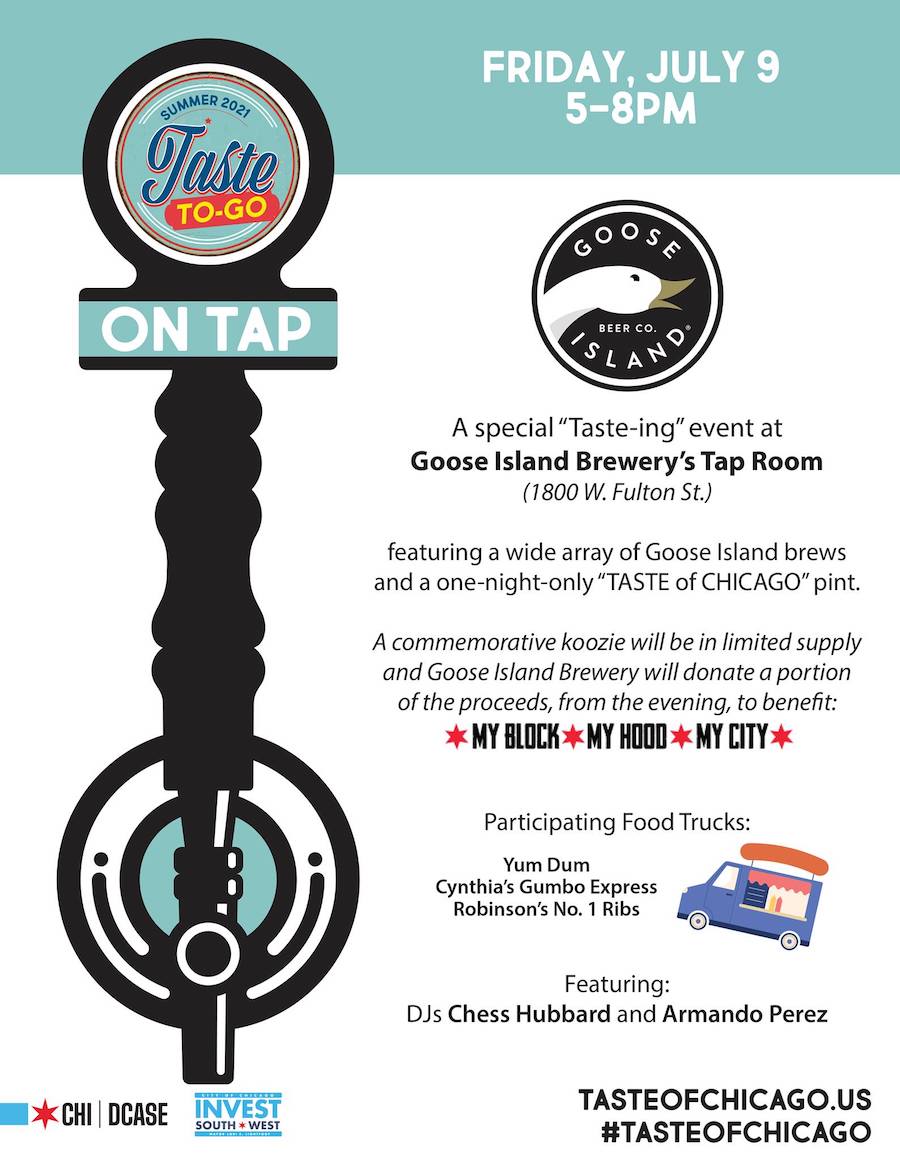
  • 5–8pm, Taste on Tap: A Special Event at Goose Island Brewery’s Tap Room

  • (1800 W. Fulton St.) Featuring a wide array of Goose Island’s brews and a one-night-only “TASTE of CHICAGO” pint. A commemorative koozie will be in limited supply and Goose Island Brewery will donate a portion of the proceeds from the evening to benefit My Block, My Hood, My City.

Taste of Chicago To-Go Food Trucks:  Food at the festival will include Cynthia’s Gumbo Express, Razpachos and Robinson’s No. 1 Ribs

DJs: Chess Hubbard and Armando Perez

Advertisement

For more information on the Taste of Chicago, visit the city’s website at chicago.gov. For more information on the entirety of Chicago’s festival schedule this month, check out our round up of both festivals and concerts going on throughout the city this month.

If you missed it, here’s what went on Wednesday and Thursday of this week at the Taste of Chicago.

Advertisement

Feature Image Credit: The Taste of Chicago on Facebook

Advertisement

Read More

What’s Going On at the Taste of Chicago Today? (July 9, 2021)Brian Lendinoon July 9, 2021 at 2:49 pm Read More »

Must Eat Food Items at Windy City Smokeout This WeekendLydia Matteonion July 9, 2021 at 3:48 pm

If country music, BBQ and beer are some of your favorite things, you need to check out Windy City Smokeout this weekend. Located in the United Center parking lot, consider this one of the biggest tailgate parties in Chicago this summer. Of course, a festival is not complete without an array of awesome food choices, so here is the round up of must-eat food items at Windy City Smokeout 2021:

Bub City

If you’re from the Chicagoland area, you’re probably familiar with Bub City. This Windy City staple is known for their tasty smoked meats and traditional American dishes. Their BBQ Nachos are the perfect mashup of a hearty meal and finger foods. 

Leroy & Lewis BBQ

Serving up juicy smoked meats with a twist, Leroy & Lewis BBQ gives you traditional barbecuing with a dash of fine dining. Modern and innovative dishes are their expertise. We recommend their Bulgogi Beef Ribs & Kimchi. You can thank us later. 

Sugarfire Smokehouse

With their unique twist on traditional BBQ, Sugarfire Smokehouse is serving up ribs, burgers, and more; all St. Louis style. With juicy pulled pork dishes and beef brisket galore, they are a guaranteed hit. You’re definitely going to want to try the Burnt End Birra Tacos.

Cafe Ba-Ba-Reeba!

Looking for a little spice outside of BBQ? Cafe Ba-Ba-Reeba has got what you’re looking for. Between the tapas, pintxos, and the sangria, all of the flavor-packed sensations are just a bite away. 

Happy Camper

Pizza, beer, and good vibes: that’s what Happy Camper is made of. With multiple locations across the country, Happy Camper is ready to serve modern spins on traditional American fare that you won’t want to miss. 

Blue Oak BBQ

Located in New Orleans, what once started as a small pop-up, Blue Oak BBQ has taken the meat game to new heights. Offering smoked meats and savory sauces that are sure to take your tastebuds for a trip to southern goodness. 

For a complete list of food menus, beer lists and music artists, head over to the Windy City Smokeout website.

Read More

Must Eat Food Items at Windy City Smokeout This WeekendLydia Matteonion July 9, 2021 at 3:48 pm Read More »

Down to one: Alleged Four Corner Hustlers chief ‘Bro Man’ Spann now lone defendant in nearing trialJon Seidelon July 9, 2021 at 3:04 pm

A long-awaited street-gang trial set to begin at the Dirksen Federal Courthouse later this summer is suddenly down to one defendant: Labar “Bro Man” Spann, the alleged chief of the murderous Four Corner Hustlers.

Court officials have for years been planning a monthslong racketeering trial for Spann, Tremayne “Trigga” Thompson and Juhwun Foster. But Thompson and Foster suddenly pleaded guilty Thursday to their roles in the West Side gang.

Spann still intends to go to trial, according to court records and comments from lawyers. The trial is set for Sept. 13 and comes as Chicago again struggles with street violence, a scenario reminiscent of the federal racketeering trial of the Hobos “super gang” five years ago.

A sweeping 2017 indictment tied the Four Corner Hustlers to six killings between 2000 and 2003. Prosecutors later tied the gang to three additional 2012 murders. A separate trial for other defendants in the case had been planned for 2019, but it was scuttled by a series of last-minute guilty pleas.

Spann, Thompson and Foster had been set to go on trial in September 2020, but the onset of the COVID-19 pandemic forced court officials to put it off for another year. They wound up planning what might have been the most logistically challenging trial of the new era.

Tremayne Thompson, from left, Rontrell Turnipseed and Juhwun Foster.
U.S. District Court

The trial had been set to take place in the Dirksen building’s 25th-floor ceremonial courtroom — its largest — with jurors in the gallery and one lawyer at each defense table to allow for social distancing, U.S. District Judge Thomas Durkin told lawyers in March.

He said that was the “only way we’re going to do it” and added, “we’ve done measurements.” It’s unclear yet how the new developments in the case will change those plans.

Spann, Thompson and Foster also potentially faced the death penalty at one point, but prosecutors took it off the table in April 2020.

Spann is accused in all six murders listed in the racketeering indictment, including the murder of Rudy “Kato” Rangel, who was a leader of the Latin Kings when he was fatally shot inside a barbershop in June 2003. Spann had previously been acquitted in state court in connection with the killing.

Rudy “Kato” Rangel Jr., the Latin Kings gang leader who was shot to death on June 4, 2003.
Cook County state’s attorney’s office

Thompson and Foster on Thursday each pleaded guilty to a racketeering conspiracy and admitted their roles in, among other crimes, the April 2003 murders of George King and Willie Woods.

King’s murder followed a drug dispute with another crew that involved the shooting of Spann and the now-deceased Jasper Davidson, records and courtroom testimony show. Spann then allegedly ordered the Four Corner Hustlers to kill anyone working for the other crew so he could take over the drug territory.

On April 8, 2003, Thompson and Foster collected two firearms from a Four Corner Hustlers stash house and drove to the 3800 block of Jackson Boulevard, records show. They hopped out of the car, walked to the 3800 block of Adams and fatally shot King, who sold drugs there.

Meanwhile, someone hired Spann to kill Woods amid a drug dispute involving a member of the Traveling Vice Lords. On April 16, 2003, Thompson and Foster fatally shot Woods in the 1500 block of South Karlov on Spann’s orders, records show.

Thompson’s plea agreement calls for him to be sentenced to between 35 and 45 years in prison, though Durkin could give him credit for time he served in state custody. If Durkin declines to go along with those terms, Thompson may withdraw from the plea deal.

Foster reached a similar agreement, though his deal calls for him to be sentenced to between 30 and 40 years in prison.

Read More

Down to one: Alleged Four Corner Hustlers chief ‘Bro Man’ Spann now lone defendant in nearing trialJon Seidelon July 9, 2021 at 3:04 pm Read More »

Vaccinated teachers and students don’t need masks: CDCAssociated Presson July 9, 2021 at 3:07 pm

NEW YORK — Vaccinated teachers and students don’t need to wear masks inside school buildings, the Centers for Disease Control and Prevention said Friday in relaxing its COVID-19 guidelines.

The changes come amid a national vaccination campaign in which children as young as 12 are eligible to get shots, as well as a general decline in COVID-19 hospitalizations and deaths.

“We’re at a new point in the pandemic that we’re all really excited about,” and so it’s time to update the guidance, said Erin Sauber-Schatz, who leads the CDC task force that prepares recommendations designed to keep Americans safe from COVID-19.

The nation’s top public health agency is not advising schools to require shots for teachers and vaccine-eligible kids. And it’s not offering guidance on how teachers can know which students are vaccinated or how parents will know which teachers are immunized.

That’s probably going to make for some challenging school environments, said Elizabeth Stuart, a John Hopkins University public health professor who has children in elementary and middle schools.

“It would be a very weird dynamic, socially, to have some kids wearing masks and some not. And tracking that? Teachers shouldn’t need to be keeping track of which kids should have masks on,” she said.

Another potential headache: Schools should continue to space kids — and their desks — 3 feet apart in classrooms, the CDC says. But the agency emphasized that spacing should not be an obstacle to getting kids back in schools. And it said distancing is not required among fully vaccinated students or staff.

All of this may prove hard to implement, and that’s why CDC is advising schools to make decisions that make the most sense, Sauber-Schatz said.

The biggest questions will be at middle schools where some students are eligible for shots and others aren’t. If sorting vaccinated and unvaccinated students proves too burdensome, administrators might choose to just keep a masking policy in place for everyone.

“The guidance is really written to allow flexibility at the local level,” Sauber-Schatz said.

Indeed, in some of the nation’s largest school districts, widespread mask-wearing is expected to continue this fall. In Detroit’s public schools, everyone will be required to wear a mask unless everyone in the classroom has been vaccinated. Philadelphia will require all public school students and staff to wear masks inside buildings, even if they have been vaccinated. But masks won’t be mandated in Houston schools.

What about requiring COVID-19 vaccination as a condition of school attendance? That’s commonly done across the country to prevent spread of measles and other diseases.

The CDC has repeatedly praised such requirements, but the agency on Friday didn’t recommend that measure because it is considered a state and local policy decision, CDC officials said.

Early in the pandemic, health officials worried schools might become coronavirus cauldrons that spark community outbreaks. But studies have shown that schools often see less transmission than the surrounding community when certain prevention measures are followed.

The new guidance is the latest revision to advice the CDC began making to schools last year.

In March, the CDC stopped recommending that children and their desks be spaced 6 feet apart, shrinking the distance to 3 feet, and dropped its call for use of plastic shields.

In May, the agency said Americans in general don’t have to be as cautious about masks and distancing outdoors, and that fully vaccinated people don’t need masks in most situations. That change was incorporated into updated guidance for summer camps — and now, schools.

The new schools guidance says:

–No one at schools needs to wear masks at recess or in most other outdoor situations. However, unvaccinated people are advised to wear masks if they are in a crowd for an extended period of time, like in the stands at a football game.

–Ventilation and handwashing continue to be important. Students and staff also should stay home when they are sick.

–Testing remains an important way to prevent outbreaks. But the CDC also says people who are fully vaccinated do not need to participate in such screening.

–Separating students into smaller groups, or cohorts, continues to be a good way to help reduce spread of the virus. But the CDC discouraged putting vaccinated and unvaccinated kids in separate groups, saying schools shouldn’t stigmatize any group or perpetuate academic, racial or other tracking.

Becky Pringle, president of the National Education Association, called the new CDC guidance “an important roadmap for reducing the risk of COVID-19 in schools.”

She added: “Schools should be consistently and rigorously employing all the recommended mitigation strategies, including requiring masks in all settings where there are unvaccinated individuals present, and ensuring adequate ventilation, handwashing, and cleaning.”

U.S. Secretary of Education Miguel Cardona pledged to work with schools to help them get kids back into classrooms.

“We know that in-person learning offers vital opportunities for all students to develop healthy, nurturing relationships with educators and peers, and that students receive essential supports in school for their social and emotional wellbeing, mental health, and academic success,” he said in a statement.

Read More

Vaccinated teachers and students don’t need masks: CDCAssociated Presson July 9, 2021 at 3:07 pm Read More »

Wimbledon win makes Matteo Berrettini first Italian Grand Slam finalist in 45 yearsHoward Fendrich | Associated Presson July 9, 2021 at 3:50 pm

WIMBLEDON, England — Cries of “Vai!” (Go!), “Forza!” (Let’s go!) and even “Andiamo, amore mio!” (Let’s go, my love!) rang through Centre Court, supporting Matteo Berrettini in his native tongue on his way to becoming Italy’s first Grand Slam finalist in 45 years.

With booming serves delivering 22 aces, and powerful forehands helping compile a total of 60 winners, the No. 7-seeded Berrettini used an 11-game run to grab a big lead and then held on to beat No. 14 Hubert Hurkacz 6-3, 6-0, 6-7 (3), 6-4 at Wimbledon on Friday.

“I have no words. Really. Just, ‘Thanks.’ And I need, I think, a couple of hours to understand what happened,” Berrettini told the capacity crowd. “I just know I played a great match. …. I never dreamed about this because it was too much, even for a dream.”

On Sunday, he will go up against either No. 1 Novak Djokovic, a 19-time major champion, or No. 10 Denis Shapovalov, a first-time Slam semifinalist.

Berrettini has created quite a sporting Sunday in London for Italy. After he plays in the Wimbledon final that afternoon — the first for a man from his country in a title match at any major since Adriano Panatta won the 1976 French Open — Italy will meet England at Wembley Stadium in the final of soccer’s European Championship that night.

“So far, it’s the best day, tenniswise, of my life,” said the 25-year-old Berrettini, who lost his only previous major semifinal at the 2019 U.S. Open. “Hopefully Sunday’s going to be even better.”

He’s now on an 11-match winning streak on grass courts, including a title at the Queen’s Club tuneup last month, when he became the first man since Boris Becker in 1985 to win the trophy in his debut at that event. Becker went on to triumph at Wimbledon that year.

The outcome Friday seemed to turn early against Hurkacz, never before past the third round at a Slam but coming off victories over eight-time Wimbledon champion Roger Federer and No. 2 Daniil Medvedev.

A key moment, oddly enough, came less than 20 minutes in, when Hurkacz was ahead 3-2 and held a break point. That was erased by Berrettini — no surprise here — by a service winner at 130 mph, punctuated by one of his many yells of “Si!”

From there, Hurkacz morphed from the guy coming off the biggest win of his career — in straight sets in the quarterfinals against his idol, Federer — back to the player who arrived in England on a six-match losing streak.

More than 50 minutes passed before Berrettini would drop another game, a stretch that gave him the first two sets and a 1-0 lead in the third.

He (almost) couldn’t miss. Hurkacz (almost) couldn’t connect.

In the first set, for example, the 6-foot-5, barrel-chested Berrettini compiled 21 winners — 11 off his forehand — and just eight unforced errors. Hurkacz, by contrast, did not accrue a single groundstroke winner in that span.

By the finish, Berrettini had 24 winners off his forehand alone, and merely 18 unforced errors. Hurkacz’s totals? Fewer than half as many winners, 27 — just four on forehands — and 26 unforced errors.

Hurkacz, so calm and collected against Federer two days earlier, was a picture of angst, leaning forward or rolling his eyes after some misses.

When Hurkacz got broken for the first time on the cloudy afternoon, the 24-year-old from Poland sat for the ensuing changeover and, between bites of a banana, motioned to his American coach, Craig Boynton, to adjust the seating arrangements in their guest box, wanting some people closer together and others more spread out.

As if that were the issue.

Hurkacz owns a formidable serve, too, but while he never seemed to be able to handle his foe’s, Berrettini did get good reads and would block returns back just to get a point started.

That worked well and eased the path to six breaks for Berrettini, who saved both such chances for Hurkacz.

Cheered from the stands by his girlfriend, Ajla Tomljanovic, who made it to the quarterfinals this week, and his parents — Mom captured his on-court interview with her cellphone — Berrettini was two points from winning on four occasions in the third set, all while Hurkacz served: twice at 5-4 (both at deuce), twice at 6-5 (at 30-all and at deuce).

But Hurkacz got through those spots, then extended the contest by grabbing the tiebreaker, in which he was granted a 4-0 lead when Berrettini netted what should have been an easy forehand volley.

“I was feeling that I was deserving to win that set, and I lost it, and I said to myself, ‘It doesn’t matter. I was … the stronger player,'” Berrettini said. “That’s what I said to myself and, eventually, it paid off.”

Hurkacz managed to regroup a bit by leaving for the locker room after the second set, and Berrettini headed off the court after the third. When play resumed, Berrettini broke to begin the fourth, and soon was back on the proper path. Hurkacz saved Berrettini’s initial match point, at 5-3, with a service winner at 134 mph.

Berrettini, and his supporters, needed to wait only five minutes for a second opportunity to close it, which he did.

Read More

Wimbledon win makes Matteo Berrettini first Italian Grand Slam finalist in 45 yearsHoward Fendrich | Associated Presson July 9, 2021 at 3:50 pm Read More »

While Chicago Honors Black History, the Present Has Gotten WorseWhet Moseron July 9, 2021 at 2:00 pm

Lake Shore Drive is now named after Jean Baptiste Pointe du Sable, the Haitian founder of Chicago. The city added an “s” to Douglas Park, changing its namesake from White supremacist Stephen Douglas to abolitionist Frederick Douglass. Last week, Mayor Lori Lightfoot dedicated a monument to journalist Ida B. Wells in Bronzeville.

Chicago is doing a great job of honoring the historical contributions of African-Americans. But these honors are going up even as life is becoming more difficult for African-Americans here. No matter how many monuments to racial equality we erect, the fact remains that Chicago itself is a monument to racial inequality—and that inequality is getting worse.

Consider this statistic on the mural above at Madison and Kostner in West Garfield Park, a neighborhood that is 95 percent Black, a result of Chicago’s history as one of the nation’s most segregated cities: The median home value in West Garfield Park is $164,500, compared to $593,000 in Lincoln Park.

It wasn’t always this way. In 1970, the median household incomes of West Garfield Park and Lincoln Park were nearly identical: $37,363 vs. $40,929, adjusted to current dollars. Today, West Garfield Park has an income of $23,857, while Lincoln Park’s is $100,326. In 1970, Chicago’s Black unemployment rate was 6.9 percent, compared to 3.5 percent for whites. By 2016, the gap was 21.9 percent to 4.9 percent. In 1980, Black wages were 4.6 percent lower than white wages. Now, they’re 21.9 percent lower.

What happened over the last 50 years? The social and economic factors that have destroyed the American middle class—globalization, outsourcing, the loss of blue-collar industrial work—have fallen particularly hard on Chicago’s Black community. The manufacturing jobs that drew African-Americans to Chicago during the Great Migration have disappeared, and they haven’t been replaced by equally well-paying work.

“While service, retail, and information sector jobs replaced lost manufacturing employment in many North Side neighborhoods, these developments did not occur to a similar extent in the South and West Sides of the city,” according to “Between the Great Migration and Growing Exodus: The Future of Black Chicago?”, a report by the UIC Institute for Research on Race and Public Policy. “Because major manufacturing companies served as anchors of employment and indirectly supported local neighborhood economies, many majority black neighborhoods in the city declined as jobs and economic opportunities continued to vanish.”

A map of Chicago’s middle-class Census tracts shows that, in 1970, they were spread evenly throughout the city. Now, most of the South and West sides are low-income, while the north lakefront is very high income. This maldistribution of resources has also resulted in a maldistribution of violence. A 2013 analysis by Daniel Kay Hertz found that in the early 1990s (when Chicago had 900 murders a year), the most dangerous neighborhoods in Chicago were six times more violent than the safest neighborhoods. By the late 2000s, the most dangerous neighborhoods were 15 times more violent. Blacks are 17 times more likely than whites to get shot in Chicago. The city’s murder rate is down from its all-time high, but most of the gains in safety have taken place in areas that are thriving economically. 

Fewer jobs and more violence results in population loss: since 1970, West Garfield Park has lost 63 percent of its residents. Citywide, Blacks were once Chicago’s largest ethnic group, but as their numbers have declined from 1.2 million in 1980 to 780,000 today. They’ve fallen behind whites, who are swelling the populations of Lake View, Lincoln Park and the Loop. This is imperiling Chicago’s position as the nation’s Black Political Mecca—home of more Black congressmen than any other city, training ground of the first Black president. On the City Council, two Black wards have flipped to other groups, and Blacks may be hard pressed to maintain their numbers in Congress and the legislature.

The legacy of segregation, it turns out, may be more enduring and harder to overcome than the legacy of Jim Crow. A report by the Corporation for Enterprise Development found that Chicago’s racial wealth gap is worse than the nation’s as a whole. The median household income for Blacks here is $30,303, compared to $70,960 for whites. It’s even worse than Mississippi, the state so many Blacks fled for Chicago during the Great Migration. In Mississippi, median Black income is $32,965. Illinois’s Black murder rate—36.4 per 100,000—was three-and-a-half times higher than Mississippi’s as recently as 2016.

The UIC study found that many of the economic incentives that drew Blacks to the North during the 20th Century have been reversed, with the South now offering more equality and opportunity:

Comparing black/white wage gaps in Chicago and three Southern cities from where a large number of blacks emigrated in the mid-20th century, wage discrimination in Chicago was much lower than in comparable Southern cities from 1940 through 1980,” the report’s authors wrote. “This is consistent with the pervasive narrative that blacks were moving away from the discriminatory South to the North, where economic opportunities were more readily available and racism was less prevalent. After 1980, however, racial wage gaps in Chicago worsened, becoming similar to many Southern cities in 1990 and 2000, and then worse than many Southern cities in 2010 and 2016. In 2010, for example, the black/white wage gap in Chicago, at 22%, was ten percentage points worse than the wage gap in Columbia, South Carolina, at 12%.”

In racial symbolism, Chicago can continue to claim moral superiority over the South. We don’t have any monuments glorifying the Confederacy. We didn’t vote for Trump. Illinois’s entire congressional delegation voted to make Juneteenth a federal holiday, while a handful of Southern Republicans voted no. But on matters of racial equality, the Land of Lincoln can no longer claim to be better than the South. We are, in fact, looking worse.

Read More

While Chicago Honors Black History, the Present Has Gotten WorseWhet Moseron July 9, 2021 at 2:00 pm Read More »

Daily Cubs Minors Recap: Leeper extends no-hit streak; Homers by Morel and Davis propel Smokies to win; Casey brilliant before exiting with injuryon July 9, 2021 at 2:41 pm

Cubs Den

Daily Cubs Minors Recap: Leeper extends no-hit streak; Homers by Morel and Davis propel Smokies to win; Casey brilliant before exiting with injury

Read More

Daily Cubs Minors Recap: Leeper extends no-hit streak; Homers by Morel and Davis propel Smokies to win; Casey brilliant before exiting with injuryon July 9, 2021 at 2:41 pm Read More »